
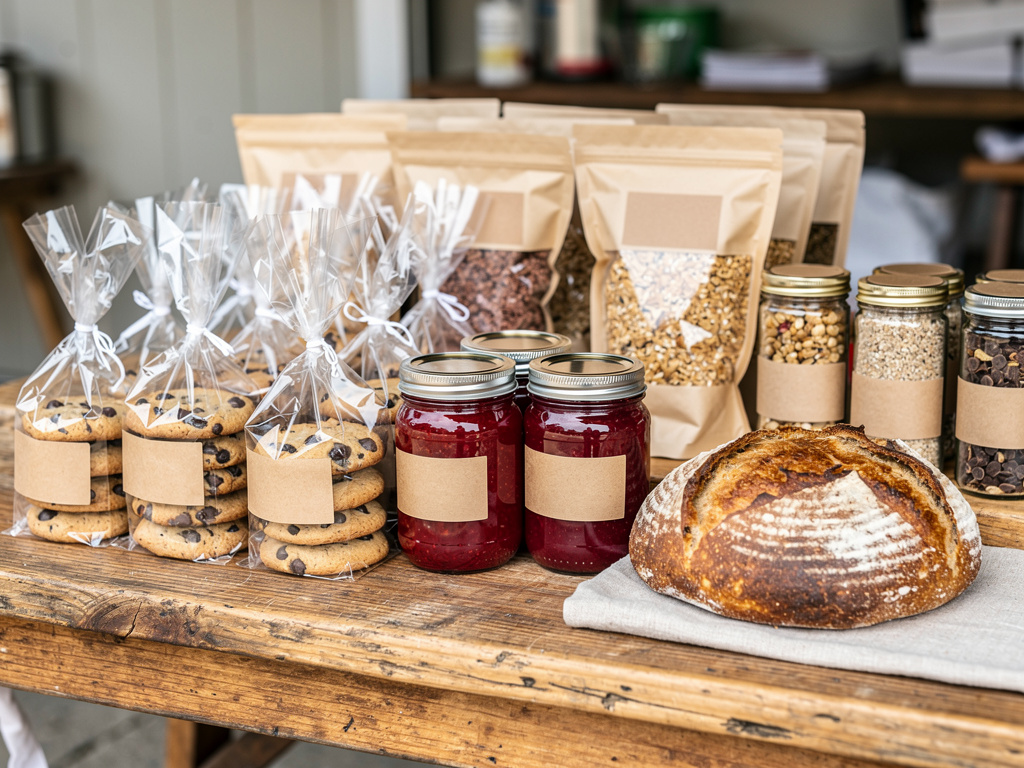


The short version: The most profitable foods for a farmers market booth are cheap to make, quick to batch, priced for an impulse buy and able to keep for days or months: cookies, brownies, spice blends, granola, jam, fudge, kettle corn, bread, quick breads and lemonade. At BLS August 2026 averages and September 30 Walmart prices, a bakery-size chocolate chip cookie costs about 45 cents to make, bag and label, so a $3 cookie leaves you about $2.55 before card fees. Spice blends, granola and fudge keep roughly 60 to 80 percent of their price, while jam keeps less than most guides say, about $4.73 on an $8 jar once you pay retail for berries and new jars. Sell 3 to 5 of these at different price points and take pre-orders between markets so less goes home unsold.
Checked on the BLS average price tables, Walmart.com and findhomegrown.com/signup, September 30, 2026: ingredient costs use BLS August 2026 U.S. city averages and Walmart.com prices loaded that day, and store prices change by week and by town. Rules differ by state, so verify your state's current cottage food rules before your first sale. Homegrown customers create an account to place their first order, and Homegrown has no drops or countdown release feature.
Not every product that sells at a farmers market is worth your time. Some have thin margins, take hours to make, or spoil before you sell them. Others sell steadily, cost little to make, and bring in real money every market day.
Margins vary a lot by product. Our farmers market profit margin calculator shows your profit once ingredients and fees come out, and this guide gives you the numbers to put into it.
The difference between a profitable booth and one that barely breaks even usually comes down to product selection. The vendors who make good money aren't always the best bakers at the market. They sell products with strong margins, fast production and reliable demand.
This guide ranks the 10 foods that give home vendors the best returns, with the cost of one unit worked out from grocery prices loaded on September 30, 2026, and real prices Homegrown vendors charge. For each you'll see why it works, what it costs, what sells best and the catch. Nine of the ten fit a cottage food or home kitchen setup. Fresh lemonade usually needs a separate permit, and so does kettle corn popped at the booth.
Once the numbers work, make ordering easy. You can take orders and get paid online in about 15 minutes. Set up a Homegrown storefront for $10 a month billed yearly with 0% commission (you pay standard card processing of 2.9% plus 30 cents), or compare the best platforms to sell food from home first.
The top 10 most profitable farmers market foods for a home vendor are cookies, brownies and bars, spice blends, granola, jams and preserves, fudge and other candy, kettle corn, sourdough and artisan bread, quick breads, and fresh lemonade. We ranked them on four things at once: the share of the price you keep, how many units you can make in an hour, how long unsold stock lasts, and whether the price is low enough for a shopper to buy on a whim.
Here's the ranked list, with the one-line reason for each spot:
Swipe the table sideways to see every product and column.
| Product | What one unit costs you | A real price to compare | Share of that price you keep | Shelf life |
|---|---|---|---|---|
| Chocolate chip cookie, bakery size | $0.45 with bag and label | $3.00 | 85% | Several days |
| Brownie, wrapped square | $0.52 with bag and label | $4.00 | 87% | 1 to 2 days wrapped one by one |
| Spice blend, 4-ounce glass jar | $1.75 to $2.54 with jar and label | $8.00 | 68% to 78% | Months |
| Granola, 12-ounce bag | About $3.95 with pouch and label | $10.00 (Crumb and Clove Bakeshop) | 60% | Weeks |
| Strawberry jam, 8-ounce jar | $3.27 with jar and label | $8.00 (Oklahoma Homesteading with Suze, 8-ounce jams) | 59% | Months, sealed |
| Chocolate fudge, quarter pound | $1.22 with bag and label | $4.00 | 70% | 1 to 2 weeks |
| Sourdough loaf | $0.62 in flour and salt | $12.00 (typical Homegrown sourdough price) | About 95% before packaging | 1 to 2 days at its best |
| Banana bread loaf | $2.42 in ingredients | $10.00 (typical Homegrown banana bread price) | About 76% before packaging | A few days |
| Lemonade, 16-ounce cup | $0.61 to $1.01 with cup and lid | $4.00 | 75% to 85% | Same day |
We worked out each cost except the brownie on September 30, 2026 from BLS August 2026 U.S. average prices for flour, sugar, butter, eggs, strawberries, lemons and bananas, and Walmart.com prices loaded that day for everything else except the granola pouch, which is Sav-On Bags' price that day. The brownie row comes from our brownie guide's pan, priced at August and September 2026 prices on September 27. Kettle corn is left out of the table because its cost per bag depends on the bag size, oil and sugar you use. The full recipe math is in each section below. Prices with a vendor name come from that vendor's Homegrown listing on the same day. The $3 cookie, $4 brownie, $8 spice jar, $4 fudge and $4 lemonade prices are examples for the math, not a survey. The share you keep is before booth fees, card fees and your time.
Share of the price you keep after ingredients and packaging
Source: our cost math from BLS August 2026 averages and Walmart.com prices checked September 30, 2026, with the granola pouch priced at Sav-On Bags that day, at the example prices in the table above. Spice jar and lemonade use the best case in their range. The sourdough and banana bread bars leave out packaging, because we priced those two before a bag and label, and the brownie bar uses our brownie guide's September 27 prices. Bread tops the chart per unit but takes the most hours, which is why it ranks eighth.
A farmers market product is profitable when it has a strong margin per unit, you can make a lot of it per hour, it sells quickly at an easy price, and unsold stock keeps until next week. Those four factors decide whether a product actually makes you money, not just whether it sells. Check them before you invest time and ingredients.
Margin per unit is the gap between your price and what the product costs you in ingredients and packaging. At BLS August 2026 averages and Walmart September 30 prices, a batch of 24 bakery-size chocolate chip cookies costs about $10.78 to make, bag and label, and sells for $72 at $3 each. A loaf of sourdough uses about 62 cents of flour and salt, but it ties up your kitchen for most of a day, so its margin per hour is far thinner than its margin per loaf.
Production efficiency is how many sellable units you make per hour of work. A recipe that turns out 24 to 60 cookies in about an hour of hands-on time beats one that makes 4 loaves in the same hour. Your time is your scarcest resource, especially if you bake around a day job.
Sell-through rate is how easily a product moves at the market. Products priced at impulse levels, $3 to $8, tend to get more transactions and sell out more often than products at $20 or more. High sell-through also means less unsold stock to haul home.
Shelf stability is your safety net. Products that stay sellable for days or weeks mean unsold stock isn't wasted. A jar of jam that doesn't sell on Saturday sells next Saturday. A cream puff that doesn't sell on Saturday goes in the trash.
Here's how the top product categories compare on those factors:
Swipe sideways to compare cost, price, markup and shelf life.
| Product | Cost per unit, BLS August and Walmart September 2026 prices | Example sell price | Markup on cost | Shelf life | Production speed |
|---|---|---|---|---|---|
| Spice blends | $1.75 to $2.54 per 4-ounce jar | $6 to $11 | 3.1x to 4.6x at $8 | Months | Very fast, no oven |
| Cookies | $0.13 standard, $0.32 bakery size, before packaging | $2 to $4 | About 6.7x at $3 with packaging | Several days | Fast |
| Granola | About $4.43 a pound before packaging | $10 per 12 ounces | About 2.5x with packaging | Weeks | Fast |
| Jams and preserves | $3.27 per 8-ounce jar | $8 to $10 | 2.4x to 3.1x | Months, sealed | Moderate |
| Brownies and bars | About $0.52 per wrapped square | $3 to $5 | About 6x to 10x | 2 to 3 days cut, 1 to 2 days wrapped one by one, about 5 uncut | Fast |
| Bread | $0.62 per loaf in flour and salt | $10.06 to $14.38 | Very high per loaf | 1 to 2 days | Slow |
| Fudge and confections | $1.22 per bagged quarter pound ($4.35 a pound before packaging) | $4 per quarter pound | About 3.3x | 1 to 2 weeks for fudge, longer for hard candy | Moderate |
Costs come from the recipe math in each section below, using the same BLS and Walmart.com prices. The brownie figure is the one worked out in our brownie guide at September 2026 prices. Sell prices are the ranges we saw on Homegrown listings that day or example prices, and yours will depend on your market.
With that framework, here's each product in detail.
Cookies are one of the most reliable money earners for home bakers at farmers markets, because one bakery-size cookie needs about 45 cents of ingredients, bag and label, and sells for $2 to $4. They hit every factor: low cost, fast to make in volume, an impulse price and several days of shelf life.
Why cookies are profitable: We priced the original Nestlé Toll House recipe with BLS August 2026 averages and Walmart.com prices on September 30, 2026. Flour costs 33 cents, two sticks of butter $2.01, white sugar 34 cents, brown sugar 26 cents, two eggs 38 cents, a 12-ounce bag of Great Value chocolate chips $3.86, vanilla 45 cents, and 2 cents of baking soda and salt. That's $7.64 for the batch before rounding each line. Nestlé says the recipe makes 5 dozen standard cookies, about 13 cents each. Scoop it into 24 bakery-size cookies and each one costs about 32 cents, or 45 cents with a clear treat bag and a printed label.
The time is short too. Nestlé lists 15 minutes of prep and 9 to 11 minutes per sheet in the oven for cookies dropped by the rounded tablespoon. Bakery-size cookies are bigger and need longer in the oven, so a batch is about an hour to an hour and a half of your time with cooling and bagging. At $3 each, 24 cookies bring in $72 against $10.78 in ingredients and packaging.
Cookies are impulse purchases. A shopper who came for tomatoes will grab two cookies without thinking twice. That means lots of transactions and steady sell-through.
In a pull of the Homegrown catalog on September 30, 2026, 1,404 of the 2,773 products listed by 311 vendors were in the Bakery category, or 51%. We started with every listing its vendor put in Bakery or ready-to-eat food that has a cookie word in its name, description or size options. We read each one by hand and kept the cookies that say how many you get: 194 listings from 76 vendors. We left out look-alikes like cake pops, cookie cakes, sandwich cookies, brownies, bars, kits, mini cookies and custom decorated cookies. Each vendor's typical price per cookie ran from $0.83 to $5.83, the middle vendor charged $2.35, and the middle half of vendors charged $1.50 to $3.00. Sixteen vendors charged under $1.50, 16 charged $1.50 to $1.99, 21 charged $2 to $2.99, and 23 charged $3 or more, mostly for gourmet flavors, gluten free cookies or oversized cookies.
That spread is the lesson. In listings that state a cookie count, 13 of the 16 bakers under $1.50 a cookie priced only packs of 6 or more, like half dozens, dozens and 10-packs. The other 3 sold smaller amounts: Mimi's Bakery and Farm Stand sold single cookies at $1, D&D Bees sold packs of 4, and Wild Aromas by Sourdough sold packs of 5 and 10. Most of the bakers at $3 or more gave shoppers a reason to pay more: organic ingredients, gluten free recipes, gourmet flavors or a bigger cookie. A few charged $3 to $5 for a plain chocolate chip cookie. At a market, big singles at $3 to $4 next to a half-dozen box lets every shopper pick a price.
What sells best:
Compare your cookie to the store's price per pound, not per package. The BLS average for store-bought chocolate chip cookies was $5.21 a pound in August 2026. A bakery-size cookie from the Toll House batch above is about 1.85 ounces of dough, a little less once baked, so at $2 it works out to about $17 a pound of dough, 3.3 times the store price, and even more by baked weight. Shoppers still see it as a $2 treat.
Margin example: 24 bakery-size cookies cost $7.64 in ingredients and $3.14 in bags and labels. At $3 each that's $72 in sales against $10.78 in direct costs. Even if you pay yourself $20 an hour for 1.5 hours ($30), you keep about $31 on one batch, and a double batch takes far less than twice the time. Cinnamon rolls are another high-margin bake, and their smell sells them on impulse.
Brownies, lemon bars, blondies and other bar cookies are very profitable: they share the cookie's advantages but feel more substantial to shoppers, which supports $3 to $5 a square. Our brownie guide worked out a wrapped square at about 52 cents at September 2026 prices, so a $4 brownie keeps about $3.48 before fees.
Why they're profitable: A single 9x13 pan makes 12 to 16 squares. In the Homegrown catalog on September 30, 2026, single brownies ran from $3.00 at two vendors to $8.00 for a loaded S'mores brownie, with a dark chocolate walnut brownie at $5.50. On Homegrown, Seriously Sourdough lists a dozen brownies at $20 and Root to Rise lists a dozen gluten free brownies at $25 (September 30, 2026). Sold as single squares at $3 to $5, a single pan can bring in $36 to $80. Hands-on time is short: about 10 minutes of mixing and about 15 minutes to cut and wrap, plus 25 to 35 minutes in the oven and time for the pan to cool completely before you cut.
Selling fees change that math by place. On a $20 pan they run $0.67 on a Square card reader at the booth (2.6% + 15 cents) and $2.35 on Etsy before shipping (6.5% transaction fee, 3% + 25 cents processing and the 20-cent listing fee), checked on Square's and Etsy's fee pages on September 30, 2026. The seven places to sell brownies compares every option on the same pan.
Brownies keep longer than most bakes, but not for a week. Bob's Red Mill gives an uncut pan about five days in an airtight container, cut squares two to three days, and brownies wrapped one by one about one to two days. Bake close to market day and wrap unsold squares for the freezer instead of holding them for next week.
What sells best:
Tip: Pre-cut, individually wrapped brownies sell better than cutting to order at the booth. The wrapping signals value, keeps the product clean and makes the sale faster. At the September 27, 2026 prices our brownie guide used, a Wilton clear treat bag and an Avery 2 x 4 inch label add about 12 cents a brownie, and how to sell brownies from home puts that on top of a $6.35 Hershey's pan to land at $0.52 a wrapped square.
Spice blends give you one of the best returns per hour of work at a farmers market, because a taco-style blend costs about 40 cents an ounce in store-bought spices, needs no oven, and sells for $6 to $11 a jar. By share of price they come close to cookies rather than beating them: a 4-ounce jar costs $1.75 to $2.54 to fill and label, so an $8 jar keeps 68 to 78 percent.
Why spice blends are profitable: We priced a 12-ounce batch of taco-style seasoning with Great Value spices on Walmart.com on September 30, 2026: 4 ounces of chili powder ($1.44), 3 ounces of cumin ($1.64), 2 ounces of paprika (86 cents), 1.5 ounces of garlic powder (48 cents), 1 ounce of onion powder (33 cents) and half an ounce of salt (2 cents). That's $4.78 before rounding each line, or about 40 cents an ounce. A 24-pack of 4-ounce glass shaker jars cost $20.99, about 87 cents a jar, and a printed round label adds 8 cents.
How much blend fits a 4-ounce jar depends on how dense it is, so here's the range. Filled with 2 ounces, the jar costs you $1.75 all in. Filled with 4 ounces, $2.54. Buying spices in bulk, or selling in resealable bags instead of glass, pushes the cost lower still.
Production is mixing, filling and labeling. No cooking, no baking, no cooling. A single 1 to 2 hour session can fill dozens of jars.
Spice blends are compact and light. You can display about a dozen 4-ounce jars in the space one loaf of bread takes up, and they hold their flavor for months, so almost nothing goes to waste.
What sells best:
On Homegrown on September 30, 2026, Smoky Butts BBQ listed its Delta Midnight BBQ Rub at $6 for a 4-ounce shaker, and Deal Family Creations listed its Apple Smoke Seasoning and Rub at $11, with no size stated.
Note: Check your state's cottage food law for spice blends. California's approved list names "Spice mix or rubs" and "Herbs & herb blends," and Florida's list names "Dry herbs, seasonings and mixtures" (both checked September 30, 2026). For a full guide to sourcing, making and pricing herb and spice products, see how to sell dried herbs and spice mixes from home.
Granola is a strong keeper product because it uses cheap pantry ingredients, scales easily in big batches and keeps for weeks, though the nuts leave you a smaller share of the price than cookies or spice blends. At Walmart ingredient prices on September 30, 2026, a 12-ounce bag of pecan granola costs about $3.95 with the pouch and label, and 12-ounce bags sell for around $10.
Why granola is profitable: Here's a simple batch priced that day. Six cups of Great Value old fashioned oats ($1.96), 2 cups of chopped pecans ($6.46), half a cup of vegetable oil (33 cents), three quarters of a cup of brown sugar (26 cents), a teaspoon of salt (1 cent) and 2 teaspoons of vanilla (90 cents). That's $9.93 before rounding each line, for about 36 ounces of raw mix, or roughly $3.32 of ingredients per 12 ounces. Twelve ounces of this granola is roughly 3 cups, about all a typical 8-ounce pouch holds, since pouch sizes are rated by the weight of coffee beans, so price the next size up. A 16-ounce kraft stand-up pouch with a window, rated for 7 cups, cost 56 cents each in a 100-pack from Sav-On Bags on September 30, 2026, and a label adds 8 cents. That's about $3.95 a bag, so a $10 bag keeps about $6.05, or 60%.
The nuts are most of the cost. Pecans are two thirds of that batch, so swapping half of them for sunflower or pumpkin seeds cuts your cost per bag noticeably.
Production is fast: mix, spread on sheet pans, bake 30 to 40 minutes, cool, bag and label. One oven load on two large sheet pans makes 2 to 4 pounds depending on your pans. Unsold bags carry over to next week, so waste stays low.
On Homegrown on September 30, 2026, Crumb and Clove Bakeshop listed its "Good Stuff" granola at $10 for a 12-ounce bag and Gary's Granola listed a 16-ounce bag at $15.
What sells best:
California's approved list names "Granola" and "Trail mixes," and Florida's names "Cereals, trail mixes and granola" (checked September 30, 2026). For pricing by the bag, how much to sell granola for goes deeper.
Jams and preserves are profitable, but less than most guides claim when you pay retail for everything. With store-bought strawberries and new jars, one 8-ounce jar of strawberry jam costs about $3.27, so an $8 jar keeps about $4.73. Their real strengths are a shelf life of months, low spoilage risk while the seal holds, and strong gift appeal.
What one jar costs: We priced the Sure-Jell strawberry jam recipe from Kraft Heinz on September 30, 2026. It calls for 5 cups of crushed fruit (about 2 quarts of strawberries), 7 cups of sugar, one box of pectin and half a teaspoon of butter, and it fills about eight 8-ounce jars.
That's $26.18 for the batch, or $3.27 a jar. If the fruit comes free from your own garden or a neighbor's tree, the cost drops to about $1.98 a jar, and reusing clean bands brings it down a little more. Two cost lines surprise most new jam vendors: the new jars ($1.00 each) and the pectin ($4.12 a batch).
Why jam still earns its spot: Sealed jars last for months, so nothing spoils. They're small, light, easy to haul and look beautiful on a table. Homegrown vendors on September 30, 2026 listed 8-ounce jars at $8 (Oklahoma Homesteading with Suze) and $10 (Gram's Jams), and Deal Family Creations listed its jams at $9 a jar, with no jar size stated.
Jam rules differ more than bakery rules. California only approves fruit butters, preserves, jams and jellies that meet the federal standard in 21 CFR Part 150, which sets fruit and sugar content, so low-sugar recipes can fall outside it. California also allows only the fruits that federal standard names, so a watermelon jam, for example, is not on its list. Florida's list names "Jams, jellies and preserves." Both lists were checked on September 30, 2026. Pepper jellies, low-acid spreads and anything with vegetables need a closer look at your own state's list before you sell.
What sells best:
Production: One batch fills about 8 jars in about 2 hours of active work including canning. At $9 a jar, that's $72 from 2 hours, or $45.82 after the $26.18 batch cost. Sauces and condiments like BBQ sauce can pair well with preserves, and what goes into the cost of a jar walks through labor and overhead on top of these numbers.
Candy and confections are naturally profitable at farmers markets because they're made in batches, keep well, carry high margins and sell as both treats and gifts. A basic chocolate fudge made from 18 ounces of chocolate chips and a 14-ounce can of sweetened condensed milk costs about $4.35 a pound at Walmart prices on September 30, 2026.
Why confections are profitable: That fudge batch is $5.79 of Great Value chocolate chips, a $2.47 can of Great Value sweetened condensed milk and 45 cents of vanilla, $8.71 for about 2 pounds. A quarter-pound piece costs about $1.09, or $1.22 with a treat bag and label. Priced at $4 a piece, an example price, it keeps about $2.78. Legacy Fudge on Homegrown listed single fudge flavors at $4 and a six-pack at $20 on September 30, 2026, without stating a size.
Gift appeal stretches sales beyond one person's sweet tooth. Shoppers buy confections as presents, often several at a time, and holiday months push that further.
Confections also display beautifully. Rows of cut fudge, stacks of wrapped caramels and pieces of chocolate bark draw people to your table.
What sells best:
California's approved list names fudge, toffee, brittles, hard candy and marshmallows without eggs, and Florida's names "Candies and confections" (checked September 30, 2026). For pricing by the piece and the pound, how much to sell candy for has the details.
Kettle corn and flavored popcorn are profitable and among the cheapest foods you can sell, and if you pop it at the booth with the right permit, the smell of a fresh batch pulls people in. Kettle corn bagged at home sells on flavor and price. Great Value yellow popping corn cost $2.47 for 32 ounces on Walmart.com on September 30, 2026, which is $1.24 a pound of kernels, and oil and sugar add only cents per batch.
Why popcorn works: The product is mostly air, so a small amount of kernels fills a lot of bags. The Popcorn Board says 2 tablespoons of kernels make about a quart popped. Its chart calls those 2 tablespoons "1 ounce," but that is a volume ounce (the same chart puts 8 ounces in a cup), not a weight ounce, so it does not tell you how many quarts a pound bag makes. USDA's Food Buying Guide measures the finished product by weight instead: a pound of popped popcorn counts as 48 cups, or 12 quarts. Either way, a quart bag holds only about 2 tablespoons of kernels, a small slice of a $1.24 pound. Your real costs are the bags, the labels and your time at the kettle, not the corn.
What sells best:
California's list names popcorn and candied popcorn, and Florida's names "Popcorn and popcorn balls" (checked September 30, 2026). Popping it fresh at the booth is a different matter than bagging it at home. Cooking on site is not home production, so ask your county health department which permit it needs.
Yes, but only if you price it correctly and plan around its short shelf life. A sourdough loaf made with 500 grams of flour uses about 62 cents of flour and salt at BLS August 2026 prices, and Homegrown sourdough bakers typically charge $10.06 to $14.38 a loaf. The most common mistake bread vendors make is underpricing because they compare to grocery store bread.
Your artisan loaf is not competing with the $1.82-a-pound white pan bread BLS tracks in stores. Shoppers at the farmers market want artisan bread because the grocery store doesn't have it.
Why bread is profitable when priced right: Flour is cheap, BLS put all-purpose flour at 55 cents a pound in August 2026, and bread flour costs somewhat more. In a pull of the Homegrown catalog on September 30, 2026, 72 vendors listed sourdough loaves. We counted Bakery listings that are loaves and say sourdough in the name, the description or the size options, plus the loaves of shops with sourdough in their name, priced at the full loaf, and left out cookies, bagels, rolls, focaccia, quick breads and other sourdough treats. The middle vendor charged $12, and the middle half of vendors charged between $10.06 and $14.38.
Considerations: Bread has a shorter window than cookies or bars. It's best the day it's baked and acceptable for 1 to 2 days after. That creates waste risk on slow days. Bread also makes fewer units per batch. A batch of sourdough that takes most of a day or an overnight rise from mixing to baking makes 4 to 8 loaves, compared to 24 to 60 cookies from a much shorter session.
What sells best:
Best approach for bread vendors: Limit yourself to 3 or 4 types per market day and bake to a conservative guess. Take pre-orders during the week so you know your baseline before deciding how much extra to bring. What goes into the cost of a sourdough loaf covers starter, packaging, labor and overhead on top of flour.
Quick breads are worth selling and the easiest bread to profit from, because they need no rise time and stay moist for a few days when wrapped. A banana bread loaf made with 1 pound of bananas, 1.5 cups of flour, three quarters of a cup of sugar, a stick of butter and one egg costs about $2.42 at BLS August 2026 averages.
In the Homegrown catalog on September 30, 2026, 25 vendors listed banana bread loaves (Bakery listings whose name, description or size options say banana bread or a banana loaf, priced at the full loaf, not counting muffins, minis or slices). The middle vendor charged $10, and the middle half charged $8.50 to $12.50. That's a strong return on an hour of work, and overripe bananas are often the cheapest ones in the store.
Fresh lemonade has strong margins and some of the fastest transactions at a farmers market, but it usually needs a permit that your cottage food registration does not cover. A 16-ounce cup costs about 61 cents to $1.01 to make at September 2026 prices, depending on how much ice goes in, so a $4 cup keeps roughly $3 to $3.39.
The cost of a cup: The USDA Food Buying Guide says a pound of fresh lemons gives about three quarters of a cup of juice. At the BLS August 2026 average of $2.11 a pound, a cup of fresh juice costs about $2.82 in lemons. Mix it 1 cup juice, 1 cup sugar and 6 cups water and you get 8 cups for about $3.27, enough for four 16-ounce cups without ice. With a Great Value 16-ounce cup and lid (about 20 cents each in a 25-pack), that's $1.01 a cup, or about 61 cents if ice fills half the cup.
On a warm Saturday, 100 cups at $4 is $400 in sales against $61 to $101 in lemons, sugar and cups.
Important caveat: Drinks are usually regulated separately from cottage foods. California's approved list names no ready-to-drink beverages. Its only drink items are dry ones, like powdered beverage mixes, tea, coffee and hot chocolate mix. Florida's list names no drinks at all (both checked September 30, 2026). Pouring cups at a market often takes a temporary food permit of its own, so check where lemonade sells and what each place requires before you book the booth, and can you sell homemade lemonade for the permit side.
Approach products carefully when they take hours of hand work per unit, go stale within hours, or need refrigeration your cottage food law doesn't allow. Some products have real customer appeal but hurt your profit. Here's a quick comparison:
Swipe sideways for the full list of products to handle with care.
| Product | Issue | What it does to your return | Better alternative |
|---|---|---|---|
| Custom decorated cookies | Hours of hand piping for each dozen | Your hourly return falls far below plain cookies | Sell them as premium pre-orders, not market stock |
| Fresh pastries and croissants | Short shelf life, stale by mid-morning | High waste risk on a slow day | Shelf-stable baked goods |
| Refrigerated products | Not on California's or Florida's cottage food lists; Texas requires DSHS registration and extra labels | Varies, plus the cost of keeping them cold | Shelf-stable alternatives |
| Elaborate layer cakes | 5 or more hours for one product | One sale for most of a day's work | Batch-friendly products like cookies or bars |
California's list covers "Baked Goods Without Cream, Custard, or Meat Fillings." Texas allows foods that need time and temperature control only after registering with DSHS and adding safe handling labels. Both checked September 30, 2026.
If you want to try a risky product anyway, test it small. Bring six, note the time they sell out, and only scale up what sells before noon two weeks in a row.
The best sellers at farmers markets tend to be ready-to-eat treats under $10 and fresh, in-season produce, though no public source tracks sales by product across U.S. markets, so this answer comes from what vendors list most and what shoppers can buy on a whim. Baked goods are the biggest share of those listings: on Homegrown, 51% of all 2,773 listed products were in the Bakery category on September 30, 2026.
What sells best follows a few patterns you can use:
If you're shopping rather than selling, the best things to buy are what's in season that week and whatever a vendor made that morning, like bread, jam from local fruit or a fresh pie. Those are the things a grocery store can't match.
No public source ranks baked goods by sales, so the best guide is what vendors list most: cookies, sourdough bread, cinnamon rolls, banana bread and brownies, which are affordable, familiar and easy to eat on the spot. Our September 30 catalog pull found 90 vendors listing cookies, 72 listing sourdough loaves, 38 listing cinnamon rolls, 25 listing banana bread loaves and 20 listing brownies. We counted a vendor when a bakery or ready-to-eat listing named the product in its name, description or size options, then checked each match by hand and dropped look-alikes like cake pops, cookie-flavored granola, cinnamon roll focaccia and brownie-flavored cookies. The sourdough and banana bread counts are loaves only, using the rules in those sections above. Those are counts of vendors who list each product, not sales. The cookie prices earlier in this guide come from a narrower group, the 76 bakers who state a cookie count per package.
A good baked goods table has one thing people eat now (a cookie or brownie), one thing they take home (a loaf) and one thing they give away (a box of six). If you're setting up your first booth, how to start a baking business from home covers the full setup from legal requirements through production planning.
Unique things to sell at a farmers market are twists on the proven sellers, not brand new categories: a signature spice blend, a jam flavor nobody else makes, or a cookie built for a specific diet. They get attention and still keep the low costs and long shelf life that make the top 10 profitable.
Real examples from Homegrown listings on September 30, 2026:
A unique product still has to pass your state's list. Hot pepper jams, unusual fruits and anything with vegetables deserve a check before you make a batch to sell.
Usually not a full food license, because most of the top 10 fall under state cottage food laws that let you make them in your home kitchen. What you need varies by state, from nothing to file up to a registration, a permit or a kitchen inspection.
Three examples, each checked on the state agency's page on September 30, 2026:
Farmers markets can add their own rules on top of the state's, like proof of insurance or a booth application. Our farmers market vendor permits by state guide lists the rules for each state. Verify your state's current rules with your state agency or county health department before your first sale.
What you make depends on your products, your market and how many hours you put in, but the math is simple enough to run before your first Saturday. Here's one worked example using the costs in this guide, with the assumptions spelled out.
Say you bring three products and sell out:
That's $376 in sales and $105.74 in product costs. If 70% of sales come in by card across 30 transactions on a Square reader at 2.6% plus 15 cents, card fees are $11.34. Take off a $40 booth fee and you keep $218.92 before counting your time. Booth fees vary a lot by market, so plug in yours.
Your first few markets will likely be lower while you build regulars. For more on what vendors earn over a season, how much you can make selling at farmers markets goes deeper.
Use the floor price formula: add up your ingredient cost, packaging cost and time cost per unit, then multiply by at least 2 to 3. That's your minimum price. Anything below it and you're losing money or working for free.
Here's the formula with a real number. A bakery-size cookie costs 45 cents in ingredients and packaging at BLS August 2026 and Walmart September 30 prices. If 24 cookies take you 1.5 hours and you pay yourself $20 an hour, time adds $1.25 a cookie. That's $1.70 per cookie, and 2 times that is $3.40, so the formula points to $3.50. The $3 cookie in this guide's examples sits under that floor once you pay yourself, so if your market will pay $3.50, charge it. The room above your cost pays for booth fees, card fees, cookies that don't sell and rainy Saturdays.
Then check what comparable products sell for at your market. Walk it as a customer before you start selling and note what other vendors charge. Farmers market shoppers expect artisan pricing. They're there for quality local food, not bargains.
The 2x to 3x multiplier is a floor, and specialty products often sell well above it. How to price food products for a farmers market adds overhead like booth fees and equipment to the same formula, line by line.
Build a small lineup of 3 to 5 complementary products at different price points rather than picking just one. The most profitable approach raises how much each customer spends through natural add-ons.
A strong lineup includes:
This structure gives every customer a way in and creates natural add-ons. The customer came for a $10 loaf, noticed the cookies, and grabbed a $3 cookie and a $10 jar of jam. Your sale just went from $10 to $23.
For farm stand vendors choosing a product mix, what to sell at a farm stand covers the same decision with a focus on stand display and walk-in traffic. And to get more from produce you already grow, adding value-added products to your farm stand explains how to turn a pound of strawberries into about three jars of jam.
Pre-orders let you sell the same high-margin products on the six days a week you're not at the market, without another booth fee or another early morning. If 20 regulars each pre-order $20 of cookies, jam or bread a month for pickup, that's $400 of sales made to order, with nothing left over to throw away.
Pre-orders have real advantages over market-only sales:
The ordering tool has its own cost, and in a business where you track the margin on every cookie, that cost matters.
Text messages and Instagram DMs cost nothing up front, but tracking orders, confirming payments and coordinating pickups takes time you could spend baking. If DMs take you 3 hours a week and your time is worth $20 an hour, that's $60 a week.
Etsy charges a 20-cent listing fee, a 6.5% transaction fee and 3% plus 25 cents for payment processing, so a $20 order costs you $2.35. It's built for shipping to strangers more than local pickup for regulars.
Shopify Basic costs $29 a month billed yearly or $39 billed monthly, plus 2.9% plus 30 cents per standard online card sale, or 3.5% plus 30 cents for premium cards. At $400 a month in pre-orders, the plan alone is 7 to 10 percent of your sales.
Square has a Free plan with no monthly cost, but online card payments on it cost 3.3% plus 30 cents, 96 cents on a $20 order.
When each cookie costs you 45 cents and each jar of jam $3.27, the fee on every order matters. At $20 an order, Square's Free plan costs a little less than Homegrown's yearly plan until you pass about 125 online orders a month, or about $2,500 in sales, because Square takes 8 cents more per order and Homegrown's plan adds $10 a month. Homegrown is $10 a month billed yearly, or $12.50 billed monthly, with no percentage fees beyond standard payment processing of 2.9% plus 30 cents, which you pay and your customer never sees. Your regulars see what you're baking this week, order and pay ahead for pickup, and you get a clean order list before you turn on the oven.
What it does for this kind of business:
Swipe sideways to see every fee for each ordering method.
| Ordering method | Monthly plan | Trial | Platform fee | Card processing | Customer pays on a $20 order | You pay on a $20 order | You pay in a month of 20 orders at $20 | You pay in a month of 50 orders at $20 |
|---|---|---|---|---|---|---|---|---|
| Text or DM, cash at pickup | $0 | Not applicable | None | None with cash | $20.00 | $0 in fees, plus your time | $0 in fees, plus about $240 of your time at 3 hours a week | $0 in fees, plus your time |
| Etsy | $0 (a one-time set-up fee may apply) | Not applicable | 6.5% transaction fee plus $0.20 listing fee per sale | 3% + $0.25 | $20.00 plus any shipping | $2.35 | $47.00 | $117.50 |
| Square, Free plan | $0 | Not applicable | None | 3.3% + 30¢ online | $20.00 | $0.96 | $19.20 | $48.00 |
| Shopify Basic | $29 billed yearly ($39 monthly) | 3 days, then $1 a month for the first 3 months on most plans | None with Shopify Payments | 2.9% + 30¢ online for standard cards, 3.5% + 30¢ for premium cards | $20.00 | $0.88 plus the plan | $46.60 yearly plan ($56.60 monthly) | $73.00 yearly plan ($83.00 monthly) |
| Homegrown | $10 billed yearly ($12.50 monthly) | 7 days, no charge until day 8 | None, 0% commission | 2.9% + $0.30, paid by you | $20.00 | $0.88 plus the plan | $27.60 yearly plan ($30.10 monthly) | $54.00 yearly plan ($56.50 monthly) |
We checked these on each company's pricing or fee page on September 30, 2026: Etsy's Fees and Payments Policy and Etsy Payments page, Square's processing fees page, Shopify's pricing page and findhomegrown.com/signup. Card processing is figured on the $20 price. The DM row assumes 3 hours a week at $20 an hour for 20 orders.
Where others fit better: if you ship jam and spice blends across the country, Etsy's marketplace and shipping tools do things Homegrown doesn't. If you already take cards at your booth with a Square reader, Square's Free plan is a low-cost way to start online.
The honest limits: Homegrown handles pickup and local delivery, not shipping, wholesale accounts or custom order quoting. Customers create a Homegrown account to place their first order. Your storefront is listed on the Homegrown marketplace, but plan on most orders coming from people you send to your own link, like the regulars who already buy from your booth. There's no drops or countdown release feature. It handles one thing: letting your local customers see what you're selling this week, order it and pay, so you can focus on baking instead of managing messages.
The combination of market-day sales plus between-market pre-orders is the model that turns a farmers market side hustle into steady weekly income. For a deeper look at running the bakery side, see selling baked goods, and to grow the pre-order list itself, how to get more pre-orders from farmers market customers has the tactics.
Spice blends are among the most profitable foods to sell at a farmers market per hour of work, because a 4-ounce jar costs $1.75 to $2.54 to fill at September 2026 Walmart prices, needs no oven and sells for $6 to $11. Cookies are one of the most reliable overall. A bakery-size cookie runs about 45 cents with its bag, sells for $2 to $4, and moves in high volume as an impulse buy. Most successful vendors sell a mix of a high-margin product and a high-volume one.
It depends on your products, your market and your hours, so run the math for your own booth. In one worked example, selling out 60 cookies at $3, 12 jars of jam at $8 and 10 bags of granola at $10 brings in $376. After $105.74 in ingredients and packaging, $11.34 in card fees and a $40 booth fee, you keep $218.92 before counting your time. Your first few markets will likely be lower while you build a customer base.
No. Most vendors selling baked goods, jams, granola, spice blends and similar products work under their state's cottage food law, which allows production in a home kitchen. California, Florida and Texas all allow it, with different lists and paperwork. Some farmers markets add requirements beyond cottage food rules, like insurance, so check with your specific market and verify your state's current rules.
Avoid products that need refrigeration, since they're left off cottage food lists in states like California and Florida. Also skip highly perishable products like fresh pastries that go stale by mid-morning, and time-heavy products like custom decorated cookies that pay poorly per hour. Start with shelf-stable, batch-friendly products like cookies, granola or spice blends that scale well.
Start with 3 to 5 complementary products at different price points. Include at least one impulse product at $3 to $8, one staple at $8 to $14, and optionally one premium product at $15 to $25. That gives every customer a way in while raising your average sale.
Add up your total cost per unit, meaning ingredients, packaging and your time, then multiply by 2 to 3 for your minimum price. A bakery-size cookie at 45 cents in ingredients and packaging plus $1.25 of your time comes to $1.70, which points to a price around $3.50. Then check what similar products sell for at your market and price at or slightly above the average.
Focus on shelf-stable products like jam, granola and spice blends that can be sold at the next market if they don't sell. Take pre-orders between market days so you make to known demand. Bake to conservative estimates for your first few markets, then adjust based on what actually sold. Freeze unsold brownies and cookies instead of holding them for next week.
More on choosing, pricing and selling the most profitable farmers market foods:
You now know which foods earn their spot on your table: cookies at about 45 cents each, spice blends at 40 cents an ounce, granola, jam, fudge and a loaf or two for the shoppers who come for bread. The next step is letting your regulars order those same products between Saturdays, so part of every batch is sold before you turn on the oven.
Print your storefront link as a QR code on your booth sign. Tell shoppers they can order this week's cookies and jam for pickup on Wednesday. Every pre-order you take is a cookie you don't have to guess about and a jar you don't haul home. Over a season, that's the difference between baking for hope and baking for orders.
Start your Homegrown storefront in about 15 minutes. It's $10 a month billed yearly or $12.50 billed monthly, with a 7-day trial and no charge until day 8, and no percentage fees beyond standard payment processing.



