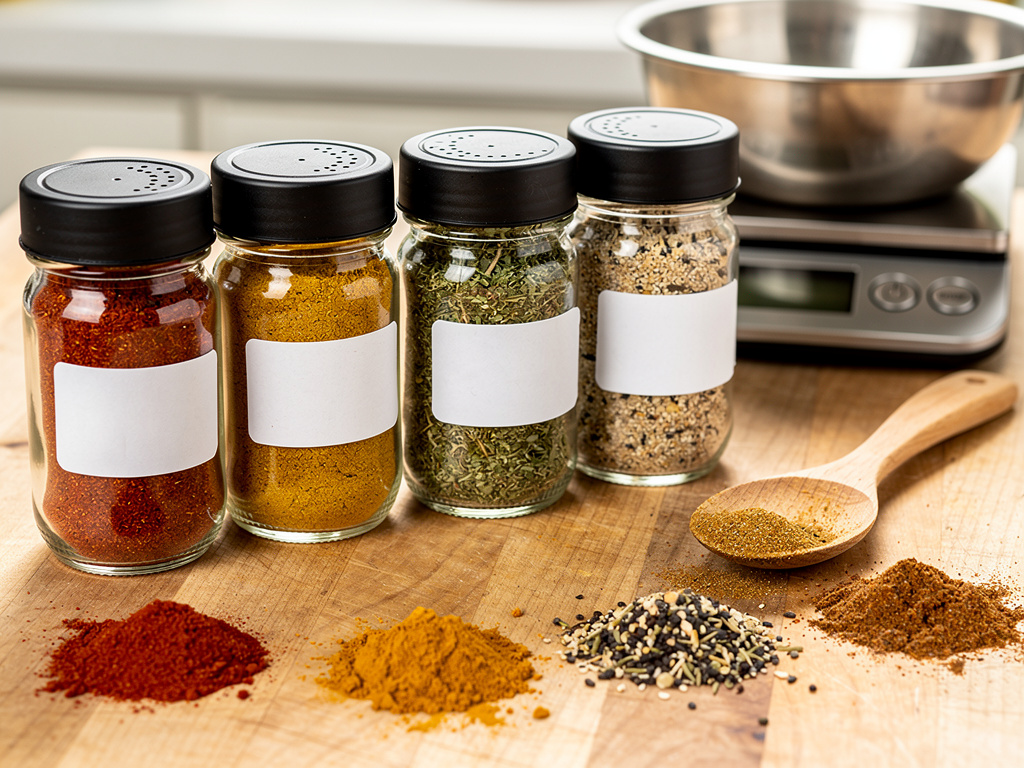


The short version: You can sell homemade spice blends in some form in all eight states this guide checked, because dry seasonings don't need refrigeration (Michigan names herb mixtures and dip mixes, not rubs, so ask MDARD first), but the states split hard on where you can sell them: Texas and Washington don't let you mail them. Only Ohio, New York, California (Class B) and Texas (through a registered cottage food vendor) let you sell to stores or restaurants, and in Colorado a non-food storefront can sell your jars only if its staff act as your "designated representative" (restaurants, grocery stores and other retail food establishments cannot). Our example rub costs $1.91 to $2.54 in ingredients to fill a half-cup glass shaker jar (about 2.5 ounces of blend), plus $1.20 to $1.53 for the jar, so a $10 jar keeps 59% to 69% of its price before labels and selling fees. Label every jar with ingredients by weight, net weight, allergens like sesame and your state's home-kitchen statement (New York only recommends one), and never claim a blend treats or prevents anything. Stocking your first 24 jars runs about $186 in supplies.
Checked on each state agency's page, Spiceology, Specialty Bottle, USPS Notice 123 and Homegrown's signup page, October 12, 2026. Rules change, so verify your state's current rules before you sell. Homegrown is $10/mo billed annually ($12.50 billed monthly) with no commission, for pickup and local delivery only, not shipping. Customers create a Homegrown account to place a first order, and there is no drops or countdown release feature.
Spice blends are one of the simplest food products you can sell from a home kitchen. There is no cooking involved, no refrigeration needed, and a jar keeps its flavor for one to two years when you store it right. Our example rub costs $1.91 to $2.54 in ingredients per half-cup jar plus $1.20 to $1.53 for the jar, and The Spice House sells 2.4-ounce jars of its own rubs for $9.79 to $9.99, so there is real room between what a jar costs you and what people already pay.
If you already make a taco seasoning your family asks for or a rub your neighbors want to buy, you are closer to a real business than you think.
This guide covers the rules in 8 states, real ingredient and jar costs, pricing, labels, equipment, and where to sell your spice blends and seasonings from home. New to home food laws? Start with our directory of cottage food rules for every state.
Ready to actually start selling? Take orders and get paid online in about 15 minutes. Set up a Homegrown storefront ($10/mo, 0% commission) so your local regulars can reorder for pickup, or compare the best platforms to sell food from home.
Yes, you can sell spice blends from home in some form in each state this guide covers (Texas, California, Florida, Colorado, Ohio, New York, Washington and Michigan), because dry seasonings are shelf-stable, need no refrigeration and involve no cooking. Home food rules go by different names (cottage food in most states, "home processing" in New York), but they all cover low-risk foods made in a home kitchen and sold directly to the people who eat them.
Here is how the 8 states describe what you can make:
What you need beyond that depends on the state. Some want a permit, some want a food safety course, and every one wants a correct label. The next section puts all 8 side by side.
Spice blends are still one of the simplest home-kitchen products to start. Unlike baked goods, you don't need an oven. Unlike jams, there is no canning. You mix dry ingredients from approved sources, package them, and label them.
You cannot say your spice blend treats, cures or prevents a health condition. The FDA's page on label claims for foods and dietary supplements puts it plainly: "only a drug can legally make such a claim." Just like with herbal tea, the safe lane is flavor, not medicine.
What you can say:
What you cannot say:
Keep your marketing focused on flavor, recipes, and cooking. Michigan's agency says the same thing from the other side: herbal teas and tinctures "advertised with health claims" are not treated as conventional foods there and may have to be licensed as a dietary supplement. A blend sold as food, described as food, stays under your home food rules.
Every state in our October 12, 2026 check lets you sell dry spice blends in some form directly to the people who eat them (Michigan's list names dry herb mixtures and dry dip mixes rather than rubs), but they split on everything else. Only Washington charges a state permit fee ($355 for two years), 4 of the 8 require a food safety course, and 4 allow sales to stores or restaurants, while in Colorado only a non-food storefront can take your jars, and only when the store's employees serve as your designated representative; no restaurant, grocery store or other retail food establishment can. We read each state's own agency page or rule, not a summary.
Scroll sideways to see every column.
| State | What the list says | Permit or registration | Training | Yearly sales cap |
|---|---|---|---|---|
| Texas | Any food except 6 banned groups | None required; local health departments may not require a permit or fee | Accredited food handler course | $150,000 |
| California | "Spice mix or rubs," "Seasoning salt," "Herbs & herb blends" | Register (Class A) or get a permit (Class B) from your county; fee set by the county | Cottage Food Operator Training within 3 months | $88,878 Class A, $177,756 Class B (2026) |
| Florida | "Dry herbs, seasonings and mixtures" | No FDACS food permit | Not listed on the FDACS page | $250,000 |
| Colorado | "Dry spices"; "Dry Spice Blends & Rubs" from 2027 | None today; yearly CDPHE registration from January 1, 2027 | Food safety course (CSU class, food handler card or local course) | $10,000 per product type today; $150,000 total from 2027 |
| Ohio | "Dry seasoning blends," "Dry herbs and herb blends" | None; exempt from licensing and inspection | Not listed on the ODA page | None listed on the ODA page |
| New York | "Repacking/blending of commercially dried spices or herbs," "Seasoning salt" | Home Processor Registration, no fee; water test if you're on a private well | Not listed on the page | None listed on the page |
| Washington | "Dry spice blends"; dry seasonings "obtained from approved sources" | $355 permit, valid 2 years, with a kitchen inspection and a Master Business License | Food Worker Card for each person | $35,000 |
| Michigan | "Dry herbs and dry herb mixtures," "Dry dip mixes" (rubs not named) | No license, registration or inspection | Optional MSU Extension course | $50,000 ($75,000 if a unit sells for $250 or more) |
We checked each row on the state's own page on October 12, 2026: Texas DSHS, California CDPH and its 2026 adjusted sales limit, FDACS, CDPHE, Ohio's rule and ODA page, New York Agriculture and Markets, WSDA and MDARD. California's caps rise each January with inflation. Michigan's law lets MDARD adjust its cap each October 1 starting in 2026; MDARD's page still showed $50,000 on October 12, 2026. Texas's law, SB 541, also has DSHS adjust its $150,000 cap for inflation each year; DSHS's page still showed $150,000 on October 13, 2026.
The second half of the picture is where you can sell. Read it closely, because "online" and "shipping" are not the same thing.
Swipe left to see the rest of the table.
| State | Online orders and delivery | Stores, restaurants, wholesale | Home-kitchen statement on the label |
|---|---|---|---|
| Texas | Online sales only when you, an employee or a household member delivers in person; post your label information on your website before you take payment | Only through a registered "cottage food vendor," who can resell at a farmers market, farm stand, food service establishment or retail store | "THIS PRODUCT WAS PRODUCED IN A PRIVATE RESIDENCE THAT IS NOT SUBJECT TO GOVERNMENTAL LICENSING OR INSPECTION." |
| California | Phone and internet sales allowed; a direct sale "may be fulfilled in person, via mail delivery, or using any other third-party delivery service" | Class B only, "indirectly through restaurants and food markets" | "Made in a Home Kitchen" in 12-point type, plus your registration or permit number and the county that issued it |
| Florida | Website and mail order allowed, delivered in person or by USPS or a commercial carrier | Not allowed: no wholesale | "Made in a cottage food operation that is not subject to Florida's food safety regulations." (10-point) |
| Colorado | Internet sales allowed; you and the buyer agree on delivery "as long as it does not involve interstate commerce" | Not allowed for restaurants, grocery stores or other retail food establishments; a non-food store qualifies only if its employees act as your "designated representative" | A home-kitchen disclaimer that also warns about common allergens, and buyers must already get your phone or email address plus the production date; at the point of sale, a sign in the exact words on CDPHE's page saying the food was made in a home kitchen without state licensing or inspection and is not for resale |
| Ohio | Sales inside Ohio only ("may only be sold in Ohio"); the ODA page does not mention mail order, so ask ODA before you ship | Allowed: grocery stores, registered farm markets, farmers markets and restaurants, inside Ohio | "This Product is Home Produced." (10-point) |
| New York | Internet sales "within New York State only"; no shipping out of state | Allowed: wholesale to local restaurants, cafes and grocery stores inside New York | Recommended, not required: a phrase like "Made in the Home Kitchen of XYZ" or "Made at Home by XYZ," 1/16 inch or larger |
| Washington | You can take orders online, but payment and delivery must be person to person; no mail or courier | Not allowed: no wholesale or consignment | "Made in a home kitchen that has not been subject to standard inspection criteria." plus your permit number |
| Michigan | Internet or mail order inside Michigan, after the buyer can "directly interact" with you (a face-to-face or virtual meeting) | Not allowed: no restaurants, grocery stores, wholesalers or consignment | "Made in a home kitchen that has not been inspected by the Michigan department of agriculture and rural development." (11-point) |
Checked October 12, 2026 on the same agency pages, plus Fla. Stat. 500.80, RCW 69.22.020, MCL 289.4102 and MDARD's selling page. Shipping across state lines is a separate question from these in-state rules; our guide to shipping cottage food covers it.
Read the two tables together and three patterns show up:
Colorado's rules change on January 1, 2027. CDPHE's update page says producers will have to register with the department every year, show a food safety training certificate, and put a department registration number, the county where the food was made and a website address the department provides on every label, along with the contact phone or email and production date that buyers must already be given today. From 2027, a Colorado producer who sells online must also post the point-of-sale disclaimer on the website, according to CDPHE's 2027 labeling page. The same page gives new exact wording for the 2027 label disclaimer: it says the kitchen is not subject to state licensure or inspection, that the kitchen "may also process common food allergens such as tree nuts, peanuts, eggs, soy, wheat, milk, fish, and crustacean shellfish," and that the product is not intended for resale. It adds that if you sell out of your home, "there should be a placard, sign or card posted at home for the customer to read." The sales cap moves from $10,000 per product type to $150,000 total. If you sell in Colorado, plan your 2027 labels now.
Washington's law says cottage food "may not be sold by internet, mail order," and WSDA's page says you can take orders online but delivery and payment must happen "in a person to person transaction." Homegrown's card checkout doesn't match WSDA's person-to-person payment wording, so a Washington seller should ask WSDA first; if WSDA approves online payment with in-person pickup, Homegrown fits. WSDA also caps a permit at 50 master products, and each blend counts as one product even with size variations.
The spice blends that sell best solve a specific cooking problem: they save time, add flavor a single jar can't, and make a weeknight dinner taste noticeably better. No public data ranks spice blend sales at farmers markets, so use two real signals instead: what home vendors already list, and what your own customers taste and buy.
In a pull of the Homegrown catalog on October 12, 2026 (2,867 products from 317 vendors), 20 listings from 9 vendors were dry seasonings: 11 seasoned or herb salts, 6 spice blends and seasonings (two adobos, a sazón, an all-purpose seasoning, a salsa and dip mix and a ginger-turmeric seasoning), and 3 rubs. Listed prices ran from $5 to $14. Six listings named a 4-ounce size in the product name or description, priced at $5, $6, $8, $8, $8 and $10. We searched every product name and description for whole words like seasoning, rub, spice and salt, read every match, then read the full product lists of the 11 vendors with a possible match; 9 made the count. We left out 4 bread-dip "Spices" listings whose descriptions don't say whether they are dry, three listings with no description at all (two of them mushroom seasonings), a seasoned flour and soup mixes.
Dry seasoning listings on Homegrown, by type
Source: Homegrown catalog pull, October 12, 2026, 20 dry seasoning listings out of 2,867 products. A listing is one product page, even when it has several sizes.
The takeaway: flavored salts are the most common dry seasoning on Homegrown right now, and rubs are the least crowded. If you're good at rubs, there's room.
These blends are staples people reach for several times a week, which is what makes them reorder products:
These blends can carry a higher price because they are harder to find and more interesting:
Start with three to five core blends: two or three everyday blends, one signature blend and one seasonal rotation. Too many options overwhelm customers and complicate your production, and in Washington every blend counts toward the 50-product limit on your permit. Washington also lets you sell only the products WSDA approved on your permit, so adding a blend later, like a seasonal one, means listing it when you renew the permit (no fee beyond the renewal) or filing an amendment form with a $105 fee in between ($30 processing plus $75 public health review), and WSDA may add a $125 inspection. New York asks you to send its Home Processor Registration Request form again, marked as a supplemental registration, with the products you want to add.
You can expand your line over time, but starting small lets you perfect your recipes, dial in your production process, and learn what your specific market wants.
To make a seasoning to sell, write the recipe by weight, buy every spice from a commercial supplier, mix in batches you can trace, and fill each jar to a weighed net weight that matches the label. Weight is the step that's easy to skip: a recipe written in teaspoons can't tell you what to print as the net weight, and it won't taste the same batch to batch.
Buying from commercial suppliers is not just a quality choice. New York only approves blending of "commercially dried" spices and herbs, and it prohibits drying your own herbs. Washington's rule covers dry seasonings "obtained from approved sources." The reason is safety: the FDA's questions and answers on spice safety say spice shipments offered for import had a Salmonella rate of about 6.6% in fiscal years 2007 to 2009, and that 9 of 11 types of retail spices tested significantly lower, which FDA says is consistent with industry reports that "responsible manufacturers apply a pathogen reduction treatment" to many spices before retail sale. Buying spices that a supplier sells as food is how a home blender benefits from that step.
Yes, compared with small retail jars: our example rub costs $0.76 to $1.01 per ounce in ingredients from Spiceology's 16- to 96-ounce bags, while a 4.1-ounce jar of a rub that Spiceology sells (Derek Wolf's Tennessee Smoke) lists at $9.99, or $2.44 an ounce, and The Spice House's 2.4-ounce rub jars work out to $4.08 to $4.16 an ounce. A finished rub bought in bulk costs about the same as making it, or less: Spiceology sells that Tennessee Smoke rub in a 22-ounce size for $19.99 ($0.91 an ounce), and its All-Purpose BBQ Rub runs $0.85 an ounce in a 20-ounce bag and $0.64 in a 96-ounce bag. For someone buying a blend in small jars, that gap is the price of the label, the jar and the convenience.
For you as a vendor, the same gap is your margin, and it depends heavily on pack size. Smoked paprika shows it well:
Smoked paprika, price per ounce by pack size
Source: The Spice House smoked sweet paprika, 2.2 oz jar $9.49 and 8 oz bag $20.99; Spiceology smoked paprika, 16 oz $19.20 and 80 oz $77.24. Prices loaded October 12, 2026, before shipping.
Smoked paprika in a small retail jar from one spice shop costs more than four times as much per ounce as smoked paprika in an 80-ounce bag from a bulk supplier. That's why the jar on your own kitchen shelf is the wrong price to plan a business around.
Price a standard 4-ounce (half-cup) jar at about $8 to $12, then check that number against your real costs. Our example rub costs $3.11 to $4.07 for the ingredients and the glass jar, so a $10 jar keeps $5.93 to $6.89 before labels and selling fees, and an $8 jar keeps $3.93 to $4.89. Your margin only holds if you buy ingredients in bulk, as the cost table below shows.
Use these as starting prices, then adjust to your market and your own costs:
Two reality checks from October 12, 2026: the six Homegrown listings that named a 4-ounce size were priced at $5, $6, $8, $8, $8 and $10, and Spiceology lists a 6-pack of mini rub jars at $39.95 and a 4-pack rub set at $49.95. Three of those six, Casa Isla Mía's $8 adobos and sazón, list "Net Weight: 4 oz (113 g)," about 1.6 times the blend in our 2.5-ounce example jar, so per ounce they sit well under the range above. The $10 listing says it comes in a 4-ounce glass jar, which fits the range, and the $5 and $6 listings don't say whether 4 oz is the weight or the jar size. Spiceology's 4-pack rub set ($49.95) sits above our gift-set range, and its 6-pack of mini jars ($39.95, about $6.66 a jar) is a bigger set than our 3- to 4-jar sampler. Your own costs and customers decide where you land.
Our example smoky rub costs $3.11 to $4.07 per filled half-cup jar, ingredients and jar included, depending on the bag and jar quantities you buy. Each jar holds 2.5 ounces of blend. Here is the breakdown for a 10-ounce batch, which fills four jars, with ingredient prices from Spiceology and the jar from Specialty Bottle:
Scroll sideways to see both bag sizes.
| Ingredient (10-oz batch, 4 jars) | Amount | Cost from 16-oz bags | Cost from 80 to 96-oz bags |
|---|---|---|---|
| Smoked paprika | 3 oz | $3.60 | $2.90 |
| Chili powder, dark | 2 oz | $1.80 | $1.33 |
| Garlic powder | 1.5 oz | $1.34 | $0.88 |
| Onion powder | 1.5 oz | $1.22 | $0.72 |
| Black pepper, ground | 1 oz | $1.06 | $0.82 |
| Cumin, ground | 0.75 oz | $0.75 | $0.58 |
| Mexican oregano | 0.25 oz | $0.38 | $0.38 (16-oz bag) |
| Batch ingredients | 10 oz | $10.15 | $7.62 |
| Ingredients per jar (batch divided by 4) | 2.5 oz | $2.54 | $1.91 |
| 4-oz (half-cup) glass shaker jar | 1 jar | $1.53 (1 to 119 jars) | $1.20 (120 to 999 jars) |
| Cost per filled jar | $4.07 | $3.11 |
We checked these on Spiceology (16-oz bags: smoked paprika $19.20, dark chili powder $14.39, imported garlic powder $14.24, onion powder $12.99, ground black pepper $16.99, ground cumin $15.99, Mexican oregano $24.45; large bags: paprika 80 oz $77.24, chili powder 96 oz $63.99, garlic 96 oz $56.38, onion 96 oz $46.34, pepper 80 oz $65.99, cumin 80 oz $61.99) and Specialty Bottle (4-oz round glass spice jar with shaker fitment) on October 12, 2026, before shipping and tax. Totals come from unrounded costs, so the rounded large-bag rows add up a cent lower than $7.62.
Then add your label and seal. Label cost depends on the sheets or rolls you buy and your printer, so divide the pack price by the number of labels to get your number. At a $10 price, our example keeps $5.93 (16-oz bags, jars bought 1 to 119 at a time) to $6.89 (large bags, 120-plus jars), a 59% to 69% margin before labels and selling fees. Your own blend will cost more or less depending on its ingredients, so price your real recipe the same way. For pricing across market, wholesale and online channels, see our guide on how to price food products for a farmers market.
Buy the big bag only for the ingredient you use most. In our example, smoked paprika is 3 of every 10 ounces, and moving it from the 16-ounce bag ($1.20 an ounce) to the 80-ounce bag ($0.97 an ounce) saves $0.18 a jar on paprika alone. The small-share spices, like oregano at a quarter ounce per batch, can stay in small bags without hurting your margin.
Buying in bulk cut the price of smoked paprika by more than three quarters on October 12, 2026, from $4.31 an ounce in a retail jar to $0.97 in an 80-ounce bag. Here's the same spice at four sizes:
At the 16-ounce prices, our 10-ounce batch costs $10.15 in ingredients; at the large-bag prices it costs $7.62. That difference adds up fast when you fill 50 or 100 jars at a time.
Look for suppliers that sell 1-pound and multi-pound bags to restaurants and small food businesses. Keep every receipt or lot number, because New York and Washington both tie home blending to spices from commercial or approved sources.
Package spice blends in a container that seals out air and moisture, shows the product, and fits your price: a 4-ounce (half-cup) glass shaker jar cost $1.53 from Specialty Bottle on October 12, 2026, and dropped to $1.20 at 120 jars. The container you choose affects how your table looks, how long the blend stays fresh, and your cost per unit.
Most spice vendors choose from four containers: glass shaker jars, tins, stand-up pouches and plastic sifter jars. Of the two we priced, a 4-ounce glass jar cost $1.53 and a 2-ounce tin $0.95.
Here is a detail that is easy to miss: a "4 oz" jar is a volume size, half a cup, not a weight. On October 12, 2026, The Spice House's half-cup jars of spices and seasonings held 1.8 to 3 ounces by weight (salt, which is denser, up to 5.3), its half-cup jars of leafy herbs held only 0.5 to 0.8 ounce, and its one-cup rub jars held 5 to 6.2 ounces. Plan on roughly 2 to 3 ounces of a ground blend in a 4-ounce jar, then fill one and weigh it, because your label must state the real net weight.
Most vendors start with one container type for consistency. Glass jars are a natural fit for farmers markets because customers can see the blend. Buying in case quantities from a packaging supplier like Specialty Bottle lowers the per-unit cost once you know which container works for your brand.
Plan for six things on every label: the product name, ingredients by weight, net weight, allergens, your name and address (or an ID number where your state allows one), and your state's home-kitchen statement. Two states are worth a closer look. The Texas DSHS label list is shorter, with no ingredient list or net weight, though both are still good practice, and a jar a registered cottage food vendor sells for you must carry the date it was made. Colorado's CDPHE page says buyers must also be given your phone number or email and the date the food was produced. Here's what each of the six means:
Two spice-specific label points trip people up. First, federal rules at 21 CFR 101.22 let packaged foods list spices together as "spice," but paprika, turmeric and saffron must be declared as "spice and coloring" unless you name them, and onion and garlic are treated as foods, not spices, so they always get named. Naming every ingredient is simpler for a small batch, and customers ask about heat and allergies anyway. Second, mustard is not one of the nine US major allergens, so the law doesn't force a "Contains" line for it, but listing it by name in your ingredients answers the question before anyone asks.
For the full rules, see our guides to cottage food labeling requirements and the nine major allergens on a cottage food label.
A homemade spice blend keeps its best flavor for roughly 1 to 2 years. McCormick's shelf life guide gives bottled seasoning blends 1 to 2 years, ground spices 2 to 4 years, and leafy herbs like basil and oregano 1 to 3 years, when stored properly. A homemade blend is only as fresh as its most fragile ingredient, so plan around the shortest one.
Put a best-by date on your labels. This guide uses 12 months from the blending date, a conservative choice that fits inside McCormick's 1 to 2 years for bottled blends and gives customers confidence in what they're buying.
Store your blends in airtight containers away from heat, light, and moisture, and tell your customers to do the same. McCormick also suggests keeping red pepper spices like paprika and chili powder in the refrigerator to hold their color, which is a good tip to print on a recipe card.
Spice blending needs very little equipment: a digital scale, mixing bowls, a funnel, and airtight storage. A basic digital kitchen scale ran $11.99 to $29.99 on Etekcity's site on October 12, 2026, and it's the one tool you can't skip, because your net weight label depends on it.
Essential equipment:
Nice to have:
Total startup cost: about $186 for the scale, 24 glass jars and the bags to fill them with our example rub. That's $11.99 for the scale, $36.72 for 24 jars at $1.53, and $137.45 for the 16-ounce bags (two of smoked paprika, one each of the other six), before labels, supplier shipping and any permit fee. Spiceology also sells Mexican oregano in a 4-ounce bag ($9.55), which covers the 1.5 ounces those 24 jars use and brings the total to about $171. Washington's $355 permit would more than double it. Six of the eight (Texas, Florida, Michigan, Ohio, New York and Colorado) charge no state permit fee, and California's fee is set by your county.
That still makes spice blends one of the cheapest home-kitchen products to start. No oven, no dehydrator, no canning equipment. Just a scale, bowls, containers, and labels.
You can sell spice blends face to face in every state we read, at farmers markets and the other direct-sale venues your state lists, but stores, shipping and online payment each depend on your state. Start where every state agrees, in person, then add channels your state's page allows.
Farmers markets are the best starting point for spice blend sellers, because tasting sells seasoning and every state we read allows direct sales there. Your first season tells you which blends your market buys; keep a simple tally per market day and let it decide your second-season lineup.
What makes spice blends sell at markets:
Selling to stores is allowed in only half the states in this guide, so check this before you print a wholesale price sheet. Ohio allows cottage foods in grocery stores and restaurants inside Ohio, New York allows wholesale to local facilities inside New York, California allows it for Class B operators through restaurants and food markets, and Texas allows it only through a cottage food vendor registered with DSHS. Michigan, Florida, Colorado and Washington don't allow store or wholesale sales of cottage food. Colorado's page adds one narrow exception: a non-food storefront can sell your jars only if its staff act as your "designated representative"; restaurants, grocery stores and other retail food establishments cannot. CDPHE's page answers the storefront question this way: "The law requires that Cottage Foods be sold directly to an informed end consumer from the producer or their designated representative. The store and its employees would need to function as the designated representative."
Where it's allowed, spice blends fit naturally in:
Approach these stores with a finished label, a wholesale price sheet, and samples. Our wholesale pricing guide walks through the math: a store that marks your price up 30 to 50 percent pays you about 67% to 77% of the shelf price, and one that asks for keystone pays you half, so a $10 jar goes to the shop for $5 to $7.69. At keystone's $5 and our example's $3.11 to $4.07 cost per filled jar, that leaves $0.93 to $1.89 before labels, which is why wholesale works best as a side channel for a home spice vendor. In states that ban it, the path to stores is a licensed kitchen (see the section on outgrowing your home kitchen below).
Online ordering and shipping are two separate questions. The agency pages for 7 of the 8 states allow online orders, each with its own limits, but Ohio's page doesn't mention online orders at all, so ask ODA. Mail delivery is clearly allowed in only 3 of the 8 (California, Florida and Michigan, each inside its own state rules). New York allows internet sales inside the state and bans shipping out of state, but its page doesn't say whether you can mail a jar within New York, so ask the department. Colorado leaves the delivery method to you and the buyer inside Colorado. In Texas you, an employee or a household member must deliver in person, Washington rules out mail and couriers, and Ohio is silent on mail order.
Where shipping is allowed, it costs more than you might expect. USPS Notice 123, effective October 4, 2026, prices a USPS Ground Advantage retail package up to 8 ounces at $8.40 (zone 1) to $10.20 (zones 8 and 9), and up to 15.999 ounces at $10.05 to $13.65. The commercial price list, which you get when you buy postage online through a postage service, starts at $7.33. On a $10 jar, shipping can cost almost as much as the blend. Weigh a packed jar in its box before you set shipping prices.
Your platform choice depends on whether you're selling locally, shipping, or both:
Our breakdown of Etsy fees for food sellers goes deeper on the Etsy math.
Spice gift sets are some of the easiest products to assemble and sell at a higher price. Suggested starting prices:
Every jar in a gift set still needs its full label, even when the set has a pretty outer tag. Our list of gift basket ideas to sell has more combinations. Order your packaging early for November and December, when gift orders cluster, because jar suppliers' price breaks reward one big order over several small ones.
Spice blends are a reorder product: a jar runs out, and the customer who loved it wants the same one again. The problem is that a reorder arrives as a text, a DM or a "do you have the smoky one this week?" at your booth, and you end up tracking jars and payments across a dozen conversations.
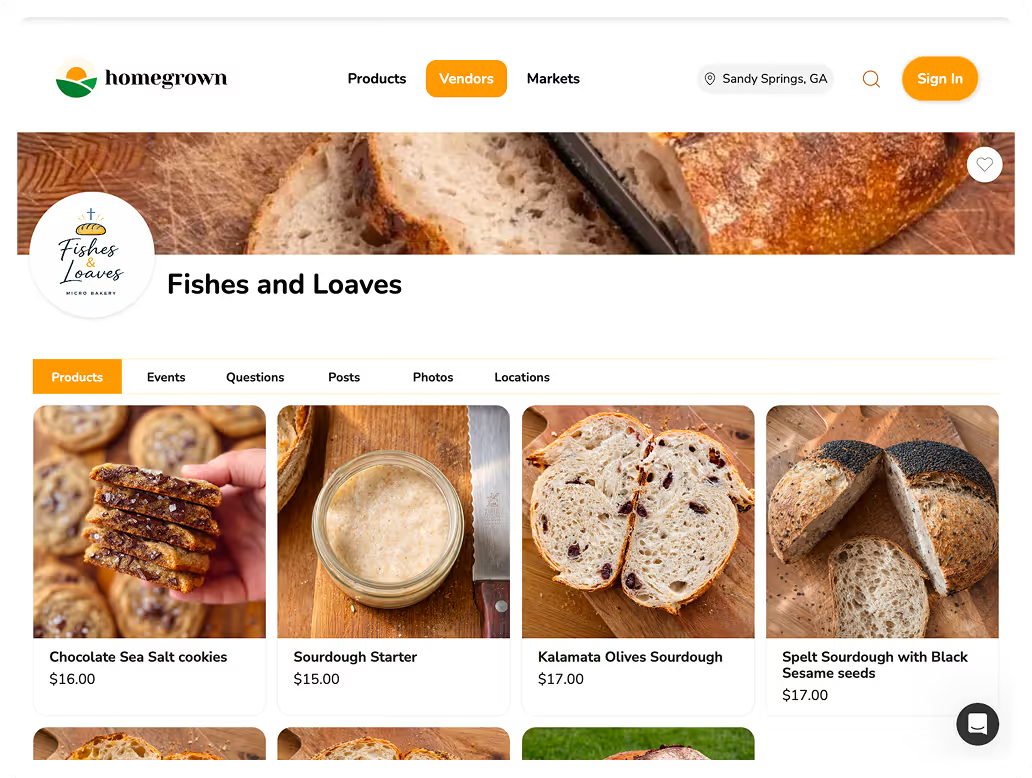
Homegrown gives your regulars one link to reorder their blends and pay upfront for pickup or local delivery. It costs $10 a month billed annually ($12.50 billed monthly) with no percentage fees beyond standard payment processing (2.9% + $0.30 per sale, paid by you). You set up a storefront, list each blend with its sizes as separate options, and choose your pickup days and delivery radius (1 to 25 miles). Orders land in one dashboard with a pickup time or a delivery address, so you fill exactly the jars people paid for before market day. Texas asks you to post your label information on your website before you take payment, and a product description is a natural place for it.
Here's how it compares with what spice sellers usually consider, on a $20 order (one 3-jar sampler) and a month of 50 such orders:
Swipe to compare every platform.
| Platform | Subscription | Trial | Platform fee | Card processing | Customer pays on a $20 order | Vendor pays on a $20 order | Vendor pays for 50 orders a month |
|---|---|---|---|---|---|---|---|
| Homegrown | $10/mo billed annually, or $12.50/mo billed monthly | 7 days, no charge until day 8 | $0 (0% commission) | 2.9% + $0.30, vendor pays | $20.00 | $0.88 | $54.00 annual plan, $56.50 monthly plan |
| Hotplate (default: customer pays the fee) | $0 | None needed | 5% + $0.55, added to the customer's total | 2.9% + $0.30 on what the customer pays, vendor pays | $21.55 | $0.92 | $46.25 |
| Hotplate (vendor covers the fee) | $0 | None needed | 5% + $0.55, vendor pays | 2.9% + $0.30, vendor pays | $20.00 | $2.43 | $121.50 |
| Shopify Basic | $29/mo billed yearly, or $39/mo billed monthly | 3 days, then $1/month for 3 months | $0 with Shopify Payments (2% with a third-party processor) | From 2.9% + 30¢ online (3.5% + 30¢ on premium cards) | $20.00 plus any shipping you charge | $0.88 | $73.00 yearly plan, $83.00 monthly plan |
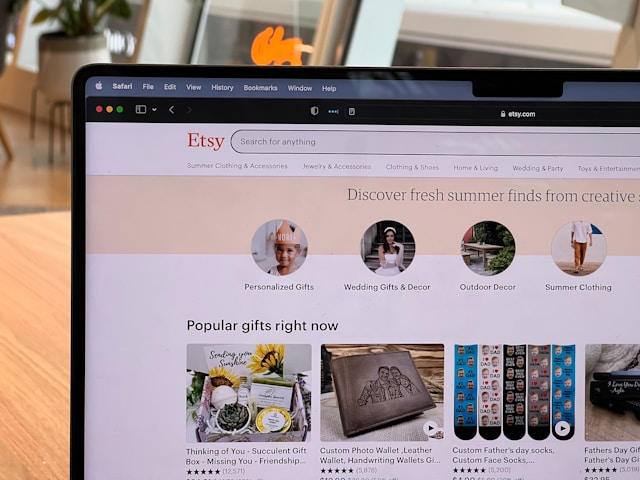
| Etsy | $0; a one-time set-up fee may apply | None | $0.20 listing + 6.5% transaction | 3% + $0.25 on the total sale (US) | $20.00 plus any shipping you charge | $2.35 | $117.50 |
We checked these on Homegrown's signup page, Hotplate's pricing page, Shopify's pricing page and Etsy's Fees & Payments Policy on October 12, 2026. Hotplate's pricing page calls the fee split "your choice"; its own post, "What Hotplate does" (September 1, 2025), says "we charge a fee to your customer" by default and that 80% of chefs keep that default. Hotplate's card fee is figured on what the customer pays (the item plus Hotplate's passed-on fee); per-order fees are rounded to the cent and month totals are built from the unrounded figure. Shopify's per-order figure uses its standard card rate. Shipping costs and Etsy's fees on any shipping you charge are not included.
The fee is only part of the choice. Hotplate is built around timed food drops and costs the vendor the least per month when customers pay its fee, but they see $21.55 at checkout instead of $20, and you still pay the 2.9% + $0.30 card processing on that total. Etsy is the shipping marketplace, and its $2.35 a sampler is the price of being listed there. Shopify gives you a full website for $73 to $83 a month at 50 orders, more than most home spice sellers need early on. Homegrown is the local reorder link: flat pricing, your customers pay your price, and a refill order shows up as a pickup on your list.
Honest bounds: Homegrown does not ship, so out-of-town customers who want a jar mailed need Etsy or your own shipping setup where your state allows it. It doesn't handle wholesale invoicing to shops. Customers create a Homegrown account to place a first order, and there's no drops or countdown release feature. Your storefront is listed on Homegrown's marketplace, but plan on most orders coming from people you send to your own link. In Washington, ask WSDA about online payment first, as covered in the state section above. In Texas, DSHS allows an online sale only when the food is personally delivered by you, someone who works for you or someone in your household, so hand orders to the buyer yourself rather than using a courier. In Michigan, give each buyer the chance for a face-to-face or virtual meeting before the sale, which MCL 289.4102(4) requires for internet orders.
Already have regulars asking for refills? Set up your Homegrown storefront, add your three best blends, and text the link to the customers who bought a jar this season. The 7-day trial means no charge until day 8.
Sometimes: 4 of the 8 states we read use wording that takes in a single spice, but blends are the safer product. New York lists "Repacking/blending of commercially dried spices or herbs," and Washington's rule covers "Recombining and packaging of dry herbs, seasoning and mixtures" from approved sources. Texas allows "any foods, except" six groups, and none of them is a spice. Colorado's current list says "Dry spices," and its list for 2027 names "Dry Spice Blends & Rubs." Florida lists "Dry herbs, seasonings and mixtures," which names seasonings separately from mixtures but doesn't say spices. California lists "Herbs & herb blends," "Seasoning salt" and "Spice mix or rubs"; Ohio lists "Dry herbs and herb blends" and "Dry seasoning blends"; and Michigan lists "Dry herbs and dry herb mixtures" and says "Shelf stable dry bulk mixes can be repackaged." None of those four names a single spice, so read your own state's list, or ask its agency, before you sell plain black pepper by the ounce.
There's also a business reason to blend. A single spice competes on price with every grocery store, while your blend is a recipe only you sell. If you love a single spice, sell it inside a story: a seasoned salt, a pepper blend, or a sampler where one jar is your favorite single spice.
You outgrow home food rules when you want sales your state's cottage food rules don't allow, like wholesale in Michigan, Washington, Florida or Colorado, or when you near your state's cap, such as $35,000 a year in Washington. The next step is a licensed kitchen, either your own or a shared commercial kitchen, or a co-packer who blends and packs your recipe in their licensed facility.
Building your own seasoning plant is a different scale of business, and the cost depends on your space, equipment and state licensing. For most home vendors, a shared commercial kitchen or co-packer is the first step, long before a building of your own.
The fastest growth levers for a spice blend vendor are tasting, recipe cards, one signature blend, refills and partnerships with other vendors. Each one turns a first jar into a second.
Sampling sells spice blends because a taste answers the one question a label can't: will I like this on my food? Set up a simple sampling station with crackers, bread cubes, or tortilla chips at every market, and follow your state's sampling rules (Florida wants samples prepackaged).
Mix a small amount of each blend with cream cheese or olive oil for easy tasting. Label each sample clearly so customers know what they're tasting and can find the matching jar.
Include a recipe card with every purchase, with one recipe of five to seven ingredients that takes 30 minutes or less. A simple card with one recipe that features your blend does two things: it helps the customer use the product right away, and it brings them back when they want to make the recipe again.
The easier the recipe, the more likely customers will actually make it. The back of the card is a good place for your storage tip and best-by date.
Your signature blend is the product that sets you apart from every other spice vendor. It should be a flavor combination nobody else at your market offers.
Give it a memorable name. "Grandma Rosa's Sunday Sauce Seasoning" tells a story that "Italian Herb Blend #2" doesn't. Before you print labels, search the name online to make sure another seasoning company isn't already using it.
Once a customer finishes a jar, make it easy for them to come back:
Repeat customers are where the real profit is. A customer who buys one $10 jar is worth $10. A customer who comes back every month is worth $120 a year.
Partner with two or three other farmers market vendors on bundles that put your blend next to the food it seasons:
These partnerships put your jars in front of another vendor's regulars. Keep each product's sale with its own vendor unless your state allows sales through someone else; in Michigan, for example, sales by consignment are prohibited.
It depends on your state. Among the eight states we checked on October 12, 2026, Texas, Florida, Michigan and Ohio need no state permit to sell spice blends from home, New York needs a free Home Processor Registration, California needs a county registration or permit, Washington needs a $355 two-year permit, and Colorado will require yearly registration starting January 1, 2027. Texas, California, Colorado and Washington also require a food safety course or food worker card. Look up your own state in our state-by-state cottage food guide.
Online ordering is allowed, with limits, in 7 of the 8 states here; Ohio's agency page doesn't mention it, so ask ODA. Delivery rules differ too. California and Florida allow mail delivery, Michigan allows it inside the state after a face-to-face or virtual meeting with the buyer, New York allows internet sales inside the state, Colorado lets buyer and vendor agree on in-state delivery, Texas wants you, someone who works for you or a household member to hand-deliver, Washington requires person-to-person payment and delivery, and the Ohio agency page skips mail order entirely. Learn the details in our guide to what you can sell under cottage food laws, and for mailing across state lines, our guide to shipping cottage food.
McCormick gives bottled seasoning blends a shelf life of 1 to 2 years, ground spices 2 to 4 years, and leafy herbs 1 to 3 years, when stored tightly capped away from heat, moisture and sunlight. For homemade spice blends, a best-by date 12 months from the blending date is a safe, simple rule. Print it on every jar along with the batch date.
No. Under FDA rules, only a drug can legally claim to diagnose, treat, cure or prevent a disease, so calling a turmeric blend "anti-inflammatory" moves your product out of the food category. Calling a cayenne seasoning a metabolism booster is what the FDA calls a structure/function claim, a claim about how a food affects the body, and it can make your blend read like a dietary supplement. Michigan's agency says herbal teas and tinctures sold with health claims may need to be licensed as dietary supplements. Stick to flavor descriptions and cooking suggestions.
About $186 in supplies covers a digital scale ($11.99), 24 half-cup glass shaker jars ($36.72) and the 16-ounce bags to fill them with a 7-ingredient rub ($137.45), at prices checked October 12, 2026. Add labels, supplier shipping and your state's fees, which range from nothing in six of these states to $355 in Washington, and California's fee is set by your county. You don't need a commercial kitchen or special equipment to start.
No public data ranks spice blend sales at farmers markets, so your own tasting table is the best guide. On Homegrown on October 12, 2026, seasoned and herb salts led the dry seasoning listings (11 of 20), followed by spice blends like adobo and all-purpose seasoning (6) and rubs (3). A strong starting line is two or three everyday blends, such as a BBQ rub and a taco seasoning, plus one signature blend that is unique to you.
Check your state first. New York's home processing rules allow blending only "commercially dried" spices and herbs and prohibit drying herbs at home, and Washington's rule covers seasonings "obtained from approved sources." Several other states list dried herbs as allowed cottage foods. When you sell spice blends from home, buying spices from a commercial supplier and keeping the receipts is the simplest way to stay inside the rules.
These guides go deeper on the pieces this article touches:
If you only read one, make it your state's entry in the cottage food directory, since every number in your business plan depends on what your state allows.
Ready to start selling your spice blends? Set up your Homegrown storefront in about 15 minutes and give your market customers a way to reorder for pickup.