
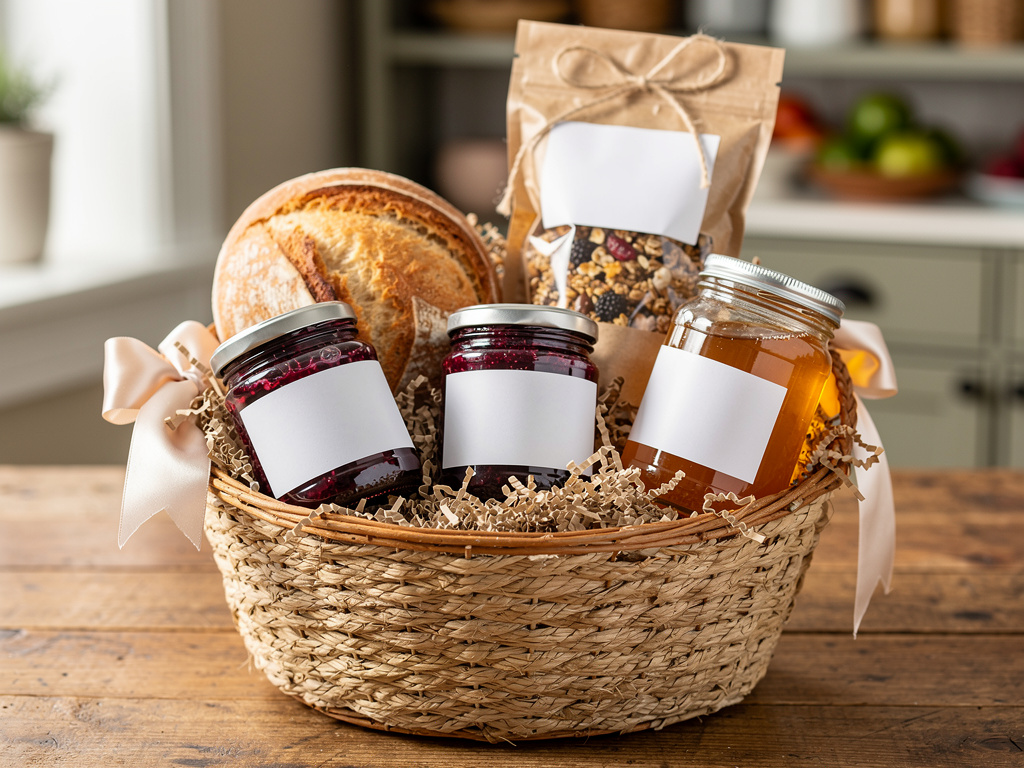


The short version: The easiest gift baskets to sell from a home kitchen are built from foods you already make and label, like three 8 ounce jams in a kraft box, a loaf with jam and granola, or a sampler of every cookie you bake. Adding factory-packaged food, another maker's product or a bottle of wine brings in extra rules: Michigan does not let anyone else sell your cottage food for you, and alcohol needs its own permit in the states we checked. Price a basket at the shelf price of what goes in it, plus packaging and your assembly time: a 14 by 10 inch basket, clear bag, shred and ribbon came to $7.70 from supplier pages today. Only 2 of the 2,748 listings on Homegrown are called a gift basket, while 63 already sell a mix of flavors or products in a single listing.
Checked on September 27, 2026: supply prices on WebstaurantStore, ClearBags, Carpenter Core and Nashville Wraps, fees and card processing on Homegrown's signup page and Hotplate's pricing page, and the rules on the Michigan, Texas, Minnesota, Mississippi, California, Connecticut, Maryland and federal pages named below. Rules change and differ by state, so verify your state's current rules before you sell. Homegrown customers create an account to place their first order, and Homegrown has no drops or countdown release feature.
Most gift basket idea lists are written for someone who buys everything at a warehouse store and arranges it. If you bake bread, make jam or pull honey, you start from a different place. You already have the best thing in the basket. The questions are what else can legally go in it, how to label it, and how to charge enough that the packaging and the time you spend packing pay for themselves.
This guide gives you basket ideas built from the foods home vendors actually list, real prices for the supplies, and the rules we could load from state and federal pages today. It works for birthdays, new babies, teachers and thank-yous, not just December.
A home food vendor can usually sell a basket made only of their own labeled cottage foods, because each item is already legal on its own. Things get harder as soon as the basket holds food someone else made. The table below sorts baskets into five kinds by what is inside them, from the simplest to the one that needs a separate permit.
Scroll sideways to see every column.
| Kind of basket | Example | What usually applies | Who to ask |
|---|---|---|---|
| Only your own cottage foods | Three jars of your jam, or your bread with your jam | Your state's cottage food rules, with each item labeled the way it would be on its own | Your state cottage food program |
| Your food plus non-food gifts | Cookies with a mug and a tea towel | Cottage food rules for the food. Sales tax can apply to the non-food part (California's 10 percent test is below) | Your state tax agency |
| Your food plus bought, factory-sealed food | Your granola with a bag of store-bought coffee | Retail food rules for the bought item. California lets nonperishable, prepackaged food be sold from a private home | Your county environmental health office |
| Your food plus another home cook's food | Your bread with a neighbor's jam | Often not allowed. Michigan says another person cannot sell your products. Texas allows resale only by a registered cottage food vendor | Your state cottage food program |
| Any basket with wine, beer or liquor | A bottle of wine with your crackers | A separate alcohol permit, such as Connecticut's gift basket retailer permit or Howard County, Maryland's new gift basket permit for florists | Your state alcohol agency |
Rules loaded from the Michigan, Texas, California, Connecticut and Maryland pages named in the sections below on September 27, 2026. Other states differ; check yours.
If you want seasonal themes, pre-order windows and booth display tips for December, our guide to holiday gift boxes and food baskets covers the Christmas rush. This article stays on the ideas you can sell all year, the rules on what can go inside, and the math behind the price.
The best gift basket ideas to sell start with your best-selling product and add two or three things that go with it. You are selling a finished gift, so the basket should make sense in one sentence: "everything for Sunday breakfast" or "three jams to try." Here are ideas grouped by what you already make.
The median jam listing on Homegrown is $9.00, so a three-jar trio starts at $27.00 of product before the box. A basket of three to five products is easier to price, pack and carry than a basket of ten. Keep the number small and let one item be the star.
Homegrown vendors already sell 63 listings that bundle several flavors or products together, and only 2 of them have basket in the name. That means plenty of vendors are already making the thing a shopper would call a gift basket, without calling it one.
In a pull of the Homegrown catalog on September 27, 2026, 63 of the 2,748 listings, from 40 vendors, sold two or more flavors or products as one purchase. The median listed price was $20.00. Twelve of the 63, from 7 vendors, mixed different kinds of product in one order. Only 2 listings had "basket" in the name, both juice gift baskets from Juicy's Juices at $30.00 and $60.00. How we counted: we searched every listing's name and full description for words like bundle, sampler, variety, assorted, flight, collection and basket, read every match by hand, and kept only listings whose name, description or options say one purchase holds two or more different flavors or products. Several of one product (a two-jar bundle of the same ghee) did not count.
Homegrown listings that sell a mix as one purchase, by kind
Source: Homegrown catalog pull, September 27, 2026, 63 listings from 40 vendors, sorted by hand.
A few real listings show how home vendors build these:
Most of these stick to what the shop itself makes, like Bakin' Me Happy's cookies and brownies, Crimson's sauces and Fir & Flour's loaves. That is the safest pattern to copy, and the next sections explain why.
Gift baskets sell every month because people need a gift for a moment, not a season. A basket that says "for the new parents" or "thank you, coach" is easier to buy than a jar with no story. These occasions come up all year:
For December cookie sets, see our guide to selling Christmas cookies and holiday gift sets. When a company wants 40 baskets for its clients, use our corporate gifting pricing tiers so the big order still pays. To find those buyers in the first place, along with realtors, rental hosts and holiday market shoppers, the guide to where to sell gift baskets maps seven places, the cottage food rules that open or close each one, and what a $45 basket pays you in each.
Sometimes, but the store-bought item is not covered by your cottage food exemption, so it falls under your state's regular retail food rules. Cottage food laws cover food you make at home. A bag of coffee or a box of crackers you buy and resell is retail food, and each state decides how a home vendor can handle it.
California is one clear example. Section 114285(b)(1) of the California Health and Safety Code says "Nonperishable, prepackaged food may be given away, sold, or handled from a private home." Riverside County's environmental health department, in a bulletin last revised in January 2017, says that rule was meant for small businesses that use prepackaged foods, and names gift basket assembly as the example. The county asks those home vendors to register before they start, with no permit fee.
That permission comes from California law, and your state may not have a rule like it. Read your own state's rules for the words "resale" and "prepackaged" before you buy a case of crackers.
A factory-sealed item keeps the label its manufacturer printed. Do not open a big bag of nuts or candy and repack it into small bags for your baskets. Riverside County's rules for home vendors say the food "must remain in a prepackaged state at all times," and repacking makes you the one who packaged that food.
The simplest workaround is to buy non-food gifts instead, like a wooden spoon, a mug or a tea towel. They add value without adding a food rule, though they can change the sales tax, which we cover below.
For another home cook's jam, in Michigan and Minnesota, no, because cottage food there is meant to be sold by the person who made it. Texas allows it once the reseller registers. A basket of local favorites from several kitchens sounds friendly, but it turns you into the one selling someone else's cottage food.
Michigan says it plainly. On its cottage food selling page, the Michigan Department of Agriculture and Rural Development (MDARD) says the sale must go directly from the cottage food operation to the consumer, and "Another person or business cannot sell your products for you." The same page says you cannot donate cottage foods for silent auction baskets. The Minnesota Department of Agriculture (MDA) says a cottage food registration is not a food license, "so therefore cottage foods cannot be wholesaled to businesses for resale." Mississippi draws the same line for stores. In its cottage food FAQ, the Mississippi State Department of Health answers "No" when asked whether cottage food can go in a store or restaurant on consignment, and adds: "Cottage Foods may not be sold with or associated with a regulated food business."
Texas allows resale, with steps. The Department of State Health Services (DSHS) says "Cottage food vendors who purchase products from CFPOs and sell directly to consumers must register on the DSHS Online Licensing Registry." A cottage food production operation (the home cook, called a CFPO) can sell to that vendor at wholesale, except time and temperature control for safety foods, the ones that must be kept cold or hot. The vendor must post a sign saying the food was made in a private residence that is not inspected, and the label must show the date the food was made.
Honey has its own rules, and both states let a beekeeper sell their own honey to a business that resells it. MDARD says honey and maple syrup "are not considered cottage foods" in Michigan and have their own licensing exemptions, and its maple syrup and honey exemption page says those producers "can wholesale their products, including to grocery stores and other retailers who will then resell them, as long as they are labeled correctly." In Minnesota, the MDA says honey from hives the beekeeper owns or rents, with nothing bought added to it, is a "product of the farm or garden" and can be "wholesaled to other businesses." The MDA also says a cottage food registration or food license is required when a honey or maple syrup producer supplements their product with sap, maple syrup or honey from another producer. Neither page says what you need to resell that honey from a home basket business, so a basket that puts a bee farm's honey next to your own jams still needs a check with your state first.
If you want a basket from several local vendors, the cleanest way is for each vendor to sell their own product on their own listing. Or split it: you sell your part, and point buyers to your neighbor for the rest.
Not without an alcohol permit, and a cottage food registration is not one. States regulate who can sell alcohol, and a home kitchen exemption does not touch it. Some have created a permit just for gift baskets, with limits on who can hold it.
Maryland's permit also says the permit holder or an employee delivers the basket, and the person receiving it shows proof they are at least 21. A gift basket with alcohol cannot be left on a porch like a loaf of bread.
For a nonalcoholic swap, use a mulling spice blend or a hot cocoa mix you make. Michigan's cottage food list allows powdered drink mixes but says "No simple syrups," so a homemade cocktail syrup is out there. A bottle of sparkling cider you buy is store-bought food, so the rules above for bought items apply.
Keep out anything your state does not allow you to make at home, even if it would look great in the basket. A butter set or a cheese board can need a food license that a jar of jam does not. The most common problems in gift baskets are cheese, meat, butter and pet treats.
You will see butter sets and charcuterie boxes for sale on Homegrown and elsewhere. The rules for those differ by state and by license, so before you copy a basket you see online, check that your own setup covers every item in it.
Label every food item the way it would be labeled if you sold it alone, then add a tag to the basket that lists what is inside. That way each jar or bag is still legal after the basket is unpacked, and nothing depends on a label that got thrown away with the cellophane.
States require the item-level label before sale. Michigan's law, MCL 289.4102(2), says "Cottage food products must be prepackaged and properly labeled before sale." The Texas DSHS page says foods sold by a cottage food production operation "must be packaged and labeled," with the name, the address or an identification number in place of the address, the product name, major allergens and the home kitchen statement.
Federal rules add two points for gift packages:
Our guide to cottage food labeling requirements walks through the required label elements. Put them on every item, not just the basket tag.
Write the basket tag as an ingredient card: item name, then its allergens, one line each. A buyer giving a basket to someone with a nut allergy reads that card first, and a five-line card takes about the same time to print as a pretty one.
Yes, a basket that mixes food with non-food gifts can be partly taxable. In states that tax food and non-food products like candles and mugs differently, putting both in one basket can make part of the basket taxable.
California spells this out in CDTFA Publication 106 on combination packages. A gift package of only food is generally exempt. A mixed package stays nontaxable when "The retail value of the nonfood products is 10 percent or less than the total value of the contents (not including the container), and The container's retail value is 50 percent or less of the entire package value." Past that, you owe tax on the non-food part.
Here is how that plays out. A $5 candle added to $27 of your food makes $32 of contents, and the candle is 15.6% of that. That is over 10%, so in California the candle's price is taxable. Keep a record of what each item costs you. When the non-food part is over 10%, the publication measures the tax on the non-food part if you have those records, and on the whole package if you do not.
Other states write this differently, so ask your state's tax agency how to list a mixed basket. Our guide to sales tax at farmers markets covers how home vendors collect it.
A 14 by 10 inch basket with a clear bag, shred and a ribbon costs about $7.70 in packaging when you buy supplies by the pack. A kraft box deep enough for three 8 ounce jars standing up, with shred and a stretch ribbon loop, costs $1.33. A wooden crate big enough for a loaf lying flat with jars and cookies beside it, 12 by 9 3/4 by 5 1/4 inches inside, comes to $21.75 with an extra-large bag, 3 ounces of shred and a ribbon. These are prices we loaded from supplier pages on September 27, 2026.
Swipe the table to see the price per basket.
| Supply | Product and size | Supplier and pack | Pack price | Per basket |
|---|---|---|---|---|
| Small basket | TableCraft 1187W rectangle basket, 10 1/4 by 7 1/2 by 2 3/4 inches | WebstaurantStore, 12 per pack | $53.49 | $4.46 |
| Medium basket (breakfast basket) | TableCraft 1188W rectangle basket, 14 by 10 by 3 inches, room for a 9 by 4 1/2 inch loaf with a jar beside it and a bag of granola at the end | WebstaurantStore, 6 per pack | $36.99 | $6.17 |
| Long basket | TableCraft 1113W oblong woven basket, 13 by 5 inches | WebstaurantStore, 12 per pack | $41.49 | $3.46 |
| Wooden crate | Unstained wooden gift crate, 12 by 9 3/4 by 5 1/4 inches inside (13 1/2 by 10 1/2 by 5 5/8 outside) | Carpenter Core, 12 at $20.22 each | $242.60 | $20.22 |
| Kraft box | 8 by 8 by 5 inch kraft bakery box, deep enough for three 8 ounce half-pint jars (3 15/16 inches tall) standing up | WebstaurantStore, 10 per pack | $6.99 | $0.70 |
| Clear basket bag (small basket) | Round bottom basket bag, 24 by 30 inches (RB2430) | ClearBags, 100 per pack, $5.99 flat-rate shipping | $80.87 | $0.81 |
| Extra-large basket bag (crate and breakfast basket) | Clear flat basket bag, 30 by 40 inches (CB3040) | Nashville Wraps, 50 per pack | $42.00 | $0.84 |
| Crinkle paper shred | Lavex kraft crinkle cut shred, 10 pounds | WebstaurantStore, 10 pound box | $36.99 | $0.46 at 2 ounces |
| Stretch ribbon loop (kraft box) | Simplex 19 inch gold candy box ribbon, pre-tied, stretches to about twice its length, enough to go around an 8 by 8 by 5 inch box | WebstaurantStore, 50 per pack | $8.59 | $0.17 |
| Ribbon for tying a bag | Silver curling ribbon, 3/16 inch by 350 yards | Nashville Wraps, one spool, sale price ($2.49 regular) | $1.59 | Under $0.01 at 1 yard |
Prices loaded from each product page on September 27, 2026, before shipping from WebstaurantStore, Carpenter Core and Nashville Wraps. Prism Pak's shrink bag sizing guide says to measure around the basket at its widest point, add 10%, divide by 2 and round up to the next even number to get the bag width. The 14 by 10 inch basket and the 13 1/2 by 10 1/2 inch crate both measure 48 inches around, so each needs a bag at least 28 inches wide and takes the 30 by 40. The 10 1/4 by 7 1/2 inch basket needs 20 inches, so it takes the 24 by 30, not the 18 by 24. The guide is written for shrink bags, which heat-shrink to fit, and these cellophane bags do not, so that width is a minimum. Size up when a loaf or jar sits above the rim. Curling ribbon at 1 yard a basket is our working figure. Shred works out to $0.23 an ounce (160 ounces in 10 pounds); 2 ounces a kraft box and 3 ounces a basket or crate are our working figures, so weigh what your own basket takes.
A starter order for the breakfast basket, one pack each of the 14 by 10 inch baskets, the 30 by 40 bags and shred, plus one spool of curling ribbon, comes to $117.57 before WebstaurantStore and Nashville Wraps shipping. That buys 6 baskets, 50 bags, enough shred for about 53 baskets at 3 ounces, and 350 yards of ribbon. The baskets run out first, so price your first six and reorder once they sell.
Price a gift basket at the shelf price of everything inside, plus the packaging, plus your assembly time, plus a 10% cushion, then round up. You already built your profit into each item's shelf price, so the basket only has to pay for the box and your time. Never sell the basket for less than a customer would pay for the items one by one.
Here is the math for three baskets. The jam price is $9.00, the median of the 69 jam listings on Homegrown today. The bread, granola, cookie and spice prices are example prices; use your own.
Swipe sideways to follow each basket to its price.
| Basket | Contents at shelf price | Packaging | Assembly at $20 an hour | Lowest price | Price to charge (lowest x 1.1, next $5) | Card processing at 2.9% + $0.30 | Left after contents, packaging and processing |
|---|---|---|---|---|---|---|---|
| Jam trio box | 3 jams at $9 = $27.00 | Kraft box for 8 ounce jars, shred, ribbon: $1.33 | 10 minutes: $3.33 | $31.66 | $35.00 | $1.32 | $5.35 |
| Breakfast basket | Loaf $10, jam $9, granola $8 = $27.00 | 14 by 10 inch basket, 30 by 40 bag, 3 ounces of shred, curling ribbon: $7.70 | 15 minutes: $5.00 | $39.70 | $45.00 | $1.61 | $8.69 |
| Farm table crate | 2 jams $18, loaf $10, cookies $12, spice $8 = $48.00 | 12 by 9 3/4 inch crate, 30 by 40 bag, 3 ounces of shred, curling ribbon: $21.75 | 20 minutes: $6.67 | $76.42 | $85.00 | $2.77 | $12.48 |
Supply prices loaded September 27, 2026 from WebstaurantStore, ClearBags, Carpenter Core and Nashville Wraps, before shipping. Processing is figured on the basket price at the 2.9% + $0.30 rate Homegrown lists on its signup page.
The "left after" column is what pays for your assembly time and your trip to the supply store. The jam trio leaves $5.35 for 10 minutes of work, the breakfast basket $8.69 for 15 minutes and the crate $12.48 for 20 minutes. The crate only works if buyers will pay $85, because the $20.22 crate is the biggest cost in it after the food.
If you want to price bundles below the single-item total to move more product, our bundle pricing guide works through that tradeoff. This method keeps the basket at full price, which fits a gift better than a deal.
Offer two set baskets, like a $35 jam trio and a $45 breakfast basket. Most buyers pick between two options faster than they build a custom order, and you pack two layouts instead of ten.
On Homegrown, a $45 basket costs the customer $45.00 and costs you $1.61 in card processing, plus your monthly plan. On Hotplate, the same basket costs the customer $47.80 by default, or costs you $4.41 if you choose to cover Hotplate's fee yourself. The table shows every fee on every row.
Swipe sideways to compare all three fee rows.
| Platform | Monthly plan | Trial | Service or platform fee | Card processing | Customer pays on a $45 basket | Vendor pays on a $45 basket | Vendor pays in a month of 20 baskets at $45 |
|---|---|---|---|---|---|---|---|
| Homegrown | $10 billed annually ($12.50 billed monthly) | 7 days, no charge until day 8 | None, 0% commission | 2.9% + $0.30, paid by the vendor | $45.00 | $1.61 plus the plan | $42.20 ($44.70 on monthly billing) |
| Hotplate, customer pays the fee (default) | $0 | No plan to try | 5% + $0.55 on the subtotal, paid by the customer | 2.9% + $0.30, the vendor pays it | $47.80 | $1.61 | $32.20 (customers pay $56.00 more in fees) |
| Hotplate, vendor covers the fee | $0 | No plan to try | 5% + $0.55 on the subtotal, paid by the vendor | 2.9% + $0.30, also on the vendor | $45.00 | $4.41 | $88.20 |
Checked on Homegrown's signup page and Hotplate's pricing page on September 27, 2026. Hotplate's own blog post "What Hotplate does" (September 1, 2025) describes the customer-paid fee as the default and says "80% of Hotplate chefs keep the default as-is." Processing is figured on the $45 price. If a platform charges it on the total with fees, tips and tax, it runs a few cents higher. Sales tax is not included.
At 20 baskets a month, counting card processing, Homegrown costs you $10.00 more than Hotplate's default on annual billing ($42.20 against $32.20), or $12.50 more on monthly billing ($44.70), and your customers pay no added fee. If you would rather cover Hotplate's fee so the customer sees $45.00, Hotplate costs you $88.20 against $42.20 on Homegrown.
Gift basket orders come with choices: which size, which jam, which pickup day, and a note for the card. When those choices come in through text messages, one missed detail means a basket goes out wrong on someone's birthday. Homegrown is $10 per month billed annually ($12.50 billed monthly) with no percentage fees beyond standard payment processing, and it gives each basket one page where the buyer picks, pays and chooses a pickup time.
For baskets, four tools on the storefront do most of the work:
Hotplate has no monthly plan and charges 5% + $0.55 per order, which your customer pays unless you turn on paying it yourself. Its tools center on drops, preorder windows with a set start and end time and a countdown timer, and Homegrown has no drops feature. If short timed sales are how you want to sell baskets, Hotplate fits that better. Etsy charges a $0.20 listing fee, a 6.5% transaction fee and, for a US bank account, payment processing of 3% + $0.25 on the total sale, and it says new shops may have to pay a one-time set-up fee (all on Etsy's fee and payments policy pages, September 27, 2026). Its payments policy also has shops agree to ship what they sell. That suits shipping, which some home food rules limit: in Michigan, a cottage food product may only be sold or delivered within the state.
Homegrown handles pickup and local delivery, not shipping, and it does not sell packaging or tell you what your state allows in a basket. The person buying a basket makes a Homegrown account the first time they order. Your storefront also appears on Homegrown's marketplace, but plan on most basket orders coming from people you send to your own link. Start your storefront and list your first basket in two sizes before the next birthday or teacher gift comes around.
The costly gift basket mistakes are pricing below the single-item total, adding foods you are not allowed to sell, and packing baskets before you have orders. Watch for these:
Photograph each basket once, on the same table, before you sell the first one. Buyers choose baskets from the picture, and the same photo can stay on your listing for the next year.
It depends on what is inside. A basket made only of your own cottage foods usually needs nothing beyond your state's cottage food rules for each item. Reselling bought food can fall under retail food rules, reselling another home cook's food is limited or banned in states like Michigan, and any wine or beer needs an alcohol permit. Verify your state's current rules before you sell.
In many states, yes, when every food in the basket is a cottage food you made and labeled. California's Health and Safety Code section 114285 also allows nonperishable, prepackaged food to be sold from a private home, and Riverside County, for one, asks you to register first. Pickup from your porch or farm stand keeps the sale simple.
Charge the shelf price of every item inside, plus packaging, plus your assembly time, then add a 10% cushion and round up. A breakfast basket with $27.00 of food, $7.70 of packaging and 15 minutes of work at $20 an hour comes to $39.70, and the cushion takes it to $45. Never charge less than the items would cost separately.
Only with an alcohol permit. Connecticut offers a gift basket retailer permit that allows up to four bottles of wine per basket, and Howard County, Maryland created a $100 gift basket permit for florists that took effect July 1, 2026. In Connecticut and Maryland the alcohol needs its own permit. Michigan's cottage food list says "Beverages are not allowed to be produced under Food Law exemptions for Cottage Food Operators," and a cottage food exemption covers food you make at home, not alcohol you buy.
The best gift basket ideas to sell for a home baker are a sampler of every cookie or brownie flavor, a sourdough flight of three mini loaves, and a breakfast basket with bread and jam. Homegrown vendors already sell versions of all three, like Fir & Flour's $18.00 sourdough flight box. Keep the basket to three to five items.
Yes, label every food item the way you would if you sold it alone, and add a tag listing what is inside. Michigan's cottage food law says products must be prepackaged and properly labeled before sale, and Texas requires cottage foods to be packaged and labeled. That keeps each item legal once the basket is unpacked.
This article covers basket ideas, the rules on what can go inside, and the price. These five guides go deeper on the parts it only touches, from the December rush to a 40-basket company order, bundle deals and the label on every jar:
The basket that sells is usually your best-selling product with two friends beside it. Start with two set baskets, like a $35 jam trio and a $45 breakfast basket. Price each from your shelf prices plus the packaging, $1.33 for a kraft box or $7.70 for a basket with a bag, and your assembly time. Label every jar and bag inside so the gift stays legal after the cellophane comes off, and keep anything your state does not let you make at home out of it.
Then take the orders before you pack. A basket bought for a birthday, a new baby or a teacher usually comes with a date attached, and the buyer wants to know it will be ready. When someone who got one of your baskets asks for "one like last time," you want that basket to be one tap away, with the sizes, the price and the pickup day already set. Set up your Homegrown storefront, list your first basket in two sizes, and send the link to the people who already buy your jam and bread.



