
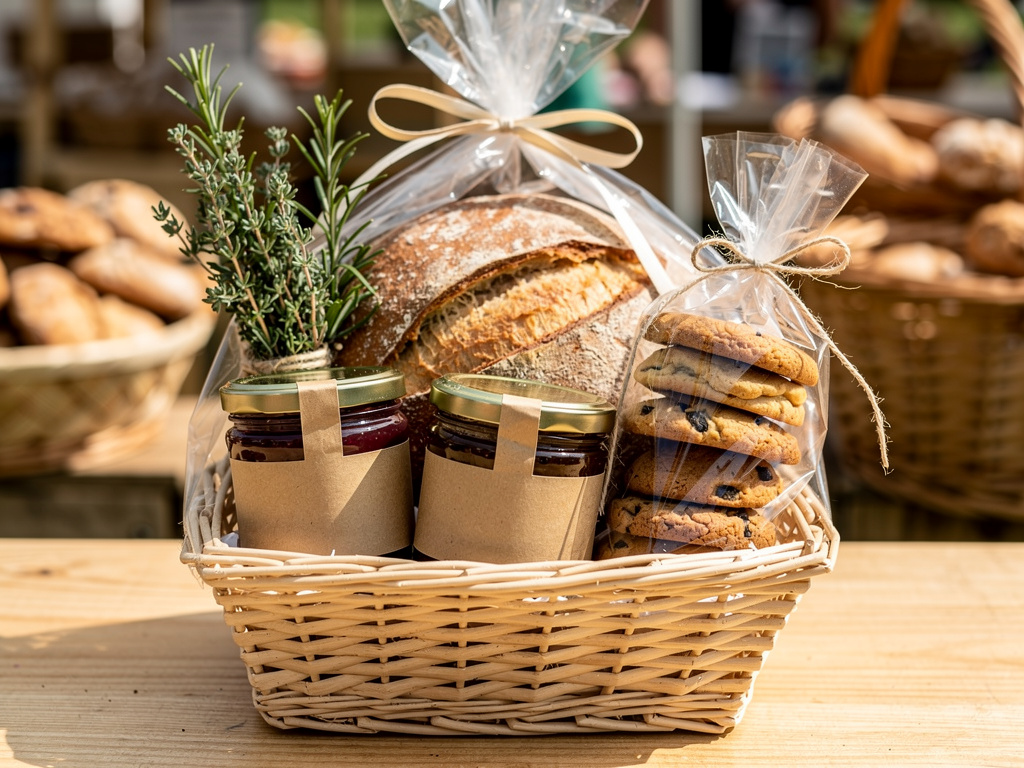


The short version: Homemade gift baskets sell in seven places: your own storefront link, farmers markets, holiday markets and craft fairs, businesses that buy client gifts, wedding planners and rental hosts, gift shops and florists, and Etsy. Your state's cottage food law decides which of those you can use, because Michigan and Minnesota both bar shops from reselling home kitchen food and Minnesota does not let you ship it yet. A $45 basket reaches you as $45.00 in cash, $43.39 through a Homegrown storefront link and $40.27 on Etsy before shipping. Start where you hand the basket over yourself, then line up business buyers before the holidays.
Checked October 7, 2026: Homegrown is $10 a month billed annually or $12.50 billed monthly, with 0% commission and 2.9% + $0.30 card processing that the vendor pays (findhomegrown.com/signup). The Etsy, Square and Shopify fees came off their own pages that day, and the Michigan, Minnesota, Texas and IRS rules off the agencies' own pages. Honest bounds: customers create a Homegrown account to place a first order, Homegrown has no shipping and no drops feature, and your storefront is listed on the marketplace, but plan on most orders coming from people you send to your own link.
You put together six baskets for your sister's office last December, everyone asked who made them, and now you are wondering whether people outside your family would pay for one. They would. The harder question is where to find them, and which of those places your state lets a home kitchen use.
A gift basket is a different sale from a single loaf or jar. The buyer is almost never the person who eats it. It is a realtor thanking a family, an office manager with 25 clients on a list, or a daughter who lives two states away. That changes where you sell. If you still need the basket itself, the guide to gift basket ideas to sell covers what goes in it, how to label a mixed basket and how to price it. The holiday side, from themes to a December timeline, is in the guide to selling holiday gift boxes and food baskets. This guide is only about where: seven places that sell baskets, the cottage food rules that open or close each one, and what a $45 basket pays you in every place.
Homemade gift baskets sell in seven places that work for a home kitchen, and most part-time vendors only need three of them: one place where people see a finished basket, one link where they order it, and one buyer who orders many at once. The first three places below sell one basket at a time at your full price. The next three sell to businesses: two that buy for a whole list and one that resells your baskets. The last one ships to strangers.
Two ideas are left off on purpose. Donating baskets to a silent auction is a common first step, and Michigan forbids it for cottage food outright. Big chain stores want barcodes, case packs and steady weekly volume, which is a different business from a home kitchen.
Your cottage food law picks your places because it controls three things a gift basket depends on: whether someone else can sell your food, whether you can ship it, and how far it can travel. A basket of candles and soap is not food, so those limits do not touch it. The moment your cookies or jam go in, they do.
The differences between states are large, and we read three of them for this guide. The Michigan Department of Agriculture's cottage food selling page says cottage foods "cannot be sold on consignment," that "another person or business cannot sell your products for you," and that you cannot donate them to "a public auction, fundraiser, or soup kitchen." It does allow sales by phone, internet and mail order, but only inside Michigan.
Minnesota is tighter. The Minnesota Department of Agriculture's cottage food guidance lists three places a registered home cook can sell: from home, at a farmers market and at a community event. It adds that home kitchen food "cannot be sold from a retail location or store," and that food for people cannot be shipped by mail or a shipping company until in-state shipping opens on August 1, 2027.
Texas opens a door the other two close. Texas lets a shop or reseller register as a "cottage food vendor" and sell your food on your behalf, and the Texas Department of State Health Services says that vendor "can sell directly to consumers at a farmers' market, a farm stand, a food service establishment, or any retail store."
Scroll sideways to see every column.
| Place to sell | Michigan | Minnesota | Texas |
|---|---|---|---|
| Your own link with pickup or your own delivery | Yes, inside Michigan, if the buyer can talk with you before the sale | Yes, you deliver in person inside Minnesota | Yes, if you, an employee or a household member delivers |
| Farmers markets and community events | Yes | Yes | Yes |
| Mailing a basket to the buyer | Mail order allowed inside Michigan | Not allowed until August 1, 2027, then inside Minnesota only | Online sales are allowed with personal delivery, so plan on handing baskets over |
| Gift shop or florist reselling your food | No | No | Yes, through a shop registered as a cottage food vendor, and not for foods that need temperature control |
| Consignment shelf | No | No | Not addressed on the DSHS page; a registered cottage food vendor selling on your behalf is the route the page names |
| Donated silent auction basket | No | Yes, donated to a community event that raises money for a person or for an educational, charitable or religious group | Donations allowed unless the food needs temperature control |
Read on each agency's own page on October 7, 2026: michigan.gov/mdard cottage food selling and samples, mda.state.mn.us cottage food law guidance, and dshs.texas.gov Texas cottage food production, with the Texas farmers market row from Texas Health and Safety Code 437.001. Rules change, and these are three states, not fifty. Verify your state's current rules before you sell a basket anywhere new.
A basket that mixes your food with someone else's is a second rule on top of these. The gift basket ideas guide shows how Michigan and Minnesota limit putting another home cook's jam in your basket, and how store-bought products fall under your state's regular retail food rules. Check both before you build a basket for a shop or a business order.
Try first the place that matches how many baskets you can build in a week and who already buys from you. A vendor who sells bread at one Saturday market starts somewhere different from one who knows four realtors. Pick one row below, start there, and add the second place only after 4 weeks, when the first is working.
Scroll sideways to see every column.
| Your situation | Start here | Add next | Why it fits |
|---|---|---|---|
| You already sell at a weekly farmers market | One display basket on your table | Your storefront link for basket orders | Market shoppers already trust your food, and the link catches the ones who need a gift next Tuesday |
| You make 5 to 10 baskets a week at most | Your storefront link, shared with regulars | One realtor or office | Small numbers you can plan, at your full price |
| You can only sell a few weekends a year | Holiday markets in November and December | A card with your link in every bag | Gift shoppers come to you in a short season, and the link sells in the other months |
| You know people in real estate or a busy office | Business gift orders | A standing December order | One yes can be 10 or more baskets with no table fee |
| You live in a state that allows shipping and pack well | Etsy | Your own link for repeat buyers | Strangers find you, and the repeat buyers cost less on your own link |
These rows are planning guides built from the fee pages, rule pages and catalog pull in this article, all checked October 7, 2026. Your state's cottage food rules come first: if a row names a place your state closes, skip to the next row.
A storefront link turns one basket into repeat orders because gift buying comes back on a calendar: the same customer needs a birthday basket in March, a teacher gift in May and a holiday basket in December. If the only way to order is a text to you, most of those moments pass without a sale. A link that lists your baskets in three sizes, with a pickup day and a lead time, catches them.
Put the link everywhere a gift buyer might think of you:
If gift orders keep arriving as texts you have to track by hand, Homegrown is built for that local basket order. It costs $10 per month billed annually with no percentage fees beyond standard payment processing of 2.9% + $0.30, which you pay rather than your customer. You can list one basket with sizes as variants, such as a $30, $45 and $60 version, each with its own price. You set an order prep time, so nobody orders a basket for tomorrow when you need three days. Customers pay online and pick up at your porch, your market booth or another pickup spot you name, or you deliver inside a radius of 1 to 25 miles for a delivery fee you set and keep, minus card processing. Check your state's rule before you name a pickup spot: in Minnesota, you or an employee must be present for the sale or delivery, and a basket cannot be left for pickup anywhere but your home or the buyer's home. Sales tax is calculated and remitted for you, and the customer list stays yours.
Compare that with the tools basket makers usually try. Etsy charges a $0.20 listing fee, a 6.5% transaction fee and 3% + $0.25 processing, which is $4.73 on a $45 basket before shipping and ads, against $1.61 on Homegrown plus its plan. Shopify Basic is $29 a month paid yearly plus 2.9% + 30 cents a card payment, a full website you build yourself. Square's Free plan is $0 a month with 3.3% + 30 cents on online payments, $1.79 on the same basket, which works if all you need is a payment link and you track pickup days and sales tax yourself.
Homegrown has limits to know before you choose it. It handles pickup and local delivery, and its signup page shows no shipping, so a basket for a buyer three states away needs another channel. Customers create a Homegrown account to place a first order. There is no drops or countdown release feature. Your storefront is listed on the Homegrown marketplace, but plan on most orders coming from people you send to your own link.
If your basket orders live in a string of texts every December, set up your Homegrown storefront and list your three basket sizes before the season starts. Your regulars get one place to order a gift, and you get one list of what to build each week.
Bring one finished basket to your farmers market even if you only sell two a month there, because the basket on your table is an advertisement for every other place on this list. Most market shoppers will not carry a $45 basket around for two hours. Many will remember it when a birthday comes up, if they know how to order.
A farmers market is also a place all three states we checked allow for cottage food. Minnesota names it among its three places to sell, Michigan lists it, and Texas Health and Safety Code 437.001 lets a home cook sell directly to consumers and hand the food over at the point of sale, which covers a market booth. Homegrown's signup page says you can add pickup spots from more than 8,800 markets, any within 25 miles of you, which matters for baskets: a customer can order on Wednesday and collect the basket at your booth on Saturday.
Make the market basket work for you:
The guide to getting more pre-orders from farmers market customers covers the table sign and the card that turn a browser into an order.
Holiday markets and craft fairs are worth a table for baskets when the fair falls between mid-November and mid-December, because that is when shoppers arrive with a gift list and a budget. A basket solves a whole gift in one purchase, which is exactly what a tired shopper on December 10 wants.
The risk is betting a whole season on one day. A table fee and a rainy Saturday can leave you with eight baskets of food that has a short shelf life. To make a fair pay:
In Minnesota, a holiday fair counts as a community event if it is organized with a set start and end time and several vendors, which is the state's own definition. The guide to choosing a holiday craft fair as a food vendor helps you pick which fairs earn their table fee.
Build your holiday baskets in two price tiers that are $20 apart, such as $25 and $45, and put the smaller one at the front of the table. A shopper with ten names on a list can buy ten small baskets, which is $250 in one sale, where a single $45 basket is one sale and one name crossed off.
Realtors, small offices, insurance agents, dentists and other local businesses buy gift baskets for work, often 10 or more at a time, for closings, client thank-yous and December gifts. A realtor who closes 12 sales a year and gives a $45 basket at each closing would be a $540 customer, and you only had to win them once.
These buyers think about price differently from a shopper at your table. Under IRS Publication 463, a business "can deduct no more than $25 for business gifts you give directly or indirectly to each person during your tax year." The same publication says packaging and wrapping are usually not counted toward that $25, but an ornamental basket is counted when its value is large next to what is inside. You do not need to give tax advice. You do need to ask each business buyer for their budget per person, because some will want baskets near $25 and others will spend more and not care about the deduction. A sheet with three boxes at $22, $35 and $60 answers that question before they ask, and the pitch guide for employee and client gift boxes shows the email and sample drop that go with it.
Here is a simple way to land your first business buyer:
Quantity prices for these orders, such as one price for 10 to 24 baskets and a lower one for 25 or more, are laid out in the guide to corporate gifting bulk pricing tiers. Price from your retail number and only lower it when your cost per basket really drops.
Wedding planners and short-term rental hosts can become steady basket buyers because both hand a gift to a stream of people they want to impress. A couple getting married often leaves a welcome bag or basket in the hotel room of every out-of-town guest, which can mean one identical basket for every guest room, all due on one date. A rental host leaves a welcome basket for each new guest and needs a fresh one every few days in a busy season.
The two buyers want different things:
To find them, ask the venues and planners you already know, and post your basket in local rental host groups once a season. A host with 2 rentals and a new guest every 4 days needs about 15 baskets a month, which is a standing order worth one phone call. The guide to edible wedding favors for food vendors covers how wedding orders are quoted and timed, and most of it carries straight over to welcome baskets.
A gift shop or florist will sell your baskets only where your state lets another business resell home kitchen food, and in Michigan and Minnesota it does not. Michigan's selling page says plainly that "another person or business cannot sell your products for you," and Minnesota's guidance says cottage foods "cannot be wholesaled to businesses for resale." In both states, a florist adding your cookies to its arrangements is selling your cottage food for you, which neither state allows.
Texas is the exception among the three states we read. A shop that registers with the state health department as a cottage food vendor can buy your cottage foods at wholesale and sell them in its store, as long as they are not foods that need temperature control for safety (Texas calls these TCS foods, ones that must be held cold or hot to stay safe). The shop must post a sign saying the food was made in a private home that is not inspected, and the label must carry the date the food was made.
If your state allows it, the trade-off is the price per basket:
A basket of candles and soap is a different case, because those are not food. A florist or boutique can buy non-food baskets without any cottage food rule in the way, and the where to sell candles guide covers how gift shops price those.
Sell gift baskets on Etsy only if your state lets you ship what is in them and you are ready to pack food that survives a few days in a truck. Etsy brings shoppers you would never meet, many of them ordering for someone far away. It also takes more of each sale than a local link, and it is built around shipping.
Etsy's seller and fee pages listed the fee stack on October 7, 2026: $0.20 to publish a listing, which lasts four months or until the item sells, while a listing with several in stock renews at $0.20 each time one sells, a 6.5% transaction fee on the item price plus any shipping and gift wrap you charge, and 3% + $0.25 payment processing. Etsy also charges an Offsite Ads fee on orders that come from its outside ads: 15% for shops under $10,000 in sales over the past year, which can opt out, and 12% for shops at $10,000 or more, which cannot. On a single $45 basket with no shipping charge, the fees come to $4.73 before shipping and ads.
Shipping is where the rules bite:
The state-by-state shipping picture is in the guide to whether you can ship cottage food, and the full Etsy fee breakdown for food sellers shows how ads and shipping change the math. A basket of only non-food products, such as candles and soap, ships without any cottage food limit.
Do not promise shipping on a storefront that does not ship, and do not list a food basket on Etsy before you check your state's shipping rule. As of October 7, 2026, the Homegrown signup page lists pickup and local delivery but no shipping. If a buyer in another state wants a basket, it goes through a channel your state allows, or it does not go at all.
On a $45 basket, the way you take the money costs you anywhere from $0 in cash to $4.73 on Etsy before shipping and ads. The table shows every part of the fee stack for each option on the same basket, plus a month of 50 basket orders, so you can compare them side by side.
Swipe left to see all eight columns of the fee stack.
| Way to get paid | Subscription | Trial | Platform fee | Card processing | Customer pays on a $45 basket | You pay on a $45 basket | A month of 50 baskets (you) |
|---|---|---|---|---|---|---|---|
| Homegrown storefront | $10/mo billed annually, or $12.50/mo billed monthly | 7 days, no charge until day 8 | $0, 0% commission, no shopper fee | 2.9% + $0.30 | $45.00 | $1.61 | $90.50 billed annually, $93.00 billed monthly |
| Etsy | $0 (a one-time shop set-up fee may apply) | None needed | $0.20 per listing, renewed at $0.20 each time one sells, plus 6.5% transaction fee; Offsite Ads fee on orders from those ads | 3% + $0.25 | $45.00 plus shipping | $4.73 before shipping and ads | $236.50 |
| Shopify Basic | $29/mo paid yearly, or $39/mo paid monthly | 3 days, then $1/mo for 3 months | $0 with Shopify Payments (2% with another processor) | 2.9% + $0.30 online on standard cards, 3.5% + $0.30 on premium cards | $45.00 | $1.61 ($1.88 on a premium card) | $109.50 paid yearly, $119.50 paid monthly |
| Square Free, online link | $0 | None needed | $0 | 3.3% + $0.30 online | $45.00 | $1.79 | $89.50 |
| Square Free, tap at your table | $0 | None needed | $0 | 2.6% + $0.15 in person | $45.00 | $1.32 | $66.00 |
| Cash or check | $0 | Not applicable | $0 | $0 | $45.00 | $0.00 | $0.00 |
Fees read on each company's own page on October 7, 2026: findhomegrown.com/signup, etsy.com/sell and etsy.com/legal/fees, shopify.com/pricing and squareup.com/us/en/pricing. The 50-basket column is 50 times the per-basket figure plus the monthly plan. Card processing is figured on the $45 price before sales tax. Etsy's columns leave out shipping charges, which also carry the 6.5% fee, and ads. Market table fees are not in the Square and cash rows.
At 50 baskets a month, Square's online link costs $1.00 less than Homegrown's annual plan, because its 18 cents more per basket does not yet add up to Homegrown's $10. The two cost about the same at 56 baskets a month. Etsy costs you $236.50 at that volume, about 2.6 times Homegrown's $90.50, which is the price of reaching strangers in states where you are allowed to ship.
A $45 basket reaches you as anything from $45.00 in cash at your table to $22.50 from a gift shop paying half of retail, where your state allows a shop to resell it. The table follows the same basket through every place, so you can weigh what reaches you against who does the selling.
Drag the table sideways to follow one $45 basket through every place.
| Place | Price the buyer pays | What reaches you | Who does the selling | When you are paid |
|---|---|---|---|---|
| Farmers market, cash | $45.00 | $45.00, before your table fee | You, in person | On the spot |
| Farmers market, card tap on Square Free | $45.00 | $43.68 | You, in person | On Square's deposit schedule |
| Your Homegrown storefront link | $45.00 | $43.39, before the $10/mo plan billed annually | You, through your link | At checkout; most of it reaches your bank the next business day, and Homegrown holds 20% of each order for 30 days, then releases it |
| Business order of 10 through your Homegrown link | $450.00 | $436.65, or $43.67 a basket | You, once | At checkout, with the same 20% held 30 days, then released |
| Etsy | $45.00 plus shipping | $40.27 before shipping costs and ads | Etsy search and you | On Etsy's payout schedule |
| Gift shop at half of retail (example, where allowed) | Set by the shop | $22.50 | The shop | When the shop pays you |
| Consignment at 60/40 (example, where allowed) | $45.00 in the shop | $27.00 | The shop | Only after it sells |
Fees from each company's page on October 7, 2026. Square Free in person is 2.6% + $0.15, Homegrown is 2.9% + $0.30, Etsy is $0.20 per listing, 6.5% and 3% + $0.25. The wholesale and consignment rows are examples only; shops set their own terms, and Michigan and Minnesota do not allow a shop to resell cottage food at all.
The closer the basket goes from your hands to the person who paid for it, the more of the $45 you keep. A business order of 10 keeps almost all of it and sells ten baskets in one conversation, which is why it is worth the effort of a price sheet.
Homegrown vendors sell 9 listings that are offered as gifts and hold two or more products or flavors, priced from $10 to $60 with a median of $28, counted from the 70 of 2,906 listings that used the word "gift" on October 7, 2026. Only two of them are called a gift basket. The rest are boxes, bags, flights and bundles that do the same job.
In a pull of the Homegrown catalog on October 7, 2026, 70 of 2,906 listings from 30 of 310 vendors used the word "gift" in the name or description. We read all 70 by hand and counted a listing as gift-ready only when one purchase holds two or more different products or flavors in a box, bag or basket and the vendor offers it as a gift. That left 9 listings from 7 vendors: a juice shop's small and large gift baskets at $30 and $60 in any flavor mix, a brownie shop's $18 box and $28 six-flavor party box, a $50 six-candle bundle, a $38 set of four butters in two flavors, a $20 flight of four mini sourdough loaves, and two Halloween gifts, a $10 bag with a mini cake and a cookie and a $15 box of a dozen mixed mini cookies that comes with a sign for the neighbor's door. We left out single loaves, jars, teas and bouquets described as giftable, a 3-jar bundle of one product, a one-flavor dog treat bag, subscriptions and gift cards.
Prices of the 9 gift-ready listings on Homegrown
Source: Homegrown catalog pull, October 7, 2026, 2,906 listings. Base listing prices; the cookie box also has a $26 option with larger cookies. Counted by reading every listing that mentions "gift".
Two lessons stand out. First, the cheapest gifts are seasonal and built for one buyer to give to one neighbor: a $10 bag and a $15 box in this October's pull, made for leaving on a porch. That is a basket in miniature, sold through a link, at a price nobody has to think about. Second, the juice shop sells the same basket in two sizes, $30 and $60, and lets the buyer pick the flavors. Two sizes and a choice are enough. Plenty more vendors already sell mixed boxes, samplers and flights without calling them gifts, such as cookie variety boxes and mini loaf samplers. Only 30 of 310 vendors used the word "gift" anywhere in a listing, so calling a mixed box a gift is a cheap step most have not taken.
Open each place a season before its buyers shop: business buyers in late summer, holiday markets in early fall, and your link all year. Gift baskets follow the calendar of giving, so the months before each holiday matter more than the holiday itself. A business planning 25 client baskets for December needs your answer by October, not on December 15.
Swipe left for the full gift basket year.
| Months | Who is buying | Where to focus | What to set up for the next season |
|---|---|---|---|
| January and February | Valentine's Day buyers, people who received a basket and want their own | Your storefront link and regulars | Price sheet for business buyers |
| March to May | Easter, teacher appreciation, Mother's Day, graduations | Your link, farmers markets as they open | Ask about summer wedding orders |
| June to August | Weddings, new rental guests, closing gifts | Wedding planners, rental hosts, realtors | Pitch offices for December client gifts and apply to holiday markets |
| September and October | Back-to-school thank-yous, fall and Halloween gifts | Business orders for December, your link | Lock in December delivery dates |
| November and December | Holiday shoppers, offices, families sending gifts | Holiday markets and craft fairs, business orders, your link | Put a card with your link in every basket |
A planning guide for a part-time vendor, built from the occasions in this article, not a measured schedule. Local market seasons and your state's rules decide what you can open when.
The Mother's Day ideas for food vendors and the guide to Valentine's Day sales for home bakers cover the two spring holidays where a small basket sells well.
Five choices look promising for gift baskets and usually cost more time than they return: donated auction baskets, a Facebook group used as your checkout, big stores, a basket for every holiday at once, and free baskets for exposure. Knowing them up front saves you a season.
If you want to move your regulars from a Facebook group to a link, the guide to switching from a Facebook group to a storefront covers how to do it without losing anyone.
You test a new place in 30 days by opening one place at a time, setting it up in a week and judging it on the money that reached you per hour, not on compliments. Opening three places at once leaves you guessing which one worked, and it stretches a home kitchen too thin in a gift season.
After one month you will know which place pays in your town, which buyer comes back, and which basket size sells. That is worth more than any guess, including the ones in this guide.
You can sell homemade gift baskets locally through your own storefront link with pickup or delivery, at farmers markets, at holiday markets and craft fairs, and to local businesses such as realtors and offices that buy client gifts. Wedding planners and short-term rental hosts buy welcome baskets too. Gift shops and florists can resell a food basket only in states that allow it, which Michigan and Minnesota do not. A basket of candles or soap is not under that rule.
Local is usually better for a home food vendor, because many states limit shipping cottage food and a local buyer picks the basket up from you. On a $45 basket, Etsy's fees came to $4.73 before shipping on October 7, 2026, against $1.61 in card processing on a Homegrown storefront plus its $10 monthly plan, billed once a year. Etsy fits when your state allows shipping and your baskets travel well.
Usually not a license, but sometimes a registration. Michigan lets you sell some foods made in your home kitchen without a license or inspection, Texas asks you to register only if you sell foods that must be kept cold or hot to stay safe but requires every home cook to complete an accredited food handler course, and Minnesota requires you to complete training, pass an exam and register before you sell. Many states let you sell gift baskets of food you make at home under a cottage food law, with rules on labels, sales limits and where you can sell. Michigan, Minnesota and Texas each spell out which places are allowed, and each caps yearly sales: $50,000 in Michigan ($75,000 for products priced at $250 or more each), $78,000 in Minnesota and $150,000 in Texas. Verify your state's current rules, and check separately if your basket mixes in products you did not make.
Yes, realtors and local businesses are some of the best gift basket buyers because they order many baskets at once for closings and client gifts. Under IRS Publication 463 a business can deduct no more than $25 per person per year for business gifts, so ask each buyer for their budget per person before you quote. A 10-basket, $450 order through a Homegrown link costs $13.35 in card processing.
Often you cannot. Of the three states we read, none lets you mail cottage food to another state, and other states vary from allowing shipping anywhere to banning it. Michigan allows mail order only inside Michigan, Minnesota does not allow shipping cottage food for people until August 1, 2027, and Texas ties online sales to delivery by you, an employee or someone in your household. A gift basket of only non-food products, such as candles or soap, does not have that limit.
November and December are the busiest months for gift baskets, but the work that fills them starts in late summer, when offices and realtors plan their December gifts. Spring brings Easter, teacher appreciation and Mother's Day, and summer brings weddings and closing gifts. A storefront link keeps orders coming in the months between.
This page maps where to sell gift baskets, and these six guides go deep on the parts it only touches, from what goes in the basket to the rules on shipping it. Read the first one if you have not built your first basket yet.
The simplest gift basket business is one basket people can see, one link where they order it, and one business that orders ten at a time. Every other place on this list is worth adding once those three work, and your state's cottage food rule tells you which ones you are allowed to add.
That is the honest answer to where to sell gift baskets: sell them where you can hand them over, as close to the person paying as you can get. A $45 basket at your table or through your link pays you about twice what the same basket pays through a gift shop at half of retail, in the states that allow shops at all. And every basket you hand over carries your card to someone who will need a gift next month.
If your basket orders keep arriving by text the week before a holiday, start your Homegrown storefront and list your basket sizes with a lead time before the next rush. The plan is $10 a month on yearly billing or $12.50 month to month, with no commission, and the 2.9% + $0.30 per card payment comes out of your side, never your customer's. Your buyers pick a size, pay online and choose pickup or local delivery on your schedule, and you start each week with a list of exactly which baskets to build.



