
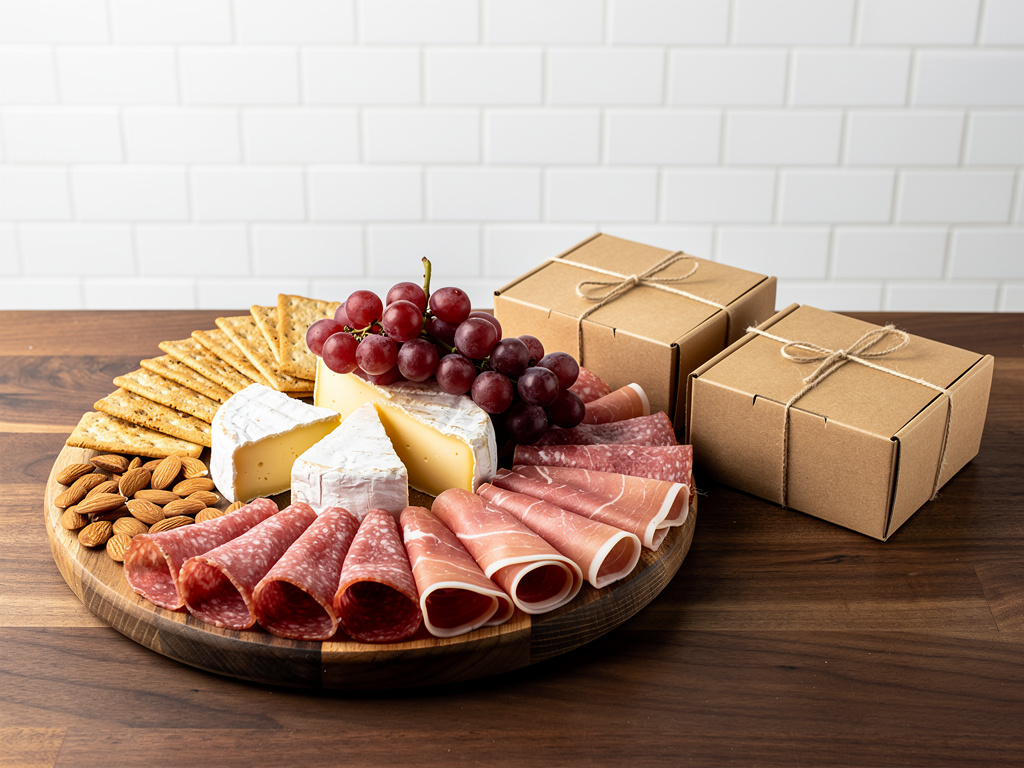


The short version: Charcuterie boards sell in seven places that actually work: your own pre-order link, local Facebook groups and Instagram, wedding planners and venues, breweries and wineries, offices and client gifts, farmers markets, and bundles with other local vendors. Nearly every one of them runs on pre-orders, because a meat and cheese board is perishable and built the day it is picked up. On a $75 board, card fees run $1.53 to $2.78 through Venmo, Square or your own Homegrown link, and Etsy's listing, transaction and card fees add up to $7.58 before you pay to ship a cold box across the country. Facebook Marketplace is the one popular place to skip, because Meta's commerce policy prohibits some animal products sold as food, meat included, and a board built on salami is likely to fall under it. In many states, including Minnesota, a board with meat and cheese also needs a food license rather than a cottage food registration, so the places you choose have to match the license you hold.
Checked September 24, 2026: Homegrown is $10 a month billed annually or $12.50 billed monthly, with 0% commission and card processing of 2.9% + $0.30 paid by the vendor, and 7 days before the first bill on day 8 (findhomegrown.com/signup). Square, Venmo and Etsy fees come from their own pricing pages, and the Marketplace rule from Meta's commerce policy, all loaded the same day. Honest bounds: your customer creates a Homegrown account to place a first order, there is no countdown or timed release feature, and your storefront is listed on the Homegrown marketplace, but plan on most orders coming from people you send to your own link.
Your boards look great, your friends keep asking for them, and you have a price in mind. The hard part now is finding people who will pay $75 for one on a normal Tuesday, not just at your sister's baby shower. A charcuterie board is not a cookie that can sit on a shelf for a week. It holds meat and cheese, it can sit out for two hours at most, and it has to reach a fridge fast. That rules out half the usual places food vendors sell, from shop shelves to shipping.
This guide ranks the seven places that work for a small, part-time charcuterie vendor, shows what each one costs you on a single $75 board, and names the places that look good on paper but fall apart for meat and cheese.
Seven places reliably sell charcuterie boards for a small vendor, and a part-time seller can run two or three of them at once. Each one brings a different kind of order, from a $40 board for two or three to a grazing table for 100 wedding guests.
If you have not sorted out licensing, sourcing or food safety yet, start with our guide on how to sell charcuterie boards from home, which covers the permits, the supplies and the 2-hour rule. If you have not settled on a price, the charcuterie board pricing guide builds each size from real grocery costs. This page picks up where those two end: the boards are priced and legal, and now they need buyers.
Your first place to sell should match what you already have today, whether that is a following, a booth, a job in an office or a friend who plans weddings. A vendor with 400 people in a neighborhood Facebook group starts differently from a vendor with nothing but good photos.
Scroll sideways to see every column.
| What you have today | Start here | Add next | Why this order |
|---|---|---|---|
| A few happy friends and good photos | Your own pre-order link | Local Facebook groups | You need one place to take paid orders before you ask strangers to order |
| An active local Facebook group or Instagram | Your own pre-order link | Offices and client gifts | The audience is already there; it needs a page that takes payment and a pickup day |
| A job in an office or a spouse in real estate | Offices and client gifts | Your own pre-order link | Coworkers and clients order the same thing again for every meeting and closing |
| A friend who plans events or works at a venue | Wedding planners and venues | Breweries and wineries | One planner can send you several events a season |
| Coolers, a canopy and a license that covers events | Farmers markets or brewery pop-ups | Your own pre-order link | Strangers taste the board in person, then reorder through the link |
These pairings are our suggestions for a part-time vendor, not rules. Check which places your license covers before you book any event, since some local health departments treat a pop-up as a separate permit.
A good start is one place that brings in new people and one place where those people order again. A brewery pop-up finds the customer. Your link is where that customer orders a board for their book club three weeks later.
Every place you sell charcuterie boards should end at one order link, because boards are made to order and you cannot buy the prosciutto until you know how many boards are coming. The link is where an order becomes a paid order with a size, a date and a pickup time.
Without it, orders come in through five doors at once. A Facebook comment, an Instagram DM, a text from a coworker, an email from a wedding planner and a note someone handed you at the market. Each one needs a size, a date, any swaps, a payment and a pickup time, and each one lives in a different app.
Here is what one order link fixes:
If your board orders already live in your DMs, setting up a Homegrown storefront for your charcuterie boards turns each one into a paid order with a size and a pickup day before you buy a single wedge of brie. Homegrown says most vendors are live in under 15 minutes.
Local Facebook groups, Instagram and Nextdoor sell charcuterie boards best when you post a photo, the sizes and a link, then let people order through the link. These are free to post in, and they reach the people most likely to order: neighbors planning a party this weekend.
What works in each one:
The one habit that holds all four together: never take the order in the comments or the DMs. Answer the question, then send the link. Our guide on how to sell food on Instagram without taking orders in DMs walks through the exact replies to use.
Facebook Marketplace is not a place to list charcuterie boards. Meta's commerce policy, which covers Marketplace and Shops on Facebook and Instagram, lists "Some products from animals intended for consumption, such as raw fish, meat, or eggs" as prohibited. We checked that policy on September 24, 2026. A board built around salami and prosciutto is a meat product, and a removed listing can put your account's selling privileges at risk. Post in groups and on your own profile, and send people to your own link. The Facebook Marketplace alternatives guide covers other ways to reach the same local buyers.
Wedding planners and venues bring the largest charcuterie orders a small vendor will see, because one wedding can mean a grazing table for more than 100 guests. The average 2025 wedding had 117 guests and hired 13 wedding professionals, according to The Knot Worldwide's 2026 Real Weddings Study, which surveyed couples married in 2025. The same study found 85% of couples hired a caterer. Across all 2025 weddings, the whole day cost an average of $292 per guest.
Those numbers tell you where a board fits. A grazing table is rarely the main meal. It is the cocktail hour, the late-night snack, the bridal suite tray or the rehearsal dinner spread, and those are the slots a planner fills with smaller vendors.
How to get in front of them:
Keep event orders separate from your weekly board orders. Grazing tables need a deposit, a signed agreement and a site visit, which is contract work. Your pickup boards can stay simple, and the pricing guide's grazing table section covers setup fees and per-guest pricing for the bigger jobs.
Breweries and wineries are some of the best places to sell charcuterie, because many of them serve drinks but have no kitchen, and a $40 board for two or three is exactly what their customers want next to a glass. The pitch is simple: you bring the food, they keep people in their seats longer.
A real example: The Board Babes, two siblings in Roseville, California, who both work full-time in the medical field, run a mobile charcuterie bar that is "appearing at breweries and farmers markets across Placer County and available for hire at private parties and events," according to a January 27, 2026 success story from the California Office of the Small Business Advocate. Before launching, they got sellers permits and food handlers permits and formed an LLC with help from their local Small Business Development Center. That is a business run alongside two full-time jobs, built on exactly two of the places on this list plus private events.
What to know before you pitch a taproom or tasting room:
Our guides on selling food at brewery taprooms and hosting a tasting event at a wine shop cover the pitch in more detail, and the taproom guide also covers the schedule and what a venue may charge you.
Offices, realtors and small businesses order charcuterie boards for meetings, celebrations and client gifts, and they tend to order the same thing again. One office manager who likes your board for a Friday meeting can order every month.
Where these orders come from:
Start with the office you already know. If you or someone in your house works in an office, bring a board to one meeting and put your link on the box. Our guide to selling food at work through office and workplace orders covers how to do that without being pushy.
For bulk gift orders, set a price per box that changes with quantity, and name a deadline. Corporate gifting bulk pricing tiers lays out how to set those breaks so a 30-box order still pays you for your time.
You can sell charcuterie at a farmers market if your license covers it and you can keep every box cold for the whole market day, which usually means small sealed grazing boxes on ice rather than big boards. A vendor can make it work by treating the market as a place to find new customers, then taking the real orders through a link.
Meat, cheese and fresh fruit need refrigeration, and a board should not sit at room temperature for more than two hours, according to K-State Research and Extension's charcuterie board tips. On a July Saturday above 90 degrees, the limit drops to one hour, according to the University of Nebraska-Lincoln's charcuterie food safety guide.
What a charcuterie booth needs:
Our breakdown of the real cost of selling at farmers markets puts booths at $20 to $75 a week, then adds up the gas, permits and hours the booth fee leaves out. For why meat and cheese are handled differently from bread and jam, see our guide to TCS foods and cottage food law.
Some of the easiest new customers for a charcuterie board belong to other local vendors whose products already go on one: jam, sourdough and pickle vendors, and florists. A joint gift box or a shared pop-up puts your board in front of people who already buy local food.
Homegrown's own catalog shows that 7 vendors already pitch their products as something to put on a board. In a pull on September 24, 2026, 19 listings from 8 vendors mentioned charcuterie, grazing or graze in their names or descriptions. Only one vendor sold the boards themselves. The other 15 listings were jams, breads, crackers, and pickled and candied foods described as something to put on a board.
What 19 Homegrown listings that mention charcuterie or grazing actually sell
Source: live pull of the Homegrown catalog, September 24, 2026, 2,637 products from 300 vendors; the 19 listings whose name or description mentions charcuterie, grazing or graze, sorted by what the product is. All 4 board listings come from one vendor.
That is a map of who to call. Here is how a partnership usually works:
Our guide to cross-promoting with other local businesses covers how to pick a partner and what to agree on before you start.
On a $75 board, the payment side costs you between $1.53 and $7.58 depending on where the order comes in, and the bigger cost difference is usually a booth fee or shipping, not the card fee. Here is the full fee stack on one board and on a month of 20 boards.
Scroll sideways to see every column.
| Where the order comes in | Monthly plan | Trial | Platform or listing fee | Card processing | Customer pays on a $75 board | You pay on a $75 board | You pay on 20 boards a month |
|---|---|---|---|---|---|---|---|
| Your Homegrown storefront link | $10 billed annually ($12.50 monthly) | 7 days, first bill on day 8 | None, 0% commission | 2.9% + $0.30, paid by you | $75.00 | $2.48 plus the plan | $59.50 ($62.00 on monthly billing) |
| Square Free plan, online checkout or invoice | $0 | None, the plan is $0 | None | 3.3% + 30¢, paid by you | $75.00 | $2.78 | $55.50 |
| Square Free plan, card reader at a market or event | $0 | None, the plan is $0 | None | 2.6% + 15¢, paid by you | $75.00 | $2.10 | $42.00, plus any booth fee |
| Venmo business profile | $0 | None, no plan | None | 1.9% + $0.10, paid by you | $75.00 | $1.53 | $30.50 |
| Venmo personal account, goods and services payment | $0 | None, no plan | None | 2.99%, paid by you | $75.00 | $2.24 | $44.85 |
| Etsy | $0 (a one-time shop set-up fee may apply) | None, no plan | $0.20 listing + 6.5% transaction fee, paid by you | 3% + $0.25, paid by you | $75.00 plus shipping | $7.58 before shipping | $151.50 before shipping |
We checked these fees on findhomegrown.com/signup, Square's pricing page, Venmo's fees page and etsy.com/sell on September 24, 2026. Card processing is figured on the $75 board price. Etsy's fees policy charges its 6.5% transaction fee and its 3% payment processing fee on the shipping price you charge too, and a sale that comes from Etsy's Offsite Ads adds a 15% fee, $11.25 on this board, unless you opted out; Etsy says those ads are optional for most sellers. Venmo does not give you an order list, sizes or pickup times; you track those yourself.
Two things the table does not show. Venmo is the cheapest per payment, but it is only a payment. You still take the order, the size, the swaps and the pickup time somewhere else, and that is where boards for ten go unclaimed. And the market and event rows carry costs outside the card fee: a booth, a permit, ice, and five or six hours of your Saturday.
Charcuterie boards sell poorly anywhere the board has to be shipped, stocked on a shelf, listed on Facebook Marketplace or sold through big delivery apps. Each one runs into a problem a meat and cheese board cannot get around. For shipping and shelves, the problem is the same: a board holds meat and cheese that have to stay cold, and it can sit out for no more than two hours.
The places that look good on paper:
None of these are forbidden in every case. A commercial kitchen with a wholesale license and cold shipping can make them work. For a home or part-time charcuterie business, the seven places above bring in more orders with less risk.
The place you sell often changes the permit you need, because cottage food laws in many states leave out meat and cheese, so a charcuterie board needs a food license and each new setting can add a permit. Minnesota's Department of Agriculture answers the question directly in its cottage food guidance: "Can I sell charcuterie boards with a cottage food registration? No," because meat and cheese are not allowable cottage foods. We checked that page on September 24, 2026.
How the place you sell can change what you need:
Rules change often and differ by county. A board for 6 people picked up at your door and a grazing table for 117 people set up at a venue can fall under different permits. Verify your state's current rules with your state agriculture or health department before you add a new place to sell. The legal section of how to sell charcuterie boards from home covers the license paths, from home kitchen inspections to renting a commercial kitchen.
A Homegrown storefront gives every place you sell one link that takes paid charcuterie orders with a size, a date and a pickup time, so the brewery regular, the office manager and the Facebook neighbor all land in the same order list. It is $10 per month billed annually ($12.50 billed monthly) with no percentage fees beyond standard payment processing, and you see every board for the weekend before you shop.
You list each board size with its guest count and price. Customers pick a size, choose one of your pickup days, and pay when they order. You can offer pickup from your porch or kitchen, or local delivery within a radius you set anywhere from 1 to 25 miles, with a flat delivery fee you keep in full minus card processing. Payouts reach your bank account the next business day.
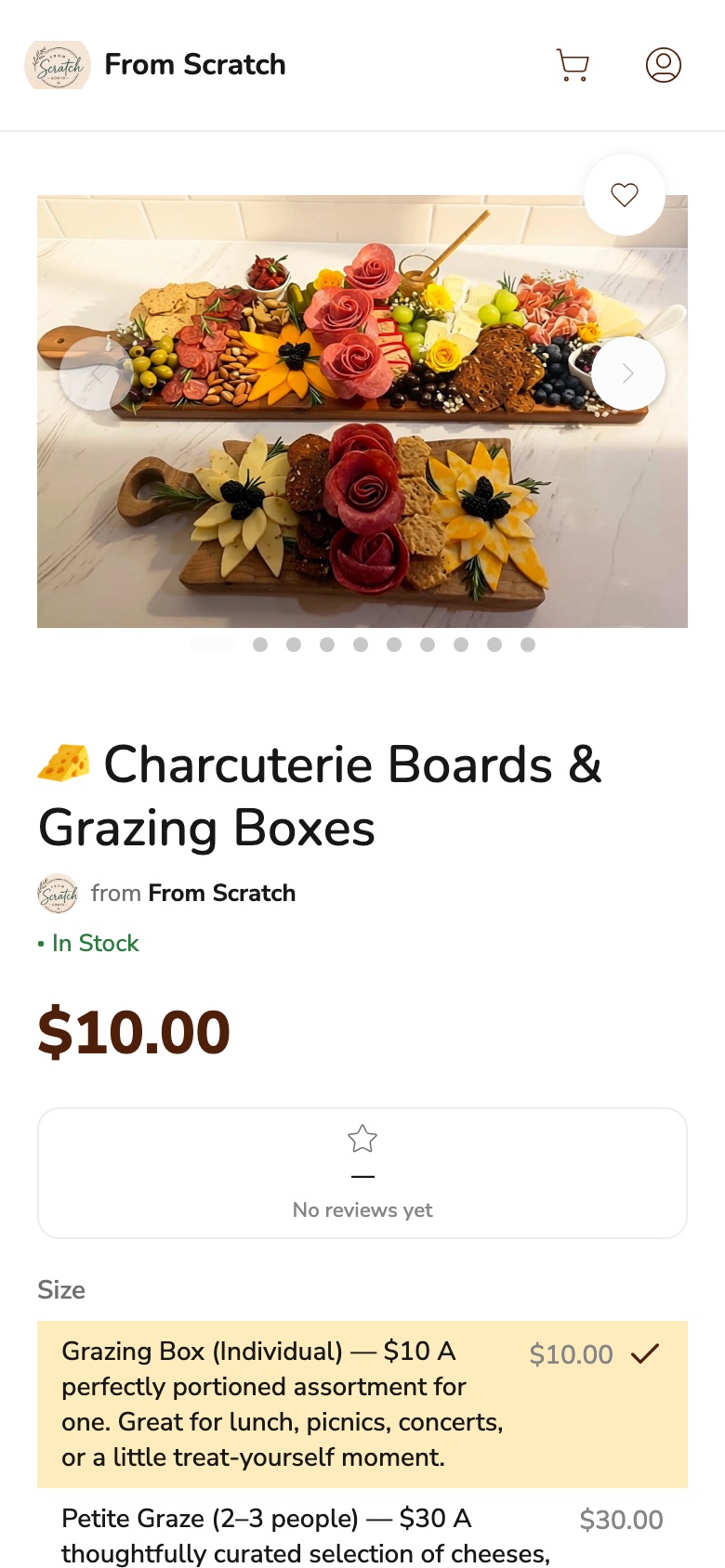
In a pull of the Homegrown catalog on September 24, 2026, one of 300 vendors sold charcuterie boards: From Scratch, whose board listing runs in five sizes from a $10 grazing box for one to a Signature Grazing Board for 14 to 18 people that checks out at $200. The same listing names a Front Porch pickup at its farmstand in Barrington, Illinois, with set pickup days.
How that compares with what charcuterie vendors usually use:
What Homegrown does not do: it does not book, contract or invoice a 200-guest wedding grazing table, it does not supply delivery drivers, and customers create a Homegrown account to place a first order. It has no countdown or timed release feature. Your storefront is listed on the Homegrown marketplace, but plan on most orders coming from people you send to your own link from the places on this list. Card processing of 2.9% + $0.30 is paid by you, with no option to add it to your customer's total.
If your charcuterie orders come from three different places and live in three different apps, start a Homegrown storefront for your boards and put that one link on every post, box and business card.
Pickup is the safest way to hand over a charcuterie board, because the board goes straight from your fridge to the customer's car, and local delivery works when you keep the trip short and the board cold. Both beat shipping by a wide margin for meat and cheese.
What works for each:
Our guides on pricing a delivery fee as a food vendor and food packaging for local delivery cover how much to charge and which boxes hold up.
Charcuterie vendors who sell steadily tend to sell mostly by pre-order, keep a short menu of four or five sizes, and use their public places (markets, breweries, groups) to collect customers who order again through their link. From Scratch, the one Homegrown vendor selling boards in our September 24, 2026 catalog pull, runs five sizes by guest count with set pickup dates.
Habits worth copying:
Close orders two days before pickup. For a Saturday pickup, a Thursday cutoff leaves you Friday for one grocery run and one prep session, instead of three trips to the store for last-minute boards. At the Cook's Illustrated guideline K-State Research and Extension passes along, 2 to 3 ounces of meat and 2 to 3 ounces of cheese per person, eight boards for six people need 6 to 9 pounds of each, and that is a shopping list you want to write once.
You can open one new place to sell charcuterie boards this week with a menu, a few photos, one order link and one message to the right person. Pick the place that fits what you already have, and do these five things in order.
After 2 to 3 weeks, check where your orders actually came from. Keep the place that brought paying customers, drop the one that brought only questions, and add the next place from the list.
You can sell charcuterie boards from home through your own pre-order link, local Facebook groups and Instagram, wedding planners and venues, breweries and wineries, office and client gift orders, farmers markets, and gift boxes with other local vendors. Most home vendors take paid pre-orders and hand boards off by pickup or short local delivery. Check that your food license covers each place before you start selling there.
No, not as a Marketplace listing. Meta's commerce policy, checked September 24, 2026, prohibits "Some products from animals intended for consumption, such as raw fish, meat, or eggs," and a board built on salami and prosciutto is likely to fall under that. You can still post photos in local Facebook groups and on your own profile and link people to your own order page.
You can list them, but shipping meat and cheese safely takes insulated boxes, ice packs and overnight shipping, which few home vendors can do at a sensible price. Etsy's fees on a $75 board come to $7.58 before shipping, and Etsy's 6.5% transaction fee and 3% processing fee also apply to what you charge for shipping. A small charcuterie vendor does better selling within driving distance, where boards stay cold.
Many breweries and wineries welcome food vendors because they serve drinks without running a kitchen, and charcuterie pairs with both. Ask the manager what permit they need from you, since rules differ by county and some venues will ask for your own event or mobile permit. Bring a board to taste and a short menu with your order link.
Build a one-page event menu with a per-guest price, a minimum guest count and setup details, then send it with photos of a real grazing table. Start with smaller pieces like bridal suite boards or rehearsal dinner spreads, and ask venues what they require from outside food vendors. The average 2025 wedding had 117 guests, so one booking can be your biggest order of the month.
Yes, if your license covers it and your local health department approves any temporary permit the market requires. Sell small sealed grazing boxes kept in coolers, and keep every box cold, since K-State Research and Extension advises that a board not sit at room temperature for more than two hours. Use the booth to meet new customers and put your order link on a sign.
Five more guides for the steps around this one, from the license you need before your first sale to the price you put on a board for 10.
A part-time charcuterie business does not need all seven places on this list to fill a month of orders. It needs one place that brings in new people, one place where those people order again, and one link that turns every conversation into a paid order before you shop. For a part-time vendor, that can mean a brewery, a market or a Facebook group for the first, and a storefront for the second. Set up your charcuterie board storefront on Homegrown, list your sizes and pickup days, and put the link on every board that leaves your kitchen.
Then give it a month before you judge any of them. Twenty boards at $75 is $1,500 in orders, and on your own link the card fees on those 20 come to $49.50 plus the plan. Count which place sent each paid order, keep the two that sent the most, and only then add a third.



