
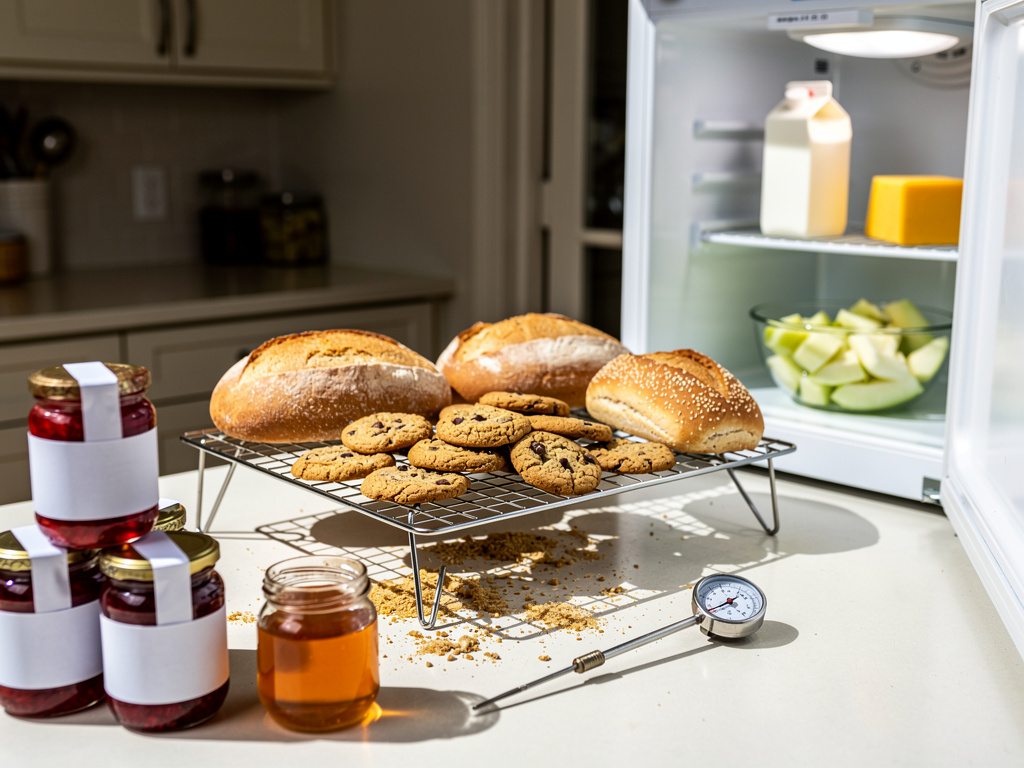


The short version: TCS foods are foods that have to be kept at or below 41°F or at or above 135°F to stay safe: meat, dairy, raw eggs and most cooked eggs, cooked rice and beans, sprouts, cut melons, cut leafy greens, cut tomatoes, and anything with a cream or cream cheese filling. Non-TCS foods are dry, sugary or acidic enough to sit on a counter, like bread, cookies, standard jams, honey, candy and dried herbs. Many state cottage food laws cover only non-TCS foods, and Washington, for one, will not let you sell a pastry with a cream cheese filling from your home kitchen. Of the 12 states we checked, Texas, Illinois, Wyoming, Utah and North Dakota allow some TCS food from a home kitchen statewide, each under its own rules, and Maine leaves the choice to its towns.
Checked October 1, 2026: the FDA's 2026 Food Code, USDA's danger zone page, the home kitchen rules of 12 states (Texas, Illinois, Wyoming, Utah, North Dakota, Maine, Arkansas, Washington, Minnesota, New Jersey, Mississippi and Virginia) on each state's own agency or legislature website, Alabama Extension's pH guide, and Homegrown's signup page. Rules change, so confirm yours with your state before your first sale. Homegrown customers create an account to place their first order.
Once you know your foods are non-TCS, you can set up a Homegrown storefront so local customers can order ahead, and try it free for 7 days.
TCS stands for Time and Temperature Control for Safety. These are foods that must be kept at specific temperatures to prevent bacterial growth. In plain English, TCS foods are products that spoil or become dangerous if left at room temperature for too long. This matters for cottage food vendors because many cottage food laws only allow non-TCS foods (shelf-stable products like baked goods, jams, and honey). If a product needs refrigeration to be safe, it is a TCS food, and many states, including Washington and Minnesota, will not let you sell it from a home kitchen under cottage food law. The Alabama Extension pH Pantry Guide provides a practical reference for understanding where the TCS/non-TCS line falls for specific foods, particularly acidified products like sauces and preserves. For the products each state allows, see our guide to what you can sell under cottage food laws.
TCS means a food has to be held at 41°F or below, or at 135°F or above, to stay safe.
TCS stands for Time and Temperature Control for Safety. The FDA uses this term in its 2026 Food Code to categorize foods that support rapid bacterial growth at certain temperatures. The Food Code is the model rulebook the FDA asks state and local health departments to adopt for restaurants and food shops. These foods must be:
The "danger zone" is the temperature range where bacteria like Salmonella, E. coli, and Campylobacter multiply rapidly. How long food can safely sit in that range depends on whose rule you follow. USDA's Food Safety and Inspection Service rounds the range to 40°F to 140°F for home cooks and says bacteria in it can double in as little as 20 minutes.
For cottage food vendors, the practical implication is simple: if your product needs a refrigerator to be safe, it is TCS, and you probably cannot sell it under cottage food law.
Homemade baby food purees land on the same side of that line. Of the 9 states checked in our guide to whether you can sell homemade baby food, 6 give a fresh or frozen vegetable puree no home-kitchen route, while Texas allows refrigerated purees with state registration. Fresh juice is the clearest example, and also one where that is changing: Illinois and Texas now let registered home cooks sell homemade juice held at 41°F or below, with a dated label and a few extra rules.
A TCS food is any food that needs time and temperature control to limit the growth of harmful bacteria or the toxins they make. That is the FDA Food Code's own definition, and Texas and Arkansas use the same idea in their home food rules. Older rules call it "potentially hazardous food," and at least 4 states in this guide, Washington, Minnesota, Wyoming and Mississippi, still use that name.
The Food Code names six groups as TCS food, from raw meat and eggs to cut tomatoes and garlic in oil:
The Food Code also leaves out five kinds of food:
Minnesota's cottage food guidance turns those tables into two numbers a home cook can use: non-potentially hazardous foods have a pH of 4.6 or below, or a water activity of 0.85 or less. Water activity measures how much free water a food has for bacteria to use, on a scale from 0 (bone dry) to 1 (pure water).
You can sort the Food Code's definition into three categories: animal foods, a short list of plant foods, and foods the code's acidity and water activity tables flag. If you remember these three, you can place almost any product.
The third group is where most homemade sauces, fillings and frostings get decided. A jar of salsa or a fruit filling is not on any list by name. Its pH and water activity decide it.
These 9 food groups need temperature control because harmful bacteria can grow in them at room temperature. Washington's cottage food rules, for example, leave out meat, fish, dairy, cut fresh fruits and vegetables, raw seed sprouts and baked goods with cream fillings.
Swipe the table sideways to see why each group is TCS.
| Food category | Examples | Why it is TCS |
|---|---|---|
| Dairy | Milk, cheese, yogurt, cream, butter (treat butter as TCS unless a lab test says otherwise) | Protein + moisture = bacterial growth |
| Eggs | Raw shell eggs, cooked eggs (except an air-cooled hard-boiled egg left in its shell), egg-based dishes | Protein + moisture |
| Meat and poultry | All cuts, ground meat, sausage | High protein, high moisture |
| Seafood | Fish, shellfish | High protein, rapid spoilage |
| Cooked grains | Rice, pasta, quinoa | Cooking adds water, and moist cooked starch feeds bacteria |
| Cut produce | Sliced melons, cut tomatoes, cut leafy greens | Exposed flesh supports bacteria |
| Cream-based products | Cream cheese frosting, custard, cheesecake | Dairy + sugar + moisture |
| Tofu and soy products | Tofu, tempeh | Protein + moisture |
| Sprouts | Alfalfa, bean sprouts | Warm, moist growing conditions |
Groups follow the FDA's 2026 Food Code definition of TCS food, checked October 1, 2026. Tofu and tempeh count because they are cooked plant foods.
These 8 food groups stay safe at room temperature when they are made right, though each state still decides which ones it allows.
Swipe sideways for the reason each group stays shelf stable.
| Food category | Examples | Why it is non-TCS |
|---|---|---|
| Baked goods | Bread, cookies, muffins, scones (no cream filling) | Low moisture, high sugar or starch |
| Jams and jellies | Strawberry jam, grape jelly | High sugar content holds back bacteria |
| Honey | Raw honey, honey flavored with dry spices | Very little free water |
| Candy | Caramels, fudge, brittle, toffee | High sugar, low moisture |
| Dried foods | Dried herbs, spice mixes, tea, dried fruit | Moisture removed |
| Vinegar-based | Hot sauce, some salsas, pickles (only where your state allows acidified foods) | Acidity prevents bacterial growth |
| Nuts and seeds | Roasted nuts, nut butters, seed mixes | Low moisture |
| Oils | Plain oils; infused oils only where your state allows them, since garlic in oil is TCS | Plain oil holds almost no water |
Each state still writes its own allowed list. Washington, for example, allows only jams that meet the FDA's standard for jams and jellies, so low sugar jams are out there. Checked on Washington's cottage food page on October 1, 2026.
Jerky is shelf-stable when it is made right, but it is a meat product, and Washington, Minnesota and Texas all leave meat out of their cottage food rules.
The key factors that make a food non-TCS are: low moisture (dried foods, candy), high sugar (jams, honey), high acidity (pickled foods, vinegar-based sauces), or combinations of these that prevent bacterial growth.
The difference is whether bacteria can grow in the food at room temperature: a TCS food can, so it needs a fridge or a hot holder, and a non-TCS food cannot, so it can sit on a shelf. Three things decide it: what the food is made from, how wet it is, and how acidic it is.
Swipe sideways to compare TCS and non-TCS food side by side.
| Question | TCS food | Non-TCS food |
|---|---|---|
| Where it is stored | At or below 41°F, or at or above 135°F | On a shelf at room temperature |
| What it is made from | Animal foods, cooked plant foods, raw sprouts, and melon, lettuce or tomato once it is cut | Flour, sugar, dried fruit, nuts, acidified produce |
| Water activity | High, often above 0.92, the Food Code's wettest row, where only foods below pH 4.2 escape | Low: below 0.88 is non-TCS at any pH in the Food Code's Table B, and Minnesota uses 0.85 or less |
| Acidity | Not acidic enough: above pH 4.6 under Minnesota's rule | pH 4.6 or below under Minnesota's rule (Alabama's cottage law asks for below 4.2) |
| Time out of the fridge | Usually 4 hours at most in a food business (6 if it starts no warmer than 41°F and stays at or below 70°F) | No clock for safety, only for quality |
| Cottage food status | Left out of the rules in Washington, Minnesota and Arkansas | The core of nearly every cottage food allowed list we checked |
The water activity and pH lines come from the FDA's 2026 Food Code tables (Table B, for foods that are not cooked and sealed), Minnesota's cottage food guidance and Alabama Extension, all checked October 1, 2026. Foods near the lines need a lab test, not a guess.
The characteristics of a TCS food, then, are moisture, protein or starch for bacteria to feed on, and a pH that is not acidic enough to stop them. Take away any one of those far enough and the food can cross over. That is how a jam (lots of sugar ties up the water) and a pickle (vinegar lowers the pH) end up on shelves while a bowl of cut melon does not.
Bread, uncooked rice, salt, dry cereal, a whole banana and an unopened can of food are not TCS foods, while raw shell eggs, cooked rice, cut melon and a filled taco are. Food safety quizzes ask this question a lot, so here are 11 products that come up often, in one place.
Slide the table left to see the reason for each food.
| Food | TCS or not? | Why |
|---|---|---|
| Baked bread | Not TCS | Baking dries it enough to sit on a shelf. Fillings like cream cheese can change that |
| Uncooked rice | Not TCS | A dry plant food. It becomes TCS once it is cooked |
| Salt | Not TCS | A dry mineral, not an animal food or one of the plant foods the Food Code names |
| Dry cereal | Not TCS | A dry, baked or toasted grain. Washington's cottage food list allows cereals, trail mixes and granola |
| Whole banana | Not TCS | Whole raw fruit is not on the Food Code's list. Cut melons, cut leafy greens and cut tomatoes are the cut produce it names |
| Unopened can of food | Not TCS | Commercially sterile food in a sealed can is left out of the definition until it is opened |
| Air-cooled hard-boiled egg, shell on | Not TCS | The Food Code leaves it out. Peel it and it is TCS |
| Cooked rice | TCS | A cooked plant food |
| Raw shell eggs | TCS | A raw animal food, washed or unwashed, unless pasteurized in the shell |
| Filled taco | TCS | Meat, cheese, cooked beans, cut tomatoes and cut lettuce are all TCS. A plain hard taco shell is dry and shelf stable |
| Butter | Treat as TCS | An animal food under the Food Code, so treat it as TCS unless a lab test or your health department says otherwise. Minnesota and Arkansas keep it out of their home food laws as a dairy product. Minnesota still allows it baked into a cookie that meets its water activity rule |
Checked against the FDA's 2026 Food Code definition of TCS food and Washington's, Minnesota's and Arkansas's home food pages on October 1, 2026.
If a quiz asks which food is not TCS and lists a baked good, a dry ingredient or whole uncut fruit next to meat, dairy, eggs, cooked rice or cut melon, the baked good, the dry ingredient or the whole fruit is the answer.
Baked bread is not a TCS food, because baking leaves it too dry for harmful bacteria to grow at room temperature. That holds for sandwich loaves, sourdough, rolls and bagels. Most quick breads are non-TCS too, though Arkansas warns that banana, carrot, pumpkin and zucchini breads may be TCS. It is the reason bread sits at the center of almost every cottage food law, from Washington's "oven baked goods" to North Dakota's "baked goods, jams, jellies." Baked goods are also the center of Homegrown's catalog: the Bakery category held 1,399 of 2,748 listings on October 1, 2026.
What goes in or on the bread is what can change the answer:
Bread dough can be TCS, depending on what is in it and how it is kept. The FDA Food Code's TCS definition does not name dough, but Wyoming's Food Freedom Act lists "frozen doughs" with quiches and pizzas as potentially hazardous food, and dough made with milk or raw eggs carries animal foods the Food Code counts as TCS. If you want to sell take-and-bake dough, ask your state first, because a rule written for baked bread may not cover it.
Before you list a loaf, our homemade bread selling rules by state show which states license home bakers and which exempt them.
Cottage food laws were designed to allow safe food production in home kitchens. The fundamental assumption is that home kitchens cannot guarantee the temperature control that TCS foods require:
By limiting cottage food to non-TCS products, states lower the food safety risk of home kitchen production. Washington's cottage food FAQ says it plainly: the law allows low risk foods, and potentially hazardous foods and foods requiring refrigeration are not allowed. Its example is cooked vegetables, which must be held hot, above 135°F, or cold, below 41°F, so they cannot be made in a cottage food kitchen. Washington also inspects each home kitchen before it issues a $355, two year cottage food permit. Shelf-stable products like bread, jam, and honey are safe at room temperature when made right. They do not need the temperature equipment that a commercial kitchen provides.
Fermented vegetables show how a recipe, not the vegetable, decides the answer. Ohio State University Extension's sauerkraut guide says the amount of salt is critical to food safety and should not be adjusted, and that acidity rises as the cabbage ferments over three to six weeks. States split on selling it: Texas lists fermented vegetables among cottage foods that need a batch number on the label, while Washington does not allow canned sauerkraut.
This is why the TCS distinction matters for your business: it draws the line between what you can sell from home (non-TCS) and what requires a licensed kitchen with inspected refrigeration (TCS). Guacamole shows the cost of that line: Arkansas's health department lists it as a fresh sauce that cannot be made at home for sale, and pricing guacamole from a rented kitchen means adding $1.29 to $2.83 of rent to every 8 ounce tub.
Some products straddle the TCS/non-TCS line, and their classification varies by state:
Cream cheese frosting usually makes a cupcake TCS, though Arkansas allows a frosting documented as non-TCS.
The question: Is a cupcake with cream cheese frosting TCS?
The answer: Usually, yes. The cream cheese makes it TCS. The cupcake itself (non-TCS) plus cream cheese frosting (TCS) = TCS product. Some states allow cream cheese frosting if the final product is shown to be non-TCS. Arkansas's homemade food guide bars cream cheese based frostings unless the final product is documented as non-TCS, with a water activity of 0.85 or less or a pH of 4.6 or less. Washington does not allow cakes or pastries with cream cheese fillings. Check your specific state.
The safe route: Use buttercream frosting instead of cream cheese frosting, as long as it has enough sugar to meet your state's rule. Arkansas lists buttercream as an allowed frosting, and Washington allows frostings that have a cook step or are made with enough sugar to stay stable at room temperature. For the sugar route, Washington's test is a 3 to 1 ratio, by weight, of non-perishable ingredients like sugar to perishable ones like butter, eggs, cream or milk. A cup of butter weighs 226 grams on King Arthur Baking's ingredient weight chart and a cup of powdered sugar weighs 113 grams, so the common 1 cup of butter to 4 cups of sugar is only 2 to 1. To reach 3 to 1 with that cup of butter, you need 6 cups of powdered sugar (678 grams), or less butter.
Pickles are non-TCS only when they are acidified properly, and states set different rules for selling them.
The question: Are homemade pickles TCS?
The answer: Properly acidified pickles (pH 4.6 or below) are non-TCS because the acidity prevents bacterial growth. Improperly acidified pickles or fermented vegetables with insufficient acid are TCS. Some states add training or testing rules before you can sell pickled products. Some states include pickles under cottage food; others do not.
Brine, vinegar and canning rules differ by state, and our homemade pickle selling rules lay them out side by side.
Raw shell eggs count as TCS food, and egg sales usually run under their own state rules.
The question: Are fresh eggs TCS?
The answer: Yes. The FDA Food Code counts raw shell eggs as TCS food whether they are washed or unwashed, unless they were pasteurized in the shell. Unwashed eggs have a natural protective coating (bloom), but federal rules do not treat it as a substitute for cold storage. An FDA rule requires shell eggs held at a retail establishment to be stored at 45°F or below. Egg sales fall under separate egg regulations in states like Minnesota and Washington, not cottage food law. Both let egg farmers sell eggs from their own flock to consumers at the farm without an egg license (in Minnesota, only if the flock has fewer than 3,000 layers), and both add rules for eggs sold at a farmers market.
Cooked eggs are a different case, because a boiled and peeled egg has to be refrigerated, so a tray of deviled eggs is a TCS food, and what to charge for deviled eggs has to cover the licensed kitchen and cold storage that come with it.
Quick breads with fruit or vegetable puree baked into the batter are usually non-TCS.
The question: Are quick breads with fruit or vegetable puree TCS?
The answer: Generally no. Baking drives moisture out of the loaf, and the sugar in a quick bread ties up much of the water that is left. Pumpkin bread, banana bread, and zucchini bread are often treated as non-TCS once baked, but states draw the line differently. Arkansas's guide lists quick breads as allowed, yet warns that banana, carrot, pumpkin and zucchini breads may be TCS foods. Washington, for example, allows sweet breads made with zucchini, pumpkin or strawberries as long as the fruit or vegetable is baked into the batter. However, if you add a cream cheese swirl or a low sugar glaze, the product can become TCS. Pumpkin pie is a different case. Washington does not allow it, and North Dakota's law lists it with cheesecake among foods that must be labeled with safe handling instructions and kept frozen.
Chocolate-covered strawberries are allowed as a cottage food in some states and banned in others.
The question: Are chocolate-covered strawberries TCS?
The answer: It depends on your state, and the fresh fruit underneath the chocolate is the reason. The FDA Food Code does not list whole strawberries as TCS food, but some cottage food programs still keep chocolate-covered fruit out. The chocolate coating does not change the classification of the fruit. Chocolate-covered pretzels or cookies are generally non-TCS, because the pretzel or cookie under the chocolate does not need a fridge.
You can check any product in four steps: read the ingredients, think about the finished product, check your state's list, and ask your state when you are unsure. Each of the 12 states we checked for this guide posts its home food rules online, so the third step rarely takes long.
If any ingredient is TCS on its own (dairy, meat, eggs, cut fresh fruit), the final product is likely TCS. The exception is a recipe where sugar, acid or drying makes the finished food shelf stable, which is why buttercream made with butter and powdered sugar is allowed in Arkansas, and in Washington when it has a cook step or meets a 3 to 1 sugar ratio by weight.
Even if individual ingredients are non-TCS, the final product might be TCS if the preparation process adds moisture or changes the properties:
Many state cottage food laws have a list of allowed products, such as Washington's allowed and prohibited lists. If your product is on the list, your state allows it under its cottage food rules. If it is not on the list, it may be TCS or may simply not have been considered.
Texas works the other way. Since September 1, 2025, its cottage food law allows any food except a short list:
Homegrown's free cottage food law checker is a quick first stop: pick your state and it shows revenue limits, license requirements, labeling rules and the products you are allowed to sell.
Call your state's Department of Agriculture or Health and describe your specific product. They will tell you whether it is allowed under cottage food law. A 5-minute phone call is better than guessing wrong and selling a product that violates your state's law.
If the product you want to sell is classified as TCS and not allowed under cottage food law, you have four options:
You can often make a product non-TCS by swapping out the one ingredient that needs refrigeration.
Switch cream cheese frosting to buttercream. Replace fresh fruit topping with dried fruit. Use shelf-stable ingredients instead of refrigerated ones.
Focus on the non-TCS products your state allows: sourdough bread, cookies, jam, honey, candy, dried herbs, and acidified sauces and pickled vegetables (where allowed). These products skip the TCS complications. They are also the kind of product most Homegrown listings fall under.
In a pull of the Homegrown catalog on October 1, 2026, 1,399 of the 2,748 product listings from 308 vendors sat in the Bakery category and 298 in the Pantry category, 1,697 in all, or 62%. The animal food groups the FDA Food Code starts from when it defines TCS food were far smaller: 115 meat and poultry listings, 51 eggs and dairy, and 7 seafood.
The Bakery category is not all shelf stable. Reading each Bakery listing that mentions cream cheese or cheesecake, 59 of the 1,399 (about 4%), from 23 vendors, say the product is a cheesecake or is made with, filled with, topped with or packed with cream cheese. Listings that only suggest spreading cream cheese on a bagel, or only name a "cheesecake" flavor, were not counted. Vendors pick each category, these are listings, not sales, and a listing says nothing about the kitchen it was made in.
Homegrown listings in 6 of its 16 categories
Source: Homegrown catalog pull, October 1, 2026, 2,748 listings from 308 vendors. Counted by the category each vendor chose.
If you need to sell TCS products, rent time in a commissary kitchen that has inspected refrigeration and holds the appropriate health department permits. Sushi is the plainest example: raw fish and cooked rice both need temperature control, and pricing sushi from a licensed kitchen puts an 8-piece California roll at about $10 once rent, packaging and your time are counted. See our guide on commissary kitchen vs home kitchen.
If you live in a state with food freedom laws (Wyoming, North Dakota and Utah, plus Maine towns that adopt a food sovereignty ordinance), some TCS products may be allowed for direct-to-consumer sales from home kitchens. Sushi shows where that stops: Wyoming and Utah allow homemade food that needs refrigeration but restrict meat, so the rules for selling homemade sushi treat a cucumber and avocado roll as the clear case and a tuna roll as a question to put to the state in writing. Arkansas also has a Food Freedom Act, but it covers only foods that do not need time and temperature control. Soup is a good test case: of the 12 states in our guide to selling homemade soup state by state, 5 allow cooked soup from a home kitchen with conditions (Texas, Illinois for vegan soup only, Utah, Wyoming and North Dakota), and meat is out in all 5 apart from narrow exceptions. See our guide on food freedom states.
Of the nine states in this guide's table, Texas, Illinois, North Dakota, Utah and Wyoming allow some TCS food made in a home kitchen, and Maine leaves the choice to towns. Illinois lets registered home cooks sell TCS foods that are not on its banned list, such as bottled juice and vegan soup. Washington, Minnesota and Arkansas keep home kitchen sales to non-TCS foods. Here is how nine states handle it.
Slide the table left to read each state's key rules.
| State | Allows TCS food made at home? | Key rules |
|---|---|---|
| Texas | Yes, since September 1, 2025, except meat, poultry, seafood, ice products, low-acid canned foods, raw milk and CBD or THC products | Register with the state health department to sell TCS food, finish food handler training, label TCS food with the date it was made, give a safe handling statement (on the label, invoice or receipt) telling buyers to keep it refrigerated or frozen, keep TCS food at 41°F or below (or 135°F or above for hot food) in storage and delivery, and stay under $150,000 a year. TCS food cannot be sold wholesale or donated |
| Illinois | Yes, for TCS foods not on its banned list, such as bottled juice and vegan soup | Register with your local health department. Meat, poultry, seafood, most dairy, cheesecakes, and pumpkin, sweet potato, custard and creme pies are banned. TCS food cannot be shipped and must be kept at safe holding temperatures |
| Wyoming | Yes, under the Food Freedom Act, with most meat left out | Sell directly to an informed end consumer in Wyoming, yourself or through a designated agent, with up to $250,000 in gross revenue a year |
| Utah | Yes, under the Home Consumption and Homemade Food Act, except most meat and raw dairy | Business license, in-person sales within Utah, and a label with a not-for-resale, uninspected statement and an allergen list |
| North Dakota | Yes, including cream pies, cheesecake and pumpkin pie, but not uninspected meat (small-flock poultry is the narrow exception) | No license or inspection. Foods that need refrigeration carry safe handling instructions and a statement that they were transported and kept frozen |
| Maine | Only where a town, plantation or county adopts a food sovereignty ordinance | Covers direct sales from the person who made the food to the person who eats it. Meat and poultry still need state inspection |
| Arkansas | No. The Food Freedom Act covers non-TCS food only | TCS food needs an Arkansas Department of Health permit. Dairy products cannot be sold under the act; the state's guide points dairy sellers to Act 698 of 2025, a raw milk law that lets farms sell raw milk products off the farm |
| Washington | No. Food products requiring refrigeration are not allowed | $355 two year permit, a kitchen inspection, and a $35,000 yearly sales limit |
| Minnesota | No. Home-canned pickles are allowed because at pH 4.6 or lower they are not TCS | Registration and a $78,000 yearly sales limit, with dairy products and chocolate-covered fruit left off the allowed list |
Each row was checked on that state's own agency or legislature page on October 1, 2026.
If you sell TCS food under one of these laws, plan on four things:
Arkansas spells out what a non-TCS label needs. Its guide asks home cooks to give five things: the date made, their name, address and phone number or an ID number, the common name of the food, the ingredients in descending order, and the statement that the product was made in a private residence exempt from state licensing and inspection and may contain allergens. The jar below is a real Arkansas Food Freedom Act label. If your printed label has no spot for the date the food was made, you can add it as a separate sticker.
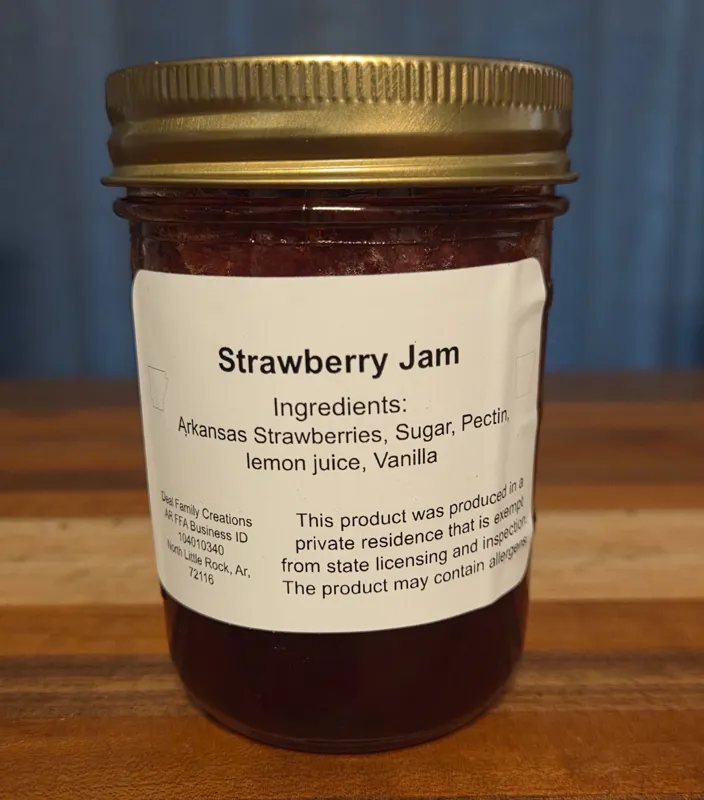
These rules change often. Texas opened cottage food to TCS foods in 2025, Arkansas let farms sell raw milk products off the farm the same year, and Washington and Minnesota post their allowed product lists online.
Look up your own state agency's page before your first sale. Last verified October 1, 2026.
For every state's sales cap and license on one page, see our cottage food laws by state guide.
You've figured out which of your products are non-TCS, confirmed they're on your state's allowed list, and have your labels ready. The next question is how customers actually find you and order.
If you still need a label, Homegrown's free cottage food label template gives a label mockup, your state's required disclaimer text and a checklist of required elements, ready to print.
If you start with text messages, Instagram DMs, and Facebook posts, that works for your first handful of sales. Once orders pick up, though, you can lose track of who ordered what, chase Venmo payments, and spend more time managing messages than baking.
Text messages and DMs: Free but disorganized. No payment tracking, no order confirmations, and no sales records if your state requires documentation for cottage food compliance. If customers pay through a Venmo business profile, Venmo charges 1.9% + $0.10 per payment.
Etsy: Handles payments and creates order records, but charges a $0.20 listing fee and a 6.5% transaction fee, and Etsy Payments adds 3% + $0.25 per US order. Some new shops also pay a one-time set-up fee shown at signup. For a cottage food vendor doing local pickup, you're paying for a shipping-focused platform. And Etsy controls the customer relationship: its policy for shop owners bars adding a buyer to your email or mailing list without the buyer's consent.
Homegrown is $10 per month billed yearly or $12.50 month to month, with no percentage fees beyond standard payment processing of 2.9% + 30 cents per card payment, which you pay as the vendor (customers pay no added fee), and a 7-day trial with no charge until day 8. It is built for local food vendors selling straight to the customer by pickup or local delivery, the kind of direct sale North Dakota and Wyoming require for home kitchen food. Utah requires the sale itself to happen in person. Washington lets you take orders online, but payment and delivery must pass directly from you to the customer in person, and Mississippi says you must be present to sell your food. Check with your state's cottage food office before taking prepaid online orders. Customers see your products, create an account to place their first order, and pay by card in one checkout. Each order lands in your dashboard prepaid, with its pickup time or delivery address, so you bake to a count instead of a guess. Your storefront is also listed in the Homegrown marketplace automatically, but plan on bringing your own customers with your link.
Swipe sideways to see every fee column.
| Way to take orders | Monthly plan | Trial | Platform fee | Payment processing | Built for local pickup | Sales records | Vendor pays on 20 orders of $25 |
|---|---|---|---|---|---|---|---|
| DMs + cash | $0 | None needed | None | None | No system | Manual | $0 |
| DMs + Venmo business profile | $0 | None needed | None | 1.9% + $0.10 per payment | No system | Manual, plus Venmo's payment list | $11.50 |
| Etsy | $0 | No plan to try | $0.20 listing fee + 6.5% transaction fee | 3% + $0.25 per US order | No (shipping-first) | Yes | $56.50 |
| Homegrown | $10 billed yearly ($12.50 monthly) | 7 days, no charge until day 8 | None | 2.9% + $0.30 per card payment | Yes, plus local delivery | Yes (customer account required) | $30.50 on the yearly plan ($33 monthly) |
We checked each fee on Venmo's business profile page, Etsy's fees and Etsy Payments policies, and Homegrown's signup page on October 1, 2026. The last column assumes 20 orders of $25 each ($500 in sales), paid by card or Venmo, with no shipping or sales tax. On Homegrown the customer pays the $25 price with no added fee, and the vendor pays the card processing.
The last column works out like this:
Homegrown doesn't handle nationwide shipping or wholesale accounts. It handles direct-to-consumer local sales with pickup or local delivery, the kind of local sale Texas allows. Utah requires the sale itself to happen in person, and Washington and Mississippi require each sale to pass directly from you to the customer.
If your state does let you sell TCS food, timing matters more. Texas asks for the date the food was made on the label, and taking orders ahead with a set pickup day lets you make Friday's cheesecakes for Friday's pickups instead of holding them in a fridge all week. To compare more ways to take orders, see our guide to the best platforms for selling baked goods online.
The trend in several states is toward allowing more products, including some TCS foods, under cottage food and food freedom laws:
If a product you want to sell is currently restricted in your state, the law may change, as Texas's did in 2025. In the meantime, sell what is allowed and advocate for broader laws.
For more on the legal framework for home food sales, see our guides on food freedom explained, cottage food licensing for Instagram vendors, and health department permits for farm stands.
Selling perishable (TCS) foods where your state allows them? Control timing with order-ahead pickup. The easiest way to take local orders and get paid is an online storefront. See the best platform to sell food from home, or set up a Homegrown storefront in about 15 minutes ($10/mo billed yearly, 0% commission, plus 2.9% + 30¢ per card payment, paid by you, the vendor, with no added fee for customers).
TCS stands for Time and Temperature Control for Safety. It refers to foods that require specific temperature control (at or below 41°F, or at or above 135°F) to prevent bacterial growth and foodborne illness.
No. Bread (including sourdough and rolls) is non-TCS because baking reduces moisture to levels that do not support bacterial growth. Most quick breads are non-TCS too, though Arkansas warns that banana, carrot, pumpkin and zucchini breads may be TCS. Bread with cream cheese frosting, custard filling, or fresh fruit topping may become TCS because of the added ingredients.
No. Properly made jam with sufficient sugar content is non-TCS. The high sugar concentration prevents bacterial growth. This is why jam shows up on cottage food allowed lists in states such as Washington and New Jersey. Washington allows only jams that meet the FDA's standard for jams and jellies, so low sugar jams are out.
Standard cookies (chocolate chip, oatmeal, sugar, peanut butter) are non-TCS. Cookies with cream filling, fresh fruit, or custard-based components may be TCS depending on the specific ingredients.
Buttercream made with butter and powdered sugar can be non-TCS when it has enough sugar to tie up the water bacteria need. Arkansas lists buttercream as allowed. Washington wants frostings to have a cook step or enough sugar to be stable at room temperature, and its sugar test is 3 parts non-perishable ingredients to 1 part perishable ones by weight, which a common recipe of 1 cup of butter to 4 cups of sugar does not meet. Cream cheese frosting is usually TCS, and Arkansas allows cream cheese based frostings only when the final product is documented as non-TCS. If in doubt, use buttercream.
Only if your state allows it (through cottage food law expansion, food freedom law, or a separate vendor permit) and you can maintain proper temperature control at the market (insulated cooler with ice or a plug-in refrigerated display). Outside those laws, expect to need a health department permit for TCS products. Arkansas, for example, does not allow TCS foods to be sold without a permit from its Department of Health.
Check your state's current cottage food allowed product list. If cream pies, cheesecake, fresh meat dishes or other foods that need refrigeration appear on the list, your state allows some TCS products. If the list only includes shelf-stable products, TCS products are not allowed. Texas and Illinois work the other way. They list only what is banned, so a TCS food that is not on the banned list may be allowed once you register. When in doubt, call the agency that runs your state's cottage food program (agriculture in some states, health in others).
In many cases, yes. The most common swap is replacing cream cheese frosting with buttercream frosting on cupcakes and cakes, and that single change can move your product from TCS to non-TCS, as long as the buttercream has enough sugar to meet your state's rule (Washington asks for 3 to 1 by weight). Replacing fresh fruit toppings with dried fruit, using vinegar-based sauces instead of cream-based ones (where your state allows acidified foods, and only if they meet its pH rule), and increasing sugar concentration in preserves are all ways to reformulate. The key is understanding which specific ingredient triggers the TCS classification.
Nothing may happen right away, but you are taking an unnecessary risk. If a customer does get ill or reports you, the health department may investigate. Selling a restricted product without proper licensing can lead to a stop-sale order or fines, and your cottage food insurance may not cover a product your permit did not allow. The safest approach is to verify every product against your state's allowed list before you sell it. A 5-minute phone call to whichever state office runs cottage food where you live (agriculture or health) is far cheaper than a food safety incident.
A food is not a TCS food when it is acidic enough or dry enough that it does not support the growth of harmful bacteria at room temperature. Bread, cookies, jam made with enough sugar, honey, candy and dried herbs are common examples. Minnesota's guidance gives the cutoffs as pH at or under 4.6, or water activity at or under 0.85, and the FDA Food Code also leaves out unopened canned food and eggs pasteurized in the shell.
Whole, uncut strawberries are not a TCS food under the FDA Food Code, which names melons, leafy greens and tomatoes that have been cut among the produce that needs temperature control. Cottage food rules can still keep strawberries out. Washington does not allow cut fresh fruit or baked goods garnished with fresh fruit, and Minnesota and New Jersey do not allow chocolate-covered strawberries. Strawberry jam and sweet bread with strawberries baked into the batter are a different story: New Jersey lists strawberry jam, and Washington allows the bread.
No. Uncooked rice is a dry plant food, and the FDA Food Code counts a plant food as a TCS food once it is cooked, while naming only a few raw ones, such as sprouts and some cut produce. Cooked rice is TCS, which is why this guide lists cooked grains among the foods that need temperature control. Dry mixes can fit cottage food rules: Washington allows dry bread, soup and dip mixes, and New Jersey lists dry baking mixes.
By the FDA Food Code's definition, butter is an animal food, so treat it as TCS unless your health department or a lab test says otherwise. Cottage food rules treat it as dairy too: Minnesota names butter among the dairy products that cannot be sold as cottage foods, and Arkansas says dairy products, butter included, cannot be sold under its Food Freedom Act. Butter baked into a cookie or beaten into a high-sugar buttercream is a different case, which is why Arkansas lists buttercream as an allowed frosting. If you want to sell butter itself, plan on a licensed dairy route or one of the few states that allow some home dairy sales, covered in our homemade butter selling rules.
Yes, and the FDA Food Code has a rule for exactly that case. TCS food prepared from ingredients at room temperature, such as tuna salad made from canned tuna, has to be cooled to 41°F or below within 4 hours. Cooked TCS food gets a stricter clock: from 135°F down to 70°F within 2 hours, and down to 41°F within 6 hours in total. These are rules for food businesses, and they are one more reason many cottage food laws leave TCS food to licensed kitchens.
These guides go deeper on the products and rules this guide touches. Pick the one that matches your next question:



