
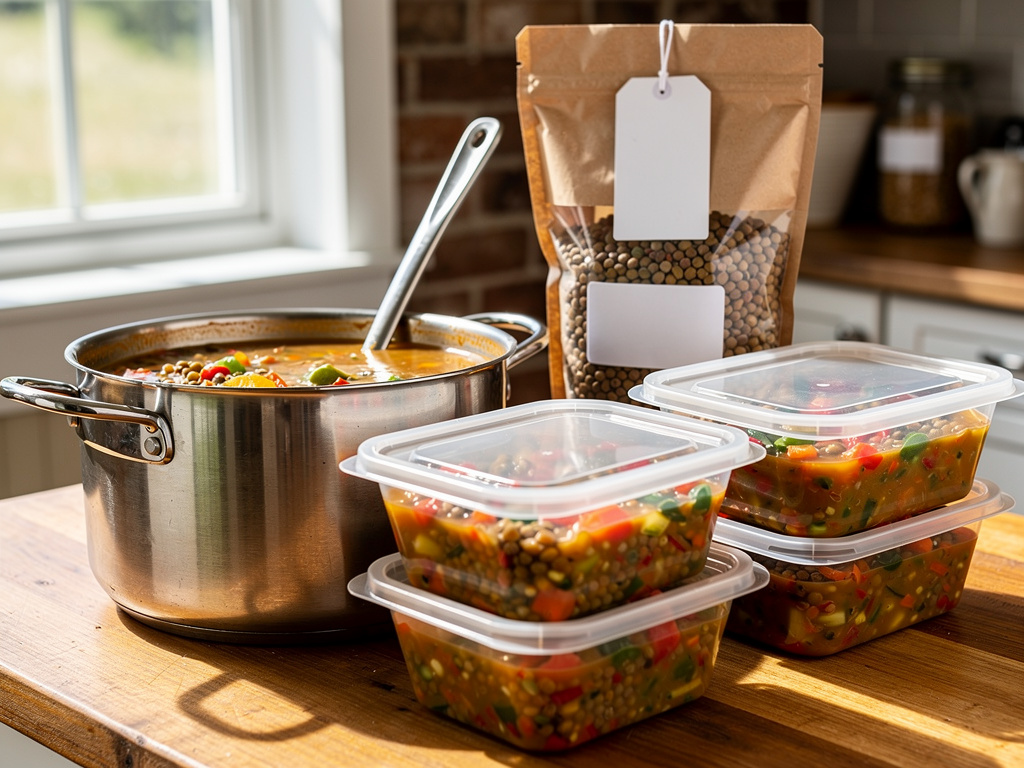


The short version: In 7 of the 12 states checked for this guide, you cannot sell a cooked pot of homemade soup from your home kitchen, because soup has to be kept hot or cold to stay safe and those states' cottage food laws only cover shelf-stable foods. The other 5 now allow it with conditions: Texas, Illinois (vegan soup only), Utah, Wyoming and North Dakota, and none of their home food laws allows beef, pork or chicken in it outside narrow small-farm exceptions. Of the 7 that say no (California, Colorado, Florida, Georgia, Minnesota, Missouri and Washington), only California has a way in: its home restaurant permit can cover same-day soup in counties that allow it. A dry soup mix is often allowed instead: California, Washington and Wyoming name soup mixes on their own lists, and Missouri allows them only from your own stand where the local health agency does. Home-canned low-acid soup is ruled out in 9 of the 12, and for meat soup or anything else the routes are a licensed commercial kitchen, a temporary event permit for hot soup, or a local home kitchen permit in California or Utah.
Every rule here was read on the agency's own page or in the statute on October 14, 2026: the home food pages for Texas, Washington, California, Missouri, Florida, Georgia, Colorado and Minnesota, 410 ILCS 625/4 and the University of Illinois Extension 2026 Cottage Food Guide, Utah Code 4-5a-104 and 105, Utah Code 26B-7-416 on home kitchen permits, the Wyoming Food Freedom Act, North Dakota Century Code 23-09.5, FDA's 2022 Food Code, 21 CFR 108.35 and 113.3, and USDA's meat and poultry definitions at 9 CFR 301.2 and 381.1. Laws move and counties layer on their own permits, so verify your state's current rules with the agency that runs your state's program before your first sale. Homegrown takes orders and payments but does not make any soup legal where you live. Customers create a Homegrown account to place a first order, and Homegrown has no drops or countdown release feature.
Somebody tasted your white bean soup at a potluck and asked if they could buy a quart every week. Before you take the money, it helps to know that soup sits on the wrong side of the line most home food laws draw.
That line is time and temperature. Foods that need a refrigerator or a warmer to stay safe are called time and temperature control foods, and our guide on which TCS foods cottage food laws allow covers the whole category. This guide is the soup version: cooked soup, frozen soup, soup mixes, canned soup and hot soup at a market, with the agency's own words for each.
Sometimes: 5 of the 12 states checked for this guide let a home kitchen sell cooked soup, and the other 7 do not under their home food rules (California's county home restaurant permit is the one exception). Utah also has a second, separate route: a home kitchen permit from the local health department that can cover soup with meat in it. Think of a cottage food law as a permission slip: your state names the low-risk foods you may cook at home and sell without a licensed kitchen. Low-risk usually means safe at room temperature, like bread and jam, and a quart of soup is not.
Here is how the 12 states split on October 14, 2026:
Your state not listed? The cottage food laws by state guide names every state's agency. Search your state's list of banned foods for "soup", "requires refrigeration" and "potentially hazardous".
Soup needs time and temperature control because bacteria grow fast in a cooked, wet, low-acid food once it slips below 135°F. FDA's 2022 Food Code, the model code many state health departments adopt, says food like this must be held "At 57°C (135°F) or above" or "At 5°C (41°F) or less". Anything in between is where the trouble starts, and once a pot comes off the heat the Food Code gives you 2 hours to get it from 135°F to 70°F and 6 hours total to reach 41°F.
Three things make soup riskier than most home foods:
Our guide to what makes a food TCS explains pH and water activity, the two lab numbers that decide it. For soup, the answer is almost always yes, it needs temperature control.
Texas, Illinois, Utah, Wyoming and North Dakota let a home kitchen sell cooked soup, each with conditions, while the other 7 states in this table limit you to a dry mix or nothing under their home food rules, with California's county home restaurant permit as the one exception. California's county home restaurant permit and Utah's home kitchen permit, both covered further down, are the only routes in the table that add soup made with store-bought meat. The table below uses each state's own page or statute, loaded on October 14, 2026.
Scroll sideways to see every column.
| State | Cooked soup from a home kitchen? | Dry soup mix? | Key conditions | Source checked |
|---|---|---|---|---|
| Texas | Yes, with no meat, poultry or seafood | Yes (any food except the listed exclusions) | Register with DSHS to sell TCS foods; pass an accredited food handler course; keep at 41°F or below, or 135°F or above; dated label with safe handling statement; $150,000 a year | Texas DSHS cottage food page |
| Illinois | Yes, vegan soup only | Yes, with no dehydrated tomato and no dairy | No meat, fish or dairy; no cut or pureed fresh tomato; store, carry and sell at 41°F; no shipping of TCS food; register with your local health department (fee up to $50); everyone who makes or packs the food needs a Certified Food Protection Manager certificate | 410 ILCS 625/4; Illinois Extension 2026 guide |
| Utah | Yes, sold directly to an informed customer; with meat only under a microenterprise home kitchen permit | Yes | Made and sold in Utah; under the homemade food law, no meat apart from a poultry exception and rabbit, pending USDA approval; label says not inspected; business license still needed. With the local health department permit: served the same day, or within 72 hours with temperature logs | Utah Code 4-5a-104, 105; 26B-7-416 |
| Wyoming | Yes, sold by you or your designated agent | Yes, "dry soup mixes excluding meat based soup mixes" | Only in Wyoming; no meat apart from listed exceptions; $250,000 a year | Wyoming Food Freedom Act, W.S. 11-49 |
| North Dakota | Yes, sold directly to an informed customer | Yes | No uninspected meat apart from a poultry exception; refrigerated foods labeled as transported and kept frozen | N.D.C.C. 23-09.5-02 |
| California | No, except under a county home restaurant permit | Yes, "Bean soup mixes" and "Vegetable soup mixes" | Cottage list covers foods that are not potentially hazardous only; Cottage Food Operator Training within three months of registering with your local environmental health department | CDPH Approved Cottage Foods list, April 2026; CDPH cottage food operations page |
| Washington | No | Yes, "soup mixes" from approved-source ingredients | $355 two-year permit, plus a Food Worker Card and a state Master Business License; $125 for each re-inspection after a failed one; $35,000 a year; no shipping | WSDA cottage food page |
| Missouri | No | Maybe, "Dry soup mixes" under a Food Code exemption, sold from your own stand where your local agency allows it | Cottage law covers baked goods, jams and jellies, and dried herbs only | Missouri DHSS 2026 guidance |
| Florida | No | Likely, under "Dry herbs, seasonings and mixtures" | $250,000 a year; no wholesale | FDACS cottage food page |
| Georgia | No, "cooked vegetable products do not qualify" | Likely, under "Dry Herbs, Seasonings and Mixtures" | An ANSI-accredited food safety training program (a food handler course is enough); a rented kitchen needs a Food Sales Establishment License | GDA cottage food page and FAQ |
| Colorado | No | Ask, soup mix is not named | Dry spices and dehydrated produce are eligible; freeze-dried meals are not; a food safety training course before you start | CDPHE cottage foods page |
| Minnesota | No | Likely, if the mix stays at a water activity of 0.85 or less | No meat or dairy; cottage food training and exam before you register; $78,000 a year | MDA cottage food guidance |
We checked every row on the state's own page or statute on October 14, 2026. "Likely" means the soup mix fits a category the state lists but the state does not name soup mixes, so confirm with the agency before you sell. Counties and cities can add zoning or permit rules on top of these, so check with your local agency too.
If you live somewhere else, check whether your state has a food freedom law. Our food freedom states list covers the states that let you sell most homemade foods to an informed customer.
Since September 1, 2025, Texas has let cottage food operators sell soups and other TCS foods from home, as long as the soup has no meat, poultry or seafood and the operator registers with the Texas Department of State Health Services (DSHS). The change came from Senate Bill 541, which also raised the annual sales limit to $150,000.
The DSHS cottage food page says "Allowable foods now include any foods, except" meat, poultry, seafood, ice products, "low-acid canned goods", CBD or THC products, and raw milk products. A CFPO is a cottage food production operation, the Texas name for a home food business, and the page says "CFPOs that sell TCS foods must register with DSHS". Soup sold that way has to be kept and delivered at 41°F or colder, or at 135°F or hotter.
What that means for a Texas soup cook:
The Texas cottage food law guide covers the rest of the Texas rules. Creamy soups made with regular pasteurized milk are not on the Texas exclusion list, but they raise more questions than bean soup does, so ask DSHS in writing before you add one.
All four let a home cook sell some cooked soup, but each draws the line in a different place, and Illinois is the only one limited to vegan soup. Here is the short read on each.
The University of Illinois Extension 2026 Cottage Food Guide lists "Fresh or frozen vegan soups" as TCS foods a registered cottage food operation may sell, stored, carried and sold at 41°F or below. The statute, 410 ILCS 625/4, still bans meat, poultry and fish, bans dairy except in baked goods and candy that do not need refrigeration, "cut or pureed fresh tomato", and fresh cut leafy greens unless they are "dehydrated, acidified, or blanched and frozen". So a lentil soup works, a soup made from pureed fresh tomatoes does not, and TCS food cannot be shipped. The statute also says anyone "preparing or packaging a product" must be a certified food protection manager, and the guide says you and every helper who makes or packs the food must pass that course and exam before your registration is approved: at least 8 hours, a proctored exam, usually $100 to $300, good for 5 years, and a food handler card does not count.
The pattern across all four: sell direct to the customer (Wyoming and Utah allow a named agent), tell the buyer it was made in an uninspected home kitchen, and leave the meat out unless you hold Utah's home kitchen permit.
Yes, in 10 of the 12 states in this guide a dry soup mix is allowed or fits a category the state lists, making it the easiest legal soup product, and 3 of them name soup mixes on their own cottage lists, with Missouri naming them under a local-option exemption. A soup mix is dry beans, lentils, grains, dried vegetables and spices in a bag or jar, with a recipe card. The customer adds water and cooks it, so the risky step happens in their kitchen, not yours.
Where each state stands, from the pages we loaded:
Our guide to selling baking mix in a jar covers layering, jars and gift sets, and every tip there works for a 15-bean soup jar.
Soup mix ideas that stay dry and simple:
Keep every ingredient dry and store-bought, keep meat and bouillon with meat out, and print the cooking steps on the label. Most of these five steps come from what the states above require; the cooking steps are good practice.
No, freeze-dried soup is not a reliable way around the rules, and 2 of the 12 states in this guide rule it out by name. Freeze-drying removes water, so it sounds like it should turn soup into a dry mix. The states have not accepted that argument.
Colorado's cottage food page lists "Freeze dried meals" as ineligible, next to meat products and foods that need refrigeration. Missouri's 2026 guidance lists "Freeze dried foods" among the foods that cannot be sold under its cottage law. We checked both pages on October 14, 2026. Freeze-drying does not get around the meat limits either: Texas and Illinois keep meat out of home kitchen food, and Wyoming, Utah and North Dakota allow it only under the narrow exceptions listed above. Utah's home kitchen permit does not help here: it covers food served within 72 hours of when it was made, not a shelf product.
The reason is process, not the finished product. A freeze dryer only works if the soup was cooked, cooled and handled safely first, and nobody inspects that step in a home kitchen. California's approved list has a category for "Dried, Dehydrated, and Freeze-Dried Foods" with examples "not limited to" the ones it names, which include vegetables and vegetable soup mixes, but it does not name freeze-dried soup or cooked meals. If you want to sell freeze-dried soup, ask your state agency in writing and keep the answer.
No in 9 of the 12 states checked, because most jarred, shelf-stable soup is a low-acid canned food with a real botulism risk. Federal rules at 21 CFR 113.3 define a low-acid food as one with "a finished equilibrium pH greater than 4.6 and a water activity (a w ) greater than 0.85". Vegetable, bean and chicken soup all fit that description.
Texas lists "low-acid canned goods" among its exclusions, and Illinois bans "low-acid canned foods" by name. Both states allow acidified canned foods made under their own recipe and testing rules, but most soups are not acidic enough to qualify, so ask the agency before canning a tomato soup. The other 7 states do not allow cooked soup under their home food rules, and California's home restaurant permit only covers food made and served the same day, not jars sold later. Utah's home kitchen permit stops at 72 hours from when the food was made, so it does not cover jars either. Utah's, Wyoming's and North Dakota's laws do not name canned soup as an exclusion, but they put all of the risk on you and your customer, and a jar of low-acid soup canned without a tested process is exactly where botulism grows.
Commercial canners of meatless low-acid soup answer to FDA. A canned soup with beef or pork in it is usually a USDA product instead: 9 CFR 301.2 counts food made "wholly or in part from any meat" as a meat food product unless the meat is there "only in a relatively small proportion", and 9 CFR 381.1 does the same for poultry, with its own exemptions. Under 21 CFR 108.35, a company must register on Form FDA 2541 "not later than 10 days after first so engaging" in canning low-acid foods, and file its scheduled process "not later than 60 days after registration and prior to the packing of a new product". We checked all four rules on eCFR on October 14, 2026. That is a factory route, not a kitchen upgrade.
The practical answer for a small soup business is frozen quarts. Frozen quarts are also simple to price: our soup pricing guide with a quart-by-quart cost build puts a meatless quart at about $2.86 in food and a container, against $9.99 to $16.99 for frozen quarts at four farms and markets. Freezing keeps the soup at a safe temperature without pressure canning, and customers already buy soup that way. Our guide to selling frozen meals locally covers containers, freezer space and delivery.
Usually only with a temporary food establishment permit from your health department, even in states that let you sell frozen soup from home. Ladling hot soup into cups is food service, and food service needs a permit almost everywhere. Wyoming is the exception among the 12 states in this guide: its Food Freedom Act exempts homemade food sold directly to an informed customer, including at farmers markets, from state permits, so ask your county health office whether it requires anything more. North Dakota allows sales "only for home consumption", which its law limits to a private home or to family members, employees and nonpaying guests, so soup eaten at your booth falls outside it. Utah's exemption covers food "for personal or home consumption" and does not say whether a cup eaten at a market counts. In either state, ask the health department about a temporary permit before serving hot soup. Utah's home kitchen permit is no help at the market: the law ties it to the location and hours on the permit and bars eating the food on site, though it says an operator may still apply for a different event permit.
The FDA Food Code defines a temporary food establishment as one that runs "for a period of no more than 14 consecutive days in conjunction with a single event or celebration". Permit length and fees are set by your health department, not the Food Code. In Texas, a permit for a farmer or food producer selling at farmers markets must last at least a year, cost no more than $100 a year, and cover every farmers market in the permitting agency's area. The Texas farmers market page is blunt about when you need one. At markets where DSHS is the health authority, "A temporary food establishment permit is required to sell all other potentially hazardous food/time temperature control for safety foods". Markets under a city or county health department follow that department's rules.
What a hot soup booth usually needs:
Frozen or cold soup is a simpler booth. You sell sealed, labeled containers from a cooler that holds 41°F or below, and nobody eats at your table. That frozen-quart setup runs on a weekly rhythm, and our step-by-step guide to selling soup from home lays it out day by day, from a Wednesday order cutoff to a Friday cook day timed against the 2-hour cooling rule.
Yes, California's home restaurant permit, called a Microenterprise Home Kitchen Operation or MEHKO, can cover hot or cold soup, but only in counties that allow it, and only for soup made and served the same day. Los Angeles County describes it as "a small-scale, home-based restaurant", and San Diego County notes that state law "requires a County to either allow or not allow MEHKOs in their jurisdiction".
The limits, from the Los Angeles and San Diego County MEHKO pages loaded on October 14, 2026:
Our MEHKO laws guide explains the permit and which states have one. For soup, it fits a weekly soup night better than a freezer business.
Yes: Utah's microenterprise home kitchen permit, issued by your local health department under Utah Code 26B-7-416, lets a home cook sell temperature-controlled food like chicken noodle soup or beef stew, as long as it is served the same day or within 72 hours with temperature logs. It is a different law from Utah's homemade food act above. That act needs no permit but rules out meat. This one needs a permit and an inspection, and its list of ruled-out foods does not include cooked meat.
Utah Code 26B-7-416 says an operator "may not operate a microenterprise home kitchen unless the operator obtains a permit from the local health department". The operator must "prepare, cook, and serve time and temperature controlled food on the same day", or serve it within 72 hours of when it was prepared while keeping temperature logs. Each local health department sets its own fee: Utah County Health Department's 2026 fee schedule lists $310 for a new permit and $80 for a renewal. We loaded both on October 14, 2026.
What the permit asks of a soup cook, from the statute:
For soup, the 72-hour clock is the whole plan. Cook chicken noodle soup at 10 a.m. on Thursday and every quart has to reach a customer by 10 a.m. on Sunday, so a freezer full of quarts sold over a month does not fit. Buy the chicken and beef from a store and ask the health department which meat sources it accepts before your inspection.
Scroll the table sideways to compare the two permits.
| Home kitchen permit | Who issues it | How long after cooking | Meat soup | Eating at your home | Farmers market | Sales limit | Fee example |
|---|---|---|---|---|---|---|---|
| California MEHKO | Your county, only if it has opted in | Made and served the same day | Yes | Allowed | No | 30 meals a day, 90 a week, $100,000 a year adjusted for inflation | Set by each county |
| Utah microenterprise home kitchen | Your local health department | Same day, or up to 72 hours with temperature logs | Yes | Not allowed | No, the permit covers your address and hours | None in the statute | Utah County: $310 new, $80 renewal |
From the Los Angeles and San Diego County MEHKO pages, Utah Code 26B-7-416 and Utah County Health Department's 2026 fee schedule, all loaded October 14, 2026. Fees and county participation change, so ask your own health department before you apply.
Our MEHKO guide names California and Utah as the states with these permits. Washington's Senate Bill 5605 would have created a home kitchen permit, but the Washington Legislature's bill page shows it never left a Senate committee in the 2025 or 2026 sessions (checked October 14, 2026).
Almost any soup can be sold from a licensed kitchen under your own food license, but a soup with meat or poultry in it, like chicken noodle or beef stew, may also need USDA or state meat inspection, so ask before you add one. This route exists in all 12 states in this guide, and it is the usual way to get soup onto a store shelf. Georgia's FAQ says a rented or shared kitchen "would require a Food Sales Establishment License", and Minnesota's page says a food license "requires the use of an approved kitchen space".
If your soup has meat in it, ask on the same call whether USDA meat inspection rules apply to it. Bone broth follows the same route; see our guide to selling bone broth locally.
Cooked soup has to drop from 135°F to 70°F within 2 hours, then to 41°F within 6 hours total, under FDA's 2022 Food Code. Health departments that adopt the Food Code use these numbers, and Texas uses the same 41°F and 135°F lines for cottage food soup. A full stockpot left on the counter will not make it. The same numbers apply to soup prepared, cooked and cooled in a licensed kitchen, and when that soup is reheated to serve hot, it has to reach 165°F within 2 hours.
The Food Code's approved cooling methods include:
Split a 20-quart batch into ten 2-quart containers or shallow pans no more than 2 inches deep, set them in an ice bath, and stir. Write the time and a thermometer reading at the start, at 2 hours and at 6 hours on a log sheet. If your soup is not at 70°F by the 2-hour mark, the batch is the lesson, not the product.
Once it is cold, keep it at 41°F or below, or frozen solid. For frozen soup, leave about an inch of space at the top of each container so it can expand, and freeze flat in a single layer so it freezes fast.
A soup label needs the product name, ingredients, allergens, your name or registration number, and your state's home kitchen statement, plus a date and handling instructions for any soup sold cold or frozen. The exact wording depends on the state, and Texas wants its safe handling statement in at least 12-point type.
State wording worth copying exactly:
Things every soup label should have, whatever the state:
Seven of the 2,927 products on Homegrown on October 14, 2026 were a soup, stew, chili, broth or dry soup mix, from 4 vendors. That is a small shelf, and it shows the formats vendors list. The chicken soup and the beef and chicken bone broths need a licensed or inspected kitchen outside the narrow farm exceptions above, and the listings do not say which route each vendor used.
In a pull of the Homegrown catalog on October 14, 2026, 7 of the 2,927 products listed by 322 vendors were a soup, stew, chili, broth or dry soup mix. We counted a listing when the thing sold was one of those, after reading 117 keyword matches in names, descriptions and categories and opening every matching vendor's other listings. Two are dry mixes (Thomas Family Farm's "Cream of Soup" at $3.00, sold in chicken and mushroom versions with no ingredients listed, and "Onion Soup Mix" at $5.00), two are bone broths from KairosGO (a broth at $5.99 and a freeze-dried broth powder at $6.99), and three are ready-to-eat: Mama K's Kitchen's chicken soup at $11.00 a quart, and Cryptid Kitchen's red lentil stew and veggie chili from $3.00 and $4.00 for 16 ounces. We did not count a raw, frozen beef stew kit you cook yourself in a slow cooker.
Mama K's Kitchen sells the soup "by the quart with dry noodles packaged separately", which keeps the noodles from going soft. Cryptid Kitchen pairs its chili with cornbread muffins and its stew with rice, which turns a soup into a meal. Meatless chili like Cryptid Kitchen's costs about $2.58 a quart to make against $6.45 with ground beef, which our chili pricing guide turns into bowl and quart prices. Both are easy ideas to borrow once your license is sorted.
Soup works best as a preorder, because you cook exactly what was ordered and nothing sits in your freezer for weeks. Frozen quarts, weekly soup nights and soup mix jars all run on a list of names, quantities and pickup times, which gets messy fast in text messages.
Homegrown is $10 per month billed annually ($12.50 billed monthly) with no percentage fees beyond standard payment processing (2.9% + $0.30 per order, paid by you), and it gives you one link where customers see this week's soups, pick pickup or delivery, and pay before you start cooking. Compare that to Hotplate, which has no monthly plan but adds a 5% + $0.55 fee to your customer's checkout by default, plus 2.9% + $0.30 card processing you pay (about $0.88 to $0.92 on a $20 order), or the Square Free plan, $0 a month with 3.3% + 30¢ processing on online orders and no platform fee. We checked all three pricing pages on October 14, 2026.
Scroll sideways to see every column.
| Ordering tool | Subscription | Trial | Platform or service fee | Card processing | Customer's total for a $20 soup order | Vendor's cost on that $20 order | Vendor's cost for 50 soup orders of $20 in a month |
|---|---|---|---|---|---|---|---|
| Homegrown | $10 a month billed annually ($12.50 billed monthly) | 7 days, no charge until day 8 | $0, 0% commission | 2.9% + $0.30, paid by the vendor | $20.00 | $0.88 plus the plan | $54.00 ($56.50 on monthly billing) |
| Hotplate, default | $0 | No plan to try | 5% + $0.55, paid by the customer | 2.9% + $0.30, paid by the vendor | $21.55 | About $0.88 to $0.92 | About $44.00 to $46.25 |
| Hotplate, vendor covers the fee | $0 | No plan to try | 5% + $0.55, paid by the vendor | 2.9% + $0.30, paid by the vendor | $20.00 | $2.43 | $121.50 |
| Square Free plan, online | $0 | No plan to try | None | 3.3% + 30¢ online, paid by the vendor | $20.00 | $0.96 | $48.00 |
Checked on Homegrown's signup page, Hotplate's pricing page and Square's fee page on October 14, 2026. Hotplate's pricing page says you can pay its fee yourself or pass it on, "your choice", and Hotplate's own post says 80% of its sellers keep the default of charging the customer. Card processing is figured on the $20 price. Hotplate's default range runs from $0.88, if processing leaves out Hotplate's own fee as the example on its pricing page does, to $0.92, if it is charged on the full $21.55 the customer pays. Tips or tax add a few cents more on any row.
What Homegrown does for a soup vendor:
What it does not do: Homegrown does not make soup legal in your state, check your license, or keep your soup cold. Customers create a Homegrown account to place a first order. Card processing of 2.9% + $0.30 is paid by you, with no option to pass it to the customer. There is no drops or countdown release feature. Your storefront is listed on the Homegrown marketplace, but plan on most orders coming from people you send to your own link. In Utah, where the agriculture department says homemade food is sold in person, ask the department whether paying online before an in-person pickup fits before you turn on online payment.
Once your soup is legal where you live, a preorder page is the difference between cooking to order and guessing. Start your Homegrown storefront with a 7-day trial and no charge until day 8, and post your first soup menu this week.
Read your state agency's banned foods list, then email the agency one specific question and keep the written answer. An email that takes 10 minutes to write saves you from guessing, and an agency reply is the best proof you have if a market manager or inspector asks.
You can take orders online in most of the states that allow homemade soup, but you usually have to hand the soup over yourself. Texas lets you sell online when you, an employee or a household member delivers in person, and you must post the label information on your ordering page before you accept payment, though the address or registration number can go on the label after the customer pays. Illinois does not let cottage operators ship TCS foods. Washington allows internet orders for its approved cottage foods but bans shipping them, and WSDA says "payments must be directly from the producer to the end consumer in a person to person transaction". Ask WSDA whether taking payment online before pickup counts before you set that up. Utah's agriculture department says homemade food "must be sold in-person" at a prearranged location, so ask it whether an order paid online and handed over in person fits before you take payment ahead.
Not under the home food rules in 9 of the 12 states checked for this guide. Texas and Illinois ban poultry in cottage foods, the other 7 bar cooked soup from their home food rules, and North Dakota, Utah and Wyoming allow poultry only under narrow exceptions for farms that slaughter no more than 1,000 birds a year. Two home kitchen permits are the exception. California's home restaurant permit (MEHKO) can cover chicken soup made and served the same day in counties that allow it, and Utah's microenterprise home kitchen permit from the local health department can cover it if you serve it within 72 hours and keep temperature logs. Otherwise, outside those small-farm poultry exceptions, chicken soup is a licensed kitchen product in every state this guide covers.
For hot soup served in cups, almost always yes, usually a temporary food establishment permit from your health department. Wyoming is the exception in this guide: its Food Freedom Act exempts homemade food sold to an informed customer at a farmers market from state permits, so check with your county health office. North Dakota's exemption covers home consumption only, so it does not cover soup eaten at the booth. Utah's covers "personal or home consumption" and does not say whether a cup eaten at a market counts, so ask the county health department before serving it there. For sealed frozen soup, it depends on your state: in Texas, frozen cottage food soup from a registered operator needs no local permit, but soup ladled into cups, or any other unpackaged TCS food, at a DSHS market needs a temporary food establishment permit. Ask your market manager which health department covers the market.
Soup that is prepared, cooked and cooled in a food establishment and then reheated for hot holding must reach at least 165°F in every part for 15 seconds, under section 3-403.11 of FDA's 2022 Food Code. The reheating has to be fast: the soup may spend no more than 2 hours between 41°F and 165°F. Once it is hot, hold it at 135°F or above. Check the middle of the pot with a probe thermometer, not the edge.
The appliance does not change the rule. If your state allows homemade soup, a slow cooker is fine. Follow the Food Code's 2-hour and 6-hour cooling limits, then store the soup the way your state requires, such as 41°F or below in Texas and Illinois, or frozen in North Dakota. If your state does not allow homemade soup, cooking it slowly does not make it legal.
The legal route sets your costs more than the recipe does. A home kitchen quart in Texas or Utah carries ingredients and containers, while a commissary quart also carries kitchen rent. On Homegrown on October 14, 2026, ready-to-eat soup listings ran from $3.00 for 16 ounces of lentil stew to $11.00 for a quart of chicken soup.
Yes, in 10 of the 12 states in this guide a dry soup mix in a jar is allowed or fits a listed cottage food category, and California, Washington and Wyoming name soup mixes outright. Missouri and Colorado are the ones to check first. Colorado's cottage food page does not name soup mixes, so ask CDPHE. Missouri's cottage law does not cover soup mixes, and its guidance allows them under a Food Code exemption only where local laws allow, sold from your own stand direct to the customer. Keep every ingredient dry and store-bought, leave out meat, and print the cooking steps on a tag. Verify your state's current rules before holiday markets.
More on the rules and the business side of selling soup:
Check your state's rules first, then put your soup menu where customers can order and pay ahead. Whether you are selling frozen lentil soup in Texas, soup mix jars where your state allows them or hot soup from a licensed kitchen, preorders tell you exactly how much to make. A soup menu with a Thursday order cutoff and a Saturday pickup gives you one cooking day, one cooling log and no quarts left over. Start with two or three soups you already make well, and add more once you know which ones your regulars reorder. If cooked soup is not allowed where you live, the same page can take soup mix orders in states that allow online orders and payment, while you line up a licensed kitchen for the real thing. In Washington, ask WSDA first, and Missouri's exemption covers sales from your own stand only. Keep your agency's written answer, your cooling log and your labels together, and you will have everything a market manager or inspector is likely to ask for. Set up your Homegrown storefront for $10 per month billed annually, with no percentage fees beyond standard payment processing.



