
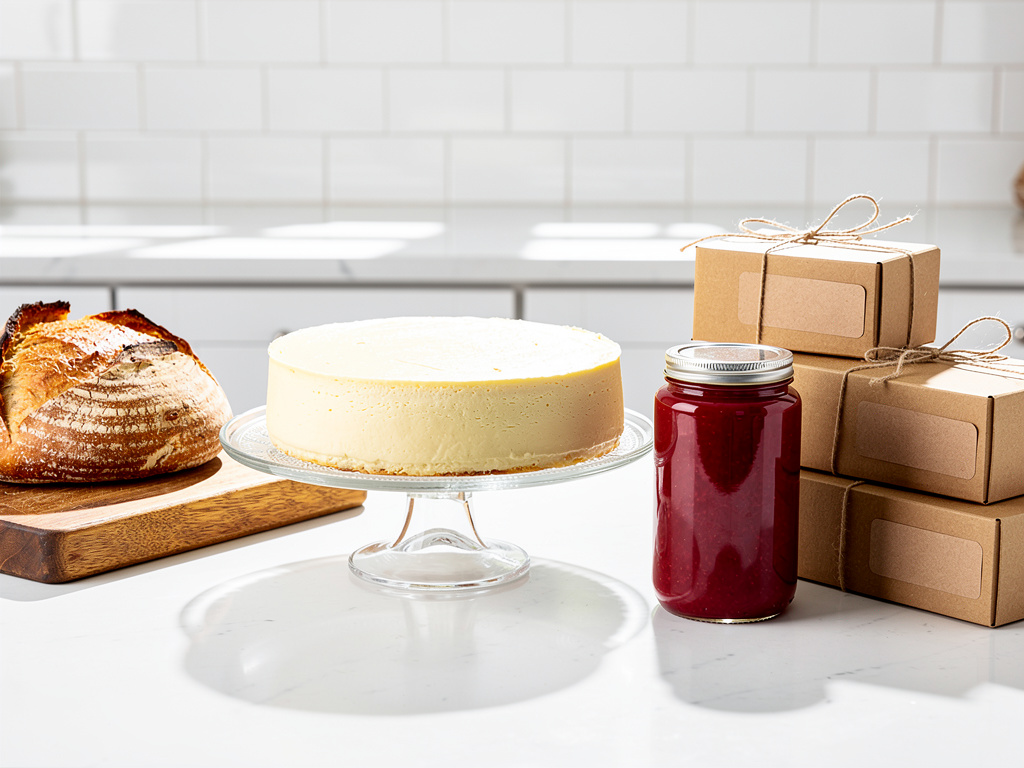


The short version: In Texas you can sell almost any food you make at home, with no permit, no license and no kitchen inspection, as long as your cottage food operation earns $150,000 or less a year. Senate Bill 541 (in effect since September 1, 2025) bans only six food groups: meat and poultry, seafood, ice and ice cream, low-acid canned goods, CBD or THC products, and raw milk. Every operator needs an accredited food handler course, every product needs a label, and chilled foods like cheesecake and cream pies need a DSHS registration, 41°F or colder storage, the make date on the label and a safe-handling statement. You can take orders online and have customers pick up at your house, but you, an employee or someone in your household must hand the order over, so shipping an online order is out. Every wholesale buyer must be a cottage food vendor, so a store or restaurant can buy from you at wholesale only if it signs a contract with you and registers with DSHS as one, and only for foods that do not need to be kept cold.
Checked on the Texas DSHS cottage food page, Texas Health and Safety Code Chapter 437 and the enrolled text of SB 541, October 14, 2026: every Texas rule in this guide was read in those sources that day, along with the DSHS registration guide, Local Government Code 250.009 and 25 TAC §229.661. This is general information, not legal advice. Homegrown prices were checked on findhomegrown.com/signup the same day; Homegrown customers create an account to place their first order, and there is no drops feature.
If you want Texas customers to order ahead for pickup or delivery, you can set up a Homegrown storefront and try it free for 7 days.
In Texas, you can sell most homemade foods directly to customers with no permit, no license, and no kitchen inspection, up to $150,000 in gross annual income from your cottage food sales. Since September 1, 2025, Texas has used an "everything except a short banned list" model under Senate Bill 541, so you can sell far more than baked goods, including foods that must stay refrigerated. This guide covers exactly what you can sell, how to register if you make refrigerated foods, the food handler course every operator needs, how to label everything, how online orders and pickup work, and how to start this week.
Ready to begin? Follow our step-by-step guide to starting a cottage food business in Texas, then come back here for the rule-by-rule detail.
The Texas cottage food limit is $150,000 in annual gross income from the sale of your cottage foods, raised from $50,000 by SB 541. The law tells the Texas Department of State Health Services (DSHS) to adjust that figure every year for inflation, using the Consumer Price Index. On October 14, 2026, the DSHS page still listed $150,000, so that is the number to plan around until DSHS posts a new one. There is no per-product or per-month cap, only the yearly total.
The cap counts gross income, the money customers pay you before you subtract ingredients, packaging or fees. A baker who sells $2,900 a week for 52 weeks takes in $150,800 and is over the line, even if her profit is a fraction of that.
Here are the main rules on one page. Each row is explained further down.
Scroll sideways to see every column.
| Texas cottage food rule | Detail | Where it comes from |
|---|---|---|
| Annual sales cap | $150,000 gross income, adjusted each year for inflation by DSHS | Health and Safety Code 437.001(2-b)(B) |
| Permit or license | Not required. A city, county or local health department cannot require one or charge a fee to sell directly to consumers | 437.0192(a) |
| Food handler course | Required for every operator, from a program accredited by DSHS | 437.0195(a) |
| DSHS registration | Required to sell TCS (must-stay-cold) foods; optional otherwise, to put an ID number on labels instead of your address | 437.01953, 437.0193(b-1) |
| Allowed foods | Anything except the six banned groups below | 437.001(2-b)(A) |
| Where you can sell | Directly to consumers (in person, at a farmers market or farm stand, or online with a personal hand-off), or wholesale to a cottage food vendor that has registered with DSHS (non-TCS foods only), who then sells in stores and restaurants. Stores and restaurants qualify only as cottage food vendors themselves: under contract to you and registered with DSHS | 437.001(2-b)(C), 437.0194, 437.01965 |
| Online orders | Allowed when the operator, an employee or someone in the household hands the food to the customer. Home pickup counts if that hand-off happens | 437.0194(b), 437.001(2-b)(D) |
| Shipping | Not allowed for an online order, even inside Texas, because the hand-off rule needs one of you to deliver it. For any other shipped order, ask DSHS first | 437.0194(b)(1) |
| Effective law | SB 541, September 1, 2025 | SB 541, Section 9 |
We read each rule in Chapter 437 of the Texas Health and Safety Code and the DSHS cottage food page on October 14, 2026. DSHS says it will adopt new rules for SB 541; check its page before you rely on any detail.
No: a Texas cottage food production operation does not need a permit, license, or inspection to start, and you pay $0 in city or county permit fees because the law bans them. Under SB 541, a local government authority, including a local health department, may not regulate the production of food at your home, and may not require you "to obtain any type of license or permit or pay any fee" to sell directly to a consumer or a cottage food vendor, or to give out samples (Texas Health and Safety Code Chapter 437, Section 437.0192). The law even bars a city or county from keeping on staff someone who knowingly tries to make a cottage food operation get a permit.
Registration with DSHS is a separate, lighter step, and it is not a permit. You must register if you sell TCS foods, the ones that have to stay cold for safety. If you only sell shelf-stable foods, registration is optional; its main benefit is a DSHS ID number you can print on labels instead of your home address. A cottage food vendor who buys your food at wholesale must register too; registering is that business's job, not yours.
Three things still apply even without a license:
Yes: every person who operates a Texas cottage food business must complete "a basic food safety education or training program for food handlers accredited under Health and Safety Code, Chapter 438(D)," according to the DSHS cottage food page, checked October 14, 2026.
What that means in practice:
Texas now uses an exclusion model: you can sell any food you make at home *except* 6 banned groups, per the Texas DSHS cottage food page. Before SB 541, Texas allowed only foods that did not need temperature control for safety; now the test is the banned list. Commonly sold allowed foods include:
Prohibited foods (the six banned groups):
TCS foods cannot be sold wholesale or donated. When in doubt, the test is whether the food falls into one of the six banned groups; if it does not, it is allowed, and the only question left is whether it needs the extra TCS steps. That opened up whole categories: in our October 14, 2026 pull of the Homegrown catalog, the 6 cheesecake listings (not counting one $30 box of a dozen minis) ran $20 to $55, a product a Texas home kitchen could not sell before SB 541.
Texas's written rule for cottage foods, 25 TAC §229.661, was last amended in 2022 and still describes the old food list. The statute changed on September 1, 2025, and the DSHS page says "DSHS will adopt rules" to carry out SB 541. When the new rules come out, details such as registration steps could change. We checked the rule's history on October 14, 2026.
Some of these yes, some no, and it all comes down to the six banned groups: of the 7 groups below, 2 are a flat no for a Texas home kitchen. Here is how the law sorts the foods people ask about most.
A TCS food (short for "time and temperature control for safety") is one that has to be kept cold or hot to stop germs from growing, and Texas lets home kitchens sell it only with four extra steps. The law's own examples include "baked goods that require refrigeration, including cream or custard pies or cakes" (437.001(8)). A food made with a cold ingredient is not TCS if the finished product no longer needs temperature control, so a cookie baked with butter and eggs is generally not a TCS food.
If you sell a TCS food, you must:
Two more limits apply only to TCS foods: you cannot sell them wholesale to a cottage food vendor, and you cannot donate them to a bake sale or event. For the hand-off, a cooler with ice packs and a probe thermometer is a simple way to keep a cheesecake at 41°F or below between your fridge and the customer's hands.
In a pull of the Homegrown catalog on October 14, 2026, 19 of the 2,927 products listed by 322 vendors were cheesecakes, cream or custard pies, meringue or key lime pies, tiramisu, tres leches or flan, from 9 vendors, priced from $6 for a single mini key lime pie to $55 for a chocolate and mascarpone cheesecake. That is the kind of chilled dessert SB 541 opened to Texas home kitchens. The pull does not tell us which of those shops are in Texas. Our rule: a whole-word match on those dessert words in the product name or description, every match read, cookies, cake pops, breads and fudge that only borrow the flavor left out, and each counted vendor's full product list read.
Pickles, fermented vegetables like sauerkraut, and plant-based acidified canned goods (a plant-based food with a finished pH of 4.6 or less that is heat-processed and sealed in an airtight container) are allowed, but only with a proven recipe and a batch record (the statute exempts pickled cucumbers, see below). Low-acid canned goods, such as plain home-canned green beans, corn or beets without added acid, are banned outright.
Before you sell pickled, fermented or acidified products, Section 437.01951 says your recipe must meet one of these:
Then, for every batch, you must give it a unique batch number on the label and keep a record for at least 12 months with the batch number, the recipe, the recipe source or test results, and the date you made it. The statute says this section does not apply to pickled cucumbers, but the DSHS label list asks for a batch number on all pickled fruit or vegetables without repeating that exception, so numbering your cucumber pickles too is the simple way to stay on the right side of both.
Number batches by date plus a letter, such as 261014A for the first batch made on October 14, 2026, and write the same code in a notebook or spreadsheet with the recipe name and source page. The law asks you to keep 12 months of records, and a code that is already the date means one less column to fill in.
Registration is a 17-step online form on the DSHS Online Licensing Registry, and approval is automatic. DSHS's own registration guide says DSHS staff do not review it, and if you do not get approval within a few minutes, your application was missing information. Neither the DSHS cottage food page nor its registration guide lists a fee (checked October 14, 2026), so budget $0 for this step unless DSHS posts one.
The guide's steps, shortened:
There is no application to wait on for shelf-stable foods, so the food handler course and your labels are the only steps that take any lead time. Here is the order to do it in.
Every Texas cottage food product must be packaged to prevent contamination and labeled. Every label needs six things, and some products need more. Foods too large or bulky to package can skip the package, but the label information then goes on an invoice or receipt.
Every label needs:
Some products need more:
Selling online adds one more step. Before you take payment, all the label information has to be posted on your website for the customer to read. Your address can wait: the law lets you leave it out of the online listing, as long as your address or DSHS ID is on the label after the customer pays. See our cottage food labeling guide for templates.
Texas lets you sell directly to consumers almost anywhere in the state, plus one wholesale path. The law defines a cottage food operation as one that sells "directly to consumers or to a cottage food vendor," and delivers "at the point of sale or another location designated by the consumer or cottage food vendor." You can sell:
A store or restaurant can buy from you at wholesale only by becoming your cottage food vendor, which takes a contract between the two of you plus its own DSHS registration (non-TCS foods only). A cottage food vendor is a person in Texas who has a contract with you, sells your food directly to consumers in Texas on your behalf, and registers with DSHS. That vendor must post the "PRODUCED IN A PRIVATE RESIDENCE" sign near your food, and your label must show the make date. TCS foods cannot go through a cottage food vendor at all.
You can also give out samples at any location in Texas, and donate non-TCS food to a bake sale or charity event.
Yes, as long as the order goes from your hands, an employee's, or a household member's straight to the customer. Texas allows an online sale "only if" the customer buys the food online from you and "the operator or operator's employee or household member personally delivers the food to the consumer" (Section 437.0194(b)). The law names who must hand the food over, not where, and its definition of a cottage food operation says delivery happens "at the point of sale or another location designated by the consumer." Your front door is a fine place for that hand-off.
The same rule is what rules out shipping. A carrier like USPS or a courier app is none of those three people, so an online order cannot be shipped, even to a customer in the next town. SB 541 also struck the words "or by mail order" from this section. The old law required the personal hand-off too, so shipping an online order was never allowed; for any other kind of shipped order, ask DSHS first.
Swipe left to see each delivery method.
| How the online order reaches the customer | Fits the Texas rule? | Why |
|---|---|---|
| Customer picks up at your house and you hand it over | Yes | You personally deliver it at a place the customer chose |
| Your teenager or spouse hands it over while you are out | Yes | A household member counts |
| You drive it to the customer's door and hand it to them | Yes | Personal delivery by the operator |
| You meet the customer at a farmers market or a parking lot | Yes | A location the customer chose |
| A cooler on your porch with nobody home | Unclear; ask DSHS first | Nobody "personally delivers" the food; we found no DSHS ruling either way |
| DoorDash, Uber or another courier | No | The driver is not you, an employee or a household member |
| USPS, UPS or FedEx | No | Shipping cannot meet the hand-off rule |
Our reading of Health and Safety Code 437.0194(b) and 437.001(2-b)(D) and the DSHS "Distribution" section, checked October 14, 2026. The porch-cooler row is our cautious reading, not a DSHS ruling.
An unattended porch pickup, where the customer grabs the order from a cooler while nobody is home, does not clearly fit the words "personally delivers," and we found no DSHS guidance on it. Email DSHS at foodestablishments@dshs.texas.gov before you set one up, and keep the answer. For TCS foods it is riskier still, because you also have to deliver them at 41°F or below.
The simplest legal setup is an online ordering page that shows your label information before checkout and gives customers a pickup time at your house or a delivery slot you drive yourself. That matches the two things Texas asks of every online sale: label information posted on your website before payment, and a personal hand-off.
That is the job Homegrown does for Texas cottage food operators. It costs $10 a month billed annually ($12.50 billed monthly) with a 7-day trial (no charge until day 8), no commission, and no fee added to your customer's total; the only other cost is standard card processing of 2.9% + $0.30 per order, which you pay. Every listing has a place for allergens and ingredients, so those details sit on the product page before the customer pays; add your operation's name and the "PRODUCED IN A PRIVATE RESIDENCE" statement to each product description too. You choose which days customers can pick up, or offer local delivery inside a radius you set (1 to 25 miles) on the days you drive. Hotplate, a pre-order app, charges no subscription but by default adds 5% + $0.55 to your customer's subtotal. Etsy is built around shipping, which Texas rules out for online orders, and its help page says Etsy "doesn't have a built-in tool for offering local pickup or delivery."
Homegrown customers create an account to place their first order, there is no drops or countdown release feature, and while your storefront is listed on the Homegrown marketplace, plan on most orders coming from people you send to your own link. Homegrown does not register you with DSHS, check your recipes, or make your labels for you. And on delivery days, hand the bag to the customer rather than leaving it at the door.
Swipe to compare all five options.
| Option | Monthly plan | Platform or service fee | Payment processing | Customer pays on a $20 order | You pay on a $20 order | You pay in a month of 50 orders at $20 | Local pickup built in? |
|---|---|---|---|---|---|---|---|
| Homegrown | $10 billed annually ($12.50 monthly); 7-day trial, no charge until day 8 | None, 0% commission | 2.9% + $0.30, paid by you | $20.00 | $0.88 plus the plan | $54.00 ($56.50 on monthly billing) | Yes, pickup days you choose, plus optional local delivery |
| Hotplate, default | $0, no trial needed | 5% + $0.55, paid by the customer | 2.9% + $0.30, paid by you | $21.55 | About $0.88 to $0.92 | About $44.00 to $46.25 | Yes, pickup times set for each pre-order window |
| Hotplate, you cover the fee | $0, no trial needed | 5% + $0.55, paid by you | 2.9% + $0.30, paid by you | $20.00 | $2.43 | $121.50 | Yes |
| Etsy | $0 (a one-time set-up fee may apply), no trial | 6.5% transaction fee, plus a $0.20 listing renewal for each product sold | 3% + $0.25, paid by you | $20.00 | $2.55 (two $10 products) | $127.50 | No built-in tool, and shipping is out in Texas |
| Venmo business profile plus DMs | $0, no trial needed | None | 1.9% + $0.10, paid by you | $20.00 | $0.48 | $24.00 | No storefront, so you still need a website for your label information |
Fees checked October 14, 2026 on findhomegrown.com/signup, Hotplate's pricing page and its post "What Hotplate does" (which says "80% of Hotplate chefs keep the default as-is"), Etsy's Fees and Payments Policy and payment processing help page, and Venmo's business profile fee page. Hotplate's range depends on whether card processing is figured on the $20 alone or on the total with Hotplate's fee. Venmo says customers who pay a business profile by credit card are exempt from its standard 3% credit card fee. Sales tax and tips are left out.
Set two pickup windows a week, such as Wednesday 5 to 7 p.m. and Saturday 9 to 11 a.m., and be home for both. Batching hand-offs into 4 hours a week is what makes the personal hand-off rule workable when you also have a day job.
Most Texas cottage food problems come from a handful of mistakes, and every one is avoidable with the rules above:
If you follow the cottage food rules, nothing: a home kitchen inside the law needs no food permit at all. The penalty question matters when an operator goes outside those rules, for example by selling meat tamales from home or passing the $150,000 cap, because the business is then no longer a cottage food operation and falls under the permit rules for food businesses in Chapter 437. Breaking one of the cottage food rules themselves, such as shipping an online order or leaving the required statement off a label, also violates Chapter 437, and Section 437.018 lets DSHS penalize anyone regulated under the chapter.
Chapter 437 sets these penalties:
Your city may also have its own rules on things like home businesses and signs. Those are separate from food permits, which a city cannot require of a cottage food operation.
Senate Bill 541 took effect September 1, 2025, tripled the sales cap from $50,000 to $150,000, and swapped the old food list for six banned groups. Homemade Texas, the advocacy group that pushed for it, called it "the biggest expansion of the Texas Cottage Food Law yet." Here is the before and after.
Swipe left for the before and after.
| Rule | Before SB 541 | Since September 1, 2025 |
|---|---|---|
| Sales cap | $50,000 | $150,000, adjusted each year for inflation |
| Foods | Only foods that did not need temperature control for safety (the law named 19 types, then "any other food that is not" a TCS food) | Anything except six banned groups, including TCS foods with registration |
| Wholesale | Not allowed | Non-TCS foods, sold through a DSHS-registered cottage food vendor |
| Label disclosure | A statement that the food is not inspected | "THIS PRODUCT WAS PRODUCED IN A PRIVATE RESIDENCE THAT IS NOT SUBJECT TO GOVERNMENTAL LICENSING OR INSPECTION." |
| Home address on label | Required | Optional if you register and use a DSHS ID number |
| Online and mail order | Internet or mail order, personally delivered by the operator | Internet only, personally delivered by the operator, an employee or a household member; "or by mail order" struck |
| Who can operate | An individual at home | An individual at home, or a 501(c)(3) nonprofit at a director's or officer's home |
From the enrolled text of SB 541, which shows the struck and added words, read October 14, 2026.
Read a plain-English breakdown from the advocacy group Homemade Texas, which pushed for the bill.
Up to $150,000 in gross annual income from cottage food sales under SB 541, a figure the law tells DSHS to adjust each year for inflation. The DSHS page still listed $150,000 on October 14, 2026. There is no monthly or per-product limit under the Texas cottage food law.
No. Texas requires no permit, license, or kitchen inspection for a cottage food operation, and local governments are prohibited from requiring one or charging a fee. You do need an accredited food handler course, correct labels, and a DSHS registration if you sell refrigerated TCS foods.
Yes, since September 1, 2025. You must register with DSHS, store and deliver cold foods at 41°F or below, put the make date on the label, and add the 12-point safe-handling statement on the label or receipt. TCS foods cannot be sold wholesale or donated.
Yes. You can take orders online as long as the order is delivered in person by you, an employee, or a household member, and customers can pick up at your home when one of you hands the order over. You cannot ship an online order, even to a customer inside Texas, and your label information must be on your website before the customer pays.
Meat and poultry, seafood and fish, ice products and ice cream, low-acid canned goods, CBD/THC products, and raw milk products. Almost everything else made in a home kitchen is allowed under the Texas cottage food law, though chilled foods need the extra TCS steps.
Only if you sell TCS (must-stay-cold) foods. Registration is optional for everyone else; it gives you a DSHS ID number to print on labels instead of your home address. Registration runs through the DSHS Online Licensing Registry, approval is automatic, and DSHS lists no fee.
No. SB 541 bars any local government authority, including a local health department, from requiring a license, permit, or fee for cottage food sold directly to consumers or to a cottage food vendor, or for giving out samples. If a city asks you for one, Section 437.0192 of the Health and Safety Code is the rule to point to.
Only if the store becomes your cottage food vendor by contracting with you and registering with DSHS. You can sell non-TCS foods at wholesale only to a registered cottage food vendor, a person in Texas with a contract with you who registers with DSHS and then sells your food to customers at a farmers market, farm stand, restaurant or retail store. TCS foods cannot be wholesaled at all.
These 7 guides pick up where this one stops, each on a question Texas readers of this page ask next.
Texas keeps the rules for home cooks and bakers short: a $150,000 cap, no permit, and a banned list of just six food groups. The work that remains is small and mostly one-time: a food handler course, a label template, a DSHS registration if you sell chilled foods, and a plan for handing orders over in person. Once your food handler course is done, your labels are right and (if needed) your DSHS registration is in, set up an easy way for customers to order and pay. Set up a Homegrown storefront to take Texas cottage food orders online for pickup at your house or delivery you handle yourself, then compare the rules in nearby states like Oklahoma, Louisiana, Arkansas, and New Mexico.
*This guide is general information, not legal advice. Cottage food rules change, so verify current requirements with Texas DSHS before you start selling. Last verified: October 14, 2026.*
Planning to sell at a farmers market? See our Texas farmers market vendor permit guide for the permits you will need on market day.



