
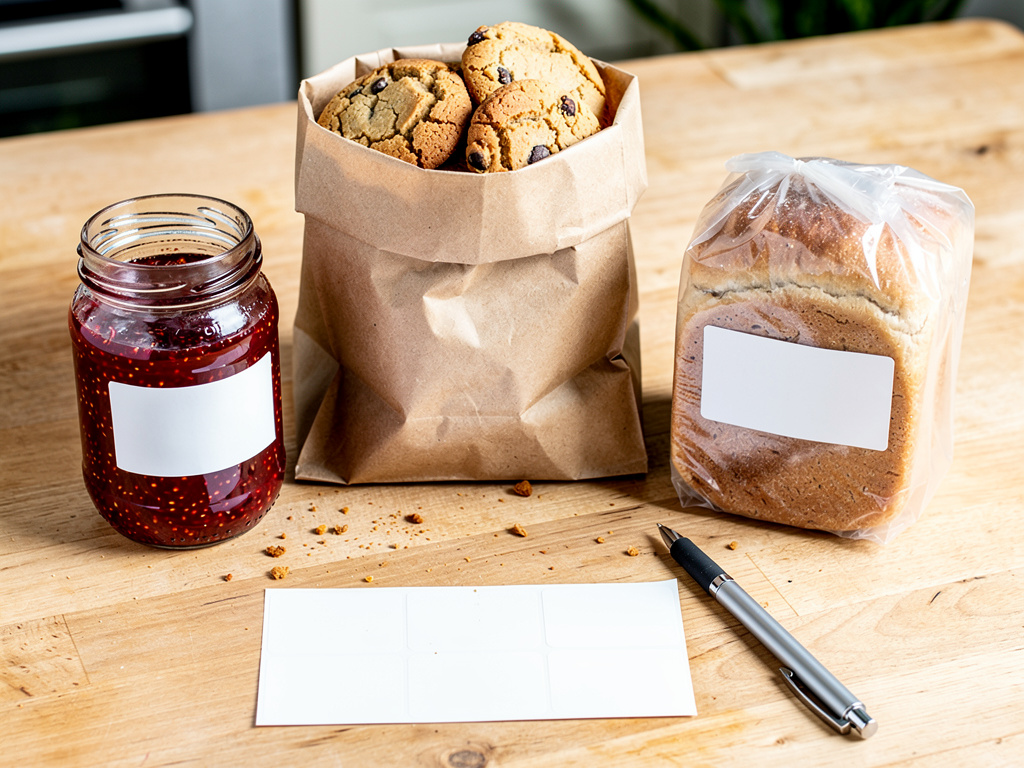


The short version: In most states, a cottage food label needs the product name, an ingredient list in order by weight, the net weight or volume, your name and address (or an ID number some states issue instead), any of the nine major food allergens, and your state's home-kitchen disclaimer. The disclaimer is where vendors slip: 11 of the 13 state rules we read set exact wording, and 8 of them also set a minimum type size of 10 to 12 point. Copy your state's sentence word for word from the agency page, print it on the front of the package, and add any extra your state lists, such as a permit number or the date you made the food.
Checked on each state agency's own page or statute, October 5, 2026: California, Colorado, Florida, Georgia, Louisiana, Maryland, Michigan, New York, Ohio, Texas, Utah, Virginia and Washington, plus the FDA's allergen and nutrition labeling rules. Rules change, so verify your state's current rules with its agency before you print a big batch. Homegrown pricing came from findhomegrown.com/signup the same day.
Once your labels are ready, you can set up a Homegrown storefront so local customers can order ahead, and try it free for 7 days.
Almost every cottage food product you sell needs a label. Not because it makes your jam jars look polished on a farmers market table, though it does, but because state law requires it. Missing a required element can get your product pulled from a farmers market, put you in violation of your cottage food exemption, or create a real safety problem for a customer with a food allergy.
You don't need a professional designer, expensive labeling software, or a compliance consultant. You need to know what goes on the label, get the wording right, and print something clean and readable.
This guide covers every required element, quotes the exact disclaimer from the 11 states that set one (and what New York and Louisiana ask for instead), shows two example labels, and walks through the most common mistakes so you can avoid them before your first sale. If your state isn't one of the 13, start with cottage food laws by state to find your state's agency, then use the same checklist.
Cottage food labeling requirements are the state rules that say what must be printed on food you make in your home kitchen and sell under your state's cottage food exemption. Across the state rules we read on October 5, 2026, most share the same six things: a product name, an ingredient list, the net quantity, who made it and where, the allergens, and a statement that it was made in a home kitchen rather than a licensed food business. Colorado, Texas, Louisiana and Georgia's 2025 statute ask for less, as the next sections show.
Where states differ is in the details:
The federal Food and Drug Administration (FDA) sets the allergen rules that Florida, Georgia, Maryland, Michigan and Washington point to by name, which is why the allergen section of this guide applies almost everywhere.
Cottage food labels matter because they do 2 jobs at once: they warn people with food allergies, and they tell every buyer the food came from a home kitchen, not a licensed and routinely inspected food plant. Getting your label right protects your customers and keeps your cottage food business in compliance.
Food safety. Your label tells customers what's in the product. For someone with a peanut allergy, a tree nut allergy, a wheat allergy, or celiac disease, your ingredient list and allergen declaration are the difference between a safe purchase and a serious reaction. When the federal allergen labeling law passed, the FDA says the eight allergens it named accounted for 90 percent of food allergies and serious allergic reactions in the U.S. Your label is a safety document first and a marketing tool second.
Legal transparency. Your state requires you to tell buyers that your product came from a home kitchen that isn't licensed and inspected the way a commercial food business is. Washington and Utah do inspect cottage food kitchens before approving them, and Washington's statement still says the kitchen "has not been subject to standard inspection criteria." This is the cottage food disclosure statement, and in 11 of the 13 states we read it's the one element you can't put in your own words. Omitting it, or using the wrong wording, can get you removed from a farmers market, earn you a compliance notice, or cost you your ability to sell under your cottage food exemption.
Beyond the legal requirements, a well-made label also builds trust. Customers at a farmers market are making quick purchase decisions. A clean, complete label with clear ingredient information signals that you take your product seriously. A handwritten sticker with incomplete information signals the opposite, even if the food itself is excellent.
Six core elements show up in nearly every state rule in this guide, and they are good practice everywhere. The exceptions are small: Colorado's checklist has no net weight line, and its disclaimer names the common allergens in place of a "Contains" line; Texas's state health department lists allergens but not a full ingredient list or net weight, Louisiana's statute only requires the "not produced in a licensed or regulated facility" statement, and Georgia's 2025 statute (O.C.G.A. 26-2-473) lists only your business name, address and phone (or ID number) plus its two-sentence statement, though the department's older FAQ still asks for the full list. Listing all six costs you nothing in those states and answers the questions customers ask anyway.
Here are the six, in the order most labels print them:
The product name should be a clear, descriptive name that tells the customer exactly what they're buying. Use names like "Strawberry Jam," "Sourdough Bread," "Maple Pecan Granola," "Chocolate Chip Cookies," or "Garlic Herb Salt." California's labeling sheet calls this the "common or descriptive name" and wants it on the front panel.
If your product has a creative or brand name, pair it with a descriptive identifier. "Sunrise Spread, Lemon Curd" is clear. "Sunrise Spread" by itself leaves a customer guessing. The goal is that someone who picks up your product and reads the label knows immediately and unambiguously what they're holding.
For products with multiple varieties, the name should distinguish between them. "Blueberry Jam" and "Peach Jam" are clear. Listing both as just "Homemade Jam" creates confusion and doesn't meet the intent of the cottage food labeling requirement. The word jam is itself regulated: FDA's standard of identity (21 CFR 150.160) requires a finished product of at least 65 percent soluble solids, made with at least 45 parts fruit to 55 parts sugar by weight (at least 47 for some fruits), before the label can say jam. A reduced-sugar version has to be named something like a fruit spread, one of the traps covered in what you are allowed to sell as homemade jam.
List every ingredient in descending order by weight: the ingredient used most goes first, the ingredient used least goes last. Florida, Georgia, Maryland, Michigan, New York, Ohio, Washington and California all write that heaviest-first, by-weight rule into their own labeling pages or statutes, and it's the federal rule too.
Use common names. Write "sugar," not "sucrose." Write "butter," not "milk fat." Write "baking soda," not "sodium bicarbonate." The purpose of the ingredient list is to be understood by a regular person, not to show off chemistry knowledge.
Sub-ingredients. If your product contains a compound ingredient (like chocolate chips, which themselves contain multiple ingredients), list the sub-ingredients in parentheses: "Chocolate chips (sugar, cocoa butter, milk solids, soy lecithin, vanilla)." Michigan and Washington both require this, and both use the same example: "soy sauce" alone is not acceptable, "soy sauce (wheat, soybeans, salt)" is. It matters most for allergens, because those chocolate chips contain milk and soy.
Water. If water is an ingredient (as in jam, bread, or any cooked product), include it in the list at its position by weight. Many home vendors forget to list water, but it's an ingredient in any product where you add it during production.
No lab test needed. Michigan, Washington and Georgia all say you do not need a laboratory to write your ingredient list. You build it from your recipe.
Don't forget anything. Go through your recipe ingredient by ingredient and make sure every single one appears on the label. This includes things people might consider incidental:
If it's in or on the product, it goes on the label. Michigan's page answers the trade-secret question directly: "You are required to list all of your ingredients."
Measure after production, not before: the net quantity is the amount of product the customer is actually getting. For solid products like bread, cookies, or granola, this is weight: "Net Wt. 8 oz (227 g)." For liquid products like jam, honey, or hot sauce, this is volume: "Net 8 fl oz (237 mL)."
Whether you need the metric number depends on your state. California's labeling sheet asks for both "English (pound) units and metric units (grams)," and Michigan's page says the net weight "must also include the metric equivalent." Florida and Maryland ask for the net weight or volume without saying which units, so printing both is the safe choice everywhere.
For baked goods, weigh the finished product, not the dough or batter. A 24-ounce dough ball might become a 20-ounce loaf after baking. The net weight on the label should reflect what the customer is actually getting.
If your products vary slightly in weight (which is natural for handmade products), weigh several from each batch and use a conservative figure that represents the lightest one. Never overstate the weight. Maryland also allows a count ("12 cookies") in place of a weight.
Who made the product goes on the label in 12 of our 13 states; Louisiana's statute only requires the disclaimer. Most of those 12 want an address, while Washington wants your permit number and four states let you swap the address for an ID number. This identifies who made the product and where to find you if there's an issue: a quality complaint, an allergen question, or a recall.
The address rule varies more than any other element:
If you operate under a business name, Georgia's statute, Florida's statute, Maryland's guidelines and Ohio's code all refer to the name of the cottage food operation or business, so the name you actually operate under is the one that goes on the label. "Your Business Name, Jane Smith, Anytown, CA" covers both bases.
Your label has to name any of the nine major food allergens that are in the product, because allergen declarations are safety-critical. Federal law names those nine that must be declared whenever they're present, and Florida, Georgia, Maryland, Michigan and Washington point their cottage food labeling guidance straight at those federal requirements:
Sesame became the ninth major allergen on January 1, 2023, under the FASTER Act, per the FDA's food allergies page, checked October 5, 2026.
There are two accepted formats for allergen declaration, and either one satisfies the cottage food labeling requirement. The FDA's guide to food allergen labels spells out both:
"Contains" statement. A separate line immediately after or next to the ingredient list: "Contains: wheat, eggs, milk." This is the simpler method and is harder to miss when scanning a label.
Inside the ingredient list. The allergen's source name goes in parentheses right after the ingredient, such as "whey (milk)," "lecithin (soy)" or "flour (wheat)." If the ingredient's own name already says the allergen ("wheat flour," "buttermilk"), that counts too. Bold type is not what the federal rule asks for; the word is.
The "Contains" statement is recommended for cottage food vendors because it's clearer and less likely to result in a missed allergen. If you declare inside the list, you need to catch every ingredient that carries an allergen. Miss one and you've created a safety gap.
Two state labeling pages we read on October 5, 2026 still leave sesame off their allergen lists: California's labeling sheet (revised January 2025) and Michigan's labeling page. Both states point to federal allergen rules, and the federal list has included sesame since January 1, 2023. Declare sesame.
"May contain" statements are different from "Contains" statements. A "may contain" advisory (for example, "May contain traces of tree nuts") is used when there's a risk of cross-contact from shared equipment, even though the allergen isn't an intended ingredient. The FDA says these statements are not required by law and must be truthful and not misleading. They're good practice if you make several products in the same kitchen and some contain allergens that others don't.
For example, if you make peanut butter cookies and plain sugar cookies on the same baking sheets, a "May contain peanuts" statement on your sugar cookies is truthful even though peanuts aren't in the sugar cookie recipe. The FDA says an advisory line is not a substitute for good manufacturing practices, though, so wash the sheets between batches and use the line only for the risk that is left. Colorado builds this into its disclaimer: its required sentence says the kitchen "may also process common food allergens."
For a deeper walk through hidden allergen sources, the Big 9 allergens on a cottage food label goes ingredient by ingredient.
The disclosure statement, often called the cottage food disclaimer, is the sentence that tells buyers your food came from a home kitchen rather than a licensed, routinely inspected food business. It's the most important label element from a compliance point of view, because it's the one an inspector or market manager can check against a fixed sentence. Of the 13 rules, 11 set exact wording; New York says home processors "should add a phrase like" "Made in a Home Kitchen," and Louisiana's statute requires the meaning without fixing the sentence.
The exact wording varies by state and usually matters. Here are three real examples from state pages checked October 5, 2026:
The difference between these statements isn't just cosmetic. Florida, Georgia, Ohio, Virginia and Washington put the exact sentence in statute; for the other states, we quote the sentence as each agency's own labeling page prints it. Using a paraphrase, even a close one, can technically put you out of compliance. A farmers market manager or inspector who checks your label is looking for the specific required language, not an approximation.
How to find your state's required disclosure language: Go to your state's agency page (usually the department of agriculture or health) and look for the labeling section, or start from the table in the next section. Copy it word for word. Don't paraphrase. Don't abbreviate. Use it exactly as written.
Where to place it on the label: The disclosure statement should be clearly visible and easy to read. California, Utah and Virginia all require it on the principal display panel, which is the front of the package. Florida, Maryland, Michigan, Washington and Georgia's FAQ call for a color that contrasts with the label background. A spot directly below the product name works well, where it's impossible to miss.
Usually no, but four states in this guide have a date rule and one has a batch rule. Virginia's statute requires "the date the food product was processed" on every exempt home food label. Colorado's label list includes the production date. Texas requires the date made on time-and-temperature-controlled foods and on food sold through a registered cottage food vendor. Maryland requires the date made on labels for products sold to retail stores. Texas also requires a unique batch number on pickled fruit or vegetables, fermented vegetables and plant-based acidified canned goods.
The cottage food disclaimer is a different sentence in almost every state, so copy yours from the table below or from your agency's page, word for word. We read each of these 13 states' own agency page or statute on October 5, 2026. Each state name links to our full guide for that state.
Scroll sideways to see every column.
| State | Exact disclaimer wording | Minimum size | Address on the label | Other label rules worth knowing |
|---|---|---|---|---|
| California | "Made in a Home Kitchen" (or "Repackaged in a Home Kitchen") | 12-point, on the front panel | Name, city and ZIP; street address only if you're not in a current phone directory | Your registration or permit number and the county that issued it; net quantity in both pounds/ounces and grams |
| Colorado | "This product was produced in a home kitchen that is not subject to state licensure or inspection and that may also process common food allergens such as tree nuts, peanuts, eggs, soy, sesame, wheat, milk, fish, and crustacean shellfish. This product is not intended for resale." | Not stated | Physical production address, plus a current email or phone number | Production date on the label; a point-of-sale sign with a shorter version of the disclaimer |
| Florida | "Made in a cottage food operation that is not subject to Florida's food safety regulations." | 10-point, contrasting color | Name and address | Nutrition information only if you make a nutrition claim |
| Georgia | Statute (HB 398, since July 1, 2025): "This product was produced at a residential property that is exempt from state inspection. This product may contain allergens." The state's FAQ page still shows the older "MADE IN A COTTAGE FOOD OPERATION THAT IS NOT SUBJECT TO STATE FOOD SAFETY INSPECTIONS" | 10-point (the FAQ adds all caps, Times New Roman or Arial) | Business name, address and phone, or a Department of Agriculture ID number in place of the address | Online listings must show the same information on the web page |
| Louisiana | No fixed sentence. The label must clearly indicate the food "was not produced in a licensed or regulated facility" | Not stated | Not stated in the statute | Raw honey that isn't pasteurized or filtered is exempt from the statement |
| Maryland | "Made by a cottage food business that is not subject to Maryland's food safety regulations" | 10-point, contrasting color | Business address, or a Department of Health ID number plus your name and phone | Labels for retail-store sales add phone, email and the date made |
| Michigan | "Made in a home kitchen that has not been inspected by the Michigan Department of Agriculture & Rural Development" | 11-point (about 1/8 inch tall), contrasting color | Physical address, no PO box; the label list also allows an MSU Product Center registration number and phone | Net weight must include the metric equivalent |
| New York | No mandated sentence. Home processors "should add a phrase like" "Made in a Home Kitchen" | 1/16 inch or larger | "Full address" on the labeling section; the FAQ says street address or PO box | All nine allergens identified in the ingredient statement |
| Ohio | "This product is home produced." | 10-point | Name and address of the business | Also follow the federal labeling rules in 21 CFR Part 101 |
| Texas | "THIS PRODUCT WAS PRODUCED IN A PRIVATE RESIDENCE THAT IS NOT SUBJECT TO GOVERNMENTAL LICENSING OR INSPECTION." | Not stated (a 12-point safe-handling statement applies to foods that need time and temperature control for safety, or TCS) | Address, or a state health department registration number instead | Allergens listed; date made on TCS foods; batch number on pickled, fermented and acidified foods |
| Utah | "Home Produced" | 12-point, bold, on the front panel (other required text at least 1/16 inch) | Name, full street address and phone number | Name, full ingredient list, net quantity and allergens |
| Virginia | "NOT FOR RESALE PROCESSED AND PREPARED WITHOUT STATE INSPECTION." (the agency FAQ prints a dash after "RESALE") | Not stated; on the front panel | Physical address or PO box, plus phone | The date the food was processed |
| Washington | "Made in a home kitchen that has not been subject to standard inspection criteria." | 11-point, contrasting color | Business name and your state permit number | A label for every product goes in with your permit application |
Sources, all loaded October 5, 2026: CDPH Cottage Food Labeling Requirements (rev. 1/2025); CDPHE cottage foods page and checklist; Florida Statutes 500.80; Georgia HB 398 (O.C.G.A. 26-2-473) and the GDA cottage food FAQ; Louisiana R.S. 40:4.9; Maryland Department of Health Guidelines for Cottage Food Businesses (2025); MDARD cottage food labeling page; NYS Agriculture and Markets home processing page; Ohio Revised Code 3715.023 and OAC 901:3-20-02; Texas DSHS cottage food production page; UDAF cottage food page and its Basic Labeling Guidelines for Cottage Foods; Code of Virginia 3.2-5130 and the VDACS home food exemptions FAQ (rev. July 2026); RCW 69.22.020 and the WSDA cottage food page.
Count the rows and the pattern is clear. Eleven states give you a sentence to copy: California, Colorado, Florida, Georgia, Maryland, Michigan, Ohio, Texas, Utah, Virginia and Washington. The other two, New York and Louisiana, leave the wording to you. In New York, the agency's own suggestions ("Made in a Home Kitchen" is one) are the safe pick. In Louisiana, write a line that plainly tells buyers the food did not come from a licensed or regulated facility, since that meaning is what the statute requires.
Georgia's own pages disagree. The HB 398 law that took effect July 1, 2025 sets the two-sentence statement shown in the table above and lets you use a state ID number instead of your address. The Department of Agriculture's cottage food FAQ, checked the same day, still shows the older all-caps statement and says your physical address must be on the label, and its HB 398 FAQ says the old rules are being amended. Until the department finishes that update, email CottageFoodInfo@agr.georgia.gov and ask which sentence an inspector will look for.
Colorado's cottage food page announces that the "Tamale Act" (HB26-1033), signed June 4, 2026, begins January 1, 2027. The enacted bill summary says every producer will have to register with the state and get a registration number, and it replaces today's $10,000 cap on each product type with a $150,000 yearly cap for each vendor. The state's labeling guidance for the new law was not posted yet when we checked on October 5, 2026, so a Colorado label printed now may need a reprint in January.
The disclaimer has to be at least 10-point type in the eight states that set a size in points, and 12-point in California and Utah, the strictest we read. Here is how the eight compare:
Minimum disclaimer type size, in points
Source: each state's agency page or statute, read October 5, 2026. New York asks for 1/16 inch or larger instead of a point size. Colorado, Louisiana, Texas and Virginia did not state a size on the pages we read.
Point size is a printing measure, so it helps to know what it looks like. Michigan's page translates its 11-point minimum as "about 1/8" tall." Set your disclaimer in the size your state names, print a test label at 100 percent scale (not "fit to page"), and hold a ruler to it.
If your state sets no size, use 10-point as your floor anyway. It keeps the statement readable at arm's length, and it means one label design works if you ever sell under a stricter state's rules.
Michigan's page puts 11-point type at about 1/8 inch tall, which gives you a ruler test for an 11-point rule. Print one test sheet with scaling set to 100 percent, measure from the top of a tall letter like "h" to the bottom of a "g" in your disclaimer line, and if it comes in clearly under 1/8 inch, bump the size before you print a 300-label pack. In a 12-point state like California or Utah, go one size larger than the line that passes this test.
A cottage food label example is easiest to understand laid out the way it prints. The California Department of Public Health's labeling sheet and Michigan's cottage food labeling page both publish a sample 3-ounce chocolate chip cookie label, and they follow the same order: disclaimer, product name, maker, ingredients, allergens, net weight. Here is a version for California, built from CDPH's sample, followed by the same cookie for Ohio.
California example (front panel, everything on one label):
MADE IN A HOME KITCHEN
Permit #: 00000, issued in county: Your County
Chocolate Chip Cookies
Your Name, 123 Example Lane, Anytown, CA 9XXXX
Ingredients: enriched flour (wheat flour, niacin, reduced iron, thiamine mononitrate, riboflavin, folic acid), butter (milk, salt), chocolate chips (sugar, chocolate liquor, cocoa butter, milkfat, soy lecithin), brown sugar, eggs, walnuts, vanilla extract, baking soda, salt
Contains: wheat, milk, soy, eggs, walnuts
Net Wt. 8 oz (227 g)
California wants "MADE IN A HOME KITCHEN" in 12-point type on this front panel, plus the permit or registration number and the county that issued it.
Ohio example (same cookie):
Chocolate Chip Cookies
Your Business Name, 45 Example Avenue, Columbus, OH 43XXX
Ingredients: enriched flour (wheat flour, niacin, reduced iron, thiamine mononitrate, riboflavin, folic acid), butter (milk, salt), chocolate chips (sugar, chocolate liquor, cocoa butter, milkfat, soy lecithin), brown sugar, eggs, walnuts, vanilla extract, baking soda, salt
Contains: wheat, milk, soy, eggs, walnuts
Net Wt. 8 oz (227 g)
This product is home produced.
Ohio's statute sets that last line at ten-point type, so it can sit at the bottom of the label as long as it's that size.
The names and addresses above are placeholders, not real businesses. Notice what changed between the two labels: the disclaimer, the address line, and California's extra permit number and county. The ingredient list, allergen line and net weight are identical, because those follow the same federal-style rules in both states. That's why the cleanest way to build labels for several products is one template with a fixed disclaimer block and a swappable ingredient block.
Maryland's guidelines show two layouts: one label with everything, or a front label (product name, maker, address or ID, net weight, disclaimer) plus a back label that repeats the product name over the ingredients and the "Contains" line. Both work anywhere a rule doesn't put a specific element on the front panel. California, Utah and Virginia do, so in those states keep the disclaimer on the front.
If you sell jam or honey, the jam label ideas and honey label ideas guides show how to fit all of this on a small jar without losing your brand.
Among the states we checked, Washington is the only one whose agency page says a label for every product must be submitted before you can sell: "An accurate label of every product you plan to sell must be submitted with the application." Washington inspects your kitchen before issuing the permit, and you add products later by submitting changes.
Two more states ask for a label in narrower cases or leave it to the county:
The other 10 states we read did not ask for a label before sales on the pages we checked: Colorado, Florida, Georgia, Louisiana, Michigan, New York, Ohio, Texas, Utah and Virginia. Utah and New York do require a registration (Utah approves operators through an inspection and registration process), so ask either agency what the application includes. Texas requires registration with its state health department if you sell foods that need time and temperature control for safety (TCS). Colorado adds registration on January 1, 2027.
A state that doesn't review your label up front can still check it later. Georgia's department investigates complaints, Florida's statute lets the department inspect after a complaint, and New York reviews kitchens on a complaint basis. A wrong label usually gets noticed when a customer or market manager reads it.
Yes, in four of the states in this guide, and Washington's statute asks for a permit number on the label instead of an address. Here is how each of the 5 works, from each state's own page on October 5, 2026:
California works the other way: you can print just your name, city and ZIP if you're listed in a current telephone directory, but you also add the number your county issued and the county's name. Virginia accepts a post office box with a phone number.
Online and custom orders still need the label information, but at least 4 states we checked let you deliver it on a web page, an invoice or a sign instead of only a sticker. Washington is the exception: its statute says cottage food "may not be sold by internet, mail order, or for retail sale outside the state" (RCW 69.22.020). The cottage food page of the Washington State Department of Agriculture (WSDA) reads that as a ban on online sales, not online orders: you can advertise and "take orders over the Internet," but you can't ship, and delivery and payment must happen "in a person to person transaction" between you and the buyer. So in Washington, take the order online, then hand over the food and take payment in person, and confirm with WSDA before you set up online ordering. Here is what the pages we read say:
The practical takeaway: write each product's ingredients, allergens and disclaimer once, and use the same text on the printed label and on the product listing your customers order from.
This is where a scattered order system causes label mistakes. When orders come in through Instagram DMs and texts, the ingredient and allergen details live in your head or in old messages, and a customer with a sesame allergy is relying on whatever you typed that day. On a Homegrown storefront, every product listing has an allergens and ingredients section (listed as included on the signup page, checked October 5, 2026), so you write the same ingredient and allergen text that's on your label once and every customer sees it before they order. You can also show an approximate location until purchase, so your street address isn't on your storefront. Homegrown does not check that your wording matches your state's rules, so copy it from your label.
These aren't required in most of the states covered here, but including them makes you look professional and protects you and your customers. Check the date rules above first, because in 2 states, Virginia and Colorado, a date is required on every label, not optional.
You don't need a graphic designer or expensive software: a home printer, blank label sheets and a free design tool will get you a compliant, professional-looking cottage food label. Here's the practical approach.
If you'd rather not build one from scratch, our cottage food label template shows a sample label for your state, its disclaimer text and a checklist of the required elements. Compare its disclaimer line against the table above and your state's agency page before you print.
Printing options:
Scroll sideways to see every column.
| Method | Example product and price | Cost per label | Best for |
|---|---|---|---|
| Home printer on paper label sheets | Avery 22806, 2" x 2" matte white, 300 labels for $12.49 (sale price; regular $22.38) | About 4.2 cents, or about 6.1 cents with $5.95 flat-rate shipping | Small quantities, getting started, back labels |
| Home printer on water-resistant sheets | Avery 22827, 3.5" x 4.75" water resistant (removable adhesive), 32 labels for $22.66 | About 71 cents | Jars and bottles that sweat in a cooler or get wiped down |
| Online custom label printer | Sticker Mule custom labels; the page's price data starts at $47 (no size or quantity stated) | Depends on size and quantity | Larger runs with a design that won't change often |
Prices from avery.com product pages and stickermule.com's custom labels page, checked October 5, 2026. Avery's prices were marked as sale prices that day and do not include printer ink. Shipping on Avery orders under $75 was a $5.95 flat rate.
Do the math once for your own product line. At the sale price, a 300-label pack plus shipping is $18.44, or about 6.1 cents a label, so labeling 100 small bags or jar back labels costs about $6 in label stock. A 2" x 2" label is too small for most jar fronts; the 3.5" x 4.75" water-resistant sheets in the table run about 71 cents a label. Pre-printed custom labels make sense once your wording is final, because a reprint is the expensive part when a state changes its rule.
Printed vs. handwritten: Printed is the safer choice, but handwritten is not banned everywhere. Georgia's, Michigan's and Washington's pages all accept hand-printed labels that are clearly legible, written with durable, permanent ink, and large enough to meet the type size rule. Handwritten labels still smear, fade, and look less professional than a basic printed label from a home printer.
If you are taking online pre-orders and customers are picking up at a farmers market or at your home, your label does two jobs: it identifies the product for the customer and it is your compliance record. A clean label makes pickup quick when you have 15 orders staged on your porch. Managing those orders through DMs and Venmo works at small scale but breaks down once you have more than a handful of regulars: payments disconnect from orders, and you spend more time coordinating pickup than labeling jars. Etsy is the other common choice, but it charges a $0.20 listing fee per item, a 6.5% transaction fee on each sale and, for US sellers, 3% plus $0.25 in payment processing (checked on Etsy's fees and payments policies, October 5, 2026), so about $2.35 on a $20 order before shipping or tax, and it's built around shipping, while Michigan, Ohio, Colorado, Maryland, New York, Utah, Virginia and Washington all keep cottage food sales inside the state. Homegrown costs $10/month billed annually ($12.50 billed monthly) with no percentage fees beyond standard payment processing (2.9 percent plus $0.30 per transaction, paid by you, so about $0.88 on a $20 order). It gives you one link where customers order, pay, and choose pickup or local delivery, with a 7-day trial (no charge until day 8). Customers create a Homegrown account to place their first order, and your storefront is listed on the marketplace, but plan on most orders coming from people you send to your own link. Homegrown does not design your labels, verify your ingredient lists, or check that your disclosure statement matches your state's required language. It handles the ordering step so each properly labeled product is matched to the right customer at pickup.
A health or nutrition claim is the one thing that can turn a simple cottage food label into a federal nutrition label. The FDA's small business exemption (21 CFR 101.9(j)(1)) excuses sellers whose total sales to consumers are not more than $500,000 a year, or whose food sales are not more than $50,000, from the Nutrition Facts panel, "provided that the food bears no nutrition claims or other nutrition information." Make a claim and the exemption is gone.
The states we read say the same thing in their own words:
Health claims ("supports immune health," "good for digestion") are a separate, stricter category under 21 CFR 101.14, and they're a bad fit for a cottage food label. The organic claim has its own rule: under USDA's organic regulations (7 CFR 205.101), an operation selling $5,000 or less of organic products a year is exempt from certification, but anything above that needs a certifier before "organic" goes on the label. Colorado's cottage food page is stricter in its wording: it says cottage foods labeled "organic" have to be certified, though you may list an ingredient as organic as long as the word isn't on the primary label.
Understanding what goes wrong helps you get it right the first time. These are the label mistakes the state rules in this guide make easiest to make.
No. Pet treats are animal food, not cottage food, and the 4 states in this guide whose pages address them all send them to separate rules. Washington's FAQ says its cottage food law "applies to human-grade food only." Georgia's cottage food page says "Pet food and pet treats require a feed license," New York's page says pet foods and pet treats made at home "require a separate registration," and Utah's agriculture department posts a separate Home Produced Pet Treats application. At the federal level, the FDA's animal food labeling rules (21 CFR part 501) call for a product name, a net quantity statement, the name and place of the manufacturer or distributor, and every ingredient listed by weight. That FDA list does not include the "Contains" allergen statement used on human food, though every ingredient still has to appear. The difference shows up on the label itself. A cottage food label carries a home-kitchen disclaimer and a "Contains" line; a pet treat label carries the name of the animal it's for and, under the model feed rules from the Association of American Feed Control Officials that the FDA says many state pet food rules are based on, a guaranteed analysis of protein, fat, fiber and moisture. If you sell both people cookies and dog biscuits from the same kitchen, keep two separate label templates so a disclaimer never ends up on a dog treat and a guaranteed analysis never ends up on a cookie. If you bake dog treats, how to sell dog treats from home covers the feed license side.
It takes an afternoon of work and saves you from compliance headaches, farmers market rejections, and the much harder task of fixing labels after you've already sold products with incorrect information.
Here's the checklist:
Once your label is ready and your product is compliant, you're ready to sell. If you're still working through the rest of the startup process (product selection, pricing, finding your first sales channel), how to start a cottage food business covers the full sequence from product to first sale. And since cottage food labeling requirements are tied directly to the rules in your state, cottage food laws by state is the right place to verify what your state specifically requires before you print your first label.
Before you go to the farmers market, it's also worth confirming whether your city or county requires a local business license for home-based food vendors. Do you need a business license to sell food from home breaks down exactly when you need one and when you don't. And for a broader look at building a home food business from the ground up, beyond labeling, how to sell food from home covers the sales, pricing, and operations side in full.
Usually not. Under the FDA's small business exemption, sellers with no more than $500,000 in total sales to consumers, or no more than $50,000 in food sales, don't need a Nutrition Facts panel as long as the label, your product listings and your ads make no nutrition claims. California, Florida and Maryland all say a claim like "low sugar" or "high protein" brings the nutrition panel back, so keep cottage food labeling requirements simple by leaving claims off.
In the states that spell it out, yes. Florida, Georgia, Maryland and Ohio ask for the name of the cottage food operation or business, so a business name works when it's the name you operate under. Maryland adds that a label using its ID number must still show your business name and phone. Check your state's specific rule before you drop your personal name.
No. A label printed at home on adhesive label sheets is perfectly acceptable, and Georgia, Michigan and Washington even accept hand-printed labels in permanent ink if they're legible and meet the type size rule. Paper label sheets cost about 4 to 6 cents a label at Avery's sale prices checked October 5, 2026. Some farmers markets have their own packaging standards that effectively require printed labels.
Use your state's minimum for the disclaimer: 12-point in California and Utah, 11-point in Michigan and Washington, and 10-point in Florida, Georgia, Maryland and Ohio, based on the pages we read October 5, 2026. New York asks for 1/16 inch or larger. If your state names no size, 10-point for the disclaimer and a readable size for the ingredient list are a safe floor for cottage food labeling requirements anywhere.
Not usually. A cottage food label carries one state's disclaimer, and no two of the 11 states with fixed wording use the same sentence. Most vendors never need a second label, because 8 of our 13 states (Michigan, Ohio, Colorado, Maryland, New York, Utah, Virginia and Washington) keep cottage food sales inside the state. If you live near a border, your exemption covers the state where your kitchen is, because the state rules we read tie it to the kitchen in your own home. Before you sell at a market across the line, check that your home state allows sales outside it and ask the other state's agency what it requires.
Reprint. State cottage food laws change often: Texas updated its labeling rules on September 1, 2025, Georgia set a new disclaimer on July 1, 2025, and Colorado's new law starts January 1, 2027. Check your state agency's page once or twice a year and before every large print run, and update your labels before your next sale.
Printing your own labels at home costs about 4.2 cents a label on Avery's 2" x 2" paper sheets (300 for $12.49 on sale, checked October 5, 2026), or about 6.1 cents with $5.95 shipping, before ink. Water-resistant sheets for jars ran about 71 cents a label. Sticker Mule's custom labels page lists a starting price of $47 in its price data, with no size or quantity stated. A first pack of 300 paper labels with shipping comes to $18.44.
These five guides answer the questions that usually come right after the label, from the allergen details to the printer you print it on. Each one is a live Homegrown guide, and the state guides linked in the table above go deeper on caps, permits and allowed foods for those 13 states:
When you are ready to take orders, an ordering page takes about 15 minutes to set up: no website to build, no complicated setup. Put the same ingredient and allergen text from your label on each product, and share one link with the customers who already want to buy from you. Start your Homegrown storefront for $10 a month billed annually.



