
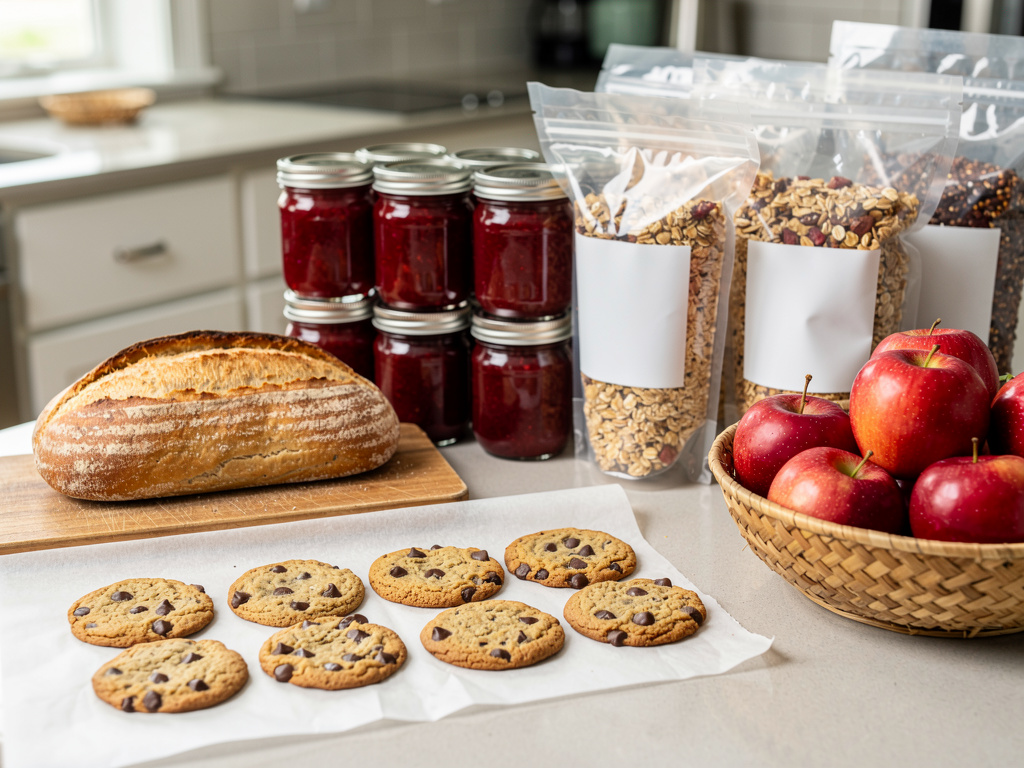


The short version: New York's cottage food law is the Home Processor exemption: you register with the Department of Agriculture and Markets, and then you can sell approved shelf-stable foods from your home kitchen without a state food processing license. Per the department's page, registration currently costs nothing and has no expiration date unless you move, and neither the regulation nor that page sets a sales cap. You can sell retail and wholesale, at markets, by home delivery and online, but only to buyers inside New York and only foods on the approved list (no tempered chocolate dipping, no homemade buttercream or cream cheese frosting, nothing that needs refrigeration). The department says to allow up to 16 weeks for it to review a request, so send yours well before your first market.
Checked October 6, 2026: the department's Home Processing page, the Home Processor Registration Request form (FSI-898c), its qualification flow chart (revised July 2026), its registered home processor list (dated September 24, 2026), and the regulation, 1 NYCRR 276.4. Homegrown, Hotplate and Etsy prices were checked on their own pages the same day. On Homegrown, customers create an account to place their first order, and there is no drops feature. This guide is general information, not legal advice.
Once your Home Processor registration comes through, you can set up a Homegrown storefront so customers can order ahead, and try it free for 7 days.
In New York, you can sell homemade shelf-stable foods under the state's Home Processor exemption. The department's page lists no sales cap and no fee, and the registration does not expire unless you move. You can sell retail and wholesale, in person and online, anywhere inside New York. This guide covers what the exemption is, what you can and cannot make, how to apply and how long it takes, how to label, where the registered list lives, and the sales tax and chocolate rules that trip New York vendors up.
Ready to begin? Our step-by-step guide to starting a cottage food business in New York walks through the business side. This page is the rulebook, including the department's current review time of up to 16 weeks.
The New York Home Processor exemption lets you make certain low-risk foods in your own kitchen and sell them without the Article 20-C food processing license that a commercial bakery needs. It is New York's version of a cottage food law. The department's latest list shows 21,674 registered home processors, and the law behind it is short. Agriculture and Markets Law section 251-z-4 lets the state agriculture commissioner exempt small food processors by regulation, and the regulation, 1 NYCRR 276.4, exempts "processors of home-processed foods" as long as their products are clean, labeled, not adulterated and not misbranded.
Most of the day-to-day rules come from the department's Home Processing page, not from the regulation. That matters, because the page can change without a new law. Here is how the pieces split:
The regulation's definition is the heart of it. A home-processed food is made "in a private home or residence using only the ordinary kitchen facilities" that also feed your household, and it excludes potentially hazardous foods, low-acid canned foods and acidified foods like pickles (1 NYCRR 276.3). That is why the department's FAQ says commercial equipment is not allowed.
New York has no cottage food sales limit: neither the regulation (1 NYCRR 276.4) nor the department's Home Processing page sets an annual sales cap for registered home processors, so the rules as written let you sell as much as you can make. The limits that do apply are about what you make and where you sell it, not how much.
Scroll sideways to see where each rule comes from.
| New York home processor rule | Detail | Where it comes from |
|---|---|---|
| Annual sales cap | None stated | Not in the regulation or on the agency page |
| License | Not required; exempt from Article 20-C licensing | 1 NYCRR 276.4(b) |
| Registration | Required; no fee; no expiration date; re-register if you move | Agency page |
| Review time | Allow up to 16 weeks | Agency page notice |
| Allowed foods | Only the approved shelf-stable list | Agency page |
| Sales allowed | Retail and wholesale | Agency page |
| Where you can sell | Farms, farm stands, farmers markets, green markets, craft fairs, flea markets, home delivery, online | Agency page |
| Shipping | Within New York only; no out-of-state shipping | Agency page and flow chart |
| Kitchen inspection | Complaint basis, per the agency; the regulation lets the state inspect as needed | Agency FAQ and 1 NYCRR 276.4(i) |
Every row was checked on the department's Home Processing page and on 1 NYCRR 276.4 at Cornell's Legal Information Institute on October 6, 2026.
No license, but you must register for the Home Processor exemption with the state before you sell. Per the department's page, registration currently costs $0 and has no expiration date, and it exempts you from Article 20-C food-processing licensing. The department's 2020 announcement of its registration numbers adds that home processors are also exempt from the Article 28 retail food store license. Because the exemption is tied to your address, you must re-register if you relocate.
People search for a "home processor license" in New York, but there is no such license. What you receive is an approved registration. Two groups cannot use it at all:
Bake sales are a separate case. The department's July 2026 flow chart says that if you only want to run a bake sale or similar fundraiser, you do not need the exemption, and it points you to the Department of Health instead. Prepared meals are the opposite case: the same chart says anyone selling meats, sandwiches or similar entrées, or a product that needs refrigeration, does not qualify, and it sends them to Agriculture and Markets food business licensing or to the Department of Health's permits.
You apply by filling out the one-page Home Processor Registration Request (form FSI-898c) and sending it by email to agr.sm.HPRegistrations@agriculture.ny.gov or by mail to the Division of Food Safety and Inspection, 10B Airline Drive, Albany, New York 12235. There is no fee. The form asks for:
If you are on a private well, attach a lab test with your application. The department's overview asks for negative results for Total Coliform and E. coli from a certified lab, and the form says the analysis can be no more than three months old.
The department's notice to applicants, checked October 6, 2026, says it is getting a high volume of requests and to "allow up to 16 weeks to review the request," processed in the order received. Plan your first market date around it.
To add a product later, send the same form again, mark it as a supplemental registration, and list the new products. The form says approval is needed for any product added after your first registration.
You can sell only the foods on the department's approved list, and each one has to be shelf-stable. The current list on the Home Processing page names 34 product entries, checked October 6, 2026. The ones most home vendors ask about:
"Repacking" is the key word on the last group. You can bag commercially dried herbs, but the list says drying herbs yourself is prohibited, and the same goes for drying fruit. Roasting or grinding coffee beans is on the banned list. If you saw repackaged coffee, dried pasta or repacked candy on an older version of the list, none of the three is on the current one, so ask the department before you put them on a form.
Anything that needs refrigeration is banned, along with a long list of specific foods the department names. Its page says it bans foods with no step that kills germs, foods tied to outbreaks, and foods that must be kept cold for safety. The named examples include:
Two pairs on these lists look alike and are not. Fudge the candy is allowed, but fudge sauce is banned. Cake pops are allowed, but not with a chocolate or candy melt coating. If you want to frost cakes, the department's FAQ says you can make a shelf-stable frosting from shortening, sugar and commercially made meringue powder, or use store-bought frosting.
In a pull of the Homegrown catalog on October 6, 2026, 1,461 of 2,892 products (51%) were listed under Bakery, so baked goods make up about half of what vendors list on Homegrown. In the same pull, 61 listings from 30 vendors used one of these phrases in the name or description: buttercream, cream cheese frosting, cheesecake, chocolate-dipped, chocolate-covered, dipped in chocolate or cocoa bomb (whole-word match, counting plurals and spellings without the hyphen). Those vendors sell in many states, and some of the phrases are flavor names, but every one is a listing a New York home processor would need to check against the banned list before copying it.
Starting takes six steps, and the slowest one is waiting for the department to review your request. Do them in this order:
Count back 16 weeks from the first market you want to sell at. For a December 1 holiday market, that is August 11, so the form should go out in early August, not after Thanksgiving. List every product you might sell on that first form (it has 10 lines), so a new holiday product (say, fudge when you only registered cookies) does not need its own supplemental request and another wait.
Every New York home-processed product needs a label with the four things the regulation names, plus allergens and a home kitchen statement the department asks for. Under 1 NYCRR 276.4(b), the label must show:
The department's page and the federal rules add more:
Each different product you sell needs its own label, so a vendor who sells four cookie flavors prints four labels, even if "Cookies" is one line on the registration. One more rule sits in the regulation itself: glass jars of jam, jelly and marmalade need "suitable rigid metal covers." A simple compliant label might read: *"Hudson Valley Granola. Made in a Home Kitchen. Your Name], [Street], [Town], NY [ZIP]. Ingredients: oats, honey, roasted almonds, sunflower oil, salt. Contains: tree nuts (almonds). Net wt. 10 oz (283 g)."* See our [cottage food labeling guide and our guide to the big 9 allergens on a cottage food label for templates.
New York lets home processors sell retail and wholesale at farms, farm stands, farmers markets, green markets, craft fairs and flea markets, by home delivery, and over the internet, as long as every sale stays in New York. The department's 2020 announcement says the 2018 changes added online sales within New York and sales direct from your home. Your options:
The one geographic rule: all home-processed foods must be sold within New York State. The department's FAQ adds that your website or social media accounts may not advertise foods the exemption does not allow, so advertising chocolate-dipped strawberries on your page is a problem even if you never fill an order. One more rule people miss at markets: everything must be pre-packaged and labeled at home, and the department says packaging at an agricultural event like a craft fair or farmers market is not permitted. Planning to sell at a market? Our New York farmers market vendor permit guide covers what else you need on market day.
The department's page says two slightly different things about wholesale. Its overview says the exemption allows "wholesale or retail sale at agricultural farm venues," while its FAQ says you may sell "wholesale to local facilities (restaurants, cafes, grocery stores, etc.)." Read together, selling 50 jars of strawberry jam to a Rochester cafe looks allowed, but if your plan depends on wholesale, email the registration team and get the answer in writing.
Because online ordering and home delivery are explicitly allowed, and there's no sales cap, the system you take orders through matters a lot in New York. The catch is the in-state rule. A nationwide marketplace like Etsy shows your listing to buyers in every state, but you could only fill orders going to New York addresses. Here is what the common options cost on a $20 order of cookies, which New York does not tax:
Scroll sideways to see every column.
| Option | Monthly plan | Platform fee | Card processing | Customer pays on a $20 order | Vendor pays on a $20 order | Vendor pays for 50 orders of $20 in a month |
|---|---|---|---|---|---|---|
| Homegrown, billed annually | $10 (7-day trial, no charge until day 8) | None (0% commission) | 2.9% + $0.30, paid by the vendor | $20.00 | $0.88 plus the plan | $54.00 |
| Homegrown, billed monthly | $12.50 | None (0% commission) | 2.9% + $0.30 (vendor pays) | $20.00 | $0.88 plus the plan | $56.50 |
| Hotplate, default (customer pays the fee) | $0 | 5% + $0.55, charged to the customer | 2.9% + $0.30 (vendor pays) | $21.55 | $0.88 | $44.00 (your customers pay $77.50 more) |
| Hotplate, vendor covers the fee | $0 | 5% + $0.55, covered by the vendor | 2.9% + $0.30 (vendor pays) | $20.00 | $2.43 | $121.50 |
| Etsy | $0 (a one-time set-up fee may apply) | $0.20 listing fee (renewed after each sale on multi-quantity listings) plus 6.5% transaction fee | 3% + $0.25, on the total including tax and shipping | $20.00 plus shipping | $2.35 | $117.50 |
Checked on each company's own page on October 6, 2026: Homegrown's signup page, Hotplate's pricing page and its post "What Hotplate does," which says "we charge a fee to your customer" by default and that 80% of its chefs keep that default, and Etsy's Fees and Payments Policy and Etsy Payments Policy. Processing is figured on the $20 food price with no tip, tax or shipping. Hotplate's own worked example shows $1.27 of processing on a $30 order with a $3 tip, so its processing can run on more than the food price. Etsy's ad fees are left out. Offsite Ads charge 15% on orders they bring in, or 12% once a shop passes $10,000 in sales over a year, and past that line a shop can no longer opt out.
Sell to New York customers without living in your DMs, for $10 a month billed annually. Homegrown gives you a storefront with built-in payments, pickup scheduling and local delivery inside a radius you choose, for $10 per month billed annually ($12.50 month to month) with no percentage fees beyond standard payment processing. For a home processor with no sales cap, the $10 plan stays the same whether you sell 20 orders or 200, and the only per-order cost is card processing. Etsy adds its own per-order fees on top of processing, and Hotplate adds one that your customers pay by default. Pickup and a delivery radius you set keep orders local, which fits New York's in-state rule better than a nationwide marketplace, and Homegrown's signup page says it calculates and remits sales tax for you, which helps once fudge or caramel corn is on your menu. The honest limits: customers create a Homegrown account to place their first order, there is no drops or countdown release feature, and your storefront is listed on Homegrown's marketplace but you should plan on most orders coming from people you send to your own link. Start your 7-day trial (no charge until day 8) and have a New York storefront live in about 15 minutes.
The department posts the full list of registered home processors as a downloadable PDF on its Home Processing page, under "List of Registered Home Processors." The version we downloaded on October 6, 2026 says it is current as of September 24, 2026. It runs 896 pages and shows each processor's last name, trade name, county, products and processor ID. Buyers use it to check that a home baker is registered, and you can use it to see who already sells what in your county.
We counted 21,674 entries, each with its own processor ID, spread across all 62 New York counties. That is about three times the 7,086 registered home processors the department reported in December 2020. The two counts may be built differently, but the growth is plain. The six counties with the most registrations:
Registered home processors, six largest counties
Source: NYS Agriculture and Markets, Registered Home Processors list dated September 24, 2026, downloaded October 6, 2026. 21,674 entries counted by the county column.
The home processor exemption works in New York City the same way it does upstate: it is statewide, and the department's page does not carve out the city. The registered list shows it in practice: 4,103 of the 21,674 entries (about 19%) are in the five city counties, which are Kings (Brooklyn) with 1,462, New York (Manhattan) with 1,051, Queens with 951, the Bronx with 376 and Richmond (Staten Island) with 263.
City vendors still follow the same rules as everyone else: approved foods only, pre-packaged at home, sold inside New York. The department also tells every applicant to check with local zoning officials before starting a home-based business. If you rent, read your lease too, since the state registration does not override it.
The department's Home Processing page says, checked October 6, 2026: "Currently there is no fee associated with a New York State Department of Agriculture and Markets Home Processor Registration," and the registration "does not currently have an expiration date."
Home-processed baked goods like cookies and bread are generally exempt from New York sales tax, but candy and confectionery are taxable, and several foods on the home processor list count as candy. The state's Tax Bulletin on candy and confectionery (TB-ST-103), loaded October 6, 2026, sorts it this way:
The state's sales tax registration page says every person who sells taxable goods, "even if you make sales from your home," must register with the Tax Department before beginning business. So a vendor selling only cookies and bread may never need to collect tax, while one who adds fudge or caramel corn does: a $10 box of fudge is taxable, and a $10 box of cookies is not. The department's own FAQ sends tax questions to the Department of Taxation and Finance, so confirm your product mix with them. Our guide to sales tax at farmers markets covers collecting it at a booth.
You can sell homemade dog treats in New York, but under a separate pet food registration that costs $100 a year per product, not under the Home Processor exemption. The department's pet food page says treats made at home are registered under the state's commercial feed law, and the rules are stricter on cost:
So three flavors of dog biscuits cost $300 a year, while the same three flavors of people cookies cost nothing to register. If treats are part of your plan, read our guide to selling dog treats from home.
When you need a product the list bans, commercial equipment, or a rented commercial kitchen, you move to a commercial license or permit. The department's flow chart sends those vendors to Agriculture and Markets food business licensing or to the Department of Health's permits. For a food processor, the Agriculture and Markets license is the Article 20-C food processing license. Section 251-z-3 of the Agriculture and Markets Law sets that license at $400 for two years, or $175 for a "small-scale processor" with no more than ten full-time employees, or $900 for an operation the department rules needs closer oversight because of its volume, how hazardous its products are or how many processes it runs, and the renewal is due at least 30 days before the next license period.
The switch is all or nothing. The department says your home registration becomes "Null & Void" once you open a food business licensed by Agriculture and Markets or permitted by the Department of Health, and from then on all food must be made in the commercial facility. It is also void if you make or sell foods the exemption does not allow.
The usual reasons New York home vendors make the jump:
At $175 for two years, a small-scale license costs about $7.29 a month, so the fee is rarely the hard part. The kitchen is. If your first license is for a shared kitchen incubator, section 251-z-3 waives the fee for the first two years.
These eight mistakes can void a New York home processor registration, get a product pulled, or break a separate rule, and several are about what you make, not just paperwork:
Getting a commercial license or a Health Department permit ends your home registration. If you get a license to make one product in a commercial kitchen, the department says all the food you sell commercially must then be made there, not just that one product.
The regulation has stayed short, but the rules around it have moved several times. Here is what changed and when:
What has not changed: the department still says there is currently no fee and no expiration date, and neither its page nor the regulation sets a sales cap. Always confirm the current allowed-foods list with the Department of Agriculture and Markets before adding a product.
No. Neither New York's regulation (1 NYCRR 276.4) nor the Department of Agriculture and Markets' Home Processing page sets an annual sales cap for registered home processors. The limits are on which foods you make and the rule that every sale stays inside New York.
No license, but you must register for the Home Processor exemption with the NY Department of Agriculture and Markets' food safety division. Registration has no fee and no expiration date, and it exempts you from Article 20-C licensing. You re-register if you move, because the registration is tied to your address.
Yes. New York cottage food law allows internet sales and home delivery, plus retail and wholesale at farms and markets, but every sale must stay within New York. The department's FAQ says shipping products out of state is not permitted.
The department says chocolate products have been linked to foodborne illness, and melting chocolate is not a heat step that kills germs because chocolate melts at low temperatures. That is why tempered chocolate, candy melts and almond bark for dipping, coating or drizzling are banned for home processors. Shelf-stable confections like fudge, toffee and caramels are allowed.
Anything that needs refrigeration, frostings made with butter, eggs or cream cheese, tempered chocolate for coating, cheesecake and cream pies, products containing alcohol, pickles and sauces, raw nuts and nut butters, freeze-dried foods, meat, fish, poultry and beverages. Only foods on the department's approved shelf-stable list qualify.
Yes. The department's FAQ says registered home processors can sell wholesale to local restaurants, cafes and grocery stores, as long as the products are made, packaged and labeled at home and sold to businesses inside New York. Its overview words this as wholesale at "agricultural farm venues," so confirm with the registration team if a store account is your main plan.
Fill out form FSI-898c, the Home Processor Registration Request, and email it to agr.sm.HPRegistrations@agriculture.ny.gov or mail it to the department in Albany, with a water test if you use a private well. There's no fee and no expiration, though you must re-register if you move.
The department's FAQ says kitchens are reviewed on a complaint basis only, so there is no routine inspection before you start. The regulation, 1 NYCRR 276.4(i), still lets the state inspect whenever it decides it is needed. Follow good food-safety and allergen practices.
The department's page, checked October 6, 2026, warns that a review can run 16 weeks, with requests handled in the order received. Send your form at least four months before the first market or holiday rush you want to sell at.
New York's no-cap, no-fee home processor registration is built to grow with you: once you're registered and your labels are right, you can sell retail, wholesale, and online without a revenue ceiling. Send your form early, since the review can stretch to 16 weeks, and list every product you might sell so you only wait once. Print labels that name all nine allergens, keep every sale inside the state, and check the approved list again before you add a new flavor. Then set up a Homegrown storefront to take New York cottage food orders with pickup and in-state delivery for $10 a month billed annually ($12.50 month to month). If you live near a border, remember you cannot ship, deliver or sell across the line into New Jersey or Pennsylvania; those customers have to buy from you in New York. You can also compare the rules in nearby states like Pennsylvania, New Jersey, Connecticut, Vermont and Massachusetts.
*This guide is general information, not legal advice. Cottage food rules change, so verify current requirements with the state agriculture department before selling. Last verified: October 6, 2026.*



