
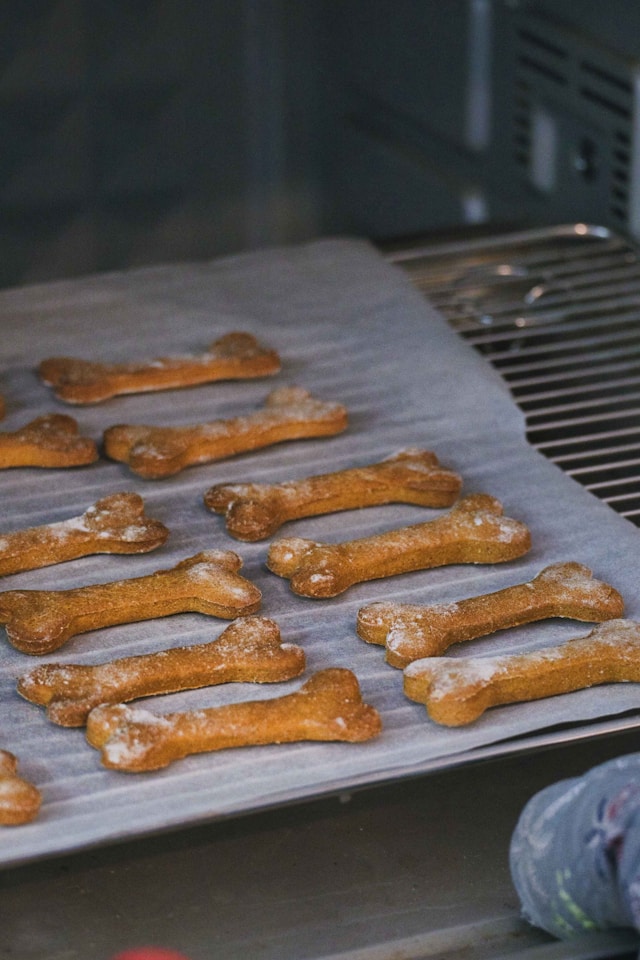


The short version: A dog treat is legally pet food, so in 7 of the 8 states we read you register it with the state as pet food instead of using cottage food law, while Minnesota folds certain baked dog treats into its cottage food registration. In the five states we read that publish a per-product fee, registering three flavors costs $150 to $300 in the first year, and Colorado, Indiana and New York all require a guaranteed analysis on every baked treat label. On Homegrown, the 25 dog treat and cookie listings had a median price of $6, and by our estimate a bag of 12 homemade biscuits costs about $1.07 in ingredients and packaging. Start at a dog-friendly farmers market or with local pickup orders, because selling online into another state means registering in that state too.
Checked October 8, 2026: the pet food pages of 8 state agencies (Colorado, New York, Washington, Indiana, Texas, California, Minnesota and Florida), the Office of the Texas State Chemist's fee schedule, AAFCO's startup FAQ, the FDA's pet food page, Homegrown's catalog and signup page, and the fee pages of Etsy, Square and Venmo. Rules and fees change, so verify your state's current rules before you sell. Homegrown customers create an account to place their first order, and Homegrown has no timed drops feature.
You've been baking dog treats for your own dogs for a while now. The peanut butter biscuits come out perfect every time. Friends started asking you to make some for their dogs. Someone at the dog park offered to pay you for a bag. Now you're wondering if there's an actual business here.
There is. Pet owners already pay for premium dog food, and a $6 bag of homemade treats made with ingredients they can actually read fits right next to it. The pitch is short: real ingredients, made by a person, not a factory. No preservatives you can't pronounce, no fillers, no mystery meal.
The regulatory path for dog treats is clearer than most people assume, but it is not the cottage food path. Dog treats aren't covered by cottage food laws anywhere we looked except Minnesota (those laws apply to human food). They fall under pet food rules. Pet food registration has no sales cap in any state we read, and five of the eight charge a fee for each flavor you sell.
This guide covers the legal side, labeling, ingredients, pricing, packaging, and where to actually sell your treats, in person and online. Whether you want a weekend side hustle at the farmers market or a small local business with regular customers ordering every month, it all starts the same way.
Ready to actually start selling? Once your treats are registered, you can take orders and get paid online in about 15 minutes: set up a Homegrown storefront ($10/mo billed annually, 0% commission, 2.9% + $0.30 card processing paid by the vendor), or compare the best platforms to sell food from home.
Yes, selling homemade dog treats is legal once you register them with your state's feed program, usually part of the department of agriculture, and AAFCO says almost every state requires that registration or a license. Outside Minnesota's cottage food route, every state we read treats dog treats as pet food, not cottage food. Colorado, Minnesota and New York let you start with paperwork instead of a commercial kitchen, while California requires an approved facility and the Washington, Texas and Florida pages we read don't say.
Here's the key distinction: cottage food laws, which govern selling homemade food for human consumption, don't cover dog treats in any state we read except Minnesota. Your state's cottage food rules about revenue caps, allowed products, and labeling requirements usually don't apply here. AAFCO, the Association of American Feed Control Officials, says it plainly on its startup FAQ for new pet food businesses: treats and snacks are pet food, and pet food sold at a farmers market, over the internet or in a local store is all "commercial feed." AAFCO writes the model rules many states build on, but it is not a regulator. Your state is.
At the federal level, the FDA's rules apply to every pet food, including a $6 bag of biscuits. Its pet food page says the federal food law requires all animal foods to "be safe to eat, produced under sanitary conditions, contain no harmful substances, and be truthfully labeled." Common ingredients like meat, poultry and grains need no FDA approval before you sell, but the same page says food additives and colorings must be approved for use, so check any icing color you use. The page also notes that some states enforce their own labeling rules, and many of them are based on AAFCO's model. One federal filing usually does not apply to you: AAFCO's FAQ says pet food plants register with the FDA under the Bioterrorism Act, but "if you make your product in your own home, then you are exempt."
At the state level, the rules vary, but the states we read want some of the following from you before the first sale:
What this means practically: outside Minnesota's cottage route, you file a form with the state (its feed program, or the public health department in California) and pay a company fee, a per-flavor fee or both, and in Colorado, Indiana and New York the state also approves your label. For a home baker it is mostly a paperwork process, with some checks after you start: Indiana's inspectors can collect samples of treats offered for sale, and Minnesota says an inspection may be conducted once your license is issued. Our state-by-state answer to can you sell homemade dog treats walks through the kitchen rules in more detail.
Before you start selling, check two things:
The bottom line is that the path to legally selling homemade dog treats is clearer than most people think. Spend 30 minutes on your state's feed program page before you start, file the registration, and you're ready to go. If you are also considering selling human food from home alongside your dog treats, how to sell food from home covers the cottage food framework that applies to those products.
A cottage food permit you already hold for bread or cookies won't cover dog treats unless you live in Minnesota, going by the eight state pages we read. California's public health department says it directly in its pet food FAQ, checked October 8, 2026: "Animal food products are not covered under California's Cottage Food Law." Minnesota is the exception among the 8 states we read, covered in the next section.
Yes, in 7 of the 8 states we read you need a pet food registration or feed license before your first sale, so you cannot legally sell dog treats without one there. The eighth, Minnesota, lets you sell certain baked or dehydrated dog treats under a cottage food registration instead, which is still a registration.
Here is what each state charged on its own website when we checked it on October 8, 2026. "Product" usually means one recipe under one name, so three flavors are three products.
Swipe sideways to see all six columns for each state.
| State | Who you register with | Company or license fee | Fee per product | Home kitchen? | First year, 3 flavors |
|---|---|---|---|---|---|
| Colorado | Dept. of Agriculture feed program | $75 a year (Feb 1 to Jan 31, not prorated) | $25 a year per label for packages of 10 lb or less, billed the January after the year of sales | Yes, with good manufacturing practices | $150 ($75 up front, then $75 of label fees the next January) |
| New York | Dept. of Agriculture and Markets | None listed | $100 a year; every registration expires December 31 | Yes, for shelf-stable baked treats | $300 |
| Washington | State Dept. of Agriculture | None listed on the pages we read; no inspection fee on pet food in packages under 10 lb, but you file a twice-yearly report (due July 31 and January 31) even when you owe nothing | $90 per product for packages under 10 lb, on a two-year cycle | Not stated on the pages we read | $270 (three products at $90 each, for one registration cycle) |
| Indiana | Office of Indiana State Chemist | $50 a year | $50 a year for packages of 10 lb or less | Kitchen not inspected unless there is a complaint | $200 |
| Texas | Office of the Texas State Chemist | $75 one-time license | $50 a year per product for packages of 5 lb or less, due September 1 of each state fiscal year (September 1 to August 31) | None of the four Texas sources we read says | $225 ($75 license plus 3 products at $50), then $150 a year |
| California | Dept. of Public Health | $190 a year Pet Food Processor Registration | Not listed separately | No, approved facility required | $190 plus kitchen rent |
| Minnesota (cottage food route) | Dept. of Agriculture | $0 at $7,665 or less in yearly sales; $50 from $7,666 to $78,000 | None | Yes, for certain baked or dehydrated treats | $0 or $50, plus required food safety training |
| Florida | Dept. of Agriculture and Consumer Services | $40 a year master registration for up to 25 tons, expires June 30 | None in the fee section of the statute we read | Not stated on the pages we read | $40 |
We loaded each figure on the agency's own page on October 8, 2026: Colorado's pet treat FAQ, New York's pet food page, Washington's pet food registration and inspection fee reporting pages, Indiana's "I Want to Make and Sell Pet Treats" guide, the Texas feed license application and fee schedule, California's pet food FAQ, Minnesota's pet food and cottage food registration pages, and Florida Statute 580.041 with the FDACS feed distributor licensing page. Lab tests for your label, city business licenses and sales tax permits are extra wherever they apply. The Texas license form is dated 2011 and leaves the product fee blank; the $50 comes from the state chemist's fee page and Texas Agriculture Code section 141.071.
First-year state fees to register 3 dog treat flavors
Source: each state agency's page, loaded October 8, 2026. Washington's $270 is three products at $90, for one registration cycle of up to two years (WSDA places a new registration into one of two overlapping July-to-June cycles), and pet food in packages under 10 lb owes no inspection fee. Texas's $225 is the one-time $75 license plus $50 for each of three products sold in bags of 5 lb or less. California and Minnesota are left out because their cost depends on kitchen rent or on your sales.
The math is simple once you know your state's two numbers. Add the company fee once, then add the product fee for every flavor. A vendor in Indiana with three flavors pays $50 plus 3 times $50, or $200. In Texas, the Office of the Texas State Chemist's fee page lists a one-time $75 facility license and a flat $50 a year for each product sold in containers of five pounds or less, due September 1, so three flavors cost $225 the first year and $150 each year after. The same lineup in New York costs 3 times $100, or $300, and because every New York registration expires December 31 and renewals are due by December 1, registering in October means paying $300 again by December 1.
Minnesota is the only state among the 8 we read where dog treats can go through cottage food. Its pet food business page says cottage food registration "now includes certain types of baked or dehydrated cat and dog treats." The cottage food page we read the same day sets a $78,000 yearly sales cap, with no registration fee up to $7,665 and a $50 fee above that, and it announces a change taking effect August 1, 2027: one registration tier with a $30 yearly fee for everyone. Cottage pet treats need the date they were made and the line "These products are homemade and not subject to state inspection" on the label, and the same line on a sign at your table and on your web page.
Florida Statute 580.041 says every distributor of commercial feed must get a master registration "before her or his brands are distributed in this state," and the fee for up to 25 tons a year is $40. Registrations expire June 30. The FDACS licensing page, checked the same day, does not say whether a home kitchen qualifies, so ask FDACS before you bake. Florida also requires a tonnage report within 30 days after each quarter and lab tests from an FDACS-certified lab (the licensing page lists them), unless FDACS grants an exemption.
Colorado, New York and Minnesota say you can make dog treats to sell in your home kitchen, and Indiana does not inspect home kitchens unless a customer complains. California bans it: treats there must come from an approved facility with a $190 yearly registration. The Washington, Texas and Florida pages we read don't say either way.
Here is what each agency said on October 8, 2026:
Two kinds of treats trip up home bakers. Dehydrated jerky and freeze-dried meat are left out of New York's home kitchen allowance, and New York makers of those treats need a scheduled process (a tested recipe with set processing steps and records) from a recognized process authority. "Human grade" claims are off limits for home-made treats in New York, and Colorado allows them only from a commercial kitchen with a human food manufacturing license.
Texas shows how a silent page looks. The Texas health department's FAQ says it does "not regulate the manufacturing of pet food" and sends pet bakers to the Office of the Texas State Chemist, and neither the chemist's fee page nor its license form mentions home kitchens. If your state's page doesn't answer the kitchen question, call the feed program and ask one thing: "Can I make shelf-stable baked dog treats in my home kitchen to sell?" Write down who you spoke to and the date.
A registered dog treat label needs at least 8 fields in Colorado and 9 in Indiana, and all three states whose label lists we read (those two plus New York) require a guaranteed analysis on treats. Dog treat labels follow pet food rules, not human food rules: you don't need a human nutrition facts panel, but you do need a few pet food fields most home bakers don't expect.
Required elements on a dog treat label (the fields Colorado, Indiana and New York list between them):
What's NOT required on a treat:
The guaranteed analysis costs money. Colorado and Indiana both say to send a finished treat to an animal food testing lab for the protein, fat, fiber and moisture numbers. Indiana notes the labs charge a fee and that some guarantees can be calculated if you know your ingredient values, and New York says any lab that can run a "crude analysis" will do. Budget one lab test per recipe as a first-year cost, and call around for a price. New York also says not to print label stock until your application is approved, because reprinting is expensive.
Allergen and sensitivity notes: Your label also sells the bag. Dog owners who seek out homemade treats are often doing so because their dog has food sensitivities. Calling out what's NOT in your treats can be as powerful as your ingredient list. "No wheat, no corn, no soy, no artificial preservatives" speaks directly to why someone is buying homemade instead of grabbing a bag off the shelf at PetSmart.
If you use peanuts, tree nuts, or other common allergens, name them clearly in the ingredient list. Clear labeling protects both the dogs and you.
Best-by date: No state page we read requires one on a treat, but it is good practice. Fresh baked treats without preservatives have a shorter shelf life than commercial treats, and a best-by date manages customer expectations. Include storage instructions too: "Store in an airtight container. Best within 2 weeks. Can be frozen for up to 3 months."
Health claims are the fastest way to get an application denied. New York says applications for products making drug claims "will be denied," and a registered product making them gets a Stop Sale Order. Colorado allows "may support" language for an ingredient but no claims to treat a condition. Colorado says labeling includes websites and social media, and New York says drug claims are not permitted "on pet food labels, websites, or other product advertisements," so the rule covers your storefront listing and your Instagram captions too.
Practical label options for getting started:
Our estimate is roughly 40 cents of packaging per bag when you're starting out. Don't let packaging costs eat your margin. Simple and clean is perfectly fine.
Lead with simple, recognizable ingredients that pet owners can read and trust: oat flour, peanut butter (xylitol-free), pumpkin, and sweet potato are common bases for homemade dog treats, and peanut butter and pumpkin lead the Homegrown catalog. On Homegrown, peanut butter (written out or as "PB") appears in the name or description of 15 of the 40 dog food listings, and pumpkin in 7. Every ingredient choice you make is a positioning decision, because the ingredient story is the reason a dog owner buys your bag instead of one at the pet store.
High-appeal base ingredients:
Protein-forward options (higher price point):
Before you sell a protein treat, check your state's kitchen rule. New York leaves dehydrated and freeze-dried treats out of its home kitchen allowance, and Colorado requires a raw pet food safe handling statement with the words "Keep Frozen" on anything containing raw meat or poultry.
What NOT to use: toxic to dogs
This is non-negotiable. Indiana's state chemist lists chocolate, onion, grapes and raisins, coffee and garlic as not safe for dogs, and says its list "is not an all inclusive list." The ASPCA's poison control list adds more:
Know this list cold. Print it and post it in your kitchen. One mistake with a toxic ingredient isn't just bad business; it could seriously harm someone's dog. New York says the same about approval: ingredients like "onions, raisins, grapes, chocolate, and others are not approved," and a label listing one may be denied. When you are unsure of an ingredient, call the state and ask first.
Positioning your ingredients: You're not just listing what's in your treats. You're making a case for why they're better than what's on the shelf. "Made with real pumpkin and oat flour. No artificial preservatives, no corn syrup, no fillers" tells the whole story in one line. Keep it truthful: Indiana says you can call a treat "all natural" only if it's true, and that a food containing minerals, vitamins or preservatives needs a qualified statement, and New York denies applications that claim "organic" or "non-GMO" without written proof.
Consider developing a few signature recipes that become your brand identity. A "classic peanut butter bone," a "pumpkin oat round," and a "sweet potato chew" give you a core lineup. Then add seasonal or specialty products around that core. Keep in mind that every new recipe is usually a new registration fee, and Indiana says even adding yogurt icing to an existing treat makes it a new product. Our guide to the dog treat flavors and shapes that sell best at farmers markets shows which second and third flavors to bake and what each format sells for.
Making dog treats to sell takes the same recipe you bake for your own dog, run as a repeatable batch: about 36 biscuits from one batch, weighed, bagged 12 to a bag and labeled the same way every time. The difference between baking for your dog and baking to sell is consistency, because the label you registered promises the same recipe, weight and guaranteed analysis in every bag.
Time is the real cost. Our dog treat pricing guide times one batch at about 1.5 hours to mix, roll, cut, bake, cool, bag and label 36 biscuits. That number matters more than flour prices when you set your price, so time your own first batch with a phone timer.
Bake to orders when you can. A market day is a guess. A batch baked for orders that are already paid is not. That is the main reason home dog treat bakers take pre-orders, covered below.
On Homegrown, treat and cookie bags had a median price of $6 across 25 listings, and the most common price was $5 (7 listings), when we pulled the catalog on October 8, 2026. We estimate ingredients and packaging for a bag of 12 biscuits at about $1.07, so a bag at $6 to $10 leaves you about $4.93 to $8.93 before fees and your time. The 25 treat and cookie listings ran from $4.00 to $12.99, and the priciest single listing was freeze-dried beef liver at $14.
Here is how the 37 single dog food listings broke down (the other 3 are a monthly box and two gift bundles, which aren't comparable to one bag):
Slide the table left for the range, median and an example.
| Product type | Listings | Price range | Median | Example from the catalog |
|---|---|---|---|---|
| Treats and cookies (biscuits, bites, training nuggets, macarons) | 25 | $4.00 to $12.99 | $6.00 | Harvest Bites, 12 treats for $6.00 ($0.50 a treat) |
| Dog cakes and pupcakes | 3 | $5.00 to $10.00 | $10.00 | 4 inch, two-layer peanut butter banana cake for $10.00 |
| Dried and smoked meat treats and dog bones | 4 | $5.00 to $14.00 | $8.75 | Freeze-dried beef liver for $14.00 |
| Dog drinks, cake and ice cream mixes, dog-safe peanut butter | 5 | $5.50 to $12.50 | $7.50 | 4 oz squeezable dog peanut butter for $7.00 |
Source: a pull of the Homegrown catalog on October 8, 2026, 2,910 products from 312 vendors. We counted a listing as dog food when its name or description named dogs, pups or pets and it was food, then read every other listing from those 9 vendors. A painted jar sold filled with 30 treats counts as a gift bundle; three empty painted treat jars do not count. Also left out: dog tags, toys, stickers, keychains, a paw salve, a grooming bar, a $0.01 test listing, and human foods that matched the word "dog" (hot dog buns, cheese dog bites). These are listing prices, not sales.
Cost breakdown per bag of 12 biscuits (simple peanut butter pumpkin recipe, 36 biscuits a batch):
That's about $2.00 of ingredients for 36 biscuits, or about $0.67 a bag, plus $0.40 of packaging: about $1.07 a bag. Swap in your own receipts; the pumpkin, peanut butter and packaging prices are our examples, not a federal average.
At $10 a bag paid in cash, you keep about $8.93 after materials. Card payments shave a little off: a tap on Square's free plan costs $0.41 on a $10 bag, which leaves about $8.52. If you bring 6 bags to a Saturday farmers market and sell out, that's about $54 after materials in cash or about $51 on card taps. Sell 15 bags and it's about $134 in cash or $128 on cards, before your booth fee. Real listings often run lower than $10: our guide to what a $5 bag of dog treats pays you per hour works it out to about $7.26 an hour on two-bag orders, and about $6.97 on one-bag orders, once your baking time is counted.
In a pull of the Homegrown catalog on October 8, 2026, 9 of the 312 vendors listed dog food, across 40 listings out of 2,910 products. The biggest lineup had 17 dog food listings, seven of them priced at $5, most of those bone and paw shaped treats. The lowest single price was $4.00 (training nuggets and a two-cookie iced pack) and the highest was $14.00 (freeze-dried beef liver).
Price per treat, not just per bag. A "$5 bag" can mean 12 treats or 4 large ones. The listings that say what's inside show the spread: Harvest Bites at $6 for 12 treats is $0.50 a treat, Pup Chip Cookies at $6 for six is $1.00 a cookie, and Paw-Some Cookies, two iced paw cookies for $4, are $2.00 a cookie. Iced and decorated treats earn more per piece because they take more of your time, so price them from the time they take, not just from the ingredients.
Custom and decorated treats are worth adding once your base recipes are dialed in. Birthday bones with the dog's name, paw print cookies, seasonal shapes, "gotcha day" boxes (the anniversary of a dog's adoption), holiday gift sets and "new puppy" boxes are higher-priced, lower-volume products. On Homegrown, all three cake listings and one birthday treat bag sat at $5 to $10, a Spoiled Dog Bundle (a bag of treats, a toy and a tag) was listed at $23, and a hand-painted jar sold filled with 30 treats at $20. Remember that a frosted version of a registered recipe is usually a new product with its own registration fee.
A raise can be small. Between our catalog pull on September 22, 2026 and the one on October 8, 2026, one Homegrown dog treat vendor moved its 12-treat Harvest Bites bag from $5 to $6 and its monthly box of 6 bags from $20 to $25. A $1 raise on a $5 bag is a 20% raise on every bag, and nearly all of it lands on your margin (all of it on cash sales), because materials stay at about $1.07 a bag.
Pricing psychology: If your treats are consistently selling out at the farmers market, raise your price by $1 a bag. If you're bringing home unsold inventory, reduce your batch size before you cut the price. The market will tell you what to charge. Don't anchor to grocery store treat prices. Your customers aren't comparing you to Milk-Bone. They're comparing you to the "artisan" bags at the boutique pet store, and yours are fresher, more personal, and made that week.
Use clear cellophane bags or kraft paper bags with a window so customers can see the treats, add a clean label with every registered field on it, and keep packaging near 40 cents a bag. A bag of treats that looks like a gift will outsell the same treats in a plain zip-lock bag.
What works well for dog treats:
Package size changes your fees in some states. Colorado and Indiana set their per-product fees on packages of 10 pounds or less, Washington on packages under 10 pounds, and Texas splits at 5 pounds. In Texas, a flavor sold only in bags of 5 pounds or less pays the flat $50 a year, but if the same flavor also goes in bigger bags, the state chemist's fee page moves every size of it to tonnage reporting, where a licensed facility pays at least $100 a year in inspection fees. Indiana's guide also covers selling loose treats from a jar at your booth: no per-product fee, but you still pay the $50 license, the container needs a full label customers can see, and you file a quarterly tonnage report with a $5.00 minimum per quarter. Bags are simpler for most home bakers.
Seasonal and themed packaging sells. Christmas bone shapes in holiday bags, Valentine's heart treats in red packaging, Halloween pumpkin-shaped treats in orange bags, "Birthday Pup" boxes with decorated treats inside. They are some of the most photographed products you'll make. One Homegrown dog baker offers its iced paw cookies in seasonal and holiday designs, and sells its little cakes in birthday cake, pumpkin spice and peanut butter banana bacon for birthdays and gotcha days.
Photography matters more than you might expect. A photo of dog treats arranged on a wooden cutting board or displayed in a gift box, ideally with a happy dog sniffing at them, is the kind of post dog owners share. If your packaging photographs well, your customers become your marketing team.
Invest time in getting 5 to 10 good product photos when you first start. Natural light, simple backgrounds, and a willing dog model are all you need. These photos will work across your social media, your Homegrown storefront, and your farmers market signage.
The best places to sell dog treats from home are dog-friendly farmers markets, pet events, independent pet stores, and local pre-orders through your own online storefront link. On a $10 bag, those places leave you anywhere from $10.00 in cash at a farmers market booth to $5.00 when a pet store buys at wholesale, and our guide to where to sell dog treats works out the full fee stack for seven places.
Every one of these counts as selling pet food, so your state registration has to cover it. Colorado's feed program says registered labels are "eligible to sell anywhere in Colorado, including farmers' markets and in stores," and New York says products must be registered "whether they are being sold at farmers' markets or at big box stores."
Drag the table sideways to see what each place leaves you.
| Where you sell one $10 bag | Fees on that bag | You keep | After $1.07 of materials | Fees on 50 bags in a month |
|---|---|---|---|---|
| Cash at a farmers market booth | $0 | $10.00 | $8.93 | $0, plus booth rent |
| Card tap at the booth (Square Free plan, 2.6% + 15¢) | $0.41 | $9.59 | $8.52 | $20.50, plus booth rent |
| Venmo business profile payment (1.9% + $0.10) | $0.29 | $9.71 | $8.64 | $14.50, with no order page |
| Homegrown storefront link (2.9% + $0.30, plus $10/mo plan) | $0.59 | $9.41 | $8.34 | $39.50 with the plan billed annually ($42.00 billed monthly) |
| Etsy ($0.20 listing + 6.5% + 3% + $0.25) | $1.40 | $8.60 | $7.53 | $70.00, before shipping |
| Pet store wholesale at half of retail | No card fee | $5.00 | $3.93 | You receive $250 for 50 bags that retail for $500 |
We checked these rates on Square's pricing page, Venmo's fee page, Homegrown's signup page, and Etsy's Fees and Payments policies on October 8, 2026. Every row assumes one $10 bag per order. Etsy's 6.5% and 3% also apply to any shipping you charge. Etsy may charge a one-time shop set-up fee shown during setup, plus a 15% Offsite Ads fee on orders from Etsy's offsite ads for shops under $10,000 a year in sales unless the shop opts out. Materials are the $1.07 a bag worked out in the pricing section.
Dog-friendly farmers markets put your target customer right in front of your booth with their dog on a leash. The buying psychology is different from a regular market. Dog owners see your treats while they're thinking about their dogs, and often while the dog is pulling toward your booth because it smells like peanut butter.
At $10 a bag paid by card tap, you keep about $8.52 a bag after materials, so a $40 booth fee is covered after 5 bags. If you're new to market selling, our guide on how to sell at a farmers market covers booth setup, pricing display and the fundamentals. For dog treats specifically, a few things work especially well.
Tips for selling dog treats at farmers markets:
Check each market's vendor policy before you apply. Some farmers markets only accept human food vendors, and others welcome pet products, especially markets that already allow dogs.
Pet expos, dog shows, adoption events, shelter fundraisers, and "yappy hour" events at dog-friendly businesses put you in front of buyers who are already in pet-spending mode. They're one-day crowds, so bring more bags than you would to a weekly farmers market.
Vendor fees vary widely. The three 2026 dog events our where-to-sell guide checked in September charged vendors $75 to $900. Two required insurance outright, and the third asked for a certificate from food vendors, anyone handing out pet food samples and anyone bringing an animal. A shelter fundraiser on the low end of that range is a good first event.
Look for local pet events through:
Check those sources every month or two, so you see vendor calls before the application deadlines.
Independent pet supply stores can buy local treats at a wholesale price or take them on consignment. Our where-to-sell guide works the math at half of retail, $5 on a $10 bag, a shortcut some store owners use, not a fixed rule. A conversation with the store owner, a sample bag of your best seller, and a clear explanation of your ingredients is often all it takes to get on a shelf.
That $5 leaves you about $3.93 after your $1.07 of materials. The margin is lower per bag, but the store sells for you all week. You drop off product, they sell it, you restock.
What stores look for in a local dog treat vendor:
Build a relationship with the store owner. Ask them what sells well and what their customers ask for. Their feedback is valuable market research.
Online pre-orders work by opening orders midweek, baking only what's paid for, and handing bags off at a set pickup time. Post your available treats on Instagram or a neighborhood app like Nextdoor, open orders by Wednesday, and have everything bagged and labeled for Saturday morning pickup from your porch or your farmers market booth.
This channel is especially strong for custom orders. Dog birthday treats, holiday gift boxes, and special-occasion packaging all work better as pre-orders than as market-day inventory. You bake exactly what's ordered, nothing goes to waste, and customers get exactly what they want.
But the more successful your treats are, the faster DM-based ordering breaks down. The regular who wants peanut butter biscuits every other Saturday, the customer asking about holiday boxes in October, the person whose dog has allergies asking about grain-free options: that's three separate threads to juggle while you're also baking.
Instagram DMs work for your first 5 to 10 customers. After that, you're scrolling through message threads trying to match Venmo payments to orders and figure out whether Ashley wanted the pumpkin or the peanut butter this week.
Etsy handles payment but charges a $0.20 listing fee, a 6.5% transaction fee and 3% + $0.25 in payment processing. On a $10 bag of treats, Etsy takes $1.40 in fees, before shipping. Etsy is built for shipping, and shipping dog treats out of state can mean registering them in each state you ship to. For local pickup at the farmers market or from your porch, the shipping-first checkout adds a step your customers don't need.
Homegrown ($10/month billed annually) is built for local pickup and delivery orders. Your regulars see your treat lineup, reorder from the same link, and pay right there. Paid orders land in your dashboard with a pickup time before you start prepping, so there's no guessing how many dozen peanut butter biscuits to make.
Swipe across to compare the three ways to take orders.
| Instagram DMs + Venmo | Etsy | Homegrown | |
|---|---|---|---|
| Handles payment | Separately, through Venmo | Yes | Yes |
| Built for local pickup | No order system | No (shipping-first) | Yes |
| Built for local delivery | No order system | No | Yes, you set the radius and fee |
| Fees on 20 orders of one $10 bag | $5.80 (Venmo business profile) | $28.00, before shipping | $11.80 processing plus the $10 plan |
| Repeat ordering for regulars | Manual messages | Works | Works, from the same link |
| New customers find you | Only followers | Yes (nationwide, shipping-focused) | Your storefront is listed on the local marketplace, but plan on most orders coming from your own link |
Fees checked on Venmo's fee page, Etsy's Fees and Payments policies, and Homegrown's signup page on October 8, 2026. Homegrown is $12.50 a month on monthly billing. The full monthly fee stack, with trials and a $20 order, is in the ordering tools table further down.
Homegrown doesn't ship. If you want to ship treats across the country, Etsy is the better platform for that, as long as your treats are registered in every state you ship to. For local pickup at your farmers market booth or from your porch, Homegrown does one thing well.
Dog treat content does well on Instagram and TikTok because the product is cute and the customer is a dog owner who already posts their dog. A "baking day" reel showing you mixing dough, cutting bone shapes, and pulling golden biscuits from the oven, with a happy dog waiting at the end, is the kind of post people share with other dog owners.
Tips for social media selling:
Yes, you can sell dog treats online, but AAFCO says that selling on the internet legally counts as distributing your products in every state, and most states require you to register before you offer products for sale there. The setup least likely to pull you into other states' rules is an online order page that offers only local pickup or delivery inside the state where your treats are registered, and you should ask your feed program whether it sees even that as an internet offer to other states.
Three of the state pages we read say it directly. New York: "You may sell your products on the Internet," but "all states have their own registration requirements." Colorado, asked whether treats registered there can be sold outside the state: "No, each state has its own registration and licensing requirements." Minnesota: "If a product is offered on a website, it is being offered into distribution in Minnesota," which requires a license and registration.
Your three options for selling dog treats online:
Here's why shipping adds up. Registering 3 flavors costs $150 in Colorado for the first year. Shipping the same 3 flavors into New York adds $300, and adding Washington adds $270 in the first year. That's $720 in registrations before the first out-of-state box ships, which is the case for keeping online sales local until the orders justify more states.
Etsy doesn't change those rules. A sale through Etsy is still a sale of pet food into the buyer's state. Etsy's fees on a $10 bag are $1.40 before shipping, and its 6.5% transaction fee and 3% processing fee also apply to the shipping you charge.
Minnesota's pet food business page says two different things about shipping cottage food dog treats. Its cottage food section, read on October 8, 2026, says registered producers "may ship cottage pet treats in the mail or by commercial delivery to the end consumer," and so does the cottage food registration page. Its FAQ says cottage food sold online "must either be picked up in person by the customer or personally delivered by the cottage food producer." Ask the Minnesota Department of Agriculture in writing before you ship.
Your online listing is also part of your label in some states. Colorado says "Labeling includes websites and social media that market your product," and Indiana applies its human grade rules to "websites and social media." Write your storefront descriptions with the same care as the bag: ingredients, the treat statement, and no claims that a treat cures or prevents anything.
Take dog treat orders through one storefront link where customers pick a flavor, pay, and choose a pickup time, so paid orders land in your dashboard with a pickup time instead of a pile of messages. Once your treats are registered, the ordering tool is the next decision, and the right one depends on whether you sell locally or ship.
Scroll right for the full fee stack on each option.
| Option | Monthly plan | Trial | Platform fee | Card processing | Customer pays on a $20 order | Vendor pays on a $20 order | Vendor pays in a month of 50 orders at $20 |
|---|---|---|---|---|---|---|---|
| Homegrown | $10 billed annually ($12.50 billed monthly) | 7 days, no charge until day 8 | $0, 0% commission | 2.9% + $0.30, paid by the vendor | $20.00 | $0.88 plus the plan | $54.00 ($56.50 on monthly billing) |
| Etsy | $0 (a one-time shop set-up fee may apply, shown during setup) | None | $0.20 per listing per item sold, plus 6.5% transaction fee | 3% + $0.25 | $20.00 plus shipping | $2.55 for two bags | $127.50, before shipping and any Offsite Ads fee |
| Square Online, Free plan | $0 | Not applicable | $0 | 3.3% + 30¢ | $20.00 | $0.96 | $48.00 |
| Venmo business profile (with Instagram DMs) | $0 | Not applicable | $0 | 1.9% + $0.10 | $20.00 | $0.48 | $24.00, with no order page, product list or pickup times |
We checked these on Homegrown's signup page, Etsy's Fees and Payments policies, Square's pricing page and Venmo's fee page on October 8, 2026. A $20 order is two $10 bags. Etsy charges its $0.20 listing fee again each time an item sells, and its Offsite Ads fee of 15% applies to orders that come from Etsy's offsite ads for shops under $10,000 a year in sales, unless the shop opts out. Shipping, labels and state registration are not included for any option.
If you've been juggling dog treat orders across DMs and texts, Homegrown is $10 per month billed annually ($12.50 month to month) with no percentage fees beyond standard payment processing, which is 2.9% + $0.30 per order, paid by the vendor and not passed to the customer. You get an online storefront where dog owners see your registered flavors, order for pickup at your house or market table (or delivery inside a radius you set), and pay before you bake. That means you bake the exact number of bags that sold, which matters when every flavor carries its own registration fee. Etsy is the better fit if you plan to ship nationwide and register in each state, but on a local $20 order it costs you $2.55 against $0.88. Venmo with Instagram DMs is the cheapest per order at $0.48, but you match payments to messages by hand. Square's free plan is $0.96 a $20 order online and shines for card taps at the booth.
What Homegrown doesn't do: it doesn't register your products, print your labels or ship treats across the country. Customers create a Homegrown account to place their first order. There is no timed drops feature, and no release date to share for one. Your storefront is listed on the Homegrown marketplace, but plan on most orders coming from dog owners you send to your own link.
If your treats are registered and the orders are coming in over text, you can set up a Homegrown storefront for your dog treats and share one link at your next farmers market.
Starting a dog treat business from home takes eight steps, and the state fees for a three-flavor launch run $150 to $300 in the first year in the five states we checked that print a per-product fee, before lab tests and packaging. In Colorado, Indiana and New York the label gets reviewed before you can sell (Colorado says reviews go in the order labels arrive), so start the paperwork before you plan your first farmers market.
What it costs to start. Here is a realistic first-year budget for three flavors, using the numbers in this guide:
Bridge the paperwork to your first order. Once the registration is approved, the fastest first sales come from people who already asked you for treats. Send them one link where they can see your registered flavors and pay ahead. A Homegrown storefront gives your dog treat regulars that link for $10 a month billed annually, and you bake only what they ordered.
You can sell homemade dog food in some states, but a complete meal has to meet AAFCO's nutrient profiles and carry a nutritional adequacy statement, which treats skip. That makes dog food a much bigger project than a $6 bag of biscuits, and Minnesota's cottage food route covers only "certain types of baked or dehydrated cat and dog treats," not meals.
What changes when you move from treats to food:
If dog food is your goal, start with treats, learn your state's registration process on three products, and talk to the state about nutrient testing before you formulate a meal. A treat is the shortest legal path to a first sale.
Yes, everywhere we checked except Minnesota's cottage food route. You register with your state feed program, usually part of the department of agriculture, before your first sale. The five states we checked on October 8, 2026 that publish a per-product fee charge $25 to $100 a product: $25 a label in Colorado, $50 in Indiana, $50 a year in Texas on bags up to 5 lb, $100 in New York, and $90 for a two-year cycle in Washington. Some also charge a company fee, such as $75 a year in Colorado, $50 a year in Indiana and a one-time $75 license in Texas. Minnesota is the exception, where certain baked dog treats can be sold under a cottage food registration instead.
None of the agency pages we read sets a shelf life for homemade dog treats, so use these as starting points and test your own recipe:
Slide left to see both kinds of treats.
| Storage method | Soft treats | Dry biscuits |
|---|---|---|
| Room temperature (airtight container) | 1 to 2 weeks | 2 to 3 weeks |
| Refrigerated | 3 to 4 weeks | 3 to 4 weeks |
| Frozen | 2 to 3 months | 2 to 3 months |
Starting points to test against your own recipe, not a rule from any of the 8 state agencies whose pages we checked.
Include a best-by date on your labels and recommend freezing for customers who buy in bulk. A note like "Freeze what you won't use within 2 weeks" helps customers get the most from their purchase. If you bake in a New York home kitchen, sell only the dry, shelf-stable kind.
No, check the market's vendor policy first, because some farmers markets only allow human food vendors while others welcome pet products. Markets that already allow dogs are the natural fit. Your state registration has to cover the sale too: Indiana's state chemist says a vendor selling one-pound bags at a farmers market must label each bag and pay the $50 annual fee for each product. Apply to several markets in your area and ask each manager what paperwork it wants from a dog treat vendor.
Keep a clear record of every ingredient and batch in every product you sell, and put a complete ingredient list on every label. If you use peanuts, tree nuts, dairy or other common allergens, name them clearly. You can't prevent every sensitivity, but clear labeling protects both your customers' dogs and you. Indiana's state chemist, for example, investigates when a pet becomes ill or dies and a veterinarian suspects the food, so a batch record matters. Consider a product liability insurance policy as you grow.
Yes, dry baked dog treats ship well, but every state you ship into can require its own registration. Colorado's feed program says treats registered there cannot be sold outside Colorado on that registration, and AAFCO says internet sales count as distributing in every state. You'd also need sturdy packaging that prevents breakage. Starting with local sales and adding shipping once orders justify more registrations keeps your fees down. Etsy is built for shipped orders, at $1.40 in fees on a $10 bag before shipping.
Price custom and decorated dog treats from the extra time they take, not just the ingredients. On Homegrown in October 2026, two iced paw cookies were listed at $4, or $2.00 a cookie, against $0.50 a treat for a plain 12-treat bag at $6, and dog cakes were listed at $5 to $10. If decorating a dozen birthday treats takes an extra hour, add your hourly rate for that hour to the price of the plain dozen.
Dry biscuit-style dog treats do not need refrigeration. They store well at room temperature in an airtight container for about 2 to 3 weeks. Softer treats with more moisture (pumpkin or applesauce treats baked soft rather than crisp) have a shorter room-temperature shelf life of about 1 to 2 weeks and keep better refrigerated. New York only allows home-kitchen treats that need no refrigeration or freezing, so check your state before you sell soft treats.
These five guides pick up where this one leaves off, from the permit to the price to the first place you sell. Start with the first if your registration isn't filed yet, and jump to the pricing guide if you already sell and want to know whether your bags pay for your time.
A dog treat business starts at $150 to $300 in state fees for three flavors, in the states that print their per-product fees. The ingredients are simple, the buyers are motivated, and the market values what you're offering: treats made by a person who cares about what goes into them, sold to people who care about what goes into their dogs.
Start with what you know. If your peanut butter biscuits are the ones everyone raves about, register those first. Bring a few dozen to your next farmers market, set up a simple display, and watch how quickly dog owners gravitate to a table that smells like fresh-baked peanut butter.
If you're new to selling baked products in general, how to sell baked goods covers the fundamentals that apply across product types, from pricing to presentation. For a full walkthrough of launching a home-based food business alongside your treats, how to start a cottage food business covers the human food side, and cottage food laws by state explains the separate rules for anything you bake for people.
The dog owners in your life already know your treats are worth paying for. You're just making it official. Set up your Homegrown storefront and give your dog treat regulars a link instead of managing DMs.



