
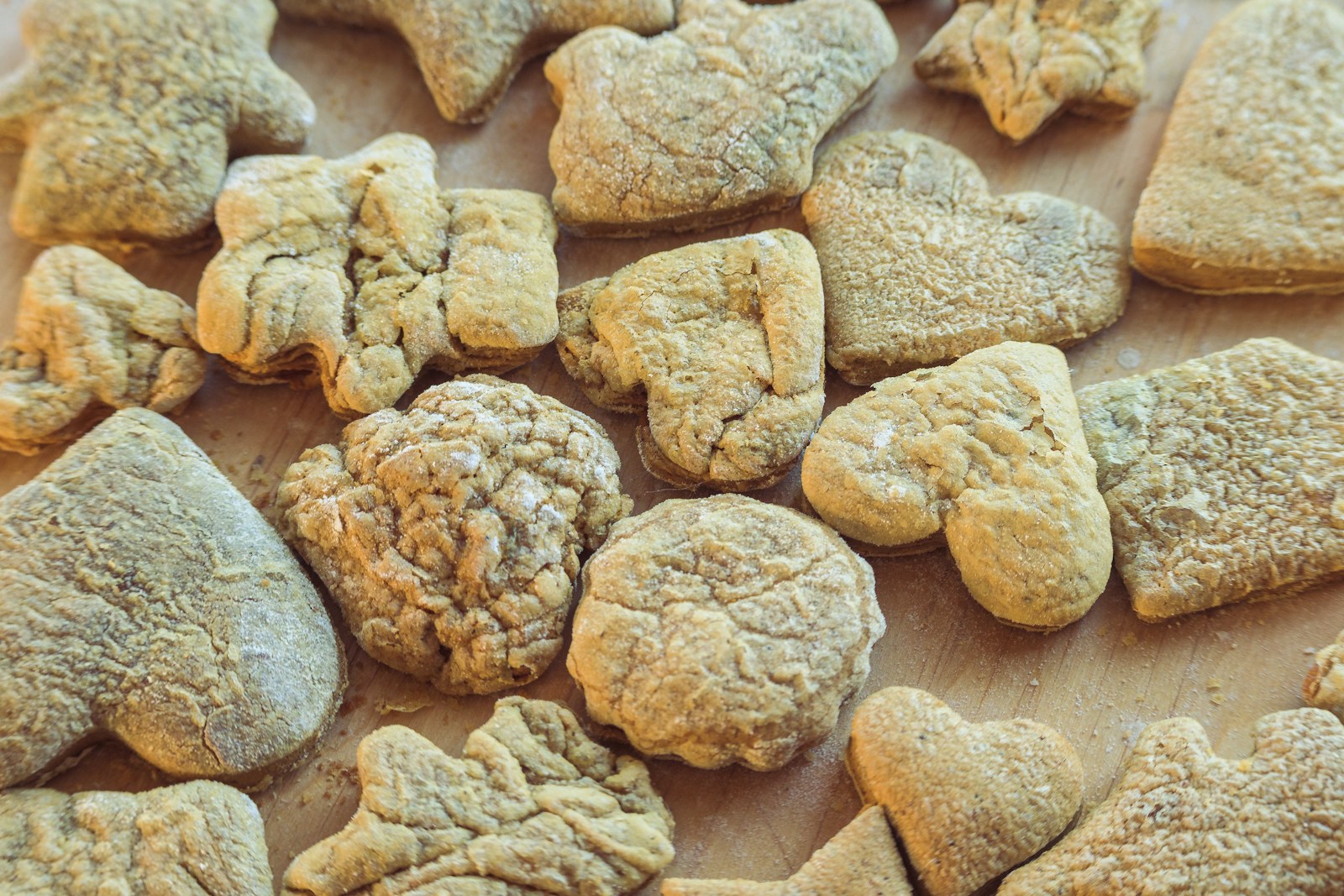


The short version: You can sell homemade dog treats legally in most of the United States once you register with your state's feed program, because a dog treat is legally pet food and most cottage food laws do not cover it. Minnesota is the exception we found: its cottage food registration covers baked or dehydrated dog treats, but not treats of animal origin like liver or jerky. Colorado and New York let you bake at home, while California requires an approved facility. In the six states we read that publish a per-product fee, three flavors cost $150 to $300 in the first year before lab tests, and Tennessee and Nevada charge a license fee instead, starting at $50 and $75. In Canada, the federal government does not register pet food sold inside the country, though federal labelling law may still apply to your bags.
Checked October 7, 2026: the pet food pages of the feed regulators in 10 states (Colorado, New York, Washington, Indiana, Texas, California, Minnesota, Kentucky, Tennessee and Nevada), AAFCO's startup FAQ, the FDA's pet food page, the Canadian Food Inspection Agency and Competition Bureau pages, Homegrown's catalog and signup page, and the Shopify and Venmo fee pages. Rules and fees change, so verify your state's current rules before you sell. This is general information, not legal advice. Homegrown customers create an account to place their first order, and Homegrown has no timed drops feature.
Yes, you can sell homemade dog treats in most of the United States, but not the way you sell cookies for people. Dog treats count as pet food, so the cottage food rules that let you sell bread and jam from your kitchen do not apply anywhere on our list of 10 states except Minnesota. AAFCO, the group whose model rules many states base theirs on, says "almost all of the states have some sort of registration or licensing requirements that you must meet before your product can be offered for sale." The same AAFCO page is not consistent about which states sit outside those feed laws: one passage says every state except Alaska and Nevada has a commercial feed law, and another passage on that page says every state except Alaska has one. Nevada's own Department of Agriculture settles its half of that: its legislature passed commercial feed licensing in 2015, and the license costs $75 a year. Do not read either AAFCO line as permission to skip registering; ask your own state feed program. Every state in this guide wants you to register your business, your products, or both before your first sale, Minnesota's cottage food route included. A few states let you bake at home, and Indiana says it does not inspect home kitchens unless there is a complaint. California does not let you bake them at home.
Yes, dog treats are legal to sell in all 10 states we read once you register, though California requires an approved kitchen instead of your home one. The six states that publish a per-product fee charge $25 to $100 for each product sold in small bags (10 lb or less, under 10 lb in Washington and 5 lb or less in Texas), for each registration period, and Washington's $90 lasts as long as two years. The rules are not the same as the ones for human food, and your cottage food permit does not cover dog treats in any state we read except Minnesota.
This page is about the permission question: who you register with, what it costs, and whether your kitchen counts. If you already know you are allowed and want the recipes, packaging and pricing side, our guide to selling dog treats from home covers how to sell once the paperwork is done.
Here is the simplest way to think about it. A dog treat is legally a pet food. The Association of American Feed Control Officials (AAFCO), the group that writes the model rules many states follow, says it plainly on its startup FAQ for new pet food makers: treats and snacks are pet food. So the question "can I sell dog treats?" is really "can I sell pet food?", and the answer depends on your state feed program.
What most of these state programs have in common:
Cottage food laws cover food for people, and dog treats are legally pet food. The California Department of Public Health says so directly in its pet food FAQ: "Animal food products are not covered under California's Cottage Food Law." Eight of the other nine states we read put dog treats under their feed control laws, not their cottage food rules. Minnesota is the one that lets certain treats go either way.
The treats look and bake like cookies, but the legal category is decided by who eats it, not by how it is made. A peanut butter biscuit sold for a dog is pet food even if a person could eat it.
What that means for you in practice:
Here is how the two sets of rules compare for a home baker:
Swipe sideways to compare both columns.
| Question | Cottage food (treats for people) | Pet food (treats for dogs) |
|---|---|---|
| Who regulates it | Your state or local health or agriculture office, depending on the state | Your state feed program, often the department of agriculture |
| What you pay | Varies by state, often a permit or nothing | A company fee, a per-product fee, or both ($25 to $100 a product on packages of 10 pounds or less, under 10 pounds in Washington and 5 pounds or less in Texas, each registration period, in the 6 of 10 states we read that publish one) |
| Label rules | Cottage food label with a home kitchen statement | Pet food label: species, net weight, guaranteed analysis, ingredients, feeding directions in some states, your address |
| Home kitchen | Allowed by definition | Depends on the state (California says no) |
Pet food column checked on each state feed program's website on October 7, 2026. Minnesota's cottage food route for baked dog treats follows the cottage food column, with its own pet treat label.
If you sell both, you run two sets of paperwork. That is common and not a problem. Our cottage food startup guide covers the human food side.
In Minnesota you can sell baked or dehydrated dog and cat treats under a cottage food registration, but not treats of animal origin. The Minnesota Department of Agriculture's cottage food training gives an oatmeal peanut butter biscuit as the example of a treat you can sell, and frozen liver, raw ground venison and dehydrated turkey jerky as treats you cannot, because they are of animal origin. Its own quiz asks which of those four products a cottage food producer can make, and the answer it gives is the biscuit.
Here is what the Minnesota cottage food training (revised December 2025) and the department's cottage food registration page said when we read them on October 7, 2026:
If your treat contains meat, or you want to sell to a pet store, Minnesota's commercial feed license is the other route, and its pet food business page says you register each product or pay tonnage depending on package size. Minnesota also passed changes that take effect August 1, 2027: one registration tier with a $30 yearly fee for everyone, shipping allowed for cottage food made for people too (pet treats can already ship), and advanced training for all registrants. The human food side of Minnesota's rules is in our Minnesota cottage food law guide.
Minnesota's training tells cottage producers who ship pet treats out of state to check that cottage pet treats are allowed in the receiving state. A Minnesota cottage registration does not register your treats anywhere else, and all 9 of the other states we read require a registration or license before a single bag arrives.
The FDA requires every pet food, including a $5 bag of homemade dog treats, to be safe to eat, made under sanitary conditions, free of harmful substances and truthfully labeled. That comes from the federal Food, Drug, and Cosmetic Act, as described on the FDA's pet food page, checked October 7, 2026.
The FDA page describes no approval step for a finished treat before it goes on sale. It says common ingredients like meat, poultry and grains are considered safe and do not need premarket approval, while vitamins, minerals, flavorings and preservatives must be generally recognized as safe for that use or approved as food additives. The same page says some states also enforce their own labeling rules, and many of those rules are based on AAFCO's models.
There is one federal step you can usually skip. AAFCO's FAQ says pet food makers register their facility with the FDA under the Bioterrorism Act, but "if you make your product in your own home, then you are exempt." The rule itself says the same thing: 21 CFR 1.227 defines what counts as a facility and states that "the private residence of an individual is not a facility." So a home vendor usually does not file a federal facility registration. AAFCO has no regulatory authority of its own, so confirm your own setup with the FDA before you skip the filing.
The federal rules that still apply to you:
Your state feed control program regulates dog treats, and it is usually part of the state department of agriculture. Some states put it somewhere else, so look for the words "commercial feed" or "pet food registration" on your state's website.
Here are the 10 state programs whose pages we read for this guide:
If your state's page is hard to find, AAFCO keeps a state-by-state contact list. Call the feed program and ask one question: "What do I need to sell baked dog treats in small bags that I make at home?"
Six of the 10 states print a per-product fee, and for small bags (10 lb or less, under 10 lb in Washington and 5 lb or less in Texas) it ran $25 to $100 a product on each registration cycle. Washington bills its $90 once per two-year cycle, while Colorado, New York, Indiana, Kentucky and Texas bill every year. Some states also charge a company or license fee: $75 a year in Colorado, $50 a year in Indiana, a one-time $75 license in Texas, $190 a year in California, at least $50 a year in Tennessee and $75 a year in Nevada. For a small vendor with three flavors, registration works out to $150 to $300 in the first year in Colorado, Kentucky, Indiana, Texas, Washington and New York, before any lab tests.
Swipe sideways to see all six columns for each state.
| State | Who you register with | Company or license fee | Fee per product | Home kitchen allowed? | First year, 3 flavors in 1 lb bags |
|---|---|---|---|---|---|
| Colorado | Dept. of Agriculture | $75 a year | $25 a year per label (packages 10 lb or smaller; anything over 10 lb is reported as tonnage with a $50 minimum a year) | Yes, with good manufacturing practices | $150 |
| New York | Dept. of Agriculture and Markets | None listed | $100 a year; every registration expires December 31 | Yes, for shelf-stable baked treats | $300 |
| Washington | State Dept. of Agriculture | No company fee. No inspection fee on pet food in packages under 10 lb, but you file a report twice a year even when you owe nothing | $90 per product for packages under 10 lb, $22 per product if it is sold only in 10 lb or larger packages, and $90 if you sell it both ways; two-year cycle | The Washington pages we read do not say | $270, which covers one registration cycle of up to two years |
| Indiana | Office of Indiana State Chemist | $50 a year | $50 a year | Kitchen not inspected unless there is a complaint | $200 |
| Kentucky | Univ. of Kentucky Division of Regulatory Services | None; Kentucky says it does not require a separate facility license | $50 a year for products sold only in packages of 10 lb or less | Kentucky's pages do not say | $150 |
| Texas | Office of the Texas State Chemist | $75 one-time license | $50 a year for each product sold in bags of 5 lb or less, due September 1 of each state fiscal year; the license form calls these "annual products" and lists them on a Small Package Registration Form. Bulk or loose sales carry a $100 minimum a year, and the form says a licensee who sells some products in small bags and others in bulk owes the per-product fees and that $100 minimum; one product sold in both sizes is a tonnage product | Not stated on the form | $225 ($75 license plus $50 for each of 3 products) |
| California | Dept. of Public Health | $190 a year | Not listed separately | No, approved facility required | $190 plus kitchen rent |
| Minnesota, cottage food route | Dept. of Agriculture | $0 up to $7,665 in yearly sales; $50 from $7,666 to $78,000 | None | Yes, for baked or dehydrated treats not of animal origin | $0 or $50, plus the required training |
| Tennessee | Dept. of Agriculture | Commercial feed license, minimum $50 a year; later years are based on tonnage sold | None; Tennessee licenses the business, not each product | The guide describes home-based pet treat operations in Tennessee but does not state a kitchen rule; ask the Agriculture Inputs section | $50 |
| Nevada | Dept. of Agriculture | $75 a year, expires December 31; $20 late fee | None listed; quarterly tonnage tax of $0.15 a ton, $5 minimum each quarter, or $20 prepaid for the year | Not addressed on Nevada's page | $95 ($75 license plus $20 of tonnage tax) |
We checked every fee in this table on October 7, 2026, on each agency's own page, and for Tennessee in the University of Tennessee's extension guide: Colorado's pet treat FAQ, New York's pet food page, Washington's pet food registration page and its commercial feed inspection fee reporting page, Indiana's "I want to make and sell pet treats" guide, Kentucky's feed registration page and pet treat packet, the Texas license application, the Texas state chemist's fee page, Texas Agriculture Code section 141.071 and the Texas health department's FAQ, California's pet food FAQ, Minnesota's pet food business and cottage food registration pages, Tennessee's feed license forms page with the University of Tennessee Extension's licensing guide (publication PB1832, updated in 2026), and Nevada's commercial feed page. Lab tests, city business licenses and sales tax permits are extra wherever they apply. The Texas license form we read is marked revised May 3, 2011, and does not print the $50 product fee, which comes from the chemist's fee page and the statute, so confirm the current fees with the Office of the Texas State Chemist.
Colorado's $25 label fee is due each January for the year before. Washington registrations run on two-year cycles, July 1 through June 30 of the second year, and two cycles are active at all times, one starting in even years and one in odd years. Washington's page says a new registration falls into one of them depending on when your application arrives, and stays there. Nothing on that page prorates the fee or says which cycle a new application joins, so plan on $90 per product buying anywhere up to two years. Washington also requires a report of all feed you distributed in the state twice a year, due July 31 and January 31. Its inspection fee is $0.12 per ton with a $12.50 minimum, but the inspection fee page exempts pet food distributed in packages under 10 pounds, so a vendor selling 1 lb bags owes no inspection fee. You still file the report, even at zero, and a late report costs 15% of the fee owed or $50, whichever is greater. Watch the calendar in New York and Colorado too. New York registrations expire December 31 no matter what month you register, fees are not prorated, and renewals are due by December 1, so three flavors registered in September cost $300 for about four months, then $300 again by December 1. Colorado's $75 company fee covers February 1 to January 31 and cannot be prorated. Time your first registration early in the year if you can. Three more states run on a fixed calendar: Nevada's $75 license also expires December 31 every year, Kentucky's registrations end June 30, and Texas charges its $50 product fee for each state fiscal year, September 1 to August 31, even if you sell for only part of it.
First-year registration cost, three flavors in 1 lb bags
Source: each state's feed program pages, the Texas state chemist's fee page and statute, and the University of Tennessee Extension's licensing guide, checked October 7, 2026. Washington's $270 can last two years, so it works out to as little as $135 a year, and pet food in packages under 10 lb owes no Washington inspection fee. Colorado's $150 arrives in two payments: the $75 company fee up front, then the three $25 label fees the January after the year of sales. Tennessee's $50 is its minimum license fee, and Nevada's $95 is the $75 license plus $20 of prepaid tonnage tax. Texas's $225 is the $75 license plus $50 per product. California and Minnesota are left out because their cost depends on kitchen rent or on your sales.
The math is simple once you know your state's two numbers. Add the company fee once, then add the product fee for every flavor. A vendor in Indiana with three flavors pays $50 plus 3 times $50, or $200. The same lineup in New York costs 3 times $100, or $300, and in Kentucky 3 times $50, or $150.
Kentucky charges $50 a year for each dog treat product, Tennessee licenses the business for a minimum of $50 a year with no per-product fee, and Nevada charges a $75 yearly license plus a small quarterly tonnage tax. None of the three states' pages, checked October 7, 2026, says whether a home kitchen qualifies, so ask before you bake your first batch to sell.
Kentucky. The University of Kentucky's Division of Regulatory Services runs the state feed program, and its pet food startup page and pet treat packet say every pet treat must be registered before it is sold in Kentucky. You send an application, a copy of each label and $50 for each product sold only in packages of 10 pounds or less. Kentucky "does not require a separate facility license," so three flavors cost $150. The registration year runs July 1 to June 30, a renewal form arrives each June, and the packet says there are no late fees on renewals. The packet also says a Kentucky registration only lets you sell in Kentucky, and that for simple treat formulas the office may be able to help you work out the guaranteed analysis.
Tennessee. AAFCO's Tennessee page says the state does not register individual feed products; it licenses each facility that makes or labels feed. Its Department of Agriculture issues a commercial feed license, and its forms page says that license covers pet treat companies. The University of Tennessee Extension's licensing guide, updated in 2026, says a minimum $50 annual fee is due with the first license, and after the first year the renewal fee is based on how many tons you sold in the previous 12 months, with a late fee if you renew past the deadline. The same guide says all pet food products and makers are subject to inspection, that a treat label must say "treat" or "snack" on the front or carry feeding directions saying it is for intermittent or supplemental feeding only, and that any scale you weigh treats on at the point of sale falls under the department's Weights and Measures section.
Nevada. Nevada's Department of Agriculture says its legislature passed commercial feed licensing and quarterly sales reporting in 2015. The license is $75 a year and expires December 31, with a $20 late fee on renewals after that date. Every quarter you report your tonnage and pay $0.15 a ton or $5, whichever is greater, and you file the report even if you sold nothing. If you know you will stay under 33 tons a quarter, you can prepay $20 for all four quarters. Nevada also does not approve licenses for feed products that contain industrial hemp. The human food side of the state's rules is in our Nevada cottage food law guide.
Home kitchens are allowed for dog treats in Colorado, and for some dog treats in New York (shelf-stable ones that are not dehydrated, freeze-dried, canned or acidified) and Minnesota (baked or dehydrated treats not of animal origin), but California bans them outright and requires a $190 registration plus an approved facility. Indiana sits in between: it only looks at a home kitchen after a complaint. The Washington, Texas, Kentucky, Tennessee and Nevada pages we read do not say either way.
Here is what each agency's page said when we checked it:
The state's pet food page says every pet food and treat must be registered before it is sold, at $100 per product per year. Shelf-stable baked treats can come from a home kitchen, but a home processed treat "cannot claim on the label, website, or other advertisement to be 'human grade' or 'made with human grade ingredients.'" New York's test for that claim is about where the treat was made: "a product must be produced in a commercial facility that is in compliance with federal regulations 21 CFR part 117 CGMPs," the federal good manufacturing rule for human food. Colorado, New York and Indiana all ask for paperwork before a human-grade claim, and all three want proof that the treat came from a licensed human food facility. New York says that documentation "must accompany the application." Colorado's pet treat FAQ answers the human-grade question with "No, unless you use a commercial kitchen and provide the human food manufacturing license and other proof that it is edible by humans."
California is the big exception. The state requires a Pet Food Processor Registration ($190, renewed yearly, checked October 7, 2026) and an approved facility such as a shared commercial kitchen or a church or school kitchen. A food truck does not count. If you live in California, price out kitchen rent before you plan your lineup.
Dehydrated and jerky treats are the other common catch. New York's home kitchen allowance leaves out dehydrated, freeze-dried, canned and acidified treats. New York also has a separate rule for them. In-state makers of jerky or dehydrated or freeze-dried meat or poultry treats must get a scheduled process from a recognized process authority, follow it, and submit it with the pet food registration application. A scheduled process is a recipe with set processing steps, the safety targets the product has to hit, and the records you keep. Minnesota's cottage route leaves out jerky and liver treats entirely, because they are of animal origin. If jerky is your product, ask your state program before you buy a dehydrator.
None of the 10 state pages we read sets a shelf life for homemade dog treats, so the number on your bag is yours to test and print. The rules shape it in two ways. New York only lets home kitchens make treats that are shelf-stable, meaning they need no refrigeration or freezing, so a soft treat that has to go in the fridge cannot come from a New York home kitchen. Minnesota's cottage food label must show the date each treat was made, which gives your customer a starting point even without a best-by date.
Room temperature is the line both states draw. New York's home kitchen rule turns on whether a treat needs refrigeration or freezing, and Minnesota's training says cottage producers make food that does not need refrigeration to stay safe. Bake a test batch, store a few bags the way a customer would, and check them every few days before you put a date on the label. Our guide to selling dog treats from home covers storage and packaging in more detail.
Six of the states in this guide charge a fee for each product, from $25 to $100 when the treats go in small packages (10 lb or less, or under 10 lb in Washington; Texas charges $50 per product each fiscal year for bags of 5 lb or less, under Texas Agriculture Code section 141.071), and a new recipe or a new name usually counts as a new product. That is why a lineup of ten flavors can cost far more to register than a lineup of three.
Indiana's state chemist gives the clearest examples in its guide for people who want to make and sell pet treats:
New York draws the lines the same way, with two extra examples. Selling the same treat in different bag sizes does not need a second registration. But "ABC Dog Treats for Medium Dogs" and "ABC Dog Treats for Large Dogs" are two products, because each label is marketed to a different size of dog. Any change to the name, formula or guaranteed analysis makes a new product in New York too.
In a pull of the Homegrown catalog on October 7, 2026 (2,924 products from 310 vendors), 40 dog food listings came from 9 vendors. We counted on whole words in product names, descriptions and vendor names, read every match, then read every listing from each matched vendor, and left out empty treat jars, toys, tags, stickers and a $0.01 test listing. The biggest lineup, Barks & Bites Bakery, had 17 dog food listings, and several of them offer more than one flavor. If each of those 17 listings were registered as one product, Indiana's product fees alone would be $850 a year plus the $50 license, and New York's would be $1,700. Counting each flavor as its own product, as both states' rules describe, would push those totals higher.
Launch with three flavors, not ten. Three registered products run $150 in Colorado, of which only the $75 company fee is due up front, $150 in Kentucky, and $200 in Indiana for the first year. The 25 treat, cookie and bite listings in that Homegrown pull (cakes, mixes, drinks, chews and freeze-dried meat left out) had a median price of $6, so at $6 a bag it takes 25 bags of sales to cover Colorado's $150, 34 bags for Indiana's $200 and 50 bags for New York's $300, before you pay for flour or bags. Once you know which flavor sells, register the next one. Seasonal shapes cut from a registered recipe and sold under the same product name may not need a new registration in Indiana, so ask your state before you pay for a pumpkin version of your peanut butter bone.
A registered dog treat label needs at least 8 required fields in Colorado and Washington, 9 in Indiana and 7 for a treat in New York, and all four of those states require a guaranteed analysis on a baked treat label. Colorado words it as "at least 8 items" that must be formatted a particular way "depending on the type of product," so treat 8 as a floor rather than a finished checklist. The fields the states share are the product name, the species, net weight, a guaranteed analysis, an ingredient list in order of weight and your name and address. Colorado and Washington add a lot code, Washington and Indiana add feeding directions, and New York adds a calorie content statement. Your state reviews the label when you register, so get it right before you print a roll of labels.
The fields Colorado, Washington, Indiana and New York list between them, which make a good starting template in other states:
Minnesota's cottage food route is much shorter: your name, your address or registration number, the date made, the ingredients, and "These products are homemade and not subject to state inspection." No guaranteed analysis is on that list. The FDA's pet food page lists a net quantity statement among the label items federal regulations require, so put the weight on the bag too.
The guaranteed analysis is the field home bakers do not expect, and it adds a cost. Colorado and Indiana both say to send a sample of the finished treat to an animal food testing lab, and Indiana notes the labs charge a fee and that some guarantees can be calculated if you know the ingredient values. Neither state endorses a particular lab. Colorado's FAQ lists 11 labs you could choose from and says you are welcome to use any other lab you like, New York says any lab that can perform a "crude analysis" will do, and Indiana's guide says to find food analysis labs through an internet search and to call around for the best price. Kentucky's packet says its office may be able to help with the guarantees for simple treat formulas. Budget a lab test for each recipe as a first-year cost on top of registration. Our cottage food labeling guide covers human food labels; do not reuse that layout for dog treats without checking the pet food fields above.
Claims are the other place labels get rejected. Colorado says you cannot claim a treat will improve a physical condition, though you can say an ingredient "may support" an animal's health. New York is stricter: it treats any reference to the health benefits of a feed product or ingredient as a drug claim, on the label, a website or an ad, and denies the application. Colorado also says labeling includes the websites and social media that market your product, so your storefront description counts too.
Pet food labels are changing. AAFCO's home page announces new model pet food regulations as the first major update to pet food labels in more than 40 years, and Washington's labeling guide now comes in two editions: the current one, valid through June 2030, and a modernized one that takes effect July 2030 (checked October 7, 2026). If you are designing labels now, ask your state which version it will review.
Getting legal to sell dog treats takes seven steps, and you can start all of them from your kitchen table this week. Kentucky's feed office says changes are often required after it reviews a label, so leave time for a second round before you print.
Once you are registered, save a copy of the approval on your phone. If a farmers market manager or a pet store owner asks, it is the fastest way to show you are legitimate. New York and Kentucky both strongly suggest you do not print label stock until your labels are approved, because reviews often send back changes.
No, in nine of our ten states you need the same registration at a farmers market that you need anywhere else. A farmers market is still a sale to the public, so the pet food rules apply. Indiana's state chemist answers the farmers market question directly. Asked what you have to do to take treats to the market in one pound bags, its guide says "You must label each bag and the $50 annual fee must be paid to our office for each product." New York's pet food page says products must be registered before distribution "whether they are being sold at farmers' markets or at big box stores." Once you are registered, the registration travels with you: Colorado's feed program says registered labels "will be eligible to sell anywhere in Colorado, including farmers' markets and in stores."
How you package treats at the booth changes what you owe in some states. Indiana is the clearest example:
Texas splits it differently, at 5 pounds. Its feed license form counts treats in packages of 5 pounds or less as annual products with a per-product inspection fee, and anything in bigger packages or sold in bulk as a tonnage product with a $100 minimum annual inspection fee. A product sold in both small and larger containers counts as a tonnage product. Kentucky splits at 10 pounds: $50 a product a year for bags of 10 pounds or less, and a quarterly fee of $0.35 a ton or $25, whichever is greater, for larger packages.
Many markets set their own vendor rules too, such as proof of registration or a certificate of insurance. Call the market manager before you apply and ask what they need from a dog treat vendor. Dog festivals ask for paperwork too: the three events in our guide to where to sell dog treats charged vendors $75 to $900 when we checked them in September 2026, and all three asked for insurance in some form. Minnesota's cottage food producers are the exception to the license rule: they sell baked dog treats at farmers markets under the cottage food registration instead.
Yes, but every state you ship into can require its own registration. Colorado's feed program says it directly. Asked whether treats registered in Colorado can be sold outside it, its pet treat FAQ answers "No, each state has its own registration and licensing requirements," and points you to AAFCO's state contact list. AAFCO's own FAQ says the same about internet sales: selling online "would legally be considered as distributing your products in every state." Kentucky's packet says a Kentucky registration only lets you sell in Kentucky, and New York says you may sell online but should register in each state where you sell. That can turn a $150 Colorado registration into a stack of state fees.
This is why keeping online sales local makes sense for a small dog treat vendor:
A quick example shows why. Registering 3 flavors costs $150 in Colorado for the first year. Shipping the same 3 flavors into New York adds $300, and adding Washington adds $270 for one Washington cycle. That is $720 in registrations in the first year before the first out-of-state box ships.
Selling through Facebook groups has its own rules on top of the state ones. Our breakdown of whether it is legal to sell food on Facebook covers the platform side.
Yes, you can sell homemade dog treats in Canada without any federal registration, because the Canadian government does not register pet food made and sold inside the country. There is no Canadian version of a US state feed registration, but federal labelling law (the Consumer Packaging and Labelling Act) may still apply to your bags, and your province or city may have rules of its own, such as a business licence. The Canadian Food Inspection Agency (CFIA) says in its guideline for pet food export certificates, checked October 7, 2026: "The production and the sale of pet food in Canada are currently not regulated by the Government of Canada. Therefore, the CFIA does not control the sale of pet food in Canada, unless it is notified that a pet food poses an animal health risk."
CFIA's own page on pet food oversight says its role is limited to the rules for importing and exporting animal products and by-products. That does not mean there are no rules for a home baker in Canada. Here is who handles what, from the CFIA and Competition Bureau pages we read the same day:
Shipping from Canada into the United States is where the paperwork returns. CFIA's export guideline says each shipment of pet food to the US needs a commercial document, such as an invoice, and a zoosanitary export certificate, and every US state you sell into can require its own registration, the same way AAFCO's FAQ describes for internet sales inside the US. CFIA's guideline also says the US requires the facility that makes the pet food to be approved for export, and that CFIA will inspect and approve facilities exporting pet food to the US every 2 years. Each of the 10 states we read in the US requires its own registration or license before you sell there, so sell locally first, and ask CFIA whether a home kitchen can be approved for export before your first cross-border box.
Usually yes to a sales tax permit, often yes to a local business license, and insurance is optional, though many farmers markets ask for a certificate of insurance. These are separate from your pet food registration, and your feed program will not handle them for you.
The three extra pieces most dog treat vendors need:
How long each one takes depends on your city, county and state, so start all 3 at the same time you file your state registration. Tennessee adds a fourth piece for anyone who weighs treats at the booth: its extension guide says point-of-sale scales fall under the state's Weights and Measures section and should be inspected before use.
You can be ordered to stop selling and owe late fees on top of the normal fees, and in Texas selling without a license is a Class C misdemeanor; you still have to register. In Texas, for example, the license application lists a $75 late fee for applications received more than 30 days after a violation notice. Nevada adds a $20 late fee to a license renewed after December 31.
State feed inspectors can check products where they are sold. Indiana's guide says its inspectors may collect samples of products offered for retail sale during normal business hours. Tennessee's extension guide says all pet food products and makers are subject to inspection. If your treats are not registered, a sample is one way they find out.
What is at risk if you skip registration:
The fees are small next to those risks. In the six states with a published per-product fee, three flavors cost $150 to $300 to register for the first year.
Once your treats are registered, you need a way for local dog owners to order and pay without chasing you in text messages. The right tool depends on whether you sell locally or ship, and on how much you want to pay each month.
Scroll sideways to see every column.
| Option | Monthly plan | Trial period | Platform fee | Card processing | Customer pays on a $20 order | Vendor pays on a $20 order | Vendor pays in a month of 50 orders at $20 |
|---|---|---|---|---|---|---|---|
| Homegrown | $10 billed annually ($12.50 monthly) | 7 days, no charge until day 8 | $0, 0% commission | 2.9% + $0.30, paid by the vendor | $20.00 | $0.88 plus the plan | $54.00 ($56.50 on monthly billing) |
| Shopify Basic | $29 billed yearly ($39 monthly) | 3 days, then $1 a month for 3 months | $0 with Shopify Payments | 2.9% + 30¢ online on standard cards, 3.5% + 30¢ on premium cards | $20.00 | $0.88 plus the plan | $73.00 ($83.00 on monthly billing) |
| Venmo business profile | $0 | Not applicable | $0 | 1.9% + $0.10 per payment | $20.00 | $0.48 | $24.00, with no order page or pickup scheduling |
We checked these on Homegrown's signup page, Shopify's pricing page and Venmo's fee page on October 7, 2026. Card processing is figured on the $20 price, at Shopify's standard card rate. Venmo's Tap to Pay rate is 2.29% + $0.09. Shopify's $83 is what month four onward looks like on the intro path, and $73 if you switch to annual billing. Its live intro offer of $1 a month for the first three months puts each of those months near $45 in a 50-order month, under Homegrown's $54, so Shopify is the cheaper row while the offer lasts. Over a whole first year the plans come to $120 on Homegrown, and about $354 on Shopify on the intro path or $348 if you prepay a year and give up the $1 months. Shipping, labels and registration fees are not included for any option.
Your registration covers selling in your state, so the natural next step is taking orders from dog owners nearby. Homegrown is $10 per month billed annually ($12.50 month to month) with 0% commission; card processing is 2.9% + $0.30, paid by the vendor. You get an online storefront where customers see your registered flavors, order for pickup at your porch or your market booth, and pay before you bake. That means you bake the exact number of bags that sold, which matters when every flavor carries its own registration fee. Shopify can do the same job at $39 a month, with 2.9% + $0.30 processing on standard cards and 3.5% + $0.30 on premium cards. Its intro offer runs $1 a month for the first three months, which is cheaper than Homegrown while that offer lasts, and then it bills at the standard $39 a month. That is about $354 across a first year, against $120 on Homegrown. Paying Shopify a year up front instead is $29 a month, $348 for the year, and it gives up the $1 months. If you use it to ship, remember that each state you ship to may set its own registration rule. Venmo is cheaper per order, but it gives you no order page, no product list and no pickup times, so you end up matching payments to messages by hand. Homegrown does not register your products, print your labels or ship treats across the country. Customers create a Homegrown account to place their first order, Homegrown has no timed drops feature, and your storefront is listed on the Homegrown marketplace, but plan on most orders coming from dog owners you send to your own link.
If your homemade dog treats are registered and you are tired of taking orders over text, you can set up a Homegrown storefront and share one link at your next market.
Yes, in every state we checked, though in Minnesota a cottage food registration can stand in for a feed license. You register with your state feed program, usually part of the department of agriculture, before your first sale. For treats packed in small bags (10 pounds or less, under 10 pounds in Washington and 5 pounds or less in Texas), fees ran $25 to $100 for each product you register in Colorado, New York, Washington, Indiana, Kentucky and Texas, the six states we checked on October 7, 2026 that publish one. Five of them bill that every year, and Washington's $90 runs on a two-year cycle. Several also charge a company or license fee: $75 a year in Colorado, $50 a year in Indiana, a one-time $75 license in Texas, $190 a year in California, at least $50 a year in Tennessee and $75 a year in Nevada.
Not legally in 9 of the 10 states we read on October 7, 2026, where you need a pet food registration or feed license before the first sale, including at a farmers market. Minnesota is the exception: you can sell baked or dehydrated dog treats that are not of animal origin under a cottage food registration, which is free up to $7,665 in yearly sales but still requires registering and training. Selling homemade dog treats without the registration your state asks for can bring late fees. In Texas, distributing pet food without a license or without paying the inspection fee is a Class C misdemeanor under Texas Agriculture Code section 141.143, and section 141.121 lets the state put a stop-sale order on feed sold in violation of the law.
In every state we checked except Minnesota, no. Cottage food laws cover food for people, and dog treats are legally pet food. California's public health department states that animal food products are not covered under its Cottage Food Law, and the other states we read handle dog treats through their feed programs instead. Minnesota is the exception: its cottage food registration includes certain baked or dehydrated treats for dogs and cats, though not liver, jerky or other treats of animal origin (Minnesota Department of Agriculture, checked October 7, 2026).
It depends on your state. Colorado allows home kitchens if you follow good manufacturing practices, New York allows them for shelf-stable baked treats, Minnesota allows baked or dehydrated treats under its cottage food registration, and Indiana only inspects a home kitchen after a complaint. California does not allow dog treats to be made, packaged or stored in a residential home.
For three flavors in 1 pound bags, first-year registration ran $150 in Colorado ($75 due up front and the three $25 label fees the January after), $150 in Kentucky, $200 in Indiana, $225 in Texas ($75 license plus $50 a product), $270 in Washington (three products at $90 each, good for as long as two years, with no inspection fee on packages under 10 lb), and $300 in New York, based on each agency's own figures as of October 7, 2026. Tennessee's license starts at $50 a year with no per-product fee, and Nevada's is $75 plus a small tonnage tax. New York registrations all expire December 31 and renewals are due by December 1, so a fall start pays twice within a few months. California charges $190 a year but also bans home kitchens, so you rent approved space like a shared commercial kitchen.
Usually, yes. Indiana and New York, the two states we read that spell it out, treat each recipe and product name as its own product with its own fee, and Colorado charges for each small-package label. Indiana says one recipe cut into different shapes may share a registration if the name stays the same, but adding an ingredient or changing the name makes it a new product. New York says one treat sold in different bag sizes needs only one registration.
Yes, but selling on Etsy does not change the pet food rules. Colorado's feed program says a registration in Colorado does not let you sell outside it, because each state has its own registration and licensing requirements, and AAFCO says the same about internet sales. So every buyer's state can require its own registration whether the order comes through Etsy, your own site or a shipping label you print at home. That is why it makes sense to sell locally for pickup or delivery in your own state first, and add other states only when the orders justify the extra fees.
These 5 guides pick up after the permit: recipes and packaging, pricing, where to sell, more products to add and the human food side. If your registration is already filed, start with the first one. If you also bake bread or cookies for people, the last one covers that separate permit.



