
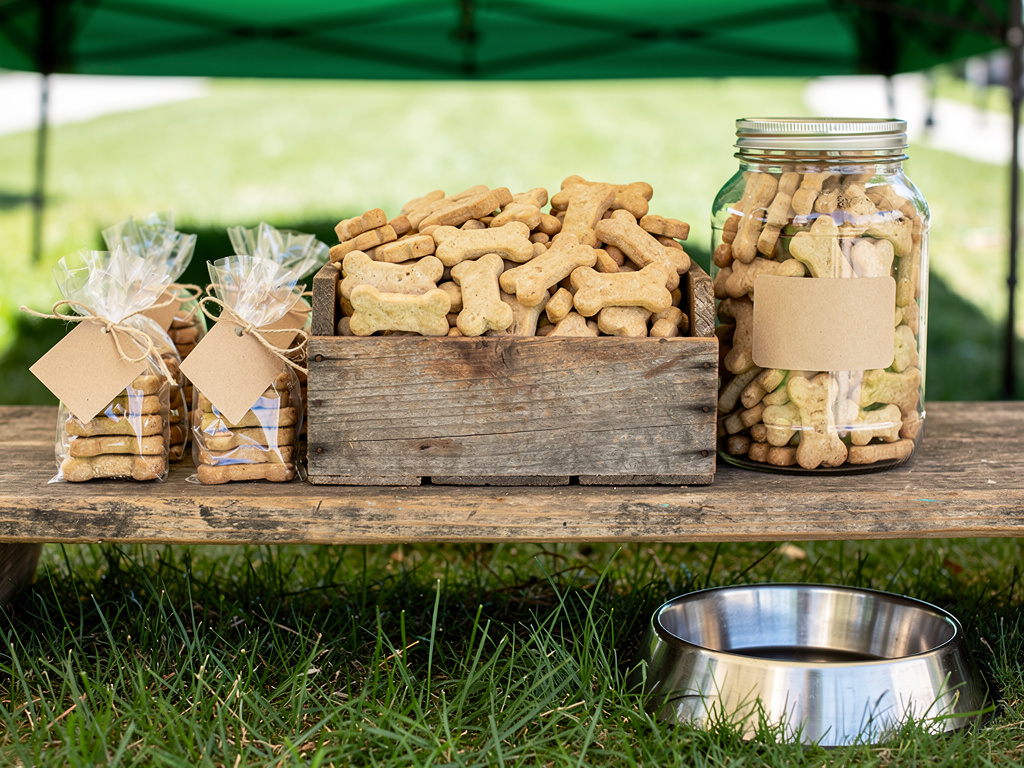


The short version: Dog treats sell in seven places: dog-friendly farmers markets, dog festivals and pet events, independent pet stores, groomers and trainers, your own online storefront link, Etsy, and neighborhood groups that point to that link. On a $10 bag, a card tap at a market booth leaves you $9.59, your own storefront link leaves $9.41 plus a $10 monthly plan, Etsy leaves $8.60 before shipping, and a pet store buying at wholesale pays you $5.00. Every one of those places counts as a sale of pet food, so your state registration has to cover it, and a registration in one state does not cover shipping into another. Start with one in-person place where dogs can sniff the table and one online link where their owners can reorder.
Checked September 22, 2026: Homegrown is $10 a month billed annually or $12.50 billed monthly, with 0% commission and card processing of 2.9% + $0.30 paid by the vendor, and you are not charged until day 8 (findhomegrown.com/signup). Etsy charges $0.20 a listing, a 6.5% transaction fee and 3% + $0.25 payment processing (etsy.com/sell). Square's Free plan charges 2.6% + 15¢ in person and 3.3% + 30¢ online (squareup.com/us/en/pricing). Honest bounds: a dog owner creates a Homegrown account to place a first order, there is no countdown or timed release feature, and your storefront is listed on the Homegrown marketplace but most orders will come from the link you hand out yourself.
Your peanut butter bones are a hit with every dog on the block, you have the registration paperwork sorted, and now the question is where the bags actually go. A farmers market table, a pet store shelf, a basket at the groomer, an Etsy listing: each one takes a different cut, asks for different paperwork, and suits a different kind of treat.
This guide walks through seven places a part-time dog treat vendor can sell, what each one leaves you on a single $10 bag, and how to pick the first one. If you still need the recipes, labels, packaging and the legal basics, start with the companion guide on how to sell dog treats from home, which covers all of that before you pick a place to sell.
You can sell dog treats in seven places: farmers markets that welcome dogs, festivals and pet events, independent pet stores, groomers and trainers, your own online storefront, Etsy, and neighborhood groups online. A part-time vendor can run two of them at once without help, and most should start with one in person and one online.
The rule for picking is short. Start where dog owners already gather, then add the place that lets them buy again without seeing you. Dogs go through a bag of treats quickly, so a customer who likes your bag in June is a customer who needs another bag in July, and the second place is where that reorder lands.
Pick your first place from what you already have, not from what pays best on paper. A vendor with a busy neighborhood group and no booth should open an order link first, and a vendor who already works a Saturday market should add a link before adding a second booth. Either way, keep the second place under $1 a bag in fees, so the reorder does not eat your margin: a booth card tap is $0.41, and your own link is $0.59 a bag plus the $10 monthly plan billed annually, which works out under $1 a bag once you sell about 25 bags a month (31 bags on the $12.50 month-to-month plan).
Swipe to see the whole table.
| What you have right now | Start here | Add second | Why that order |
|---|---|---|---|
| Friends and neighbors already asking for bags | Your own storefront link | A dog-friendly farmers market | The demand is there, so the missing piece is a way to take orders and payment without a pile of text threads |
| A booth at a market you already work | Your own storefront link | A groomer or trainer | Market customers reorder midweek if you hand them a link, and a groomer's counter fills the weeks between markets |
| A shelf-stable treat, good labels and time to pitch | One independent pet store | Dog festivals | A store sells for you all week, and festivals put your brand in front of the same owners who shop there |
| Nothing yet, and a full-time job | A dog-friendly farmers market | Your own storefront link | One Saturday tells you which flavor dogs pick and what owners will pay, faster than any amount of planning |
Card and platform fees in this guide come from each company's own pricing page, loaded September 22, 2026; booth fees and materials come from the Homegrown guides linked where they appear.
A dog-friendly farmers market is the best first place for most dog treat vendors, because the customer walks up with the dog, and five $10 bags cover a $40 booth. Our breakdown of the real cost of selling at farmers markets puts most booth fees at $20 to $75 a week.
That five-bag number comes from real costs. Our guide to what to charge for dog treats prices materials for a bag of 12 biscuits at about $1.07, ingredients and packaging together. A card tap through Square's Free plan costs 2.6% + 15¢, which is $0.41 on a $10 bag. That leaves $8.52 a bag, so a $40 booth is paid off by the fifth bag, and cash sales carry no card fee at all. The pricing guide shows $8.49 on the same bag because it figures an online card rate of 2.9% + $0.30 on two-bag orders, where this guide uses Square's 2.6% + 15¢ in-person rate for a booth sale.
What makes a market work for dog treats in particular:
Two things to settle before you pay a booth deposit. First, ask the market manager whether pet products are allowed; some markets only take food for people. Our tips on the farmers market vendor application cover what managers ask for. Second, remember that a market sale is still a pet food sale. AAFCO, the Association of American Feed Control Officials, which says following its model pet food rules will help you meet or exceed state requirements, puts a market sale in the same box as any other on its startup page for new pet food makers, checked September 22, 2026: it is commercial feed, and your state's rules apply.
How you display the treats can change what you owe. The Office of Indiana State Chemist's guide, I Want to Make and Sell Pet Treats in Indiana, answers the farmers market question directly. For treats taken to market in one pound bags, "You must label each bag and the $50 annual fee must be paid to our office for each product." For treats sold loose from a box where the customer picks one or two, you still pay the $50 license, label the container where customers can see it, and file a quarterly report with a $5.00 minimum per quarter instead of paying the per-product fee.
Pack two gallons of water for a four-hour market and keep a stainless steel bowl full on the ground in front of your table, with a jar of broken biscuits beside it for samples. A dog that stops to drink keeps its owner standing in front of your bags, and that pause is when a $10 bag sells. Sample only from a treat you have registered, and ask your state feed program if you are unsure whether free samples count.
Dog festivals are worth it when the fee is under about $125 and the crowd is local, because 15 bags at $10 covers even a $125 space. Bigger shows can work too, but a $900 booth needs more than 100 bags sold before you keep a dollar.
Here is what three real events charged dog treat and pet product vendors in 2026:
Scroll right for the rest of the table.
| Event | Vendor fee | What else it asks for | $10 bags to cover the fee |
|---|---|---|---|
| Whatcom Humane Society Dog Days of Summer, Bellingham, Washington, September 13, 2026 | $100 for a for-profit vendor, $25 for a non-profit | Vendors must be pet-related, and must provide insurance naming the shelter as an additional insured | 12 bags at the for-profit rate |
| Paw Prints PetFest and 5K, Friends of the Burlington County Animal Shelter, New Jersey, October 10, 2026 | $75 for vendors of goods and services, which most likely covers a table of bagged treats; the $125 food vendor rate buys space for a food truck or trailer | Bring your own table, chairs and canopy; $75 for each extra space; the fee is not refunded once you are accepted; a certificate of insurance if you count as a food vendor, give away pet food samples or bring an animal | 9 bags at the $75 goods and services rate |
| The National Dog Show cluster, Greater Philadelphia Expo Center, Oaks, Pennsylvania, November 12 to 15, 2026 | $900 for a 10 by 10 foot booth for all four days, $450 for each extra 5 feet | The application must include the booth fee and a certificate of insurance | 106 bags over four days |
Fees read on each event's own vendor page on September 22, 2026: the Whatcom Humane Society festival application, the Friends of the Burlington County Animal Shelter vendor page and the National Dog Show vendor information page. Bags to break even use $8.52 a bag, which is a $10 bag after $1.07 in materials and a $0.41 card tap, rounded up.
The Whatcom Humane Society's festival vendor page shows one shelter event's setup: a flat fee, a rule that every vendor sells something for pets, and an insurance requirement. The vendor information page for the National Dog Show cluster shows the other end: a four-day booth priced for companies with a full product line and staff to run it.
Ask these questions before you send a vendor fee:
All three events above ask for insurance in some form. The Whatcom Humane Society wants the shelter named as an additional insured on your policy, the National Dog Show wants a certificate of insurance with the application, and the Burlington County shelter festival in New Jersey wants a certificate from food vendors, from any vendor giving away pet food samples, and from anyone who brings an animal to the event, showing at least $1 million per occurrence and $2 million aggregate in general liability, so if the organizer puts your treats in the food class or you hand out samples at your table, you need one. Get a quote for general liability insurance that includes product liability, with a certificate that can name the event as an additional insured, before festival season, not the week the application is due. Our guide to cottage food business insurance covers what these policies cover and what they cost.
A festival pays best when you treat it as a way to meet a crowd of local dog owners, not just as a sales day. The bags you sell cover the fee. The customers who take your link home are the profit, and our breakdown of whether a craft fair table fee pays off shows how to track that return after the event.
Dog owners should order from an online storefront link you control, because a dog runs out of treats on a Tuesday, not on market day. A link is where the owner you met at the booth or the festival buys the next bag without texting you, and where you see the full order count before you bake.
Homegrown is $10 a month billed annually, or $12.50 billed monthly, with no percentage fees beyond standard payment processing of 2.9% + $0.30 per transaction, which is $0.59 on a $10 bag. You list your flavors, add your pickup points, and share one link on your bag labels, your market sign and your social posts. Dog owners order and pay before you preheat the oven, so you bake the exact number of bags that sold. That matters more for dog treats than for most products, because in many states, including Colorado ($25 a label) and Indiana ($50 a bagged product; loose treats sold from a labeled jar pay a quarterly tonnage fee instead), every flavor you add is another registration fee.
A few things Homegrown does that fit a dog treat business:
Here is how the alternatives compare for a dog treat vendor specifically:
A dog owner creates a Homegrown account to place a first order, which is one extra step at checkout. It is built for pickup and local delivery, not for shipping boxes across the country. It does not register your treats or print your labels. There is no countdown or timed release feature. Your storefront is listed on the Homegrown marketplace, but plan on most orders coming from dog owners you send to your own link. The 2.9% + $0.30 card fee is always yours to pay and cannot be added to the customer's total.
In a pull of the Homegrown catalog on September 22, 2026, 9 of the 293 vendors listed dog food, across 38 dog food listings out of 2,585 products. Their pickup points show where real dog treat vendors hand off orders: 3 list a farmers market (Six Arrows Farmers Market, Bushy Run Market Day in Jeannette, Pennsylvania on Saturday mornings, and North Union Farmers Market at the Cleveland Clinic on Wednesdays), 1 of those 3 also lists a dog groomer, Paw Patrol Dog Grooming, 1 lists a parking lot pickup in Summerville, South Carolina plus home pickup, and the other 5 list only their own place. These are listings and pickup settings, not sales.
If your regulars already ask when the next batch of peanut butter bones is coming out, give them somewhere to put the order. You can set up a Homegrown storefront, add your market booth and your porch as pickup points, and print the link on your next run of labels.
A local pet store buys dog treats at about half your retail price, so a $10 bag pays you $5.00, or $3.93 after $1.07 in materials. You earn less per bag than at a booth, but the store sells your bags seven days a week while you stay home and bake.
Independent pet stores and pet boutiques are the right target, not the big chains. An owner-run shop can say yes on the spot and often likes a local story on the shelf. A chain usually buys through a head office and a distributor, which is a different business from a part-time kitchen.
Before you walk in, know that a store sale is a registered pet food sale like any other. AAFCO's startup page counts a bag on a store shelf as commercial feed, and the Colorado Department of Agriculture's pet treat FAQ, checked September 22, 2026, says a label registered there can be sold in stores anywhere in the state. A store owner may ask to see that registration, so keep a copy on your phone.
The math decides whether wholesale fits. At $10 retail, $5.00 wholesale leaves $3.93 a bag after materials, against $8.52 selling the same bag yourself at a booth. Wholesale is worth taking for volume you would not have sold on your own, like the shop's regulars who never come to a market. It is not worth taking if it uses up the bags your own customers would have bought at full price.
Yes, groomers, dog daycares and trainers are some of the best second places for dog treats, because the same dog owners come back every few weeks and your bag sits right at the counter where they pay. These deals can run as consignment, as wholesale, or as a pickup point for your online orders.
Here is how each setup works:
Here is what each setup pays you on the same $10 bag, with the 30% consignment share as an example rather than a standard:
Scroll sideways to see every column.
Scroll sideways to see every column.
| How the business takes it | What you get on a $10 bag | Who holds the bags | When you get paid |
|---|---|---|---|
| You sell it yourself at a booth | $9.59 after a 2.6% + 15¢ card tap | You | At the sale |
| Pickup point for your online orders | $9.41 after 2.9% + $0.30, plus your monthly plan | You, until the owner collects | Online, when the owner orders |
| Consignment, business keeps 30% | $7.00 | You, sitting on their counter | Only after it sells |
| Wholesale, half the shelf price | $5.00 | The business, once it buys them | When the business pays you |
Card rates in this table come from Square's pricing page (2.6% + 15¢ in person) and Homegrown's signup page (2.9% + $0.30 online), both checked September 22, 2026. The 30% consignment share is an example, not a published rate.
Pickup points are the easiest of the four to start, since no money changes hands between you and the business. One real example: in the September 22, 2026 catalog pull, Barkin' Paws Dog Treats & More listed Paw Patrol Dog Grooming as a pickup point on its Homegrown storefront, next to a farmers market. A groomer gets a reason for customers to stop by, and you get a pickup spot that is not your front porch.
Treat a veterinary office the same way as any store. AAFCO's startup page names a vet's office as one more place where a treat counts as commercial feed, so the bag on the vet's counter needs the same registered label as the bag on your market table.
Trainers are the natural fit for small, low-crumb treats. R&B Dog Bakery listed four flavors of training nuggets at $4.00 each in the same catalog pull, which is the kind of product a trainer can hand out at the end of a puppy class or keep by the register.
Sell dog treats on Etsy only if you ship a shelf-stable treat and are ready to register in every state you ship to. Etsy's fees are $1.40 on a $10 bag, and the harder cost is the pet food paperwork: the Colorado Department of Agriculture answers "If my treats are registered in Colorado, can I sell them outside the state?" with "No, each state has its own registration and licensing requirements."
The Etsy fee stack on a $10 bag, checked on etsy.com/sell on September 22, 2026:
That leaves $8.60 of a $10 bag before shipping supplies, against $9.41 through your own storefront link, plus its $10 monthly plan. The full breakdown of Etsy fees for food sellers shows the same stack on bigger orders.
Etsy suits a narrow kind of dog treat vendor. Freeze-dried single-ingredient treats, hard biscuits that survive a box, and gift sets for the holidays all ship well. Soft pumpkin chews, anything with yogurt icing and birthday cakes do not. If most of your customers live within 20 miles of you, a pickup link does the same job for less, and the per-state fees for shipping sit in our guide to whether you can sell homemade dog treats for six states.
Yes, neighborhood groups and social media find you dog treat customers for free, but they work best as the front door to your storefront link, not as the place you take orders. One weekly post with one link, one order cutoff and one pickup time turns a group into orders without a pile of messages to sort.
Where local dog owners already talk:
A good weekly post names this week's flavors, the price, the order cutoff ("order by Thursday 8pm") and the pickup point, then ends with the link. The post costs $0 to publish, and each order it brings in pays the same $0.59 card fee on a $10 bag as any other order through your link. Taking orders in comments and messages works for a handful of regular customers and gets hard to track as orders grow, when you are matching payments to names by hand and chasing who paid for which bag.
On a $10 bag of dog treats, a card tap at a market booth costs you $0.41, your own storefront link costs $0.59 plus the monthly plan, Etsy costs $1.40 before shipping, and a pet store buying at wholesale keeps $5.00. Here is the full stack for every place, figured on one bag per order.
Scroll sideways to see every column.
| Place | Monthly plan | Trial | Platform fee or cut | Card processing | Customer pays on a $10 bag | You keep on a $10 bag | You pay in a month of 50 bags |
|---|---|---|---|---|---|---|---|
| Market booth, cash | $0, plus booth rent ($20 to $75 a week) | Not applicable | $0 | $0 | $10.00 | $10.00 | $0 plus booth rent |
| Market booth, Square Free reader | $0, plus booth rent | Not applicable, Free plan | $0 | 2.6% + 15¢ in person, paid by the vendor | $10.00 | $9.59 | $20.50 plus booth rent |
| Homegrown storefront link | $10 billed annually ($12.50 monthly) | 7 days, not charged until day 8 | $0, 0% commission | 2.9% + $0.30, paid by the vendor | $10.00 | $9.41 plus the plan | $39.50 ($42.00 billed monthly) |
| Square Online, Free plan | $0 | Not applicable, Free plan | $0 | 3.3% + 30¢ online, paid by the vendor | $10.00 | $9.37 | $31.50 |
| Shopify Basic | $29 billed yearly ($39 monthly) | 3 days, then $1 a month for 3 months | $0 with Shopify Payments (2% with another provider) | From 2.9% + 30¢ online (3.5% + 30¢ on premium cards), paid by the vendor | $10.00 | $9.41 plus the plan | $58.50 ($68.50 billed monthly) |
| Etsy | $0 (some new shops pay a one-time set-up fee) | None | $0.20 listing plus 6.5% transaction fee | 3% + $0.25, paid by the vendor | $10.00 plus shipping | $8.60 before shipping | $70.00 before shipping |
| Pet store, wholesale | $0 | Not applicable | The store keeps half the shelf price | None to you, the store runs its own register | $10.00 at the store | $5.00 | $250 given up to the store (you receive $250 of the $500 it takes in) |
We checked every platform fee in this table on each company's own page on September 22, 2026: findhomegrown.com/signup, squareup.com/us/en/pricing, shopify.com/pricing and etsy.com/sell. Card processing is figured on the $10 price with one bag per order; a two-bag order pays the fixed 15¢ or 30¢ once, so it costs a little less per bag. Etsy's 6.5% and its 3% processing fee also apply to the shipping price you charge, and its 15% Offsite Ads fee is left out. Shopify's $1 months are an introductory offer shown that day. Booth rent is the $20 to $75 weekly range from our farmers market cost breakdown. Wholesale at half of retail is keystone pricing, which a Shopify blog post on keystone pricing (September 10, 2026) calls a shortcut store owners use; it is not a fixed rule, and the store sets its own terms and shelf price.
What one $10 bag leaves you, before materials
Source: fee rates from each company's pricing page, checked September 22, 2026, applied to one $10 bag per order. Monthly plans and booth rent are not included in the bars; the own storefront link carries a $10 monthly plan billed annually, and Shopify Basic a $29 monthly plan billed yearly.
Three things the table makes plain:
At 50 bags a month, your own storefront link costs $39.50 all in on the annual plan. The same 50 bags on Etsy cost $70.00 before a single shipping label, and on Etsy your bag sits in search results next to other shops' treats.
Yes, your state pet food registration decides where your bags can legally be sold, and nearly every other state has its own rules (AAFCO's startup guide says every state except Alaska, and in one passage Nevada too, has a commercial feed law). In Colorado, a registration covers sales anywhere inside the state and nowhere else. The Colorado Department of Agriculture's pet treat FAQ, checked September 22, 2026, says registered labels "will be eligible to sell anywhere in Colorado, including farmers' markets and in stores," and that a Colorado registration does not cover sales in other states, because "each state has its own registration and licensing requirements."
AAFCO's startup page lists the places where pet food sold "is considered commercial feed," and the list reads like the table of contents of this guide:
The same page adds that "you will need to meet the requirements of any other state where you plan to sell your products." So the practical rule for a part-time vendor is simple. Register once in your own state, sell in as many local places as you like, and treat every new state as a new application.
What that costs varies by state. In Colorado, a $75 yearly company fee plus $25 per product label comes to $150 for three flavors, with the label fees billed the January after the year of sales. In Indiana, a $50 license plus $50 per product comes to $200 for three flavors, paid by check with paper forms. Both were read on each agency's own page on September 22, 2026. Our guide to whether you can sell homemade dog treats lays out the fees and home kitchen rules for six states.
Shipping is where a registration quietly stops covering you. An Etsy order from the next state over, a gift box mailed to a customer's sister, a wholesale case sent to a shop across the state line: each one is a sale in a state where your treats may not be registered. Rules and fees change, so verify your state's current rules with your state feed program before you add a new place to sell, and ask about every state you plan to ship into.
Match the treat to the place: small training treats to trainers, cakes and birthday bags to pre-orders, single bags and samples to markets, and shelf-stable meat treats to stores and shipping. The Homegrown catalog shows real vendors pricing each of these differently. For the market table itself, our list of best-selling dog treat flavors and shapes for farmers markets ranks the formats from $4 training bags to $10 birthday cakes and explains why three flavors is the right start.
In the September 22, 2026 catalog pull, the 35 dog food listings sold as one bag or item (leaving out two bundles and the monthly subscription box) had a median price of $7.50, and the most common price was $5.00, on 7 listings. Training nuggets sat at $4.00 (four flavors from R&B Dog Bakery), dog cakes and birthday bags at $10.00 (three listings from two vendors), freeze-dried organ meat at $8.49 and $14.00, and a monthly subscription box at $20.00 from Barkin' Paws Dog Treats & More. Barks & Bites Bakery also listed a pumpkin-infused dog "beer" at $5.50. These are listed prices, not sales.
A place-by-place guide to what goes where:
Dog-friendly breweries and patio pop-ups also sell treats. A pumpkin dog "beer" like the $5.50 one in the catalog fits a brewery's dog night, where the owners are holding a drink of their own.
Add one new place at a time, give it four weeks, and keep the place that pays you the most per hour. A second place can usually be set up within a week without baking an extra batch, because the work is an application, an email or one walk-in visit.
If you sell at a market today, our guide to QR codes that build a customer list at the farmers market shows how to turn one Saturday of buyers into people you can reach next week.
Sell in two or three places, not six, and make every place send customers back to one link. Bake to orders wherever you can, because a registered flavor that sits unsold is paid for twice: once in ingredients and once in the registration fee.
Habits worth copying:
That last habit is what connects the places. The market meets the dog, the groomer keeps you in front of the owner, and the link is where the owner actually buys the next bag. Our guide to the best platform to sell dog treats online compares the options for that link in more detail.
The biggest costs of selling dog treats in more places never appear on a pricing page: your time, insurance, event gear, registration fees per flavor and the bags that come back stale. Add them up before you judge any place by its card fee.
The costs to count:
None of these make a place bad. They just mean the cheapest place on the fee table is not always the cheapest place to sell. A $0.41 card tap at a booth that takes a 10-hour Saturday can pay you less per hour than a $0.59 online order you bag in five minutes on a Friday night. If your regulars are already asking for weekday orders, open a Homegrown storefront and let the market be where you meet new dogs instead of the only place anyone can buy.
You can sell homemade dog treats at markets that welcome dogs, at shelter fundraisers and pet festivals, in independent pet stores, groomers, daycares and trainers, and through your own online storefront link for local pickup. Start with one in-person place and one online link. Your state pet food registration has to be in place first, because every one of those places counts as a pet food sale.
Yes, if the market allows pet products and your treats are registered with your state feed program. AAFCO treats a market sale as a sale of commercial feed, so the same rules apply as anywhere else. Indiana, for example, requires a label on each bag and $50 a year per product for treats sold in one pound bags at a market. Ask the market manager whether pet products are allowed before you apply.
Yes, independent pet stores and pet boutiques can buy from local bakers, often at keystone pricing (about half the retail price) or on consignment. A $10 bag sold wholesale pays you $5.00. Bring a finished, fully labeled sample bag, a one-page price sheet with a minimum order, and a copy of your state registration. Chain stores usually buy through a head office and distributors, so start with owner-run shops.
Locally, for most part-time vendors. On a $10 bag, Etsy takes $1.40 in listing, transaction and processing fees before shipping, against $0.59 in card processing on your own storefront link plus a $10 monthly plan. The bigger issue is registration: almost every state has its own pet food rules, so shipping dog treats to Etsy buyers in other states can mean registering in each of them. Etsy fits shelf-stable treats that ship well, sold by a vendor willing to register where the buyers are.
Often, yes. The Whatcom Humane Society's 2026 festival required vendors to provide insurance naming the shelter as an additional insured, the four-day National Dog Show cluster wanted a certificate of insurance with every application, and a New Jersey shelter festival asked food vendors, anyone handing out pet food samples and anyone bringing an animal for a certificate showing $1 million or more of general liability per occurrence. Farmers markets and pet stores may ask for it too. Price a general liability policy with product liability included before festival season, so the certificate, naming the event as an additional insured when asked, is ready when an application wants it.
A dog-friendly farmers market is the best place to sell dog treats as a beginner, because most booths rent for $75 a week or less and you learn in one Saturday which flavor dogs choose. Five $10 bags cover a $40 booth after materials and card fees. Add an online storefront link as your second place, so the owners you meet can reorder between markets.
Six guides that pick up where this one stops, from the permit to the price on the bag. Each one is written for a part-time vendor baking at home, and each one answers a question this guide only touches.



