
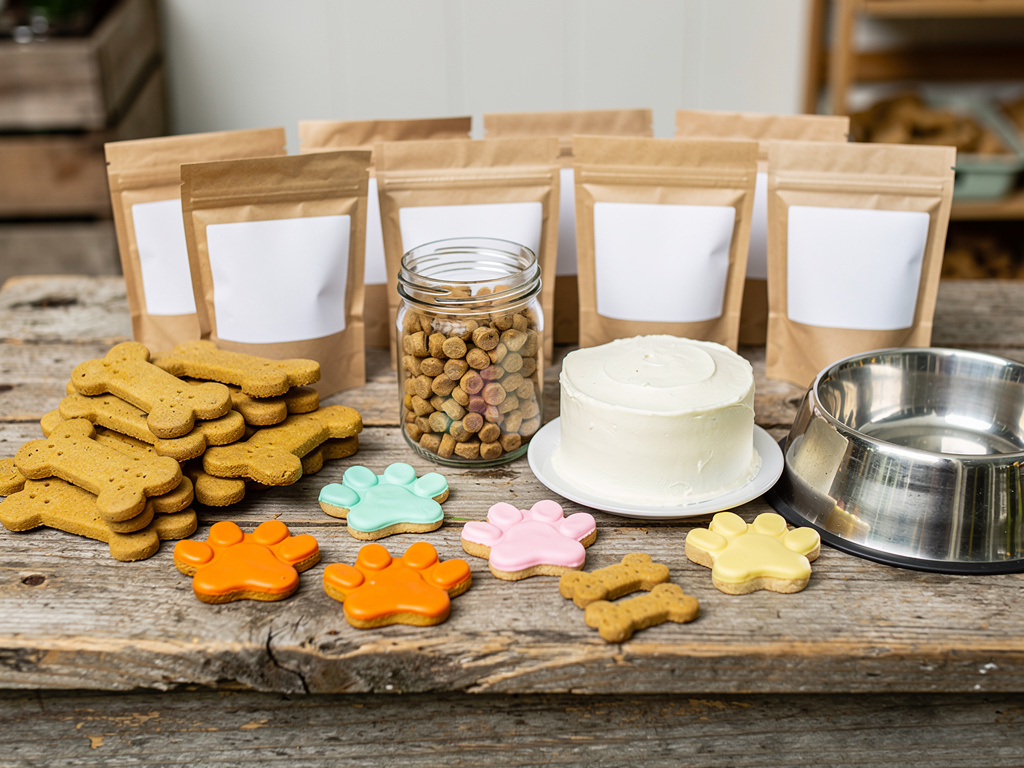


The short version: Lead with peanut butter. It was named in 16 of the 37 dog treat listings on Homegrown on September 29, 2026, and two market bakers profiled by their local papers in 2023 named peanut butter, or peanut butter bacon, as their top-seller. A lineup that fits a small farmers market booth is three flavors of baked treats in bone and paw shapes (peanut butter, pumpkin and one savory like bacon or salmon) in $5 to $8 bags, plus $4 training treats or iced cookies for impulse buys and $10 birthday cakes taken as pre-orders. Keep the flavor count low at first, because states like Virginia and Washington count each flavor as its own product to register, at $50 a year per flavor sold in bags in Virginia, so verify your state's current rules before you add a flavor or a shape.
Checked on September 29, 2026: the Homegrown catalog (2,762 listings from 311 vendors), Homegrown's signup page, Square's and Venmo's fee pages, and the pet treat pages of the Virginia, Washington, Minnesota and Utah agriculture departments. Catalog prices are what vendors list, not how many they sold. Homegrown customers create an account to place their first order, and Homegrown has no drops feature (a timed release with a countdown).
A dog treat booth sells to two customers at once. The dog decides what smells good, and the owner decides what to pay for. The treats that sell best at a farmers market win both votes: a flavor the dog pulls toward, in a bag the owner can grab for five or eight dollars without thinking twice.
This guide is about what to put on the table. It ranks flavors, shapes and formats using the real dog treat listings on Homegrown, what market bakers say about their own best-sellers, and the state rules that, in some states, make every extra flavor cost money. It is written for a part-time vendor baking at home for one or two Saturday markets. If you still need the basics of getting started, our guide on how to sell dog treats from home covers registration, labels, ingredients and booth setup, and this page picks up at the question it leaves open: which treats to bake.
Crunchy baked treats in small bags are the core of the dog treat lineups on Homegrown, making up 15 of the 37 listings for dogs. Around that core, vendors add cheaper impulse buys (training treats and iced cookies at $4), celebration products (cakes and birthday bags at $10) and a few higher-priced extras like freeze-dried liver and bundles.
Here is how the 37 listings break down. Across all of them, the median listed price is $7.50, from $4.00 up to $25.00. We counted every listing a dog eats or drinks, in the Pet Supplies category or anywhere the name or description said it was for dogs, and read each one by hand. Jars, tags, toys and salves were left out.
Scroll sideways to see every column.
| Format | Listings (vendors) | Listed prices | A real example | Its job at the booth |
|---|---|---|---|---|
| Everyday baked treats | 15 (6) | $5.00 to $12.99, median $7.00 | Barkin' Paws Harvest Bites, 12 treats for $6.00 | Your main earner, in every flavor you register |
| Dog drinks, spreads and mixes | 5 (1) | $5.50 to $12.50 | Barks & Bites Bakery Paw-Rona dog "beer," $5.50 | A conversation starter and gift item |
| Training treats | 4 (1) | $4.00 each | R&B Dog Bakery Salmon Training Nuggets, $4.00 | The low-price first purchase |
| Meat, liver and bones | 4 (3) | $5.00 to $14.00 | KairosGO freeze-dried heart, kidney and liver, 3 oz for $8.49 | The premium bag for picky dogs |
| Iced and fancy cookies | 3 (2) | $4.00 to $9.00 | Barks & Bites Bakery Paw-Some Cookies, 2 iced paws for $4.00 | The eye-catcher up front |
| Cakes and birthday bags | 3 (2) | $10.00 each | R&B Dog Bakery Birthday Treats bag, $10.00 | Pre-orders picked up at the market |
| Bundles and boxes | 3 (2) | $13.00 to $25.00 | Barkin' Paws Monthly Subscription Box, 72 treats for $25.00 | The bigger order from a regular |
Source: a pull of the Homegrown catalog on September 29, 2026, 37 dog treat listings from 9 vendors. We counted by category and description, then opened every listing from each of those vendors, not by a word in the product name. These are listed prices, not sales.
Homegrown dog treat listings by format
Source: Homegrown catalog pull, September 29, 2026, 37 dog treat listings from 9 vendors.
The pattern is simple. One format carries the booth, and everything else either brings people in or raises the average order.
If you already know your best bag and want regulars to reorder it between market days, a Homegrown storefront lists each flavor with its own price and lets customers pick it up at your next market. It costs $10 a month billed annually, with no percentage fees beyond standard payment processing.
Peanut butter is the dog treat flavor to bet on first: it is named in 16 of 37 listings for dogs on Homegrown (43%), from 4 of the 9 vendors, and it tops the two market vendor reports quoted below. Pumpkin and banana come next in the catalog, then apple, blueberry and bacon.
What the 37 listings name, counting the product name, the description and the flavor options:
Several listings have no description at all, so treat these counts as floors. Keep in mind that listings show what vendors chose to bake and list, not how many bags sold. For sales, the best evidence is what vendors report from their own tables.
We found no public count of dog treat sales across farmers markets, so the vendor reports below are the closest thing to a sales ranking, and they point the same way. The Idaho Falls Post Register profiled Bark Bakers, a Saturday vendor at the Idaho Falls Farmers Market, on June 26, 2023: "Out of all the flavors, peanut butter is the most popular." And Rita Ciatto of Adirondack Barkery, who has baked dog treats for markets since 2012, told the Daily Gazette in 2023 that her best-seller is peanut butter bacon and that "what dogs like is generally meat and peanut butter."
Peanut butter is the safe first flavor because owners already know their dog likes it, so the bag needs no explaining. In the Homegrown catalog it shows up in 6 of the 7 formats, from $4.00 training nuggets to the $23.00 Spoiled Dog Bundle. A shopper who has never seen your booth can say yes to a peanut butter bone in two seconds. A duck and cranberry biscuit needs a conversation first.
It also smells. A tray of peanut butter biscuits pulls dogs across the aisle, and the dog pulling on the leash does more selling than your sign.
Three things keep peanut butter working for you:
Make your second flavor pumpkin and your third a savory one like bacon, salmon or turkey. That covers the three reasons owners buy: the flavor their dog loves, the flavor that sounds healthy, and the flavor for the dog who does not care about sweet.
Pumpkin is the "good for them" flavor. Owners connect it with an easy stomach, it bakes into a sturdy biscuit, and three of the nine vendors list it. Barkin' Paws Harvest Bites, 12 treats for $6.00, list rolled oats, pumpkin, unsweetened applesauce, egg and cinnamon, and nothing else.
A savory flavor catches the owners who pass on anything sweet. R&B Dog Bakery lists a salmon nugget made with sweet potato and blueberries and a "Turkey Pup-Pie" inspired by pot pie. Miss Laney's Pawtisserie sells a salmon and sweet potato treat in a 6 oz bag for $12.99, described as grain-free.
Three lineups to start with at a first market:
Bones and paws are the shapes Barks & Bites Bakery, the catalog's biggest dog treat baker with 16 of the 37 listings, uses on its everyday treats, and R&B Dog Bakery sells Blueberry Paws. That is what vendors list, not a sales count. Our advice is to start with them anyway, because owners recognize a bone or a paw from across the aisle as a dog treat. A round biscuit next to someone's cookie table could be for people. A bone cannot.
The shapes the catalog vendors use, and what each one does:
Keep one shape and one name per flavor at first. Customers learn "the peanut butter bone" faster than a table where every flavor comes in four shapes.
Sometimes, and it depends on your state, so ask before you buy a new cookie cutter. AAFCO, the association of state feed regulators, says pet food sold at a local farmers market is commercial feed. What counts as a separate product is up to each state.
Four states, four different answers:
We read these four state pages on September 29, 2026. The rules on flavors, shapes and sizes differ from state to state and change over time, so check with your state's feed or pet food program before you add a flavor, a shape or a size word to your product name.
Our guide on whether you can sell homemade dog treats covers the full registration process and what goes on the label.
Bring three flavors to your first market, 20 bags of each. Three is enough for a real choice, small enough to bake well in one evening, and in a state that charges per flavor it keeps your registration bill low while you learn what sells.
The math in Virginia for treats sold in bags, using its $50 license and $50 per flavor:
The starting table in the short version, three flavors plus a $4 training bag and a $10 birthday cake, is five products in Virginia if you sell them packaged: $250 plus the $50 license, $300 a year. To stay at $200, add the training bag and the cakes after the three flavors prove themselves.
Virginia's guide says treats sold loose and unpackaged skip product registration. You still need the $50 license, a yearly tonnage report and an inspection fee of $0.07 a ton on your sales, with a $35 minimum, and the same label rules apply.
Adirondack Barkery runs a "doggie buffet" of 20 different options, but that is after more than a decade at markets. Ciatto also told the paper she checks each flavor "with at least 50 dogs," handing samples to friends who tell her what works. Start at three and earn the fourth.
Bring 20 bags of each of your three flavors to your first two markets and write down the time each flavor sells out. The flavor that is gone by 10 a.m. gets doubled next week. The flavor with 12 bags left gets swapped out, not discounted.
We found no sales data on training treats, but our advice is to use them as the cheap first purchase, because a $4 bag is an easy yes for an owner who has never tried you. R&B Dog Bakery lists four training nuggets at $4.00 each: peanut butter oatmeal, salmon, pumpkin and turkey pup-pie.
Training treats earn their table space in three ways:
Keep the pieces small. Owners hand out many small rewards in one training session, so a big bone is the wrong product here. A trainer who runs classes near your market is also a steady buyer, and our guide to where to sell dog treats covers selling through trainers and groomers.
Yes, but they work best as pre-orders picked up at the market, not as walk-up products that sit in the sun. Three cake and birthday listings in the Homegrown catalog are all priced at $10.00, from Barks & Bites Bakery and R&B Dog Bakery.
What those listings are:
Iced cookies are the walk-up version. Barks & Bites Bakery sells Paw-Some Cookies at $4.00 for two and Summer Paw Cookies at $4.00, decorated like watermelon and a sunny beach. Put a few on a cake stand at the front of the table. They stop people even when the owner came for a plain bag.
A birthday cake needs a few days' notice, a pickup day and a name. That is an order, not an impulse buy, which is why it belongs on a pre-order list.
Freeze-dried liver, organ meat and bones are a smaller, higher-priced niche: 4 of the 37 listings, from 3 vendors, priced $5.00 to $14.00. They are meat treats rather than baked biscuits, which can appeal to owners of picky dogs or dogs on limited diets.
The four listings:
All three vendors also sell meat for people, which is the natural fit. They have the organ meat and bones already. If you bake biscuits, one freeze-dried liver bag can sit beside your lineup as the premium pick.
Check the rules before you add chews. Since July 1, 2024, Washington requires registration of chews, skins and bones that are "minimally processed (e.g., uncooked, raw, and/or dehydrated)." Other states have their own rules, so ask your state feed program first.
For summer, one catalog vendor, Barks & Bites Bakery, lists cold and fun products, like dog "beer," frozen treat mixes and fruit-decorated cookies. For fall and winter, pumpkin and holiday designs are the natural switch. Your core peanut butter bag stays on the table all year either way.
What the catalog shows for summer:
Notice that the frozen item is a mix. The owner freezes it at home, so the vendor never has to keep ice cream frozen at a hot booth. If you want to sell anything frozen or refrigerated, plan for a cooler and check your state first. Minnesota's cottage food route, for example, covers only "certain types of baked or dehydrated" dog treats.
For fall, our suggestion is to move pumpkin to the front of the table and switch iced cookies to leaves, pumpkins and holiday shapes. Our list of the best-selling fall farmers market products covers what shoppers buy for people in the same season.
Price your core bag between $5 and $8, which is where 11 of the 15 everyday baked treat listings in the catalog sit, with a median of $7.00. Then add one item under $5 and one at $10 or more, so every shopper has a yes.
A price ladder for one table:
Four everyday bags in the catalog are listed at $10 or more, from Simply Home-Made Dog Treats and Miss Laney's Pawtisserie. Miss Laney's Pawtisserie lists 6 oz bags at $12.99, with a note that every purchase supports shelter and rescue animals.
Round numbers help at a booth. $5 and $8 are faster to take in cash than $4.75, and customers stop doing math. Our guide to what to charge for dog treats walks through the cost of each bag so your price covers your time.
Bundles do not replace single bags, but they raise the size of the order from owners who are already buying. The three bundles and boxes in the catalog run from $13.00 to $25.00.
How the catalog vendors build them:
Bundles also answer the gift shopper. Someone buying for a friend's dog wants one thing to hand over, and a $23 bundle with a tag, a toy and a bag of treats is exactly that. Price a bundle a little under the sum of its parts, not far under: our pricing guide suggests 10% to 15% below buying the same bags one at a time.
A three-flavor sampler is also a good way to introduce a new flavor. Put the new one in a pack with the two flavors people already trust. If you mix different treats in one bag, ask your state how it wants a mixed pack labeled.
You find your best-selling flavor in four market days by counting sellout times, not by guessing. Bark Bakers in Idaho Falls hands each new treat to "around 10 families" to try on their dogs before it goes on sale, and Adirondack Barkery tests each flavor on at least 50 dogs. At the booth, sellout times tell you the rest.
Also write down what people ask for that you do not have. "Do you have anything grain-free?" three weeks in a row is a flavor request.
Once you know your best-selling flavor, the next problem is selling it between Saturdays. The owner whose dog loves your peanut butter bone runs out on Wednesday, and if the only way to get more is to catch you at the next market, some of them buy a bag at the pet store instead.
Homegrown gives you one storefront link for that reorder. It costs $10 a month billed annually ($12.50 billed monthly) with no percentage fees beyond standard payment processing, and it starts with a 7-day trial with no charge until day 8. Here is how it compares on one $20 order with two other ways to take orders between markets.
Scroll sideways to see every column.
| Tool | Monthly plan | Trial | Platform fee | Card or payment fee | Customer pays on a $20 order, before sales tax | Vendor pays on a $20 order | Vendor pays in a month of 50 orders at $20 |
|---|---|---|---|---|---|---|---|
| Homegrown | $10 billed annually ($12.50 monthly) | 7 days, no charge until day 8 | None | 2.9% + $0.30, paid by the vendor | $20.00 | $0.88 plus the plan | $54.00 ($56.50 on monthly billing) |
| Square Online, Free plan | $0 | None needed (Plus and Premium have a 30-day trial) | None listed | 3.3% + 30¢ online, paid by the vendor | $20.00 | $0.96 | $48.00 |
| Venmo business profile | None listed | None | None listed | 1.9% + $0.10, paid by the vendor | $20.00 ($20.60 if paid by credit card) | $0.48 | $24.00 |
We checked these on Homegrown's signup page, Square's pricing page and Venmo's fee page on September 29, 2026. Venmo charges the sender 3% when paying with a credit card. All three totals are before sales tax; Homegrown calculates sales tax at checkout and remits it for you. Square's in-person rate on the Free plan is 2.6% + 15¢, which is about $0.31 on a $6 bag at your booth.
Venmo is the cheapest per order, but it handles the payment, not the order. You still take the order by text, keep the flavor list in your head and chase down who is picking up what. Square Online can do more, but you build and run a second online store next to your card reader. Homegrown is built for the reorder:
What it does not do: your customers create a Homegrown account to place their first order. There is no drops feature and no automatic monthly billing, so a treat box is a listing customers order each month. You cannot sell by the pound, so loose treats need a set bag size. Card processing is paid by you, not added to the customer's total. Your storefront is listed on Homegrown's marketplace, but plan on most orders coming from market regulars you send to your own link. And Homegrown does not register your treats or check your labels; that stays between you and your state.
The mistakes that slow a dog treat table are too many flavors, no price signs and treats the owner cannot identify, and each one is fixable before next Saturday.
The common ones:
Experienced dog treat vendors build the table around one proven flavor and treat every other item as a test. They know which flavor pays the booth fee, and they protect it.
Habits worth copying from the vendors in this guide, plus one of our own:
Peanut butter biscuits are the safest bet, though we found no public data that ranks dog treat sales across markets. In the Homegrown catalog on September 29, 2026, peanut butter appeared in 16 of 37 dog treat listings, and market vendors profiled in Idaho and New York named peanut butter, or peanut butter bacon, as their top-seller.
Peanut butter is the flavor market vendors name as their top-seller, and it leads the Homegrown catalog, followed by pumpkin, banana, apple, blueberry and bacon. A good starting lineup is one peanut butter flavor, one pumpkin flavor and one savory flavor like bacon, salmon or turkey.
Start with three. Three flavors give shoppers a choice and let you see which one sells first. In states that register each flavor separately, like Virginia at $50 per bagged flavor per year, three flavors also keep your first-year costs down.
Eleven of the 15 everyday dog treat bags on Homegrown are listed between $5 and $8, with a median of $7.00. Add a $4 item for first-time buyers and a $10 cake or larger bag for owners who want more.
Yes, but take them as pre-orders and hand them over at the market. The three cake and birthday listings on Homegrown are all $10.00. Plan on a few days' notice and a set pickup day for a cake.
It depends on your state. Virginia counts each flavor, and each different product name, as a new product for treats sold in bags. A new bag size is not, unless the size word is in the name. Washington also counts a different label or product name as a separate product, so a new shape sold under its own name can cost a registration in both states. Minnesota registers each product sold under a commercial feed license, but a cottage food baker registers once a year instead of registering each product, and Utah's home-produced pet treat registration covers all versions of a treat. Verify your state's current rules before you add a shape.
Once you know which treats to bake, these guides cover the rest of selling them, from the rules in your state to where to sell, what to charge and how to take orders between markets:
The table that sells is short: peanut butter first, pumpkin second, one savory flavor third, in $5 to $8 bags with something under $5 in front. Count what sells out, double the winner and swap the slowest. Keep your flavor list short until your state's registration costs are worth it.
Then build out from the winner. Add a $4 training bag if puppies keep stopping by. Take birthday cakes as pre-orders once people start asking. Test a seasonal flavor in a sampler, and check with your state whether the sampler and the new flavor need their own registration first. Every new product should earn its spot by selling faster than the one it replaces, and the notebook of sellout times is how you know. Give each change two market days before you judge it.
When your regulars start asking how to get more between Saturdays, set up your Homegrown storefront with your three flavors and a market pickup window, and put the QR code next to your best-seller.



