
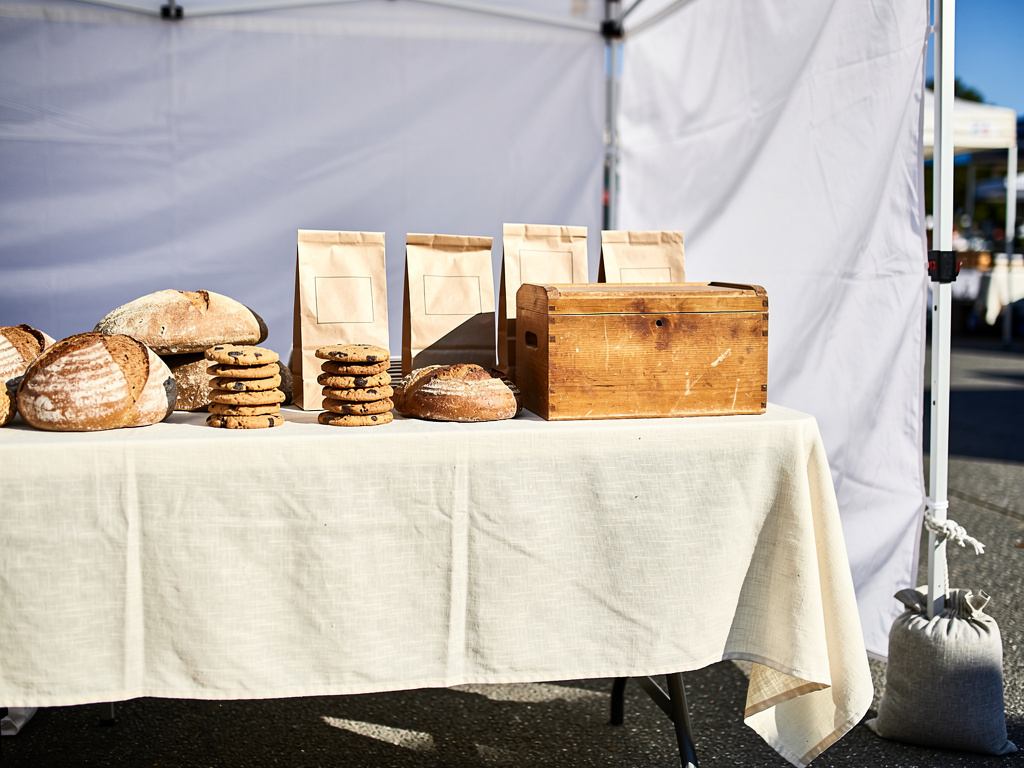


The short version: One market day in a farmers market booth cost a home baker $20 to $84 at the seven markets we read on September 30, 2026 (Muskegon's $15 Thursday rate requires a state certified facility), and Portland's Saturday market charges bakeries 9% of their sales whenever that beats its $84 day rate. The booth fee is not the big number. In our worked example a solo baker spends $187.71 in cash to sell $300, and the booth is only $35 of that. Count the 13 to 17 hours of your own time and a first-season baker can end the day near $8 an hour, before FLIP's $299-a-year starting liability policy and a tent from $129.95. In our example, pre-orders picked up at the market raised that number from $8.02 to $13.51 an hour.
Checked on September 30, 2026: booth fees come from each market's own 2026 vendor handbook, application or fee page (Portland Farmers Market, Corvallis-Albany Farmers' Markets, Muskegon Farmers Market, Dodge Park Farmers Market in Sterling Heights, Grand Island Area Farmers Market, Ames Main Street Farmers' Market and the Gardens GreenMarket in Palm Beach Gardens), insurance from FLIP's site, card fees from Square's and PayPal's pricing pages, and platform prices from Etsy, Shopify and findhomegrown.com/signup. Fees change every season, so read your market's current application before you budget. Homegrown customers create an account before their first order, and Homegrown has no drops or countdown-release feature.
A common answer online is that a farmers market booth costs $20 to $75 a week. Across seven real 2026 market fee pages, one market day ran $20 to $84 for a home baker, so that old range is close. It is also the least important number you need to know. The real cost of selling at a farmers market includes your ingredients, your packaging, your gas, your permits, your insurance, and the 13 to 17 hours you spend shopping, baking, packing, driving, setting up, selling, and tearing down every single market day.
To put numbers against your own setup, our calculator estimates how much it costs to start a home bakery, itemized by category.
When you add all of that up, the booth fee is one of the smaller lines on the list.
Once the numbers work, make ordering effortless. Take orders and get paid online in about 15 minutes. Set up a Homegrown storefront ($10/mo billed annually, 0% commission), or compare the best platforms to sell food from home.
A common answer is $20 to $75 a week for a booth, and the markets we read mostly fit it. A single market day for a home baker ran from $20 to $25 on a Saturday at Ames Main Street Farmers' Market in Iowa, depending on how many dates you book, up to $84 or more at Portland Farmers Market's Saturday market at Portland State University in Oregon. Muskegon, Michigan charges $15 on a Thursday, but that is a producer rate, and Muskegon defines a producer as someone selling food made in a state certified facility, so ask the market before you count on it for food from a home kitchen. Among markets that publish a season price, season passes ran from $200 at Grand Island, Nebraska, to $775 for a regular seasonal stall in Muskegon, Michigan ($825 for a corner stall), assigned by seniority from a waiting list. Palm Beach Gardens lets vendors prepay its October 4 to May 30 season for a discount it does not list; at $60 a week for 35 Sundays, that is about $2,100 before the discount and tax.
That number is real. But it is one line item on a 10-line expense sheet.
In our worked example later in this article, the $35 booth fee is 19% of the $187.71 a baker spends in cash on a $300 market day. Once you count 14 hours of your own time, it is a much smaller share of what the day really costs. A booth range like $20 to $75 on its own fits a produce farmer who loads up a truck with what they already grew. If you are a food vendor (a baker, a jam maker, a spice blender), your cost structure is completely different because you have to buy ingredients, make the product, package it, and label it before you ever get to the market.
What makes food vendor costs different from produce vendor costs:
This article gives you the full picture, starting with what real markets charge.
A farmers market booth ran a home baker $20 to $84 for one market day across seven markets in five states: $20 to $25 for a Saturday at Ames, $30 for a Thursday in Sterling Heights, Michigan, and more than $84 on a big day at Portland's Saturday market, where bakeries pay 9% of sales. Muskegon, Michigan's $15 Thursday stall is cheaper, but only for food from a state-certified kitchen. Each fee below comes from the market's own paperwork for 2026, not from a survey or a blog.
Scroll sideways to see every column.
| Market | One market day for a baker | Season option | Other fees on the same page | Insurance it asks for |
|---|---|---|---|---|
| Portland Farmers Market, Saturday at Portland State University (Oregon) | 9% of gross sales or $84 (May to September), whichever is greater; $74 floor October to April | None, you pay per market | $15 application, $38 yearly membership | $1,000,000 per occurrence, market named as additional insured |
| Gardens GreenMarket, Palm Beach Gardens (Florida) | $60 plus tax per Sunday (non-farm, value-added) | Prepay the season for a discount; no credit for missed Sundays | $5 per outlet for power | Not on the fee page |
| Muskegon Farmers Market (Michigan) | $50 on Saturdays, $15 on Thursdays, $25 to $35 on Tuesdays; producer rates, for food made by the seller in a state certified facility, and farm goods get first pick of daily stalls when space is short | $775 regular seasonal stall ($825 corner), May to November | $300 dealer fee if over 80% of what you sell is not your own | $500,000 minimum, market named |
| Corvallis Saturday market, Corvallis-Albany Farmers' Markets (Oregon) | $36 for a 10 by 20 foot space | Prepay 5 to 8 market weeks for 5% off, 9 or more for 10% off | $25 yearly membership | Strongly encouraged; required for processed and restaurant-style food vendors |
| Dodge Park Farmers Market, Sterling Heights (Michigan) | $30 per Thursday for a 10 by 10 pavilion space | $408 for all 16 dates, prepaid | $8 a day for electricity | Not checked for regular vendors |
| Grand Island Area Farmers Market (Nebraska) | $30 per Saturday for a single stall | $200 for the season, May 23 to October 24 | None listed | Required for all vendors, with Bosselman Enterprises named as additional insured and the market's address on the policy |
| Ames Main Street Farmers' Market (Iowa) | $25 per date for "1-12 dates" and $20 per date for "12+ dates," as the sheet puts it (bakery); $50 per date for prepared food | $475 full season for bakery, $625 for prepared food | $20 non-refundable application | $500,000 general liability, market named |
We read each market's 2026 handbook, application or fee page on September 30, 2026. "Not checked" means the page we read did not say, not that the market does not ask. Our guide to becoming a farmers market vendor read six more 2026 applications on September 29, 2026 (in Virginia, Oregon, Maryland, New Jersey, Colorado and Kentucky) and found $20 to $50 a market day and $50 to $550 a season.
One market day's booth fee for a baker, 2026
Source: the seven markets' 2026 fee pages and handbooks, as read September 30, 2026. Portland's figure is the peak-season floor; bakeries pay 9% of sales when that is higher. Muskegon's Thursday rate is $15, and its daily rates are for producers selling food made in a state certified facility. Ames is $25 a date for 1 to 12 dates and $20 a date for 12 or more. Bar widths are each fee divided by $84.
Three patterns stood out across the seven:
The 2026 Portland Farmers Market vendor handbook is worth a read even if you never sell in Oregon. It shows every fee class, the reporting rules and the late fees in one place, which is what a well-run market's paperwork looks like.
Yes, some markets charge a percentage of your sales instead of, or on top of, a flat booth fee. At Portland Farmers Market's Saturday market, a bakery pays 9% of its gross sales for the day or the $84 food artisan rate, whichever is greater, according to the market's 2026 handbook. At Portland's smaller neighborhood markets the bakery rate is 8% of sales or the food artisan rate of $46 to $60.
Here is what that means in dollars at the Saturday market in peak season:
At a percentage market, the fee grows with your sales, so a strong day costs more in dollars and a slow day still costs the floor. You also do paperwork a flat-fee vendor never sees. Portland asks percentage-paying vendors to report their sales weekly and charges a $25 late fee when a month's sales are not reported by the end of the month.
If you are comparing a flat-fee market with a percentage market, run your expected sales through both. A $50 flat Saturday beats 9% on any day over $556, and a percentage fee is cheaper only on your slowest days, if the market has no floor.
A season pass is cheaper if you will attend most of the market days, and it is a bad deal if you expect to skip several dates. Most season prices we read were paid up front (Muskegon splits its seasonal stall into payments due June 13 and August 1, 2026), and Palm Beach Gardens says plainly that vendors who prepay get no refund or credit for missed Sundays.
Swipe the table left to see when a season pass pays off.
| Market | Day rate | Season price | Market days in the season | Season cost per market day | Days you must attend for the pass to pay off |
|---|---|---|---|---|---|
| Grand Island (NE) | $30 | $200 | 23 Saturdays, May 23 to October 24 | $8.70 | 7 |
| Ames, bakery (IA) | $25 (1 to 12 dates), $20 (12 or more) | $475 | 24 Saturdays, May 2 to October 17, no market July 4 | $19.79 | 21 to 24, depending on how the $20 rate is applied |
| Sterling Heights (MI) | $30 | $408 | 16 Thursdays | $25.50 | 14 |
| Muskegon, Saturday (MI) | $50 | $775 | Tuesday, Thursday and Saturday, May to November; seasonal stalls go by seniority from a waiting list, so a newcomer pays the daily rate, and both prices assume a state-certified kitchen | Depends on how many you attend | 16, counting only $50 Saturdays |
Math: season price divided by the day rate, rounded up, gives the days you must attend. Grand Island: $200 / $30 = 6.7, so 7. Sterling Heights: $408 / $30 = 13.6, so 14. Muskegon: $775 / $50 = 15.5, so 16. Ames: $475 / $20 = 23.75, so 24 if every date is billed at $20, or 21 if the first 12 are billed at $25 ($300 + $20 x 9 = $480). Season dates come from each market's own 2026 page, read September 30, 2026.
At Grand Island, a vendor who comes to all 23 Saturdays pays $200 for the season instead of $690 at the day rate. At Ames, the bakery season price of $475 saves almost nothing over paying $20 a date. The pass is a bet that you will show up. If you are new, unsure of your product, or likely to skip rainy weeks, pay by the day for the first month.
The costs most vendors plan for are the booth fee, ingredients, packaging and gas, which come to $95 to $304 a market day. They are real, but they are not the whole story.
Slide sideways to read the notes on each cost.
| Cost | Range per market day | Notes |
|---|---|---|
| Booth fee | $20 to $84 | The 7 markets we read, leaving out Muskegon's $15 Thursday rate, which needs a state-certified kitchen; Portland's Saturday market can charge 9% of sales instead |
| Ingredients | $50 to $150 | Varies hugely by product type |
| Packaging (bags, boxes, labels) | $15 to $40 | Gets cheaper when you buy in bulk |
| Gas and transportation | $10 to $30 | Round trip plus a loaded vehicle |
| Subtotal | $95 to $304 |
The booth fee range comes from the seven market fee pages in the table above. The ingredient, packaging and gas lines are planning ranges for a small food vendor, not checked prices. Put your own receipts in their place.
Those four lines come to $95 to $304 a market day. Once you add insurance, card fees, waste and samples from the next section, the full range runs about $131 to $389. The math: insurance at $299 over a 20-day season is $14.95 a market day, card fees run $6.38 ($200 in 20 PayPal payments) to $14.90 ($400 in 30 Square payments), waste is 10 to 20% of ingredients ($5 to $30), and samples run $10 to $25.
The ingredient line is where most of the variation lives. A jam maker buying bulk fruit in season might spend $50 per market day on ingredients, while a baker using high-quality butter, vanilla extract, and specialty flour can easily hit $150 or more. Packaging costs also creep up faster than people expect. Once you add branded stickers, allergen labels, and cellophane bags, that $15 estimate can double. And transportation costs go beyond just gas. You are putting miles on your car every week with a heavy load, and that wear adds up over a full 20-week season.
Application fees, insurance, permits, equipment, waste, card fees, samples and wear and tear are the costs that catch first-time vendors off guard, and FLIP's farmers market policy alone starts at $299 a year. Every one of them is real, and most of them hit you before you sell your first product.
In our worked example below, a vendor who budgets only for the booth, ingredients, packaging and gas plans for $150 of the day's $187.71 in cash costs. The $37.71 left out (waste and card fees) is 20% of the real bill, before insurance and application fees are spread across the season.
Fees, insurance limits and permit prices are set by each market and each state, and they change every season. Muskegon's dealer fee alone has risen $50 a year since 2022 and reached $300 in 2026. We read every figure in this section on September 30, 2026; read your own market's current application before you count on any of them.
Your time is the biggest cost: a solo baker spends 13 to 17 hours on one market day, and most first-season budgets leave it out. For a solo food vendor, it is almost always the biggest line on the sheet.
Here is what a typical market day actually looks like for a one-person baker:
Total: 13 to 17 hours for one market day.
Now do the math that actually matters. This example uses a 14-hour day, near the low end:
Swipe if the amounts are cut off on your phone.
| Line Item | Amount |
|---|---|
| Gross sales | $300.00 |
| Minus ingredients | -$80.00 |
| Minus booth fee | -$35.00 |
| Minus packaging | -$20.00 |
| Minus gas | -$15.00 |
| Minus unsold product | -$30.00 |
| Minus card fees ($210 on cards in 15 Square taps) | -$7.71 |
| Net profit | $112.29 |
| Divided by 14 hours | $8.02/hour |
Math: card fees are 2.6% of $210 ($5.46) plus 15 cents on 15 payments ($2.25), from Square's pricing page on September 30, 2026. Cash costs: $80 + $35 + $20 + $15 + $30 + $7.71 = $187.71. Net: $300 minus $187.71 = $112.29. The $30 of unsold product is a rough first-season day, 30% of the $100 spent on ingredients and packaging, above the 10 to 20% to budget once you know how much to bring. This example leaves out insurance, which at $299 a year over a 20-day season would take another $14.95.
In this example the baker earns $8.02 an hour for 14 hours of work, before insurance. The federal minimum wage is $7.25 per hour, and many states set a higher one: California's is $16.90 on the Department of Labor's state table (updated January 1, 2026), and Florida's rose to $15.00 on September 30, 2026, the last step of the raise its voters approved in 2020. That means a first-season vendor with these numbers earns barely more than the federal minimum, and about half the minimum wage in Florida or California, for skilled work.
This is not meant to discourage you. It is meant to help you price correctly. If you know what your real hourly rate is, you can take action to improve it. Every extra $50 in sales at the same costs adds about $3.57 an hour to this baker's day.
Ways to increase your effective hourly rate:
The vendors who earn more than $20 an hour at markets got there by doing this math honestly and adjusting. Our guide to how much you can make selling at farmers markets works out $22 to $33 an hour for an established vendor who nets $400 a day over 12 to 18 hours of work.
Here is the complete startup cost breakdown for a cottage food vendor selling at farmers markets. These are one-time costs you pay before your first market day. Booth fees are left out because you pay them per market.
Swipe left to see the typical and high columns.
| Item | Low | Typical | High | Notes |
|---|---|---|---|---|
| Pop-up tent (10x10) | $129.95 | $129.95 | $218.86 | Eurmax basic steel and Standard models |
| Tent weights | $20.95 | $20.95 | $20.95 | Four empty sandbags at ABCCANOPY, sand extra |
| Folding table | $0 | $112.50 | $112.50 | $0 if you own one; Lifetime 6-foot fold-in-half list price, single table out of stock September 30, 2026 |
| Tablecloth | $15 | $20 | $30 | Planning range |
| Signage | $20 | $30 | $50 | Planning range |
| Labels and packaging (first batch) | $50 | $75 | $100 | Cheaper in bulk after this |
| First-day ingredients | $50 | $100 | $150 | Depends on your product |
| Cottage food permit | $0 | $0 | $355 | $0 in 38 states; $355 in Washington covers two years |
| Food handler card | $0 | $15 | $15 | ServSafe online course and test, if your state requires one |
| Market application and membership | $0 | $25 | $53 | $53 is Portland's $15 application plus $38 membership |
| Liability insurance (one year) | $0 | $299 | $299 | FLIP's starting price; $0 only if no market asks |
| Card reader | $0 | $0 | $59 | $0 with Tap to Pay on iPhone XS or newer; $59 for Square's reader |
| Total startup | $285.90 | $827.40 | $1,463.31 | One-time |
Prices checked September 30, 2026 on eurmax.com, abccanopy.com, lifetime.com, ServSafe's product page, fliprogram.com and squareup.com. Permit figures are from our cottage food license cost guide, with the Washington and Delaware fees re-read on each agency's page the same day. Tablecloth, signage, packaging and ingredient lines are planning ranges, not checked prices.
A realistic startup budget for a cottage food vendor selling at farmers markets is about $827, inside a range of $286 to $1,463. The biggest swings are liability insurance ($0 or $299), your state's permit ($0 to $355) and whether you already own a table.
Ways to keep startup costs on the lower end:
After startup, your recurring cost per market day runs about $131 to $389 depending on your product and your market. That range spreads the same $299 insurance policy from the startup budget over a 20-day season at $14.95 a day, so do not budget for it twice: without the insurance share, the day costs about $116 to $374. That is the number you need to beat in sales every single week.
For more on getting your booth set up efficiently, check out our guide on farmers market booth setup ideas that actually work.
You get a booth by applying to the market during its application window, sending the fee and the paperwork it asks for, and paying the booth fee once it accepts you. Markets fill early, so start a few months before the season.
Our guide to becoming a farmers market vendor walks through each step with six more 2026 applications, and our farmers market vendor application tips cover what to write so the manager says yes.
Breaking even, or losing a little money, is a normal first season, and it does not mean your business is failing.
Here is why the first season is hard:
Our guide to farmers market income puts first-season vendors at $150 to $400 a market day and returning vendors at $400 to $800, mostly because of repeat customers. The first season is tuition. The second season is where the business actually starts.
A reasonable first-season goal is to cover your startup costs and learn what works. At the typical $827 startup budget and the $112.29 net from our example day, that takes about eight market days. If you can do that, you are in a strong position for year two.
Pre-orders picked up at your booth are how you earn between market days, and in our example they raise the baker from $8.02 to $13.51 an hour. The numbers above assume all your revenue comes from market-day sales. But the 6 days between markets are lost sales unless you give customers a way to order from you during the week.
Pre-orders change the cost equation in two ways. First, you bake to known demand instead of guessing, so the pre-ordered part of your table carries no waste. Second, pre-orders add revenue without adding a booth fee, gas, or setup time. Take the baker in our example: $300 at the Saturday market plus 10 pre-orders of $15 ($150) picked up at the booth. The pre-orders cost about $40 in ingredients and $10 in packaging (the same shares as the market day), $7.35 in card processing and $2.31 for a week of a $10-a-month plan, so they add $90.34. Add one more hour to bake and pack them and the day earns $202.63 over 15 hours, or $13.51 an hour instead of $8.02.
The question is what you use to manage those pre-orders, and whether it adds another cost line to the expense sheet you just spent this entire article tracking. Here is the full fee stack on each common option:
Slide the table sideways to compare all four options.
| Option | Monthly plan | Trial | Platform or transaction fee | Card processing | Customer pays on a $20 order | You pay on a $20 order | You pay in a month of 50 orders at $20 |
|---|---|---|---|---|---|---|---|
| Texts plus a Venmo business profile | $0 | None needed | None | 1.9% + $0.10 | $20.00 | $0.48 | $24.00, plus your time tracking every order by hand |
| Etsy | $0 (Etsy may charge a one-time set-up fee) | None | 6.5% transaction fee plus $0.20 listing fee per sale; 15% Offsite Ads fee on sales from Etsy's ads | 3% + $0.25 | $20.00 plus any shipping | $2.35 | $117.50, more if an ad drives a sale |
| Shopify Basic | $29 billed yearly ($39 monthly) | 3 days, then $1 a month for 3 months | None with Shopify Payments, 2% with another processor | 2.9% + 30¢ standard cards, 3.5% + 30¢ premium cards, online | $20.00 | $0.88 at standard card rates, plus the plan | $73.00 ($83.00 monthly) at standard card rates |
| Homegrown | $10 billed annually ($12.50 monthly) | 7 days, no charge until day 8 | None | 2.9% + $0.30, paid by you | $20.00 | $0.88 plus the plan | $54.00 ($56.50 monthly) |
Checked September 30, 2026 on Venmo's fees page, Etsy's Fees and Payments Policy and Etsy Payments Policy (US rate), Shopify's pricing page and findhomegrown.com/signup. Etsy's Offsite Ads fee is 15% with an opt-out for shops under $10,000 a year in sales, and 12% with no opt-out above that. A month of 50 orders at $20 is $1,000 in sales. Card processing is figured on the $20 price.
Texts and Venmo cost the least in fees. But tracking pre-orders through DMs is unpaid administrative work, and you just learned that your time is the most expensive line item in this business. Past a handful of weekly pre-orders, tracking them by hand starts to eat the time you saved.
Etsy charges a 6.5% transaction fee, a $0.20 listing fee each time a listing sells and renews, and 3% + $0.25 payment processing. On the $150 a week of pre-orders in our example (10 orders of $15), Etsy takes $18.75 a week, or $975 over a 52-week year, before any Offsite Ads fee. That's another line item on your already-tight cost sheet.
Shopify Basic at $29 a month billed yearly ($348) or $39 billed monthly ($468) was built for e-commerce businesses that ship nationwide. For a vendor selling $300 a day at a farmers market, that's another fixed cost before you've sold anything, plus 2.9% + 30¢ on each online order paid with a standard card, or 3.5% + 30¢ with a premium card.
Homegrown costs $10 per month billed annually ($120 a year), or $12.50 billed monthly, with no percentage fees beyond standard payment processing of 2.9% + $0.30, which you pay and your customer does not. It is built for how market vendors actually operate: weekly pre-orders with market-day pickup. You add your market as a pickup location, set the pickup days and times, and set an order prep time so orders close before your baking day. The built-in QR code goes on your table sign so shoppers can order next week's bread before they walk away. At $120 a year, the plan costs about what two Sundays cost at Palm Beach Gardens, before tax.
Swipe sideways for the weekly cost of each option.
| Cost Source | Annual Cost | Impact on Per-Market Math |
|---|---|---|
| Text/DMs plus Venmo business | $200.20 in fees (but hours a week managing) | $3.85 a week in fees, and it eats your most expensive resource: time |
| Etsy | $975.00 in fees | Adds $18.75 a week to your cost sheet, more with Offsite Ads |
| Shopify Basic, billed yearly | $348 plan + $382.20 processing = $730.20 at standard card rates | $14.04 a week whether you sell much or not |
| Homegrown, billed annually | $120 plan + $382.20 processing = $502.20 | $9.66 a week, $2.31 of it the plan |
Math for $150 a week of pre-orders, 10 orders of $15, 52 weeks ($7,800, 520 orders). Venmo: 1.9% of $7,800 ($148.20) + $0.10 x 520 ($52). Etsy: 6.5% ($507) + 3% ($234) + $0.25 x 520 ($130) + $0.20 x 520 ($104). Shopify (at its standard card rate) and Homegrown processing: 2.9% ($226.20) + $0.30 x 520 ($156). Prices checked September 30, 2026.
Homegrown is built for pickup and local delivery, not nationwide shipping, and it does not price by the pound yet (selling by weight is on its roadmap, not live). Your customers create a Homegrown account to place their first order. There is no drops or countdown-release feature. Your storefront is listed in Homegrown's local marketplace, but plan on most orders coming from people you send to your own link. Payouts go to your bank by ACH (an order on Saturday lands Tuesday morning, per the signup page), with 20% of each order held for 30 days as a reserve and released automatically. What it handles is the one job in this section: letting your market customers order and pay between markets so you bake to demand and capture revenue you would otherwise lose.
At a $12 product that keeps about $8.80 after ingredients, you need 3 sales to cover a $20 date at Ames and 10 sales to cover Portland's $84 floor. Counting your booth fee in sales, not dollars, is the fastest way to see whether a market fits your prices.
In a pull of the Homegrown catalog on September 30, 2026, the 1,402 Bakery listings from 180 vendors had a median base price of $12.00, and the middle half ran from $6 to $16. The 299 Pantry listings (jams, sauces, spice blends and the like) from 66 vendors had a median of $10.00. We counted by the category each vendor chose for the product, not by words in the product name, and used the base price before any size options.
Here is the math at the $12.00 median Bakery price, with ingredients at the same 26.7% share as our worked example ($80 of $300), so each sale keeps $8.80 before other costs:
At the $12 median bakery price, every booth we read costs between 3 and 10 sales before you earn anything for your time, or 2 at Muskegon's $15 Thursday if you bake in a state certified facility. If your best seller is a $6 cookie bag, double those counts.
Before you apply, divide the market's day rate by what one sale keeps after ingredients. If the answer is more than 10 sales, ask the manager how many shoppers come through on a typical Saturday. A $60 Sunday is 7 sales of a $12 loaf before tax, and before you have paid for gas or your time.
Our guide to the break-even point for a farmers market booth turns this into a full formula with your fixed and variable costs.
A market is worth continuing when your sales there beat your full cost for the day, consistently, over four to six tries. The math is simple. Add up every cost for a typical market day:
That total is your break-even number. If you consistently sell above it, the market is profitable. If you consistently sell below it, it is not.
If your total costs per market day are $200 and you consistently sell less than $200, that market is not working for you. Give it four to six tries before deciding, but do not keep going to a market that loses money just for exposure.
"Exposure" is the most dangerous word in the farmers market world. Exposure does not pay for your ingredients. Exposure does not cover your gas. If a market is not making you money after six visits, it is time to try a different one.
A few things to check before walking away:
A market that covers its costs but leaves you at $8 an hour is a pricing problem, not a market problem. Put a QR code on your table that opens a Homegrown storefront with your weekly menu, and the shoppers who liked your bread on Saturday can order next week's loaf on Wednesday for pickup at your booth.
For a deeper dive on calculating whether a specific market is worth your time, read our guide on how to calculate your farmers market booth ROI.
If you want strategies to boost sales without spending more money, our guide on how to market your food business with no budget covers what actually works.
A farmers market booth costs a home baker about $20 to $84 for one market day at the seven 2026 markets we read, and many markets meet once a week, so that is also the weekly cost. Muskegon, Michigan charges $50 on Saturdays and $15 on Thursdays, but only for food from a state-certified kitchen. Season passes are cheaper per day if you attend most dates, such as Grand Island, Nebraska's $200 for 23 Saturdays, which works out to $8.70 a market day instead of $30. Always ask about season pricing before committing to weekly payments.
Yes, every one of the 13 markets we and our vendor guide read in September 2026 charged vendors a booth fee, a season fee or a share of sales. Many also charge an application fee ($15 to $45 where listed) or a yearly membership ($25 at Corvallis-Albany, $38 at Portland). Plan on insurance too, since most markets ask for proof of liability coverage. The real cost of selling at a farmers market is the booth plus those required extras.
Not if you qualify under your state's cottage food law, though some markets, like Muskegon, Michigan, write their stall rates for food made in a certified kitchen. Many states let you bake and make shelf-stable foods in your home kitchen without a commercial kitchen license, and 38 states charge nothing for the standard cottage food path. Cottage food laws usually cover products like baked goods, jams, jellies, honey, granola, spice blends, and dry mixes. Check your state's specific rules, because some states have annual sales caps and product restrictions.
Our guide to farmers market income puts first-season vendors at $150 to $400 per market day and established vendors at $400 to $800 or more. What you keep depends on your costs: the baker in our worked example sold $300 and kept $112.29 after cash costs, or $8.02 an hour over a 14-hour day. Adding $150 of pre-orders for market pickup raised that to $13.51 an hour. First-season vendors should expect lower margins while they learn.
It can be, but only if you price your products to cover all costs including your time. Vendors who treat it as a hobby and underprice consistently lose money. The vendors who make it work treat their booth like a small business: they track every expense, price for profit, and drop markets that do not perform. A useful test is whether one market day covers its booth fee in 10 sales or fewer.
Baked goods, jams and preserves, honey, prepared foods, and specialty products like hot sauce and spice blends consistently sell well. Bakery is also the biggest category in Homegrown's own catalog, with 1,402 of 2,768 listings in our September 30, 2026 pull. The key is not just what you sell but how you price it: products with higher margins per unit make the math work better for a solo vendor.
Many markets require general liability insurance from food vendors, and each market sets the limit. Muskegon and Ames ask for $500,000, while five of the six applications in our vendor guide asked for $1,000,000. FLIP's farmers market policy starts at $299 a year or $25.92 a month, checked September 30, 2026. Always check the vendor application for the specific markets you are applying to, because insurance requirements vary widely.
These six guides go deeper on the costs in this article, from the paperwork a market asks for to the formula for your own break-even number. Start with the first if you have not applied anywhere yet, since it reads six more 2026 applications with fees of $20 to $50 a market day. Each one was live on September 30, 2026.
Selling at a farmers market is not free, and it is not cheap. But it is also not as expensive as most people fear, especially if you qualify for a cottage food path that skips commercial kitchen costs and, in 38 states, the permit fee.
The vendors who succeed are not the ones who ignore costs. They are the ones who know every number, price accordingly, and treat each market day like a small business operation. When you know your real costs, including your time, you can make smart decisions about which markets to attend, how to price your products, and when a market is no longer worth it.
If you take one number away, make it your own hourly rate. Our example baker made $8.02 an hour selling $300 at the market, and $13.51 once $150 of pre-orders rode along to the same booth. Run your own day through the same table before you pay for a season pass.
Start with the math. The rest follows.



