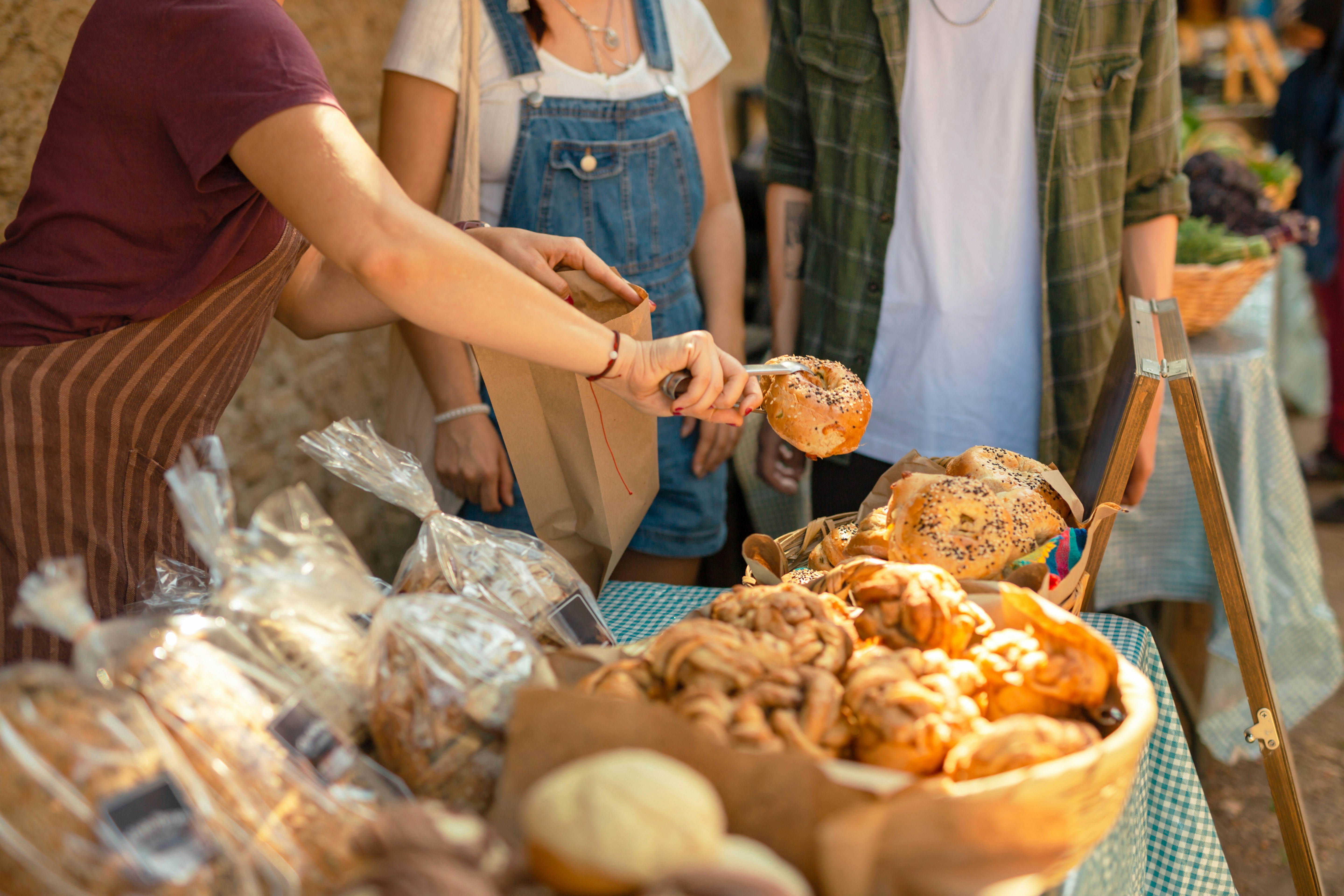


The short version: You can start selling at a farmers market with one product, a table, a tent and a liability policy, for roughly $460 to $820 before ingredients. In the eight 2026 market fee sheets we read, a flat booth day cost $20 to $84 at seven, and two markets take a share of your sales (6% with a $5 minimum at Portneuf Valley; at Portland, bakeries pay 8% to 9% or the flat food artisan rate, whichever is more). All 9 state cottage food rules we checked let you sell home-baked goods, with yearly sales caps from $35,000 in Washington to $250,000 in Florida (Colorado caps each product type at $10,000 of net revenue) and a $355 permit in Washington. The vendors who grow use the booth to meet people, then take orders between market days.
Checked on each market's 2026 vendor application, each state agency's own page, FLIP's insurance page and Square's fee page, October 6, 2026. Fees and rules change every season, so read your market's current application and verify your state's current rules before you apply. Homegrown pricing ($10 a month billed annually, 0% commission) came from findhomegrown.com/signup the same day; customers create a Homegrown account to place a first order, and there is no drops feature.
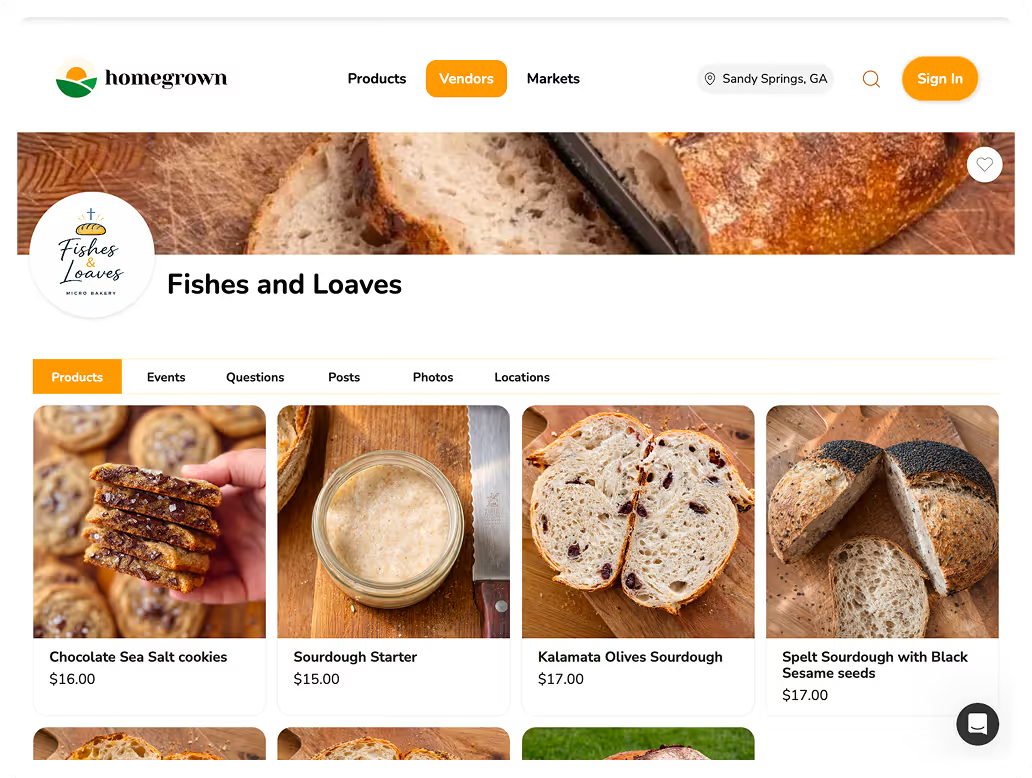
If you want shoppers to order between market days, you can set up a Homegrown storefront and try it free for 7 days.
Farmers markets are one of the easiest ways to start selling food directly to people who want to buy it. You don't need a storefront, a website or a wholesale account. You need a product, a booth fee, an insurance certificate and a Saturday morning.
But if you search for advice on how to get started, you'll find articles telling you to write a business plan, get a commercial kitchen, invest in professional signage and build a brand identity, all before you've sold your first loaf of bread or jar of honey.
This guide is for the person who makes something good and wants to try selling it at a local Saturday market. It uses real numbers: booth fees from eight 2026 market fee sheets, the rules from nine state agencies, and a real farmers market budget from the University of Maryland Extension. No MBA required. Just your product, a table, and a willingness to show up. If you want the full application walkthrough, how to become a farmers market vendor compares six 2026 applications side by side, deadline by deadline.
It can be, for a part-time vendor: a farmers market is a small source of income and a low-cost place to meet your first regular customers. But only if you count every cost, including your own time. A booth fee is one of the smallest lines on the list.
The University of Maryland Extension walks through a real example in A Booth at the Farmers' Market: Profit or Loss. A farmer called Paul sells his own beef at a market 6 miles from his farm. He pays $15 a week for his space. After paying for the beef itself, he has $300 left from a market day and thinks that's his profit. It isn't. Here is what the Extension counts against that $300 for one market day:
That's $174 in selling costs, which leaves Paul $126 of real profit on top of paying himself $14 an hour. If he works for free, he keeps $231. That's not retirement money, but it's not nothing either, and the Extension's point is the useful one: most of these costs stay the same every week, so the main way to earn more is to sell more on the same day.
Run Paul's math on your own first market before you sign up for a season. If your booth fee is $30 and you spend 7 hours on the day, you need to clear $128 above your ingredient cost just to cover the booth and pay yourself $14 an hour, before your share of travel, gear, insurance and permits. Price your table to that number, not to what the vendor next to you charges.
The thing the math doesn't capture is what else you get from a market. You meet every person who stops at your table, face to face, and those people came looking for local food. Some of them become regulars who would order from you every week, not just on Saturdays. The market becomes the way you find customers, and the real revenue grows between market days.
Selling at a market makes sense when:
Yes, you have to pay to sell at a farmers market, and in the eight 2026 market fee sheets we read on October 6, 2026, a flat booth day cost between $20 and $84 at seven of them, and Portneuf Valley charges 6% of sales with a $5 minimum. Five of the eight also charge an application fee or a yearly membership, and seven require proof of liability insurance before your first day.
Here is what each market charges a new food vendor for one 10 by 10 booth:
Swipe to see each market's fees.
| Market | Application or membership | One booth day | Season option | Insurance required |
|---|---|---|---|---|
| Boone County Farmers Market, Kentucky | $75 season membership with a reserved space | $20 for non-members | $75 membership, May 9 to October 31 | Yes; $1,000,000 product liability for processed foods |
| Lyons Farmers Market, Colorado | $45 application | $25 | Pay weekly or up front | $1,000,000 |
| Laurel Farmers Market, Maryland | None listed | $25 if you attend fewer than 4 days | $50 inside city limits, $100 outside | $1,000,000, market and city named |
| Bloomfield Community Farmers Market, New Jersey | None listed; food vendors also pay a one-time $30 Health Department temporary food license | $30 per date, sold in two 11-date blocks ($330 each) | $550 for 22 weeks if paid by April 24 | $1,000,000 per occurrence, $2,000,000 aggregate |
| St. Johns Farmers Market, Portland, Oregon | None in 2026 | $47 non-farmer food, $42 farmer, $50 arts and crafts | Pick any number of dates | $1,000,000, market named |
| Culpeper Downtown Farmers Market, Virginia | $25, non-refundable | $50 part-time, as space allows | $300 for the full season | $1,000,000 |
| Portland Farmers Market, Oregon (5 markets) | $15 application plus $38 yearly membership | Food artisans $46 to $84; bakeries pay 8% or 9% of sales or the food artisan rate, whichever is more | Billed per market day | $1,000,000 per occurrence, market named |
| Portneuf Valley Farmers Market, Idaho | $125 yearly membership | 6% of sales or $5, whichever is more; walk-on food vendors pay $60 plus 6% | Membership plus the daily 6% | Liability insurance, or a signed waiver |
We read each market's own 2026 vendor application, handbook or vendor page on October 6, 2026. Portland's top food artisan rate ($84) is its Portland State University market in May to September. Fees change every season, so read your market's current application before you budget.
Two things stand out. First, percentage fees grow with you. At Portneuf Valley, a $300 day costs you $18. At Portland's Portland State University market, a bakery pays 9% of sales or the $84 May-to-September food artisan rate, whichever is more, so in those months the 9% only kicks in once you sell more than $933.33 in a day. Second, a cheap booth does not mean a cheap season, because the insurance costs the same whether you sell 10 days or 30.
A market's own rules can be stricter than your state's. Georgia's agriculture department says plainly that a farmers market may require a Food Sales Establishment License even though cottage food operators don't need a state license, and Michigan's agency says the same about its markets. Read the market's application before you assume your home-kitchen status covers you.
You find a farmers market by searching a directory for markets near you, visiting the ones that fit as a shopper, then applying with product photos and permits, usually in late winter for a summer season, and sending an insurance certificate with the application or after you are accepted, depending on the market. The deadlines are the part first-timers miss.
Search the USDA National Farmers Market Directory for markets near you, then visit them as a customer before applying as a vendor. Not all markets are the same. A busy downtown market with 60 vendors and live music is a completely different experience from a 12-vendor neighborhood market in a church parking lot. Both can work, but they attract different customers and have different dynamics.
The USDA's Local Food Directories list markets that have two or more farm vendors selling at the same place on a regular schedule, with hours, location and the payment types each one takes. Then go walk the market. See what's being sold, what the prices look like, how much foot traffic there is, and whether there's a gap your product could fill. The National Farmers Market Coalition's education pages are a good place to learn how markets are run before you talk to a manager.
Pay attention to category mix. If a market already has four bakers, it might not need a fifth. Markets can cap how many vendors sell similar products: Portneuf Valley's handbook says its manager "will limit types of vendors to keep the variety of vendors large," and Culpeper caps craft booths at 10% of its space. Smaller or newer markets tend to have more open slots and less competition per category.
Also ask about vendor commitment. Some markets let you buy single days so you can try it out without a season-long commitment. Others push a season plan. The regular seasons we read ran 18 to 39 market days: the 18 Wednesdays at Portland's Kenton market, Lyons' 20 Sundays (its full-time plan covers 16 of them), Bloomfield's 22 weeks, Culpeper's 26 Saturdays, Laurel's 31 Thursdays from April 2 to October 29 and the regular season at Portland's Portland State University market, which its handbook counts as 39 market days (Saturdays, April 4 to December 19). For a first-timer, a market with day rates lets you test the waters before you commit.
Questions to ask the market manager before you apply:
Expect a written application, an application fee of $0 to $45 in the markets we read (plus a $38 to $125 yearly membership at three of them), and a request for your permits and a $1,000,000 insurance certificate. You'll typically fill out a form that asks what you sell, how it's made, where it's produced, and whether you have the necessary permits and insurance.
Here's what to expect:
Apply early. The 2026 deadlines we read fell between late February and late April: Culpeper's was February 27, St. Johns' priority date was March 1, Lyons closed April 22 and Bloomfield's was April 24. Popular markets fill up fast, especially for baked goods and prepared foods. If you're waitlisted, ask if there are substitute vendor opportunities when regulars can't make it.
Before you apply, gather these six things. Get an insurance quote early, and buy the policy when the market asks for the certificate: Boone County, Bloomfield, Culpeper and Laurel want it with the application, while St. Johns, Lyons and Portland want it after they accept you (St. Johns asks you not to buy until you are approved).
Slide the table for the details.
| Requirement | Details |
|---|---|
| Product description and photos | Clear photos of your products help your application stand out |
| Permits and licenses | Varies by state and product type; the market manager can tell you what's needed |
| Insurance (COI) | General liability, usually $1,000,000 per occurrence; FLIP's vendor policy starts at $299 a year or $25.92 a month, annual only (no one-day cover) |
| Booth fee | $20 to $84 a day where the market charges a flat rate, or 6% to 9% of sales at the two that charge a share (Portneuf Valley's minimum is $5) |
| Seasonal commitment | Some markets sell single days; the regular seasons we read ran 18 to 39 market days, and Lyons' full-time plan is 16 of its 20 |
| Deadline | February 27 to April 24 for the 2026 summer seasons we read |
Insurance and fee figures from FLIP and each market's 2026 application, read October 6, 2026.
Not usually: all four 2026 market rule books below want most of what you sell to be your own, and all four add a distance or county rule on top. Laurel requires you to grow, produce or process what you sell, Portneuf Valley allows resale only of a few listed fruits (and honey when local crops fail), Culpeper caps goods you did not make at 20% of your sales, and Boone County lets members resell produce they bought from other market members. A market is not a place to flip wholesale goods.
Here is how the 2026 rules we read draw the line:
If you make your product yourself, you're the kind of vendor these rules are written for. Write down where you make it and where your ingredients come from, because applications ask.
You need a table, a tent, a cash box with change, a price sign for every product, a way to take cards, and your permits and insurance certificate in a folder. Everything else can wait until you know the market.
You need a table, a tent, a cash box, price signs, and a way to accept card payments. Your setup doesn't need to be elaborate. Here's what actually matters:
The essentials:
Worth adding early on:
You don't need a custom tent, branded packaging, or professional signage to start. A clean, well-organized table with clear prices and a friendly face behind it is more than enough. For layout ideas, farmers market booth setup ideas shows what works on a 10 by 10 space.
Plan on about $460 to $820 to get to your first market day, before ingredients and packaging. Insurance is the biggest single line. Without it, the gear, reader, application fee or membership and first booth fee come to $160 to $518.
Swipe for where each cost comes from.
| Item | Estimated cost | Where the number comes from |
|---|---|---|
| Pop-up tent (10x10) with leg weights | $80 to $150 | Planning estimate for a basic tent |
| Folding table | $40 to $60 | Planning estimate |
| Tablecloth and signage | $20 to $40 | Planning estimate |
| Card reader | $0 (Tap to Pay on your phone) to $59 (Square Reader) | Square's shop and fee pages |
| Application fee or yearly membership | $0 to $125 | The 2026 market applications we read; Portneuf Valley's $125 yearly membership is the high end |
| Booth fee (first market day) | $20 to $84 | The flat day rates in 7 of the 8 market fee sheets we read |
| Liability insurance (annual) | From $299 a year, or from $25.92 a month | FLIP's farmers market insurance page |
| Cash box with change | $100 to $150 in starting cash | You get this back at the end of the day, so it is not a cost |
| Total to get started | About $460 to $820 | Low and high ends of each line above ($459 to $817), at FLIP's starting price, cash float left out |
The gear lines are planning estimates, not quotes; prices change week to week, so check before you buy. Square, FLIP and market figures were read on October 6, 2026. Paying FLIP monthly comes to $311.04 a year instead of $299.
Sell one or two things you make well, and price them at or a little above what similar vendors at your market charge. Baked goods, farm-fresh eggs, raw honey, seasonal produce, jams and preserves, and cut flowers are common top sellers at farmers markets, and baked goods are the easiest of those to start legally from a home kitchen.
In a pull of the Homegrown catalog on October 6, 2026, 54 of the 311 vendors with at least one product listed a pickup spot with "farmers market" in its name, and 23 of those 54 listed two or more such markets. Bakery was the biggest category in their shops: 234 of their 523 products (44.7%), filed under Bakery by the vendors themselves. The count only includes pickup spots named as a farmers market, so vendors who list a market under another name are not in it.
Start with one or two products, not ten. First-time vendors often think they need a full product line. They don't. One great sourdough bread or one type of cookie, made well and displayed attractively, is better than a scattered table with a little of everything. You can always add products as you learn what your customers want.
Pricing rules:
For per-item math on breads, cookies and pies, how to price baked goods works through the ingredient and labor costs line by line.
Most vendors selling shelf-stable homemade products at a farmers market operate under their state's cottage food law, which lets you make certain low-risk foods in your home kitchen without a commercial kitchen license. This is where most first-timers get stuck, not because the rules are complicated, but because they don't know where to look.
Cottage food laws are the most important thing to understand if you're making shelf-stable foods at home. All 9 states we read on October 6, 2026 let you make baked goods at home and sell them directly to customers; fruit jams are allowed in all 9 (Texas allows them by leaving them off its short list of banned foods). For your state, start with our guide on cottage food laws by state. These laws typically require:
Treat our state-by-state guide as a map and confirm the rule on your state agency's own page, because caps and product lists change.
Product-specific rules:
The best first step: Contact the market manager and ask what permits are required for your specific product. They deal with this every season and can point you to exactly what you need.
To sell homemade food at a farmers market you need to fit your state's cottage food list, follow its label rule, stay under its sales cap, and get any registration it requires. Those four things change a lot from one state to the next, as this table of 9 state agencies shows.
Slide sideways to see every state.
| State | Sales cap | State permit or fee | One rule that matters at a market |
|---|---|---|---|
| California | $88,878 (Class A) or $177,756 (Class B) for 2026 on CDPH's adjusted sales limit sheet; CDPH's web page still says $75,000 and $150,000 | Register or get a permit through your county environmental health department | Class A sells only directly to the public; Class B can also sell through restaurants and stores |
| Colorado | $10,000 in net revenue per product type | None; a food safety class or food handler card is required first | Display a sign: "This product was produced in a home kitchen that is not subject to state licensure or inspection. This product is not intended for resale." A new law, the Tamale Act (HB26-1033), begins January 1, 2027 |
| Florida | $250,000 a year | No state food permit | Free samples must be prepackaged |
| Georgia | None: the agency "does not have any limits on gross sales" | No state license, registration or fee since July 1, 2025 (House Bill 398); the Department of Agriculture requires an ANSI-accredited food safety course, and Food Handler training counts | A market can still require a Food Sales Establishment License |
| Michigan | $50,000 a year, or $75,000 if your products sell for $250 or more each | No license or registration | Farmers markets are named as a place to sell; a market can still require a license |
| New York | None stated on the agency page | Home Processor registration with Agriculture and Markets | Everything is packaged and labeled at home; packaging at the market is not allowed |
| Ohio | None stated on the agency page | No license or inspection | Label must say "This Product is Home Produced" in 10-point type |
| Texas | $150,000 a year (since September 1, 2025) | No permit or fee; food handler training required; register only if you sell foods that need temperature control, or want an ID number in place of your address | Label must carry "THIS PRODUCT WAS PRODUCED IN A PRIVATE RESIDENCE THAT IS NOT SUBJECT TO GOVERNMENTAL LICENSING OR INSPECTION." |
| Washington | $35,000 a year | $355 for a two-year Cottage Food Permit, with a home kitchen inspection | You can only sell the products WSDA approved on your permit |
Read on each agency's own page on October 6, 2026: California Department of Public Health (web page and 2026 adjusted limit sheet), Colorado Department of Public Health and Environment, Florida Department of Agriculture and Consumer Services, Georgia Department of Agriculture (cottage food page, cottage food FAQ and HB 398 FAQ), Michigan Department of Agriculture and Rural Development, New York Agriculture and Markets, Ohio Department of Agriculture, Texas Department of State Health Services and Washington State Department of Agriculture. Each state name links to our full guide for that state. Verify your state's current rules before you apply.
California's cottage food web page and its own 2026 sales limit sheet disagree. The page calls $75,000 (Class A) and $150,000 (Class B) the current caps, while the 2026 sheet, which CDPH updates each January for inflation, sets $88,878 and $177,756 for 2026. Ask your county environmental health department which figure it enforces before you plan around the higher one.
Yes, in all 9 states whose cottage food rules we read: baked goods are the easiest food to sell at a farmers market because every one of those states lets you bake them in your home kitchen. What you need is your state's label, any registration it asks for, and the market's insurance.
What you need to sell baked goods at a farmers market, in order:
The rules for selling baked goods at a farmers market also cover how you hand out samples. Portland Farmers Market requires a hand washing station for any vendor giving samples. If you want samples, ask the manager what the market needs before you bring a cutting board. Our guide on how to sell baked goods goes deeper on pricing, packaging and where else bakers sell. If you also cook or bake for the market, the FDA's safe food handling basics boil food safety down to four steps: clean, separate, cook and chill.
Only from a licensed kitchen: none of the 9 state cottage food lists we read includes homemade ice cream, so selling it means making it under a food license and holding the permits your health department and the market require.
The state pages are clear about it:
If ice cream is your product, call your state agriculture department and your county health department before you buy equipment. Ask which license covers frozen desserts, whether you can rent time in a licensed kitchen, and what the market needs to see for a product that has to stay frozen all day.
Meat, poultry, dairy, most foods that need refrigeration, and many canned or pickled foods need more than a cottage food permit: meat appears on none of the 9 state lists we read, and Washington, New York, Ohio and Michigan rule out pickles and salsa while Georgia rules out salsa. Texas is the exception on refrigeration: since September 1, 2025 it lets a registered cottage operator sell some foods that must be kept hot or cold, with the date it was made on the label and a safe handling statement, but it still bans meat, seafood and ice cream. Fresh produce you grow yourself usually needs the least paperwork of all.
Insurance, yes: 7 of the 8 markets we read require a liability policy, and the eighth wants a signed waiver if you don't have one. Sales tax depends on your state and product, and three of the markets we read require a sales tax registration.
Insurance. The common ask is $1,000,000 per occurrence, with the market named on your certificate. FLIP, a vendor insurance program, says markets often want $1,000,000 per occurrence and $2,000,000 aggregate, and its policy includes that from $299 a year or $25.92 a month. FLIP does not sell one-day cover, so if you plan on two or three markets a season, an annual policy is the only FLIP option. For other carriers and what each covers, read farmers market vendor insurance.
Sales tax. Whether your products are taxable depends on your state. What we saw in 2026 market paperwork:
Our guide to sales tax at farmers markets covers how to register and what to collect.
Take cards with a phone app and a reader, or with Tap to Pay on the phone itself. On Square's $0-a-month plan, each tap, dip or swipe costs 2.6% + 15 cents, so a $20 sale costs you 67 cents. Cash costs nothing to take but limits who buys.
Here is what each option costs you on a $20 sale and on 50 of them:
Scroll right to compare each payment option.
| Option | Hardware | Monthly fee | Fee per sale | You pay on a $20 sale | You pay on 50 sales of $20 |
|---|---|---|---|---|---|
| Cash | Cash box and $100 to $150 in change | $0 | None | $0.00 | $0.00 |
| Square Free, Square Reader | $59 one time | $0 | 2.6% + 15 cents | $0.67 | $33.50 |
| Square Free, Tap to Pay on your phone | None | $0 | 2.6% + 15 cents | $0.67 | $33.50 |
| Venmo business profile (customer scans your QR code) | None | $0 | 1.9% + 10 cents | $0.48 | $24.00 |
| Venmo business, Tap to Pay | None | $0 | 2.29% + 9 cents | $0.55 | $27.40 |
Read on Square's fee page, Square's Reader page and Venmo's fee schedule, all on October 6, 2026. The customer pays $20 in every row; the fee comes out of what you receive. Square's Plus plan lowers the in-person rate to 2.5% + 15 cents for $49 a month per location.
A few things the table doesn't show. Tap to Pay needs a supported phone and the latest software, so test it at home before market day. Some markets also run token programs for SNAP shoppers: Laurel's application describes matching SNAP dollars with $1 Maryland Market Money vouchers spent only at the market, and the market reimburses vendors for those vouchers every month. Ask your manager how tokens are paid out. And check the signal: Lyons warns there is no WiFi in its park, so vendors should be ready for offline payments or bring a hotspot. For a deeper comparison, see the best payment methods for farmers market vendors.
The vendors who do best at farmers markets are the ones who talk to everyone, offer samples where the market allows it, and capture customer info for between-market sales. Good products get people to stop. What sells is how you interact with the people walking by your booth, and it takes longer than the market hours: the University of Maryland example counts 6 hours to set up, sell and tear down at a market that runs from 8 a.m. to noon.
Your market day, step by step:
For platform recommendations for market vendors, check out our guide on the best ecommerce platforms for farmers market vendors.
You grow beyond the farmers market by turning the people you meet on Saturday into customers who order from you during the week. The Saturday market is where customers find you. What you do the rest of the week is where the real business grows.
Your market regulars are your first online customers. They already know your product and trust your quality. All they need is an easy way to order between Saturdays. The question is how you take those orders without living in your text messages.
The usual first system is DMs and Venmo, which works until you have 15 people texting "save me two sourdough" on Wednesday night and you are matching payment screenshots to names before you start baking. A Google Form gives you a form but not payment, so you are still chasing Venmo confirmations separately. Square Online has a $0-a-month plan, but online orders on it cost 3.3% + 30 cents each, and it is a full online store builder with its own setup, which is more than you need for a dozen between-Saturday orders.
Ways to keep in touch with market customers between Saturdays:
Tell every market customer: "If you want to order during the week, here's where to go." Hand them a card, point to your QR code, or just text them your link after the market.
For a full walkthrough on setting up online ordering, see our guide on how to sell farm products online.
The goal isn't to replace the market. Saturday is where you meet people. Tuesday through Friday is where you fill orders.
Give them one link where they can order and pay before market day, then hand the order over at your booth. Pre-orders mean you bake to a number instead of a guess, and the money is in before you load the car.
Homegrown is $10 a month billed annually ($12.50 billed monthly), with no percentage fees beyond standard payment processing of 2.9% + $0.30, which you pay and your customer doesn't. You list what you are bringing to market that week, share the link on a QR code at your booth or text it to regulars, and customers order and pay in one step. Set how many loaves you have, and the count updates automatically as orders come in, so you don't take more orders than you baked. You add the farmers markets you sell at as pickup spots (the market list auto-suggests markets within 25 miles), set the pickup days and how much notice you need, and show up Saturday knowing exactly what to bring, with payment already collected. Customers order for pickup or local delivery, whichever you offer.
Here is the full cost of taking 50 pre-orders of $20 a month each way:
Swipe for the full fee stack on each option.
| Option | Subscription | Trial | Platform fee | Card processing | Customer pays on a $20 order | You pay on a $20 order | You pay for a month of 50 orders |
|---|---|---|---|---|---|---|---|
| Homegrown | $10/mo billed annually, or $12.50/mo billed monthly | 7 days, no charge until day 8 | $0, 0% commission | 2.9% + $0.30, paid by you | $20.00 | $0.88 | $54.00 on the annual plan, $56.50 on the monthly plan |
| Square Online, Square Free plan | $0 | None needed | None listed beyond processing | 3.3% + 30 cents online | $20.00 | $0.96 | $48.00 |
| Square Online, Square Plus plan | $49/mo per location | 30 days | None listed beyond processing | 2.9% + 30 cents online | $20.00 | $0.88 | $93.00 |
| DMs or a form, paid to a Venmo business profile | $0 | None needed | $0 | 1.9% + 10 cents | $20.00 | $0.48 | $24.00, plus the time spent matching payments to orders |
| DMs, cash at pickup | $0 | None needed | $0 | None | $20.00 | $0.00 | $0.00, plus no-shows you can't charge |
Read on findhomegrown.com/signup, Square's fee and online store plan pages, and Venmo's fee schedule that same day. Sales tax is left out of every row. Homegrown calculates and remits sales tax on its orders; check how any other option handles it before you compare totals.
So Homegrown is not the cheapest way to take a pre-order. Cash and Venmo cost less in fees, and Square's $0 plan costs $6.00 less a month at 50 orders. What the $10 buys is one page that takes the order, takes the payment, tracks your quantities, sets the pickup market and time, and handles sales tax, instead of four things you stitch together by hand.
What Homegrown doesn't do, so you can decide:
Sell more by letting customers order online for booth pickup. To take local orders and payment between markets, see the best platform to sell food from home, or set up a Homegrown storefront in about 15 minutes ($10/mo billed annually, 0% commission, 7 days with no charge until day 8).
It depends on your state, your city and what you're selling. Texas bars local health departments from requiring a permit or fee from a cottage food operation, and Georgia's House Bill 398 bars cities and counties from regulating cottage food directly except to opt out of store sales, though Georgia notes that general business licensing and zoning still apply. Washington, for one, requires cottage food operators to hold a state Master Business License. Some markets add their own license rules on top. You may also need a sales tax registration; Culpeper's market requires Virginia sales tax registration from every vendor. Your market manager is the best first resource, because they know exactly what your local market requires.
Yes, in all 9 states whose cottage food rules we read on October 6, 2026. Cottage food laws allow home-kitchen production of shelf-stable baked goods like bread, cookies, brownies, and fruit pies (without cream or custard filling). You'll need to label your products with the home-kitchen statement your state words for you, such as Ohio's "This Product is Home Produced," and stay under your state's sales cap if it has one. Check our cottage food laws by state guide for a quick overview, then confirm on your state agency's own page.
For a basic setup, plan on $140 to $250 for a tent, table, tablecloth, and signage, plus $0 to $59 for a card reader. Add $20 to $84 per market day for booth fees (the flat-rate range from the market fee table above) and from $299 a year for a FLIP liability policy if your market requires one. Your ingredient and packaging costs depend on what you sell. You can get to a first market day for about $460 to $820 in total upfront costs, counting an application fee or yearly membership of up to $125.
Markets often stay open in light rain, so ask yours what its weather rule is, but expect foot traffic to drop. A pop-up tent with weights on every leg protects your products and you. Whether to go on a rainy day depends on your product (baked goods travel fine, cut flowers might not) and whether you've already prepped inventory. As a general rule: if the market is open, show up. Regulars notice when you're not there, and they might find a new vendor to replace you. Farmers market rain day tips covers what to pack.
Less than you think. Start with one or two products and bring enough for the market's foot traffic. As a starting guess for a small market, 3 to 4 dozen cookies or 2 dozen loaves of bread is a reasonable first batch; it's a planning number, not a rule, so ask the manager how many shoppers come on a typical day. For a larger market, scale up. It's better to sell out early (which creates urgency for next week) than to haul half your inventory back home.
Use a mobile card reader like Square Reader or Tap to Pay on your phone. A Venmo business QR code also works for shoppers who use Venmo. Shoppers who carry only a card can't buy from a cash-only table, so going cash-only means you lose sales. On Square's $0-a-month plan you pay 2.6% + 15 cents for each in-person card payment, which is 67 cents on a $20 sale (checked on Square's fee page, October 6, 2026).
Yes. Set up a Homegrown storefront ($10 a month billed annually, 0% commission), share the link with your customers, and let them order and pay during the week for pickup at your booth. You show up on Saturday knowing exactly what to bring, with payment already collected. Pre-orders cut waste and guesswork.
More on selling at farmers markets, chosen for the questions this guide raises:
You don't need a commercial kitchen, a business plan, or a full product line to start selling at a farmers market. You need a product people want, a table to put it on, an insurance certificate, and one Saturday morning.
Start with one market. Bring one product. Talk to every person who stops. And when regulars start asking if they can order from you during the week, have a link ready instead of a group chat.