
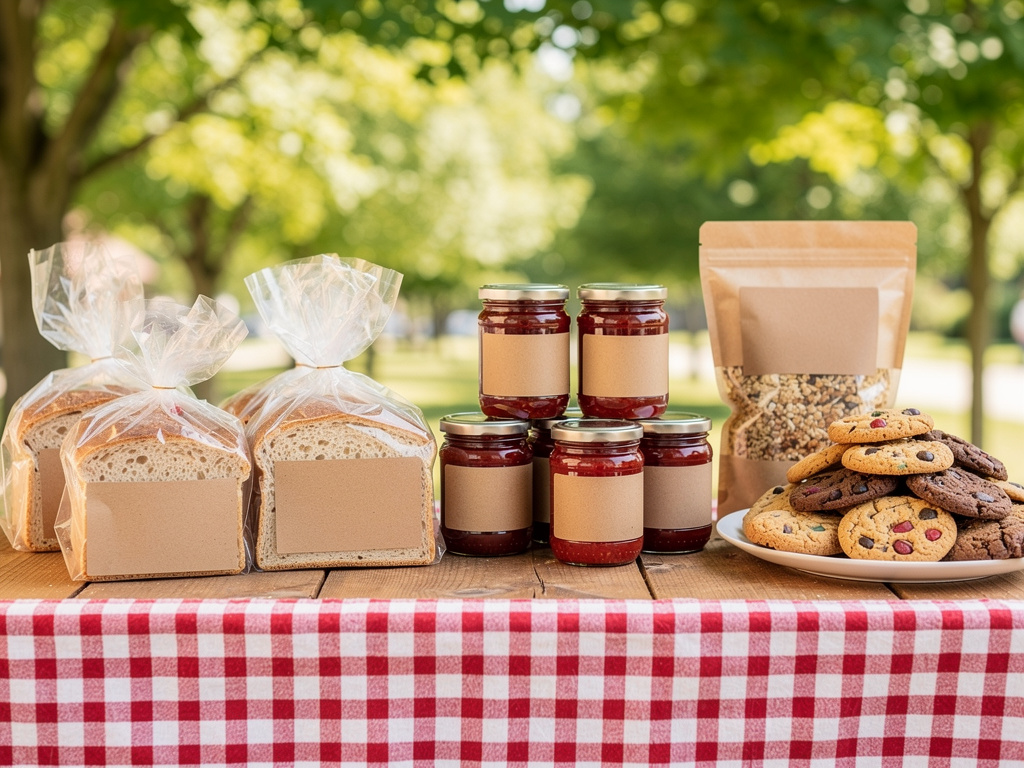


The short version: Michigan lets you sell shelf-stable foods made in your own home kitchen with no license, no registration and no inspection, as long as your gross sales stay at or below $50,000 a year ($75,000 if you sell products at a price of $250 or more per unit). Those caps come from 2025 Public Act 51, which took effect March 24, 2026 and raised the old $25,000 limit. Since that date you can also sell online, by mail order or through a third-party delivery platform, but only to consumers in Michigan and only if you offer each buyer an in-person meeting or a live video call before the sale. You still sell directly to the consumer (no stores, restaurants, wholesale or consignment), and every label carries MDARD's statement that the food was made in a home kitchen the department has not inspected.
Checked October 19, 2026: MCL 289.4102 on the Michigan Legislature site, MDARD's cottage food, FAQ, labeling, selling and allowed-foods pages, and the MSU Product Center's registration pages. The law lets MDARD adjust both caps for inflation each October 1 starting in 2026; on October 19, 2026, MDARD's pages still said $50,000 and $75,000. Verify your state's current rules with MDARD before you sell.
Michigan asks very little of you before your first sale. You do not fill out a form with the state, you do not pay the state a fee, and nobody inspects your kitchen first. What you do have to get right is the list of foods, the label, where you sell, and the new rules for online orders.
This guide walks through all of it with the exact wording from Michigan's food law and from MDARD, the state's Department of Agriculture and Rural Development, which oversees cottage food. If you want a launch plan once you know the rules, our guide to starting a cottage food business in Michigan picks up where this one ends.
Once you know which of your foods qualify, you can set up a Homegrown storefront to show your menu and take pickup orders from Michigan buyers, with a line on each product offering the face-to-face meeting or live video call described below before they check out.
The Michigan cottage food sales limit is $50,000 in gross sales a year, or $75,000 a year for an operation selling products priced at $250 or more per unit. Both numbers are in MCL 289.4102(5), the section of Michigan's food law that sets the cottage food rules, and MDARD's selling page states the same two numbers.
The law does not define "gross sales," but the plain meaning is everything customers pay you for cottage food, before you subtract ingredients, packaging or fees. A $20 order counts as $20 toward the cap, even if you only kept $8 of it. If you charge delivery fees, ask MDARD whether they count too.
Three details about the cap trip people up:
Scroll sideways to see every column.
| Michigan cottage food rule | What the law or MDARD says | Source |
|---|---|---|
| Yearly sales cap | $50,000 in gross sales; $75,000 if the operation sells products priced from $250 per unit up (mixed prices: ask MDARD) | MCL 289.4102(5) |
| Inflation adjustment | MDARD "may adjust" both caps each October 1, starting October 1, 2026; no new figure posted as of October 19, 2026 | MCL 289.4102(5), MDARD pages |
| License, registration, inspection | None from MDARD: "no application forms to complete, no registration process" | MDARD FAQ |
| Optional registration | MSU Product Center, $50, owed again after a new address, business name or main contact; your label then shows a code and phone number, not your street address | MCL 289.4102(8), MSU Product Center |
| Allowed foods | Foods that do not need time or temperature control for safety, from MDARD's list | MCL 289.1105, MDARD |
| Where you make and store it | Your own primary residence in Michigan, in its kitchen; products stored only in that home | MCL 289.1105, MCL 289.4102(6) |
| Who you sell to | Directly to the consumer; no consignment, no wholesale | MCL 289.4102(4) |
| Online, mail order, delivery apps | Allowed to Michigan consumers only, if the buyer is offered an in-person or live video meeting before the sale | MCL 289.4102(4) |
| Label statement | MDARD's "not inspected" home kitchen statement, at least 11-point type | MCL 289.4102(3), MDARD labeling page |
Every row was read on October 19, 2026 on the Michigan Legislature's copy of MCL 289.4102 and 289.1105, MDARD's cottage food pages, and the MSU Product Center's registration pages.
The $50,000 and $75,000 figures in the law apply "until October 1, 2026." After that date the law says MDARD "may adjust" them using a Detroit-area inflation index, and it can do so again every October 1. When we checked MDARD's selling page and FAQ on October 19, 2026, both still said $50,000 and $75,000. Check MDARD's selling page each fall for a new number.
Michigan's cottage food law changed on March 24, 2026, when 2025 Public Act 51 (House Bill 4122) took effect. The Senate Fiscal Agency's summary of the bill lists five changes:
The law's history line on the Michigan Legislature site reads "Am. 2025, Act 51, Eff. Mar. 24, 2026," so any guide that still quotes a $25,000 cap or says Michigan bans online sales is describing the old law.
Michigan cottage food yearly sales caps
Source: Senate Fiscal Agency summary of HB 4122 and MCL 289.4102(5), both read October 19, 2026.
The new law kept the limits that matter most day to day. Under MCL 289.4102 as amended, you still cannot sell by consignment or at wholesale, MDARD's selling page still bars sales to restaurants and grocery stores, and your products still have to be foods that do not need temperature control for safety.
Want the rules as a PDF? MDARD's two-page Michigan's Cottage Foods one-pager, dated 03/2026, lists the $50,000 and $75,000 caps and the main allowed and banned foods, ready to print. Its shortened label line reads "not inspected by" instead of the law's "that has not been inspected by," so copy your label wording from the labeling section below, not from the PDF.
No, Michigan requires no license, registration or inspection from MDARD before you start a home food business. MDARD's FAQ puts it plainly: "There are no application forms to complete, no registration process, and you do not need to obtain a food license or permit from MDARD."
That does not mean nobody else can ask for paperwork. Here is what can still apply to you:
The optional $50 MSU Product Center registration has its own section below. It is a privacy tool for your label, not a license.
You can sell foods that do not need time or temperature control for safety, which means foods that stay safe at room temperature without a fridge. The law's own examples are "jams, jellies, dried fruit, candy, cereal, granola, dry mixes, vinegar, dried herbs, and baked goods that do not require temperature control for safety" (MCL 289.1105).
MDARD's allowed foods list, read October 19, 2026, goes further. These are some of the foods it names as allowed:
That buttercream rule is easy to miss. MDARD allows homemade buttercream only from the 2 recipes it names, both lab-tested (commercially prepared, shelf-stable buttercream is also allowed): Kansas State University's "Simple Buttercream Frosting" or Texas Come and Bake It's "American Buttercream Frosting," followed exactly, with no additions other than food coloring or flavoring extracts.
Vanilla extract is on MDARD's allowed list, but alcohol in candy is not. MDARD's list says "No confections that contain alcohol, like truffles or liqueur-filled chocolates," and allows "Extracts that are used for flavoring foods, like vanilla extract." If you want to make extract, our guide to selling homemade vanilla extract walks through the alcohol rules.
Michigan bars any food that needs refrigeration to stay safe, plus several groups the law names outright: meat and poultry, milk products, beverages, home-produced ice, and canned foods other than standardized jams, jellies and preserves (MCL 289.1105, linked above). MDARD's list, read October 19, 2026, adds detail that matters for new vendors, grouped here by type:
Honey and maple syrup sit outside the cottage food list. MDARD says they "are not considered cottage foods" but "have their own set of licensing exemptions under the law," so read MDARD's honey and maple syrup page instead of this one for those.
If you are not sure whether a recipe needs refrigeration, MDARD's FAQ gives the test it uses: a food with "water activity greater than 0.85" and a pH "between 4.6 and 7.5" is one that needs temperature control. Our guide to which foods count as time and temperature control foods explains those two numbers in plain terms.
Michigan allows "Cultivated or wild foraged mushrooms that are raw or dried," with one condition for wild ones. MDARD's list says "You must be able to provide proof that wild foraged mushrooms were identified by a certified mushroom expert." Cooked mushroom dishes are a different story, since MDARD's list bars "food products made with cooked vegetable products."
You can start selling cottage food in Michigan in seven steps, and none of them involves sending a form or a fee to MDARD: pick a product from MDARD's list, check your kitchen, decide on MSU registration, make your labels, check local rules, pick where you sell, and keep a running sales total.
Turn the yearly cap into a weekly number. $50,000 spread over 52 weeks is about $961.54 a week, and over a 30-week market season it is about $1,666.67 a week. If your sales spreadsheet shows you running ahead of that pace by midsummer, start planning your move to a licensed kitchen before you hit the cap, not after.
Every Michigan cottage food label must show who made it, what it is, what is in it, how much is in it, any allergens, and the MDARD "not inspected" statement. The list below comes from MDARD's labeling page and MCL 289.4102(3), both read October 19, 2026:
Hand-printed labels are fine if they are legible, written in permanent ink and large enough to meet the font size rule. A simple label for a granola bag could read like this:
MADE IN A HOME KITCHEN THAT HAS NOT BEEN INSPECTED BY THE MICHIGAN DEPARTMENT OF AGRICULTURE & RURAL DEVELOPMENT
Great Lakes Maple Granola. Jamie Rivers, 123 Orchard Lane, Maple Town, MI 49999. Ingredients: rolled oats, maple syrup, almonds, sunflower oil, salt. Contains: almonds. Net Wt. 12 oz (340 g).
Weigh what actually goes in the bag. If you fill 12 ounces of granola, the label says 12 ounces with 340 grams beside it, and a heavier fill means a new label.
Wedding cakes and other big cakes get their own rule. MDARD says that for cakes "that are not easily packaged, you must include all labeling requirements on the invoice and deliver the invoice with the cake." Smaller cakes go in a box with the label on the box. Our cottage food labeling guide has layout templates, and the allergen label guide covers the "Contains" line in more depth.
Register with the MSU Product Center if you do not want your home address printed on every label. Registration is voluntary, costs $50, charged again if you move or change your business name or main contact, and lets your label show your name, phone number and a registration code (formatted like C-000000000) instead of your address. MCL 289.4102(8) caps the fee at $50, and the MSU Product Center's registration page is where you pay and sign up.
What to know before you pay, from MSU's own pages read October 19, 2026:
For a vendor who takes online orders and delivers, a label without a street address is worth a lot. For someone who sells three loaves at a church craft fair, it may not be worth $50.
Yes, since March 24, 2026, Michigan lets you sell cottage food by internet or mail order, or deliver it through a third-party food delivery platform, with two conditions. The buyer must be a consumer in Michigan, and you must provide, in the law's words, "an opportunity for a consumer to directly interact with the cottage food operation before the cottage food product is sold" (MCL 289.4102(4)).
The law defines that interaction, and it is more than a message thread:
In plain terms, a typed chat or an inbox message is not one of the two kinds of meeting the law names. The safe reading is to offer every online buyer the chance to meet you face to face or on a live video call before the sale, since the law's virtual meeting is one where you can see and hear each other. A phone call fits MDARD's "speak to" summary but not that see-and-hear wording, so get MDARD's answer in writing before you rely on phone calls alone. The law requires the opportunity; it does not say the buyer has to take it.
Online, mail-order and delivery sales must be "sold or delivered only to a consumer in this state." Shipping a box of cookies to a customer in Ohio or Indiana is outside the Michigan exemption. MDARD's answer on selling in another state is "You will need to check with the other state to determine its regulatory requirements." Our guide on whether you can ship cottage food to another state covers how other states treat shipping.
Third-party delivery has one more limit. MDARD's FAQ says a farm stop or small market cannot act as a go-between that holds pre-sold cottage food for customers to pick up. In MDARD's words, the law "does not allow for a retail market or farm-stop to serve as go-between or provide temporary storage at a retail location prior to delivery."
Here is what a compliant online order can look like in practice:
None of the MDARD cottage food pages we read on October 19, 2026 shows a sample setup for online orders. If you want a yes for your exact setup, email MDARD-CottageFood@michigan.gov with your zip code and describe it.
You can sell Michigan cottage food in Michigan wherever you sell it yourself, directly to the consumer. MDARD's selling page, read October 19, 2026, lists what is allowed and what is not.
Allowed:
Not allowed:
Put simply, a $6 loaf you hand to a shopper at your booth is a legal sale, and the same $6 loaf on a coffee shop's counter is not. MDARD explains the store and restaurant ban this way: because your home kitchen is not inspected, "the food is not considered an approved source for use in a restaurant or grocery store." Bake sales are a separate case. MDARD says bake sales run by charitable, religious, fraternal or other nonprofit groups are exempt from licensing on their own terms, but they are not cottage food sales, and a nonprofit cannot run a cottage food business because, in MDARD's words, "Nonprofits do not have a single family domestic residence."
Planning to sell at a market? Our Michigan farmers market vendor permit guide covers what each market may ask for on top of the cottage food rules.
You must make cottage food in the kitchen of your primary home in Michigan and store it in that same home. The law defines a cottage food operation as a person who makes the food "only in a kitchen of that person's primary domestic residence within this state," and adds that products "must be stored only in the primary domestic residence."
MDARD's FAQ fills in the details, down to your water: if you use a private well, test it at least once every 12 months, since MDARD says well water "should be tested, at least annually, for coliform bacteria and partial chemistry."
You can gross up to $50,000 a year selling cottage food in Michigan, or $75,000 at the $250-per-unit tier. What you keep depends on your margin, since the cap counts gross sales, not profit. At $20 an order, $50,000 is 2,500 orders in a year.
Ways to get the most out of the cap:
Now that Michigan allows online orders, the hard part is taking them without tracking every order in a separate Instagram or Facebook message thread. Homegrown gives you one order page for pickup and local delivery at $10 per month billed annually ($12.50 billed monthly), with no percentage fees beyond standard payment processing, and you can put your "video call or meet me in person before you order" line in every product description, where buyers read it before checkout.
How it compares with two tools Michigan vendors often try first, on a $20 order:
Scroll sideways to see every column.
| Option | Subscription | Trial | Platform fee | Card or payment processing | Customer pays on a $20 order | You pay on a $20 order | You pay on 50 orders a month |
|---|---|---|---|---|---|---|---|
| Homegrown | $10/mo billed annually, or $12.50/mo billed monthly | 7 days (no charge until day 8) | $0, 0% commission | 2.9% + $0.30 | $20.00 | $0.88 | $54.00 ($44.00 processing + $10 subscription) |
| Etsy | None required | None; Etsy says a one-time set-up fee may be charged when you open a shop | 6.5% transaction fee, plus a $0.20 listing fee for each item sold (one item here) | 3% + $0.25 (US) | $20.00, plus any shipping you charge | $2.35 | $117.50 |
| DMs plus a Venmo business profile | None | None | $0 | 1.9% + $0.10 | $20.00, paid from a Venmo balance, debit card or bank | $0.48 | $24.00 |
We checked findhomegrown.com/signup, Etsy's Fees and Payments Policy and payment processing help page, and Venmo's fees page on October 19, 2026. The $20 order is one item with no tax or shipping. Etsy's 6.5% also applies to any shipping you charge.
Venmo is the cheapest on fees, and it is a fine way to get paid. What it does not give you is an order page: every order lives in a message thread, and you count totals by hand. Etsy is a national marketplace with shipping built in, so you would have to keep every listing limited to Michigan buyers yourself, since the law only lets you sell online to people in Michigan. Homegrown fits the Michigan rules in a few specific ways:
Honest bounds: customers create a Homegrown account to place their first order. Homegrown does not run the video call for you, and a typed message is not one of the two kinds of meeting the law names. The delivery radius only limits delivery: Homegrown's signup page says shoppers outside it can still order pickup ("everyone else still gets pickup"), so turning down an online order from a buyer outside Michigan is up to you. Homegrown has no drops or countdown release feature. Your storefront is listed on Homegrown's marketplace, but plan on most orders coming from people you send to your own link. Card processing of 2.9% + $0.30 is paid by you, the vendor, with nothing passed to the customer. You can set up a Homegrown storefront with a 7-day trial (no charge until day 8).
Possibly, and the answer depends on what you sell: MDARD's getting started FAQ answers the sales tax question with "Possibly," and says cottage food businesses "must meet all other provisions of law regarding businesses, including tax law." It also says "In general, sales tax is not charged on prepackaged foods that are not for immediate consumption."
So a sealed $8 bag of granola that a customer takes home to eat later is the kind of sale MDARD describes as generally untaxed. A product sold to eat on the spot, or a basket that mixes food with things that are not food, is where you need a real answer from the state. MDARD also notes that "Any other taxes depend on how your business is organized," so income tax is its own question.
What to do with that:
Our guide to reporting food sales on your taxes walks through the income tax side and the records worth keeping.
When you want to wholesale, sell to stores or restaurants, or sell more than the cap, you need to become a licensed food processor, and a food outside the cottage food list needs its own license too. MDARD's licensed food processor page says that if you "would like to wholesale your products, which is not allowed under the Cottage Food exemptions, you are ready to move to the next step and become a licensed food processor," and that vendors who "reach the threshold for gross annual sales" need to become licensed to keep growing.
What that usually means for a Michigan home vendor:
If you are weighing a shared kitchen against your own space, our guide to moving from cottage food to a commercial kitchen compares the costs.
Nine mistakes put Michigan vendors outside the cottage food rules or on shaky ground, and most come down to the food, the buyer or the label:
None of the MDARD cottage food pages we read requires insurance, but a market can ask for it, so it is worth a look. Our guide to cottage food business insurance covers what a policy typically includes.
Michigan cottage food law caps you at $50,000 in gross sales a year, or $75,000 if, in MDARD's words, "the products sold cost $250 or more per unit." The cap is counted per person, so a parent and child in one home with their own businesses each get the full amount. Since October 1, 2026, the law lets MDARD adjust both numbers for inflation, but MDARD's pages still listed $50,000 and $75,000 on October 19, 2026.
No. Under Michigan cottage food law there is no license, no registration and no inspection from MDARD, and MDARD says there are "no application forms to complete." Your city, township or county may still have zoning or business name rules, and a farmers market can set its own vendor requirements.
Yes, since March 24, 2026, but only to consumers in Michigan and only if you offer each buyer a chance to interact with you directly before the sale. The law says that means "either a face-to-face meeting or a virtual meeting," where people "can see or be seen and hear or be heard," so a typed message alone falls outside the two meetings it names. Offering to meet each buyer in person or on live video before checkout is the safe way to meet it. A phone call fits MDARD's summary that buyers get a chance to "speak to" you, but not the law's see-and-hear wording, so check with MDARD in writing before relying on phone calls alone.
No. Michigan cottage food must be sold directly from you to the consumer, and the law bans consignment and wholesale. MDARD's selling page also says you cannot sell to a restaurant or grocery store, because an uninspected home kitchen is not an approved source for them.
The label needs your name and home address (or your name, phone number and MSU registration code), the product name, ingredients in order by weight, net weight with its metric equivalent, allergens, and the statement "Made in a home kitchen that has not been inspected by the Michigan Department of Agriculture & Rural Development." That statement must be at least 11-point type in a contrasting color.
You cannot sell anything that needs refrigeration to stay safe, such as cream or pumpkin pies, cheesecake, cream cheese frosting, meat, jerky or dairy. MDARD's list also bars caramel apples, candy that contains alcohol, sauces and condiments, pickles, low-sugar jams, hot pepper jelly, beverages, tinctures, CBD products and pet treats.
No. MDARD has no registration for cottage food, and the MSU Product Center registration is voluntary. It costs $50 (paid again if your home address, business name or main contact changes) and only changes your label, letting you print a code and phone number instead of your home address.
It is the higher yearly cap, $75,000, that MCL 289.4102(5) sets for an operation selling cottage food at $250.00 or more per unit. It fits vendors of high-priced products such as wedding cakes. The law does not spell out how a mix of cheaper and pricier products is counted, so ask MDARD in writing before you plan around $75,000.
These 6 Homegrown guides answer the next questions Michigan cottage food vendors tend to ask once the rules are clear, from launch plans to shipping:
Every link above was checked live on October 19, 2026, and each guide is written for small, part-time vendors who sell from home.
You can start selling cottage food in Michigan this week with no license, no MDARD fee and no inspection, as long as you stay inside the rules above. Michigan's 2026 update gives you a $50,000 cap ($75,000 at the $250-per-unit tier) and legal online sales to Michigan buyers. Once your labels carry the MDARD statement and your order page offers buyers an in-person meeting or a video call before they pay, the next step is making ordering easy. Set up a Homegrown storefront for Michigan pickup and local delivery orders, then compare the rules in nearby states like Ohio, Indiana, Wisconsin and Illinois. Keep in mind that Michigan's online, mail-order and delivery sales stop at the state line, so an online order shipped or delivered to a customer in Toledo is outside what Michigan's law allows. If a buyer from out of state wants to order online and pick up in Michigan, ask MDARD first.
*This guide is general information, not legal advice. Cottage food rules change, so verify your state's current rules with MDARD before selling. Last checked: October 19, 2026.*



