
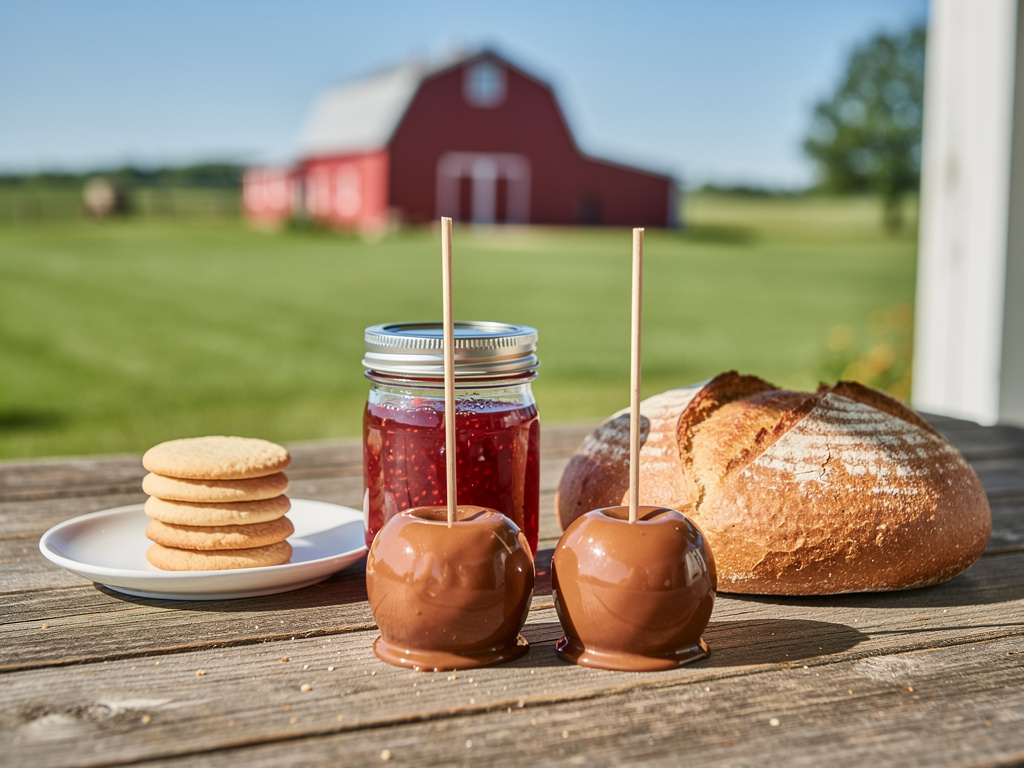


The short version: Indiana gives you two ways to sell food you make at home, and neither one needs a license, permit or kitchen inspection. The Home Based Vendor law has no sales cap and covers shelf-stable foods like cookies, bread, candy and full-sugar fruit jam, which you can sell in person, by phone or online and ship anywhere inside Indiana once you hold an ANSI-accredited food handler certificate. Since July 1, 2026, a second path under House Enrolled Act 1424, the homestead vendor law, also covers prepared foods and meat from animals you raise, sold at your property or a farmers market, up to $1.5 million a year in gross sales. Each path has its own required label statement, and neither one lets you sell to stores or to buyers outside Indiana.
Checked on the Indiana Department of Health's Home-Based Vendor Handbook (summer 2025 edition), its May 26, 2026 homestead memo and the enrolled text of HEA 1424, October 8, 2026. Your county health department enforces both laws, so confirm a new product with them before you sell it.
Once you have your food handler certificate, you can set up a Homegrown storefront so local customers can order ahead, and try it free for 7 days.
In Indiana, you can sell homemade shelf-stable foods as a Home Based Vendor (HBV) with no license, no permit, no inspection, and no sales cap. The one credential you need is an ANSI-accredited food handler certificate, and a copy goes to your county health department. You can take orders online and ship within Indiana. A newer law, in effect since July 1, 2026, adds a homestead vendor path for prepared foods and home-raised meat. This guide covers exactly what you can sell under each path, how to label it, where you can sell it, the sales tax rules that still apply, and how to start.
Ready to begin? Follow our step-by-step guide to starting a cottage food business in Indiana.
No, Indiana's Home Based Vendor law sets no limit on gross annual revenue, so a vendor who sells $3,000 of cookies a year and one who sells $90,000 follow the same food rules. The statute, Indiana Code 16-42-5.3, contains no dollar cap, no income test and no production limit. The limits it does set are about what you make, where you make it, who buys it and how it is labeled.
The new homestead vendor path is different. A homestead vendor is defined in the 2026 law as someone who receives no more than $1,500,000 in gross sales of food products or meat products in a single year. Few home kitchens will ever get near that ceiling.
Scroll sideways to see every column.
| Indiana rule | Home Based Vendor (IC 16-42-5.3) | Homestead vendor (IC 16-42-5.4, since July 1, 2026) |
|---|---|---|
| Annual sales cap | None | No more than $1,500,000 in gross sales a year |
| License / registration / inspection | None; you file a copy of your food handler certificate with the county | None beyond what federal law requires |
| Required training | ANSI-accredited food handler certificate (ServSafe Food Handler qualifies), always | The same certificate, but only if you ship or deliver |
| Allowed foods | Foods that do not need time or temperature control for safety: baked goods, candy, full-sugar acid-fruit jams, and more | Meat products from animals you raise, prepared foods including baked goods, candy, produce, natural sweeteners, fruit spreads |
| Where you make it | Your primary residence (the statute includes a permanent structure on the same property, but the 2025 handbook answers a question about sheds and barns only by saying HBVs must use their primary residence, so check with the county health office before you set up an outbuilding kitchen) | Your property: your primary residence or agricultural land you own or lease |
| Where you can sell | In person, by phone or online; delivered in person, by mail or by a third-party carrier, within Indiana | On your own land or at a farmers market; shipping or delivery within Indiana with the certificate |
| Label statement | The "home produced and processed ... NOT FOR RESALE" advisory statement, quoted in full in the label section (10-point type) | The homestead "exempt from government licensing and inspection" statement, quoted in full in the label section (10-point type) |
We read every row against the statute text printed in the state's 2025 HBV handbook, the enrolled text of HEA 1424 and the department's May 26, 2026 memo to local health departments, all on October 8, 2026.
No, Indiana requires no license, registration, permit or kitchen inspection to sell homemade food as a Home Based Vendor, and there is no "home-based vendor license" to apply for. The statute says HBV food production and sales are exempt from the rules that apply to food establishments, and the state health department's handbook says HBVs are not subject to routine inspections or product sampling. The one credential you need is an ANSI-accredited food handler certificate. You can take the ServSafe Food Handler class in person through Purdue Extension or online through ServSafe, and Purdue's home-based vendor page says the certificate is valid for three years.
Three duties come with that certificate, and the first one is easy to miss:
Cities, towns and counties cannot add their own license on top. Section 12 says a local unit of government "may not by ordinance or resolution require any licensure, certification, or inspection" of HBV foods. A health department can still inspect your kitchen if it gets a consumer complaint or believes a product is misbranded or adulterated.
The farmers market cannot demand a food license from a Home Based Vendor. The state health department's HBV handbook says HBVs "do not require food permitting by law," though a market manager may ask to see your food handler certificate and proof of liability insurance.
The difference is scope: a Home Based Vendor sells shelf-stable foods with no sales cap almost anywhere in Indiana, while a homestead vendor can sell a much wider list, including prepared foods and home-raised meat, but only on their own land or at a farmers market and only while gross sales stay at or under $1.5 million. House Enrolled Act 1424 created the homestead path in March 2026 as a new chapter of the Indiana Code (IC 16-42-5.4), and it took effect on July 1, 2026. The state health department's May 26, 2026 memo is plain that the older law did not go away: "all statutes for home-based vendors (IC 16-42-5.3) remain in force."
That means you pick the path that fits what you make. A sourdough baker who ships loaves to customers in Fort Wayne and Evansville fits the HBV law well. A family that raises chickens and wants to sell frozen pot pies at the Saturday farmers market is the kind of vendor the homestead law was written for. Check first, though: the state's May 26, 2026 memo warns that meat pies may fall under federal USDA rules.
Swipe sideways to see each answer.
| Question | Home Based Vendor | Homestead vendor |
|---|---|---|
| Can I sell cookies, bread and fudge? | Yes | Yes (baked goods and candy are both on the list) |
| Can I sell cheesecake or a casserole? | No; foods that need refrigeration are out | The law lists "prepared foods"; the state warns meat-containing ones may fall under federal USDA rules |
| Can I sell meat? | No | Only from animals raised on your property and slaughtered, processed and labeled under IC 15-17-5 |
| Can I sell at a craft fair or festival? | Yes, if the organizer allows it | The law names only your property and farmers markets |
| Can I sell online? | Yes, by phone or internet | The state's memo lists online sales and delivery; shipping needs the food handler certificate |
| Do I need a food handler certificate? | Always | Only to ship or deliver |
| Is allergen labeling required? | No, but the state encourages it | Yes, a description of allergens the food may have touched |
From IC 16-42-5.3 as printed in the 2025 HBV handbook, IC 16-42-5.4 sections 6 to 9 (added by HEA 1424), and the department's May 26, 2026 memo, checked October 8, 2026. Rows marked "the law names" are our reading of the statute's wording, not a ruling.
The homestead law is new, and the guidance around it is still filling in. When we checked on October 8, 2026, Purdue's home-based vendor page told readers to "stay tuned for additional resources," and the state memo notes that farmers markets "can be more restrictive than state law" about what they let vendors sell. Call your county health department and your market manager before you plan a homestead product line.
Indiana Home Based Vendors may sell foods that are not time/temperature controlled for safety (TCS), which means foods that stay safe on a shelf without refrigeration. The state health department wrote its summer 2025 handbook with Purdue's Food Entrepreneurship and Manufacturing Institute (FEMI), which tested 15 products that home bakers commonly make, and the handbook names far more allowed foods than the "cakes, cookies, breads, jams, and jellies" it calls the traditional HBV foods. Commonly sold products include:
The acid fruits the handbook names for jam are peaches, cherries, apricots, plums, apples, pears, citrus, blackberries, blueberries, raspberries and strawberries. Low-sugar, no-sugar and sugar-substitute jams are not allowed, and neither are jams made with low-acid ingredients like peppers, figs or mint. The full list sits in the Indiana Department of Health's Home-Based Vendor Handbook, and the handbook asks you to contact your local health department about any product it does not name.
Indiana home bakers can sell frosted cakes, cheese bread and fruit pies, but each comes with a specific condition from the 2025 handbook:
Purdue tested five pie types for the handbook. Pumpkin pie measured a water activity of 0.9704, sugar cream pie 0.9363 and buttermilk pie 0.8932, all above the 0.85 line below which pathogens cannot grow. The handbook's approved list names only high-acid fruit and pecan pies, so the others need your own lab test.
No, you do not need a permit to sell homemade candy in Indiana, because fudge, truffles, hard candy, caramel apples and cotton candy are all on the Home Based Vendor list. You do need the food handler certificate and the HBV label, the same as for cookies. The difference with candy shows up at tax time: Indiana's Department of Revenue treats most candy as taxable at 7%, while bakery items sold without utensils are exempt (more on that in the tax section below). Our guide to selling caramel apples from home covers pricing and packaging for one of the handbook's named candies.
Indiana Home Based Vendors cannot sell any food that needs refrigeration or temperature control for safety, and the 2025 handbook names dozens of specific products that fall on the wrong side of that line. The broad categories it rules out are raw or cooked meat (including tallow), prepared foods like casseroles, charcuterie boards and ready-made meals, dairy products (commercial dairy used only as an ingredient is fine), and anything made with cut leafy greens, such as kimchi or sauerkraut.
Products people often ask about that the handbook lists as not allowed for HBVs:
Pepper jelly gets its own answer in the handbook: peppers have a pH of 4.8 to 6.0, which is above the 4.6 limit, and "the amount of sugar and pectin is not enough" to prevent botulism. If pepper jelly is your signature product, our guide to selling pepper jelly from home covers costing, pricing and the tested-recipe questions to ask in other states.
In a pull of the Homegrown catalog on October 8, 2026 (2,920 products from 313 vendors across many states, not Indiana alone), 11 listings from 4 vendors were hot pepper jams or jellies, priced $5 to $9. Nine named the pepper (jalapeño, habanero, Scotch bonnet, chipotle, Carolina Reaper or ghost pepper), and two were sold simply as "Pepper Jelly" and "Hot Pepper Jam." We searched product names and descriptions, read every match, then read every product each counted vendor lists. A "Dr Pepper Jelly" made from the soda was left out. Under Indiana's HBV handbook, none of those 11 could be made in an Indiana home kitchen for sale.
Some of these foods may fit the homestead vendor path instead. The 2026 law lists "prepared foods," and it says the state's rules on temperature-controlled foods "may not apply" to a homestead vendor. Our reading is that a homestead vendor could sell a cheesecake at their own farm stand or a farmers market, but pickles and pepper jelly are not named in the law at all, so ask your county health department before you count on either.
Starting to sell cottage food in Indiana takes one scheduled step, a half-day food handler class, and everything else is work you do at your own kitchen table. Purdue Extension's 2026 in-person classes in northeast Indiana cost $40, manual and assessment included. The last of those was September 19, 2026, so check Purdue's ServSafe page (purdue.edu/servsafe) for the next dates or take the course online through ServSafe. Here is the order that works for a Home Based Vendor:
If you plan to use the homestead path instead, the steps change: no certificate unless you ship or deliver, a different label, and sales limited to your property, a farmers market and (per the state memo) online orders and delivery.
An Indiana Home Based Vendor label must include 6 required pieces of information, set out in Section 5 of the statute: your name and address, the product's common name, the ingredients in descending order by weight, the net weight or volume, the date the food was processed, and the advisory statement in at least 10-point type. Unpackaged food, like cookies in a bakery case at the market, can use a sign with the same information instead of a label on each piece.
Allergens are not on that list. The handbook says allergen labeling "is not required" for HBVs but is "highly encouraged," and it names the nine major U.S. allergens: milk, eggs, wheat, soy, tree nuts, sesame, peanuts, fish and shellfish. Listing them is the smart move, and it costs one line.
A simple compliant label might read: *"Hoosier Honey Cookies. Your Name], [Home Address]. Made [date]. Ingredients: flour, butter, honey, sugar, eggs. Contains wheat, milk, eggs. Net wt. 10 oz. This product is home produced and processed, and the production area has not been inspected by the state department of health. NOT FOR RESALE."* See our [cottage food labeling guide for templates.
Selling online adds one more rule. Section 5(b) says a Home Based Vendor "shall post the label of each food product on the vendor's Internet web site." If you take orders through a website or online storefront, each product page needs its label where customers can see it.
The required statement alone is 24 words, and it has to be at least 10-point type, so lay out your label around it first and fit the other 5 required lines after. Then photograph each finished label flat and in focus and add it to that product's page. One picture covers the Section 5(b) website rule and answers allergy questions before a customer has to message you.
A homestead vendor label needs 6 required lines too, but a different 6, set out in IC 16-42-5.4-7, which HEA 1424 added: the name of the homestead vendor or small farm owner, their address, the ingredients in descending order by weight, a description of the product, a description of allergens that might have come in contact with it, and this statement, also at 10-point type or larger: "This product was produced by a homestead vendor or the owner of a small farm that is exempt from government licensing and inspection."
Three differences from the HBV label catch people switching paths:
The memo also says homestead foods that need packaging must be packaged at your property before you take them to market, and you cannot cut, ladle, reheat or repackage them once you arrive.
Indiana Home Based Vendors can sell in person, by telephone or through the internet, and deliver in person, by mail or by a third-party carrier, as long as every buyer is an end consumer located in Indiana. The 2022 update to the law (HEA 1149) added the online and shipping options. In practice that covers:
You have to make the sale yourself. The handbook's answer on employees and family members is that HBV food must be sold in person by the person who made it, and "products cannot be sold on their behalf." Your spouse can carry the cooler, but if they run the booth alone while you are at work, that is outside the law as the state reads it.
Market days add their own rules. Free samples depend on your local health department's sanitation requirements, so call before you put out a tasting plate. Our Indiana farmers market vendor permit guide covers what markets and counties ask for on the day.
Because Indiana allows online orders and in-state shipping with no cap, a real storefront helps you take orders, collect payment and post your labels without living in your DMs. Homegrown gives Indiana vendors a storefront with built-in payments, product pages with room for label photos, and pickup scheduling for $10 a month billed annually (or $12.50 month to month) with 0% commission, plus 2.9% + $0.30 card processing. Start a 7-day trial (no charge until day 8) and have an Indiana storefront live in about 15 minutes.
Indiana lets Home Based Vendors ship to customers anywhere inside the state, and Section 6 of the statute adds three duties when you ship or deliver:
The statute says you "may not ship or deliver a food product to an end consumer who is located outside Indiana," and the handbook puts it more simply: all HBV products "must only be sold and shipped within the State of Indiana." So a customer in Indianapolis who wants a box of cookies mailed to her sister in Chicago is asking for a shipment the handbook does not allow. Homestead vendors follow the same in-state rule, with their own shipping conditions in IC 16-42-5.4-8 and -9 (added by HEA 1424): the food handler certificate before they ship or deliver at all, a sealed package, and meat kept refrigerated and handled so it cannot be contaminated. The homestead chapter does not repeat the HBV rule about keeping customer addresses for a year, though keeping them is still a good habit.
At least five kinds of small food vendors in Indiana can sell without a retail food permit from the health department, as long as they follow the conditions attached to each. The common thread is that the food is low risk, sold straight to the person who eats it, and made or grown by the vendor. Here is the list, from the HBV statute, the 2025 handbook and the 2026 homestead law:
Scroll sideways to see each condition.
| Who sells | What needs no permit | The condition that keeps it permit-free |
|---|---|---|
| Home Based Vendor | Non-TCS foods made in your primary residence | ANSI food handler certificate, the HBV label, sales to Indiana end consumers only |
| Homestead vendor or small farm owner | Meat products, prepared foods, baked goods, candy, produce, natural sweeteners, fruit spreads | Sold from your property or at a market, gross sales at or under $1.5 million, homestead label; certificate to ship or deliver |
| Produce vendor | Whole, uncut fruits and vegetables, microgreens, gourds and intact cultivated mushrooms | Not cut or processed; the handbook says these vendors are not HBVs at all |
| Farmers market or roadside stand vendor | Poultry and rabbit meat under the farm exemptions, and eggs other than chicken eggs | Poultry and rabbit frozen at the point of sale; chicken eggs need Indiana State Egg Board registration |
| Nonprofit fundraiser | Food sold at the organization's own benefit event | A tax-exempt civic, fraternal, veterans or charitable group, events on no more than 15 days a year |
Sources: IC 16-42-5.3 sections 10 and 11 and the produce and egg pages of the 2025 HBV handbook; HEA 1424 section 1, which carries the nonprofit exemption in the definition of "food establishment," checked October 8, 2026.
Anything outside those lanes, such as plating food at an event, selling refrigerated foods under the HBV law, or selling to a coffee shop, needs a permitted food establishment inspected by your local health department. The handbook says foods outside the HBV rule "shall be produced by a permitted operator within a Food Establishment."
Two other rules can still apply to a permit-free vendor. Local zoning is one: the handbook says HBV rules "only exempt operators from food related licensing and inspections," so check whether your town limits home businesses. Sales tax is the other, covered below.
No, Indiana Home Based Vendors cannot sell to stores, restaurants, cafes, wholesalers or anyone else who plans to resell the food. The statute requires that HBV food is "not resold," and the label's own "NOT FOR RESALE" line says the same thing to anyone holding the package. The handbook spells it out: products "cannot be sold to a warehouse, retail food establishment, wholesaler or another entity that intends to further distribute the product."
A few situations come up often:
The homestead path does not open the wholesale door either. The state memo says a homestead vendor "found selling beyond the end consumer" falls under federal food safety rules (21 CFR 117) and would need to register with the Indiana Department of Health as a wholesale food establishment. If selling to stores is your goal, that registration or a licensed commercial kitchen is the route.
With no cap on the Home Based Vendor path, Indiana does not limit your income; your ceiling is demand, time and how much your kitchen can produce. Because you can ship anywhere in the state, an Indiana vendor can sell to customers in Gary, Bloomington and Richmond from the same kitchen, not just the town around one farmers market.
Here is what an online month can look like in real numbers. Fifty orders of $20 each is $1,000 in sales. On Homegrown's annual plan, the fees on that month come to $54.00: $44.00 in card processing ($0.88 an order) plus the $10 plan. Those are the kinds of figures to build your prices around.
Indiana's legal in-state shipping is the multiplier: a Home Based Vendor can reach customers across Indiana, not just the local market. A few ways to get the most out of it:
An Indiana Home Based Vendor who sells online needs a page that takes orders and payment, schedules pickup or delivery, and shows every label, because Section 5(b) of the statute requires the label of each product on your website. Homegrown is $10 per month billed annually (or $12.50 billed monthly) with no percentage fees beyond standard payment processing of 2.9% + $0.30. Each product gets its own page with room for several photos, so the label photo can sit next to the product photo. Customers pick from the pickup windows you set, or local delivery inside a radius of 1 to 25 miles, and Homegrown's signup page says it calculates sales tax at checkout and files and remits it for you, which matters if caramel apples or fudge are on your menu.
Here is what the common choices cost on a $20 order:
Drag sideways to see every fee.
| Ordering tool | Subscription | Trial | Platform fee | Card processing | Customer pays on a $20 order | You pay on a $20 order | You pay for 50 orders of $20 |
|---|---|---|---|---|---|---|---|
| Homegrown (annual) | $10/mo | 7 days, no charge until day 8 | $0, 0% commission | 2.9% + $0.30, paid by you | $20.00 | $0.88 plus the plan | $54.00 |
| Homegrown (monthly) | $12.50/mo | 7 days, no charge until day 8 | $0, 0% commission | 2.9% + $0.30, paid by you | $20.00 | $0.88 plus the plan | $56.50 |
| Hotplate (its default: fee on the customer) | $0 | No plan to trial | 5% + $0.55, added at the customer's checkout | 2.9% + $0.30, paid by you | $21.55 | about $0.92 | $46.25, while your customers pay $77.50 in fees |
| Hotplate (you cover the fee) | $0 | No plan to trial | 5% + $0.55, paid by you | 2.9% + $0.30, paid by you | $20.00 | $2.43 | $121.50 |
| Etsy | $0 (a one-time set-up fee may apply) | None listed | $0.20 listing + 6.5% transaction | 3% + $0.25, paid by you | $20.00 plus shipping | $2.35 | $117.50 |
Checked October 8, 2026 on Homegrown's signup page, Hotplate's pricing page and its post "What Hotplate does" (which says "we charge a fee to your customer" and that 80% of Hotplate chefs keep that default), Etsy's Fees and Payments Policy, and Etsy's payment processing fee table for US bank accounts. Figures leave out sales tax, tips and shipping and were computed from unrounded inputs; Hotplate's default processing is figured on the $21.55 the card is charged.
What you pay for 50 orders of $20, card processing included
Source: the pricing pages in the table above, checked October 8, 2026. Hotplate's shortest bar leaves out the $77.50 its fee adds to your customers' checkouts.
Hotplate suits a vendor who sells in timed "drops," and Etsy brings shoppers who are already browsing. For an Indiana HBV, Etsy has a catch: its buyers come from every state, and the law lets you ship only inside Indiana, so any order headed outside Indiana is one you would have to turn away. Hotplate either adds $1.55 to your customer's $20 order while you still pay 2.9% + $0.30 processing (about $0.92), or costs you $2.43 in fee plus processing if you cover it. Homegrown fits an Indiana vendor who wants a steady weekly menu, local pickup and delivery, and label photos on every product page for one flat monthly price.
What Homegrown does not do, so you can decide with clear eyes:
Indiana's cottage food rules cover food safety, not the business side, so insurance is optional under the law, while sales tax registration runs through the Department of Revenue. Indiana's sales tax rate is 7%, and the Department of Revenue says a business that sells goods registers through INBiz for a Registered Retail Merchant Certificate. If everything you sell turns out to be exempt (see the table below), call the department's sales tax line at 317-232-2240 to ask whether you still need one. The good news for bakers is that most of what a Home Based Vendor makes is exempt from Indiana sales tax when it is sold unheated and without eating utensils.
The Department of Revenue's Sales Tax Information Bulletin #29 (September 2025) sorts the common HBV products like this:
Swipe sideways to see the tax reason.
| Product | Indiana sales tax | Why |
|---|---|---|
| Bread, cookies, cakes, pies, muffins, donuts, bagels, bars | Exempt | Bakery items are excluded from "prepared food" by statute, unless you hand out utensils |
| Jams, jellies, preserves, honey, peanut butter | Exempt | Grocery food on the bulletin's non-taxable list |
| Roasted coffee beans and grounds | Exempt | Listed as non-taxable |
| Caramel apples, chocolate-covered nuts, chocolate chips | 7% | Candy: sweeteners in bar, drop or piece form, with no flour |
| Cereal or granola bars made without flour | 7% | The bulletin calls them candy because they have no flour |
From Appendix A of the Indiana Department of Revenue's Sales Tax Information Bulletin #29, publication date September 2025, loaded October 8, 2026. On $20 of caramel apples, your customer pays $1.40 in tax, for $21.40 in all.
A few more steps worth handling before you grow:
None of these are part of the HBV statute itself, but handling them early keeps your business clean as it scales.
The most expensive mistakes Indiana vendors make are the ones that quietly take a product outside the Home Based Vendor law, because the exemption only covers vendors who follow every condition. The state's May 2026 memo says a vendor who misses any requirement "will be considered an unlicensed retail food establishment." Watch for these:
If your recipe is not on the handbook's list, you do not have to guess. Purdue FEMI tests a product's pH and water activity on request, and the handbook says you only need it tested once, in triplicate from three different batches, then again whenever you change the recipe.
The biggest change took effect on July 1, 2026, when House Enrolled Act 1424 (Public Law 163 of 2026) created the homestead vendor and small farm path alongside the older HBV rules. Here is how Indiana's rules got here, from the state's HBV handbook, its homestead memo and the General Assembly's bill record:
Three features define Indiana's HBV law today: no sales cap, online orders with in-state shipping by third-party carrier, and a ban on local governments adding their own license. Our cottage food laws by state hub shows how that compares with Indiana's neighbors.
When we checked on October 8, 2026, the state health department had not posted a homestead handbook like the 2025 HBV one, and Purdue's page said more resources were coming. Rules like these can shift in any legislative session, so re-check the state health department's guidance documents page each January before you add a product.
Always confirm the current allowed-foods list and label wording with your county health department, which enforces both laws.
No. Indiana cottage food law for Home Based Vendors sets no limit on gross annual revenue, so you can grow as large as your kitchen allows. The newer homestead vendor path, in effect since July 1, 2026, is the only one with a ceiling: $1.5 million in gross sales a year.
No license, registration, permit or inspection. You must get an ANSI-accredited food handler certificate (ServSafe Food Handler, in person through Purdue Extension or online) and file a copy with the local health department where you live. Cities and counties are barred from adding their own license.
Yes. Home Based Vendors can advertise, take orders online or by phone, and ship to customers within Indiana, including through third-party carriers. You must post each product's label on your website, and out-of-state shipping is not allowed.
Indiana cottage food law covers foods that stay safe without refrigeration: baked goods, candy and fudge, full-sugar jams and jellies from acid fruits, honey, maple syrup, nut butters, roasted coffee, granola, dried pasta and more. Foods that need refrigeration, like cheesecake, along with meat, pickles, pepper jelly and fermented foods, are prohibited for Home Based Vendors.
Your name and home address, the product's common name, ingredients by weight, net weight or volume, the processing date, and the state's 24-word advisory statement saying the product was home produced in a kitchen the state has not inspected, ending "NOT FOR RESALE," in 10-point type. Allergen labeling is encouraged but not required for Home Based Vendors.
Yes, if you sell as a Home Based Vendor. The certificate must come from an ANSI-accredited issuer, and Purdue says ServSafe Food Handler qualifies and is valid for three years. Homestead vendors need one only if they ship or deliver.
Yes. Indiana allows Home Based Vendors to ship directly to customers anywhere in the state, including by mail or a third-party carrier. Use a sealed, tamper-evident package and keep each customer's shipping or delivery address for at least one year.
No. There is no state registration or permit for Home Based Vendors, though the statute requires you to give a copy of your certificate to your county health department. Sales tax is separate: Indiana's tax department tells any business selling goods to register through INBiz for a Registered Retail Merchant Certificate, and you collect the 7% on taxable products like candy. A seller of only exempt baked goods or jam can confirm whether that applies by phoning the state's sales tax information line, 317-232-2240.
A homestead vendor sells food products or meat products from their property or at a farmers market and takes in no more than $1.5 million a year in gross sales. The category was created by House Enrolled Act 1424 and took effect July 1, 2026. It allows prepared foods and home-raised meat, requires an allergen line and its own label statement, and needs a food handler certificate only to ship or deliver.
Not as a Home Based Vendor: the state health department's handbook lists cheesecake as a temperature-controlled food. The homestead vendor law allows "prepared foods" sold from your own farm stand or at a market, and our reading is that cheesecake could fit there, but confirm with your county health department first. Our guide to selling homemade cheesecake compares other states' rules.
These six guides pick up where this one stops. We checked each one live on October 8, 2026, and each answers a question this page only touches:
With no cap, no permit, legal online sales and in-state shipping, Indiana is a straightforward state to start in once you have your food handler certificate. Your first week can be this simple: book a ServSafe Food Handler class, send the certificate to your county health department, check each recipe against the handbook, and print labels with all 6 required lines. Then decide whether the Home Based Vendor path or the new homestead path fits what you make. Once your labels are done, the next step is making it easy for customers to order and pay. Set up a Homegrown storefront for Indiana cottage food orders with pickup and local delivery, then compare the rules in nearby states like Ohio, Michigan, Illinois, and Kentucky, or see the full cottage food laws by state hub.
*This guide is general information, not legal advice. Cottage food rules change, so verify current requirements with the Indiana Department of Health and your county health department before selling. Last verified: October 8, 2026.*



