
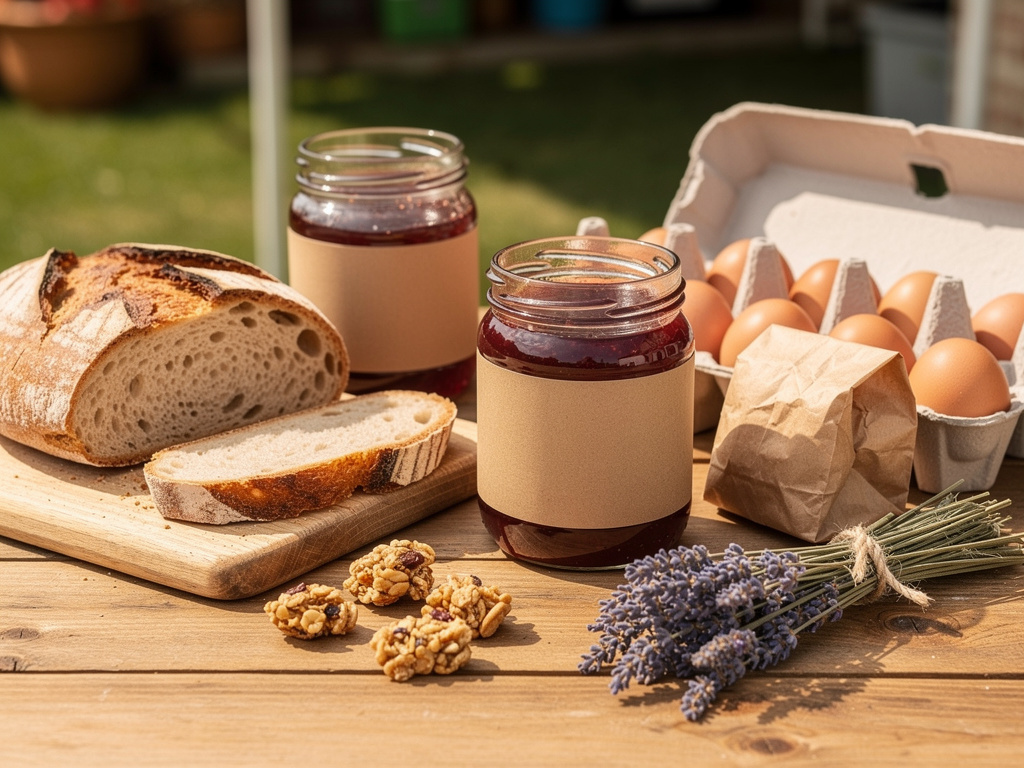


The short version: Through December 31, 2026, Colorado lets you sell shelf-stable homemade foods with no license and no routine inspection, as long as you finish a food safety course, sell only inside Colorado directly to the person who will eat the food, and keep each product under $10,000 in net revenue a year. On January 1, 2027, the Tamale Act (HB26-1033) takes effect: you must register with the Colorado Department of Public Health and Environment (CDPHE) every year, and the cap becomes $150,000 in total gross sales. The same law adds new foods, including tamales, beef, turkey and pork jerky made from USDA-inspected meat, and one type of refrigerated food in up to five variations at a time. Every product needs a full label, and every place you sell, including a website, needs CDPHE's home-kitchen sign.
Checked on CDPHE's Cottage Foods Act page and its 2027 Tamale Act pages, October 8, 2026: the current rules, the 2027 rules and the January 1, 2027 start date come from those pages and the enrolled bill. CDPHE listed the registration system as "Coming Soon" and had not posted a registration fee. Homegrown prices come from findhomegrown.com/signup the same day. Homegrown customers create an account to place a first order, and Homegrown has no drops (timed product release) feature.
Once you have finished your food safety course, you can set up a Homegrown storefront so Colorado customers can order ahead, and try it free for 7 days.
Colorado makes it simple to start a home food business: no license, no routine inspection, one food safety course. Today you sell shelf-stable foods under a $10,000-per-product cap with no registration. From January 1, 2027, the cap, the paperwork, the label and the food list all change. This guide covers both sets of rules side by side, so you know what applies to the jar of jam you sell this Saturday and what applies to the tamales you might sell next year.
If you are starting from zero, our step-by-step guide to starting a cottage food business in Colorado walks through setup in order. This page is the rulebook: what the law says, what changed, and where vendors get it wrong.
For the rest of 2026, Colorado caps cottage food sales at $10,000 in net revenue per product per calendar year, not $10,000 in total. CDPHE's own example: if you make blueberry, banana and chocolate chip muffins, each type gets its own $10,000 limit. That gives a vendor with a varied menu far more room than a vendor who sells one best seller.
On January 1, 2027, that changes. The Tamale Act replaces the per-product limit with one total cap of $150,000 in gross sales per calendar year, for everything you sell under the law. CDPHE adjusts the figure every year for inflation using the Denver-Aurora-Lakewood consumer price index, so the number will change each year with Denver-area prices. The law also bars splitting into several businesses to get around the cap.
Today's cap counts net revenue for each product, the word the statute and CDPHE's Cottage Foods Checklist use, although CDPHE's 2027 updates page calls the old limit a gross revenue limit. The 2027 cap counts gross sales, meaning your total food sales before you take out costs. Above $150,000, CDPHE says you must register as a food manufacturer or retail food establishment: a retail food establishment license from your county health department if you sell to consumers, or registration with CDPHE as a manufactured food facility if you sell wholesale.
Scroll sideways to compare today with 2027.
| Colorado rule | Through December 31, 2026 | Starting January 1, 2027 |
|---|---|---|
| Sales cap | $10,000 net revenue per product, per year | $150,000 gross sales in total, per year, adjusted for inflation |
| License or inspection | None (inspection only after a complaint) | None (inspection only after a complaint) |
| Registration with CDPHE | None | Required every year, with a registration number |
| Food safety training | Required before you start | Required, and the certificate is needed to register |
| Foods that need refrigeration | Not allowed | One type, five variations or fewer at once |
| Meat | Not allowed, even as an ingredient | Allowed if USDA inspected or exempt from inspection |
| Eggs | Up to 250 dozen a month | Same 250-dozen monthly limit |
| Where you sell | Directly to the end consumer, in Colorado only | Directly to the end consumer, in Colorado only |
| Label | Your name and production address | Your name, registration number and county, plus CDPHE's web address |
We checked both columns on CDPHE's Cottage Foods Act page, its Tamale Act pages and the enrolled HB26-1033 on October 8, 2026. The 2027 column is the law as passed; CDPHE labels its Tamale Act pages "for information purposes only" until January 1, 2027.
The Tamale Act is House Bill 26-1033, a 2026 law that rewrites Colorado's Cottage Foods Act, and its cottage food changes take effect January 1, 2027. CDPHE's main cottage foods page says it plainly: "The 'Tamale Act' HB26-1033 was passed. It begins January 1, 2027." Until then, the current rules on this page apply.
The enrolled bill makes these major changes, which CDPHE summarizes on its Tamale Act updates page:
The bill also created a cottage foods cash fund and set aside $119,354 for CDPHE to run the program in the 2026-27 budget year, based on one added staff position. As of October 8, 2026, CDPHE's Tamale Act menu listed "Complaints and Registration" as "Coming Soon," so there is nothing to sign up for yet.
Older articles called the Tamale Act "pending." It passed. We checked CDPHE's cottage foods page on October 8, 2026, and it says the act begins January 1, 2027. Until that date, refrigerated foods, meat and buttercream made with butter are still off limits, and the $10,000-per-product cap still applies.
Colorado requires no license and no routine inspection for cottage food today, and that stays true in 2027. CDPHE or your county health agency can still sample and inspect a product if it is misbranded, after a consumer complaint, or if it is suspected in an injury or foodborne illness outbreak (CDPHE's 2027 FAQ; C.R.S. 25-4-1614 (4)(a)). What you do need, right now, is a completed food safety course before your first sale. Beginning in 2027, you will also need a yearly registration with CDPHE.
CDPHE accepts any one of three training options:
You must stay in good standing with the course you chose, which means renewing it when the course says to. A food handlers card and a local class each follow their own renewal rules, so check the expiration date on yours. Our guide to getting a food handlers permit explains how those cards work.
Who can use the law matters too. CDPHE's Cottage Foods Checklist says a producer must be a Colorado resident and run the business as a sole proprietor or an LLC with two or fewer owners. When you sell in person, you or a designated representative who knows the product must be there to answer questions.
CDPHE's Cottage Foods Act page says producers must "complete a food safety training course prior to starting a cottage foods business," and only one of its three listed options is required. We read that on October 8, 2026.
There is no cottage food license fee in Colorado, so the training is the main cost tied to the cottage food law itself. CSU Extension's October 21, 2026 online class listed a ticket price of $55.20 on its Eventbrite page when we checked on October 8, 2026 (that date was sold out when we checked; CSU lists more dates through December 17). Food handlers cards and local health agency classes set their own prices.
The 2027 registration fee is still an open question. Neither the Tamale Act nor any CDPHE Tamale Act page names a registration fee on the day we checked (October 8, 2026), so do not budget from a number you saw online. Once 2027 begins, the law also sets fines: up to $100 for a violation and up to $1,000 to cover the investigation costs, if a product is found misbranded or is linked to an illness complaint.
If you already hold a CSU certificate, CSU is running shorter UPDATE classes on the 2027 rules. Those are free if you took CSU's course between January and August 2026, and $10 for other current certificate holders. Here is what a typical first-year budget looks like for a small vendor:
With no cottage food permit fee and no routine kitchen inspection, Colorado is a low-cost start.
Until the 2027 changes, Colorado allows foods that do not need refrigeration for safety, plus up to 250 dozen whole eggs a month. CDPHE calls these "non-potentially hazardous" foods. CDPHE's current list on its Cottage Foods Act page includes:
CDPHE's Cottage Foods Checklist adds dry mixes (cake, cookie and spice blends), dried pasta, flavored vinegar and bitters, syrups, and fermented vegetables such as kimchi and sauerkraut at pH 4.6 or below. Eggs must be kept at 33°F to 41°F and sold in new, labeled cartons, and egg sellers must also meet Colorado's egg law. Our guide to selling eggs from home covers cartons and grading.
For pickled products, CDPHE's state lab offers free pH testing on up to 5 products per producer while funding lasts (more on that in the vendor tip below). Not sure about a product? CDPHE answers eligibility questions by email at cdphe_mfgfd@state.co.us. Get the answer in writing before you print labels.
Until January 1, 2027, the state bars any food that needs refrigeration or a special process to stay safe. CDPHE's list of ineligible foods, checked October 8, 2026:
The checklist also flags cream cheese icing and fillings, which is why a cinnamon roll with cream cheese frosting is off the list today. If you bake that roll, our guide to selling cinnamon rolls from home covers the frosting rules state by state. Some of these foods move onto the approved list in 2027, and the next section shows which ones.
In a pull of the Homegrown catalog on October 8, 2026, 7 of the 2,907 products listed by 310 vendors were cheesecakes (whole cheesecakes or a dozen minis, counted from product names and descriptions, misspellings such as "cheescake" included, then each vendor's full list), from 4 vendors. Colorado's current rules keep cheesecake out: it needs refrigeration, and CDPHE's checklist bars cream cheese fillings. CDPHE's 2027 food list names cheesecakes as approved. Because cheesecake has to be kept cold, expect it to count toward the one-type, five-variations limit for refrigerated foods, and confirm with CDPHE before you plan a menu around it.
Starting January 1, 2027, Colorado allows unlimited shelf-stable foods plus one type of refrigerated food in up to five variations at a time, and for the first time, meat. CDPHE's 2027 food eligibility page lists examples it calls approved, including:
Many of these need refrigeration, and every food that needs it shares your one refrigerated type: tamales and cheesecake together would be two types. Ask CDPHE (cdphe_cf@state.co.us) which of your products it treats as needing refrigeration before you plan the menu.
The five-variations rule. CDPHE's examples: burritos in beef, pork, bean, breakfast and vegetarian, or tamales in five fillings. You cannot pick one ingredient and make five different foods from it, so pulled pork tamales, sliders, nachos, tacos and burritos would be five types, not five variations. You can swap your refrigerated lineup over time, as long as you never sell more than five variations of one type at once.
Meat must come from an approved source. That means USDA-inspected meat that carries the mark of inspection, which is what grocery stores and butchers sell, or meat covered by an exemption such as a poultry producer exemption. Our guide on whether you can sell homemade beef jerky covers jerky rules in other states.
Still not allowed in 2027: raw milk, alcoholic drinks (alcohol as an ingredient is fine if the finished food is no more than 5% alcohol by volume), anything with THC, CBD or CBG, pet food, vacuum-packed or other reduced-oxygen packaged foods (CDPHE's example is vacuum-packed beef jerky), smoking or curing used to preserve food, fermented foods pasteurized to make them shelf stable, acidified and low-acid canned foods sold as shelf stable (CDPHE's examples are pepper jams and jellies, garlic in oil, hot sauces and canned salsa), anything pressure canned at home, and dietary supplements. The law itself also excludes fermented or acidified foods that need refrigeration for safety (HB26-1033, section 25-4-1614 (8.5)), yet CDPHE's page lists kimchi, sauerkraut, miso, kombucha and refrigerated salsas and hot sauces as approved, so get CDPHE's answer in writing before you plan a refrigerated fermented or acidified product. Pickles and pickled vegetables stay on the approved list.
From 2027, no cottage food may be cooled and reheated before sale, and no ready-to-eat cottage food may be touched with bare hands. Refrigerated foods add their own rules. You must take a food safety course that covers time and temperature control and follow CDPHE's cooking, cooling and holding temperatures. When you transport refrigerated food, you may move it only once, and for no longer than two hours. Three violations involving refrigerated foods within 12 months ban you from selling them.
None of these 2027 foods are legal to sell yet. CDPHE's Tamale Act pages carry the line "The Tamale Act does not go into effect until January 1, 2027," which we read on October 8, 2026. A tamale or a cream cheese frosted cake sold in December 2026 is still outside the law.
Once your food safety course is done and your labels, point-of-sale sign and sales tax license (or the special event license) are in place, you can sell legally in Colorado. The course is the main cost tied to the cottage food law itself: $55.20 for the CSU class we checked. Here is the order that works under today's rules, with the 2027 step added at the end:
Certificate holders from before 2026 can take the $10 UPDATE class, a quick way to learn the 2027 temperature rules before registration opens.
Today, every Colorado cottage food product must be prepackaged and labeled with seven details, according to CDPHE's Cottage Foods Checklist:
You cannot label a cottage food "allergen free," and you cannot put "organic" on the main label unless a USDA-accredited agency certifies it. A simple label might read: *"Rocky Mountain Granola. Made by Jane Doe, 123 Aspen St, Fort Collins, CO, jane@example.com. Produced on October 8, 2026. Ingredients: oats, honey, almonds, sunflower oil, salt."* followed by the full disclaimer above. CDPHE's sample label fits Avery 5168, 8168 or 95935 sheets.
Starting January 1, 2027, the label changes. CDPHE's 2027 labeling page swaps your street address for the county where the food was made, adds your CDPHE registration number, and adds CDPHE's web address, www.cdphe.colorado.gov/dehs/cottage-foods, where customers can verify your registration and report a problem. The 2027 disclaimer on CDPHE's labeling page reads: "this product was produced in a home kitchen that is not subject to state licensure or inspection and that may also process common food allergens such as tree nuts, peanuts, eggs, soy, wheat, milk, fish, and crustacean shellfish. This product is not intended for resale." That version leaves out sesame, which today's checklist includes, so check CDPHE's page again before you reprint. CDPHE's 2027 FAQ also says a QR code cannot replace the label: every individually packaged product needs one. From 2027, a product without the required label counts as misbranded, which can bring a fine of up to $100.
Slide the label table sideways for the 2027 column.
| Label detail | Through December 31, 2026 | Starting January 1, 2027 |
|---|---|---|
| Product name | Required | Required |
| Your name and email or phone | Required | Required |
| Where it was made | Physical production address | County only |
| CDPHE registration number | Not used | Required |
| Production date | Required | Required |
| Ingredient list | Required, by weight | Required |
| Home-kitchen and allergen disclaimer | Required, exact wording | Required, exact wording |
| CDPHE web address | Not used | Required |
Current column from CDPHE's Cottage Foods Checklist, linked from its Cottage Foods Act page; 2027 column from CDPHE's Tamale Act labeling page and section 25-4-1614 (3)(a) of HB26-1033. All read October 8, 2026.
For templates and the allergen list explained, see our cottage food labeling guide and the Big 9 allergens on a cottage food label.
Colorado cottage foods must be sold directly to an informed end consumer, inside Colorado only. An informed end consumer is the person who buys and eats the food, after getting the product information on your label. Allowed places, per CDPHE:
What is not allowed: selling to restaurants, grocery stores or any retail food establishment, wholesale to other businesses, catering, and shipping or delivering outside Colorado. CDPHE's online rule is that internet sales are fine "as long as it does not involve interstate commerce." Starting in 2027, refrigerated foods can be transported only once and for no more than 2 hours before they reach the customer, which matters if you deliver.
The sign rule. At every point of sale, including your website, you must display this disclaimer on a placard, sign or card: "This product was produced in a home kitchen that is not subject to state licensure or inspection. This product is not intended for resale." For a market booth, that is a printed sign on the table. For online orders, put the same sentence on your storefront page.
Planning to sell at a farmers market? Our Colorado farmers market vendor permit guide covers county rules, sampling and the market-day sales tax account.
If you sell pickles, kimchi, sauerkraut or relish, send them to CDPHE's state lab before your first market. It tests up to five products for free (funding is limited, first come, first served) and emails you the results, which confirm whether your finished equilibrium pH is 4.6 or below. Keep that result in your booth binder.
Colorado lets you sell online for pickup or local delivery but never across state lines, so the job of your ordering page is local: collect payment, set a pickup day, and show the home-kitchen disclaimer CDPHE requires on websites. Homegrown is $10 per month billed annually ($12.50 billed monthly), with no percentage fees beyond standard payment processing of 2.9% + $0.30, which the vendor pays. You get one storefront link where Colorado customers pick products, pay up front and choose a pickup window you set.
For a Colorado vendor, the useful parts are a pickup schedule with days and time windows for each location, an order prep time so nobody orders Saturday's bread at 9 p.m. Friday, product pages with allergens and ingredients listed, and local delivery inside a radius you choose from 1 to 25 miles. If you live near a state line, set the radius so deliveries stay in Colorado. Put the CDPHE disclaimer in your storefront's about section. New vendors get a 7-day trial with no charge until day 8.
Slide the table to see the full fee stack for each platform.
| Platform | Monthly plan | Trial | Platform or service fee | Card processing | Customer pays on a $20 order | Vendor pays on a $20 order | Vendor pays in a month of 50 orders at $20 |
|---|---|---|---|---|---|---|---|
| Homegrown | $10 billed annually ($12.50 monthly) | 7 days, no charge until day 8 | None, 0% commission | 2.9% + $0.30, vendor pays | $20.00 | $0.88 plus the plan | $54.00 |
| Square Online, Free plan | $0 | Not needed on the Free plan | None | 3.3% + $0.30 online, paid by the vendor | $20.00 | $0.96 | $48.00 |
| Hotplate, default | $0 | Not needed, no plan | 5% + $0.55, paid by the customer | 2.9% + $0.30, paid by the vendor | $21.55 | $0.92 | $46.25 |
| Hotplate, vendor covers the fee | $0 | Not needed, no plan | 5% + $0.55, vendor covers it | 2.9% + $0.30, also on the vendor | $20.00 | $2.43 | $121.50 |
We checked these on Homegrown's signup page, Square's online store plans page and Hotplate's pricing page on October 8, 2026. Hotplate's page says who pays its fee is "your choice"; Hotplate's own post "What Hotplate does" says it charges the fee to your customer by default and that 80% of its chefs keep that default. The month of 50 orders adds the plan price to 50 card fees. In Hotplate's default row the card fee is figured on the $21.55 the customer's card is charged, since Hotplate's own pricing example charges processing on more than the subtotal. Sales tax and tips are not included. Homegrown's month uses the annual plan; on monthly billing it is $56.50.
Honest comparison: Square's Free plan costs $6 less than Homegrown's annual plan at 50 orders a month ($8.50 less than monthly billing), and it is a good fit if you already run Square at your market booth. Hotplate costs you less when customers cover its 5% + $0.55 fee and you pay only the 2.9% + $0.30 processing, but your customer sees a $21.55 total on a $20 order. Homegrown handles pickup and local delivery, not shipping, which suits Colorado's in-state rule but makes it the wrong tool if you later move to a licensed kitchen and ship nationwide. It also does not track your per-product $10,000 cap for you, and it has no drops or countdown-release feature. Customers create a Homegrown account to place their first order. Your storefront is listed on the Homegrown marketplace, but plan on most orders coming from people you send to your own link.
Once your course certificate is in hand and your labels are printed, set up your Homegrown storefront and put the link on your booth sign, so market regulars can order ahead for next week's pickup.
Through December 31, 2026, there is no total ceiling in Colorado, only a $10,000 net revenue ceiling for each product, so five products each near their cap could add up to $50,000 in net revenue while every product stays compliant. In 2027 the ceiling becomes $150,000 in total gross sales a year, adjusted for inflation.
Here is how the two rules compare. On paper, you would need 15 products each at the $10,000 line to reach $150,000 under today's rule. But today's cap counts net revenue and the 2027 cap counts gross sales, so the new limit is stricter per dollar than that math suggests. For a vendor selling a handful of products, 2027 is a big step up. For a vendor with a long menu and thin margins, meaning high ingredient and packaging costs, it can be tighter. Spread over 52 weeks, $150,000 works out to about $2,884.62 in sales a week.
Ways to get the most from either rule:
A costly Colorado mistake is reading the cap wrong: it is $10,000 in net revenue per product through 2026, and $150,000 in total gross sales from 2027, never $10,000 in total. The rest of the list, from CDPHE's rules:
Each of these is cheap to fix before your first market and expensive to fix after a complaint, because starting in 2027 a misbranded product can bring a fine of up to $100 plus up to $1,000 in investigation costs.
The big change is the Tamale Act (HB26-1033), which passed in 2026 and takes effect January 1, 2027. Here is the timeline as of October 8, 2026:
What CDPHE had not published as of October 8, 2026: the registration system itself (listed as "Coming Soon"), any registration fee, and the 2028 inflation-adjusted cap. Starting in 2027, the law also requires CDPHE to keep a public online registry of producers, updated monthly, so customers will be able to look you up. Watch CDPHE's Tamale Act updates page in November and December, and confirm current rules with CDPHE before you change your menu.
Colorado's cottage food law does not require insurance, but CDPHE's 2027 FAQ says it is "highly recommended," and you do owe taxes. CDPHE's tax guidance says your cottage food business is subject to income and sales tax, and some locations require extra licenses or local taxes. Colorado has a state sales tax plus local rates, and home-rule cities collect their own, so the right rate depends on where each sale happens. CDPHE points vendors to the Department of Revenue's DR 1002 publication of Colorado sales and use tax rates.
The steps to handle before you grow:
None of these are part of the cottage food exemption, and CDPHE recommends asking a qualified accountant or tax professional. Handling them in your first month keeps your business clean as it grows toward the $150,000 cap.
Through December 31, 2026, the Colorado cottage food sales limit is $10,000 in net revenue per product per year, not per business. On January 1, 2027, the Tamale Act replaces it with a total cap of $150,000 in gross sales per calendar year, which CDPHE adjusts for inflation every year.
No license or routine inspection is needed, but you must complete a food safety course before your first sale. CDPHE accepts CSU Extension's cottage food class, a food handlers card, or a local health agency class. Starting January 1, 2027, you also need a yearly CDPHE registration.
Yes. Colorado cottage food law allows up to 250 dozen whole eggs per month, both now and after the 2027 changes. CDPHE's checklist says eggs must be kept at 33°F to 41°F and sold in new, labeled cartons, and egg sellers must meet Colorado's egg law.
Today you can sell shelf-stable foods such as baked goods without cream fillings, candies, jams, honey, dry spices and teas, roasted coffee beans, and pickled produce at pH 4.6 or below, plus eggs. Starting January 1, 2027, CDPHE adds foods such as tamales, jerky from USDA-inspected meat and cream cheese frosting, with refrigerated foods limited to one type and five versions of it.
Yes. The Tamale Act (HB26-1033) passed in 2026, and on January 1, 2027, Colorado's $10,000-per-product cap becomes a $150,000 total cap on gross sales per calendar year. Above that amount, CDPHE says you must register as a food manufacturer or retail food establishment: a retail food establishment license from your county health department if you sell to consumers, or registration with CDPHE as a manufactured food facility if you sell wholesale.
Today a Colorado label needs the product name, your name, your production address, your email or phone, the production date, the ingredients by weight and CDPHE's exact home-kitchen disclaimer. Starting in 2027, the address becomes your county, and you add your CDPHE registration number and CDPHE's web address.
Through December 31, 2026, each distinct product has its own $10,000 net revenue ceiling, and CDPHE confirms that blueberry, banana and chocolate chip muffins each count separately. The per-product cap ends January 1, 2027, when one $150,000 total cap covers everything you sell.
Not in 2026: today there is no state registration beyond the required food safety training. From 2027 on, you must register with CDPHE every year before selling and put your registration number on every label. When we checked on October 8, 2026, CDPHE listed registration as "Coming Soon" with no fee posted.
These guides answer the questions Colorado vendors ask next, from setup steps to the foods that change in 2027:
Colorado is simple to start in today: finish a food safety course, label every product with the seven required label details, post the home-kitchen sign, and track the $10,000 net revenue cap for each product through December 31, 2026. Then get ready for January 1, 2027, when you will register with CDPHE every year, reprint labels with your registration number and county, and sell under one $150,000 total cap with a longer food list.
A good order of work for the rest of 2026:
When your labels are right and your course certificate is in hand, set up a Homegrown storefront for Colorado pickup and local delivery orders, and send your regulars one link instead of a string of texts.
*This guide is general information, not legal advice. Cottage food rules change, and Colorado's change on January 1, 2027. Verify your state's current rules with CDPHE before selling. Last verified: October 8, 2026.*



