
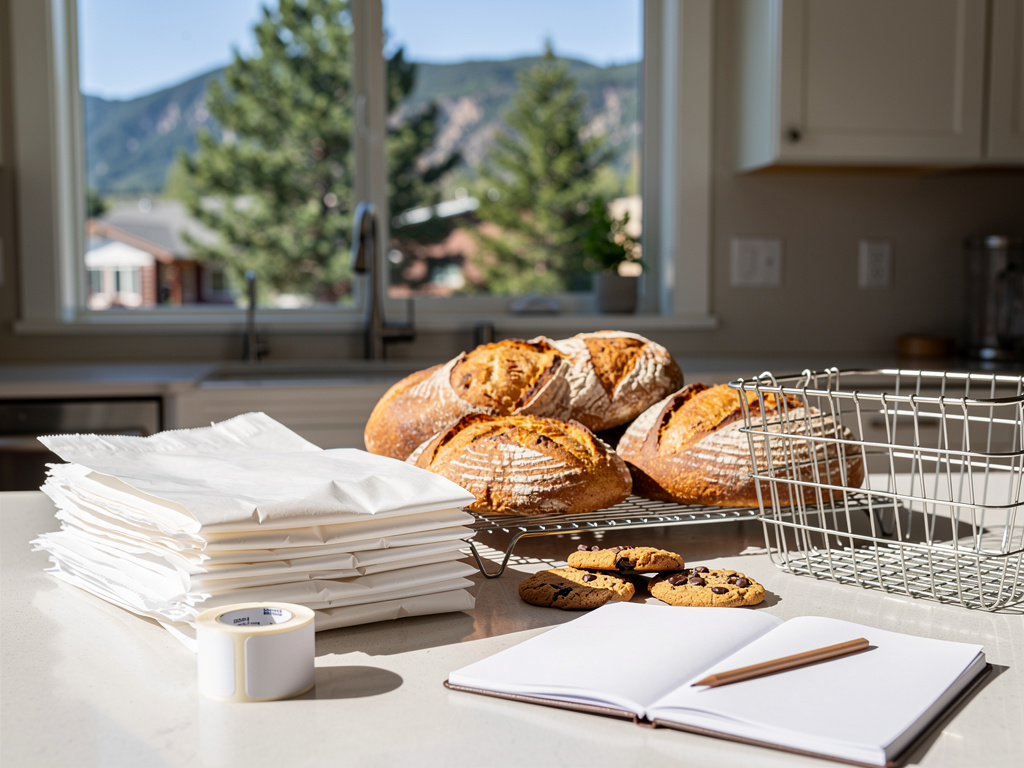


The short version: To start a cottage food business in Colorado today, you finish one food safety course, label every product, post the home-kitchen sign wherever you sell, and set up a way to take orders. There is no cottage food license, no permit fee and no routine inspection, though most vendors still need a sales tax license. Through December 31, 2026, each product you sell has its own $10,000 net revenue cap. On January 1, 2027, the Tamale Act (HB26-1033) adds a yearly registration with the Colorado Department of Public Health and Environment (CDPHE) and swaps the per-product cap for one $150,000 total cap on gross sales, adjusted every year for inflation.
Checked on CDPHE's Cottage Foods Act page and its Tamale Act pages, October 10, 2026: the current rules, the 2027 rules and the January 1, 2027 start date. The CSU class price comes from its Eventbrite listing, the sales tax license fee from the Colorado Department of Revenue's Sales Tax Guide, and Homegrown prices from findhomegrown.com/signup, all checked the same day. CDPHE listed 2027 registration as "Coming Soon" with no fee posted. Homegrown customers create an account to place a first order, and Homegrown has no drops (timed product release) feature.
For the step where you set up a way to take orders, you can set up a Homegrown storefront and try it free for 7 days.
Colorado keeps the start of a home food business simple. You do not apply for a license or wait for an inspector. You take a food safety class, make food from the approved list, label it the way CDPHE asks, and sell it directly to the people who will eat it.
The rules change on January 1, 2027, so the rules you start under this fall are not the rules you will sell under in January. This guide is the setup playbook: what to do first, what it costs, how long it takes, and how to set up your first month so the 2027 switch is easy. For the full rulebook (every allowed food, every label line, both sets of rules side by side), read our Colorado cottage food law guide.
You start a Colorado cottage food business in eight steps. The food safety course usually sets your start date, because classes run on set days; the rest is setup that takes 2 to 5 days or so, for up to about $178 in fixed costs (the cost section below itemizes it). Here is the order that saves you from redoing work:
Then plan one more step for late 2026: register with CDPHE as soon as its system opens, so you can keep selling on January 1, 2027.
You do not need one: Colorado has no cottage food license, no permit fee and no routine kitchen inspection today. After the 2027 changes there is still no license and no routine inspection, but the new registration's cost is not known yet: CDPHE had posted no fee for it as of October 10, 2026, and HB26-1033 does not name one. When people search for a "Colorado cottage food license," the thing they actually need is a food safety training certificate, and from 2027 a yearly registration number from CDPHE. Two other licenses sit outside the cottage food law: a Colorado sales tax license, and a local business license if your city or county requires one.
Here is what each piece means in plain terms:
That means $0 in license or permit fees today. So the honest answer to "how do I get a cottage food license in Colorado?" is: take the class this month, and watch for CDPHE's registration to open before January. On CDPHE's Tamale Act menu, read October 10, 2026, "Complaints and Registration" was still marked "Coming Soon," and no registration fee had been posted.
CDPHE's Cottage Foods Act page opens with this line, which we read on October 10, 2026: "The 'Tamale Act' HB26-1033 was passed. It begins January 1, 2027."
The usual pick is CSU Extension's Food Safety Training for Colorado Cottage Food Producers, a 3.5-hour class with a certificate that lasts three years. CDPHE lists it first and says more than 2,020 cottage food producers have earned its certificate since 2014. CDPHE accepts any one of three options, so pick the one that fits your schedule:
Why CSU is the usual pick: its class is built around the Colorado Cottage Food Act, and CSU says its September through December 2026 classes were updated for the 2027 law, including cooking, cold holding and hot holding temperatures for the new foods. If you plan to sell tamales or another refrigerated food in 2027, that part of the class is the point.
Already hold a CSU certificate? CSU runs two-hour UPDATE classes on the 2027 rules. They cost nothing if you took CSU's course between January and August 2026, and $10 for other current certificate holders. CSU also offers a separate live Zoom class called Passion into Profits on the business side of cottage food, with a session listed for October 22, 2026. Our guide to getting a food handlers permit explains how food handler cards work in general.
Start now if your product is already on today's list, such as bread, cookies, jam or granola. You can sell for the rest of 2026 under today's rules, then register in time for January. Waiting only makes sense if the food you want to sell is not legal until 2027, like tamales, jerky or cheesecake.
Here is how your setup work changes depending on when you open:
Scroll sideways to see both columns.
| Setup task | If you open in fall 2026 | If you open on or after January 1, 2027 |
|---|---|---|
| Food safety course | Required before your first sale | Required, and the certificate is needed to register |
| CDPHE registration | None yet; register before January 1 | Register before your first sale, then renew every year |
| What you can make | Shelf-stable foods and up to 250 dozen eggs a month | Shelf-stable foods and the same 250-dozen monthly egg limit, plus one refrigerated food type in up to five variations, plus meat from USDA-inspected or exempt sources |
| Labels | Your name and the address where the food was made | Your name, registration number, county and CDPHE's web address |
| Sales cap to track | $10,000 net revenue per product | $150,000 gross sales in total, adjusted for inflation |
| Labels you print now | Usable through December 31, 2026 | Reprint with the 2027 details |
We checked both columns on CDPHE's Cottage Foods Act page, its Tamale Act pages and the enrolled HB26-1033 on October 10, 2026. CDPHE labels its Tamale Act pages "for information purposes only" until January 1, 2027.
One practical tip from that table: if you open in the fall, print a small batch of labels. A full year's supply will be out of date in January.
You can start a Colorado cottage food business for up to about $178 in fixed costs before ingredients and packaging, and $50 of that is a refundable sales tax deposit. There is no license fee and no inspection fee. Here is the itemized budget, with every price checked on October 10, 2026:
Scroll sideways to see where each price came from.
| Startup cost | Price | Who sets it | Notes |
|---|---|---|---|
| Food safety course | $55.20 | CSU Extension, on Eventbrite | 3.5 hours, certificate good for three years |
| Sales tax license fee | Up to $16, prorated by issue date | Colorado Department of Revenue | Paid at application; licenses expire December 31 of odd-numbered years, so one issued in late 2026 costs less |
| Sales tax deposit | $50 | Colorado Department of Revenue | Refunded after you start selling, file returns and pay more than $50 in state sales tax. A vendor selling only foods exempt from state tax can ask the Department to waive it |
| Labels | $50.46 for 400 labels, about 13 cents each | Avery, item 5168 (3-1/2" x 5") | One of three Avery product numbers CDPHE's sample label is built for |
| Label shipping | $5.95 | Avery | Flat rate; free on orders of $75 or more |
| License or inspection | $0 | CDPHE | Colorado has neither for cottage food |
| 2027 registration | Not posted | CDPHE | No fee named on any Tamale Act page when we checked |
| Fixed total | Up to $177.61 | $127.61 if you leave out the refundable deposit; less if your license fee is prorated |
Prices checked October 10, 2026 on CSU Extension's Eventbrite listing, the Colorado Department of Revenue's Sales Tax Guide, avery.com and CDPHE's Cottage Foods Act and Tamale Act pages. The Avery price was a sale price; the regular price listed was $70.43.
What is not in that table depends on you:
You can be selling within a few days to about five weeks, and the class date is what decides it. Labels, signs and a sales tax account take about 2 to 5 days, longer if you order labels online and wait for them to ship. A seat in a CSU class can take longer, since the October 21 class was full when we checked.
A realistic timeline:
If you open in November or December 2026, you have two deadlines close together: your first sale, which needs the course, and January 1, 2027, which needs a CDPHE registration. CDPHE had not opened registration as of October 10, 2026. Put a reminder on your calendar to check its Tamale Act page every week in December.
Through December 31, 2026, Colorado allows foods that do not need refrigeration to stay safe, plus up to 250 dozen whole eggs a month, according to CDPHE's Cottage Foods Act page. That covers bread, cookies, jam and a long list of pantry goods:
What is off the list today: any meat, cream or custard fillings, cream cheese icing, sauces, condiments, beverages, pumpkin and cream pies, cut fresh produce, and anything with CBD or THC. CDPHE's site also has a five-question quiz on its Cottage Foods Act page that tells you if a product is "likely an eligible Cottage Food."
What changes on January 1, 2027. Shelf-stable foods stay unlimited. You may add one type of food that needs refrigeration, in up to five variations at a time, and meat from USDA-inspected or exempt sources. CDPHE's 2027 list of approved examples includes tamales, burritos, soups, jerky, cheesecakes, cream cheese frosting, refrigerated salsa and kombucha. The full lists, including what stays banned in 2027, are in our Colorado cottage food law guide. If tamales are your plan, our guide to selling tamales from home covers the product side.
How to choose your first product, if you have not yet:
Selling pickles, sauerkraut, kimchi or relish? CDPHE's state lab will test up to 5 products for pH at no cost, while its limited funding lasts, and emails you the result. Send samples before your first market, then keep the results in your booth binder.
Colorado vendors on Homegrown mostly sell baked goods: 66 of the 80 products listed by Colorado vendors were in the Bakery category when we pulled the catalog on October 10, 2026. That matches what today's rules make easy to sell.
In a pull of the Homegrown catalog on October 10, 2026, 12 of the 399 vendors had a pickup location in Colorado, from Fort Collins and Greeley down to Colorado Springs and Peyton. The 10 of them with products listed offered 80 products. We counted by the category each vendor chose for each listing: 66 Bakery, 7 ready-to-eat desserts, 5 health and wellness products (loose-leaf teas and elderberry syrup), and 2 egg listings. The Bakery listings run from sourdough loaves and sourdough starter to cinnamon roll four-packs, gluten-free donuts and cookie boxes.
What Colorado vendors list on Homegrown, by category
Source: Homegrown catalog pull, October 10, 2026, 80 products from the 10 vendors with a Colorado pickup location and at least one product listed. Categories are the ones vendors picked.
Most of these vendors do not sell only single products. They sell sets.
8 of the 10 Colorado vendors with products on Homegrown listed at least one box, pack, flight, sampler or dozen on October 10, 2026 (we read each listing's name and description and left out egg cartons). A half-dozen cookie box or a four-loaf sourdough flight raises your average order and makes your pickup day faster, because you pack fewer bags.
Under today's per-product cap, a set also matters for your records. CDPHE has not said whether a "dozen variety box" counts as its own product. The cautious way is to split each box's sales across the cookies inside it, and to ask CDPHE by email (cdphe_mfgfd@state.co.us) before you log a box as its own product. Whichever way you log it, do it the same way every time.
Every Colorado cottage food package needs seven details on its label today, and the exact disclaimer wording matters. CDPHE's Cottage Foods Checklist, linked from its Cottage Foods Act page, lists them:
Here is what a finished label could look like for a first product: *"Brown Butter Snickerdoodles, half dozen. Made by Sam Rivera, 456 Juniper Ln, Loveland, CO. sam@example.com. Made October 14, 2026. Ingredients: flour, sugar, butter, eggs, cream of tartar, baking soda, cinnamon, salt."* Then the full disclaimer. Printed on Avery's 400-label pack from the cost table, each label costs about 14 cents with shipping. Two rules people miss: you cannot call a cottage food "allergen free," and "organic" cannot appear on the main label unless the product is certified.
Starting January 1, 2027, the label changes, according to CDPHE's 2027 labeling page. You swap your street address for the county where you made the food, add your CDPHE registration number, and add CDPHE's web address, cdphe.colorado.gov/dehs/cottage-foods. CDPHE's 2027 FAQ also says a QR code cannot stand in for the label.
The sign. Separate from the label, every place you sell needs a placard, sign or card with this sentence: "This product was produced in a home kitchen that is not subject to state licensure or inspection. This product is not intended for resale." That includes your online ordering page. For a template and a line-by-line check, see our cottage food labeling guide and our cottage food label checklist.
You can sell Colorado cottage food only to the person who will eat it, and only inside Colorado, under the rules on CDPHE's Cottage Foods Act page. Within that rule, you can sell in five kinds of places:
What you cannot do: sell to restaurants or grocery stores, sell wholesale, cater an event, or ship or deliver across state lines. CDPHE's rule for online sales is that delivery is up to you and your customer "as long as it does not involve interstate commerce." Starting in 2027, CDPHE's Tamale Act FAQ says foods that need time and temperature control for safety, whether kept cold or kept hot, can be transported only once and for no more than 2 hours, which matters if you deliver. Our guide on whether you can ship cottage food covers how other states handle shipping.
A designated representative is someone who knows your product and can answer a customer's questions about it, like a partner running your booth while you bake. If you are headed to a market, our Colorado farmers market vendor permit guide covers county rules, sampling and market-day sales tax.
Give customers one link where they pick products, pay up front and choose a pickup time, so your bake list is set before you turn on the oven. That fits Colorado well: online sales are allowed but must stay local, and your website has to show CDPHE's home-kitchen sign. Homegrown is built for exactly that kind of local selling. It costs $10 per month billed annually ($12.50 billed monthly), with no percentage fees beyond standard payment processing of 2.9% + $0.30 per order, which the vendor pays.
The parts that fit a new Colorado vendor:
Here is how the full fee stack compares with two other tools:
Slide the table to see every fee for each option.
| Option | Monthly plan | Trial | Platform or service fee | Card processing | Customer pays on a $20 order | Vendor pays on a $20 order | Vendor pays in a month of 50 orders at $20 |
|---|---|---|---|---|---|---|---|
| Homegrown | $10 billed annually ($12.50 monthly) | 7 days, no charge until day 8 | None, 0% commission | 2.9% + $0.30, vendor pays | $20.00 | $0.88 plus the plan | $54.00 |
| Square Online, Free plan | $0 | Not needed on the Free plan | None | 3.3% + $0.30 online, vendor pays | $20.00 | $0.96 | $48.00 |
| Hotplate, default | $0 | Not needed, no plan | 5% + $0.55, paid by the customer | 2.9% + $0.30, vendor pays | $21.55 | $0.92 | $46.25 |
| Hotplate, vendor covers the fee | $0 | Not needed, no plan | 5% + $0.55, vendor covers it | 2.9% + $0.30, vendor pays | $20.00 | $2.43 | $121.50 |
We checked these on Homegrown's signup page, Square's online store plans page and Hotplate's pricing page on October 10, 2026. Hotplate's page says who pays its fee is "your choice"; Hotplate's own post "What Hotplate does" says it charges the fee to your customer by default and that 80% of its chefs keep that default. A month of 50 orders adds the plan price to 50 card fees. In Hotplate's default row the card fee is figured on the full $21.55 the customer pays, the basis our other state guides use; Hotplate's page does not spell out which amounts its card fee is charged on. Sales tax and tips are left out. Homegrown's month uses the annual plan; on monthly billing it is $56.50.
Square's Free plan costs $6 less a month than Homegrown's annual plan at 50 orders ($8.50 less than monthly billing), and it is a sensible pick if you already use Square at your booth. Hotplate costs you less when customers cover its fee, but your customer sees $21.55 on a $20 order. Homegrown handles pickup and local delivery, not shipping, which fits Colorado's in-state rule. It does not track your $10,000 per-product cap for you, and it has no drops or countdown-release feature. Customers create a Homegrown account to place their first order. Your storefront is listed on the Homegrown marketplace, but plan on most orders coming from people you send to your own link.
Once your certificate is done and your labels are printed, open a Homegrown storefront, paste CDPHE's sign sentence into your about section, and print your link on your booth card so market regulars can order next week's pickup.
Through December 31, 2026, Colorado has no total ceiling, only a $10,000 net revenue ceiling on each product, so a vendor with five products near their caps could reach $50,000 in net revenue while every product stays legal. From January 1, 2027, the ceiling is $150,000 in total gross sales a year, about $2,884.62 a week, and CDPHE adjusts it for inflation every year.
Here is what those numbers look like for one product. Say your sourdough loaf sells for $10 and you sell 20 loaves a week all year. That is $10,400 in gross sales from one product. Because the 2026 cap counts net revenue, that loaf can still sit under its $10,000 line once costs come out, but you would need clean records to show it. Under the 2027 rule, the same loaf is just $10,400 toward a $150,000 total.
Two ways the switch can cut:
Ways to earn more under either rule:
The simplest way to track Colorado's cap is one spreadsheet with a row for each sale, a column for each product, and a running total. That one sheet works for today's per-product rule and the 2027 total rule.
Set it up like this:
Pre-orders make this easier, because every online order already has a product name, a price and a date. Cash sales at your booth do not, so write them down before you pack up.
You do not need an LLC to start, but you do need to handle sales tax, and the business structure has a Colorado limit. CDPHE's Cottage Foods Checklist says you must run the business as a sole proprietor or an LLC with two or fewer owners, so a three-person LLC does not qualify for the cottage food law.
Here is the tax and business paperwork, in order:
Whether a given food is taxed depends on the item and where you sell it, so CDPHE recommends asking a qualified accountant or tax professional. On storefront orders, Homegrown's signup page says it collects and remits sales tax for the products that need it. Sales you ring up yourself at a booth are still yours to report.
An LLC mainly protects your personal assets if something goes wrong. For a side business selling cookies at one market, you can start as a sole proprietor and revisit an LLC once sales grow. Our guide to whether you need an LLC to sell food from home walks through the tradeoff.
The first mistake to rule out is treating the $10,000 cap as a total for the whole business. Through 2026 it applies to each product, and from 2027 it becomes a $150,000 total. The rest of the list:
From 2027, a product without a correct label counts as misbranded, which can bring a fine of up to $100 and up to $1,000 to cover CDPHE's investigation costs. Fixing a label before your first market costs you one reprint.
Get your certificate, records and menu in order now, so registration takes one sitting when CDPHE opens it. The law says you register every year before selling, list the types of food you plan to sell, and receive a registration number for your labels. Here is a short prep list:
The law also tells CDPHE to keep a public online registry of producers, updated monthly. Once you are on it, customers will be able to look you up.
No. Colorado has no cottage food license and no routine inspection. You do need to finish an approved food safety course before your first sale, such as CSU Extension's cottage food class or a food handlers card, and from January 1, 2027 you also need a yearly registration with CDPHE.
The fixed costs to start a cottage food business in Colorado come to up to about $178 before ingredients and packaging, based on prices checked October 10, 2026: $55.20 for a CSU online class, a sales tax license fee of up to $16 plus a $50 refundable deposit, and $56.41 for 400 Avery labels with shipping. There is no license fee, and CDPHE had not posted a 2027 registration fee.
Through December 31, 2026, each product can earn up to $10,000 in net revenue a year, with no limit on the number of products. Starting January 1, 2027, the limit becomes $150,000 in total gross sales a year for your whole business, adjusted each year for inflation.
Today you can sell foods that do not need refrigeration, such as breads, cookies, jams, honey, candy, dry mixes, roasted coffee beans and pickled produce at pH 4.6 or below, plus up to 250 dozen eggs a month. From 2027 you may add one refrigerated food type in up to five variations and meat from USDA-inspected or exempt sources.
Yes. The Tamale Act (HB26-1033) passed in 2026, and on January 1, 2027 the $10,000 net revenue cap per product becomes one $150,000 cap on total gross sales per calendar year. CDPHE will adjust that figure every year using a Denver-area consumer price index.
Anywhere from a few days to about five weeks. The paperwork and labels take about 2 to 5 days, so the deciding factor is your training: a self-paced food handlers card can be done quickly, while CSU's online classes run on set dates. When we checked on October 10, 2026, CSU's October 21 class was sold out and its November 10 class had tickets.
No. You can start a Colorado cottage food business as a sole proprietor. If you do form an LLC, CDPHE's checklist says it can have no more than two owners to qualify under the cottage food law.
For the rest of 2026 there is nothing to register with CDPHE; you take the course and, like most vendors, get a sales tax license. Starting January 1, 2027, you must register with CDPHE every year before selling and list the foods you plan to sell. CDPHE's registration system was marked "Coming Soon" when we checked on October 10, 2026.
These guides answer what new Colorado vendors usually ask next:
Colorado asks for one class, a correct label and a sign, then lets you sell. Take the course, print a small run of labels, get a sales tax license if your products are taxed, and start your per-product log on day one. Then get ready for January 1, 2027: register with CDPHE when it opens, reprint labels with your number and county, and track one $150,000 total.
When you are ready to take orders, set up your Homegrown storefront for Colorado pickup and local delivery, and send your regulars one link instead of a string of texts. Compare more options in our guide to the best platform to sell food from home.
*This guide is general information, not legal advice. Cottage food rules change, and Colorado's change on January 1, 2027. Verify your state's current rules with CDPHE before you start selling. Last verified: October 10, 2026.*
Selling at farmers markets? See our Colorado farmers market vendor permit guide for the permits you need on market day.



