
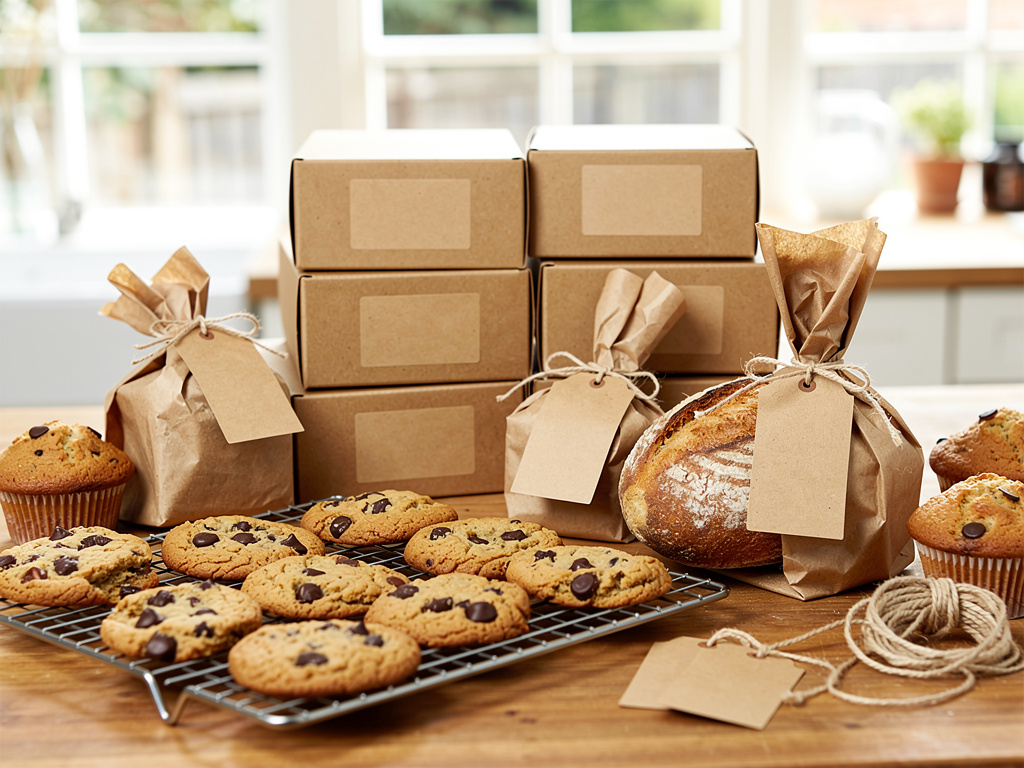


The short version: You can sell cookies, breads, cakes and fruit pies from your home kitchen in all 8 states whose cottage food rules we checked on October 5, 2026, as long as they keep at room temperature and carry the label your state asks for. Start with 3 to 5 things you already bake well, and use the cost formula (ingredients + packaging + your time + a 20 to 30% markup for profit) as your price floor, then look at the market: the middle price 46 Homegrown vendors listed for a dozen cookies was $23. Sell first to people you know and at a farmers market, and once orders pile up in your texts, move them to one ordering link with set pickup times so you bake only what is already paid for. Check your own state before the first sale, because the paperwork runs from no permit at all in Texas to a $355 permit and a kitchen inspection in Washington.
Checked October 5, 2026: the cottage food pages of the Texas, Florida, Washington, Georgia, California, New York, Pennsylvania and Ohio agriculture or health departments, 2,883 listings in the Homegrown catalog, the Bureau of Labor Statistics average store prices for August 2026, a King Arthur Baking recipe, and the pricing pages of Homegrown, Etsy, Shopify, Square, Hotplate and Venmo. Honest bounds: state rules change and differ, so verify your state's current rules before your first sale. Homegrown costs $10 a month on yearly billing plus 2.9% + $0.30 card processing, handles local pickup and delivery but not shipping, has no countdown drops feature, and your customers create a Homegrown account the first time they order.
People already want your baked goods. Friends ask when you're going to start selling. Neighbors bring it up every time you show up with banana bread. The hard part isn't the baking. It's figuring out how to actually turn it into money.
But when you search for help, most advice starts with writing a business plan, choosing a business entity, and building a Shopify store. That's not what you need. You need to know how to sell cookies this Saturday and get paid for them.
Here's how to start selling baked goods, from deciding what to make and how to price it, to where to sell, how to take orders, and what legal boxes to check. Every price, fee and state rule below was loaded from its source on October 5, 2026, unless the sentence gives another date, so you can see where each number came from.
Ready to actually start selling? Take orders and get paid online in about 15 minutes: set up a Homegrown storefront ($10 a month billed yearly, 0% commission, 2.9% + $0.30 card processing), or compare the best platforms to sell food from home first.
Start with 3 to 5 baked goods you are already known for, the products people already ask you to make. If everyone asks for your cinnamon rolls, sell cinnamon rolls. If your chocolate chip cookies disappear at every potluck, those are your lead product. Don't try to launch with a 20-product menu.
Three to five products is plenty when you're starting out. You want to keep your ingredient costs manageable, your prep time reasonable, and your menu simple enough that customers can decide quickly. A focused menu also means you get really efficient at making those products, which saves time and money.
You'll have company. In a pull of the Homegrown catalog on October 5, 2026, 1,455 of the 2,883 listings were in the Bakery category, from 183 of the 309 vendors. On Homegrown, baked goods are the most common thing vendors list, which is good news (customers already look for them) and a nudge to be known for something specific.
There are two basic models for selling baked goods, and they work differently:
Most bakers start with standard products because they're simpler to produce and sell. Add custom orders once you have a rhythm.
How much to make for your first market: Less than you think. Seriously. It's better to sell out early and learn what people want than to come home with 10 dozen unsold cupcakes. Cupcakes make that easy to plan, and a cupcake business built on pre-orders bakes only the dozens already paid for. Start with small batches of your top 3 or 4 products. You'll learn fast what sells and what doesn't.
Pick your lead product by the batch, not the piece. King Arthur's sugar cookie recipe makes 3 1/2 dozen in about an hour, so one batch is three and a half boxed dozens. If you set aside six for samples, divide your batch cost by 3 instead of 3 1/2. Products that come out of the oven in sellable round numbers are easier to price and pack.
Yes, you can sell baked goods from home in each of the 8 states we checked on October 5, 2026 (Texas, Florida, Washington, Georgia, California, New York, Pennsylvania and Ohio), as long as you follow that state's cottage food rule. Cottage food laws are the state rules that allow this: they let you make lower-risk food at home and sell it, usually straight to the person who eats it.
The line every state we read draws is the same idea in different words: food that is safe at room temperature is in, food that must stay in the fridge is usually out. Washington's agriculture department lists what its home bakers can make, and it reads like most bakers' menus:
What usually needs more than a home kitchen: cheesecake, cream pies, custard pies, cream-filled pastries, and frostings made with cream cheese or butter that can't sit out. New York's Department of Agriculture and Markets, for example, does not allow homemade buttercream or cream cheese frosting under its home processor rule. Among the 8 pages we read, two give home bakers a path for those: since its 2025 law, a Texas home baker can sell foods that need refrigeration after registering with the state health department and adding safe handling wording to the label, and Ohio sells a $10-a-year Home Bakery license, with an inspection, for cheesecakes and cream, custard and pumpkin pies. The section on refrigerated desserts below has each state's version.
Washington draws one more line worth knowing: it treats frostings and glazes as allowed only when they have a cooking step or enough sugar that they won't spoil at room temperature.
Yes, in seven of the eight states on our list, banana bread and other quick breads are allowed. Georgia and Washington also say outright that fruit or vegetables baked into the batter are fine; in the other states, check your state's list before adding zucchini or pumpkin bread. Georgia's Department of Agriculture puts it plainly: sweet breads and muffins made with fresh fruits or vegetables are allowed "as long as the fruits or vegetables are incorporated into the batter and properly baked," and Washington says the same. What isn't allowed in Georgia is decorating the top with fresh fruit after baking.
New York is the one to check first. Its approved list allows breads and muffins that contain "high acid fruits, commercially dried fruits and/or commercially dried herbs" and says "Vegetables are prohibited," so zucchini and pumpkin bread are out there. Banana isn't on the list of high-acid fruits New York gives for jams, so ask Agriculture and Markets before you put banana bread on a New York menu.
You need five things before your first sale: your state's rule, any permit or training it asks for, a label, packaging, and a way to take orders and payment. None of them take a commercial kitchen.
Two more checks are easy to miss. Your city or county may have zoning rules for home businesses (Washington and Georgia both tell bakers to check). And a farmers market can ask for more than the state does: Georgia's agriculture department says a market may require a Food Sales Establishment License even though the state no longer requires a cottage food license.
If you'd rather see the license side state by state, what a home bakery license actually requires walks through it, from no permit at all in Texas and Florida to Washington's permit with a kitchen inspection.
You can sell baked goods locally in five places: farmers markets, your own home under your state's cottage food law, an online storefront for pre-orders, social media, and word of mouth. You don't need a bakery, a retail lease, or even a website. Here's how each one works when you're starting out.
Farmers markets are where many home bakers make their first real sales: you apply for a booth, pay the booth fee the market sets, show up with your products, and sell directly to customers.
Markets are great for testing products, learning what prices people will pay, and building a customer base. Brownies make a good first test, and our breakdown of where to sell brownies shows which cut fits a booth, a cafe case or a porch pickup. Markets are also the fastest way to get real feedback: you'll know immediately which products sell out and which sit on the table.
Ask the market manager what they need from you before you apply, because a market can ask for more than your state does. Pennsylvania's agriculture department notes that a Retail Food Facility License may be required for sales at an event or farmers market even after you register your home kitchen.
The main downside: you can only sell when the market is open. If your market runs Saturday mornings, your selling window is about 4 hours per week. The rest of the week, customers have no way to buy from you.
For a full first-market walkthrough, from the application to the table layout, read how to sell at a farmers market.
All 8 states whose rules we read let you sell baked goods made in your home kitchen directly to customers. These are called cottage food laws, and the cottage food laws by state guide covers the rest of the country.
How it works: customers come to you (or you deliver), they pay, and they leave with their baked goods. Many home bakers start by selling to neighbors, coworkers, church groups, and friends of friends. A school or church bake sale is a low-stakes first test too, if the organizer lets you set out a card with your ordering link.
The rules vary by state: there are usually limits on what products you can sell, sometimes on how much you can earn per year, and always on how products need to be labeled. But for baked goods specifically, cottage food laws are favorable. Cookies, breads, cakes and fruit pies are allowed in all 8 states we read (New York: double-crust fruit pies only), and brownies are named outright on the Ohio, New York and California lists and in Washington's FAQ.
If customers pick up at your house, you don't have to print your street address on your storefront for everyone to see. Homegrown shows an approximate location and reveals the exact pickup address only after someone orders. Your label may still need your address: Georgia's agriculture department says a post office box is not enough, while Texas lets registered bakers print a state ID number instead.
An online storefront lets customers see what you're selling, place an order, and pay, without you managing everything through text messages.
It works best alongside a market: take pre-orders online during the week, bake exactly what's been ordered (plus extra for walk-ups), and bring everything to the market on Saturday. You start your market day with revenue already paid for and less wasted product.
You don't need a full website or a Shopify store. Platforms built for local food sellers give you a simple link you can share anywhere: text it to regulars, post it on Instagram, print it on your business card. For the card itself, these bakery business card ideas cover what 100 cards cost from two online printers in 2026 and which ideas, like a second card in every box, bring back orders.
If you're weighing tools, the best platforms to sell food from home compares them side by side, and the fee table further down this page shows what each one costs on the same $25 order.
Instagram and Facebook are where many home bakers market their products, and for good reason. Baked goods photograph well, people love watching baking content, and local food communities on Facebook are active.
But social media is a marketing tool, not an ordering system. Posting a photo of your cookies and saying "DM me to order" works for a handful of customers. Once you have a few dozen, you're drowning in messages, losing track of who ordered what, and spending more time on your phone than in your kitchen.
Use social media to show off your products and build a following. Then send people to your online storefront to actually order and pay. Selling food on Instagram without taking orders in DMs shows how to word that switch so regulars follow you to the link.
Telling the people around you that you sell baked goods costs nothing, and it reaches people who already trust your baking. Church groups, school events, office breakrooms, neighborhood Facebook groups, community bulletin boards: these are all places where your first customers are already hanging out.
Plan on your first regulars coming from people you already know, long before strangers find you online.
You can take orders online for home-baked goods in 7 of the 8 states we read (Ohio's page doesn't address online orders), but taking an order online and shipping the box are two different rules. Some states let you mail cottage food; others say the hand-off must be in person, and several keep every sale inside the state.
Scroll sideways to see every column.
| State | Online orders | How the food can reach the customer | Selling to other states |
|---|---|---|---|
| Texas | Allowed, with the label details posted on your site before payment | You, an employee or a household member personally delivers it | Not on the page; online orders must be delivered in person |
| Florida | Allowed (website and mail order) | In person, to an event venue, or by USPS or a commercial mail service | Not addressed on the page or in the statute |
| Washington | You can take orders online | Person to person only; no mail or courier | Sales outside the state prohibited |
| Georgia | Allowed, to end consumers within Georgia | The page conflicts: an older answer says sales must be person to person, and the House Bill 398 answer allows stores and restaurants; ask the Department of Agriculture | Interstate sales may bring FDA oversight and a license Georgia can't issue to a home kitchen |
| California | Allowed (phone, internet, other digital orders) | In person, by mail, or by a third-party delivery service | Not addressed on the state page we read |
| New York | Allowed within New York only | Home delivery and in person | Not permitted, including shipping out of state |
| Pennsylvania | Registration covers internet sales | Not limited on the page | You may also need FDA registration |
| Ohio | Not addressed on the page | From your home, stores, markets and some festivals | Ohio only |
We read each state's cottage food page on October 5, 2026: the Texas Department of State Health Services, the Florida Department of Agriculture and Consumer Services and Florida Statutes section 500.80, the Washington State Department of Agriculture, the Georgia Department of Agriculture, the California Department of Public Health, New York Agriculture and Markets, the Pennsylvania Department of Agriculture and the Ohio Department of Agriculture. "Not addressed" means the page we read did not say, not that it is allowed.
The Texas health department's cottage food page spells its version out: food sold online must be personally delivered by "the operator, an employee, or a household member," and the operator has to post the label information on the website before taking payment. That's a local-delivery rule, not a shipping rule.
Washington's FAQ goes further: you can take orders over the internet, but it says delivery and payment must go straight from the baker to the customer "in a person to person transaction." If you bake in Washington and want customers to pay by card through any online ordering page, ask the Washington State Department of Agriculture (cottagefoods@agr.wa.gov) whether that counts as person to person before you set it up.
If you live somewhere that lets you mail cottage food, cookies and dense breads travel far better than frosted cakes. Our guide to selling baked goods online without Etsy or Amazon covers the shipping side for bakers whose state allows it.
Use this formula as your floor: ingredient cost + packaging cost + your time (at least $15 to $20 an hour) + a 20 to 30% markup for profit. Pricing is where many new bakers get stuck, not because the math is hard, but because it feels uncomfortable to charge real money for something you used to give away.
Here's the reality: if you price too low, you'll burn out. You'll resent the time you spend baking because it doesn't feel worth it. You'll cut corners on ingredients to save money. And you'll eventually quit, not because no one wants your products, but because you made it unsustainable.
The basic formula:
Here's a real batch. King Arthur Baking's sugar cookie recipe uses 360 g of flour, 227 g of butter, 248 g of sugar in the dough plus 149 g for rolling, and 1 egg, and makes 3 1/2 dozen in about an hour of total time. At the August 2026 average US store prices from the Bureau of Labor Statistics (flour $0.548 a pound, butter $4.021, sugar $1.024, eggs $2.272 a dozen), those four staples cost $3.53 for the batch, or $1.01 a dozen: $0.43 of flour, $2.01 of butter, $0.90 of sugar and $0.19 of egg. The baking powder, baking soda, salt, extracts and the recipe's optional 2 ounces of cream cheese add a little more, and chocolate chips, nuts or brown butter add more, so put your own receipts in.
Ingredients are the small part. Your time is the big one.
A dozen of those sugar cookies needs to sell for at least $7.56 to $17.47, depending on your wage and how long a batch really takes; the four rows below show the math. The ingredients ($1.01) are the BLS-based figure above. The $1.00 for a box and label is an example; use what yours cost. Time is either the recipe's one hour or two hours once you count boxing, cleanup and handing orders over, divided across the 3 1/2 dozen the batch makes.
Swipe sideways to see all seven columns.
| Scenario (one dozen) | Ingredients | Box and label | Your time | Cost | Profit (markup on cost) | Floor price |
|---|---|---|---|---|---|---|
| 1 hour batch at $15/hr, 20% markup | $1.01 | $1.00 | $4.29 | $6.30 | $1.26 | $7.56 |
| 1 hour batch at $20/hr, 25% markup | $1.01 | $1.00 | $5.71 | $7.72 | $1.93 | $9.65 |
| 2 hour batch at $20/hr, 25% markup | $1.01 | $1.00 | $11.43 | $13.44 | $3.36 | $16.80 |
| 2 hour batch at $20/hr, 30% markup | $1.01 | $1.00 | $11.43 | $13.44 | $4.03 | $17.47 |
Ingredient prices: Bureau of Labor Statistics average price data, US city average, August 2026, loaded October 5, 2026. Recipe weights and yield: King Arthur Baking's "Sugar Cookies" recipe, loaded the same day. Every row is rounded to the cent and then added, so each row sums as shown.
The formula gives you a floor, not a price. Even the highest row lands at $17.47 a dozen, and the middle price Homegrown vendors actually list a dozen cookies for is $23 (the next section shows all 46). Charge at least the floor, then price toward what your market pays. How to price baked goods and the cost per dozen cookies breakdown go deeper on both halves.
The grocery store trap: Your cookies are not competing with grocery store cookies. The BLS average price for store-bought chocolate chip cookies was $5.214 a pound in August 2026, for a factory product made to sit on a shelf. Your cookies are handmade, fresh, local, and probably a lot better, and customers buying from you already know that. Don't price yourself against a product that isn't your competition.
When to raise prices: Sooner than you think. If you're selling out every time, your prices are too low. If customers never push back on price, you're probably leaving money on the table. Raise prices by $1 or $2 per product and see what happens; if orders hold steady after the raise, keep it.
The 46 Homegrown vendors who sell cookies by the dozen put the middle price for a dozen at $23 on October 5, 2026, and half of them charged between $17.50 and $30.50. The cheapest dozen was $10 and the most expensive was $50, so there is no single "right" cookie price; there's a wide band where real bakers sell.
In a pull of the Homegrown catalog on October 5, 2026 (2,883 listings from 309 vendors), 46 vendors listed a dozen regular-size cookies. We searched every listing's name, description and size options for cookie words (cookie, snickerdoodle, shortbread and similar) and for cookie flavors that never use the word, together with "dozen," "doz" or "12," read all 144 first-pass matches by hand, then read every other listing from each vendor we counted (that second pass found one vendor's cheaper $18 dozen). We took one price per vendor: the lowest price it listed for 12 regular-size cookies. We left out half-dozen-only listings, baker's dozens of 13, minis, cake pops, sandwich cookies and cream pies, macarons, pizzelles, biscotti, custom decorated sugar cookies and one shop that sells cookies by the pound. These are listing prices, not sales.
Cheapest dozen cookies per vendor, 46 vendors
Source: Homegrown catalog pull, October 5, 2026, one price per vendor (the lowest listed for 12 regular-size cookies), 46 vendors. Listing prices, not sales.
What the spread tells you:
For where those dozens end up (porch pickups, coffee shops, office orders), where to sell cookies goes through each one.
Set up one shareable link where customers can see your products, order, and pay, and the DM chaos goes away. None of the guides we read for this topic on October 5, 2026 lays out every ordering tool's full fees side by side.
Here's what typically happens: You post on Instagram that you're taking orders for Saturday. People DM you. Some text you directly. A neighbor sends a Facebook message. Your aunt calls. Now you have orders scattered across four different apps, no confirmation of who's paid, and you're trying to figure out how many dozen cookies to bake while answering messages.
The solution is simpler than you think. You need a single place where customers go to order and pay. That's it.
An online storefront gives you:
Even at small scale, even with just 10 regular customers, one system saves you matching payments to messages by hand. The question is which one.
Google Forms + Venmo is cheap and manual. You build a form, share it, then match Venmo payments to form responses yourself. Venmo charges a business profile 1.9% + $0.10 a payment (2.99% when a personal account gets a payment marked for goods and services). It works for your first handful of orders. Past that, matching payments to form answers starts eating into your baking time.
Etsy has no subscription but charges $0.20 a listing (renewed each time one sells, and every four months whether it sells or not), a 6.5% transaction fee and 3% + $0.25 payment processing on every US order, plus a 15% Offsite Ads fee on any order Etsy's outside ads bring in unless you opt out (an option for shops under $10,000 a year in sales), and its fee page says a one-time shop set-up fee may apply. On a $25 order of cookies, that's $2.83 in fees before any Offsite Ads fee. Etsy is also built around shipping nationwide, so a home baker doing local pickup pays for a model they don't use, and Etsy's fee policy strictly prohibits moving a sale off Etsy, so your regulars stay Etsy's customers.
Square Online has a $0 Free plan with online card processing at 3.3% + 30 cents, or Square Plus at $49 a month per location with 2.9% + 30 cents. It handles pickup and local delivery, and it's a full restaurant-and-retail system, which is more setup than a five-product menu needs.
Shopify Basic is $29 a month billed yearly or $39 billed monthly, with online card processing from 2.9% + 30 cents (3.5% + 30 cents on premium cards) through Shopify Payments (and an extra 2% if you use another processor). Its pricing page advertises up to 87% off shipping, which tells you who it's built for.
Hotplate has no subscription. By default it adds a fee of 5% + $0.55 to the customer's subtotal ($1.80 on a $25 order), and the baker pays 2.9% + $0.30 card processing. Hotplate's pricing page says who pays the 5% + $0.55 fee is "your choice," and its own blog says 80% of its chefs keep the default.
Homegrown costs $10 a month billed yearly ($12.50 billed monthly), takes 0% commission, adds no fee for your customer, and charges the standard 2.9% + $0.30 card processing to you. You list your products, set your pickup times, and share the link everywhere: texts, Instagram, market signage. Your storefront also shows on the Homegrown marketplace, but plan on most orders coming from people you send to your own link.
Here's every option side by side on the same order: a $25 order, about one dozen cookies at the $23 middle price plus a little.
Scroll sideways to see the full fee stack.
| Option | Subscription | Trial | Platform fee | Card processing | Customer pays on a $25 order | You pay in fees on a $25 order | 50 orders a month, billed yearly | 50 orders a month, billed monthly |
|---|---|---|---|---|---|---|---|---|
| Homegrown | $10/mo billed yearly, or $12.50 monthly | 7 days, no charge until day 8 | $0 (0% commission) | 2.9% + $0.30, paid by you | $25.00 | $1.03 | $61.50 | $64.00 |
| Etsy | None; $0.20 per listing, renewed after each sale and every four months | None (no subscription) | 6.5% transaction fee | 3% + $0.25 | $25.00 | $2.83 | $141.50 | $141.50 |
| Shopify Basic | $29/mo billed yearly, or $39 monthly | 3 days, then $1 a month for 3 months | $0 with Shopify Payments (2% with another processor) | 2.9% + 30 cents (3.5% + 30 cents on premium cards) | $25.00 | $1.03 | $80.50 | $90.50 |
| Square Online Free | $0 | Not needed | $0 | 3.3% + 30 cents | $25.00 | $1.13 | $56.50 | $56.50 |
| Square Online Plus | $49/mo per location (no yearly price shown) | 30 days free | $0 | 2.9% + 30 cents | $25.00 | $1.03 | $100.50 | $100.50 |
| Hotplate, customer pays the fee (default) | $0 | Not needed | 5% + $0.55, paid by the customer | 2.9% + $0.30 on the $26.80 charged, paid by you | $26.80 | $1.08 | $54.00 (your customers pay another $90.00) | $54.00 (your customers pay another $90.00) |
| Hotplate, you pay the fee | $0 | Not needed | 5% + $0.55, paid by you | 2.9% + $0.30, paid by you | $25.00 | $2.83 | $141.50 | $141.50 |
| Venmo business profile | $0 | Not needed | $0 | 1.9% + $0.10 | $25.00 | $0.58 | $29.00 | $29.00 |
We checked every row on each company's pricing or fee page on October 5, 2026: Homegrown's signup page, Etsy's Fees and Payments Policy and Etsy Payments Policy, Shopify's pricing page, Square Online's plans page, Hotplate's pricing page and its post "What Hotplate does," and Venmo's fees page. Each fee is rounded to the cent per order, the way card processors charge, then multiplied by 50. Card processing is figured on the amount the customer is charged: Hotplate's post says its chefs pay "2.9% of the transaction + 30 cents," so on Hotplate's default we figured it on the $26.80, not the $25 subtotal; on the subtotal alone it would be $1.03 an order. Sales tax and tips are left out. Etsy's possible one-time set-up fee is not included because its page does not state the amount, and neither is its 15% Offsite Ads fee on orders its outside ads bring in. Shopify's totals assume standard cards; premium cards cost 3.5% + 30 cents.
Two honest readings of that table. Square's Free plan ($0 a month, 3.3% + 30 cents per card payment, $56.50 for 50 orders) and a Venmo business profile (no subscription, 1.9% + $0.10, $29.00) cost less than Homegrown ($10 a month billed yearly plus 2.9% + $0.30, $61.50) at 50 orders a month, so if the lowest fee is your only goal, they win; with Venmo you give up a storefront and pickup windows, and with Square you take on a restaurant-style setup. And Hotplate's default (no subscription, 2.9% + $0.30 to you, 5% + $0.55 to your customer) looks cheaper than Homegrown for you only because your customers pay $90.00 more across those 50 orders.
Yes, you can sell baked goods on Shopify for $29 a month billed yearly: Shopify doesn't stop you from selling cookies or bread, and its pricing page lists in-store pickup and flexible delivery, so you can run local pickup orders through it. What Shopify can't change is your state's rule: a Shopify store doesn't let you ship where your state forbids it. Among the 8 we read, Washington bans mail and courier delivery of cottage food, Texas requires you, an employee or a household member to hand-deliver online orders, and New York, Ohio and Washington keep sales inside the state. Georgia allows sales to customers within Georgia and warns that selling across state lines may bring FDA rules and a license it can't issue to a home kitchen.
The cost is the bigger question for a home baker. Shopify Basic is $29 a month billed yearly or $39 billed monthly, plus 2.9% + 30 cents per online card payment through Shopify Payments (3.5% + 30 cents on premium cards), or an extra 2% on top of your processor's fee if you use a different one. At 50 orders of $25 a month on standard cards, that's $80.50 billed yearly against Homegrown's $61.50.
Shopify is a good fit if you:
It's more than you need if you bake a short weekly menu for pickup. Our guide to selling food on your own website without Shopify walks through the lighter options.
Pre-orders keep you from baking too much because you bake for orders that are already paid, plus a small, planned extra for walk-ups. That's the problem this whole guide keeps circling: you can sell baked goods from home, you know what to charge, and the hard part is knowing how many dozen to make and who's picking up what.
When customers pre-order and pay during the week, you know exactly how much to bake. No more guessing whether you need 5 dozen or 12 dozen cookies. No more coming home with unsold product. You bake what's ordered, bring it to market, and sell any extras to walk-up customers.
Homegrown is built for exactly that weekly rhythm, at $10 a month billed yearly with no percentage fees beyond standard payment processing (2.9% + $0.30, paid by you, never added to your customer's total). What matters for a home baker:
Compared with two tools home bakers often weigh: at 50 orders of $25 a month on yearly billing, Etsy's fees come to $141.50 against Homegrown's $61.50, with card processing on both and Homegrown's $10 subscription included, and Etsy is set up for shipping. Hotplate costs you nothing monthly, but by default your customers pay a 5% + $0.55 fee at checkout, and Hotplate has a countdown "drop" feature for limited releases that Homegrown does not.
What Homegrown does not do: it doesn't ship orders nationwide, it has no countdown drops feature and no release date to share for one, it doesn't handle custom cake consultations with back-and-forth design approval, and your customers create a Homegrown account the first time they order. It also holds 20% of each order for 30 days as a reserve before releasing it to you, which is worth knowing in your first month. It's built for home bakers selling a set menu to local customers through pickup or delivery: weekly batches, market pre-orders, holiday rushes.
If you're tired of counting dozens across four message apps, start your Homegrown storefront and post your first pickup window this week. For the pre-order setup itself, how to take pre-orders as a home bakery covers cutoffs and pickup days.
Cottage food laws let you sell baked goods from your home kitchen without a commercial kitchen; what changes from state to state is whether you need a permit, what it costs, and whether there's a yearly sales cap. You need to check two things before you start selling: your state's cottage food law and any local requirements from your city, county or market. Here's what the 8 state pages we read on October 5, 2026 say:
Swipe sideways to see each state's cost and cap.
| State | Permit or registration | Cost | Yearly sales cap | Kitchen inspection | Agency |
|---|---|---|---|---|---|
| Texas | None for shelf-stable foods; registration if you sell foods that need refrigeration, or optional to print an ID number instead of your address | $0 (local health departments may not charge one) | $150,000 of gross income, adjusted each year for inflation | No | Department of State Health Services |
| Florida | No state food permit | $0 | $250,000 in gross sales | Only if there's a complaint (F.S. 500.80) | Department of Agriculture and Consumer Services |
| Washington | Cottage Food Permit, valid two years | $355 | $35,000 in gross sales | Yes, before the permit is issued | State Department of Agriculture |
| Georgia | No state license since July 1, 2025; an accredited food safety course is required | $0 | No limit | No | Department of Agriculture |
| California | Class A registration or Class B permit with your county | Set by your county | $88,878 (Class A) or $177,756 (Class B) for 2026 | Not stated on the state page | Department of Public Health and your county |
| New York | Home Processor Registration | $0, no expiration | None stated | Only if there's a complaint | Agriculture and Markets |
| Pennsylvania | Limited Food Establishment registration | $35, then $35 a year | None stated | Yes, routine | Department of Agriculture |
| Ohio | None for cottage foods; Home Bakery license for cream and custard pies | $0; Home Bakery license $10 a year | None stated | No for cottage foods; yes for a Home Bakery | Department of Agriculture |
We read each agency's cottage food page on October 5, 2026, plus Texas Senate Bill 541 for the inflation adjustment and Florida Statutes section 500.80. "None stated" means the page we read lists no cap. California's Class A sells only straight to customers; Class B can also sell through restaurants and food markets, with a higher cap. California's own cottage food web page still shows the original $75,000 and $150,000; the higher 2026 figures are from its adjusted sales limit sheet. Washington's page says two years in its fee answers but one year in its inspection answer, so confirm the permit term when you apply.
Of the 8 states, 4 set a yearly sales cap on the pages we read: Washington at $35,000, California at $88,878 or $177,756 depending on class, Texas at $150,000 and Florida at $250,000. Georgia says it has no limit, and the New York, Pennsylvania and Ohio pages list none. California's sheet of 2026 adjusted sales limits shows how those caps creep up with inflation: Class A was $75,000 in 2022 and is $88,878 in 2026.
The cost spread is just as wide. Texas, Florida, Georgia, New York and Ohio charge nothing for shelf-stable baked goods; Pennsylvania charges $35 a year; Washington's cottage food permit is $355 for two years, takes 6 to 8 weeks, and comes with a kitchen visit. Texas and Georgia both changed their rules for home bakers in 2025: Texas raised its cap to $150,000, adjusted each year for inflation, and Georgia dropped its state license, and how to sell brownies from home walks through both changes along with a pan of brownies costed out by the square.
What cottage food laws typically require, in the states we read:
What you typically DON'T need:
Search "[your state] cottage food law" for your specific rules and open the agency page, not a summary. If you're selling at a farmers market, check with the market organizer about their requirements too; a market can require a license your state doesn't.
These rules move. Georgia's cottage food page lists its law as "Under Revision" on October 5, 2026, and its FAQ conflicts with itself: one answer says sales must be person to person, while its House Bill 398 answer allows sales to retailers and restaurants. California's caps rise every January 1. Verify your state's current rules on the agency's own page before your first sale, and check again each year.
Don't let the legal stuff stop you from starting. For many baked goods sellers, compliance is straightforward: follow your state's labeling rules, stay within the sales limit if there is one, and sell directly to your customers.
A baked goods label in the states we read needs your business name and address (Texas lets registered bakers use a state ID number instead, Washington wants your permit number and says your home address is not required, New York accepts a PO box, and Georgia requires the street address of your home kitchen), what the product is, and any major allergens. Six of the seven states that spell out label rules (all but Pennsylvania) add a home-kitchen sentence, and six (all but Texas) also want the full ingredient list. The home-kitchen sentence is written differently in each state, so copy yours word for word:
Pennsylvania, New York, Ohio, Georgia, Florida and Washington also ask for the net weight or quantity, and Ohio wants it in both ounces and grams.
Cheesecake, cream pies, custard pies, cream-filled pastries and frostings made with cream cheese or fresh dairy are the baked goods that usually fall outside a cottage food law, because they need to stay cold to stay safe. If your best seller is one of these, check your state's rule first; this is where the 8 states differ most.
If refrigerated desserts are the heart of your menu, read can you sell homemade cheesecake before you plan around them. The usual routes are a shared commercial kitchen or a state license that inspects your home kitchen.
Start with friends, family, neighbors and coworkers, then expand to farmers markets and Instagram. You don't need a marketing plan. You need to tell people you sell baked goods and make it easy for them to buy.
Start with who you already know. Friends, family, neighbors, coworkers, church members, parents from your kids' school. These people already know your baking is good. They just need to know they can buy it and how to order. Send a text to 20 people saying what you're baking Saturday and how to order.
Farmers markets put you in front of new customers every week. Every market day, you're putting your products in front of dozens or hundreds of new people. Some will become regulars. Have a sign-up sheet or a QR code at your booth that links to your online storefront, so people who love your stuff can order again next week without coming back to the market.
Instagram works for bakers. Post photos of what you're making. Show the process. Share what's available this week. But always include a link to your storefront in your bio and in your posts. The goal isn't followers, it's customers who order and pay.
Repeat customers matter more than new ones. One customer who orders every week is worth more than 10 people who buy once. Make it easy for regulars to reorder (a shareable link they can bookmark), and focus on keeping them happy. A small, loyal customer base is what keeps a home baking business going.
A simple first-month plan:
What you make depends on how many dozens you sell and what you charge, so do the math for your own week instead of trusting a range. Here's one worked month, using the numbers in this guide: 10 dozen cookies a week for 4 weeks, each dozen sold as one order at the $23 middle price on Homegrown.
At King Arthur's 3 1/2 dozen per one-hour batch, 40 dozen is about 11.43 batches. That's about $69 an hour of recipe time, or about $35 an hour if each batch really takes two hours once you count boxing, cleanup and handing orders over. Ingredients beyond the four staples (extracts, leaveners, chips, nuts) and your booth fee or gas come out of that too.
Your time per batch is the number that decides your hourly pay, not your price. In the month above, going from two hours a batch to one hour roughly doubles what you earn per hour, from about $35 to about $69. Pre-orders with set pickup windows are the easiest way to cut the time you spend on handoffs.
You can start selling baked goods this weekend if your state needs no permit (Texas, Florida, Georgia and Ohio for shelf-stable baked goods among the 8 we read, and New York if your free registration is already approved; Texas and Georgia also require a food safety course first). If you're in Washington, Pennsylvania or California, or in New York without a registration yet, apply first: Washington's permit takes 6 to 8 weeks on average, Pennsylvania wants your materials at least 60 days before you open, and New York says it is currently taking up to 16 weeks to review new requests.
It depends on volume, price and time, so work it out from your own week. As one example, selling 10 dozen cookies a week at $23 a dozen (the middle listed price among 46 Homegrown cookie bakers on October 5, 2026) is $920 in sales over four weeks, and $790.80 is left after basic ingredients, boxes, card processing and a $10 storefront. How much that pays you per hour comes down to how long each batch takes you.
A state license often isn't needed for shelf-stable baked goods: Texas, Florida, Georgia and Ohio require no state permit, and New York's registration is free. Washington ($355 permit), Pennsylvania ($35 registration) and California (county registration or permit) are different, and Washington also requires a state Master Business License. Your city or county may still ask for a general business license or have home business zoning rules, so call your city clerk before you sell baked goods from home. Two of the 8 states limit that: Texas bars local health departments from requiring a cottage food license or permit, and Florida bars local rules on how cottage food is made or sold, though Florida's home-business rules still apply.
You can market your baked goods on Instagram and take orders through DMs. It works fine for your first few customers. But it doesn't scale: once you're past a handful of regular customers, managing orders through DMs becomes a time sink. Many home bakers use Instagram for marketing and a separate online storefront for ordering and payment, with the link in their bio.
Cookies, brownies, and breads sell well at markets and through pre-orders, and they're also the easiest products to make legally from home, since none of them need the fridge. On Homegrown, Bakery is the biggest category by far, with 1,455 of 2,883 listings on October 5, 2026. Still, the best product to sell is the one you make well that people already ask you for: specializing in a few products you're great at beats a wide menu of average ones.
No. Every state on our list of 8 lets you sell shelf-stable baked goods from your own kitchen. You need proper labels, and in Washington and Florida you can only sell directly to customers. Pennsylvania's page says direct sales too, but adds that some retail stores may carry products that meet its label rules. You'd need a licensed commercial or shared kitchen if you want to sell refrigerated desserts in a state that doesn't allow them from home, wholesale where your state forbids it, or go past your state's sales cap.
Set up a Homegrown storefront, add your products and pickup times, and share the link with customers. They order and pay during the week, and you bake exactly what has been ordered. Homegrown is $10 a month (billed yearly) plus 2.9% + $0.30 card processing, and an order prep time setting keeps people from ordering for a pickup you can't bake for in time. Pre-orders cut waste and put revenue in the bank before you start baking.
In the seven states we read that spell out label rules (Texas, Florida, Washington, Georgia, Ohio, New York and Pennsylvania), every label needs your business name, the product name and the allergens, plus your address in most of them (Washington uses your permit number instead, and a registered Texas baker can print a state ID number); six of the seven (all but Pennsylvania) add a home-kitchen statement in the state's exact wording, and six (all but Texas) also want the full ingredient list by weight. The statement differs a lot: Ohio's is "This Product is Home Produced," while Texas uses a full sentence in capital letters. Check your specific cottage food law for the exact labeling rules.
No. You don't need to open, buy or rent a bakery to sell baked goods. Cottage food laws exist so you can sell from your home kitchen first, and many home bakers only move into a commercial space once they outgrow their state's sales cap or want to sell refrigerated desserts. If you were searching for how to sell an existing bakery business, that's a business sale, and this guide doesn't cover it.
These guides go deeper on the steps above:
Selling baked goods doesn't require a bakery, a business plan, or a Shopify store. It requires baking skills you already have, a few legal checkboxes, and a way for customers to order and pay you. Start this weekend with what you've got: a farmers market booth, a few regulars, and a link to share.
For more on selling food without a physical location, how to sell food without a storefront covers pop-ups, porch pickup and delivery.
Ready to start taking orders? Set up your Homegrown storefront in about 15 minutes ($10/mo on a yearly plan plus 2.9% + $0.30 card processing, 7 days with no charge until day 8) and share the link with your first customers today.



