
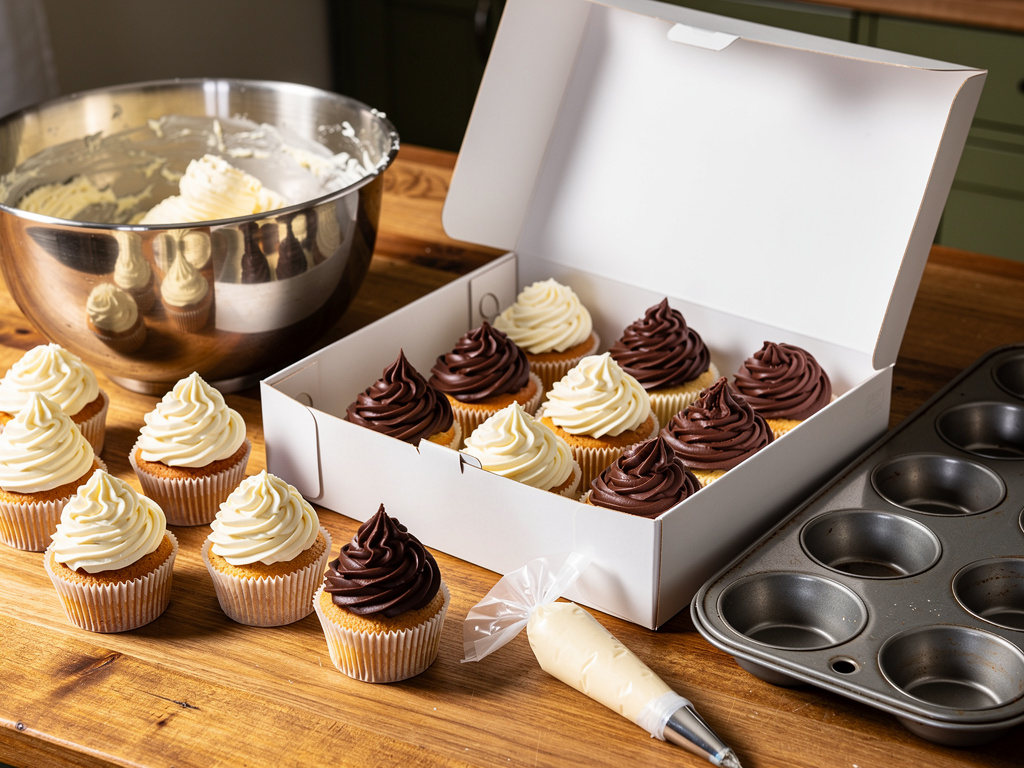


The short version: You can start a cupcake business from your home kitchen under your state's cottage food law, and California, Michigan and Texas all allow cupcakes. Check your state's frosting list first: cream cheese frosting is not allowed in Michigan, is left off California's approved list and needs a state registration in Texas, Michigan buttercream must follow one of the two lab-tested recipes the Michigan Department of Agriculture and Rural Development (MDARD) names, made exactly, California leaves out frostings made with cream unless your local environmental health office confirms yours, and Colorado's health department (CDPHE) bars buttercream made with butter until its new cottage food law takes effect January 1, 2027. A starter supply order of two cupcake pans, 1,000 liners, 10 boxes, piping bags, a scoop and a case of powdered sugar came to $88.43 before shipping, and one boxed dozen costs about $6.30 to make at August 2026 grocery prices. Cupcake vendors on Homegrown charge $20 to $42 a dozen, with a median of $31.50 across 16 listings, so a $30 dozen leaves you about $22.53 after ingredients, the box and card processing. Four dozen at that price pays back the starter order, before your time, shipping and any permit fee.
Checked on September 28, 2026: supply prices on WebstaurantStore's product pages, ingredient prices from the Bureau of Labor Statistics August 2026 average retail prices, frosting rules on the pages of the California Department of Public Health (CDPH), Colorado CDPHE, Michigan MDARD and the Texas Department of State Health Services (DSHS), frosting safety and the cost recipes from K-State Research and Extension and King Arthur Baking, and platform fees on Homegrown's signup page and Hotplate's and Square's pricing pages. Homegrown customers create an account to place their first order, and Homegrown has no drops feature (a timed release with a countdown). Rules change, so verify your state's current rules before you sell.
Most guides to starting a cupcake business give you a checklist and a price range nobody can trace. This one gives you the numbers you need to decide. It covers what the kit costs, what one dozen costs you, what real home cupcake vendors charge, and how many cupcakes one oven turns out. It also covers which frosting keeps you on the right side of your state's rules.
Every price here was loaded on September 28, 2026, from a named page. The ingredient costs come from government average prices and two published recipes, so you can swap in your own receipts and redo the math in five minutes. It is written for someone baking part-time in a home kitchen, not someone signing a lease on a storefront bakery.
Starting a cupcake business from home takes five things: a state that allows it, a frosting your state allows at room temperature, about $90 of supplies beyond your own mixer and oven, a price that covers the $6.30 a boxed dozen costs you, and a way to take orders before you bake. None of them requires a commercial kitchen or a loan.
Here is the order to do them in:
This guide stays on the start-up decisions and the numbers. For finding customers, social posts and custom cake orders, the companion guide on selling cakes and cupcakes from home covers the selling side, from order forms to lead times.
Yes, cupcakes are allowed as a home-kitchen food in all three states whose full cottage food rules this guide read on September 28, 2026 (California, Michigan and Texas; Colorado's page was checked only for its frosting rule), and our cake guide read nine state agency pages and found cakes allowed in all 8 of them that cover cottage food (the ninth is Illinois's bake sale guideline). What changes from state to state is the paperwork, the sales cap and which frostings count. Six more states, from New York's ban on homemade buttercream to North Carolina's rule against any pet in the house, are compared in the guide to whether you can sell homemade cupcakes.
Here is what the three agency pages say:
Texas lets a cottage food baker sell foods that need refrigeration, like cream cheese frosted cupcakes, only after registering on the DSHS Online Licensing Registry. Those cupcakes have to be kept at 41°F or below, carry the date they were made, and come with a safe handling statement in at least 12-point type (Texas DSHS cottage food page, checked September 28, 2026).
Other states set their own rules, caps and fees, and some add an inspection: Ohio inspects a home kitchen before it issues its $10-a-year Home Bakery license, the license Ohio uses for baked goods that need a refrigerator, as our guide to selling homemade cake covers. Look up yours in the cottage food laws by state guide, then confirm it on your state agency's own page before you take an order.
In California, Michigan and Texas, start with a tested butter-and-powdered-sugar buttercream, because it keeps at room temperature. Texas allows buttercream with no extra paperwork, Michigan accepts homemade buttercream only from two lab-tested recipes (K-State's Simple Buttercream is one), and California lists buttercream made with butter but leaves out frostings that contain cream (more on that below). Colorado is different: Colorado's health department (CDPHE) allows buttercream only when it is made with ghee or vegetable oil, and says buttercream made with butter is not allowed. That changes on January 1, 2027, when Colorado's Tamale Act takes effect: CDPHE's food list for the new law includes buttercream and cream cheese frosting. Cream cheese frosting is the one that trips new bakers up.
The reason is food science, not taste. Kansas State Research and Extension tested 49 frosting and filling recipes for acidity and water activity (how much free water bacteria can use). Its Simple Buttercream (2 cups unsalted butter, 8 cups powdered sugar, 1/2 teaspoon salt, 1/4 cup heavy cream, 2 teaspoons vanilla) tested at pH 4.6 and water activity 0.83, safe at room temperature. K-State's rule of thumb is a frosting with at least 65% sugar by weight. K-State rounds its Simple Buttercream (960 g of sugar in a 1,484 g batch, 64.7%) to 65% and confirmed it by lab test, so make it exactly as written. Its cream cheese frosting example came in at 54.8% sugar, which means it needs the refrigerator.
One California detail: the CDPH frosting category covers frostings that do not contain eggs, cream or cream cheese. K-State's recipe uses 1/4 cup of heavy cream, so a California baker should confirm it with the local environmental health office, or use a recipe without cream, before putting it on the menu.
Swipe the table to compare all three states.
| Frosting | California (CDPH list) | Michigan (MDARD) | Texas (DSHS) |
|---|---|---|---|
| Buttercream made with butter, no eggs | Allowed: "Buttercream made with butter" is on the approved list, but the frosting category leaves out frostings that contain cream, so ask your local environmental health office about a recipe with heavy cream | Only the two lab-tested recipes MDARD names (K-State's Simple Buttercream or Texas Come and Bake It's American Buttercream), made exactly | Allowed |
| Store-bought shelf-stable frosting | Allowed if it has no eggs, cream or cream cheese | Allowed | Allowed |
| Cream cheese frosting | Not on the approved list | Not allowed: "No cream cheese frostings or icings" | Allowed after you register, kept at 41°F or below |
| Whipped cream or raw egg frosting | Left out: the category excludes frostings with eggs or cream (meringue powder, powdered eggs or pasteurized eggs are allowed) | Not allowed if it needs refrigeration | Allowed after you register, kept cold |
Built from the CDPH Approved Cottage Foods list, MDARD's "What Can I Make?" page and the Texas DSHS cottage food page, all read September 28, 2026. The full nine-state picture is in our guide to whether you can sell homemade cake.
A recipe change can move a frosting from safe to unsafe. K-State notes that swapping or adding ingredients changes the numbers, and Michigan accepts its two buttercream recipes only with no changes beyond food coloring or flavoring extracts. Pick one tested recipe, write it down and make it the same way every week.
You need about $90 of supplies on top of the oven, mixer, bowls and measuring cups you already own. The core is two 12-cup pans so a full batch bakes at once, standard liners, boxes with a 12-slot insert so cupcakes do not slide, disposable piping bags and a scoop for even sizes.
Swipe sideways for the price and the reason for each supply.
| Supply | Product (WebstaurantStore) | Price | Why this one |
|---|---|---|---|
| 2 cupcake pans | Choice 12 Cup 3.5 oz. Non-Stick Carbon Steel Muffin / Cupcake Pan | $19.98 ($9.99 each) | 24 wells, so the recipe below bakes in one oven load |
| Liners | Baker's Lane 2" x 1 1/4" White Fluted Baking Cup, 1,000/Pack | $8.99 | Standard size, under a penny each |
| Boxes | Baker's Lane 14" x 10" x 4" White Cupcake / Muffin Box with 12 Slot Reversible Insert, 10/Pack | $11.49 ($1.15 a box) | Holds 12 standard cupcakes, 4 inches tall for a piped swirl |
| Piping bags | Ateco 18" High-Grip Clear Disposable Pastry Bags, 100/Roll | $10.99 | One bag frosts a batch, no washing |
| Scoop | Choice #16 Thumb Press Disher, 2 oz. (about 1/4 cup) | $6.99 | Same size every cupcake, so they bake evenly; it matches the heaping 1/4 cup King Arthur scoops per cupcake |
| Powdered sugar | 10X Confectioners Sugar Bag 2 lb., 12/Case | $29.99 ($1.25 a pound) | 24 lb, about 11 batches of buttercream |
| Total | $88.43 | Before shipping and sales tax |
Prices from each WebstaurantStore product page on September 28, 2026. Some prices drop when you buy more: two or more packs of boxes cost $10.27 each, and two or more rolls of piping bags $9.49.
What you probably already own and do not need to buy yet:
The 24 pounds of powdered sugar works out to about 11 batches because each K-State batch uses 960 grams, a little over 2 pounds.
One boxed dozen of vanilla cupcakes with buttercream costs about $6.30 to make: $5.04 of ingredients, 11 cents of liners and a $1.15 box. That figure uses the King Arthur Baking Golden Vanilla Cake recipe (24 cupcakes a batch), K-State's Simple Buttercream, and August 2026 national average prices.
The ingredient prices come from the Bureau of Labor Statistics average retail price series for August 2026: butter $4.02 a pound, eggs $2.27 a dozen, flour 55 cents a pound, sugar $1.02 a pound and whole milk $4.23 a gallon. Powdered sugar, vanilla and baking powder are priced from WebstaurantStore, and heavy cream from a $2.96 pint of Great Value cream listed on Instacart.
Swipe to see the price behind each ingredient.
| Ingredient | Amount | Price used | Cost |
|---|---|---|---|
| Cake: flour | 390 g | $0.548 a pound (BLS) | $0.47 |
| Cake: sugar | 397 g | $1.024 a pound (BLS) | $0.90 |
| Cake: butter | 170 g | $4.021 a pound (BLS) | $1.51 |
| Cake: whole milk | 1 1/2 cups | $4.229 a gallon (BLS) | $0.40 |
| Cake: eggs | 4 large | $2.272 a dozen (BLS) | $0.76 |
| Cake: baking powder and vanilla | 1 tbsp each | WebstaurantStore | $0.96 |
| Cake batch, 24 cupcakes | $4.99 (about $0.21 each) | ||
| Frosting: butter | 454 g | $4.021 a pound (BLS) | $4.02 |
| Frosting: powdered sugar | 960 g | $1.25 a pound | $2.64 |
| Frosting: heavy cream and vanilla | 1/4 cup and 2 tsp | Instacart, WebstaurantStore | $0.97 |
| Frosting batch, about 36 cupcakes | $7.64 (about $0.21 each) | ||
| One dozen, boxed | 12 cupcakes, 12 liners, 1 box | $6.30 |
Prices checked September 28, 2026. Salt is not priced. The BLS butter price is for stick butter and does not say salted or unsalted; unsalted often costs a little more. Totals are figured before rounding each line, so a column you re-add by hand can differ by a cent. The frosting batch weighs 1,484 grams, so about 40 grams a cupcake frosts roughly 36. Weigh your own swirl, because a taller one uses more.
Three things move this number more than anything else:
Redo the table with your own receipts once a month. Grocery prices move, and a price set on last spring's butter can quietly shrink your margin.
Charge at least $30 for a standard dozen, because 14 of the 16 dozen-priced cupcake products on Homegrown cost $30 or more, and it leaves about $22.53 after the $6.30 dozen and $1.17 of card processing. The cheapest dozen we found was $20 and the most expensive was $42.
In a pull of the Homegrown catalog on September 28, 2026 (2,778 products from 312 vendors), 27 products from 10 vendors were cupcakes. We counted a product when cupcakes are what the customer buys, by the product name or a cupcake option, after reading every product from each vendor that mentioned cupcakes. Of those, 16 standard-size products from 7 vendors are priced by the dozen, from $20 to $42, with a median of $31.50. Single standard-size cupcakes ran $2.50 to $5.00.
How many cupcake products sell a dozen at each price
Source: Homegrown catalog pull, September 28, 2026, 16 standard-size cupcake products priced by the dozen, from 7 vendors.
Here is what each price leaves you on one dozen:
Swipe to see what each dozen price leaves you.
| Price for a dozen | Cost to make, boxed | Card processing (2.9% + $0.30) | Left for your time |
|---|---|---|---|
| $25 | $6.30 | $1.03 | $17.67 |
| $30 | $6.30 | $1.17 | $22.53 |
| $35 | $6.30 | $1.32 | $27.38 |
Costs from the table above, checked September 28, 2026. Processing is Homegrown's rate; the platform plan is left out here and shown in the ordering section below.
If a dozen takes you an hour and a half of hands-on time, from shopping to handing over the box, $22.53 works out to about $15 an hour. Time yourself on your first three orders and set the price from that. Flavors with fillings, like lemon curd or caramel, earn more: Root to Rise on Homegrown charges $30 for its lemon dozen and $35 with lemon curd filling. Check your state before you copy the curd, because it is an egg-thickened filling: California's approved list covers baked goods without custard fillings, K-State keeps lemon curd out of Kansas fairs, and Texas allows a filling that needs a refrigerator only once you register, kept at 41°F or below. The guide to pricing baked goods walks through the full cost-plus method if you sell more than cupcakes.
One home oven with two 12-cup pans bakes 24 cupcakes every 23 to 25 minutes, the bake time King Arthur gives for its Golden Vanilla recipe. Four oven loads is 96 cupcakes, or 8 dozen, which is a full and realistic bake day for one person.
The oven is rarely the limit. These are:
A good first target is 4 dozen on one bake day. That is two oven loads, one batch of batter made twice and two batches of frosting. Once 4 dozen feels calm, move to 6.
Put a ceiling on online order size before a big order surprises you. Bake Pure Co on Homegrown sells its strawberry almond cupcakes in counts from 3 to 50 and asks anyone who needs more than 50 to reach out first. A limit like that keeps a single party order from taking over your whole bake day.
Start with three or four flavors that share one cake batter and one buttercream, sold by the dozen and the half dozen. A short menu means one shopping list, one recipe to master and less waste.
Cupcake shops on Homegrown mostly stick to the classics. The flavors in the September 28, 2026 catalog pull included:
Two practical patterns from those listings are worth copying. Seriously Sourdough sells one "Cupcakes (doz)" product at $30 with six flavor choices under it, so a customer picks a flavor inside one product. Simple Cakes sells the same two flavors three ways: $3.50 each, four for $14 and a dozen for $42.
Keep cream cheese frosting, fresh fruit and cream, custard or curd fillings off your first menu unless your state allows them and you have the refrigerator space. Red velvet is traditionally paired with cream cheese frosting, so decide early whether you will sell it with buttercream instead.
Cupcake orders should land in one place that collects payment before your bake day, because a dozen you bake without a paid order is $6.30 you may not get back. Texting, DMs and a payment app work for your first five customers. After that, orders get lost across conversations, and you end up baking from memory.
Homegrown is built for this weekly rhythm. It costs $10 a month billed annually ($12.50 month to month) with no commission and no fee added to your customer's total, plus standard card processing of 2.9% + $0.30 per order that you pay. What matters for a cupcake business:
Here is how the choices compare on a $30 dozen:
Scroll sideways to see every column.
| Platform | Monthly plan | Trial | Service or platform fee | Card processing | Customer pays on a $30 dozen | You pay on a $30 dozen | You pay in a month of 20 dozen |
|---|---|---|---|---|---|---|---|
| Homegrown | $10 billed annually ($12.50 monthly) | 7 days, no charge until day 8 | None, 0% commission | 2.9% + $0.30, paid by you | $30.00 | $1.17 plus the plan | $33.40 ($35.90 on monthly billing) |
| Hotplate, customer pays the fee | $0, no plan | No plan to try | 5% + $0.55, paid by the customer | 2.9% + $0.30, paid by you | $32.05 | $1.17 | $23.40 (your customers pay $41.00 in fees) |
| Hotplate, you cover the fee | $0, no plan | No plan to try | 5% + $0.55, paid by you | 2.9% + $0.30, paid by you | $30.00 | $3.22 | $64.40 |
| Square Online, Free plan | $0 | No plan to try (paid plans from $49 a month have 30 days) | None | 3.3% + 30¢ online | $30.00 | $1.29 | $25.80 |
We checked these fees on Homegrown's signup page, Hotplate's pricing page and Square's online store plans page on September 28, 2026. Hotplate's page says you can pay its fee yourself or pass it on to customers, "your choice", and its own example shows $2.05 on a $30 subtotal. That same example shows the chef paying $1.27 in processing, on an order that also carries a $3 tip and $2.55 of sales tax. In the table above, we figure every platform's processing on the $30 price alone, before tips and sales tax, so the rows compare evenly. Hotplate's own example figures its processing on a larger amount than the $30.
At 20 dozen a month, Hotplate with the fee passed to customers and Square's Free plan cost you less than Homegrown's plan, so the choice is about what your customer sees and what you need. When customers pay Hotplate's fee, every $30 dozen reads as $32.05 at checkout, and you still pay 2.9% + $0.30 processing on top. Hotplate is also built around drops, timed releases with a countdown, which Homegrown does not have. Square Online's Free plan gives you a full website builder, which is more to set up than a cupcake menu needs. Instagram DMs with a payment app cost little or nothing, depending on the app's fee for business payments, but leave you with no order list at all.
What Homegrown does not do: it has no drops or countdown feature, your customers create a Homegrown account to place their first order, and you pay the card processing with no option to add it to the customer's total. Your storefront appears on the marketplace, but plan on most orders coming from people you send to your own link. It does not bake, frost or drive the cupcakes for you.
If a weekly cupcake menu with a hard order cutoff is how you want to run this, set up a Homegrown storefront and list your first dozen before your first bake day, so every order you bake for is already paid.
Ask for standard cupcake orders at least 2 to 3 days ahead, and close each week's orders before you shop. That gap lets you buy exactly the butter and sugar you need and bake only what is paid for.
A simple weekly cycle for a Saturday pickup looks like this:
Custom designs and large party orders need more time than a standard dozen, often a week or more. A big order is also the time to bake ahead: unfrosted cupcakes keep 6 months in the freezer by Kansas State's storage table, and how long homemade cupcakes last walks through a bake, freeze and frost-the-day-before schedule for a Saturday pickup. The guide to taking pre-orders for a home bakery covers cutoffs and deposits in more depth.
Every box needs a label, and in Texas that label has 5 required parts, plus 2 more for cupcakes that need refrigeration. The details depend on your state, but the Texas DSHS list is a good model:
Cream cheese frosted cupcakes sold under a Texas registration also need the date they were made on the label, and the safe handling statement in at least 12-point type on the label or on a receipt that goes with the box. Texas also lets you sell online when you post the label information on your ordering page before you take payment and you, an employee or someone in your household personally delivers the order.
Your state may require a different statement, a net count or an ingredient list in order of weight. The cottage food labeling requirements guide lists them by state. Print labels on sheet stock at home to start; one label goes on the box, not on each cupcake.
You do not need an LLC to start selling cupcakes, but you do need to know your state's sales tax rules, and product liability insurance is worth pricing before your first large order. A sole proprietorship is the default the day you sell your first dozen, with no filing needed to become one, though most states, and some counties and cities, ask you to register a business name if you use one (SBA's launch your business guide).
The 5 things to sort out in your first month:
Before your first sale, finish your state's cottage food steps, any required training, your label and a sales tax registration if your state requires one. An LLC and insurance can wait until you know the business will last.
Your first month should take you from a test batch to about 11 paid dozen, one bake day a week. The goal is to learn your real costs and time, not to sell as much as possible.
By the end of the month you know your true cost per dozen, your hands-on time per dozen and which two flavors sell. That is enough to decide whether to grow to 8 or 10 dozen a week.
Experienced cupcake bakers sell a short menu, take payment before they bake and treat frosting as a recipe to follow exactly, not a mood. Most of what separates a busy home cupcake business from a stressful one is routine, not skill.
The habits worth copying from day one:
Sell a smaller size to people who are not ready for a dozen. Simple Cakes on Homegrown sells its cupcakes one at a time for $3.50, four for $14 and a dozen for $42, and a dozen minis for $24. A four-pack is an easy first order for a customer who has never tried you.
A home cupcake business selling 10 dozen a week at $30 brings in $15,000 over 50 weeks and keeps about $11,265 of it after ingredients, boxes and card processing, before your time and the $120 a year Homegrown plan. That is part-time money, and it stays well under the California and Texas sales caps below.
The math, using the numbers from this guide:
Those sales sit far below the caps checked on September 28, 2026: California's 2026 Class A limit of $88,878 and Texas's $150,000 threshold. At 10 dozen a week you are baking on two days, since one oven day tops out around 8 dozen, and growing past about 16 dozen means a third bake day or a second oven, not a bigger kitchen.
The fastest way to raise the yearly number is price, not volume. Moving from $30 to $35 a dozen at the same 10 dozen a week adds about $2,425 a year, with no extra baking. When your weekly menu is set, open your Homegrown storefront so customers can pick their flavors and pay for the week's cupcakes before you buy a single stick of butter.
A home cupcake business can start for under $100 in supplies if you already own an oven and mixer. On September 28, 2026, two 12-cup pans, 1,000 liners, 10 boxes with inserts, piping bags, a scoop and 24 pounds of powdered sugar cost $88.43 at WebstaurantStore before shipping. Add your state's registration or permit fee, if it has one, and your first week of butter, eggs and flour.
A $30 dozen of vanilla buttercream cupcakes leaves about $22.53 after the $6.30 it costs to make and box and $1.17 of card processing. That is before your time. At a lower $25 price, the same dozen leaves $17.67, which is why checking your own costs before you set a price matters for a cupcake business.
It depends on your state. Michigan's cottage food page says "No cream cheese frostings or icings," California's approved frosting category leaves out frostings with cream cheese, and Texas allows it only after you register with DSHS and keep the cupcakes at 41°F or below. K-State's worked example of a cream cheese frosting comes to 54.8% sugar, below the 65% level that keeps a frosting safe at room temperature.
Not a full food license in California, Michigan or Texas. California requires registration or a permit through your local environmental health department, Michigan requires no license for cottage food that follows its rules, and Texas requires food handler training plus registration if you sell refrigerated cupcakes. Verify your state's current rules on its agency page.
Bake only what customers have ordered and paid for, plus two or three spares for photos and tasting. A first week of 2 to 4 dozen is plenty for learning your timing. With two 12-cup pans, each oven load is 24 cupcakes, so 4 dozen is two bakes of about 25 minutes each.
Use one order page that collects payment before your bake day and closes at a set cutoff. On Homegrown, you list flavors and sizes as options under one product and set an order prep time before each pickup date, for $10 a month billed annually plus 2.9% + $0.30 card processing per order. Each customer makes a Homegrown account before a first order.
Start with one tested buttercream, three flavors and the $88.43 kit, and sell your first dozens to people who already know you. Keep the menu short, time your first three orders and set your price from what a dozen really costs you. Check your state's frosting rules before you add a new flavor, and redo your cost table whenever butter moves. A cupcake business that knows its $6.30 and its $22.53 can grow one dozen at a time without guessing.
Once orders come in every week, put them in one place with a cutoff. Set up your Homegrown storefront, list a dozen and a half dozen in your best flavors, and close orders the night before you shop so every cupcake you bake is already sold.



