

The short version: A homemade cupcake with no frosting or a plain American buttercream keeps about 2 days in a closed container at room temperature, about a week in the fridge, and 1 month in the freezer once it is frosted. A cupcake with cream cheese frosting, whipped cream, custard or curd belongs in the fridge, eaten within 3 to 4 days for cream cheese and 3 to 5 for whipped cream, custard or curd, and should not be out of the fridge more than 2 hours, or 1 hour above 90 °F, the limits USDA's Food Safety and Inspection Service sets for perishable food. Cupcakes dry out faster than a whole cake because most have a bare edge and every one has a thin liner, so the box you hand over matters as much as the recipe. None of the 30 cupcake listings on Homegrown tell shoppers how long they keep, so one storage line on your box puts you ahead.
Checked October 12, 2026: Kansas State University's frosting study (December 2020), freezer table and cupboard guide (both revised June 2026), University of Illinois Extension's freezer chart, USDA FSIS's Danger Zone page, Michigan's cottage food pages, Texas's cottage food page, the Hotplate, Etsy and Homegrown pricing pages, and a pull of 2,851 Homegrown listings. Counter and fridge times come from King Arthur Baking's storage guide. Each state writes its own cottage food rules, so verify your state's current rules before you sell a single dozen. On Homegrown, customers create an account before their first order, and there is no drops feature (a drop is a preorder window with a set start and end time).
A customer picks up three dozen cupcakes on Saturday morning for a party on Sunday afternoon. If you baked and frosted them on Friday with a buttercream that holds at room temperature, they will still be good on Sunday, right at the end of their 2 days, as long as the box stays closed. If half of them are red velvet with cream cheese frosting, those need to go in her fridge the minute she gets home, and you need to tell her that before she walks away.
This guide is for home bakers who sell cupcakes, not just bake them for the family. It takes what Kansas State University, the University of Illinois and USDA say about storage, lines it up with what King Arthur Baking says about taste, and turns it into a bake schedule, a market plan, a box and a storage card. If you are still checking whether your state lets you sell cupcakes at all, read can you sell homemade cupcakes first, because the frosting that keeps longest is often the only one your state allows.
A homemade cupcake lasts about 2 days at room temperature, up to a week in the fridge, and 1 to 6 months in the freezer, depending on what is on top and inside. The frosting and the filling set the clock, not the cake. King Arthur Baking's rule is to store a cake by its most delicate part, and a cupcake is a small cake, so a vanilla cupcake with buttercream on top and lemon curd in the middle is a curd cupcake. It goes in the fridge.
The counter and fridge times below come from King Arthur Baking's storage guide (August 19, 2024), which covers cake by frosting type. They assume a closed container in a normal room. Keep your fridge at 40 °F or below, the cold-food line USDA FSIS sets. Freezer times come from Kansas State University's storage table and the University of Illinois Extension's freezer chart. Count every day from when you baked, not from when the customer picks up. The counter and fridge times are about how long the cupcakes taste good. The safety limit is separate and only applies to perishable toppings and fillings: 2 hours out of the fridge, per USDA FSIS.
On a phone, swipe left for the freezer and market table columns.
| What is on the cupcake | Counter, in a closed container | Fridge | Freezer | OK on a market table all morning? |
|---|---|---|---|---|
| No frosting | 2 to 3 days | Up to 1 week | 6 months (K-State) or 2 to 4 months (Illinois) | Yes |
| American buttercream (butter and powdered sugar) | Up to 2 days | Up to 1 week | 1 month (both) | Yes, if it passes the 65% sugar test and your state allows it |
| Swiss or Italian meringue buttercream | Up to 2 days | Up to 1 week | 1 month as a frosted cake (both) | No, unless yours weighs in at 65% sugar or more and your state allows it; King Arthur's Swiss meringue recipe is about 31%, and Michigan allows buttercream only from two tested recipes or a commercially made, shelf-stable frosting |
| Cream cheese or mascarpone frosting | Do not store (King Arthur); 2 hours at most (USDA FSIS) | 3 to 4 days | 1 month as a frosted cake (K-State and Illinois give it for frosted cake and name no frosting type) | No |
| Whipped cream topping, custard or curd filling | Do not store (King Arthur); 2 hours at most (USDA FSIS) | 3 to 5 days | Not listed by either; K-State says not to freeze custard and chiffon pies | No |
| Jam filling or a cooked fruit topping | 1 to 2 days | 3 to 5 days, King Arthur's recommended spot | Not listed by either; their 1 month for frosted cake names no fruit topping | Check your state |
| Fresh cut fruit on top | Fridge: the FDA says to keep perishable fresh fruit like strawberries in the fridge at 40 °F or below (see its produce safety page). King Arthur's 1 to 2 days is for fresh fruit or jam on a cake eaten at home, and K-State does not allow fresh cut fruit garnishes at Kansas fairs | 3 to 5 days | Not listed by either; their 1 month for frosted cake names no fruit topping | No |
We checked King Arthur Baking's cake storage table, K-State's MF3130 freezer table (revised June 2026) and the Illinois Extension freezer chart on October 12, 2026. None of the three has a separate cupcake row, so the cake rows are used for cupcakes of the same frosting. Freezer times are for quality; food held at 0 °F stays safe.
A cupcake bakery gives the same number: The Hummingbird Bakery says buttercream cupcakes stay good for up to two days and are fine left out of the fridge. For a cupcake you plan to sell, use 2 days at room temperature as your working number, and hand the customer a box with most of those 2 days still ahead. Kansas State's cupboard guide gives a purchased cake 1 to 2 days on the shelf and a cake made from a boxed mix 3 to 7, and says to refrigerate a purchased cake with whipped cream or custard filling. When sources disagree like this, go with the shorter range: K-State's 1 to 2 days for a purchased cake tops out at King Arthur's 2, so 2 days on the counter is still the number to promise for a buttercream cupcake.
Cupcakes dry out faster than a whole cake because each one has far more exposed surface for its size, so an uncovered cupcake can taste stale well before its 2 days are up. A layer cake hides its crumb under frosting on every side. A cupcake has frosting on top, a paper liner on the sides, and often a ring of bare cake between the two.
The moisture escapes in five places:
The fix for all five is the same: frost to the edge, keep cupcakes in a closed container, and keep the container out of the sun. A cupcake that tastes dry on day 2 was usually left open on day 1.
A cupcake can sit out overnight if its frosting has enough sugar to stay stable at room temperature, and Kansas State's line for that is at least 65% sugar by weight. Bacteria need free water to grow. Sugar ties up water, so a frosting heavy on powdered sugar is safer on the counter than one heavy on cream cheese or cream.
Kansas State University tested home frosting and filling recipes and published the results as Food Safety of Frostings and Fillings (MF3544). Its kitchen test works like this:
K-State's own Simple Buttercream Frosting is 960 grams of powdered sugar in a 1,484-gram batch, which comes to 64.7%, a figure K-State rounds to 65% and treats as stable at room temperature. Its cream cheese frosting is 420 grams of sugar in 766 grams, or 54.8%, and fails. Its fudge frosting, made with milk, lands at 63.2% and fails too, which shows how close a normal recipe can sit to the line.
Which common cupcake frostings tend to pass, and which need the fridge:
The 65% line is K-State's guidance for Kansas fairs and exhibitions, not a state law. Your state may use a fixed list of approved recipes instead (Michigan does), or a different test. If you change a tested recipe by adding cream cheese, cream or fresh fruit puree, it is a new recipe and the old number no longer applies.
A filled cupcake keeps only as long as its filling, so a curd or custard center turns a 2-day counter cupcake into a fridge cupcake with 3 to 5 days. King Arthur Baking puts whipped cream, custard and curd in the "do not store at room temperature" group, and K-State does not allow lemon curd at Kansas fairs.
Fillings are easy to forget because nobody sees them. A customer looks at a buttercream swirl and assumes the whole cupcake is fine on the counter. Here is how the common fillings sort out:
Swipe the table to see each source.
| Filling | Where to store the cupcake | How long | Source |
|---|---|---|---|
| Lemon curd or other curd | Fridge | 3 to 5 days | King Arthur Baking; K-State does not allow lemon curd at Kansas fairs |
| Pastry cream or custard | Fridge | 3 to 5 days | King Arthur Baking; K-State's cupboard guide says to refrigerate cakes with custard filling |
| Whipped cream or mousse | Fridge | 3 to 5 days | King Arthur Baking |
| Cream cheese filling | Fridge | 3 to 4 days | King Arthur Baking; K-State's lemon cheese filling tests at 15% sugar |
| Jam or cooked fruit | Fridge recommended | 1 to 2 days on the counter, 3 to 5 in the fridge | King Arthur Baking |
| Same buttercream as the top | Counter | Up to 2 days | King Arthur Baking |
From King Arthur Baking's cake storage guide (August 19, 2024), K-State MF3544 (December 2020) and K-State MF3131 (revised June 2026), all loaded October 12, 2026. Caramel fillings vary too much by recipe for any of these sources to give a time; treat a homemade caramel made with cream as a fridge filling unless you have tested it.
If you offer a filling as an add-on, say on the listing which option needs the fridge. One Homegrown listing we found sells a dozen lemon cupcakes for $30 and adds lemon curd filling for $5 more, which is exactly the kind of order where a "keep refrigerated" sticker on the box saves a phone call.
Whether you can sell cream cheese frosted cupcakes from home depends on your state: Michigan does not allow them, while Texas does if you register with the state, keep them at 41 °F or below, put the date made on the label, and give the customer a printed safe handling statement. A cottage food law is the set of state rules that lets you sell certain foods made at home directly to customers without a commercial kitchen. Many of these laws were written for foods that stay safe without refrigeration, so a frosting that needs the fridge is where states split.
Michigan's agriculture department lists cakes, "including celebration cakes (birthday, anniversary, wedding, cupcakes)," as allowed cottage foods. It does not allow "cakes with glaze or frosting that requires refrigeration (e.g., no cream cheese frosting)," and it allows buttercream only from two lab-tested recipes followed exactly (food coloring and flavoring extracts are the only additions allowed): Kansas State's Simple Buttercream Frosting and Texas Come and Bake It's American Buttercream Frosting. Icings and frostings made only from shelf-stable ingredients, and commercially made shelf-stable frostings, are also allowed. We loaded Michigan's list on October 12, 2026.
You can read the whole list, including the icing rules, on Michigan's cottage food "What Can I Make?" page. That matters for the shelf life question, because the cupcakes a law like Michigan's allows are the same ones that keep 2 days on the counter. The rule and the storage advice point the same way.
Texas draws the line differently. Its health department lets a cottage food operation sell foods that need refrigeration for safety (Texas calls them TCS foods), which covers a cream cheese frosted cupcake that has to stay cold, as long as the baker registers on the state's online registry, stores and delivers them cold enough to stay at 41 °F or below, puts the date the food was made on the label, and adds a printed safe handling statement telling the customer to keep it refrigerated or frozen. Texas also requires every cottage food operator to complete an accredited food handler course. We read the Texas cottage food page on October 12, 2026. Before you add red velvet with cream cheese frosting to your menu, check your state in our cottage food laws by state guide, and read the state-by-state frosting rules in the cupcake permission guide linked above.
Frosting rules change by state and get updated. A cupcake that is legal for a home baker in one state can be off-limits one state over. Verify your state's current rules with your state agency before you sell any cupcake that needs the fridge.
Bake and frost cupcakes no more than 1 day before pickup, or bake them up to a month ahead, freeze them unfrosted, and frost the day before. Either way the customer gets at least half of the 2 days of counter life, counted from the bake or, for frozen cupcakes, from the thaw. A dozen thawed Friday morning, frosted that afternoon and picked up Saturday at 10 a.m. is about a day into its 2, so it tastes fresh at a Saturday party and is right at the edge by a Sunday afternoon party.
A schedule for three dozen cupcakes due Saturday at 10 a.m. looks like this:
If you bake fresh instead of from the freezer, move the baking to Friday morning and frost Friday afternoon once they are fully cool. The clock then starts Friday morning too, so a Sunday afternoon party is about day 2. The Hummingbird Bakery, a cupcake bakery in the UK, recommends eating them on the day of baking or within 24 hours for the best flavor, so the closer to pickup you bake, the better the first bite.
A firm cut-off is the easiest step to skip. If orders arrive by text until Friday night, you end up baking extra "just in case," and the extras are what go stale. If you want a cleaner way to collect cupcake orders by a set day, our guide to taking pre-orders for a home bakery walks through it, and Homegrown lets you set a lead time and pickup windows so pickup orders for your cupcakes are in and paid for before you thaw a single one.
You can freeze cupcakes before you sell them, and freezing them unfrosted is the best way to bake ahead. Freezer times are about quality, not safety: food kept at 0 °F stays safe, but the crumb slowly dries and can pick up freezer smells. That is why the published times differ so much.
Swipe left to compare the three freezer sources.
| What you freeze | Kansas State (MF3130) | University of Illinois Extension | King Arthur Baking |
|---|---|---|---|
| Baked, unfrosted | 6 months | 2 to 4 months | Up to a year, best within 3 to 4 months |
| Baked and frosted | 1 month | 1 month | Up to 1 month |
| Unbaked batter | 1 month | 1 month | Not listed |
All three sources cover cake, not cupcakes by name, and were loaded October 12, 2026. The Illinois numbers come from its freezer storage chart. They agree on 1 month for anything frosted, which is the number to plan around. Illinois Extension adds that freezing does not refresh baked goods; it only keeps the quality they had when they went in.
How to freeze cupcakes so they still sell well:
Freeze on the day you bake, not the day after. Unfrosted muffins get a longer runway than a frosted cupcake's 1 month, since Kansas State and Illinois Extension both give homemade muffins 2 to 3 months in the freezer. A cupcake frozen on day 2 comes out tasting like day 2.
Cupcake liners peel away and tops turn sticky when warm cupcakes get sealed in before they finish cooling, which takes at least 1 hour on a wire rack, according to Joyfully Mad's cupcake storage guide. The steam has nowhere to go. It wets the top and the paper, and the paper lets go of the cake. The Hummingbird Bakery's storage guide says the same thing: sealing cupcakes before they cool "can cause the cupcake cases to peel away" and makes them soggy.
None of this makes a cupcake unsafe. It does make a dozen look tired by the time the customer opens the box, and that is the first thing she sees. What helps:
If your liners still pull away on a humid day, it is usually the weather, not the recipe. Bake those orders closer to pickup.
Buttercream cupcakes should stay out of the fridge overnight, in a closed container at room temperature, while cream cheese, whipped cream and custard cupcakes must go in. Cold air slows mold but speeds up staling. Kansas State says it plainly about bread without preservatives: refrigeration helps prevent mold, "but it will increase staling due to moisture reduction." Cake crumb behaves the same way, and butter in the frosting turns hard and waxy when it is cold.
So the rule for a selling vendor is short:
If you want the general methods for keeping baked goods fresh without preservatives, our guide to extending shelf life without preservatives covers wraps, sealing and storage for the rest of your menu.
Keep cupcakes fresh at a farmers market by bringing only shelf-stable frostings, keeping them in closed containers, and selling from a domed display that holds a few at a time. Anything that needs the fridge falls under USDA FSIS's rule: never more than 2 hours out of refrigeration, and no more than 1 hour if it is above 90 °F. A cream cheese cupcake on an August table has used its whole allowance before the morning rush ends.
What works at a market table:
Plan the market count from your last three markets, not your hopes. If you sold 30 cupcakes twice and 42 once, bring about 34, your average, and a sign that says "pre-order a dozen for pickup next week." Every cupcake left at 1 p.m. on a hot day is one you cannot sell as fresh tomorrow.
Summer markets bring their own problems with heat and shade, and our farmers market summer tips cover them. Ask your market manager before you bring anything cold, since a market can set its own rules for food that has to be kept cold.
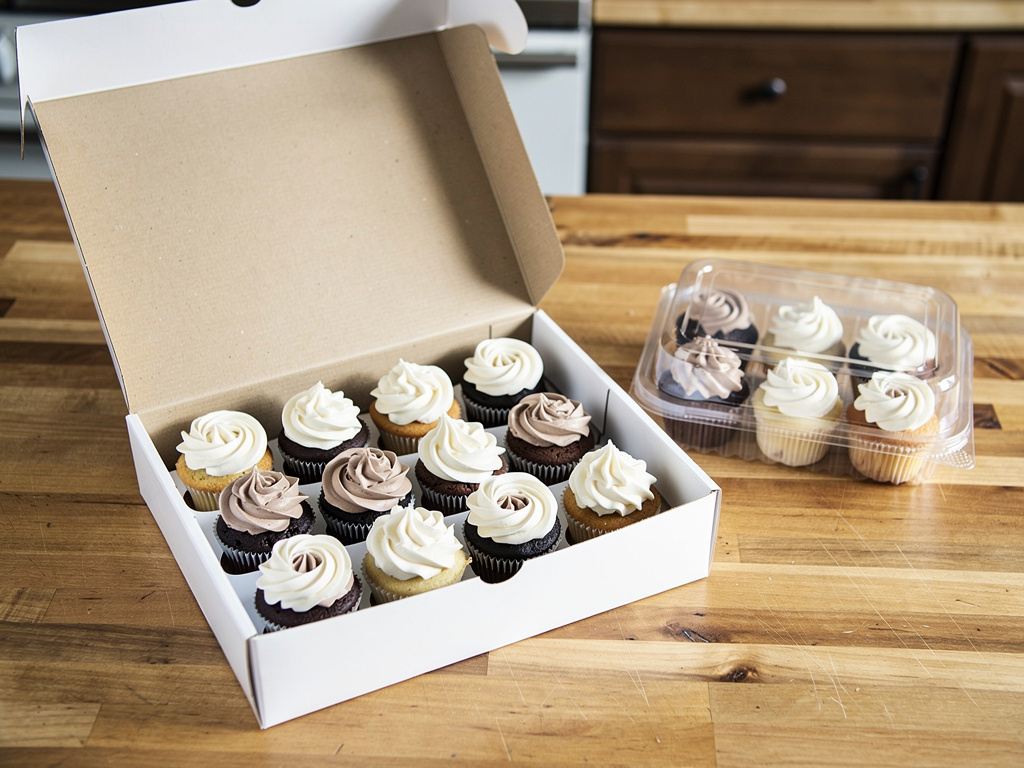
Box a dozen cupcakes in a closed box with a 12-slot insert that holds each one upright and a lid that clears the tallest swirl, so the dozen keeps the rest of its 2 days after pickup. The insert keeps them from sliding into each other on the drive home. The closed lid keeps air out, and air is what dries a cupcake.
What works for selling vendors:
A cardboard box is not airtight. It is fine for the trip home and the first day, but for anything that will sit longer, a sealed plastic clamshell or a container with a snap lid keeps more moisture in. Tell the customer to move leftovers into an airtight container on day 2. Our guide to food packaging for pickup and transport compares boxes, clamshells and carriers for baked goods.
The label should carry everything your state requires, and a separate line or card should say where to keep the cupcakes and how long they taste best. Whether a date is required depends on the state and the frosting. Texas requires the date the food was made on any cupcake that needs the fridge. Michigan's required cottage food label shows the other side: it asks for your name and address, the product name, the ingredients in order by weight, the net weight or volume, allergens, and the statement that the food was made in a home kitchen that the Michigan agriculture department has not inspected. There is no date on the list.
A storage line still answers the question every customer has. Short versions that fit next to the required information:
A storage card for the inside of the box, for a buttercream dozen frosted on a Friday:
States differ on what has to be on a cottage food label, and some add their own wording. Check yours in our cottage food labeling requirements guide before you print a roll of stickers.
The freshest cupcake is one you baked for an order you already had, and the easiest way to get there is to close orders before you bake. Cupcakes give you about 2 days on the counter. Every dozen you bake on a guess eats into those 2 days while it waits for a buyer.
Homegrown is $10 per month billed annually ($12.50 billed monthly) with no percentage fees beyond standard payment processing of 2.9% + $0.30, which you pay and which is not passed to your customer. A new storefront starts with a 7-day trial, and there is no charge until day 8. For a cupcake menu, the parts that matter are:
Here is how it compares with two places cupcake bakers often look at, on a $20 order, the price two Homegrown vendors list for a dozen vanilla cupcakes:
Scroll sideways to compare all four ways of taking a $20 order.
| Platform | Monthly plan | Trial | Platform fee | Card processing | Customer pays on a $20 order | Vendor pays on a $20 order | Vendor pays in a month of 50 orders at $20 |
|---|---|---|---|---|---|---|---|
| Homegrown | $10 billed annually ($12.50 billed monthly) | 7 days, no charge until day 8 | None, 0% commission | 2.9% + $0.30, paid by the vendor | $20.00 | $0.88 plus the plan | $54.00 ($56.50 on monthly billing) |
| Hotplate, default | $0 | No plan to trial | 5% + $0.55, paid by the customer | 2.9% + $0.30, paid by the vendor | $21.55 | $0.88 | $44.00 |
| Hotplate, vendor covers the fee | $0 | No plan to trial | 5% + $0.55, paid by the vendor | 2.9% + $0.30, also the vendor's | $20.00 | $2.43 | $121.50 |
| Etsy | $0 (a one-time set-up fee may apply) | No plan to trial | $0.20 listing fee plus 6.5% of price and shipping | 3% + $0.25, paid by the vendor | $20.00 plus shipping | $2.35 | $117.50, before fees on shipping |
We checked Hotplate's pricing page, Etsy's fees and payments pages, and Homegrown's signup page on October 12, 2026. By default Hotplate adds its fee to the customer's checkout: its post "What Hotplate does" (September 1, 2025) says "we charge a fee to your customer," while its pricing page calls who pays "your choice." We figured card processing on the $20 price, so a platform that charges it on the full total with fees and tax comes out a few cents higher.
Hotplate is a good fit if you sell cupcakes in drops, which Hotplate runs as a preorder window with a set start and end time, and you are happy with a fee on the customer's checkout. Homegrown has no drops feature. Etsy is built for shipped orders, and a buttercream swirl does not ship well, so it suits cupcakes in jars or cake mixes better than a box of a dozen. Taking orders in Instagram messages costs nothing, but nothing stops a request for "two dozen tomorrow morning" either.
Homegrown has honest limits too. A first-time customer has to create a Homegrown account before the order goes through. Your cupcakes also show up on the Homegrown marketplace, but plan on most orders coming from people you send to your own link. And Homegrown does not keep anything cold or check your state's frosting rules for you; the recipe, the box and the bake schedule are still yours.
In a pull of the Homegrown catalog on October 12, 2026, we found 30 cupcake listings from 14 vendors, out of 2,851 products from 313 vendors. We searched every listing's name, description and option names for "cupcake," then read each vendor's other listings. That added one shop's four cupcakes named only by flavor and a pineapple upside-down cake sold as a large cupcake, and left out a cookie baked in a mini cupcake pan, a dog treat called a cupcake, two mixed dessert flights that can include cupcakes, and a fall menu listing whose description mentions pumpkin cupcakes but has no cupcake option to order. We read all 30 descriptions for storage words. None of them tells the shopper how long the cupcakes keep or how to store them, and 13 have no description at all. Five mention cream cheese frosting, one offers a lemon curd filling, and dozen prices run from $20 to $38.
What the 30 Homegrown cupcake listings say is on top
Source: Homegrown catalog pull, October 12, 2026, 30 cupcake listings read by hand from name, description and options. "Buttercream" excludes the one cream cheese buttercream, which is counted under cream cheese. The pineapple upside-down cupcake names no frosting and is counted under not stated.
Put the same two lines from your storage card in the listing description. A shopper choosing between your dozen and a grocery store box wants to know they will still be good at Sunday's party, and right now not one cupcake listing we found tells her. If your listing says the frosting needs the fridge, she plans for it, and you skip the Sunday night text. You can set up a Homegrown storefront and write that line into every cupcake listing in one evening.
A cupcake has gone bad when it smells sour or off, feels sticky or slimy, shows fuzzy spots, or has a frosting or filling that has separated and turned watery. USDA FSIS lists the same signs for spoiled food in general: an unusual smell or color, a sticky or slimy surface, and visible mold.
What to look for, from the top down:
Looks can fool you here. A red velvet dozen with cream cheese frosting left on a sunny porch all afternoon can look and smell exactly like the dozen you boxed that morning. The clock decides whether it is safe to sell, not your nose: 2 hours out of the fridge, or 1 hour on a day above 90 °F.
Freeze unfrosted extras the day you bake them, when they keep 2 to 6 months (Illinois Extension gives 2 to 4, Kansas State 6), and never sell yesterday's frosted cupcakes as fresh. Leftovers are a planning problem more than a storage problem, and the bakers who have the fewest are the ones who bake to a count.
What to do with the cupcakes you have:
Leftover cupcakes are the most expensive thing on your menu, because you paid for the butter, the sugar and your evening and got nothing back. Our guide on how to start a cupcake business shows what a dozen costs to make, which is the number that makes a firm order cut-off feel worth it.
Homemade cupcakes with buttercream or no frosting last about 2 days at room temperature in a closed container, and unfrosted ones up to 3. King Arthur Baking gives those times for cake by frosting type, and a cupcake follows the same rows. Cupcakes with cream cheese frosting, whipped cream, custard or curd should not be stored at room temperature at all, and USDA FSIS says perishable food should not sit out more than 2 hours.
Cupcakes with a plain American buttercream that passes Kansas State's 65% sugar test do not need to be refrigerated, and they taste better on the counter in a closed container through day 2. A buttercream made with plenty of cream or cream cheese is different: weigh it, and if it is under 65% sugar by weight, Kansas State's line for a frosting that is stable at room temperature, keep it in the fridge. Cold buttercream turns firm, so take refrigerated cupcakes out about half an hour before serving.
You should not leave cream cheese frosted cupcakes out overnight. USDA FSIS says perishable food should not be out of the fridge more than 2 hours, or 1 hour above 90 °F, and King Arthur Baking says not to store cream cheese frosted cake at room temperature. In the fridge, in a closed container, they keep 3 to 4 days.
You can make cupcakes for an order the day before pickup and frost them that afternoon, or bake them up to a month ahead, freeze them unfrosted, and frost them the day before. Kansas State gives unfrosted cake 6 months in the freezer and Illinois Extension gives 2 to 4, so a month is well inside both. Both sources give frosted cake 1 month frozen.
Frosted homemade cupcakes keep 1 month frozen, and unfrosted ones keep 2 to 6 months, depending on whether you follow the University of Illinois Extension or Kansas State. Wrap each cupcake on its own and pack them where nothing can crush the tops. Freezing keeps the quality they had going in, so freeze them the day you bake.
Whether you can sell cupcakes that were baked, frozen and thawed is a state rule, so check your state's cottage food rules before you do. Freezing itself is safe: USDA FSIS says food kept at 0 °F stays safe. If your state allows it, freeze them unfrosted the day you bake, thaw them wrapped, and frost them the day before pickup so the customer gets a fresh-tasting cupcake. Never refreeze a frosted cupcake that came back unsold and sell it again.
These guides answer the questions that come right before and right after storage:
A cupcake only gets 2 days on the counter, so the best thing you can do for freshness is know exactly how many to bake before you turn on the oven. If you are ready to take cupcake orders by the dozen with a set pickup day, set up your Homegrown storefront and put your storage line in every listing.