
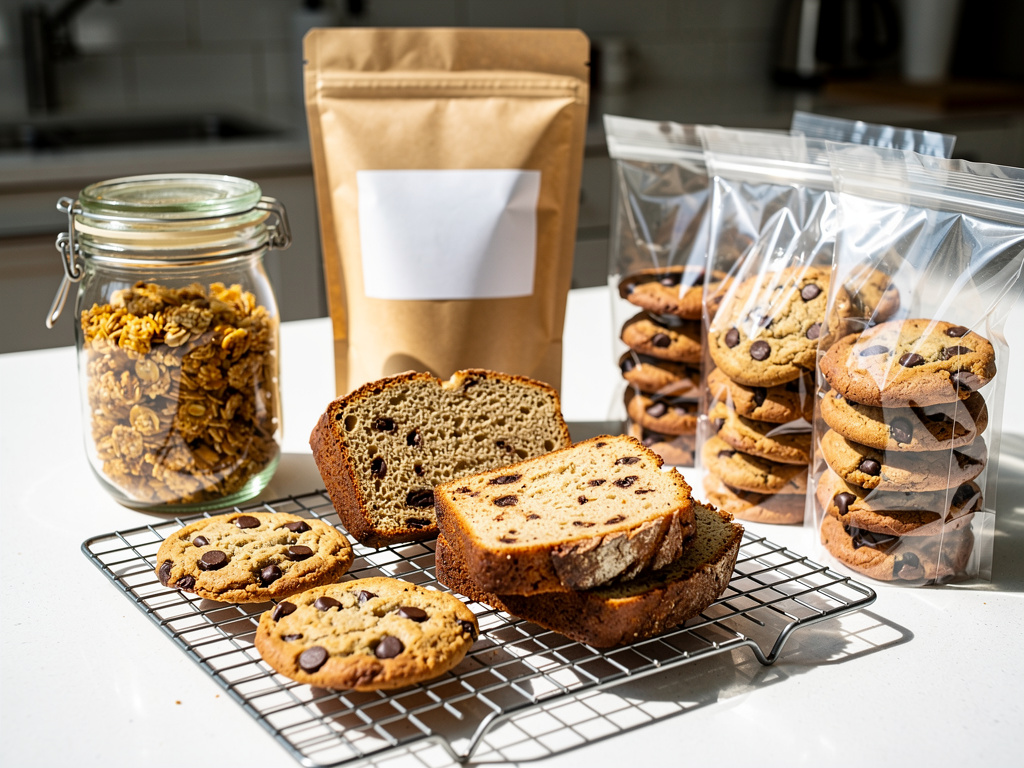


The short version: To extend shelf life without preservatives, cool every batch completely before you bag it, seal it airtight, keep it cool and dry, and freeze whatever you will not sell in the first half of its window. Sugar, acid and dryness do the real work in the recipe, and jam made from a tested recipe and processed in a canner keeps its best quality for about a year sealed, the NCHFP's window for home-canned food, while a homemade muffin keeps 3 to 7 days on the counter. The freezer is your biggest lever: that same muffin keeps 2 to 3 months frozen, and homemade cookies keep 8 to 12 months. Put a bake date and a one-line storage note on every package, because only 15 of 1,538 bakery listings on Homegrown tell shoppers how long the product keeps.
Checked October 14, 2026: USDA's FoodKeeper data (version 128) and USDA FSIS's cookie, bread and Danger Zone answers, the jam and drying pages of the National Center for Home Food Preservation (NCHFP), Kansas State University's cupboard and freezer guides (both revised June 2026), the University of Illinois Extension freezer chart, granola recipes from the University of Minnesota and West Virginia University extension services, the Homegrown, Hotplate and Etsy pricing pages, and a pull of 2,927 Homegrown listings. Storage times are quality guidelines for a typical kitchen, not lab tests of your recipe, and cottage food rules differ by state, so verify your state's current rules. Homegrown customers create an account to place their first order, and Homegrown has no drops or countdown-release feature.
If you would rather bake to order than bake ahead, you can set up a Homegrown storefront so customers order before you bake, and try it free for 7 days.
You spent three hours baking banana bread, packaged it up, listed it on your Homegrown storefront, and two days later a customer messages you that it tastes stale. That is wasted ingredients, wasted time, and a customer who probably will not order again.
Shelf life determines how much you can sell. If your cookies go soft in two days, you can only sell what moves within two days. If your granola keeps about 2 weeks in a sealed bag, you have about a week to sell it so your customer still gets the second week at home. Crunch is only half of it. Two university extension pecan granola recipes give only about 7 days, and how long homemade granola lasts plans every nut-heavy batch on that shorter window, walks through both windows and says when to freeze.
You do not need artificial preservatives to keep your products fresh longer. There are natural methods that extend shelf life a lot, and most cost nothing beyond a little attention to how you cool, package, and store your products.
Shelf life directly controls how much product you can sell before it goes bad. A cottage food vendor whose muffins keep 3 to 7 days has to sell the whole batch inside that week or throw it out. Brownies show how much one habit changes the window: a plain pan kept whole in an airtight container stays fresh about 5 days, but cut squares last only 2 to 3, according to Bob's Red Mill's brownie storage guide. Cutting the morning you sell nearly doubles your selling time, and how long homemade brownies last shows how to freeze the rest on day 1 so nothing is wasted.
Here is why this matters more for small vendors than it does for a grocery store bakery:
USDA's FoodKeeper data gives a homemade muffin 3 to 7 days on the counter and 2 to 3 months in the freezer, so freezing on bake day turns a one-week product into one you can sell for weeks.
If you are already dealing with too much waste, read how to reduce food waste in your food business for a full strategy beyond just shelf life.
The natural methods that extend shelf life without preservatives are cooling completely, airtight packaging, using sugar, salt or acid in your recipes, freezing finished products, and drying. The biggest gain comes from pairing two of them: an airtight package for the days you are selling, and the freezer for everything past that, which takes a homemade muffin from 3 to 7 days to 2 to 3 months.
Cool every batch completely before it goes into a bag, because warm food sweats and the trapped water feeds mold. When you package warm baked goods, moisture gets trapped inside the container. That moisture condenses on the bag and the food, and damp food molds sooner. The NCHFP says it plainly in its guide to packaging and storing dried foods: "Warm food causes sweating which could provide enough moisture for mold to grow." A homemade loaf that would keep 3 to 5 days on the counter, the window USDA's FoodKeeper data gives homemade bread, loses days if it goes into a bag warm.
Our rule: cool everything on a wire rack for 1 to 2 hours, until the center feels room temperature, before it goes into any bag or box. A dense loaf or a full brownie pan takes the long end of that.
Airtight packaging keeps a product near the top of its window by stopping it from drying out or soaking up humid air; a whole brownie pan sealed airtight stays fresh about 5 days. Air exposure is the enemy of freshness. Every hour your product sits in open air, it loses moisture (getting stale) or absorbs moisture (getting soggy). Airtight packaging slows both problems.
Sugar and salt tie up the water mold needs, and acid lowers pH, with no added preservative:
Freezing is the simplest way to extend shelf life from days to months. Most baked goods freeze well if wrapped properly, and University of Illinois Extension's freezer chart gives baked yeast bread, rolls, quick breads and muffins 2 to 3 months and home-baked cookies 8 to 12 months. The same chart adds a warning worth taping to your freezer: "Freezing does not refresh baked goods." Freeze on bake day, not on day 4.
For products like fruit leather, jerky (where your state allows it), dried herbs, or granola with dried fruit, drying removes the moisture that bacteria need to grow. Jerky is the one on that list where plants measure the dryness, to a water activity of 0.85 or lower under the USDA jerky guideline, which is likely why, in our read, our guide on how long homemade jerky lasts plans on about 2 weeks for home batches (USDA allows 1 to 2 months) and 12 months for plant-made jerky. For fruit, the NCHFP dries fruit leathers at 140°F and says most dried fruits keep 1 year at 60°F but only 6 months at 80°F. A dehydrator with an adjustable temperature control that reaches 140°F, like the two NESCO models listed at $69.99 (on sale from $74.99) and $99.99 on October 14, 2026, does the job.
The cheapest methods, cooling and airtight packaging, cost nothing to about 3 cents a unit, and the freezer gives the biggest gain, so start there before you buy a $69.99 dehydrator or a $109.99 vacuum sealer.
Scroll sideways to see every column.
| Method | Cost | Difficulty | What it buys you (sourced example) | Best For |
|---|---|---|---|---|
| Complete cooling | Free | Easy | Keeps condensation, and the mold it feeds, out of the bag | All baked goods |
| Airtight packaging | About $0.03 a bag (WebstaurantStore, 1,000 pack) | Easy | A whole brownie pan airtight stays fresh about 5 days; cut squares 2 to 3 | Cookies, granola, bread |
| Sugar, salt or acid in the recipe | Free (recipe choice) | Medium | Canned full-sugar jam: best within about 1 year sealed | Jams, caramels, sourdough |
| Freezing | Freezer space | Easy | A muffin's 3 to 7 counter days become 2 to 3 months frozen | Breads, cookies, muffins |
| Drying | $69.99 to $99.99 (NESCO dehydrators) | Medium | Fruit leather: up to 1 month at room temperature, up to 1 year frozen | Fruit, herbs, jerky |
| Vacuum sealing | $109.99 (FoodSaver VS1260, out of stock Oct 14) | Medium | Pulls air out; a good option for dried foods, per the NCHFP | Dense baked goods, dried fruit |
Times from USDA FoodKeeper (homemade muffins), Bob's Red Mill's brownie guide, and the NCHFP's jam and fruit leather pages; prices from the WebstaurantStore, NESCO and FoodSaver product pages. All loaded October 14, 2026.
The natural shelf life extenders that actually work are the ones that take water away from mold and bacteria: sugar, salt, acid, and drying the product out. Packaging and cold storage add to them, but they cannot fix a recipe that is wet and low in sugar. That is why the most stable baked goods you can sell are dry or very sweet: crisp cookies, biscotti, granola, toffee, and jam made from a tested recipe.
Here is how each extender works, and what it can and cannot do:
No natural extender turns a cream cheese frosting, a custard filling or a meat filling into a counter food. USDA FSIS says perishable food should not sit out more than 2 hours, or 1 hour above 90 °F, and Michigan, for one, limits its cottage food law to foods that "can safely be kept at room temperature and do not require refrigeration." Check your state's allowed-foods list before you sell anything that needs the fridge.
How long it keeps at room temperature (upper end, days)
Source: USDA FoodKeeper (cinnamon rolls, homemade bread, muffins), USDA FSIS (cookies), University of Minnesota Extension (granola), NCHFP (fruit leather), all loaded October 14, 2026. Cookies' 21 days is USDA's outer storage limit, not peak taste.
Most baked cottage food products keep about 1 to 7 days at room temperature, a few weeks at most for dry ones like cookies and granola, and 1 to 12 months in the freezer. Sealed jam and dried fruit are the outliers, measured in months on the shelf. The exact time depends on the product, how dry and sweet it is, and how it is packaged. Here is each common product with the source behind its numbers. Where no agency publishes a number, the row names the company source or says it is our rule, matched to the closest Homegrown guide.
Swipe left on a phone to see the fridge, freezer and source columns.
| Product | Room Temp | Refrigerated | Frozen | Where the numbers come from |
|---|---|---|---|---|
| Cookies (plain, butter-based) | 2 to 3 weeks; best taste about 3 days | 2 months | 8 to 12 months (Kansas State: 6 to 12) | USDA FSIS; Illinois Extension; best-taste days from our cookie guide |
| Brownies (plain) | About 5 days as a whole pan; 2 to 3 days cut | Up to 2 weeks | A few months; we plan on 2 | Bob's Red Mill; our brownie guide |
| Quick bread (banana, zucchini) | 3 to 5 days, wrapped; Kansas State says 1 to 3 | Only in a hot, humid kitchen | 2 to 3 months | USDA FoodKeeper (homemade bread); Illinois Extension; Kansas State |
| Yeast bread (sandwich loaf) | 3 to 5 days; Kansas State says 1 to 3 | Not recommended for texture; Kansas State gives 1 to 2 weeks if mold is the worry | 2 to 3 months (Kansas State: 3 to 5) | USDA FoodKeeper; Kansas State; Illinois Extension |
| Sourdough bread (whole loaf) | 3 to 5 days | Not recommended; it stales faster | Up to 3 months | Our rule, built from USDA FSIS's 2 to 4 days for store bread and 3 months frozen |
| Muffins | 3 to 7 days | Not recommended; they dry out | 2 to 3 months | USDA FoodKeeper (homemade muffins) |
| Cinnamon rolls (baked) | 1 to 3 days | No FoodKeeper time; required with cream cheese icing | 3 months | USDA FoodKeeper (baked cinnamon rolls) |
| Granola | About 7 days (nut-heavy) to 2 weeks, sealed | Not needed | About 3 months (our planning number) | University of Minnesota, WVU and Montana State Extension recipes |
| Jams and jellies (full sugar, canned from a tested recipe) | Best within 1 year sealed, at 50 to 70°F | 1 month after opening, at 40°F or colder | Not needed | NCHFP |
| Fudge (cooked, no cream cheese) | About 2 weeks, wrapped airtight | Up to 3 weeks | Up to 3 months | Our rule; no agency publishes one for homemade fudge |
| Cake pops (buttercream inside) | Up to 2 days | Up to 1 week | 1 month | Our rule, from our cake guide's buttercream times and the 1-month freezer line for frosted cake (Kansas State, Illinois) |
| Dried fruit | Most dried fruits: 1 year at 60°F; 6 months at 80°F (NCHFP) | 6 months after opening for store-bought dried fruit, 1 month if the opened bag stays on the shelf (USDA FoodKeeper) | Not needed | NCHFP; USDA FoodKeeper |
| Fruit leather | Up to 1 month | Not listed | Up to 1 year | NCHFP |
| Caramels (wrapped) | About 1 to 2 weeks | Not needed | Up to 3 months | Our rule, from our candy guide |
| Pie (fruit, baked with sugar) | 1 to 2 days, covered | Up to 1 week if refrigerated from the start; 2 to 3 days by Kansas State | 8 months (USDA); 1 to 4 months by other charts | USDA FoodKeeper |
We loaded USDA's FoodKeeper data (version 128), USDA FSIS's cookie and bread answers, Kansas State University's MF3130 and MF3131 (revised June 2026), the University of Illinois Extension freezer chart, the NCHFP's jam, fruit leather and dried food pages, Bob's Red Mill's brownie guide and the extension granola recipes on October 14, 2026. "Our rule" rows match the closest Homegrown guide. These are quality windows for a cool, dry kitchen; a hot or humid one shortens every row.
These numbers assume proper cooling and airtight packaging. For cookies on their own, our guide to how long homemade cookies last lines up USDA's 2 to 3 weeks at room temperature against the roughly 3 days The Kitchn and Food & Wine call peak taste, and turns that gap into a bake schedule for market day. Skip either step and you lose days off every row. Cake is the product where the frosting matters more than the packaging: a cream cheese frosted cake should not sit out past 2 hours, while a plain buttercream cake keeps about 2 days, and how long homemade cake lasts sorts each common frosting by counter, fridge and freezer time.
Notice that sourdough lands in the same 3 to 5 day counter window as other homemade bread. Its acid can slow mold for a few extra days, but the loaf goes stale on the same schedule, so acid buys you a safer margin more than a longer selling window. How much time the acid buys depends on how sour the loaf is, and how long homemade sourdough lasts walks through what a 2020 and a 2025 study found about sourdough and mold. Sugar is a big part of why sealed jam keeps up to a year, but sweetness alone does not set the window: caramels keep 1 to 2 weeks because they soften in damp air, shorter than plain cookies. If you are figuring out how much to bake for each selling period, knowing these numbers helps you calculate your real cost per product including waste.
The fruit pie row is the one that surprises people. USDA's FoodKeeper data gives a baked fruit pie made with sugar only 1 to 2 days on the counter, and our pie storage guide explains why pumpkin, pecan and cream pies get just 2 hours out of the fridge.
The fridge helps with mold and hurts with staling, so it is the right call for wet or perishable products and the wrong call for most plain bread, muffins and cookies. USDA's FoodKeeper data says refrigeration is not recommended for homemade muffins or homemade whole wheat bread, because they "quickly dry out and become stale." Kansas State University's guide adds the other side: for breads without preservatives, the fridge slows mold but "will increase staling due to moisture reduction."
Use this to decide:
Mogey's Cookies, a Homegrown vendor, prints all three windows right on its Fudgy Sourdough Brownie listing: "Eat within 5 days if unrefrigerated, 10 days if refrigerated, or 4 months if frozen." One sentence answers a buyer's three storage questions, and the fridge and freezer numbers tell them they can buy a second box.
The right package holds a product near the top of its window, and a heat-sealable poly bag costs about 3 cents; the wrong one, like a paper bag on soft cookies, can take it to the bottom in a day or two. Kansas State University's cupboard guide makes the same point for bread: "Store in moisture- and vapor-proof wrap."
Rule of thumb: if your product is meant to be soft, seal it airtight. If your product is meant to be crusty, leave it breathable but sell it fast.
The packaging that keeps bakery products from going stale is the one that matches how dry the product should be: sealed plastic for soft goods, a heat-sealed barrier pouch for crisp goods, and paper only for crusty bread sold the same day. No brand of container is magic. What matters is a tight seal, a size close to the amount inside, and a lid that stays shut in a warm car.
Swipe to see the package, the reason and what to avoid.
| Product | Package that keeps it fresh | Why | Avoid |
|---|---|---|---|
| Soft cookies, brownies | Heat-sealed bag or snap-lid container, parchment between layers | Holds the moisture that keeps them chewy | Paper bags and loose boxes |
| Crisp cookies, biscotti, granola | Heat-sealable barrier pouch or a jar with a gasket lid | Keeps humid air from softening them | Thin cellophane; not every cellophane blocks moisture |
| Sandwich loaf, quick bread, muffins | Plastic bread bag or sealed bag once fully cool | Slows staling on the counter | Bagging warm; the fridge |
| Crusty loaf, baguette | Paper bag or sleeve, sold same day | Keeps the crust crisp | Sealed plastic, which softens the crust |
| Fudge, caramels | Each piece wrapped, inside a sealed bag or tin with a gasket | Stops drying out and graining | Decorative tins with no seal |
| Fruit leather, dried fruit | Plastic wrap rolls inside a jar, freezer bag or vacuum bag | The NCHFP lists canning jars, tight-lid freezer containers, freezer bags and vacuum packaging | Packing before the fruit cools |
Package guidance from the NCHFP's "Packaging and Storing Dried Foods" page, Kansas State University's MF3131 and our own fudge and bread guides, loaded October 14, 2026. The cellophane note is from the Global Cold Chain Foundation's candy storage manual (revised 2024), which says "Not all cellophanes or plastic packaging materials are moisture-vapor barriers."
Control moisture by sealing crisp products away from humid air and keeping soft products from drying out, with parchment between layers and a desiccant packet in dry goods. Here is how to manage it:
A basic impulse heat sealer costs about $40 to $45: WebstaurantStore listed the Galaxy 8-inch sealer at $40.49 and the Atmovac KS-200 at $44.99 on October 14, 2026. With a dozen cookies at $24, two dozens you did not throw out cover it. Heat-sealed bags create a true airtight seal that zip-top bags cannot match, and a 7-inch bag fits the 8-inch sealer: the same store listed a Lavex 7 by 10 inch, 2 mil clear flat polyethylene bag (item 442FP7102), listed as safe for food contact with a heat-seal closure, at $26.99 for 1,000, or about 3 cents each. For cookies, granola, candy, and dried goods, heat sealing is the packaging upgrade we would make first.
Vacuum sealing removes nearly all air from the package, which slows oxidation and staling. FoodSaver's own site listed its compact VS1260 at $109.99 on October 14, 2026, marked out of stock that day. A vacuum sealer works well for dense baked goods, dried products, and freezer storage, and the NCHFP calls vacuum packaging "a good option" for dried foods. It is less ideal for delicate products like decorated cookies or frosted cupcakes because the suction can crush them.
For a complete guide on packaging materials, techniques, and suppliers, read how to package food for local delivery.
To increase the shelf life of cookies, bake them a little drier, cool them fully, seal them airtight the same day, and freeze every dozen you will not sell within a few days. USDA FSIS gives homemade cookies 2 to 3 weeks at room temperature, 2 months in the fridge and 8 to 12 months in the freezer, but those are storage limits. For taste, plan on selling inside the first few days.
Kansas State University's cupboard guide gives homemade cookies the same 2 to 3 weeks with one instruction: "Put in airtight container." It also says to "store high moisture, perishable cookies in the refrigerator," which covers anything with a cream cheese or custard layer.
Three common shelf life mistakes are packaging before the product has fully cooled, using the wrong container, and not labeling with a date. All three cost you days off the windows in the table above, and all three are free to fix.
Packaging while still warm traps steam in the bag, and that water is what lets mold start early. This is mistake number one, and it is easy to make on a rushed bake day. You are in a rush, the cookies just came out of the oven, you need to get them packaged for tomorrow's farmers market. So you bag them while they are still warm. Within an hour, the inside of that bag is fogged with condensation, and that water is exactly what the NCHFP warns can let mold grow. Cool everything on a wire rack for 1 to 2 hours, until the center feels room temperature, before packaging.
The wrong container lets air in or traps too much of it, and either one takes days off a product's window. Common container mistakes:
Match the container to the product. Cookies go in heat-sealed bags or snap-lid containers. Bread goes in bread bags with a twist tie. Granola goes in a sealed bag or a jar with a gasket lid.
If you do not put a date on your product, neither you nor your customer knows when it was made. Customers keep products too long and have a bad experience. You lose track of which batch is oldest. And you cannot track shelf life patterns across different recipes. Kansas State University's freezer guide gives the same advice for home storage: "Label and date the package for easy identification."
Put a "baked on" date on every single item you sell. It takes 5 seconds.
Plan bake days backward from pickup: bake each product no earlier than its window allows, freeze the rest on bake day, and sell inside the first half of each window so your customer gets the second half at home. That last rule is ours, and it is the one that keeps reviews good.
The windows above are starting points. To find your own, run a simple shelf test on one batch: package 6 pieces exactly the way you sell them, leave them where a customer would (a counter, not the fridge), and taste one on day 1, 2, 3, 5, 7 and 10. Write down the first day the texture or flavor is clearly worse, and set your best-by date a day or two before it. Repeat the test in summer, because heat and humidity shorten every window, and repeat it any time you change the recipe or the package.
In a pull of the Homegrown catalog on October 14, 2026 (2,927 listings from 322 vendors), 15 of the 1,538 bakery listings, from 4 vendors, give a keeping time in days, weeks or months, and 25, from 9 vendors, give any storage advice at all. We searched every bakery listing's name and description for storage words (keeps, fresh for, store, fridge, freeze, eat within and similar) and for any day, week or month count, then read every match by hand. Listings that only mention freeze-dried ingredients or a fermentation time were left out.
When a product is not selling fast enough, freeze what is left while it is still at its best, then cut the batch size, not the quality. A product that sits on your table past its window is the most expensive item you make, because you paid for every ingredient and sold nothing.
A longer shelf life does not make food safer, because it is mostly about quality, and most of the windows in this guide end when a product turns stale, dry or soft, not when it turns unsafe. Safety has its own rules: USDA FSIS says perishable food should not be left out of the fridge more than 2 hours, or 1 hour above 90 °F, no matter how well it is wrapped.
What that means for you:
Cottage food rules are written state by state, and each one lists which foods you can sell from a home kitchen, so verify your state's current rules before you sell anything that needs refrigeration.
To communicate freshness, put a clear "baked on" date and storage instructions on every label. Customers who know how to store your product properly will have a better experience and order again.
A best-by date on homemade food is your own quality promise, not a federal rule: USDA FSIS's food product dating page says that "except for infant formula, product dating is not required by federal regulations." Your state's cottage food label rules may still ask for one, so check them. Pick the date from the table above, inside the window, and stick to it.
Add a short line to your label telling customers how to store the product:
These instructions take up one line on a label but answer the question behind a freshness complaint. Without storage instructions, customers will blame you when their brownies go stale because they left the bag open for a week.
Telling buyers exactly when you baked something and how long it keeps builds trust, because almost no one else does it: only 15 of 1,538 Homegrown bakery listings give a keeping time. Freshness is a marketing advantage for cottage food vendors. Unlike grocery store products that sit on a shelf for weeks, your products are made in small batches. Lean into that.
If you want to get your master ingredient list organized to track ingredient freshness alongside product freshness, that is another layer of quality control that pays off.
Customers who receive clear freshness information know what to expect, and our catalog pull shows almost no one gives it: 15 of 1,538 bakery listings.
Freshness information only prevents complaints if customers see it before they buy, not after they discover stale brownies. If you sell through Instagram DMs, there is no product description. The customer sees a photo, sends a message, and buys. They find out shelf life when they ask, or when the product goes bad. Facebook Marketplace listings have a description field.
Homegrown is $10 per month billed annually ($12.50 month to month) with no percentage fees beyond standard payment processing of 2.9% + $0.30 per order, which the vendor pays. Each product listing has a description where you write "stays fresh 7 days in an airtight container" or "best within 3 days of baking, freezes for up to 3 months," and allergens and ingredients appear on every listing. The customer reads this before placing an order, which sets the expectation before the product is in their hands. Pickup times and a delivery radius you choose (1 to 25 miles) mean you hand over product on the day you planned your bake around.
Etsy also gives you descriptions, but it charges a 6.5% transaction fee, 3% + $0.25 payment processing and a $0.20 listing fee each time a listed item sells and renews, and your freshness details sit beside listings from shops that ship nationwide. Hotplate sells through drops, preorder windows with a set start and end, and by default passes a 5% + $0.55 fee to your customer. Homegrown does not extend your shelf life or design your labels; that is your cooling rack, your heat sealer, and your recipe. Customers create a Homegrown account to place a first order, there is no drops or countdown-release feature, and while your storefront is listed on the Homegrown marketplace, plan on most orders coming from people you send to your own link.
On a phone, swipe sideways for the monthly fee columns.
| Platform | Subscription | Trial or setup | Platform fee | Card processing | Customer pays on a $20 order | You pay on a $20 order | You pay on 50 orders a month |
|---|---|---|---|---|---|---|---|
| Homegrown | $10/mo billed annually, or $12.50 month to month | 7-day trial (no charge until day 8) | $0, 0% commission | 2.9% + $0.30, paid by you | $20.00 | $0.88 | $54.00 ($44.00 processing + $10); $56.50 month to month |
| Hotplate, default split | $0 | No setup cost | 5% + $0.55, paid by the customer | 2.9% + $0.30, paid by you | $21.55 | About $0.88 to about $0.92 | $44.00 to $46.25 (customers pay another $77.50) |
| Hotplate, you cover the fee | $0 | No setup cost | 5% + $0.55, paid by you | 2.9% + $0.30, paid by you | $20.00 | $2.43 | $121.50 |
| Etsy | $0 | A one-time set-up fee may apply | 6.5% transaction fee + $0.20 listing fee per item sold (two $10 items here) | 3% + $0.25 | $20.00 before shipping and tax | $2.55 | $127.50 |
We checked Homegrown's signup page, Hotplate's pricing page and its "What Hotplate does" post, and Etsy's Fees and Payments Policy and Etsy Payments page on October 14, 2026. Hotplate's own pricing example charges the chef's card fee on the order and tip, which on a $20 order with no tip is $0.88; the $0.92 end is the card fee on everything the customer pays, $21.55. Hotplate's post says "we charge a fee to your customer" and "80% of Hotplate chefs keep the default as-is." Etsy's offsite ads fee (12% or 15% on orders Etsy's ads bring in) is not included. All math runs from unrounded inputs.
Ready to start selling locally? An online storefront is a simple way to take local orders and get paid. See the best platform to sell food from home, or set up a Homegrown storefront in about 15 minutes ($10/mo billed annually, 0% commission).
A food vendor can extend shelf life without preservatives by cooling products completely before packaging, sealing them airtight, keeping them cool and dry, and freezing anything that will not sell inside its window. Sugar, salt, acid and drying are the natural preservatives in the recipe itself. Freezing makes the biggest difference: USDA's FoodKeeper data gives a homemade muffin 3 to 7 days on the counter and 2 to 3 months frozen.
Most baked goods freeze and thaw well if wrapped tightly and frozen on the day they are baked. University of Illinois Extension gives baked yeast bread, quick breads and muffins 2 to 3 months in the freezer and home-baked cookies 8 to 12 months, and it warns that freezing does not refresh baked goods, only holds the quality they had. Thaw at room temperature inside the packaging so condensation forms on the wrapper, not the product.
Heat-sealed bags are our first pick because they create a true airtight seal and look professional. On October 14, 2026, WebstaurantStore listed an 8-inch impulse sealer at $40.49 and a 7 by 10 inch, 2 mil clear poly bag with a heat-seal closure (Lavex 442FP7102) at $26.99 for 1,000, about 3 cents each. For decorated cookies and cupcakes that cannot be squeezed, snap-lid containers with tight-fitting lids work better.
The clearest signs are visible mold, an off or yeasty smell, a stale or cardboard-like taste, and changes in texture like granola losing its crunch or bread turning gummy. Mold means the whole piece goes, and for jam the NCHFP says to discard the entire jar. When in doubt, do not sell it: pulling a questionable product costs you one sale, and selling a bad one can cost you a customer.
Yes, within limits. Vinegar and other acids lower pH, which slows bacterial growth, and sugar ties up the water mold needs, which helps a sealed, canner-processed jar of full-sugar jam hold its best quality for about a year. Honey helps keep a crumb soft, but no study we found puts a number of days on it, and sourdough's acid slows mold without changing its 3 to 5 day counter window.
Store most shelf-stable cottage food products in a cool, dry, dark place at or below about 70 °F, the temperature Kansas State University's cupboard storage times are built on. The NCHFP stores home-canned jam between 50 and 70 °F, and dried fruit keeps 1 year at 60 °F but only 6 months at 80 °F. Anything perishable belongs in a fridge at 40 °F or colder.
A vacuum sealer is worth it if you regularly freeze dense baked goods or sell dried products. FoodSaver listed its compact VS1260 at $109.99 on October 14, 2026, while an impulse heat sealer for bags costs about $40 to $45. If you mostly sell decorated cookies or cupcakes that suction would crush, the heat sealer is the better buy.
These guides go deeper on single foods and on the business side of freshness:
Your products are already better than anything on a grocery store shelf because they are made fresh, in small batches, with real ingredients. Cool them properly, package them right, label them clearly, and you will sell more while wasting less.
Ready to start selling your fresh products online? A Homegrown storefront lets you list products with their storage notes, take orders ahead of your bake day, and manage pickups or delivery, all for $10 a month billed annually. Set one up in about 15 minutes and start reaching customers beyond the farmers market.



