
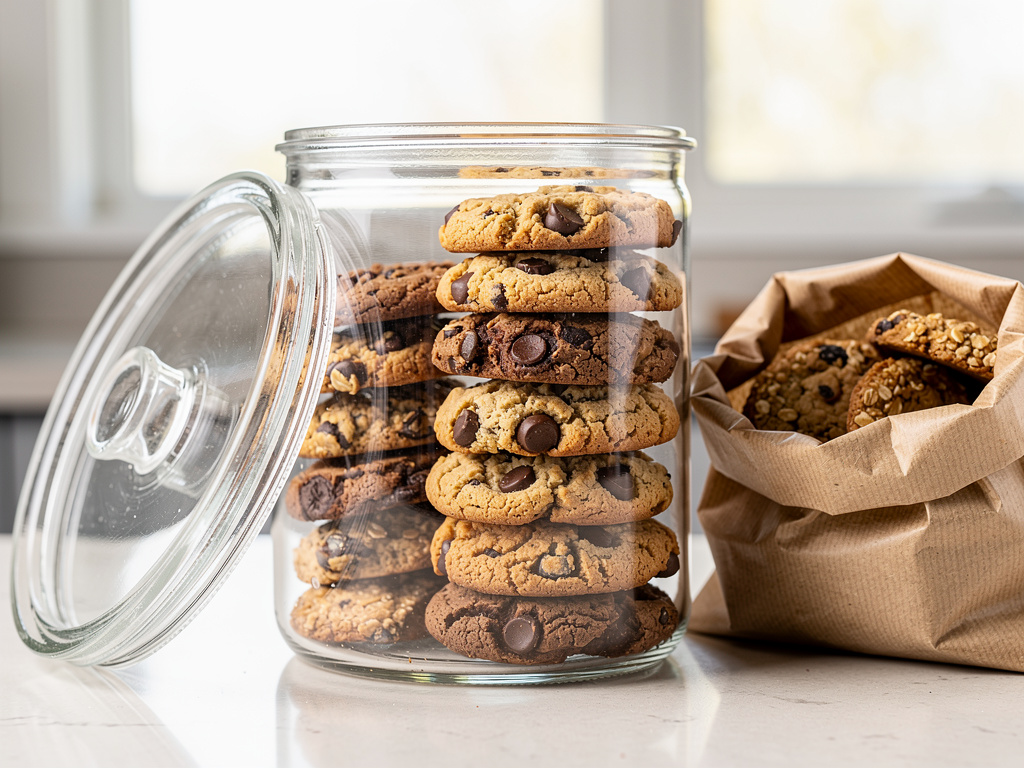


The short version: Homemade cookies last 2 to 3 weeks at room temperature, 2 months in the fridge and 8 to 12 months in the freezer, according to USDA's Food Safety and Inspection Service. That is USDA's storage limit for cookies kept the right way, not how long they taste freshly baked, which most baking guides put at about 3 days. If you sell cookies, bake no more than a day or two before pickup so your customer gets the best days at home, and freeze what does not sell the same day. Cookies with cream cheese frosting or custard fillings need the fridge, and many cottage food laws do not let you sell them from a home kitchen at all.
Checked October 1, 2026: USDA's cookie storage answer (last updated September 4, 2024), Kansas State University's storage guides (revised June 2026), Michigan's cottage food pages, and a pull of 2,746 Homegrown listings. Cottage food rules differ by state, so verify your state's current rules. Homegrown, compared below at $10 a month billed annually ($12.50 month to month), asks customers to create an account to place a first order and has no drops or countdown release feature.
A customer at your table picks up a bag of brown butter chocolate chip cookies and asks the question every cookie vendor hears: "How long will these keep?" Most vendors guess. A good answer sells the second bag, because the customer now knows they can save it for Tuesday.
This guide gives you that answer in numbers you can stand behind. It lines up what USDA and two university extension services say about cookie storage against what bakers say about taste, shows which cookies a cottage food law lets you keep at room temperature, and turns all of it into a bake schedule for a market or pickup day. It also counts how many of the 270 cookie listings on Homegrown say anything to shoppers about keeping or storing the cookies. The answer is six, and only four of those give a number.
Homemade cookies last 2 to 3 weeks at room temperature, about 2 months in the refrigerator and 8 to 12 months in the freezer when they are stored airtight. Those are USDA's numbers for bakery or homemade cookies, and Kansas State's guide adds the airtight container; moist bars and cream-filled cookies follow shorter fridge limits, covered below. The USDA Food Safety and Inspection Service's answer on storing cookies says "bakery or homemade cookies can be stored at room temperature two to three weeks or two months in the refrigerator," and that cookies "retain their quality" in the freezer for eight to 12 months.
Two university extension services back those numbers up. Kansas State University's cupboard guide gives homemade cookies 2 to 3 weeks in an airtight container, and its refrigerator and freezer guide gives baked cookies 6 to 12 months frozen. The University of Illinois Extension lists cookies baked at home at 8 to 12 months frozen, the same as USDA.
Scroll sideways to see every column.
| Where you keep them | USDA FSIS | Kansas State University | University of Illinois | What to know |
|---|---|---|---|---|
| Counter, airtight container | 2 to 3 weeks | 2 to 3 weeks | Not listed | Best taste is the first few days |
| Refrigerator, 34°F to 40°F | 2 months | Only for high-moisture cookies | Not listed | Can dry cookies out; keep it for cookies that need cold |
| Freezer, 0°F or lower | 8 to 12 months | 6 to 12 months | 8 to 12 months | Wrap well; these times describe quality |
| Moist bars (cheesecake, lemon) | 7 days in the fridge, 2 to 3 months frozen | Refrigerate custard-type bars | Not listed | Usually not a cottage food |
We checked USDA FSIS's "How should cookies be stored?" page, Kansas State University's cupboard guide and its refrigerator and freezer guide (both revised June 2026) and University of Illinois Extension's freezer storage chart on October 1, 2026. Temperatures are Kansas State's. These are storage guidelines for plain baked cookies, not a promise that every recipe stays safe that long.
If you are just starting out, our guide to how to sell cookies from home covers the rules, pricing and packaging. This page is about the clock that starts when your cookies come out of the oven.
Plan on about 3 days of best taste at room temperature, even though USDA says the cookies keep 2 to 3 weeks. The two numbers answer different questions. USDA's window is how long it says a bakery or homemade cookie can be stored at room temperature. The 3-day window is how long it still tastes like it came out of your oven, and that is the one your customer judges you on.
Cooking and baking sites land much closer to the short end:
Days homemade cookies keep at room temperature, by source
Source: the upper end of each source's room-temperature figure, all pages loaded October 1, 2026. "2 to 3 weeks" is shown as 21 days.
For a vendor, the useful number is the gap. If you bake Friday and sell Saturday, your customer gets about two of the best days at home and USDA's storage window runs about two more weeks after that. If you bake Wednesday for a Saturday market, the best days are gone before the cookie leaves your table.
Packaged cookies from the store keep 2 to 6 months in the pantry, while homemade cookies keep 2 to 3 weeks, because store cookies are built and sealed to last. USDA's FoodKeeper data lists store-bought soft cookies at 2 to 3 months and crispy ones at 4 to 6 months from the date of purchase. Kansas State's cupboard guide gives packaged cookies 2 months against 2 to 3 weeks for homemade.
Three things make the difference:
That is not a reason to change your recipe. It is a reason to bake close to the sale and package well. Our guide to extending shelf life without preservatives covers heat sealing, desiccant packets and other ways to stretch the fresh window across every cottage food product.
By Taste of Home's measure, crisp, dry cookies like biscotti and shortbread last the longest, up to about 2 weeks, while delicate and frosted cookies are best within 3 days. Taste of Home breaks storage down by cookie type, and its numbers are the most detailed of the sources we checked. Not every source agrees on dry cookies: the bakery owner Simply Recipes quotes says shortbread and other drier cookies have a shorter shelf life and should be eaten within a few days.
Swipe the table left to read each cookie type.
| Cookie type | Examples | How long they last at room temperature | Freezer | Selling note |
|---|---|---|---|---|
| Twice-baked | Biscotti | Up to 2 weeks | Up to 6 months | Your best make-ahead cookie |
| Shortbread and spritz | Shortbread, butter cookies | Up to 2 weeks | Up to 6 months | Holds up well in gift boxes |
| Drop cookies | Chocolate chip, oatmeal, snickerdoodle | About a week | Up to 6 months | Bake a day or two before the sale |
| Icebox and cutout cookies | Slice-and-bake, plain sugar cookies | About 5 days to a week | Up to 6 months, undecorated | Freeze before you decorate |
| Royal icing decorated | Decorated sugar cookies | Up to 3 days | Not recommended once decorated | Bake ahead, decorate close to pickup |
| Delicate | Pizzelles, lace cookies | Within 3 days | Do not store well | Bake the day before |
| Cream cheese or whipped cream topped | Cream cheese frosted cookies | Refrigerate, eat within 3 days | Not recommended | Often not allowed under cottage food laws |
Room-temperature and freezer times from Taste of Home's "How Long Do Cookies Last?", loaded October 1, 2026. These are Taste of Home's home-storage times, longer than the 3 days of best taste that The Kitchn and Food & Wine give; USDA's 2 to 3 weeks is the outer limit for how long homemade cookies keep.
Chewy cookies hold their texture longer than you might expect. A bakery owner quoted by Simply Recipes says chewy cookies like molasses "can sit on the counter for up to a week." If your menu mixes delicate and sturdy cookies, sell the delicate ones first and save the sturdy ones for the end of the day.
Cookies with cream cheese frosting, whipped cream, custard or cheesecake-style fillings need refrigeration, and cottage food laws generally cover only foods that are safe at room temperature. USDA puts moist bars such as cheesecake and lemon bars at 7 days in the fridge. Kansas State says to refrigerate "high moisture, perishable cookies," which it describes as custard-type bar cookies.
That refrigeration line is usually the same line the law draws. Cottage food laws let you sell low-risk foods from a home kitchen without a commercial food license, and "low risk" mostly means safe at room temperature. Many states still require a cottage food permit or registration, and our state-by-state cottage food guide lists which ones. Check your state's rules before your first sale.
Michigan's cottage food list allows "Baked goods, cookies" but says "No cream cheese frostings or icings," no cheesecake, and no cakes with frosting that needs refrigeration. Homemade buttercream is allowed only from one of two lab-tested recipes, Kansas State University's "Simple Buttercream Frosting" or Texas Come and Bake It's "American Buttercream Frosting," followed exactly. Commercially prepared, shelf-stable frostings are also allowed. We checked the Michigan Department of Agriculture and Rural Development page on October 1, 2026.
What this means for your menu:
Frosting rules differ from state to state. Michigan allows homemade buttercream only from two tested recipes (or a commercially prepared, shelf-stable frosting), and other states write their own frosting lists. Look up your state in our cottage food laws by state guide, then read your state agency's own page before you sell a frosted cookie.
Bake drop cookies the day before a market or pickup, two days ahead at most, and sturdy cookies like biscotti up to 3 or 4 days ahead. That keeps the best-taste window on your customer's side of the sale. Here is a schedule that works for a Saturday morning market or pickup:
Freeze scooped dough instead of baked cookies. The University of Illinois Extension says unbaked cookie dough keeps 3 months in the freezer, which is about 13 weekly markets from one big mixing day. Bake straight from frozen the afternoon before each market and every batch is one day old at the sale.
If you take orders ahead of time, you also stop guessing. A vendor who bakes 10 dozen "just in case" and sells 7 has 3 dozen cookies starting their clock with no buyer. A vendor who bakes 7 dozen to order has none.
Package cookies airtight once they are completely cool, keep soft and crisp cookies in separate bags, and stack them with parchment between layers. Packaging is what decides whether your customer's cookie is still soft on day 3 or already hard on day 2. Kansas State University's 2 to 3 weeks for homemade cookies assumes an airtight container.
Packaging also carries your label and your story. Our bakery packaging ideas roundup covers boxes, bags and stickers that look good on a table and keep cookies fresh at home.
The simplest way to sell fresher cookies is to bake only what is already ordered, on the day before pickup. That takes an ordering system that closes orders on time, tells you the count, and tells customers when to pick up. A notebook and a pile of Instagram DMs can do it at 10 orders a week. At 40, orders start slipping past the cutoff and the extra dozens get baked early.
For a cookie vendor, Homegrown is $10 a month on annual billing, or $12.50 month to month, with no percentage fees beyond standard payment processing. That processing is 2.9% + $0.30 per order, and you pay it, not your customer. For a cookie vendor watching the clock, four parts of it matter most:
Swipe left for the full fee stack on each platform.
| Platform | Subscription | Trial | Platform fee | Card processing | Customer pays on a $20 order | You pay on a $20 order | You pay for 50 orders a month |
|---|---|---|---|---|---|---|---|
| Homegrown, billed annually | $10/mo | 7 days, no charge until day 8 | $0, 0% commission | 2.9% + $0.30, paid by you | $20.00 | $0.88 | $54.00 ($44.00 processing + $10) |
| Homegrown, billed monthly | $12.50/mo | 7 days, no charge until day 8 | $0, 0% commission | 2.9% + $0.30, paid by you | $20.00 | $0.88 | $56.50 ($44.00 processing + $12.50) |
| Hotplate, default (fee passed to customer) | $0 | None (no subscription) | 5% + $0.55, paid by the customer | 2.9% + $0.30, paid by you | $21.55 | $0.88 | $44.00 (customers pay $77.50 in Hotplate fees) |
| Hotplate, you cover the fee | $0 | None (no subscription) | 5% + $0.55, paid by you | 2.9% + $0.30, paid by you | $20.00 | $2.43 | $121.50 |
| Etsy | $0 (Etsy Plus optional, $10/mo) | None; a one-time set-up fee may apply | $0.20 listing fee + 6.5% transaction fee | 3% + $0.25, paid by you | $20.00 plus shipping | $2.35 | $117.50, plus 9.5% of shipping (6.5% transaction + 3% processing) |
We checked Homegrown's signup page, Hotplate's pricing page and its post "What Hotplate does," and Etsy's fee policy and Etsy Payments page on October 1, 2026. Hotplate's own checkout example takes processing on slightly more than the subtotal, so its $0.88 is a floor. Etsy also charges an Offsite Ads fee of 15% on any order that comes from one of its outside ads (12% once a shop passes $10,000 in sales over 365 days, at which point the ads can no longer be turned off); the table leaves it out.
How the alternatives fit a cookie vendor:
Customers create a Homegrown account to place their first order. Your cookies show up on the Homegrown marketplace too, but most of your orders will come from the regulars you point to your own storefront link. Homegrown does not bake or package anything, and you run your own pickup or delivery; it closes your orders on time so you bake once, the day before pickup. If you want your next market to be your freshest one, set up your Homegrown storefront and set your order cutoff for Wednesday night.
Yes, baked cookies keep 8 to 12 months frozen by USDA's measure and 1 to 6 months by the baking sites we checked, and frozen dough keeps about 3 months by University of Illinois Extension's measure. Freezing is the most useful tool a cookie vendor has for evening out a busy week. The published freezer numbers disagree more than any other cookie storage number.
Swipe left to compare all seven sources.
| Source | Baked cookies, frozen | Cookie dough, frozen | What the number measures |
|---|---|---|---|
| USDA FSIS | 8 to 12 months | Not given on the cookie page | How long cookies "retain their quality" |
| University of Illinois Extension | 8 to 12 months | 3 months | Top quality at 0°F |
| Kansas State University | 6 to 12 months | 6 to 12 months (listed together with baked) | Storage at 0°F |
| Taste of Home | Up to 6 months | Up to 6 months for drop cookie dough | Home baking quality |
| Food & Wine, The Kitchn | Up to 3 months | Food & Wine: 1 month | Best taste |
| A bakery owner quoted by Simply Recipes | Up to 1 month | Not given | Bakery-fresh taste |
All pages loaded October 1, 2026. USDA frames its freezer time as how long cookies "retain their quality," and the other sources are also describing quality, not a safety cutoff.
For selling, use the short end. A cookie frozen for a month, thawed in its sealed bag and sold the next day tastes close to fresh. A cookie frozen for nine months is still inside USDA's range and can still pick up a freezer taste.
How to freeze cookies you plan to sell:
Kansas State's cupboard storage guide is a good four-page reference to keep in your kitchen; it covers cookies alongside flour, sugar and the other dry goods on your shelf. And be honest with customers: if a batch came out of the freezer, say so and tell them to eat it within a few days.
A date may not be on your state's required cottage food label, but adding a "Baked on" date is the easiest way to answer the freshness question before it is asked. Michigan's required label, for example, lists the business name and home address (or a registration number and phone number), the product name, ingredients listed from most to least by weight, net weight with the metric amount, allergens, and the statement "Made in a home kitchen that has not been inspected by the Michigan Department of Agriculture & Rural Development." There is no date on that list.
A date still helps you in three ways:
Two words to avoid: "Expires" and "Use by." Those suggest a safety cutoff you have not tested. "Best within" describes quality, which is what you are actually promising. For everything else your state does require, see our cottage food labeling requirements guide.
Tell customers three things: keep soft cookies sealed at room temperature (crisp ones with the bag slightly open), eat them within about 3 days for the best taste, and freeze any they will not get to. On Homegrown, almost no cookie vendor does this yet, which is why it stands out.
In a pull of the Homegrown catalog on October 1, 2026, we found 270 cookie listings from 94 vendors, out of 2,746 products from 308 vendors. We counted a listing as a cookie when its name or description said it was one, and read every listing by hand. Only 6 of the 270, from 3 vendors, say anything to the shopper about how long the cookies keep or how to store them. Bakin' Me Happy writes "Can be kept frozen for 3 months" on four listings, the only number in the set. Dolce Farm & Orchards says its molasses ginger cookie "keeps well," and Traditional Rise says its sourdough cookies "freeze beautifully."
A storage line can be short enough to fit under the price. Three versions you can copy:
Put the same line in three places: on the product listing, on a small card in the bag, and in the message you send when an order is ready. A customer who knows they can freeze half a dozen has a reason to buy a full dozen.
Every day a cookie spends in transit comes out of its roughly 3-day best-taste window, so a cookie shipped 2 days by ground arrives with about 1 good day left. That is why sturdy cookies like biscotti and shortbread, heat-sealed bags and fast shipping matter so much more once you ship.
Before you plan around shipping, check whether your state lets you ship at all. Some cottage food laws limit you to sales inside your state, and some to face-to-face sales; our cottage food laws by state guide lists which. Michigan's own information page says "a cottage food product may only be sold or delivered within Michigan," and the Michigan statute says cottage food products "must be stored only in the primary domestic residence," so a rented storage unit or a friend's freezer does not count either. The same information page allows internet and mail-order sales inside Michigan, as long as the customer can talk to you directly before buying.
If shipping is allowed for you, a few habits protect freshness:
Our guide to selling homemade cookies on Etsy covers which states allow shipping and what Etsy takes from each order.
A homemade cookie has gone bad when you see mold, smell something sour or paint-like, or taste a bitter, rancid edge from the butter or nuts. A cookie that is simply hard or soft has gone stale, which is a quality problem, not a safety one. Inside USDA's 2 to 3 weeks at room temperature, staleness is the usual problem; mold shows up first on moist cookies kept somewhere warm.
Signs to toss a cookie:
Signs a cookie is only stale:
None of this should reach a customer. If you are tasting your own leftovers to decide whether they can be sold, the answer is already no. The 3-day rule exists so you never have to make that call at the table.
Experienced cookie vendors freeze unsold cookies the same day, use a few as tasting samples, and shrink their next batch based on what is left. Leftovers tell you how much you over-baked. If 3 of 10 dozen come home every week, that is 30% of your ingredients and oven time with no buyer.
What works:
What to avoid is selling old cookies as fresh. A customer who gets a stale bag once does not come back to ask why. If you want your order count to set your bake count, build your Homegrown storefront and let customers order before Thursday's dough day, so every cookie you sell is one day old.
Homemade cookies last 2 to 3 weeks at room temperature in an airtight container, according to USDA's Food Safety and Inspection Service and Kansas State University. They taste their best for about the first 3 days. After that they slowly go stale, hard or soft depending on the cookie, and moist or filled cookies do not belong in this range at all.
Most homemade cookies do not need refrigeration. Sources split on whether the fridge helps: Food & Wine says it stretches best quality to about a week, and Simply Recipes' expert says it can dry sugar cookies out. Cookies with cream cheese frosting, whipped cream, custard or cheesecake fillings do need the fridge, and USDA puts moist bars like cheesecake and lemon bars at 7 days refrigerated. Those cookies are usually not allowed under cottage food laws, so check your state's list before selling them.
Homemade cookies keep 8 to 12 months in the freezer by USDA's and the University of Illinois Extension's measure, and 6 to 12 months by Kansas State University's. Baking sites give shorter times, from 1 to 6 months, because they are measuring fresh-baked taste. For cookies you plan to sell, use them within a month or two.
Bake drop cookies like chocolate chip and oatmeal the day before a bake sale or market, two days ahead at most, and sturdy cookies like biscotti and shortbread up to 3 or 4 days ahead. That way your customer gets the best-tasting days at home. Freezing scooped dough lets you bake fresh the afternoon before every sale.
Homemade cookie dough keeps about 3 months in the freezer, according to the University of Illinois Extension, and Taste of Home says most cutout and icebox doughs hold up to 3 days in the fridge. Scoop drop cookie dough into balls before freezing so you can bake as many as you need straight from frozen.
You can sell homemade cookies that were frozen, as long as the cookies are allowed under your state's cottage food rules and were stored at your home if your state requires it. Thaw them in the sealed bag so they do not get soggy, and sell them within a day or two of thawing. Telling customers a batch was frozen, and when, keeps their trust.
These five guides answer the questions that come right after "how long do my cookies last." Start with the how-to guide if you are still deciding whether to sell, and with the cost breakdown if you want to put a dollar figure on the cookies you throw away each month.
If a cookie on your menu needs the fridge, read the cheesecake guide and your state's cottage food list before you bake a batch to sell.



