
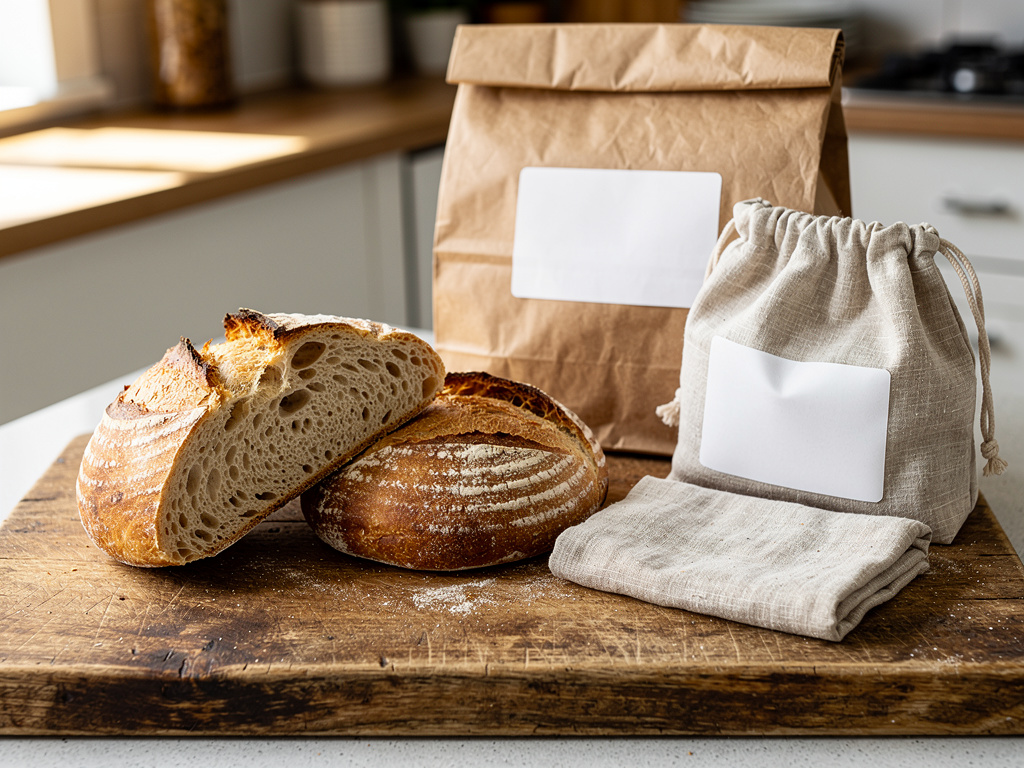


The short version: A whole loaf of plain homemade sourdough keeps about 3 to 5 days on the counter, cut side down or in a paper or cloth bread bag, and up to 3 months in the freezer for best quality. The USDA's own storage answer gives commercially baked bread 2 to 4 days at room temperature, and sourdough's natural acid can slow mold for a few extra days, but staling still ends the good eating first. Skip the fridge for plain loaves, because cold speeds up staling, and treat any loaf filled with meat or cream cheese as a fridge food. Bake as close to the sale as you can and hand every buyer one line on how to store it.
Checked on October 9, 2026: the USDA figures come from the USDA Food Safety and Inspection Service bread answer and its mold and date-labeling pages; the 3 to 5 day counter window is this guide's working guidance, built from the USDA range, a food storage guide from North Dakota State University and a 2020 study; the catalog numbers come from a pull of Homegrown's catalog that day; Homegrown, Hotplate and Square prices come from Homegrown's signup page, Hotplate's pricing page and its "What Hotplate does" post, and Square's pricing page, all that day. These are quality guidelines for typical kitchens, not lab-tested shelf life for your recipe, and cottage food rules vary by state, so verify your state's current rules. Homegrown customers create an account to place their first order, and Homegrown has no drops or countdown-release feature.
Sourdough has a reputation for keeping longer than regular bread, and it partly earns it. The acid that gives the loaf its tang also slows mold. But the moment you sell a loaf, how long it lasts stops being your private kitchen question and becomes your customer's experience. A loaf that goes hard on day two or grows fuzz on day four is the loaf they remember when your next bake goes up.
This guide is written for the home baker who sells. You will get the counter, fridge and freezer windows for each kind of loaf, what the USDA and the research actually say, how far ahead you can bake for a market, how to package and date your bread, and the one storage line almost no vendor on Homegrown gives their buyers. Every outside fact was loaded on October 9, 2026.
A whole plain sourdough loaf lasts about 3 to 5 days at a room temperature near 70 °F and about 3 months frozen, and it tastes best in the first 2 days. That window shrinks once the loaf is sliced, shrinks again for small loaves and baguettes, and changes completely when the loaf has meat or cream cheese inside. The table sorts the common loaves you are likely to sell.
Swipe the table left to see the fridge and freezer columns.
| Loaf | On the counter | In the fridge | In the freezer | Selling note |
|---|---|---|---|---|
| Whole plain boule or batard | 3 to 5 days, cut side down on a board or bagged in paper | Not recommended: it stales faster | Up to 3 months for best quality | Your best bake-ahead loaf |
| Sliced loaf or sandwich loaf | 2 to 4 days in a closed bag | Not recommended | Up to 3 months, sliced, so buyers pull out what they need | Slices dry out faster than a whole loaf |
| Baguette, mini boules, rolls | Best the day it is baked, 1 to 2 days at most | Not recommended | Up to 3 months | Bake the morning of the sale |
| Cheddar, jalapeño cheddar, herb and cheese | 2 to 4 days | Only if your recipe or state calls for it | Up to 3 months | Check your state's allowed-foods list first |
| Pepperoni or other meat inside | Into the fridge within 2 hours | Required | Wrap and freeze for longer keeping | Often outside cottage food rules (Michigan excludes it); check your state |
| Cream cheese swirl or filling | Treat as a fridge food | Required | Wrap and freeze for longer keeping | Can fall outside cottage food rules; check your state |
The counter, fridge and freezer times start from the USDA's answer for commercially baked bread (a 2 to 4 day counter range, 7 to 14 days refrigerated, 3 months frozen for quality), which we loaded on October 9, 2026. The sourdough windows above are our working guidance for a home baker's loaf, not a lab test of your recipe. Sliced loaves and small loaves get shorter windows because cut faces dry out first and, as the American Society of Baking notes, small and thin breads stale faster than large, thick ones.
How we got to 3 to 5 days, and what it means:
The single most useful line in that table is the first one. A whole loaf resting on its cut face is the version of your bread that holds up longest without any special equipment. If you sell one thing for weekly pickup, that is the shape to sell.
The USDA says commercially baked bread keeps 2 to 4 days at room temperature, 7 to 14 days in the fridge, and holds its quality for 3 months in the freezer. That comes from the USDA's answer on how long you can store bread, last updated in March 2025, and it is the closest thing to an official number for bread.
Three things to know before you lean on it:
So the USDA range is a starting point, not a sourdough answer. A plain sourdough usually does a little better than 2 to 4 days on mold, for reasons the next section covers, while the crust and crumb start losing their best texture only a little slower than other bread, since long fermentation slows staling somewhat. That is why this guide uses 3 to 5 days for a whole loaf, the same window our sourdough selling guide gives customers.
Sourdough molds more slowly because the bacteria in your starter make lactic and acetic acid, and acetic acid in particular slows mold growth. The research backs that up for very sour bread, and a second study found sourdough alone did not keep bread mold-free past 10 days, which is a reason not to count on your own loaf getting the full benefit.
In a 2020 study by Debonne and colleagues in the International Journal of Food Microbiology, researchers stored loaves at 21 °C (about 70 °F) and checked them daily for 7 weeks. In that study, full-baked bread made with an industrial sourdough showed no mold growth for the whole test, while the plain control bread lasted 4.4 to 9.2 days. The researchers tied the effect to how much undissociated acetic acid was in the bread, along with its pH and moisture.
A 2025 study in European Food Research and Technology (doi 10.1007/s00217-025-04702-4) found that adding sourdough alone did not keep bread mold-free for more than 10 days, and did no better than bread acidified with plain acid. The two studies were also set up differently. The first used 30 g of sourdough per 100 g of dough and let mold arrive on its own, while the second used 10% sourdough and seeded the bread with mold spores on purpose. The first study is the one that measured why sourdough helps: shelf life rose with the amount of undissociated acetic acid in the bread. A lab-controlled industrial culture can be very acidic. Your starter changes with the season, your feeding schedule and your kitchen temperature.
What that means for you:
Stale sourdough is hard, dry or chewy but still safe, and 5 to 10 minutes in a hot oven can revive it; moldy sourdough has fuzzy spots or an off smell and goes in the trash, whole. Customers mix the two up all the time, and knowing the difference helps you answer their messages.
Signs a loaf is only stale:
Signs a loaf has gone bad:
Staling is not the same as drying out. The American Society of Baking explains that staling begins the moment bread leaves the oven, as the starch in the crumb slowly re-forms into firmer crystals, and that it can happen even without the loaf losing water. That is why a loaf sealed in plastic still goes stale. It just goes soft-stale instead of hard-stale.
Do not cut the mold off and sell, gift or eat the rest. The USDA's guide to molds on food lists bread and baked goods as "Discard," because "porous foods can be contaminated below the surface," and it warns not to sniff a moldy item because that can cause breathing trouble. We loaded that page on October 9, 2026.
Big, whole, plain loaves keep longest, about 3 to 5 days; small loaves keep 1 to 2 days, and the USDA says a loaf with meat inside belongs in the fridge within 2 hours. Size matters because a thick loaf has more crumb protected by crust. The American Society of Baking notes that larger, thicker products stale more slowly than flat and small ones.
Here is how the common styles sort, from longest keeping to shortest:
That last group is where shelf life turns into a legal question. Cottage food laws are generally written for foods that are safe at room temperature, and Michigan says so directly. Of the 214 sourdough loaves listed on Homegrown when we pulled the catalog, 3 had pepperoni in the name and 3 had cream cheese (one spelled "creme cheese"), so filled loaves do show up for sale.
Michigan's agriculture department says cottage foods must be foods that "can be safely kept at room temperature and do not require refrigeration," and that a producer of foods that need time and temperature control for safety "does not qualify as a cottage food operator." Breads and similar baked goods are on its list of examples. That is from the MDARD cottage food getting-started FAQ, loaded October 9, 2026. Other states draw the line in their own words, so verify your state's current rules before you list a filled loaf.
Our guide to selling sourdough legally walks through what Texas, California, Michigan and Florida allow, including fillings.
No, do not refrigerate a plain sourdough loaf, because refrigerator temperatures make bread go stale faster than the counter does. It sounds backwards, since the fridge slows mold, but staling is a different process from spoiling.
A 2011 study by Aguirre and colleagues in the journal Starch (doi 10.1002/star.201100023) compared bread stored at about 77 °F, 39 °F and 0 °F. The researchers found the starch re-formed into firm crystals fastest at fridge temperature, the main thing that makes bread taste stale. At freezer temperature, the bread's water activity, a measure of the water available in the crumb, held almost steady for the 23 days the study measured. So the fridge is the worst of the three places for a plain loaf you plan to eat this week, and the freezer is the best place for one you do not.
When the fridge is the right call:
There is a real tradeoff here. North Dakota State University Extension's storage guide gives baked bread with no preservatives 2 to 3 weeks in the fridge and recommends the fridge to hold off mold. The fridge buys mold time and costs texture. For a loaf your customer will finish this week, texture matters more; for one that will sit longer, the freezer protects both.
Keep in mind that mold still grows in the cold. The same USDA mold guide notes that while most molds prefer warmth, "they can grow at refrigerator temperatures, too." The fridge buys a filled loaf time, but it does not make it a week-long product.
Bake whole plain loaves the day before, or the morning of, your market or pickup; never more than 2 days ahead. Every day the bread sits with you is a day taken off the 3 to 5 your customer gets at home.
Swipe left to see how many good days each bake schedule leaves.
| What you are selling | Best bake day | Earliest bake day | Days left for the buyer |
|---|---|---|---|
| Whole plain boule or batard | Morning of the sale, or the day before | 2 days before | About 2 to 4 if baked the day before |
| Sliced sandwich loaf | Day before the sale | Day before | About 1 to 3 |
| Baguette or mini loaves | Morning of the sale | Morning of the sale | About 1 to 2 |
| Fruit or cheese inclusion loaf | Day before the sale | Day before | About 1 to 3 |
| Frozen loaf (sold as frozen) | Any time in the last 3 months | Up to 3 months before, frozen the day it was baked | Up to the rest of the 3 months frozen |
Days left assume the counter windows in the first table (3 to 5 days for a whole loaf, 2 to 4 for sliced and cheese loaves with fruit loaves planned at the low end, 1 to 2 for baguettes), minus the days the loaf spent with you. Those counter windows are this guide's working guidance, which starts from the USDA's 2 to 4 days for commercially baked bread (checked October 9, 2026).
A Saturday market usually means a Friday bake: shape and cold-proof Thursday night, bake Friday, cool Friday night, bag Saturday morning. Pickup days work the same way. If your pickup is Wednesday at 4 PM, a Tuesday bake works, and a Wednesday morning bake gives your buyer the most good days.
Cool every loaf for at least 2 hours before it goes in a bag, longer for a big boule. A warm loaf sealed in plastic sweats, and that trapped moisture softens the crust and gives mold a head start before your customer even gets the loaf home.
Package a crusty sourdough loaf in a paper bag after at least 2 hours of cooling, and save plastic for sandwich loaves and sliced bread. Paper lets the crust breathe so it stays crisp. Plastic keeps the crumb soft but turns the crust leathery within a day.
A packaging checklist that protects shelf life:
Packaging also carries the storage message. A paper bag with a sticker that says how to store the bread does two jobs for a few cents. Our shelf-life guide for cottage food vendors covers airtight containers, heat sealing and vacuum sealing if you sell other baked goods too.
Yes, you can freeze sourdough and sell it; wrap it well, tell the buyer it was frozen, and plan on the USDA's 3 months at best quality. Freezing is the storage method that comes closest to stopping staling. The American Society of Baking describes freezing as stopping the molecular motion that makes starch crystallize after baking.
Freezing works best as a planned product, not a rescue for leftovers. A "freezer loaf" or a sliced loaf for toast lets a customer stock up once instead of buying every week.
How to freeze a loaf you plan to sell:
Be honest on the listing. A customer who expects a loaf baked that morning and gets a frozen one feels misled, even if the bread is great. A customer who orders a freezer loaf on purpose feels like they got a good deal.
Federal law does not require a date on bread, but a "Baked on" date on every loaf is one of the easiest ways to build trust. The USDA's food product dating page says that, except for infant formula, product dating is not required by federal regulations.
If you do add a date, the wording matters:
Your state may ask for more than the federal rule. Some states want extra details on a cottage food label, and a few ask for a date, so read your own state's list. The cottage food label requirements guide covers 13 states' rules, checked October 5, 2026.
Tell every buyer one line: how to store the loaf and how many days it keeps. It costs nothing, it saves you the "my bread got moldy" message, and almost nobody on Homegrown does it yet.
In a pull of the Homegrown catalog on October 9, 2026, we found 214 sourdough loaf listings from 72 vendors, with a median price of $12. Only 8 of those 214 listings, from 3 vendors, said anything about how the bread keeps, ships or should be stored, and 5 of the 8 were one baker's note about shipping early in the week. Just 3 listings, from 2 vendors, said anything about keeping the loaf fresh after pickup. The rule we used: Bakery listings with "sourdough" in the name or description, then only the ones whose name says loaf, bread, boule, batard, baguette or sourdough and does not name a cookie, bagel, roll, pie or other non-loaf item. We read every storage mention by hand and did not count one resold store-bought loaf's shelf-life note as storage advice; that loaf is still in the 214.
What 214 sourdough loaf listings on Homegrown tell buyers
Source: Homegrown catalog pull, October 9, 2026, 214 sourdough loaf listings. "Lists ingredients" counts descriptions that use the word "ingredient"; "Keeping it fresh after pickup" was read by hand.
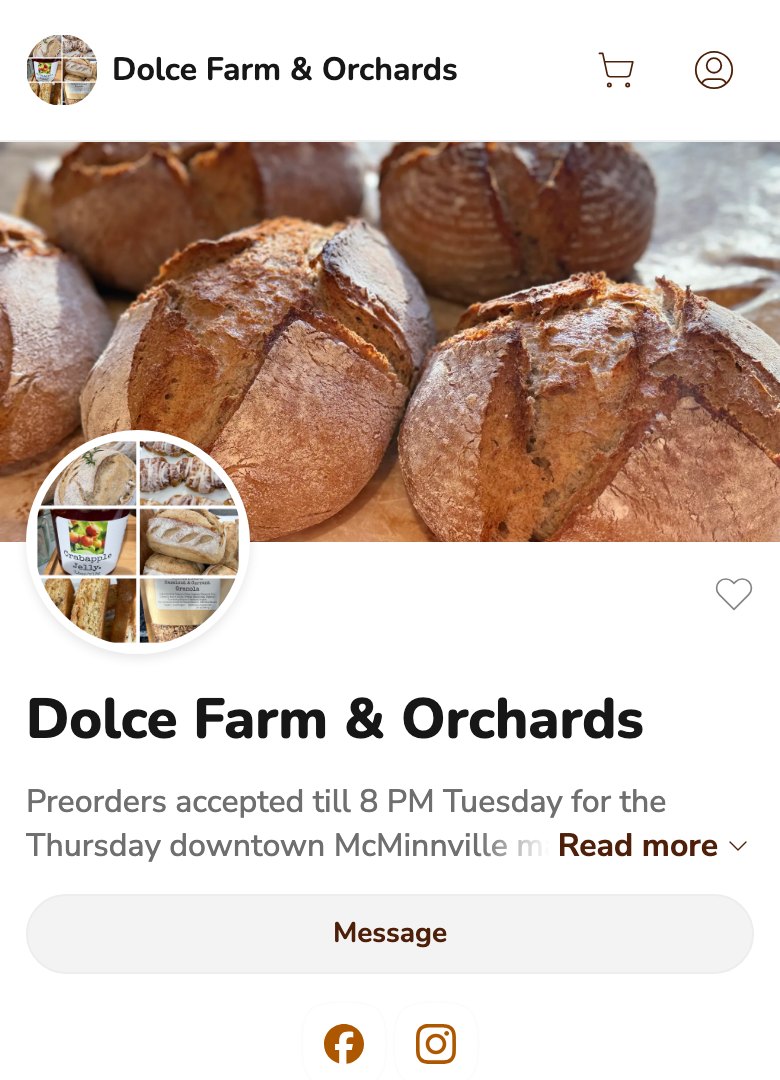
So vendors describe the fermentation and the flour, but almost never tell buyers what to do with the loaf once it is home. The one listing that mentioned freezing was Dolce Farm & Orchards' rye boule, which says: "We suggest to slice this bread when you pick it up, and store in the freezer- ready to toast when you are!"
Three storage lines you can copy onto a listing, a sticker or a pickup message:
The best shelf-life fix is not a bag or a freezer; it is baking only what is already sold, so every loaf goes out within a day of the oven. When you bake for a guess, some loaves sit with you for days, and every one of those days comes off your customer's 3 to 5.
Homegrown is built for that kind of week. It costs $10 a month billed annually, or $12.50 billed monthly, with no percentage fees beyond standard payment processing of 2.9% + $0.30 per order, which you pay. Customers order and pay on your storefront before you mix the dough, and the order prep time setting lets you require a lead time before each pickup date, so orders close in time for a cold proof. Each pickup location gets its own days and time windows, and a whole loaf, a half loaf and a sliced loaf can sit as separate sizes under one listing, each with its own price.
The usual alternatives each fit a different vendor:
Scroll sideways to see every fee column.
| Platform | Monthly plan | Trial | Platform fee | Card processing | Customer pays on a $24 order | Baker pays on a $24 order | Baker pays in a month of 50 orders at $24 |
|---|---|---|---|---|---|---|---|
| Homegrown | $10 billed annually ($12.50 monthly) | 7 days, no charge until day 8 | $0, 0% commission | 2.9% + $0.30, paid by the baker | $24.00 | $1.00 plus the plan | $60.00 ($62.50 on the monthly plan) |
| Hotplate, default | $0 | Not offered (no plan to try) | 5% + $0.55, paid by the customer | 2.9% + $0.30, paid by the baker | $25.75 | $1.00 | $50.00 |
| Hotplate, baker covers the fee | $0 | Not offered (no plan to try) | 5% + $0.55, paid by the baker | 2.9% + $0.30, paid by the baker | $24.00 | $2.75 | $137.50 |
| Square Online, Free plan | $0 | Not offered (free plan) | $0 | 3.3% + 30¢ online, paid by the baker | $24.00 | $1.09 | $54.50 |
A $24 order is two loaves at the $12 Homegrown median. Card processing here is figured on the $24 price and rounded to the cent on each order, so the month column is 50 times the per-order figure plus any plan; a platform that charges it on a total that includes fees, tips or tax runs a few cents higher. Prices come from the Homegrown signup page, Hotplate's pricing page and its "What Hotplate does" post, and Square's pricing page, all loaded October 9, 2026.
What Homegrown does not do: it will not keep your bread fresh for you, set your bake schedule, or release loaves in a timed drop, since there is no drops feature. Customers create a Homegrown account to place their first order. Your storefront is listed on the Homegrown marketplace, but plan on most orders coming from people you send to your own link. If your loaves keep going stale on your counter because you baked for a guess, set up a Homegrown storefront for pre-orders and bake this week's sourdough for buyers who have already paid.
Every day a loaf spends in a box comes straight off its counter life, so a loaf shipped 2 days by ground arrives with roughly 1 to 3 good days left. Shipping can also add heat, and warmth speeds mold. The USDA mold guide notes that mold growth "is encouraged by warm and humid conditions."
Before you ship, check that you are allowed to. Whether you may mail an order depends on your state. Michigan's agriculture department, for one, allows internet and mail-order cottage food sales only when the buyer has a chance to speak with the baker, according to the getting-started FAQ quoted above (loaded October 9, 2026). The sourdough permission guide covers whether you may mail an order in four states. If you can ship:
Freeze them the same day for your own use or a labeled freezer sale, turn them into a new product only if your state allows it, or plan your bake so there are fewer leftovers. A loaf that sits on your counter for three days and then goes to a customer is the worst of all choices.
What experienced bakers do with the extra:
At the $12 median price for a sourdough loaf on Homegrown, 4 unsold loaves a week is $48 of bread you made and could not sell, or about $2,500 over a year of weekly bakes. That $48 is sales you did not make, not money you spent. What the bin actually costs you is the flour, the oven time and your hours, which our cost per loaf breakdown walks through.
Here is the math at a few leftover counts, at the $12 median:
Shelf life and leftovers are the same problem seen from two sides. When you bake for a guess, you either run short and lose sales, or you over-bake and sell older bread or throw it away. Baking to orders that close before you mix takes most of that guessing away. The bake to order vs bake to sell guide runs that comparison in full. If you already know your weekly loaf count, a storefront that tracks the loaf quantity you set and counts it down as orders come in keeps the number you bake close to the number you sell. Start taking sourdough pre-orders on Homegrown and bake to that count.
A whole plain loaf of homemade sourdough lasts about 3 to 5 days at room temperature, stored on its cut face or wrapped in a cloth bread bag. Sliced loaves and small loaves keep less time. For comparison, the USDA gives store-bought bread 2 to 4 days on the counter.
Usually a little longer on mold, because the acids from your starter, acetic acid most of all, slow mold growth. A 2020 study found strong mold resistance in very sour industrial sourdough bread, but a 2025 study found sourdough alone did not keep bread mold-free past 10 days. Staling comes a little slower too, since long fermentation, as in sourdough, is one of the ways bakers delay it, but the good eating window still ends when the loaf goes stale, not when it molds.
No, not a plain loaf. Bread goes stale fastest at fridge temperature, so the counter is better for this week and the freezer is better for later. The exception is sourdough with meat or cream cheese inside, which belongs in the fridge, and the USDA says bread with meat goes in the fridge within 2 hours.
The USDA says bread keeps its best quality for about 3 months when frozen. Cool the loaf fully, slice it if you want toast, wrap it airtight and label it with the bake date. Thaw it on the counter in its bag or warm a whole loaf in a hot oven to bring back the crust.
Bake whole sourdough loaves the day before the market, or the morning of if you can. Two days ahead is the outer limit for a whole loaf, and baguettes and mini loaves should be baked the morning of the sale. Every day the loaf sits with you comes off the days your customer gets.
Not under federal rules: the USDA says product dating is not required by federal regulations except for infant formula. Some states ask for more on a cottage food label, so check yours. A "Baked on" date is the clearest choice for bread, and if you add a quality date, the USDA recommends the phrase "Best if Used By."
These guides pick up where shelf life leaves off: whether you can sell the loaf, what to charge for it, and how to sell it without baking for a guess. If you are new to selling bread, start with the permission guide, because a filled loaf can change which rules apply to you. Then set your price before you plan a bake schedule, since a $12 loaf you throw away earns nothing, while a $10 loaf you sell earns $10.
A sourdough loaf is at its best in the first two days and still good for about five. Your job as a vendor is to hand it over early in that window and tell the buyer how to keep the rest of it. Bake close to the sale, sell whole loaves when you can, skip the fridge for plain bread, freeze on purpose, and put one storage line on every listing. Most of the 214 loaf listings on Homegrown still skip that line, so adding it is an easy way to stand out.
Start with this week's bake. Write your storage line today, using the windows in the first table: a whole loaf gets 3 to 5 counter days, a sliced one 2 to 4, and either one 3 frozen months. Put it on the listing, the bag sticker and the pickup message. Then look at your last month of bakes and count how many loaves were left over each week. If the answer is more than 2 or 3, the fix is not a better bag. It is baking closer to the number of loaves people already ordered.



