
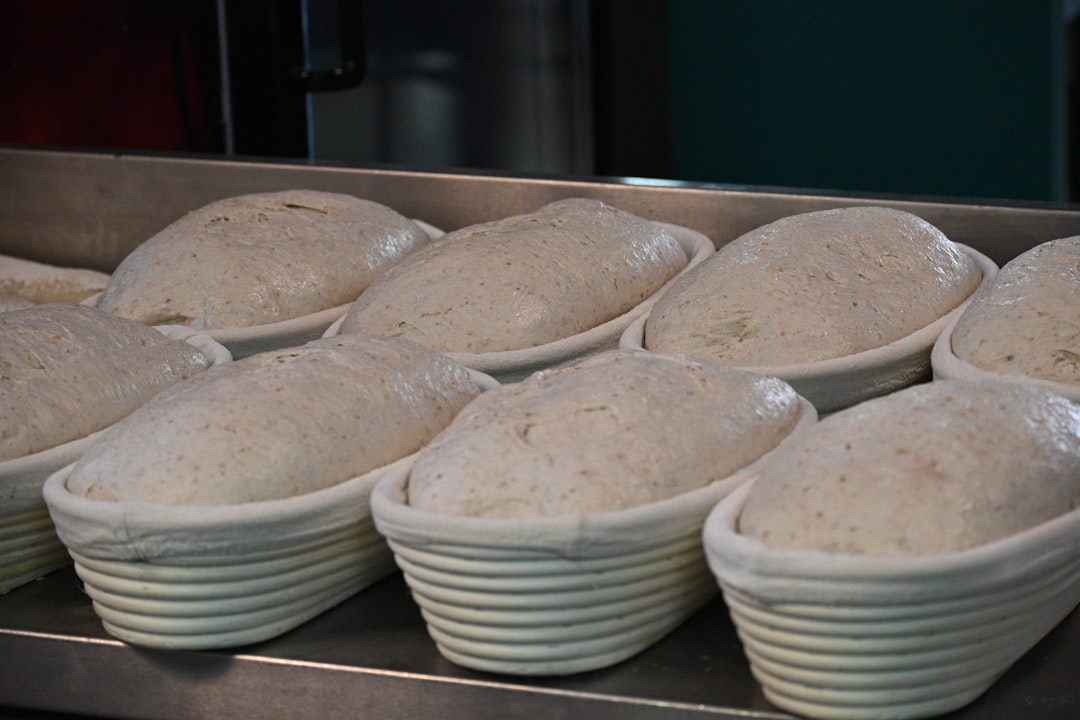


There are only two ways to run a home bakery. You bake first and then find buyers, or you find buyers first and then bake.
Almost everyone starts with the first one, because it's what a bakery looks like from the outside. A case full of things, customers choosing. And almost everyone who lasts ends up on the second one, usually after a stretch of Sunday nights spent looking at unsold product and doing quiet math about whether this is working.
The difference isn't a preference or a personality thing. It's a structural decision that determines your waste rate, your working capital, your schedule, and your effective hourly rate, and it does so more forcefully than any other choice you'll make.
The short version: Bake-to-sell means producing on a forecast and hoping demand shows up. Bake-to-order means collecting paid orders first and producing exactly that. Speculative baking carries three costs people underestimate: physical waste, cash tied up in inventory you haven't sold, and the mental load of guessing every week. Pre-ordering removes all three, and it also lets you batch larger, which is the single biggest lever on your hourly rate. The trade-off is real but small: customers wait, and you need an ordering system that doesn't leak.
Bake to sell (speculative). You decide Thursday that Saturday's market probably wants 30 loaves and 20 dozen cookies. You buy for that, bake for that, and show up. Whatever sells, sells. Whatever doesn't is yours: eaten, frozen, given away, or thrown out.
Bake to order (pre-order). You post a menu Monday with quantity caps. Customers order and pay through Wednesday. Wednesday night you have a number: 22 loaves, 14 dozen cookies, all paid. You buy for that number, bake that number, and every single unit has a name attached before it goes in the oven.
There's a hybrid that many vendors run, and it's legitimate: pre-orders form the base, with a small speculative overage for walk-ups at a market. The key is that the speculative portion is a deliberate, sized decision rather than the whole business. How to handle pre-orders and in-person sales together covers running both.
A 15 percent unsold rate sounds tolerable until you annualize it. On $1,200 a month in production, that's $180 of finished product monthly, which is $2,160 a year. But the ingredient cost isn't the real loss. The real loss is that you also spent the labor to produce it. At a 20 percent margin, throwing away 15 percent of your output doesn't reduce your profit by 15 percent. It can erase most of it.
Work it through. Twenty loaves, $16 each, $320 of potential revenue. Cost to produce all twenty, including your labor at a real rate, is roughly $260. Sell all twenty and you make $60. Sell seventeen and you make $12. Sell fifteen and you lost $20 for a day of work.
That's the shape of the problem: the costs are fixed at production, the revenue isn't, and small variations in sell-through swing you between profitable and underwater. Batch economics and cost per unit has the full arithmetic.
Speculative baking means buying ingredients before anyone has paid you. You're financing your customers' purchases out of your own pocket every week, and if a week goes badly you're financing next week's ingredients out of a smaller pot.
Pre-orders invert this entirely. Payment arrives at the moment of ordering, days before you buy a single ingredient. You're never funding inventory, your cash position can't go negative from a slow week, and you know your exact ingredient budget before you shop.
For a business with no credit line and no reserve, which describes most home bakeries in year one, this is a bigger deal than the waste number. It's the difference between a bad week being a bad week and a bad week being a setback you spend a month recovering from.
This one doesn't show up in any spreadsheet, and for a lot of people it's the reason they quit.
Every speculative bake requires a forecast: how many, of what, for a Saturday you can't see. You'll get it wrong in both directions and both feel bad. Overproduce and you watch product go stale. Underproduce and you turn people away while knowing you left money on the table.
Weather moves it. A holiday weekend moves it. A competing event in town moves it. You never get good at this, because there isn't a skill to get good at, only noise to absorb. Bakers who switch to pre-orders consistently describe the relief as bigger than the financial improvement, and that's worth taking seriously.
Here's the part that gets missed, and it's the strongest argument of the lot.
Baking labor is mostly fixed per session, not per unit. Mixing, preheating, and cleanup take roughly the same time whether you're making four loaves or twelve. So batch size, not speed, is what determines your effective hourly rate.
| Batch | Total time | Labor per loaf @ $18/hr | Cost floor | Price at 20% margin |
|---|---|---|---|---|
| 4 loaves | 3.0 hrs | $13.50 | $15.63 | $19.54 |
| 8 loaves | 4.0 hrs | $9.00 | $11.13 | $13.91 |
| 12 loaves | 4.5 hrs | $6.75 | $8.88 | $11.10 |
Identical product, identical baker, identical hourly rate. The twelve-loaf baker can profitably charge $11 where the four-loaf baker needs $19 to break even at the same margin, or can charge $16 and make roughly three times the hourly rate.
Speculative baking caps your batch size, because every additional unit is additional risk. You bake conservatively to limit downside, which locks you into the worst row of that table. Pre-ordering removes the risk entirely, so you can batch to whatever your oven and pans allow, which moves you down the table. The pricing consequences are covered in how to price baked goods.
Pre-ordering isn't free, and pretending otherwise sets people up to be surprised.
Customers have to wait. Someone who wants bread today can't have it. This is a genuine loss of impulse purchases and it's the most common objection, though it matters less than expected for the sort of product people plan around.
You need a real ordering system. A speculative baker needs no infrastructure at all: bake, show up, take cash. A pre-order baker needs a way to publish a menu, cap quantities, take payment, and confirm. Do that with DMs and a spreadsheet and you've replaced a waste problem with a coordination problem, which is worse because it damages customer trust rather than just your margin.
You have to build the habit in your customers. The first few weeks of a pre-order model underperform, because people are used to just showing up. Training an audience to look for a Monday menu takes about a month of absolute consistency.
You're exposed to no-shows. Someone orders and doesn't collect. This is why payment at the time of ordering matters so much: an unpaid reservation is a wish, a paid order is a commitment. See what to do when a customer no-shows a large prepaid order.
Some channels genuinely require speculation. A farmers market booth needs product on the table. The answer there is usually the hybrid: pre-orders for collection at your booth, plus a sized speculative batch for walk-ups, with the walk-up number set from your own history rather than optimism. How to convert market customers into online customers is the bridge between the two.
The financial case gets made most often, but the schedule change is what people actually notice first, and it's worth laying out because it's the part that determines whether you're still doing this in a year.
Speculative week. Shopping happens on a guess, so you buy wide to cover scenarios. Production happens on a guess, so you're deciding quantities right up to the moment you mix. Then market day is a variable-length event whose outcome you can't predict, followed by dealing with whatever came home. Every stage carries an open question, and the open questions run continuously in the background from Wednesday to Sunday.
Pre-order week. Monday you post. Tuesday and Wednesday you do nothing except watch orders land, which requires no decisions at all. Wednesday night the number is fixed and every remaining question is closed. Thursday you shop to an exact list. Friday you produce a known quantity. Saturday you hand off pre-sorted bags for two hours and go home.
The total hours are similar. What changes is that the uncertainty is compressed into a window that closes, instead of running the whole week. For someone doing this alongside a job or around kids, that's frequently the difference between sustainable and not, and it's the reason most people who switch describe it as a relief rather than an optimization.
There's a second-order effect too. Because you know your numbers three days out, you can commit to other things. Speculative bakers tend to keep their whole weekend loosely reserved in case the market runs long or a bake needs redoing. Pre-order bakers get Saturday afternoon back, reliably, which sounds minor and is not.
Ingredient buying gets sharper. Buying to an exact order list rather than a forecast means you stop carrying dead stock, and you stop discovering that the specialty flour you bought for a product nobody ordered has gone off. Rising input costs hit speculative bakers harder for the same reason: you're absorbing price increases on ingredients you may not sell. The USDA's Food Price Outlook is the reference for what's moving, and handling ingredient price spikes covers the response.
And the tax picture is simpler. Ingredients bought against confirmed orders are cleanly attributable business expenses in a way that speculative purchases partly consumed at home are not. If you're tracking deductions properly, and the IRS guidance on deducting business expenses is worth reading before your first tax year closes, clean attribution saves real time.
Three situations where it's the correct call, and pretending otherwise would be dogma:
Farmers markets and craft fairs. Foot traffic is the whole point. An empty table sells nothing, and the display itself is the marketing.
Wholesale to a retail account. If a coffee shop takes twelve pastries every Tuesday, that's a standing order, which is functionally a pre-order with a longer horizon. Note that most cottage food laws don't permit wholesale at all, so check your state first.
Genuinely new products. You can't pre-sell something nobody has tasted. Small speculative batches are how you find out whether a product works before it earns a permanent menu slot, which is the argument in testing a new product at a farmers market in small batches.
Outside those three, the default should be pre-order.
If you're running speculative today, this is the sequence that works.
Start with one product. Take your best seller, the one you know sells out, and offer it by pre-order only for a month. Keep everything else as it is. You learn the mechanics on a product where demand is proven.
Pick a rhythm and never move it. Menu Monday, orders close Wednesday night, bake Friday, pickup Saturday morning. The specific days matter far less than never changing them. Customers who know when to look will look.
Set caps you can comfortably produce. Below your capacity, not at it. Selling out is a good outcome: it's a clean demand signal and it builds the habit of ordering early. Under-delivering on a paid order is the one failure that costs you a customer permanently.
Take payment at order time. This is not negotiable and it's where most homegrown systems break. Unpaid reservations produce no-shows at a rate that will make you abandon the model for the wrong reason.
Announce it plainly, once. "Starting the 15th, loaves are pre-order only. Menu posts Monday, orders close Wednesday, pickup Saturday 9 to 11." No apology, no long explanation. Regulars adapt in a week or two.
Add the second product when the first one is boring. When the rhythm feels automatic, expand.
The whole model, including window lengths and cutoff timing, is in how to run a weekly food drop and the weekly drop model.
Bake to sell means producing on a forecast and hoping the demand appears, so unsold product is your loss. Bake to order means collecting paid orders first, then producing exactly that quantity, so every unit is sold before it's made. The second eliminates waste and inventory financing, and it lets you batch larger, which improves your hourly rate.
Yes, some. That's the real trade-off. In practice the loss is smaller than expected for products people plan around, like weekly bread or a Friday cookie order, and larger for genuine impulse items. Many vendors run a hybrid: pre-orders as the base, plus a small sized speculative batch for walk-ups at a market.
Usually 48 to 72 hours before bake day. That's enough time to shop, do the math, and start any long ferments, without asking customers to plan so far ahead that they forget. Shorter than 24 hours and you'll be shopping in a panic. Longer than five days and order volume drops because it's outside how people think about their week.
Take payment when the order is placed, and the problem mostly disappears. A paid order is a commitment; an unpaid reservation is a wish, and wishes no-show constantly. For the ones that still happen, have a stated policy about holding for pickup and communicate it up front. See customer no-shows on large prepaid orders.
Yes, and many successful vendors do. The distinction that matters is whether the speculative portion is a deliberate, sized decision or the entire business. Pre-orders form a guaranteed base that covers your costs, and a modest overage catches walk-ups. Size the overage from your own sell-through history, not from optimism.
Consistency and a single clear announcement. Post the menu the same day every week, close orders the same day, hand off at the same time and place. Say it once plainly rather than repeatedly apologizing for it. Most regulars adapt within two weeks, and the ones who don't were usually the ones generating the most coordination work anyway.
Custom work is already a form of ordering ahead, so the question is different there. The relevant improvement for custom orders is taking a deposit at booking and capping how many you accept per week, rather than the batch-versus-speculation question. See deposits and partial payments on custom orders.
Pre-ordering only works if the ordering itself works, and this is where most people who try it and give up actually failed.
Run pre-orders through Instagram DMs, texts, and a spreadsheet and you get a predictable set of failures. Two people are told yes for the last loaf. A message sits in a filtered folder for three days. Friday morning you can't tell who paid. Someone shows up for an order you have no record of.
Each of those is worse than the waste problem you were solving, because a stale loaf costs you six dollars and a customer who drove over for nothing costs you the customer.
What makes the model hold is having the pieces connected: a menu customers can see with live quantities that go sold-out automatically, payment collected at the moment of ordering, confirmations and pickup reminders that send themselves, and a bake list generated from the orders rather than reassembled by hand on Friday morning.
That's what a Homegrown storefront does. One link for your bio, live quantity caps so you cannot oversell, checkout and payment at order time, pickup management, and a listing in a local marketplace where nearby customers can find you. It's $10 a month billed annually, or $12.50 month to month, with no commission on your sales at any volume.
If you're setting the whole thing up from scratch, how to take pre-orders for your food business walks the mechanics, and how to start a home bakery covers everything upstream of it.



