
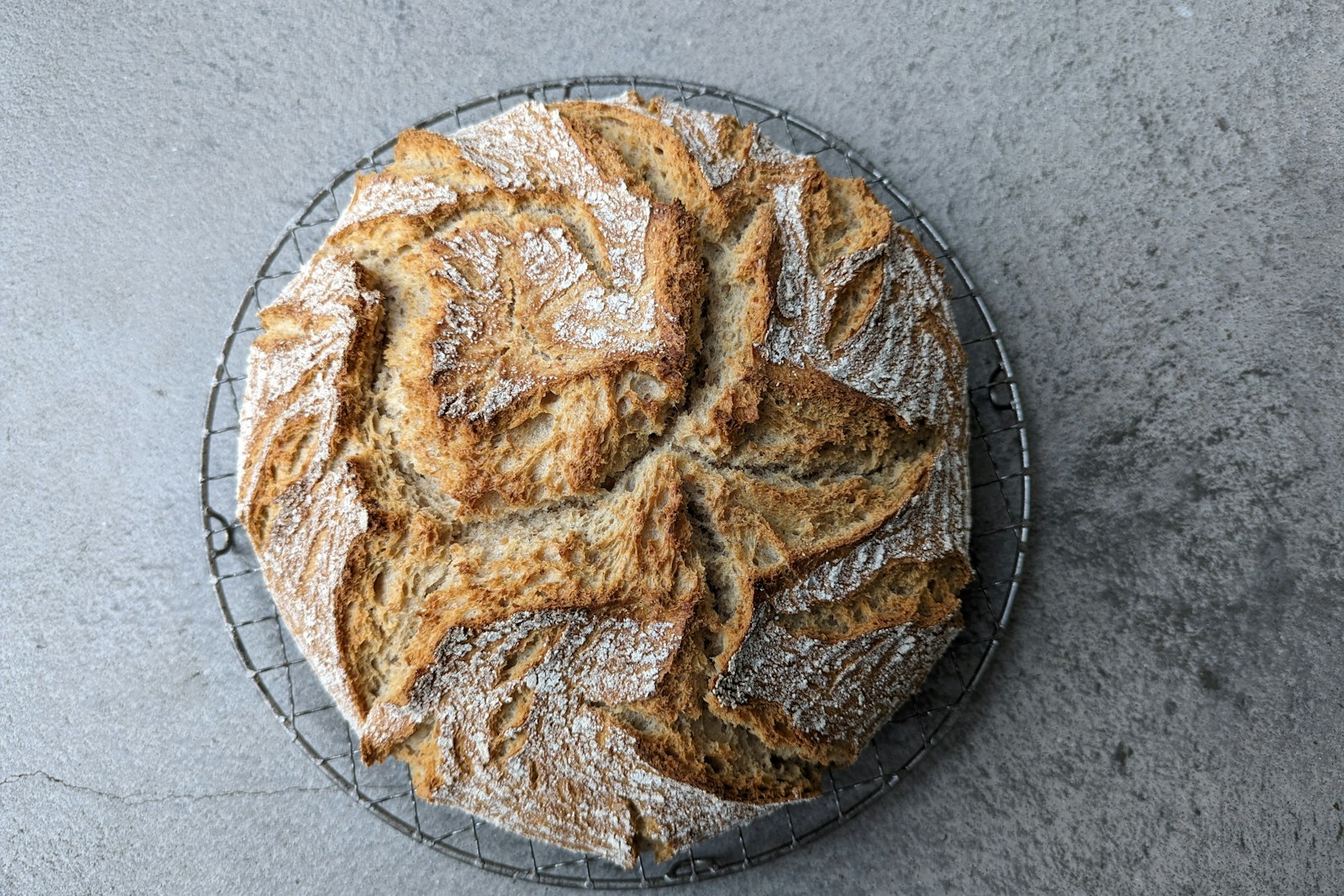


The short version: You can sell homemade sourdough bread from your own kitchen in nearly every state, under what is called a cottage food law, and you do not need a commercial kitchen to do it. Plain loaves, focaccia and sweet loaves clear the rules almost everywhere, because bread does not need refrigeration to stay safe. What varies is the money cap, the label, and whether you may mail an order or have to hand it over yourself: the four state pages checked for this article cap annual cottage food sales anywhere from $50,000 in Michigan to $250,000 in Florida, and California re-indexes its own two tiers to inflation every January. Add a filling that needs a fridge, such as cream cheese or cured meat, and the same loaf can fall outside the rules.
Checked on the Texas DSHS, California CDPH, Michigan MDARD and Florida FDACS cottage food pages, September 20, 2026: every state figure and rule below came off those pages, the two CDPH PDFs they link, the MDARD getting-started FAQ and the Arizona statute, that day, and because these rules change with each legislative session you should verify your own state's current wording before you sell. Homegrown pricing came off findhomegrown.com/signup the same day, customers create a Homegrown account to place a first order, and Homegrown has no countdown drop feature.
You baked a loaf, took it to a potluck, and three people asked what you charge. Home food sales run on a different rulebook than a restaurant, and that rulebook is written state by state. The answer is better than most home bakers expect. What trips people up is never the bread. It is the cheese you folded into it, the state line you shipped it across, or the label you skipped.
Yes, in nearly every state you can bake sourdough in your home kitchen and sell it directly to customers without a commercial kitchen or a bakery license, and in most of them without an inspection of your kitchen, and in the four states checked for this article the annual ceiling on those sales ran from $50,000 in Michigan to $250,000 in Florida. The law that lets you do it is called a cottage food law. It carves out a list of foods that are safe enough at room temperature that a regulator is willing to skip the inspection. A small number of states run a licensing or permit program instead of a blanket exemption, which is why step one is always your own state's page rather than a national summary, including this one.
Three things change from one state to the next, and they are the only three worth memorizing:
A plain sourdough boule clears all three in nearly every state. That is why bread is the product most home bakers start with, and it is why the how-to side of this, the pricing, the bake schedule and the packaging, is worth reading next in the guide to selling sourdough bread from home. This page answers the permission question. That one answers the running-it question.
One caveat worth setting up front: cottage food rules are state law, they get rewritten in regular legislative sessions, and a page that was accurate two years ago often is not. Every number here carries the date it was loaded.
Sourdough clears because a baked loaf does not need a refrigerator to stay safe, which is the single test most cottage food laws are built around. Regulators call the risky category TCS food, short for time and temperature control for safety. Michigan's Department of Agriculture and Rural Development describes its own exemption exactly that way on its cottage food page, covering foods that do not require time or temperature control for safety, checked September 20, 2026.
A finished sourdough loaf has a baked, low-moisture crumb and an acidic chemistry from the starter. A plain loaf does not grow the bacteria regulators watch for on a market table in July, which is the whole reason it clears. Focaccia, crackers and most sweet loaves land the same way. A topping, a filling or a wet add-in can move any of them, which is why the rules get written product by product and not category by category.
What pushes a food into the TCS category is usually one of these:
If you want the full mechanism, the breakdown of which foods count as TCS walks through the moisture and acidity tests a regulator applies. For a plain loaf, none of them bite.
We pulled the Homegrown catalog on August 14, 2026 and counted 1,804 products from 219 vendors. Of those product names, 263 had the word sourdough in them, spread across 47 separate vendors. Bakery was the largest category by a wide margin at 876 products, or 49% of everything listed, from 122 vendors. Bread is not a niche corner of home food selling. It is the center of it.
The line almost never runs through the bread itself, it runs through whatever you folded into it, and the nine products in the table below split along that one seam. A plain boule and a prosciutto loaf are treated as two different products by most state food codes, even though they came out of the same oven on the same morning.
The stakes are concrete: a $12 jalapeno cheddar loaf and a $12 plain loaf can land on opposite sides of the same state's rule, because of the cheese. California makes the test easy to read. The first category on the Approved Cottage Foods List that the California Department of Public Health publishes for cottage food operations is titled "Baked Goods Without Cream, Custard, or Meat Fillings," and it names Bread, Flatbreads and Crackers by hand. That title is the whole rule in eight words.
Scroll sideways to see every column.
| What you want to sell | Usual answer | Why | What to check first |
|---|---|---|---|
| Plain sourdough boule or batard | Allowed | Baked, shelf stable, no refrigeration needed | Nothing beyond your state's label rule |
| Focaccia with herbs, olive oil, olives | Allowed | Same baked, shelf-stable test | Fresh garlic sitting in oil is the one topping to ask about |
| Cinnamon raisin or chocolate sourdough | Allowed | Sugar and dried fruit do not need a fridge | Allergen line on your label |
| Jalapeno cheddar sourdough | Depends on the state | Baked-in hard cheese is fine in some states, a refrigerated filling in others | Ask whether your state treats baked-in cheese as a filling |
| Cream cheese stuffed loaf | Depends on the state | Cream filling is named as excluded in the title of California's first approved category. Texas is the other way: since Senate Bill 541 a cottage food operation may sell TCS food, so a cream cheese loaf there is a registration and cold-chain question rather than a flat no | Ask your state, and in Texas ask about registering on the DSHS Online Licensing Registry to sell TCS food |
| Loaf with prosciutto, bacon or sausage | Not allowed in most states | Named in Texas's excluded list and in the title of California's first approved category; Michigan and Florida get there by leaving meat off entirely | Ask your state, because a few states allow meat from a federally inspected source. Arizona is one |
| Sandwiches made on your sourdough | Usually not allowed | Most state lists are written around baked goods, and a built sandwich is not one. Texas is the exception since Senate Bill 541: a non-meat sandwich there is a TCS registration and cold-chain question, and a meat sandwich is still out | Ask your state, because a jam sandwich and a turkey sandwich are not the same question |
| Sourdough discard crackers | Allowed | Crackers are named on California's list and behave like bread | Your label, same as a loaf |
| Dried sourdough starter | Usually allowed | Behaves like a dry baking mix once dehydrated | Whether your state's approved list names it |
The California column entries come from the Approved Cottage Foods List published by the California Department of Public Health, and the Texas meat exclusion from the Texas DSHS cottage food page. Both loaded September 20, 2026. States that publish a banned list instead of an approved list will land in roughly the same place, but confirm yours.
The California Department of Public Health does not issue the permit itself. It maintains the approved foods list, and the first category on it is "Baked Goods Without Cream, Custard, or Meat Fillings," naming Bread, Flatbreads and Crackers among the examples. Your actual registration goes through your county Environmental Health Department. Loaded from the CDPH cottage food page and its Approved Cottage Foods List PDF, September 20, 2026.
Your state follows one of three patterns, and the spread between them runs from $0 with no paperwork to a county permit with a fee and a training course attached. Some states ask for nothing at all. Some ask you to register your name in a database. Some route you through a county office that charges a fee and reviews your paperwork.
Texas sits at the permissive end and says so in unusually blunt language. Its cottage food page, loaded September 20, 2026, states that local public health entities may not require a cottage food operation to obtain any type of license or permit, and may not charge any fee to produce or sell directly to a consumer. Registration in the state's online licensing registry is optional for a plain bread baker, and the reason to do it anyway is practical: registering gets you a unique identification number you can print on your label instead of your home address.
California sits at the other end. Registration or a permit goes through your local Environmental Health Department, not the state, and you have to finish the state's cottage food operator training inside your first three months.
Whichever pattern you land in, the application usually wants the same handful of things:
Texas requires the food handler training even though it forbids the permit fee, which is a good reminder that "no permit" and "no requirements" are not the same sentence.
Most states put a ceiling on gross cottage food sales for the year, and in the four checked for this article that ceiling ran from $50,000 to $250,000. Michigan's main cottage food page is the one to watch: it says a cap exists without ever printing the number, and the figure sits one click away in the MDARD cottage food getting-started FAQ (https://www.michigan.gov/mdard/food-dairy/cottage-food/getting-started-faq), which is where the chart below takes it from. Gross means the whole amount your customers paid, before you subtract flour, butter, booth fees or anything else. It is not profit.
Annual cottage food sales caps, four states checked September 20, 2026, California shown as two tiers
Source: Florida FDACS cottage foods page, the California CDPH Cottage Food Operations page and the Cottage Food Operation Adjusted Gross Annual Sales Limit 2026 PDF it links, the Texas DSHS cottage food page, and the Michigan MDARD cottage food getting-started FAQ, all loaded September 20, 2026. California's two figures are the inflation-adjusted limits effective January 1, 2026; the $75,000 and $150,000 written into the statute are the un-indexed base. Michigan's $50,000 rises to $75,000 where the products sold cost $250 or more per unit. Florida's page states gross sales must not exceed $250,000 annually.
California runs two tiers, and both of its numbers move every year. A Class A operation sells directly to the public and caps at $88,878 in gross annual sales, effective January 1, 2026. A Class B operation may also sell indirectly, through restaurants and food markets, and caps at $177,756. The $75,000 and $150,000 you will see quoted almost everywhere are the un-indexed base figures, and they are not only in the text of the statute. CDPH's own Cottage Food Operations page still says in its body text that "A Class A operator's current maximum gross annual sales are $75,000," on the same page that links the current pair in a one-page Cottage Food Operation Adjusted Gross Annual Sales Limit 2026 PDF. When the page and the PDF disagree, the PDF is the one carrying an effective date, so read the PDF and call your county Environmental Health Department if you are anywhere near the line. California adjusts both tiers for the state Consumer Price Index every January. The 2026 adjustment was 3.1%. Read that PDF each January rather than trusting the number printed in the law, because the law's number has been out of date since January 1, 2023, which is the date the first CPI adjustment took effect in that PDF's own table. Texas describes its $150,000 figure as an annual gross income threshold in the definition of a cottage food operation, raised by Senate Bill 541, which public health entities in the state had to comply with starting September 1, 2025. Florida's Department of Agriculture and Consumer Services (https://www.fdacs.gov/Business-Services/Food-Establishments/Cottage-Foods) states plainly that gross sales must not exceed $250,000 annually. Michigan sets the lowest ceiling of the four at $50,000 in gross sales a year, rising to $75,000 where the products you sell cost $250 or more per unit, which is not a bracket a bread baker is likely to reach.
Here is the trap that catches home bakers who expand: the cap covers everything you sell under the exemption, not each product separately. Sourdough plus jam plus granola plus cookies all pour into one number. At a $12 loaf, California's $88,878 Class A cap is roughly 7,400 loaves a year, or 142 a week, and Michigan's $50,000 is roughly 4,170 loaves, or 80 a week. Those are real ceilings for a baker who gets busy, not theoretical ones.
If you want the numbers for your own state rather than these four, the state-by-state breakdown of cottage food laws is the place to start, and your state agriculture or health department page is the thing to verify it against.
Direct sales to the person eating the bread are the channel every cottage food program is built around, and that covers almost every way a home baker actually sells. The channels that are safe nearly everywhere:
Where states diverge is selling through somebody else. Texas now permits a cottage food operation to wholesale non-TCS products to a registered cottage food vendor, who can then resell them at a farmers market, a farm stand, a food service establishment or a retail store. That vendor has to post a sign reading "THIS PRODUCT WAS PRODUCED IN A PRIVATE RESIDENCE THAT IS NOT SUBJECT TO GOVERNMENTAL LICENSING OR INSPECTION," and the loaf has to carry the date it was made.
California handles the same question through its class system. Class A is direct only. Class B is what you need if you want your bread on a coffee shop's counter, and it doubles your cap, to $177,756 for 2026, in the bargain.
Florida draws the line the other way and writes it plainly: its cottage food law basics state that cottage food products cannot be sold wholesale, so a Florida baker who wants a loaf on a shop's shelf is looking at a food permit rather than the exemption.
Michigan draws it the same way. Its getting-started FAQ (https://www.michigan.gov/mdard/food-dairy/cottage-food/getting-started-faq), loaded September 20, 2026, says a cottage food product must be sold directly from the cottage food operation to the consumer, and that sales by consignment or at wholesale are prohibited. If you picked Michigan because it looked like the easiest state to start in, that is the trade: the lowest cap of the four and no path to a shop shelf without a licensed kitchen.
The practical read for a new sourdough vendor: start direct, because direct is legal everywhere, and treat the wholesale conversation as a second-year question once you know your bake capacity. Direct still leaves four good places to choose from, a market booth, a pre-order link, porch pickup and a CSA add-on the members pay you for, and the seven places to sell sourdough, ranked by what each keeps from a $12 loaf shows which two to open first.
Taking the order online is almost always fine, and getting the loaf into the customer's hands is the part that varies. It varies more than any other rule in cottage food law. Four states, four different answers, all loaded September 20, 2026:
Across a state line is the harder rule, and the answer is usually no. A cottage food exemption is state law, and it stops working the moment the loaf leaves the state, because the receiving state has its own code and the shipment is no longer a direct sale inside the exemption. Michigan writes that out in a single line on its cottage food page: a cottage food product may only be sold or delivered within Michigan. Texas's personal-delivery rule has the same effect without saying so. California's page does not address state lines at all, which is a reason to ask your county rather than assume either way. That is the pattern to expect rather than a rule you can assume holds across all 50 states, and the only binding answer is the distribution section on your own state's page.
Two neighbors can get opposite answers to the same question. Texas requires you or someone in your household to hand the online order over in person. California explicitly allows mail and third-party delivery on the same kind of sale. Before you put a shipping option on a checkout page, read your own state's distribution section and verify your state's current rules, because this is the clause states amend most often. Checked on the Texas DSHS and California CDPH cottage food pages, September 20, 2026.
Almost every state wants the same six things on the bag, and Texas publishes the cleanest version of that list. The fields below come from the Texas DSHS labeling section, loaded September 20, 2026, and they map closely onto what other states ask for.
Read the Texas packaging rule before you assume you can skip the bag, because this one is narrower than it first reads. Texas says cottage food must be packaged and labeled, and it opens an exception only for foods that are too large or bulky for conventional packaging. For those foods, and only those, the label information reaches the customer on an invoice or receipt instead. A loaf in a paper sleeve is not too large or bulky, so in Texas it still needs the package and the label on it.
Dried starter is usually the easy yes, and a jar of live starter is the question you have to ask out loud. Once you dehydrate starter into flakes or powder, it behaves like a dry baking mix, and dry baking mixes sit on approved lists. California's approved list runs to 10 numbered categories, last reviewed April 2026, and category 4 covers dried, dehydrated and freeze-dried foods, naming baking mixes and grain mixes among the examples.
What it does not name is sourdough starter, in either form. That does not settle it on its own. Category 4, Dried, Dehydrated, and Freeze-Dried Foods, prints its examples under the heading "Examples but not limited to:", one of only three categories on the list that carry that heading, so a food that category does not print is not automatically out, and dried starter reads a lot like the baking mixes and grain mixes it does name. Ask your county Environmental Health Department first, because they are the ones who decide whether the category already reaches it. Only if they tell you it does not do you need the state, and the way California handles that is a form. CDPH publishes a Request to Add Food to the Approved Cottage Food List, form CDPH 8764, for exactly this situation. The form runs one page, names no fee, and goes in by mail or by email to the Food and Drug Branch. It also tells you the timing: CDPH considers these requests four times a year, so file in the off season rather than the week before your market opens.
Live starter in a jar is a different animal because it is wet, alive and often stored cold. Some states will shrug and call it a bread product. Some will want it treated as a refrigerated product. Ask your county office before you list it.
Discard products follow whatever the finished product is, not what it started as:
The practical move is to sell the dried starter, list the crackers, and leave the jar of live culture off the storefront until your state answers you in writing. Whatever you add, remember it pours into the same annual ceiling as the bread: starter, crackers and loaves all count against the one number, which in California is $88,878 for a Class A operation in 2026.
The permit itself is often the cheapest line on the list, and in Texas it is $0 by statute. The Texas cottage food page states that local authorities may not require a license or permit, and may not charge any fee to produce or sell directly to a consumer or to a registered cottage food vendor. California charges through the county, and the fee is set locally rather than by the state.
Here is where the money actually goes for a home sourdough vendor:
Bakers who are still deciding whether the math works should set the price before the permit. The breakdown of what to charge for a loaf of sourdough puts the ingredient cost and the market price side by side, which is the honest way to decide whether a sales cap in the tens of thousands is even a question you will ever face.
Knowing how many loaves to bake on Friday night is the problem that arrives the week after your state says yes, and at a $12 loaf it costs you real money every time you guess high. A sourdough bake is not flexible: the levain goes in two days before the customer eats it, so guessing wrong costs you either sold-out regulars or four unsold boules.
Homegrown is an online storefront built for exactly this shape of business. It costs $10 per month billed annually, or $12.50 billed monthly, with no commission on your sales and no percentage fees beyond standard payment processing at 2.9% + $0.30. You list your loaves, share one link, and customers order and pay before you turn the oven on. You walk into Saturday with a number instead of a hope. Pickup windows, pre-orders, and a customer list you own are the parts a sourdough vendor uses every week.
Scroll sideways to see every column.
| How you take the order | Subscription | Trial | Platform fee | Card processing | Customer pays on a $12 loaf | You keep on a $12 loaf | You keep on 50 loaves at $12 |
|---|---|---|---|---|---|---|---|
| Homegrown | $10/mo billed annually, $12.50 monthly | 7 days, no charge until day 8 | $0, 0% commission | 2.9% + $0.30, paid by you | $12.00 | $11.35 | $557.50 after processing and the annual plan |
| Square Online, Free plan | $0 | Not applicable on the Free plan | $0 | 3.3% + 30c online, 2.6% + 15c in person | $12.00 | $11.30 | $565.00 after processing |
| Venmo business profile | $0 | None offered | $0 | 1.9% + $0.10 received, 2.29% + $0.09 on Tap to Pay | $12.00 | $11.67 | $583.50 after fees |
| Cash at the market | $0 | None offered | $0 | $0 | $12.00 | $12.00 | $600.00 |
Homegrown figures come from findhomegrown.com/signup, Square's from squareup.com/us/en/pricing and its online store page, Venmo's from venmo.com/about/fees, all loaded September 20, 2026. The 50-loaf column runs 50 separate $12 transactions and, for Homegrown, subtracts one month of the annual plan. Card processing is figured on the $12 price, and each transaction's fee is rounded to the cent before the 50 are added. Square's online rate is the Free plan rate; its paid Plus and Premium plans run 2.9% + 30c online. Venmo's 1.9% + $0.10 is the rate for a payment received into a business profile other than a Tap to Pay payment, which Venmo charges at 2.29% + $0.09.
The honest comparison: Square's Free plan costs you $10 a month less on Homegrown's annual plan, $12.50 less on monthly, gives you a website builder, and includes its Customer Directory free, which does build a customer profile with purchase history off every sale. If a storefront and a customer list are all you want, Square is a reasonable place to land. What it does not do is treat a Saturday pickup window and a weekly bake list as things the tool is built around, so you end up bolting your bake schedule onto a general store, and its Free-plan online rate is 3.3% + $0.30 rather than the 2.9% + $0.30 you pay on Homegrown, which is about 5c a loaf back the other way. Venmo is cheaper per loaf at 1.9% + $0.10 for a remote payment, or 2.29% + $0.09 if you take it by Tap to Pay at the booth, and it has no storefront at all, which means you are typing every order into your phone and reconstructing the count from a payment feed.
What Homegrown does not do, so you know before you sign up: your customers create a Homegrown account to place a first order, there is no countdown drop or timed-release feature, card processing at 2.9% + $0.30 comes out of your side with no option to pass it to the customer, and while your storefront is listed on the Homegrown marketplace you should plan on most orders coming from the link you send your own regulars. It does not bake, deliver or mail anything for you, and it does not make you compliant with your state's cottage food rules.
Once your state says yes, the next problem is order counts, and you can set up a sourdough storefront and start taking pre-orders before your next bake day so the loaves are spoken for before the levain goes in.
They bake to a confirmed order count instead of a guess, and they build a price ladder that gives a first-time customer something cheap to try. Those two habits are the ones a vendor who bakes every week ends up building, and both of them are visible on a storefront.
The order-count habit is the bigger one. A sourdough vendor who takes pre-orders through Wednesday and bakes Friday knows the exact number before buying flour. A vendor who bakes 30 and hopes is running an inventory business with a two-day shelf life, which is the worst kind.
The price ladder is the subtler habit. The logic is that a stranger at a market is more likely to risk $6 on a baker they have never met than $16, so the cheap item is what buys you the second sale.
LubaBakes, a sourdough vendor on Homegrown, runs exactly this ladder. As of September 20, 2026 the storefront lists Granola at $3.00, Focaccia Sourdough at $6.00, a Mini Sourdough Bread at $8.00, a Sourdough Bread at $12.00, two mini flavors together for $15.00, and a seasonal Pumpkin-Shaped Sourdough at $16.00. The $6 focaccia, the cheapest loaf on the list, is the low-risk way in, and the $16 seasonal loaf sits at the top of the same ladder. That is what a price ladder is built to do: give a stranger a cheap first yes before you ask for $12.
The third habit is boring and matters more than either: they keep the label right. A vendor who has been inspected once never skips the allergen line again.
None of the five below is an inspector walking into your kitchen. Each one is a rule at least one of the four state pages checked for this article states in writing, and each is easy to break without noticing:
None of these end in handcuffs. They end in a cease-and-desist letter, an awkward conversation and sometimes a fine. The cost is mostly the month you spend off the market while you fix it.
Four steps, and none of them takes longer than the phone call at the end. Do this before you print labels or list a single loaf, because every decision downstream depends on the answers.
Keep a copy of the page you read and the date you read it. When a rule changes two years from now, you will want to know what you were operating under, and the agency will want to know too.
Yes. A farmers market booth is the clearest permitted channel a cottage food program offers, in every state whose rules were checked for this article. Direct, in-person sales to the person eating the bread are what these laws were written to allow. The market itself may have its own rules on top of state law, such as proof of your cottage food registration, a liability insurance certificate or a vendor fee, so ask the market manager for their vendor packet before you book a booth.
Texas yes, California something close but not the same thing, and in Texas the training requirement stands even though the permit itself is free. Texas requires a cottage food operator to complete an accredited basic food safety or food handler training program, and it requires that alongside its rule that local authorities may not charge a permit fee. California requires a cottage food operator training course within three months of registering. Both were checked September 20, 2026. Budget a few hours and a small course fee.
You can advertise on them anywhere, and you can take the order there in most states, but the fulfillment rule still applies. Texas requires that you, an employee or a household member personally deliver the loaf, and that your own website carry the full label text before you take the payment. Michigan allows internet and mail order sales as long as the customer can interact with you directly before buying. Social platforms are also the worst place to track a bake list, because 30 orders arrive as 30 separate conversations with no running count.
That is a separate question from your cottage food permission, and it is answered by your state's revenue department rather than its health department. Grocery food is exempt from sales tax in many states and a plain loaf usually falls in that bucket, while a sliced-and-served loaf at a market booth sometimes does not, but this article checked no state revenue department, so treat that as a starting point and not an answer. Search your state's comptroller or revenue department for "food sales tax exemption" and confirm before your first market day.
Usually yes under state cottage food law, because those laws are written around a private home kitchen and do not typically ask whether you own the home. Your lease is the separate problem. Many leases ban running a business from the unit, and a landlord finding out from a health-department complaint is a bad way for that conversation to start. Check your lease and your local zoning ordinance, which sometimes limits customer traffic to a residential address.
The exemption stops applying, which means you are operating as an unlicensed food business rather than a cottage food operation. The fix is to move production into a licensed commercial kitchen or a shared commissary, or in California to step up from a Class A registration, capped at $88,878 for 2026, to a Class B permit at $177,756. Watch the number through the year rather than discovering it in December, because gross sales include every cottage food product you sell, not just the bread.
The next questions a sourdough vendor usually has, each answered on its own page.
Once your state has told you yes, the remaining problem is knowing how many loaves to shape on Friday. Permission is a one-time piece of homework. The bake count is a question you answer every single week, and it is the one that decides whether a good Saturday leaves you with an empty table or four boules going stale on the counter.
A storefront where customers pick a loaf, choose a pickup window and pay before you bake turns that guess into a number. You get the count on Wednesday, buy flour against it, and shape exactly what is already sold. The setup takes about fifteen minutes: name your operation, photograph a loaf, set a price, pick your pickup times, and send the link to the people who already ask you when the next bake is.
You can create your sourdough storefront on Homegrown for $10 a month billed annually, or $12.50 billed monthly, with no commission on your sales and card processing at 2.9% + $0.30. Nothing about it makes you compliant with your state, so finish the four-step check above first. Then go get the loaves spoken for before the levain goes in.



