
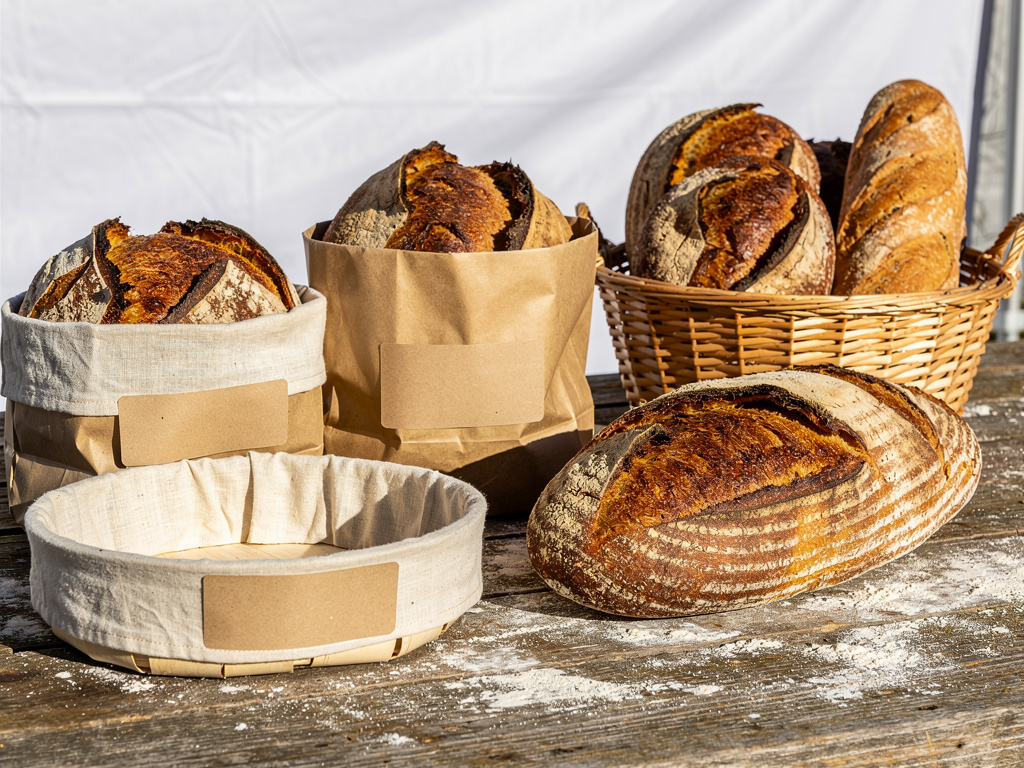


The short version: Sourdough sells in seven places: a farmers market booth, your own pre-order link, porch pickup, cafes and sandwich shops, cheese shops and co-ops, a farm's CSA box, and online, where only starter and shelf-stable sourdough products travel well. You keep $11.35 of a $12 loaf through your own link (plus a flat $10 monthly plan), $10.41 on Etsy, and $6.00 to $7.20 when a cafe buys it at wholesale. Because the dough takes two days, every place that takes orders works better when they close two to three days before you bake. Most part-time bakers do best with one in-person place and one pre-order link, and the shop and cafe routes depend on a state rule you should check first.
Checked on Homegrown's signup page, Hotplate's pricing page, Etsy's fee and payments policies, Square's and Shopify's pricing pages, September 22, 2026. Homegrown is $10 a month billed annually with 0% commission and 2.9% + $0.30 card processing paid by the vendor. Customers create a Homegrown account to place their first order, Homegrown has no timed drop or countdown feature, and you should plan on most orders coming from people you send to your own link.
You baked eight loaves on Saturday, your neighbors took five, and three are cooling on the counter while your group chat asks if you are "doing this every week now." That is the moment the question changes from whether you can sell sourdough to where it should go.
Sourdough is not like cookies or jam. It takes two days from starter to crust, it sells for about $12, and it is best within a couple of days of baking. Those three facts decide which counters make sense for it. This guide walks through seven places a home baker actually sells sourdough, what each one keeps from a $12 loaf, and which ones your state may not let you use at all.
Sourdough sells in seven places, and a part-time baker can run two of them well without hiring help. Each one asks for something different: a Saturday morning, a pitch to a shop owner, or nothing more than a link you text to the people who already love your bread.
In a pull of the Homegrown catalog on August 14, 2026, 263 of the 1,804 products listed had "sourdough" in the name, from 47 vendors. 158 of those were loaves, including sandwich and mini loaves. The rest were sweet bakes like cookies and cinnamon rolls (58), other bread formats like bagels, focaccia and English muffins (31), and starter, crackers and mixes like pancake mix (16), where 2 of the 6 starters were listed as dried and the rest as starter or a starter kit. These are product listings, not sales figures.
What sourdough vendors actually list
Source: a pull of the Homegrown catalog, August 14, 2026, 263 products with "sourdough" in the name from 47 vendors. Each product counted once.
That split matters for this article. The loaves in the top bar of that chart belong in places close to home. The 16 starter, cracker and mix products in the bottom bar are the only sourdough products that can realistically travel, and the starter only travels well when it is dried rather than live. If you have not sorted out labels, packaging and the pre-order rhythm yet, the partner guide on how to sell sourdough bread from home covers that ground. This article starts where that one stops, with loaves that need a counter.
Sourdough needs its order count about two days before it comes out of the oven, and that one fact rules out some places and favors others. You feed the starter the night before you mix, the dough ferments most of a day, shaped loaves rest in the fridge overnight, and then you bake. A customer who texts on Friday morning for a Saturday loaf is asking for a loaf whose levain was already built on Thursday night.
Here is what that looks like for a Saturday pickup at 9am:
Scroll sideways to see every column.
| Step | When | What you need to know by then |
|---|---|---|
| Orders close | Wednesday, 9pm | How many loaves, which flavors |
| Feed the starter and build the levain | Thursday evening | The total flour weight for the bake |
| Mix, fold and shape | Friday, most of the day | The count per flavor and per shape |
| Cold rest in the fridge | Friday night | Nothing new; the count is locked |
| Bake and cool | Saturday, 2am to 8am, about seven rounds of two boules in a home oven | Nothing; a late order cannot be added |
Read the places on this list through that table. Anything that tells you the count ahead of time fits sourdough well:
This is why pre-orders matter more for sourdough than for jam or cookies, which keep for weeks. The pricing guide on how much to sell sourdough for puts the median loaf on Homegrown at $12, so baking four loaves too many on a 12-loaf day is $48 of bread you did not sell.
Start with the place that matches what you already have, not the one with the biggest crowd. A baker with 200 people in a neighborhood group has a different first move than a baker with a great open crumb and nobody's phone number.
Scroll sideways to see every column.
| What you have right now | Start here | Add second | Why that order |
|---|---|---|---|
| Friends and neighbors already asking | Your own pre-order link | Porch pickup | The demand exists; you need a cutoff and a payment, not a crowd |
| No customers yet | A farmers market | Your own pre-order link | Strangers buy a $12 loaf after tasting it, almost never after reading about it |
| A slot in a busy market | Your own pre-order link | Weekly repeat orders from market regulars on the same link | The booth makes customers; the link lets them reserve next week before they leave |
| More oven than customers | A cafe or sandwich shop | A cheese shop or co-op | One standing order moves 10 loaves with no booth and no guesswork |
| A friend who runs a CSA farm | A CSA add-on | Your own pre-order link | A 60-member farm already has 60 families picking up every week |
The trap is starting in four places at once. Each place needs its own count, its own price sign and its own pickup rhythm. A baker who opens a market, two cafes and a CSA in the same month ends up running four bake schedules off one starter and one home oven.
A useful test is the count. If you can name how many loaves a place needs before Thursday night, it fits a sourdough schedule. If you cannot, it needs to earn a lot more per loaf to be worth the guess.
A farmers market is the best place to find your first sourdough customers and a hard place to make a living on sourdough alone. Booth space usually runs $20 to $75 a week, and the booth fee is the smallest line on the day once you add ingredients, packaging, gas and your time, as the breakdown of the real cost of selling at farmers markets lays out.
The booth math at $12 is friendly. Ingredients for a plain loaf run about $1 to $2 and a bag, label and tie about $0.40 to $0.80, using the napkin figures from the sourdough pricing guide. At $12, the top of that guide's $10 to $12 range for a plain loaf, that leaves roughly $9.20 to $10.60 a loaf toward the booth and your time, so a $40 booth is covered by the fourth or fifth loaf. At $10, the median plain loaf in the same guide, it leaves $7.20 to $8.60, and it takes the fifth or sixth loaf to pay for the booth. The hard part is the other direction: 16 loaves at $12 is a $192 day, and the market itself eats six to eight hours before you count the two days of dough.
What a booth gives sourdough that no web page can:
Markets often cap how many booths sell the same product, so a market that already has a sourdough baker may turn a second one away. Ask the market manager before you apply, not after. Your state may also treat a market as its own kind of sale: Pennsylvania, for example, says a Retail Food Facility License may be required for sales at an event or farmers market on top of the home kitchen registration.
A pre-order link hands you the loaf count before you feed the starter, the way a standing cafe order or a CSA add-on does, and on a $12 loaf it costs $0.65 in card processing, so you keep $11.35 per loaf, and the plan is a flat $10 a month on top. No commission comes off the top. A standing cafe order also gives you a count but pays $6.00 to $7.20 for the same loaf, and a market booth makes you guess the count on Thursday.
Homegrown handles that Wednesday cutoff with its pickup lead-time setting. It is $10 a month billed annually, or $12.50 billed monthly, with no percentage fees beyond standard payment processing at 2.9% + $0.30 per order, which the vendor pays. You list each loaf with its pickup day and place, set a pickup lead time of about two and a half days so orders for a Saturday 9am pickup close Wednesday night, customers order and pay before then, and Thursday night you know you are building levain for 14 loaves, not 9. Compare that with Hotplate, a pre-order tool many sourdough bakers use: it has no monthly plan, but by default it adds 5% + $0.55 to the customer's checkout, so a $12 loaf rings up at $13.15 before tax and tip. Etsy takes $1.59 from the same loaf and is built for shipping, which fresh sourdough does badly. Here is what Homegrown does not do. It has no timed drop or countdown release, which is Hotplate's signature. Customers create a Homegrown account the first time they order. Your storefront is listed on the marketplace, but plan on most orders coming from people you send to your own link.
Super Suzi's Sourdough lists 17 products on its Homegrown storefront, pulled live on September 22, 2026. The ladder runs from a Classic Artisan Sourdough at $12.00, through five flavored loaves at $15.00 (Maple Oat, Jalapeño Cheddar, Rosemary Garlic Sea Salt, Everything, and a Chocolate Chip Croissant Loaf), to $10.00 four-packs of bagels, English muffins and sandwich rolls, and $6.00 to $8.00 shelf-stable add-ons like a 6-ounce bag of sourdough breadcrumbs and sourdough pancake mix. The menu has something at every price a regular might want to add to the order.
Your regulars can come back to the same link and order again every week. Ten regulars who each order one loaf a week at $12 is $480 a month. Each week's count still lands by the Wednesday cutoff, and a regular who is away just skips ordering that week.
If you are already answering "are you baking this week?" messages, that is the case for a link. Set up a storefront, list your sourdough, set your pickup lead time so orders close Wednesday night, and put the link on a card in every bag so this week's loaf sells next week's.
Porch pickup works well for sourdough, as long as people reserve before they come. It costs nothing beyond a table, a cooler or bread box, and a sign, and it turns your front door into the market. The catch is the same as every other place on this list: an open-ended "come by Saturday" gives you no count, and a reserved pickup window gives you one. Ten reserved loaves at $12 is $120 by 11am, with no booth fee and nothing left on the step.
Advertising is where the neighborhood comes in. A photo of a scored loaf in a local Facebook group or on Nextdoor finds the customers. The order should not live in the comments, though. By loaf number 15, quantities, flavors, payment and pickup times spread across a dozen message threads, and somebody's cinnamon raisin goes to the wrong person.
What makes porch pickup run smoothly:
Check your town's zoning and your state's rules on selling from home before you post the sign. Most cottage food rules allow sales from your own home, but a homeowners association or a city ordinance can still say no to a sign in the yard.
Walk in at a quiet hour with two loaves, a one-page price sheet and a delivery day, and ask for the owner. Wholesale bread usually bills the shop 50 to 60 percent of what it will charge, so a loaf a cafe sells for $12 earns you $6.00 to $7.20, the convention laid out in the guide to getting your food into a local coffee shop.
Sourdough has an edge here that other breads do not. Cafes and sandwich shops want it for what they make, not just to resell. Avocado toast, grilled cheese and a turkey sandwich on sourdough are menu staples, and a shop that turns one loaf into six or eight sandwiches earns far more from it than $12. That gives you room to ask for a price near the top of the wholesale range, or to sell a pan loaf built for slicing.
Wholesale is the one place on this list that pays you for consistency. It also punishes a missed week hardest. If your starter is sluggish or your kid is sick, the shop's toast menu is empty and the owner has to explain it. Before any of this, read the section below on selling to a business, because in many states a cafe cannot legally buy from a home kitchen at all.
Yes, where your state allows sales to a business for resale, and a cheese shop is the most natural shelf a sourdough loaf will ever sit on. The customer at the cheese case is already thinking about bread. A grocery co-op or a specialty grocer works the same way, with more foot traffic and less conversation.
Shops take bread one of two ways, and the one they name decides what you earn and who eats the loss on a slow day.
Scroll sideways to see every column.
| How the shop takes it | What you get on a loaf the shop sells for $12 | Who holds the risk | When you get paid |
|---|---|---|---|
| For comparison: you sell it yourself, through your own link | $11.35 | You | At the sale |
| Wholesale, 50 to 60 percent of the shelf price | $6.00 to $7.20 | The shop, once it buys the loaves | On delivery, or on net 30 terms, paid within 30 days of delivery |
| Consignment, the shop keeps 30 to 40 percent (a 60/40 split is common, and some shops agree to 70/30) | $7.20 to $8.40 | You, sitting on their shelf | Only after each loaf sells |
Consignment looks better on paper and is usually worse for sourdough. A loaf that has not sold in two or three days is yours to take back, and the shop has no money in it and no reason to push it. Wholesale moves the risk to the shop, which is why shops prefer consignment and why you should counter with wholesale.
A few things that help a sourdough loaf sell on a shelf you are not standing behind:
In many states, no, not from a home kitchen, and this one rule decides three of the seven places on this list: cafes and sandwich shops, cheese shops and co-ops, and a CSA where the farm buys the bread. The idea behind it is old: the FDA's model Food Code, which most states copy, says in section 3-201.11 that "food prepared in a private home may not be used or offered for human consumption in a food establishment," and a cafe is a food establishment. Cottage food laws carve out an exception for selling straight to the person who eats the bread. Selling to a shop is a separate question each state answers on its own.
Here are two states that answer it in opposite ways, both checked on September 22, 2026:
Virginia's home food processing exemptions FAQ, revised July 2026, names sourdough bread as a baked good that may qualify. It also says exempt products cannot be sold for resale, on consignment, for use in retail food establishments, to other businesses, or across state lines. So a Virginia home baker can sell by phone, online or in person to the person eating the loaf, and can mail or deliver it within Virginia, but cannot sell to a cafe or a cheese shop without a state permit.
Pennsylvania has no uninspected home tier. A home kitchen registers with the Department of Agriculture as a Limited Food Establishment, which costs $35 to register and $35 a year to renew and comes with routine inspections. Penn State's Agricultural Law Center lists no annual sales cap and direct, indirect and online sales allowed for these registered home kitchens. An indirect sale is one where a shop or cafe buys your bread and resells it. So a registered Pennsylvania home kitchen can sell to a cafe or a cheese shop.
Other states land in between. Texas changed its law on September 1, 2025, so a home baker can now sell products that need no refrigeration for safety at wholesale to a registered "cottage food vendor," who resells them at a farmers market, farm stand, restaurant or retail store, with the bake date on the label. Michigan still limits cottage food to direct sales, with online and mail orders allowed only inside Michigan and only when the customer can deal with you directly first. The state-by-state detail for Texas, California, Florida and Michigan is in the permission guide to selling homemade sourdough.
Your flavored loaves may not be covered even where plain sourdough is. Virginia's July 2026 FAQ says breads with fresh toppings or inclusions such as cheese, herbs or vegetables may not qualify for the home exemption. That can cover loaves like jalapeño cheddar or rosemary garlic, two of the flavored loaves on the Super Suzi's Sourdough menu above. Verify your state's current rules for each flavor before you list it anywhere.
Yes, and a CSA add-on is one of the best-fitting places for sourdough, because the farm hands you a weekly count and a crowd that already picks up at a set time. A CSA, short for community supported agriculture, is a farm that sells seasonal memberships and hands out a box of produce every week. Many farms let members add a loaf of bread, a dozen eggs or a jar of honey to that box.
How you set it up matters as much as whether the farm says yes. There are three setups, and they are two different sales in the eyes of most cottage food laws:
The numbers can be good. A farm with 60 members where one in five adds a weekly loaf is 12 loaves a week at your full $12 price when members order and pay through your own link, with your own cutoff, as in the second and third setups. That is $144 a week in sales, or about $576 a month, with no booth fee and no guessing.
To find one, ask the farms you already buy from at your market, or look for farms near you in the USDA's Local Food Directories. Pitch the add-on in late winter, when farms are planning their season and member signup forms, not in July when the boxes are already running.
You can take sourdough orders online almost anywhere, but shipping fresh loaves is a poor fit, and in many states it is not allowed across state lines at all. What travels is the shelf-stable side of a sourdough business: dried starter, crackers, biscotti, breadcrumbs and pancake mix. In the August 2026 catalog pull, 16 of the 263 sourdough products on Homegrown were starter, crackers or mixes, and 6 of those were sourdough starter, 2 of them listed as dried.
Why fresh loaves ship badly:
Starter is different. A few grams of dried starter in a small envelope weighs almost nothing, keeps for months, and sells to a national crowd of home bakers. That is the one sourdough product where Etsy can make sense, since Etsy's audience shops nationally, but only if your state lets you sell across state lines. Virginia and Michigan do not. On a $12 order, Etsy takes a $0.20 listing fee, a 6.5% transaction fee of $0.78, and payment processing of 3% + $0.25, another $0.61, for $1.59 in total. An Etsy Offsite Ads sale adds 15 percent on top for shops under $10,000 in sales over the prior year, which can opt out of Offsite Ads, or 12 percent once a shop reaches $10,000. We checked all of that on Etsy's fee and payments policies on September 22, 2026.
Some sourdough guides still recommend Castiron as a place to sell. Castiron has closed. On September 22, 2026, its old address loaded an online casino page instead of a bakery storefront. Do not build your ordering on it, and treat any guide that recommends it as out of date.
You keep anywhere from $6.00 to $12.00 of a $12 sourdough loaf, depending on where it sells, and the place matters far more than the fee on any one app. The table below puts the full cost of each place side by side on the same loaf and the same month of 50 loaves.
Scroll sideways to see every column.
| Place | Subscription | Trial | Platform fee or cut | Card processing | Customer pays for a $12 loaf | You keep per loaf | You pay in a month of 50 loaves ($600) |
|---|---|---|---|---|---|---|---|
| Farmers market booth, cash | $0, but booth space runs $20 to $75 a week | Not applicable | $0 | $0 on cash | $12.00 | $12.00 | $0 in fees, plus $160 in booth fees at $40 a week |
| Farmers market booth, Square Free plan, card tapped | $0 | Not applicable | $0 | 2.6% + 15 cents, paid by the vendor | $12.00 | $11.54 | $23.10, plus the same booth fees |
| Your own storefront link (Homegrown) | $10/mo billed annually, $12.50 billed monthly | 7 days, no charge until day 8 | $0, 0% commission | 2.9% + $0.30, paid by the vendor | $12.00 | $11.35 | $42.40 on annual billing, $44.90 on monthly |
| Hotplate, default setting | $0 | Not applicable | 5% + $0.55 added to the customer's checkout | 2.9% + $0.30, paid by the vendor | $13.15 | $11.32 | $34.07 |
| Hotplate, vendor covers the service fee | $0 | Not applicable | 5% + $0.55, paid by the vendor | 2.9% + $0.30, paid by the vendor | $12.00 | $10.20 | $89.90 |
| Square Online, Free plan | $0 on Free, $49/mo per location on Plus | Free plan | $0 | 3.3% + 30 cents on Free, 2.9% + 30 cents on paid plans | $12.00 | $11.30 | $34.80 |
| Shopify Basic | $29/mo billed yearly, $39 billed monthly | 3 days, then $1/month for 3 months | $0 on Shopify Payments | from 2.9% + 30 cents | $12.00 | $11.35 | $61.40 on yearly billing, $71.40 on monthly |
| Etsy | $0; a one-time set-up fee may apply | None | 6.5% transaction fee plus $0.20 per listing; 12 to 15% on Offsite Ads sales | 3% + $0.25 | $12.00 plus shipping | $10.41 | $79.50, before shipping and ads |
| Cafe or cheese shop, wholesale | $0 | Not applicable | The shop keeps 40 to 50% of its $12 shelf price | $0, invoiced or paid on delivery | $12.00 at the shop | $6.00 to $7.20 | You bill $300 to $360 instead of $600 |
| Cheese shop or co-op, consignment | $0 | Not applicable | The shop keeps 30 to 40% of each loaf sold | $0 to you | $12.00 at the shop | $7.20 to $8.40, on loaves that sell | You bill $360 to $420, if all 50 sell |
Every rate was read off the company's own page on September 22, 2026: findhomegrown.com/signup, hotplate.com/pricing, etsy.com/legal/fees and etsy.com/legal/etsy-payments, squareup.com/us/en/pricing and shopify.com/pricing. Hotplate's processing is estimated on the full $13.15 the card is charged, to be conservative; Hotplate's own worked example charges processing on more than the subtotal alone. Annual billing is compared to annual billing and monthly to monthly. Wholesale uses the 50 to 60 percent of retail convention. Consignment uses the common 60/40 craft consignment split, with 70/30 where a maker negotiates it, as CraftProfessional's consignment guide describes.
Read the last column, not the fee column. The gap between your own link and Etsy is about $37 on 50 loaves. The gap between the $600 you take in selling those loaves yourself and the $300 to $360 a cafe pays is $240 to $300. The fee rarely decides a sourdough channel. The count and the share you give away do.
Experienced sourdough vendors run two places, not five, and they bake to a confirmed count rather than a hopeful one. The habits below are what keep a two-place setup running week after week.
Size every new place by your oven, not by the order. A standard home oven holds two Dutch ovens at a time, and each round takes about 50 minutes, so a six-hour Saturday bake, like the 2am to 8am one in the schedule above, tops out around 14 boules. If your pre-orders already take ten, a cafe asking for six a week is a second bake day or a second oven, not a yes. Bakers who switch the cafe loaves to pan loaves can often fit four loaf pans on one rack and double what each round produces.
Every place on this list has a second cost that never shows up in a fee table, and for sourdough it is almost always time or unsold bread. The fee on a $12 loaf runs from $0 to $1.83 (Hotplate's default: a $1.15 service fee the customer pays plus $0.68 in card processing you pay), or up to $3.39 on an Etsy sale that came through Offsite Ads. The hidden cost can run to a whole bake.
None of these is a reason to skip a place. They are the reason to run two and not five, and to pick the two whose hidden cost you can actually carry.
Pick one place, run the five steps below, and you can take orders there within seven days. The most common mistake is researching every place for a month instead of opening one this week.
That last step is the one that compounds. A market Saturday that ends with 16 loaves sold and no way to reorder is 16 people who have to remember you next week. Open a storefront for your sourdough with a pickup lead time that closes orders Wednesday night, and the same Saturday ends with 16 people who can reserve next week's loaf from their couch on Tuesday night.
If sourdough is one of several breads you bake, the broader guide on where to sell bread runs a similar seven-place comparison on a $10 plain loaf, including craft fairs and bulk orders.
With no market nearby, the best places to sell sourdough bread are your own pre-order link with porch pickup, a CSA add-on with a nearby farm, and, where your state allows it, a standing order with a local cafe. Porch pickup costs nothing beyond a table and a sign, and a reserved two-hour window keeps it from eating your Saturday. A farm with 60 members where one in five adds a weekly loaf gives you 12 confirmed loaves a week without any foot traffic at all, as long as members order and pay you through your own link rather than buying through the farm.
Facebook Marketplace and neighborhood groups are good places to advertise sourdough and poor places to run the orders. Posting is free and reaches exactly the local buyers a $12 loaf needs. The trouble starts around the 15th order, when flavors, payments and pickup times are spread across private messages and something gets missed. Post the photo in the group, then send people to an ordering page with a cutoff that records what they bought and when they are collecting it.
Independent coffee shops and sandwich shops do buy homemade sourdough, but only if your state lets a home kitchen sell to a business for resale. Many states, including Virginia and Michigan, do not allow it under their home exemptions. Where it is allowed, expect about half to three fifths of the shop's price, which is $6.00 to $7.20 on a loaf it sells for $12. Start with 6 to 10 loaves a week and a fixed delivery day.
You can sell sourdough starter in many states, since many treat dried starter as a shelf-stable cottage food, but check that your state's list covers it. Dried starter, like sourdough crackers and pancake mix, ships well. It weighs almost nothing, keeps for months, and sells to home bakers nationally as well as at your own table. In a Homegrown catalog pull from August 14, 2026, 6 of the 263 sourdough products listed were starter, dried or fresh. Check whether your state allows mailing it across state lines before you list it on a national marketplace.
Bake 10 to 14 sourdough loaves for a first market day, and plan around selling 6 to 10 of them until you know your market. At $12 a loaf, a $40 booth is covered by the fourth or fifth sale, or the fifth or sixth at $10, the median plain loaf, so 10 loaves makes it very likely you cover the table without carrying a dozen home. Bring a mix: mostly plain loaves, two or three of one flavor, and a few smaller formats. Adjust by two or three loaves the next week, not by doubling.
You can sell sourdough at most craft fairs and holiday markets, since a table at a fair counts as a direct sale to the customer in nearly every state, though some states, like Pennsylvania, may require an extra license at events, so check yours. They work best from October through December, when shoppers are buying gifts and hosting dinners. Sell gift formats there rather than the everyday loaf: two mini loaves in a box, a seasonal shape, or a loaf paired with a jar of dried starter. Take pre-orders for holiday pickup at the same table.
Each place above has a page that goes deeper than one section can.



