
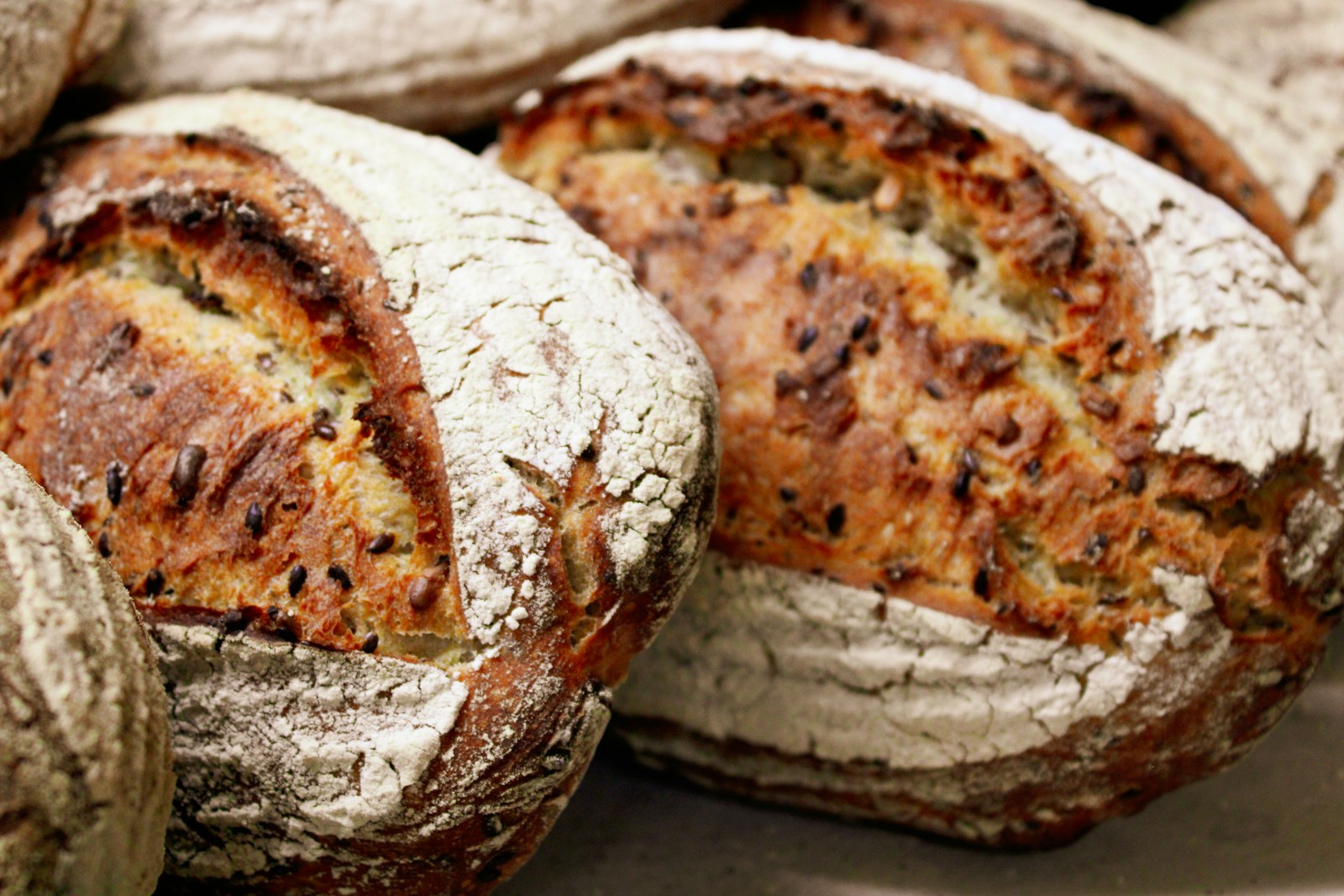


The short version: Charge $10 to $12 for a plain sourdough loaf and $12 to $15 for a loaf with inclusions like cheddar, jalapeño or blueberry. Whole grain, spelt and einkorn loaves support $14 to $20. On September 18, 2026, the median price of 172 full-size sourdough loaves on Homegrown was $12, and 71% were priced between $10 and $15.99. Card processing takes about $0.65 to $0.70 of a $12 loaf on the online ordering tools we checked, so price with that in mind rather than below it.
Checked on Homegrown's catalog, the Homegrown signup page, Hotplate's pricing page and Square's pricing page, September 18, 2026. Prices are what vendors list, not what every loaf sold for. Your town may run a dollar or two above or below. Homegrown customers create an account to place their first order.
Most home bakers should sell a standard sourdough loaf for $10 to $14, and $12 is the most common price right now. That is not a guess. On September 18, 2026 we pulled every sourdough loaf listed on Homegrown, 172 full-size loaves from 64 small vendors, and the middle of the pack sat right at $12. Plain loaves ran lower, flavored loaves ran higher, and the bakers charging $8 were mostly leaving money on the table.
The sections below cover what real vendors charge for each kind of loaf, what you keep after card fees, and what a week looks like at 8, 20 and 40 loaves.
Sell a plain sourdough loaf for $10 to $12 and a flavored loaf for $12 to $15, then adjust a dollar or two for your town. Those ranges come straight from what small vendors on Homegrown listed on September 18, 2026, not from a bakery chain or a big-city storefront.
Here is how the 172 full-size loaves broke down by type. "Middle half" means the price range where the middle 50% of listings landed, which is a better guide than the extremes.
Scroll sideways to see every column.
| Loaf type | Listings | Median price | Middle half | Highest seen |
|---|---|---|---|---|
| Plain (country, original, classic) | 39 | $10 | $8 to $12 | $15 |
| Sandwich loaf (baked in a pan) | 17 | $11 | $9.50 to $12 | $13 |
| Flavored (cheese, fruit, herbs, seeds) | 104 | $13 | $10 to $15 | $20 |
| Whole grain, rye, spelt, einkorn, organic | 12 | $14.50 | $12.25 to $20 | $20 |
| All full-size loaves | 172 | $12 | $10 to $14 | $20 |
If you want the bigger picture of getting started, including cottage food rules, labels and finding buyers, our guide on how to sell sourdough bread from home covers the whole setup. This page stays on one question: the number you write on the tag.
A few quick rules of thumb fall out of the table:
Most full-size sourdough loaves on Homegrown are priced $10 to $15.99: 71% of the 172 loaves sat in that range, and the single busiest band was $14 to $15.99. The middle half, $10 to $14, is the range this guide recommends. The price list below is built from real listings, so it shows you where your price would sit next to other small vendors.
In a pull of the Homegrown catalog on September 18, 2026, 368 of the 2,485 products listed by 288 vendors had "sourdough" in the name, from 71 vendors. After setting aside cookies, bagels, rolls, starter, mini loaves, 3-pound loaves and one $1 placeholder listing, 172 full-size loaves from 64 vendors were left. Their median price was $12, and 122 of them (71%) were priced from $10.00 to $15.99.
Full-size sourdough loaves on Homegrown by listed price
Source: Homegrown catalog pull, September 18, 2026, 172 full-size sourdough loaves from 64 vendors.
What stands out in that spread:
A flavored sourdough loaf should cost $2 to $4 more than your plain loaf. In the September 18 pull, the median plain loaf was $10 and the median flavored loaf was $13, a $3 gap across 104 flavored listings from 45 vendors.
Flavored loaves, sometimes called inclusion loaves, have something folded into the dough: cheese, fruit, nuts, herbs or seeds. Those add-ins cost real money, and they add steps to your bake. Customers also see them as a treat, so they expect to pay more.
Here is a simple ladder that matches what vendors are doing:
Price your add-in by the batch, not the loaf. If a $6 block of cheddar goes into four loaves, that is $1.50 a loaf before the extra shaping time. A $3 bump covers the cheese and pays you for the mess, and it still lands at $13 on a $10 base, right at the median.
The most common mistake here is charging the same price for every loaf. When your jalapeño cheddar costs the same as your plain loaf, customers pick the cheddar every time and you earn less on your busiest loaf.
Whole grain, rye, spelt and einkorn sourdough loaves should cost $14 to $20. In the pull, 12 of these loaves from 7 vendors had a median price of $14.50. One vendor listed all five of its organic einkorn and spelt loaves at $20, while another vendor's organic spelt loaf was $14 and its spelt wheat loaf was $13.
These flours cost more per pound than regular bread flour, and they behave differently in the dough. Spelt and einkorn ferment faster and are easier to over-proof, so you lose more loaves while you learn. That risk belongs in your price.
When you price a specialty grain loaf:
Customers who want these loaves are usually looking for them on purpose, often for flavor or because they digest them more easily. They compare you with specialty bakeries, not with the grocery store, so you do not need to shave dollars off to make the sale.
Price loaves by weight first, then round to a clean number, and charge more per pound for small loaves. A 2-pound loaf at $12 works out to $6 a pound, so a 1-pound mini at $7 is $7 a pound, which is right because a mini takes nearly the same shaping and scoring time.
Here is how size played out in the pull:
Weigh a few finished loaves and write the weight on your label. Many states require net weight on cottage food labels anyway, so check your state's rules. Once the weight is on the tag, customers can see that your $14 loaf is bigger than someone else's $10 loaf.
A simple size ladder, using a $12 standard loaf:
Assuming a 2-pound loaf at $12, sourdough sells for about $6 a pound, more than three times grocery bread, because it is a different product. Plain white sandwich bread from the grocery store averaged $1.82 a pound in August 2026, according to the Bureau of Labor Statistics' average price series for white pan bread. A 2-pound sourdough loaf at $12 is $6 a pound, about 3.3 times as much. Most listings in the pull gave no weight. The one vendor who did listed 1.5-pound loaves at $10 and $12 and a 3-pound loaf at $18, which works out to $6 to $8 a pound.
Customers already know this gap exists. They are not buying a sourdough loaf to save money on bread. They are buying slow fermentation, a crackly crust, real flavor, and a person they know who made it.
The flour is not where the money goes. All-purpose white flour averaged $0.548 a pound in August 2026 in the same government data. A loaf with about 1.1 pounds of flour uses roughly $0.60 of all-purpose flour, and even if your bread flour costs twice that, you are near $1.20.
Where your price actually comes from:
So when someone at the market says "$12 for bread?", the honest answer is that they are paying for a day and a half of fermenting and a few hours of hands-on work, not for $1 of flour.
Add your ingredients, packaging, fees and a fair hourly wage per loaf, and make sure your price sits at least $2 above that total. If a $12 loaf does not clear that bar, raise your batch size or your price before you lower your standards.
Our cost per loaf sourdough breakdown walks through every cost in detail. Here is the short check you can do on a napkin:
The time line is the one that moves the most. The same three hours spread over 16 loaves drops your labor to $3.75 a loaf, which is why bigger bake days make sourdough pay. For a broader formula that works on cookies and cakes too, see how to price baked goods.
On a $12 loaf you keep about $11.30 to $11.35 on the online ordering tools we checked, $11.54 when a customer taps a card in person on Square's Free plan, and the full $12 in cash. The difference between tools is less about the card fee and more about who pays the extra service fee and what the customer sees at checkout. The place moves the number far more than the tool does: the same $12 loaf pays you $6.00 to $7.20 when a cafe buys it at wholesale, which is why the breakdown of where to sell sourdough prices all seven places on this same loaf.
Scroll sideways to see every column.
| Way of selling | Monthly plan | Trial | Platform or service fee | Card processing | Customer pays for a $12 loaf | Vendor pays per $12 loaf | Vendor pays in a month of 50 orders at $12 |
|---|---|---|---|---|---|---|---|
| Cash at a farmers market | None | Not applicable | None | None | $12.00 | $0.00 (booth fee separate) | $0.00 plus booth fees |
| Square Free plan, card tapped in person | $0 | Not applicable | None | 2.6% + 15¢, paid by the vendor | $12.00 | $0.46 | $23.10 |
| Square Free plan, paid online | $0 | Not applicable | None | 3.3% + 30¢, paid by the vendor | $12.00 | $0.70 | $34.80 |
| Hotplate, default setting | $0 | Not applicable | 5% + $0.55, added to the customer's checkout | 2.9% + $0.30, paid by the vendor | $13.15 | $0.68 | $34.07 |
| Hotplate, vendor covers the service fee | $0 | Not applicable | 5% + $0.55, paid by the vendor | 2.9% + $0.30, paid by the vendor | $12.00 | $1.80 | $89.90 |
| Homegrown | $10 billed annually ($12.50 billed monthly) | 7 days, no charge until day 8 | None, 0% commission | 2.9% + $0.30, paid by the vendor | $12.00 | $0.65 plus the plan | $42.40 ($44.90 on monthly billing) |
We checked these fees on Homegrown's signup page, Hotplate's pricing page and Square's pricing page on September 18, 2026. Monthly totals use the unrounded per-loaf fee ($0.648 on 2.9% + $0.30 of $12, or $0.681 on Hotplate's $13.15) times 50 orders. Square's Plus plan ($49 a month) lowers online processing to 2.9% + 30¢. Card processing is figured on what the card is charged: $12, or $13.15 on Hotplate's default, because Hotplate's own worked example charges processing on more than the subtotal ($1.27 on a $30 order). Tips and sales tax would add a few cents.
What the table tells you about pricing:
Fees change. We checked every number in this table on September 18, 2026, so recheck the pricing page of whatever tool you use before you set prices for the year. Etsy is left out of the table on purpose: its fee page lists a 6.5% transaction fee and a $0.20 listing fee, but its U.S. card processing rate did not load for us that day, and we will not print a number we did not see.
At $12 a loaf, a baker selling 8 loaves a week keeps about $72, one selling 20 keeps about $185, and one selling 40 keeps about $372, before counting their own time. The table uses example costs of $2 per loaf for ingredients and packaging, card processing on every loaf, and a Homegrown plan at $10 a month, billed annually, spread across the weeks. Swap in your own numbers.
Scroll sideways to see every column.
| Loaves a week | Price | Sales | Ingredients and packaging ($2 each) | Card processing ($0.648 each) | Plan share ($10 a month, billed annually) | You keep | Example hours | Per hour |
|---|---|---|---|---|---|---|---|---|
| 8 | $12 | $96 | $16 | $5.18 | $2.31 | $72.51 | 4 | $18.13 |
| 20 | $12 | $240 | $40 | $12.96 | $2.31 | $184.73 | 7 | $26.39 |
| 40 | $12 | $480 | $80 | $25.92 | $2.31 | $371.77 | 12 | $30.98 |
| 8 | $9 | $72 | $16 | $4.49 | $2.31 | $49.20 | 4 | $12.30 |
The plan share is $10 a month (the annual billing rate) times 12 months, divided by 52 weeks. On monthly billing at $12.50, add about $0.58 a week. The hours are examples; time your own bake day once and use your number.
Three things jump out:
Once you have picked your price, the next job is making sure the price your customer sees is the price you set, and that you keep nearly all of it. Homegrown is $10 a month billed annually ($12.50 billed monthly) with no percentage fees beyond standard payment processing, so a $12 loaf shows up as $12 at checkout and you keep $11.35 of it before your monthly plan.
Here is how that compares with the tools sourdough bakers usually try:
For a sourdough baker, the parts of Homegrown that matter are the ones that fit a weekly bake: you list each loaf with its own price, so your plain, cheddar and spelt loaves sit on one page at $10, $13 and $18. Customers order and pay ahead, so you know your loaf count before you mix. Pickup times and a list of who ordered what come with it.
Honest bounds: Homegrown does not set your prices or tell you what your town will pay, and it does not ship bread across the country. Customers create a Homegrown account to place their first order. It has no timed drop release feature. Your storefront is listed on the Homegrown marketplace, but plan on most orders coming from people you send to your own link. If you want to see your loaves on a storefront at the prices you just picked, you can set up your Homegrown storefront with a 7-day trial and no charge until day 8.
No, charge the same $10 to $14 for a sourdough loaf at the farmers market and on pre-order, and if anything, protect pre-orders. A pre-order is money in hand before you mix, with zero leftover loaves, which is worth more to you than a walk-up sale.
Keeping one price everywhere does three things:
If you want a reason for customers to order ahead, give them something other than a lower price: first pick of flavors, a guaranteed loaf when the booth sells out by 10 a.m., or a mixed half loaf add-on only available ahead of time. Our breakdown of the real cost of selling at farmers markets shows why booth fees make every market loaf cost you more than a pre-ordered one.
If your market regulars keep asking whether they can "save one for next week," that is your pre-order list asking to exist. A Homegrown storefront lets them order and pay for next Saturday's sourdough at your posted price, so you bake to a known count instead of guessing how many to bring.
Look at five local sourdough prices, find the middle, and set your plain loaf at or up to $2 above it. The Homegrown data gives you the picture across 64 small vendors, but your customers compare you with the bakers they can actually buy from.
Here is a 30-minute way to do it:
When you land somewhere unusual, it is worth a second look:
Raise your price when you sell out for three or four weeks in a row, when you have a waitlist, or when your costs rise. A $1 raise on a $12 loaf is an 8% increase, and most regulars will not blink at it if you tell them ahead of time.
Costs do keep moving. The USDA's Food Price Outlook, updated August 25, 2026, found grocery food prices were 2.7% higher in July 2026 than a year earlier, and it forecasts all food prices up 3.0% in 2026. Cereal and bakery prices are expected to rise at about their usual 20-year pace. If you have not changed your price in two years, your loaf is quietly cheaper than it was.
Signs it is time to raise:
Raise one step at a time. Moving a loaf from $10 to $12 in one jump is fine; moving from $8 to $14 at once tends to lose the regulars you built. Give two weeks' notice on your storefront and at your booth.
For wording that keeps regulars on your side, see how to raise prices without losing customers.
The costliest mistake is pricing from the cost of flour instead of the cost of your time. At $9 a loaf, the 8-loaf baker in the weekly table above earns about $12 an hour, and a baker who sets $8 because "it's only $1 of flour" earns less, before any failed loaves are counted.
The other mistakes that show up again and again:
If you sell several loaf types, tiered pricing for baked goods shows how to set a clear good, better, best ladder so customers pick the tier that fits them.
A fair price for a homemade sourdough loaf is $10 to $14 for most small vendors on Homegrown, so check a few prices in your own town before you settle. On September 18, 2026, the median of 172 full-size sourdough loaves listed by small vendors on Homegrown was $12. Plain loaves had a median of $10 and flavored loaves a median of $13.
Sell sourdough at a farmers market for the same price you charge on pre-order, usually $10 to $12 for plain and $12 to $15 for flavored. Look at the other bread prices at your market before you set yours. Cash sales carry no card fee, but your booth fee comes out of every loaf you sell that day.
No, $15 is not too much for a flavored, whole grain or larger sourdough loaf. In the September 2026 Homegrown data, 48 of 172 loaves were priced between $14 and $15.99, and specialty einkorn and spelt loaves reached $20. For a plain loaf, $15 sits at the top of the range, so make sure the size or quality shows it.
A plain sourdough loaf usually costs $1 to $2 in ingredients and $0.40 to $0.80 in packaging. All-purpose flour averaged $0.548 a pound in August 2026, according to Bureau of Labor Statistics data. Your time is the biggest cost: three hands-on hours at $20 an hour over 8 loaves adds $7.50 a loaf.
Yes, charge $2 to $4 more for sourdough with inclusions like cheese, fruit, nuts or seeds. The add-ins cost more and take more time to fold in and shape. In the Homegrown data, flavored loaves had a median of $13 against $10 for plain.
Across 12 sourdough starter listings on Homegrown in September 2026, live and dried, prices ran $5 to $15 with a median of about $6.50. Five of the 12 were listed at $5, and a live starter sold in its own mason jar sat at the $15 top. Add a printed feeding guide and you can sit at the higher end of that range.
These 5 guides pick up where this pricing page stops, from the full setup for a home bread business to the cost math behind every loaf and the words to use when your price goes up:
Your price is set. The next step is putting it where customers can order ahead. Start your Homegrown storefront, list your plain and flavored loaves at the prices from this guide, and take your first pre-orders for next week's bake.



