
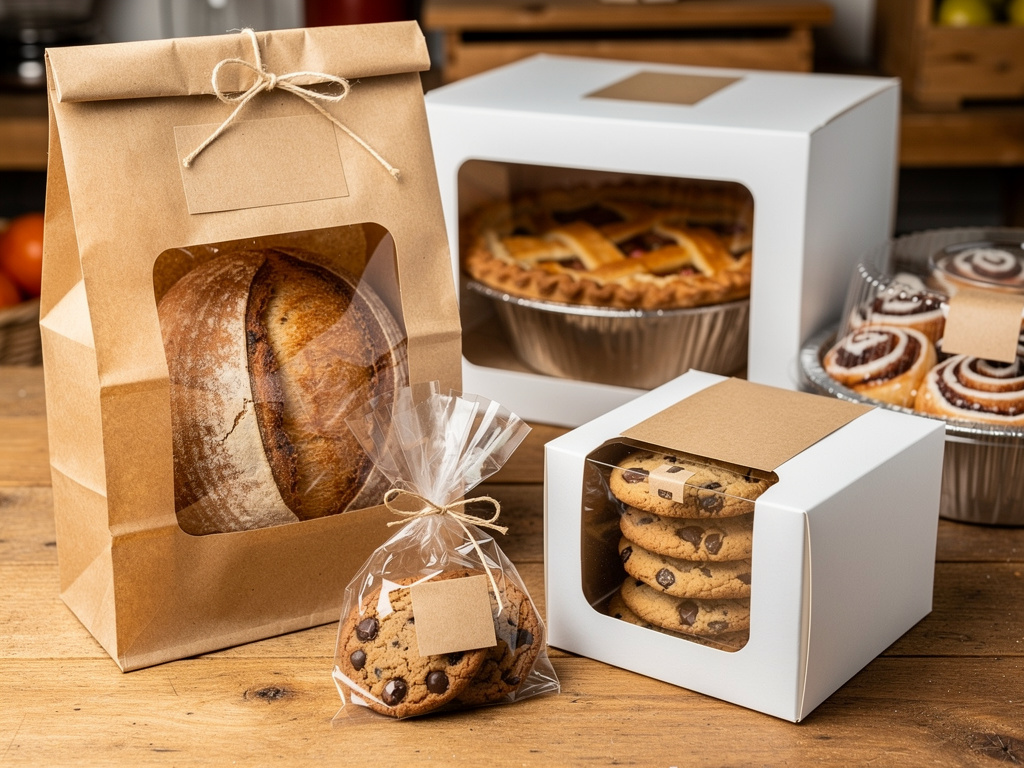


The short version: The best bakery packaging ideas start with the baked good, not the box: a 3-cent clear bag for one cookie, a 62-cent window box for a set of cookies, a 28-cent kraft window bag for a sourdough loaf, a 52-cent box for a pie, an 84-cent box plus a 32-cent cake circle for a cake, and a foil pan with a clear lid ($1.06 together) for cinnamon rolls. Those are per-package prices from WebstaurantStore and ClearBags packs of 10 to 100, before shipping. Against the median price of each type of Homegrown bakery listing, the cookie set box, loaf bag, pie box, cake box and roll pan come to about 2% to 8%, with cinnamon rolls at the top, and those medians mix single pieces with sets. Put your cottage food label on the face a customer sees first, usually the front of a bag or the lid of a box, and check your own state's wording rules before you print.
Checked on the WebstaurantStore and ClearBags product pages, Homegrown's signup page, and the California, Texas and Florida label rules, September 27, 2026: prices change often, so load the page again on the day you order. The Homegrown catalog counts come from a pull the same day. Homegrown does not sell packaging or print labels, it has no drops or countdown release feature, and customers create a Homegrown account to place their first order.
A cookie, a sourdough loaf, a pie, a cake and a pan of cinnamon rolls need five different packages, and buying the wrong one costs more than the box. A soft crust, a smeared frosting top, or a pie that slides into the lid is what a customer remembers. This guide goes baked good by baked good with prices loaded from real supplier pages today, then shows where the cottage food label goes on each package and what three states say about it.
It is written for the home baker who buys packaging 10 boxes at a time, not the bakery ordering 5,000 printed boxes. Every price below is a pack you could order this week.
Each baked good needs a package that matches three things: its shape, how moist it is, and how many you sell at once. The table below puts five common home bakes, cookies, bread, pie, cake and cinnamon rolls, side by side with a real product page, the pack size, and what one package costs.
If you sell jams, dry mixes and produce next to your bakes, our farmers market packaging guide covers those shelves. This article stays on the bakery table and goes deeper on each bake.
Scroll sideways to see every column.
| Baked good | Package | Supplier and pack | Item number | Pack price | Per package |
|---|---|---|---|---|---|
| Cookies, one or two | 4 by 6 inch clear cookie bag, 1.5 mil | WebstaurantStore, LK Packaging, 100 per pack | 13046100 | $2.89 | $0.03 |
| Cookies, a set | 6 by 6 by 3 inch white window box | WebstaurantStore, Baker's Lane, 10 per pack | 999663WBBL | $6.19 | $0.62 |
| Sourdough or artisan loaf | 10 1/4 by 4 by 14 inch kraft bread bag with window | ClearBags, 100 per pack, plus $5.99 flat-rate shipping | KBB5 | $27.78 | $0.28 |
| Sandwich loaf | 8 by 4 by 18 inch plastic food bag, 1 mil | WebstaurantStore, Choice, 1,000 per box | 1308418MED | $36.99 | $0.04 |
| Pie | 10 by 10 by 2 1/2 inch white pie box | WebstaurantStore, 10 per pack | 99910102CBBL | $5.19 | $0.52 |
| Cake | 10 by 10 by 5 inch white cake box, plus a 10 inch cake circle | WebstaurantStore, 10 boxes per pack and 25 circles per pack | 99910105CB and 99910CCC | $8.39 and $7.89 | $0.84 + $0.32 = $1.16 |
| Cinnamon rolls | 8 inch square foil pan plus clear lid | WebstaurantStore, 25 pans and 25 lids per pack | 9991155 and 999P1155 | $15.99 and $10.49 | $0.64 + $0.42 = $1.06 |
We loaded each product page on September 27, 2026. Prices are before shipping except where the shipping is named. The per-package figure is the pack price divided by the count, rounded to the cent. A mil is one thousandth of an inch, the thickness of a bag's plastic. Search the item number on the supplier's site to find the same product.
Cookies sell in two shapes, one at a time or as a set, and each shape has a low-cost package that works. A single cookie goes in a clear bag, which costs about 3 cents in a 100-pack of 4 by 6 inch bags ($2.89). A set goes in a small window box, and WebstaurantStore's 6-inch square white window box, 3 inches deep, runs $6.19 for 10, or 62 cents each. The kraft version of the same box is $5.69 for 10, or 57 cents.
Here is how to choose between them:
Lay your cookies out in a 6 inch square on the counter before you order, and you will know how many fit on one layer. For flavor and pricing ideas, our guide on how to sell cookies from home goes further.
In a pull of the Homegrown catalog on September 27, 2026, 307 vendors listed 2,721 products, and 1,426 of them (52%) were in the Bakery category. Reading each Bakery listing's name, then its description where the name did not say, we counted at least 566 bread listings, 280 cookie listings, 115 cake and cupcake listings, 51 cinnamon roll listings and 33 pie listings. Of the 280 cookie listings, 147 name a set of 2 or more, like a half dozen or a 4 pack, in the product name or its options. That count takes the word dozen, a number word, or a number from 2 to 100 that is not a weight or a size, and leaves out singles and weights like "4oz." One real example the count includes: Eonni Pastelería sells "Cookie Boxes" with options for a "Single" at $3.00 and a "Box of 4" at $10.00. The count does not read descriptions, so a listing like The Wild Crows Oven's "Cookie boxes" at $10.00, described as "A box of 4 cookies," is not in the 147, and the true number is higher.
The best packaging for a crusty sourdough loaf is a paper bag with a window, and the best packaging for a soft sandwich loaf is a plastic bag. A sealed plastic bag holds in moisture, which is what a soft loaf needs and what turns a crackly crust soft. ClearBags sells a 10 1/4 by 4 by 14 inch kraft bread bag with a window at $27.78 for 100, or about 28 cents each, plus $5.99 flat-rate shipping, which makes it about 34 cents delivered.
For sandwich bread, WebstaurantStore's 8 by 4 by 18 inch plastic food bag comes 1,000 to a box for $36.99, about 4 cents a bag. A box that size lasts a small baker a long time, so split one with a baking friend if you sell 10 loaves a week.
Four bread packaging ideas that cost little:
Our guide to selling sourdough bread from home covers pricing and bake schedules for loaves.
A cake travels well in a box that fits it closely, sitting on a cake circle that is the same size as the box floor. WebstaurantStore's white cake box, 10 inches square and 5 inches tall, is $8.39 for 10, or 84 cents each, and its 10 inch white corrugated cake circle is $7.89 for 25, or 32 cents each. Together that is $1.16 per cake. The window version of the box is $12.49 for 10, or $1.25 each, and the kraft version is $9.39 for 10, or 94 cents.
Before you order, measure your tallest cake from the circle to the top of its decorations. The box above is 5 inches tall, and a cake with piped rosettes or a topper can be taller than you think. Then check these points:
For the ride itself, our local delivery packaging guide walks through cake boards, car placement and stacking. For cake pricing and order handling, read how to sell cakes from home.
A pie box that is shallow and square works best for most pies, because it costs less than a taller cake box and takes half the height in a stack. WebstaurantStore sells a white pie box that measures 10 inches square and 2 1/2 inches deep for $5.19 per 10, or 52 cents each, and an auto-popup window version, which ships flat and pops into shape in seconds instead of being folded and locked by hand, for $9.59 per 10, or 96 cents each. The same product page suggests a Baker's Lane window pie box in that size for $7.59 per 10, or 76 cents each. So the window adds 24 to 44 cents a pie and lets a customer see a lattice top before they pick it up.
Measure your pie tin across the rim, not across the filling, and compare it to the box size on the product page. A 9 inch pie can be wider than 9 inches at the rim. Then measure from the bottom of the tin to the highest point of the top. The box is 2 1/2 inches deep, and a meringue or whipped cream top can stand taller than that, so a tall pie needs a deeper box, such as the 5 inch cake box above. Check that your state allows that pie before you box it. Cream, custard and meringue pies usually need refrigeration. California's cottage food program covers only foods that are not potentially hazardous, and the Florida Department of Agriculture and Consumer Services lists fruit pies among its approved cottage foods, so a cream or meringue pie usually does not qualify in either state. Texas allows foods that need time and temperature control only for operations registered with DSHS, the rule covered in the cinnamon roll section below. Our Little Country Place sells "9” Pies" on Homegrown at $20.00 with a "hand rolled crust, lattice on the fruit ones," and a lattice top is exactly what a window is for.
Pie packaging ideas that fit a small kitchen:
Our guide to selling pies from home covers which pies cottage food rules allow and how to price them.
Cinnamon rolls package best in the pan they baked in, with a clear lid on top, because moving sticky rolls into a box smears the glaze. WebstaurantStore's D&W Fine Pack 8 inch square foil cake pan is $15.99 for 25, or 64 cents each, and the matching Durable Packaging clear lid is $10.49 for 25, or 42 cents each. That is $1.06 per pan. The lid's product page says it "reduces the need for separate bakery boxes. Simply bake in the 8" square foil cake pan (sold separately), cover, and sell!"
The pan is 1 5/16 inches deep, so bake one test batch before you commit to a flavor that rises high or carries a thick frosting. Island Cravings801 sells 12 "Classic cinnamon rolls" on Homegrown for $32.00, and its listing says "They come in half size pans or box of 12 rolls," which shows the two shapes one baker already offers.
Four ways to package cinnamon rolls well:
If a frosting or filling means your rolls must stay refrigerated, check your state's rules first. Texas lets cottage food operations sell some foods that need time and temperature control for safety. Per the Texas Department of State Health Services (DSHS), an operation that sells them must register with DSHS, put the date the food was made on the label, and give a safe handling statement in at least 12-point type, either on the label or on a receipt or invoice given with the food. The same DSHS page says those foods must be stored and delivered at an air temperature that keeps them at 41°F or below for cold items, or 135°F or above for hot items, so plan how a refrigerated roll stays cold until the customer picks it up. Our guide on selling cinnamon rolls from home covers which states allow which rolls.
The packaging ideas that make a $10 box of cookies feel like a gift cost cents, not dollars, and most of them are about what the customer sees when they lift the lid. The box itself is the same 62-cent window box. What changes is the finish.
Eight low-cost ideas that work on any baked good:
Kraft boxes read as handmade and white boxes read as clean. Pick one and keep it across every product, so a customer can spot your box on a counter. Our guide to packaging inserts covers care cards and story cards in detail, so this article leaves those to it.
Packaging takes about 2% to 8% of the median Homegrown listing price for the five bakes in the chart below, and the share is highest where a pricier package meets a lower price. A 28-cent kraft bag is 2.3% of a $12.00 loaf. A $1.06 pan and lid is 8.2% of $13.00, the median price of a Homegrown cinnamon roll listing. Those prices are the medians of the Homegrown listings counted in the catalog pull above, and each median mixes single pieces with sets. The cinnamon roll median includes listings for one roll or a pack of 2, which would never fill a pan, and the cake and cookie medians include single cupcakes and single cookies. So the roll pan, cake box and cookie set box are each measured against a price that is sometimes for one piece, and your own share depends on what you charge for the full pan, cake or set.
Packaging cost as a share of the median Homegrown price, by baked good
Source: WebstaurantStore and ClearBags product pages and a Homegrown catalog pull, September 27, 2026. Packages: $1.06 pan and lid on a $13.00 median; $1.16 cake box and circle on $17.00; $0.62 window box on $10.00; $0.52 pie box on $20.00; $0.28 kraft bag on $12.00. Each median covers every listing of that type, single pieces and sets together.
How to read the chart for your own menu:
Buy the 10-pack first and the case second. WebstaurantStore's kraft cake box in that same 10-inch, 5-inch-tall size is $9.39 for 10, or 94 cents each, and $57.99 for a case of 100, or 58 cents each. That saves 36 cents a box, but only once you know you will sell 100 cakes in that one size.
Your cottage food label goes on the principal display panel, which federal rules at 21 CFR 101.1 define as "the part of a label that is most likely to be displayed, presented, shown, or examined under customary conditions of display for retail sale." On a bakery package, that is the face your customer sees first when it sits on the table or gets handed over at pickup. California's cottage food guide adds that a computer-printed label may put all required information on that one panel, as long as it can be read.
Here is where that face usually is, from a $0.03 cookie bag to a $1.25 window cake box:
Two habits keep labels readable. Print them large enough to read at arm's length, and test one label on the actual package before you print 100, because some stickers peel off kraft paper and cold plastic lids. Our cottage food labeling requirements guide lists what goes on the label; this section is only about where it goes.
California, Texas and Florida each put a specific sentence on your bakery package, and each sets its own rule about size or placement. Put side by side, they show how much the details vary from one state line to the next. The rules below come from each state's own page, loaded September 27, 2026.
Per the California Department of Public Health's cottage food label guide, the words "Made in a Home Kitchen" must appear in 12-point type on the principal display panel. Among the other required lines are your permit or registration number and county, the ingredients listed from most to least by weight, allergens, and the net quantity (count, weight or volume) in both English and metric units.
Per the Texas DSHS cottage food page, cottage foods must be packaged and labeled, except for foods too large or bulky for normal packaging, whose label information goes on an invoice or receipt. The label carries the disclosure "THIS PRODUCT WAS PRODUCED IN A PRIVATE RESIDENCE THAT IS NOT SUBJECT TO GOVERNMENTAL LICENSING OR INSPECTION." You can register with DSHS and print a registration number in place of your home address. If you sell online, the same page says you must post all the required label information on your website before you accept payment.
Under Florida Statutes section 500.80, a cottage food operation may only sell products that are prepackaged with a label affixed. The label must say "Made in a cottage food operation that is not subject to Florida's food safety regulations" in at least 10-point type, in a color that contrasts clearly with the label's background. To stay exempt from a Florida food permit, a cottage food operation's annual gross sales must stay at or under $250,000.
The sources: California's rules are in the CDPH Labeling Requirements for Cottage Food Products, Texas's are on the DSHS Texas Cottage Food Production page, and Florida's are in Florida Statutes section 500.80, each linked in its callout above.
A package rule in one state can be the opposite in the next. Texas lets a bulky cake carry its label information on a receipt, while Florida allows only prepackaged, labeled products. Verify your state's current rules on its own agency page before you order a season's worth of printed labels.
Yes, anything that touches your bake should be made for food contact, and California puts that in writing. Its cottage food label guide says "Labels, wrappers, inks, adhesives, paper, and packaging materials that come into contact with the cottage food product by touching the product or penetrating the packaging must be food-grade (safe for food contact) and not contaminate the food." A craft store gift box or a printed tissue meant for wrapping presents may not come with that promise, even when it costs more than the $0.62 bakery box beside it, so look for food-safe wording on its package or product page.
Four checks before you buy:
"Compostable" and "biodegradable" are separate claims from food safe, and they come with their own rules about what you can print. Our compostable packaging guide covers those words and the certifications behind them.
A home bakery's first packaging order can cover the cookies, sourdough, pies, cakes and cinnamon rolls in this guide for $84.81 before shipping, using one pack of each of 8 core products priced here. It leaves out the 1,000-count sandwich loaf bags, the kraft cookie box, the window pie boxes, and the kraft and window cake boxes. That buys 100 cookie bags, 10 window cookie boxes, 10 pie boxes, 10 cake boxes, 25 cake circles, 100 kraft bread bags, 25 foil pans and 25 clear lids.
Swipe the table to see the running total.
| Product | Count | Supplier | Pack price | Running total |
|---|---|---|---|---|
| 4 by 6 inch clear cookie bags | 100 | WebstaurantStore | $2.89 | $2.89 |
| 6 inch window cookie boxes | 10 | WebstaurantStore | $6.19 | $9.08 |
| Shallow 10 inch pie boxes | 10 | WebstaurantStore | $5.19 | $14.27 |
| 10 inch cake boxes, 5 inches tall | 10 | WebstaurantStore | $8.39 | $22.66 |
| 10 inch cake circles | 25 | WebstaurantStore | $7.89 | $30.55 |
| Kraft window bread bags | 100 | ClearBags | $27.78 | $58.33 |
| 8 inch square foil pans | 25 | WebstaurantStore | $15.99 | $74.32 |
| Clear lids for the foil pans | 25 | WebstaurantStore | $10.49 | $84.81 |
Prices from each product page on September 27, 2026, before shipping. ClearBags adds $5.99 flat-rate shipping, which brings the total to $90.80 plus WebstaurantStore's shipping at checkout.
You do not need all of it. Order only the rows for what you bake, then add a second pack of whatever sells out first. Our guide to cutting packaging costs has more ways to keep this number down without the table looking cheap.
Pre-orders tell you exactly how many boxes to fold, because every order arrives with its count before you bake. If 7 customers order a half dozen cookies for Saturday, you need 7 boxes, not a guess of 15. With boxes at 52 cents for a pie to $1.16 for a cake and its circle, a pile of unused boxes is money sitting in a closet, and a shortage is worse: a cake with no box is hard to hand over.
Three ways pre-orders shape your packaging:
If you still take orders by text and count them on paper, a Homegrown storefront lets customers pick the pack size, the pickup day and pay in one checkout, so your box count is on your screen before you preheat. Our guide on taking pre-orders for a home bakery covers the order schedule itself.
The QR code on your bakery box should open a page where the customer can reorder the same bake, pick a pickup day and pay, all in one visit. A box often sits on a kitchen counter after pickup, which makes the lid a reorder reminder that costs you nothing extra. A code that opens Instagram still leaves them messaging you and waiting.
Homegrown is built for that reorder. It costs $10 per month billed annually, or $12.50 billed monthly, with no percentage fees beyond standard payment processing of 2.9% + $0.30 per order, which you pay. Its signup page lists a built-in QR code generator ("Use on booth signage, packaging, business cards") and a custom QR URL builder that points a code at one product, so the sticker on your pie box can open your pie listing. Product options let a customer choose a half dozen or a dozen, each with its own price, and each listing can show its ingredients and allergens, which answers the questions people ask before they order a bake to share.
Two other ways bakers take orders online work differently. Hotplate has no monthly plan and adds a 5% + $0.55 fee per order that you can pass to the customer or pay yourself, plus 2.9% + $0.30 card processing on your side. Its pricing page describes a drop as "a preorder window with a clear start and end time," and Homegrown has no drops feature. Square's free plan charges 3.3% + 30¢ per online card payment and 2.6% + 15¢ in person, and Square Plus is $49 a month per location. Here is the full fee stack on a $20 order:
Swipe sideways to compare all five fee rows.
| Platform | Monthly plan | Trial | Platform or service fee | Card processing | Customer pays on a $20 order | Baker pays on a $20 order | Baker pays in a month of 50 orders at $20 |
|---|---|---|---|---|---|---|---|
| Homegrown | $10 billed annually ($12.50 monthly) | 7 days, no charge until day 8 | None, 0% commission | 2.9% + $0.30, paid by the baker | $20.00 | $0.88 plus the plan | $54.00 ($56.50 with monthly billing) |
| Hotplate, fee passed to the customer | $0 | No plan | 5% + $0.55, paid by the customer | 2.9% + $0.30, the baker's cost | $21.55 | $0.88 | $44.00 |
| Hotplate, baker pays the fee | $0 | No plan | 5% + $0.55, paid by the baker | 2.9% + $0.30, also on the baker | $20.00 | $2.43 | $121.50 |
| Square Free, online | $0 per location | No plan | None listed | 3.3% + 30¢, paid by the baker | $20.00 | $0.96 | $48.00 |
| Square Plus, online | $49 per location | 30 days | None listed | 2.9% + 30¢, paid by the baker | $20.00 | $0.88 plus the plan | $93.00 |
We checked these fees on Homegrown's signup page, Hotplate's pricing page and Square's online store plans page on September 27, 2026. Processing is figured on the $20 price. Hotplate's own example on its pricing page charges $1.27 in processing on a $30.00 subtotal, more than 2.9% + $0.30 of the subtotal alone ($1.17), so when the fee is passed on and the card is charged $21.55, the baker's processing cost can run a few cents higher, about $0.92 if it is figured on the full charge. Square's in-person rate on the free plan is 2.6% + 15¢, or $0.67 on a $20 sale.
Homegrown has limits to know before you print its code on a box. It does not sell packaging, print labels or design stickers. Customers create a Homegrown account to place their first order. There is no drops or countdown release feature, so if you sell in timed drops, Hotplate is built for that. Your storefront is listed on the Homegrown marketplace, but plan on most orders coming from people you send to your own link, which is what the code on the lid is for.
If your boxes go out with no way to reorder, start a Homegrown storefront, download your QR code, and the next pie box on someone's counter points straight back to your pie listing.
The bakery packaging mistakes that cost repeat orders are the ones the customer notices at home: a soft crust, a smeared top, a label they cannot read, or no way to order again. Most of the fixes below cost under $1 a package.
Cheap bakery packaging ideas that still look finished include clear 4 by 6 inch cookie bags at about 3 cents each, kraft window bread bags at about 28 cents, and plain pie boxes at 52 cents, all from packs of 10 to 100 checked on September 27, 2026. Finish them with baker's twine, one sealing sticker with your name, and parchment under the bake. Those three touches cost cents and make a plain package look planned.
A box 10 inches square and 2 1/2 inches deep is the pie box priced in this guide, from WebstaurantStore at $5.19 for 10 plain or $9.59 for 10 with a window. Measure your tin across the rim before ordering, because a 9 inch pie can be wider at the rim than at the filling. A shallow pie box costs less than a deeper cake box and stacks lower, but check the height too: a meringue or whipped cream top can stand taller than 2 1/2 inches and need a deeper box. Those pies usually need refrigeration, so they do not qualify as cottage food in California or Florida, and Texas allows them only for operations registered with its state health department (DSHS).
Sourdough with a crackly crust belongs in a paper bag, often a kraft bag with a window, because plastic holds in moisture and softens the crust. Soft sandwich loaves are the opposite and do well in a plastic bag. Either way, cool the loaf completely before it goes in, so no steam gets trapped.
Put the label on the principal display panel, the part a customer sees first, which on a bakery box is usually the lid beside the window. The California Department of Public Health's cottage food label guide requires the words "Made in a Home Kitchen" in 12-point type on that panel. Keep labels off the window and on the outside of the box, and on a thin paper bag or greasy box use a label sold as food safe, since California's rule also covers adhesive that soaks through the packaging.
Bakery packaging in this guide runs from 3 cents for a cookie bag to $1.16 for a cake box and circle ($1.57 with the window box). The five packages in the chart above came to 2% to 8% of the median Homegrown price for each type of bake in a September 2026 pull, and each of those medians mixes single pieces with sets. Cinnamon rolls ran highest at 8.2%, with a $1.06 pan and lid on a $13.00 median. If a package passes 10% of your price, try a smaller package or a bigger count.
In Texas you can, if the cake is too big to fit ordinary packaging. The Texas Department of State Health Services requires cottage foods to be packaged and labeled, with an exception for foods too large or bulky for conventional packaging, whose label information goes on an invoice or receipt. Florida Statutes section 500.80 allows only products that are prepackaged with a label affixed. Check your own state's agency page before you hand over an unboxed cake.
These five guides go deeper on the parts of bakery packaging this article only touches, from the car ride to the label printer:
Every box, bag and pan in this guide goes home with a customer, and it is often still on the counter when they decide whether to order again. A 52-cent pie box with a sticker that says where to reorder is still a 52-cent box, but now it points back to you. The package is the one piece of your bakery that goes home with them, sits in their kitchen, and gets seen by whoever they share the pie with.
So pick your packages by baked good, put the cottage food label where your state wants it, and give every lid a reorder link. Set up your Homegrown storefront, print its QR code on the sticker that seals your boxes and bags, and the next order for that same pie, loaf or pan of cinnamon rolls can start with a scan at someone's kitchen counter instead of a text you have to answer.



