
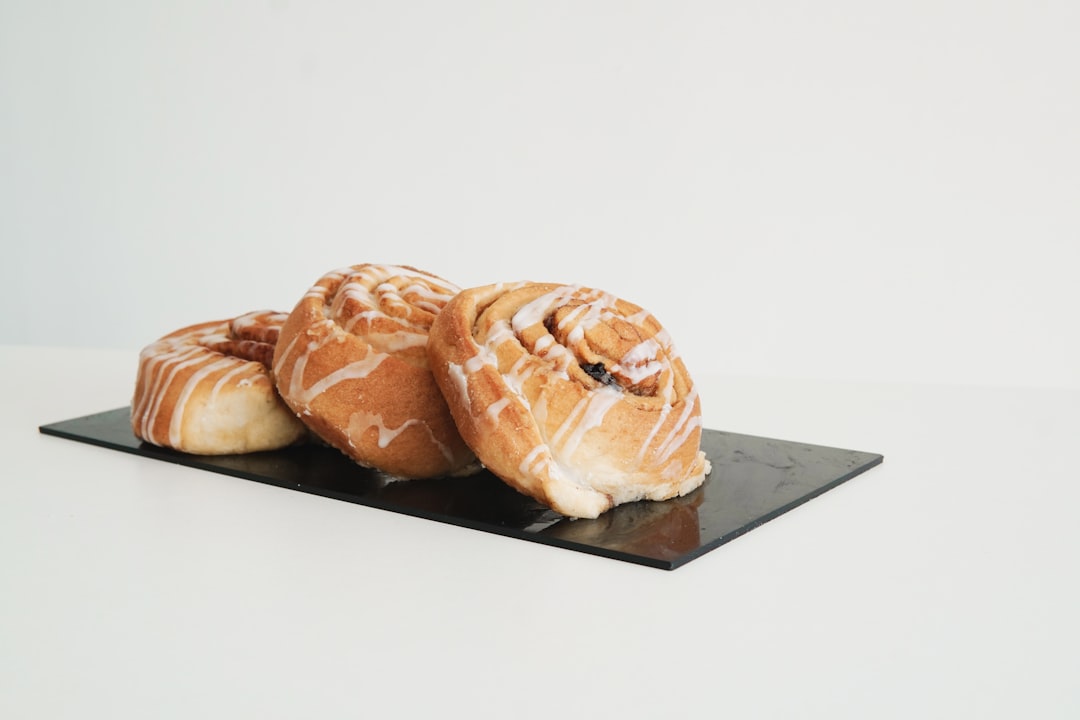


The short version: You can sell cinnamon rolls from home under your state's cottage food law, and the topping decides the rest: a powdered sugar glaze is the safest choice, buttercream depends on your state, and cream cheese frosting is ruled out in Washington, Michigan and California, and in Colorado until January 1, 2027, while Texas allows it once you register and keep the rolls cold. A pan of 12 costs about $4.19 in ingredients, or $0.35 a roll, but about $2.66 a roll once you add a box and pay yourself a baker's wage. Home bakers on Homegrown list single rolls at a median of $6.00, well above that true cost, but dozens at a median of $26, or $2.17 a roll, which is below it, so set box prices down from your single price instead of up from your ingredient cost. Take orders ahead with a cutoff so you bake to the order count, and bring warm singles to the market.
Checked October 1, 2026: the cottage food pages of Texas, Washington, Michigan, Colorado, Arkansas and California (Colorado's 2027 list on October 2), BLS average prices for August 2026, a pull of Homegrown's catalog (2,748 listings), and the pricing and card processing pages of Homegrown, Hotplate, Etsy and Venmo. Rules change, so confirm yours with your state before your first sale. Homegrown customers create an account to place their first order, and Homegrown has no drops feature.
If you want customers to order cinnamon rolls ahead for weekend pickup, you can set up a Homegrown storefront and try it free for 7 days.
Cinnamon rolls are one of the easiest things to sell from a home kitchen. People already know what they are, they look generous in a photo, and a warm one at a farmers market sells itself. On October 1, 2026, 36 of the 179 vendors with bakery listings on Homegrown, about 1 in 5, were selling cinnamon rolls or cinnamon buns.
Two parts need care before your first sale: the frosting and the box price. The first is the frosting, because cream cheese frosting is ruled out in 4 of the 6 states we read as of October 2026. The second is the box price, because a dozen priced off ingredient cost can sell for less than it costs you to make.
This guide walks through both, plus how to bake, pack and sell rolls on a Saturday schedule. If you only need the price math, our cinnamon roll pricing guide from single to dozen goes deeper on the formula. Its numbers come from an earlier, smaller pull of the Homegrown catalog on September 18, 2026, a richer recipe and a flat $0.25 a roll for packaging, so its medians and its $2.97 true cost per roll differ from the ones on this page.
Yes, a plain roll or one with a high-sugar glaze is allowed under the cottage food rules of all 6 states we read on October 1, 2026, and the frosting is what changes the answer. As of October 2026, five of those 6 states limit home kitchens to foods that are safe at room temperature, and Texas is the exception. A cinnamon roll with a sugar glaze fits that. A cinnamon roll with a dairy-heavy frosting may not, because the frosting can need a refrigerator to stay safe.
Food safety rules call a food that needs a refrigerator a TCS food, short for time and temperature control for safety. Our guide to TCS foods and why they change what you can sell explains the line in detail. For cinnamon rolls, it comes down to the topping on top of the dough.
Swipe the table sideways to read each state's frosting wording.
| State | Plain or glazed rolls | Buttercream | Cream cheese frosting | What the agency page says |
|---|---|---|---|---|
| Texas | Yes | Yes | Yes, after you register with the state health department | Allowed foods "now include any foods," except a short list such as meat and seafood. Sellers of TCS foods "must register with DSHS." |
| Washington | Yes, "rolls" and "pastries" are named; a glaze needs high sugar or a cook step (see below) | Only at 3 to 1 sugar to perishables by weight, or with a cook step | No | Not allowed: "cakes or pastries with cream or cream cheese fillings" and "glazes or frostings with low sugar content, cream, or uncooked eggs." |
| Michigan | Yes, under baked goods and breads | Only two lab-tested recipes followed exactly, or store-bought shelf-stable frosting | No | "No cream cheese frostings or icings." |
| Colorado | Yes, under baked goods | Not with butter through 2026 (ghee or vegetable oil is allowed); CDPHE's 2027 list approves buttercream (see below) | No through 2026, since foods that need refrigeration are ineligible; CDPHE's 2027 list approves it (see below) | Through 2026: "Buttercream made with butter is not allowed." Anything "having cream, custard or meringue fillings or toppings" is ineligible. |
| Arkansas | Yes, "Breads" and "Pastries" are listed under baked foods that "do not require refrigeration and have a final pH of ≤4.6 and aw value of ≤0.85"; ask the state health department if you are unsure your roll qualifies. A glaze must be shelf stable (see below) | Yes, "Buttercream" is listed, if the finished frosting is shelf stable (pH 4.6 or below, or water activity 0.85 or below); a milk-based icing must be documented as non-TCS | Only when the final product is documented as non-TCS | Not allowed: icings that are "Eggs, cream, milk, or cream cheese based; unless final product using these ingredients is documented as being a Non-TCS Food." |
| California | Yes, "Buns" are named | Yes, "Buttercream made with butter" | No | Approved frostings are those "that Do Not Contain Eggs, Cream, or Cream Cheese." |
We read each row on the state agency's own page on October 1, 2026 (Colorado's 2027 list on October 2, 2026): Texas DSHS, Washington WSDA, Michigan MDARD, Colorado CDPHE, the Arkansas Department of Health Homemade Food Guide (May 21, 2026 update) and California CDPH's approved foods list. These 6 are examples, not the whole country. For 8 states side by side, see our state-by-state guide to selling homemade cinnamon rolls.
These toppings stay safe at room temperature when they are made with enough sugar, so they are the ones to build your menu around:
Cream cheese frosting is the topping most often ruled out: Washington, Michigan, Colorado (through December 31, 2026) and California keep it out of a home kitchen, and Arkansas allows a cream cheese icing only when the finished product is documented as non-TCS. Texas is the exception among the 6: since its SB 541 took effect on September 1, 2025, a registered home baker can sell cream cheese frosted rolls with a dated label and a safe handling statement, kept at 41°F or below. Colorado's rule changes on January 1, 2027, when its Tamale Act (HB26-1033) takes effect: CDPHE's 2027 eligible foods list, which we read on October 2, 2026, approves "Frosting & Icing (Buttercream, ganache, powdered sugar icing, and cream cheese frosting)." From that date every Colorado cottage food producer must register with CDPHE and renew each year, and a baker who sells foods that need refrigeration may sell "only one type of product and up to five variations of such product at a given time."
The common trick of stirring lemon juice or vinegar into buttercream to fake a cream cheese taste does not work everywhere. Colorado does not allow buttercream made with butter at all until its Tamale Act takes effect on January 1, 2027, and Michigan's cottage food page allows buttercream only from two lab-tested recipes "followed exactly" with no additions "other than food coloring or flavoring extracts." In Washington, a typical buttercream of 1/2 cup of butter, 2 cups of powdered sugar and 2 tablespoons of milk is about 1.6 to 1 by weight, short of the 3 to 1 the state asks for. We read all three pages on October 1, 2026.
Outside Texas, the honest answer in the states above is "not from my home kitchen," unless you are in Arkansas and can document the finished frosting as non-TCS. In Washington, the WSDA cottage food page asks for "a 3 to 1 ratio of non-perishable ingredients (example: sugar) to perishable ingredients (example: eggs, butter, cream, milk) based upon weight," and a cream cheese frosting does not come close. One cup of cream cheese (227 grams) plus 1/2 cup of butter (113 grams) against 3 cups of powdered sugar (339 grams) works out to about 1 to 1.
What sellers in strict states do instead:
If your state has a food freedom law, which lets home cooks sell more foods directly to customers, read our guide to food freedom states and what they let you sell before you add cream cheese to the menu. Some, like Arkansas's, still cover only foods that do not need a refrigerator.
You can start a cinnamon roll business from home in seven steps: check your state's rules, lock one recipe, price from a real cost, make a label, set up ordering, do a small first bake and add a public spot. How long it takes depends mostly on step one. Washington, for example, says its permit application takes 6 to 8 weeks on average once it is complete, and it wants a finished label for every product with the application, so settle your recipe early and apply as soon as it is locked.
The first two steps decide everything else. A seller who starts with cream cheese frosting in a state that bans it has to change the product after customers already love it.
A pan of 12 homemade cinnamon rolls costs about $4.19 in ingredients at August 2026 grocery prices, or about $0.35 a roll. Butter is the biggest line at $1.51, more than a third of the pan. The prices below are U.S. city averages from the Bureau of Labor Statistics for August 2026, the latest month posted when we checked on October 1, 2026.
This pan of 12 costs $4.19, or $0.35 a roll, and butter at $1.51 is the largest line on it.
Slide the table left to see the price behind each line.
| Ingredient | Amount for 12 rolls | Average price, August 2026 | Cost |
|---|---|---|---|
| All-purpose flour | 4 cups (480 g, 1.06 lb) | $0.548 per lb | $0.58 |
| Butter | 1/2 cup in the dough + 1/4 cup in the filling (0.375 lb) | $4.021 per lb | $1.51 |
| White and brown sugar | 1/2 cup of each (0.45 lb) | $1.024 per lb | $0.46 |
| Whole milk | 1 cup | $4.229 per gallon | $0.26 |
| Eggs | 2 large | $2.272 per dozen | $0.38 |
| Yeast, cinnamon, powdered sugar for the glaze, salt, vanilla | 1 packet, 2 tbsp, 1 cup, pinches | Our estimate, not a measured price | $1.00 |
| Total per pan of 12 | $4.19 | ||
| Cost per roll | $0.35 |
Flour, butter, sugar, milk and egg prices are BLS U.S. city average prices for August 2026, pulled October 1, 2026. Brown sugar is priced at the white sugar average because BLS does not track it separately. Cup weights come from King Arthur Baking's ingredient weight chart. Replace the $1.00 line with your own receipts.
A richer recipe costs more. Our pricing guide's pan uses a full cup of butter and a bigger allowance for the small ingredients, and it comes to $5.92. Either way, ingredients are the smallest part of what a roll really costs you.
A single cinnamon roll really costs you about $2.69 once you count the container and your hands-on time, not $0.35. Your time is the biggest cost by far. The median hourly wage for bakers was $17.86 in the Bureau of Labor Statistics 2025 wage survey. At about 1.5 hours of hands-on work per pan, that is $26.79 a pan, or $2.23 a roll.
Packaging is the third piece. On October 1, 2026, WebstaurantStore listed a 5 1/4 inch clear hinged container at $0.11 each in a case of 500, and a 9 by 9 inch window bakery box at $0.44 each in a bundle of 200 (or $0.76 each in a pack of 10).
Swipe sideways for packaging, time and the per-roll total.
| Format | Ingredients | Packaging | Your time at $17.86 an hour | True cost | True cost per roll |
|---|---|---|---|---|---|
| Single roll | $0.35 | $0.11 clamshell | $2.23 | $2.69 | $2.69 |
| 4-pack | $1.40 | $0.44 box | $8.93 | $10.77 | $2.69 |
| Half dozen | $2.10 | $0.44 box | $13.40 | $15.94 | $2.66 |
| Dozen | $4.19 | $0.89 for two 9 by 9 boxes | $26.79 | $31.87 | $2.66 |
Ingredients from the table above. Packaging prices loaded on WebstaurantStore on October 1, 2026, at the bulk price. Time is our estimate of 1.5 hands-on hours per pan of 12, at the BLS 2025 median baker wage. Card fees are not included; they depend on how you take payment (see the fee table further down). Neither are booth fees, permits, insurance or rolls that do not sell, so add those once you know them. The half dozen and dozen assume rolls about 3 inches across, six to a 9 by 9 box. A 4 inch roll fits four to a box, so a half dozen needs two boxes ($0.89), for a true cost of about $16.38, or $2.73 a roll, and a dozen needs three ($1.33), for about $32.32, or $2.69 a roll.
For a full worksheet you can reuse for every product, use our guide to calculating the real cost of each product.
Price cinnamon rolls at $5 to $7 for a single and keep every box at $3 a roll or more, so no size sells below your true cost of about $2.66 to $2.73 a roll. Home bakers on Homegrown already charge a median of $6.00 for a single. Where they slip is the dozen, at a median of $26, or $2.17 a roll.
Homemade cinnamon rolls listed on Homegrown sell for a median of $6.00 as singles, $15 for a 4-pack, $22 for a half dozen and $26 for a dozen. These are listing prices, the price a customer sees, not a count of what sold.
In a pull of the Homegrown catalog on October 1, 2026, 52 of the 2,748 listings, from 36 of 308 vendors, were cinnamon rolls or cinnamon buns. We matched "cinnamon," "sticky bun," "sweet roll" and similar words in each product's name or description, read every match by hand, then read every other product from each of those 36 vendors (that second pass added sweet rolls and cheesecake buns, which we left out because no cinnamon is named). Single rolls ran $3 to $7 across 12 listings. Dozens ran $24 to $65 across 11 listings from 9 vendors. Only 4 listings name cream cheese frosting.
Median price per cinnamon roll on Homegrown, by pack size
Source: Homegrown catalog pull, October 1, 2026. 45 priced options in these four sizes, from 33 of the 52 cinnamon roll listings (25 of the 36 vendors); the other 19 listings came in other pack sizes or did not state one. Listing prices, not sales.
Per roll, the price falls with every bigger box. One pan of 12 sold as singles at $6 brings in $72. The same pan sold as two half dozens at $22 brings in $44. Sold as one dozen at $26, it brings in $26, about $6 less than the $31.87 it really cost you.
Aim for $5 to $7 a single, $16 to $22 a 4-pack, $22 to $30 a half dozen and $38 to $50 a dozen, so every size clears its true cost.
Slide left to compare your cost with what other bakers charge.
| Format | Your true cost | Homegrown median listing | Price range to aim for | Per roll at the low end |
|---|---|---|---|---|
| Single roll | $2.69 | $6.00 (12 listings) | $5 to $7 | $5.00 |
| 4-pack | $10.77 | $15.00 (13 listings) | $16 to $22 | $4.00 |
| Half dozen | $15.94 | $22.00 (9 listings) | $22 to $30 | $3.67 |
| Dozen | $31.87 | $26.00 (11 listings) | $38 to $50 | $3.17 |
True cost from the table above. Medians from the Homegrown catalog pull of October 1, 2026. The ranges are our suggestion, set so each size stays above your true cost with room for card fees and the rolls that do not sell.
Individual rolls are the best farmers market product because people eat them on the spot. Half dozens are the best pre-order and gift product. Offer both, and treat the dozen as an event or office order with a price that still pays you. For holiday pricing and wholesale, the full cinnamon roll pricing ladder from single to dozen has the formula.
A pan of 12 cinnamon rolls takes about 4 to 6 hours from setup to cleanup, and only about 90 minutes of that is hands-on work. The rest is rising and baking, which you can fill with a second product.
One pan of 12 runs on this timing, with about 90 minutes of it hands-on:
Time breakdown: about 1.5 hours of active work (10 + 20 + 15 + 20 + 15 + 10 minutes), plus 2 to 4 hours of rising and about 20 minutes in the oven. Many bakers mix a batch of cookies or a loaf of bread during the rise.
The overnight method lets you shape the rolls Friday night and bake them Saturday morning, so they can reach the market less than two hours out of the oven. King Arthur Baking tested the timing in a 2018 blog post on making cinnamon rolls ahead and found two things worth knowing:
Friday evening (30 to 45 minutes active): make the dough, shape and cut the rolls, let them rise about three-quarters of the way, cover tightly and refrigerate.
Saturday morning (45 minutes active): take the pan out and let it warm on the counter, covered, while the oven heats. King Arthur's recipe allows about an hour. Bake at 375°F for about 20 minutes. Glaze while warm, package and go.
Scaling it up: shape three pans (36 rolls) on Friday evening and stagger them on different fridge shelves. Bake them one after another on Saturday morning, about 20 minutes a pan, so all three are out within about an hour.
Set your order cutoff two and a half days before pickup. Nibblewick Bakehouse's cinnamon roll listing on Homegrown asks customers to order "by Wednesday, 10PM for a Saturday morning pick up," which leaves Thursday to shop and Friday night to shape the exact number of pans.
One standard batch makes 12 rolls in about 4 to 6 hours, with about 90 minutes of hands-on work. With the overnight method, a solo baker with one home oven can usually shape two or three pans on Friday evening and bake them in sequence on Saturday morning, for 24 to 36 rolls on a market day. The limit is usually oven space and fridge shelves, not dough.
No, a standard 9 by 13 inch baking pan holds 12 rolls. A round 9 inch cake pan holds 8 or 9 rolls and gives a more bakery-style look. Nothing special is needed beyond what a home kitchen already has, plus an instant-read thermometer if you want a consistent bake.
Package single cinnamon rolls in a small clear hinged container and boxes in a 9 by 9 inch window bakery box, which together add about $0.07 to $0.15 a roll (the high end is a half dozen of 4 inch rolls, which needs two boxes). Cinnamon rolls are soft, sticky and glazed, so poor packaging means crushed rolls and glaze stuck to the lid.
Single rolls travel best in a clear clamshell at about $0.11 or a kraft paper food tray at about $0.04. Those are WebstaurantStore's October 1, 2026 prices for a 5 1/4 inch clear hinged container by the case of 500 and a 3 pound kraft paper tray with a 5 1/4 by 3 3/8 inch base, which holds a roll about 3 inches across flat, by the case of 500. For a farmers market customer who eats the roll within the hour, the paper tray works. For a pre-order that may sit in a car, use the clamshell.
Do not wrap individual rolls in plastic wrap. The glaze smears against the plastic and the roll looks squashed when it is unwrapped.
A 9 by 9 inch box holds up to 9 rolls about 3 inches across in a single layer, so a half dozen of that size fits with room to spare. It holds 4 larger rolls about 4 inches across. For 12 rolls, use a 9 by 13 inch box or two 9 by 9 inch boxes. Line the bottom with parchment so the rolls lift out cleanly.
Leave a little space between rolls. If they are packed tight while the glaze is still tacky, they fuse and the customer has to tear them apart. If you are boxing warm rolls, leave the lid cracked for about 5 minutes first so steam can escape, or the tops turn soggy. For more box and label ideas, see our roundup of bakery packaging ideas.
Set boxed rolls in a plastic bin with a towel on the bottom so they do not slide, and stack no more than two boxes high. In hot weather the glaze softens, so keep shelf-stable glazed rolls in the shade or in an insulated bag without ice. Refrigerated rolls are different: a cream cheese frosted roll sold under Texas's rules has to be stored and delivered cold enough to stay at 41°F or below, so it rides in a cooler with ice packs.
For rolls you plan to display on a platter, carry them in the baking pan covered with foil and move them to the platter at the market.
Keep them in a covered container or a closed bakery box between sales. If you display rolls on an open platter, put out only 4 to 6 at a time and refill from your covered stock. A light second drizzle of glaze halfway through a long market freshens the look of the rolls on display.
A cinnamon roll label needs your business name, your address or state ID number, the product name and the allergens, and your state may add more. Five of the 6 states we read (Washington, Michigan, Colorado, Arkansas and California, so all but Texas) also want the full ingredient list. Cinnamon rolls usually contain three major allergens: wheat, milk and eggs. Add tree nuts for pecan rolls.
Texas is a good example of what a full label looks like. Its DSHS page lists, among other items:
Other states use different wording. Washington, for example, requires the statement "MADE IN A HOME KITCHEN THAT HAS NOT BEEN SUBJECT TO STANDARD INSPECTION CRITERIA" along with your permit number, the full ingredient list in order of weight, the net weight and allergens. Our guide to cottage food labeling requirements shows the common pieces, then check your own state's page for the exact words.
Sell cinnamon rolls at a farmers market for walk-up singles and through pre-orders for boxes, then add a farm stand, holiday orders and office orders as you grow. Our guide to seven places to sell cinnamon rolls covers each one in depth.
A farmers market is the best place to sell cinnamon rolls because warm rolls sell on sight and smell. People walking past your table notice them before they see your sign.
To sell cinnamon rolls at a farmers market:
A farm stand sells cinnamon rolls best as a single in a clear clamshell at $5 to $7, placed at the checkout. Customers picking up bread, eggs or jam add one on the way out. Check your state's rules first if the stand belongs to someone else: Washington, for one, says cottage food products "can only be sold directly to the consumer and not wholesale (resold by somebody else)."
Cinnamon rolls sell out at markets, which means your best customers miss out. Pre-orders turn those customers into next week's sure sales, and they tell you exactly how many pans to shape on Friday night. Taking them through Instagram DMs means confirming flavor, quantity and pickup time in a separate conversation with every customer. Our guide to taking pre-orders as a home bakery covers the setup.
Cinnamon rolls are a holiday breakfast tradition, so plan pre-orders around the mornings families gather:
Start promoting holiday pre-orders two to three weeks ahead, and cap the count at what your oven can bake on the day.
Selling through a coffee shop is a different rule from selling to the customer yourself. Texas lets a home baker sell non-refrigerated cottage foods wholesale to a shop that registers with DSHS as a cottage food vendor, but not refrigerated ones. Washington says cottage food products "can only be sold directly to the consumer and not wholesale," and sends wholesale sellers to its separate food processor license. Read our guide to getting your food into a local coffee shop before you pitch one.
Cinnamon rolls sell out at the market, and the fix is letting the next week's customers order and pay before you bake. Homegrown is $10 per month billed annually ($12.50 billed monthly) with no percentage fees beyond standard payment processing of 2.9% + $0.30 per order, which you pay, with no surcharge added to your customer's total. You list one cinnamon roll product with sizes as options (single, 4-pack, half dozen, dozen), each with its own price.
For a cinnamon roll schedule, these are the parts that matter:
How it compares: Hotplate has no monthly plan but adds 5% + $0.55 to your customer's order by default, which shows up as a $23.65 checkout on a $22 half dozen. Etsy's listing, transaction and processing fees come to about $2.54 on a $22 half dozen, before any shipping, and Etsy only fits if your state lets you mail cottage foods: Washington says you "cannot ship Cottage Food Products by mail or a courier service," and Texas requires an online order to be personally delivered by you, an employee or a household member, with your label information posted on your website before you take payment. Instagram DMs with Venmo cost the least per order, but every order is a conversation.
Homegrown does not help you choose a recipe, get your glaze right or sort out your state's frosting rules; this guide covers those. Customers create a Homegrown account to place their first order. Homegrown has no drops feature (a menu that opens at a set time with a countdown), so if your customers expect a timed release, Hotplate, whose pricing page includes "drop setup" and a countdown timer, is built for that. Your storefront is listed on Homegrown's marketplace, but plan on most orders coming from people you send to your own link. You can set up your cinnamon roll storefront here with a 7-day trial (no charge until day 8).
On a $22 half dozen, the fees you pay to take the order, card processing included, come to about $0.52 through Venmo, $0.94 on Homegrown or Hotplate's default, $2.54 on Etsy and $2.59 if you cover Hotplate's fee yourself. Over 50 orders a month, Homegrown comes to $56.90 with the annual plan, $10 more than Hotplate's default, with nothing added to your customer's checkout.
Swipe sideways to see every fee column.
| Way to take orders | Monthly plan | Trial | Platform fee | Card processing | Customer pays on a $22 half dozen | You pay on a $22 half dozen | You pay in a month of 50 orders |
|---|---|---|---|---|---|---|---|
| Homegrown | $10 billed annually ($12.50 monthly) | 7 days, no charge until day 8 | None, 0% commission | 2.9% + $0.30, paid by you | $22.00 | $0.94 plus the plan | $56.90 ($59.40 on the monthly plan) |
| Hotplate, default | $0 | No plan to try | 5% + $0.55, paid by the customer | 2.9% + $0.30, paid by you | $23.65 | $0.94 | $46.90 |
| Hotplate, you cover the fee | $0 | No plan to try | 5% + $0.55, paid by you | 2.9% + $0.30, paid by you | $22.00 | $2.59 | $129.40 |
| Etsy | $0 (a one-time set-up fee may apply) | No plan to try | $0.20 listing fee per sale + 6.5% transaction fee | 3% + $0.25, paid by you | $22.00 plus any shipping | $2.54 | $127.00 |
| Instagram DMs + Venmo business profile | $0 | No plan to try | None | 1.9% + $0.10, paid by you | $22.00 | $0.52 | $25.90 |
We checked each fee on October 1, 2026, on Homegrown's signup page, Hotplate's pricing page and its post "What Hotplate does" (which says 80% of Hotplate chefs keep the customer-paid default), Etsy's Fees and Payments Policy and its US payment processing page, and Venmo's fee page. Processing is figured on the $22 price; Etsy charges its 3% on the total with shipping and tax, so it runs higher with shipping. Etsy's listing fee renews at $0.20 after each sale.
For a closer look at the Hotplate side, our Hotplate alternative guide compares the two for weekly bakers.
Classic cinnamon should be most of what you bake, and one or two seasonal flavors give regulars a reason to order again. On Homegrown, pumpkin and apple were the flavors vendors named most: each was in the titles of 4 cinnamon roll listings on October 1, 2026, and both were offered as options on two more.
Spread a thin layer of diced apple, cooked down with butter and brown sugar for about 5 minutes, over the cinnamon sugar before rolling. Top with a maple glaze made with powdered sugar and maple syrup instead of milk. These fit September through November. Cooked apple baked into the roll is a different thing from fresh fruit, and Washington bars "fresh fruit fillings or garnishes." Arkansas also lists fruit sweet breads among the foods that may need refrigeration, so check there before you list an apple roll.
Add canned pumpkin to the dough or filling and nutmeg and clove to the cinnamon, and finish with a brown butter glaze. Pumpkin ties apple as the flavor most often named in Homegrown listing titles and options this fall: Nibblewick Bakehouse, Bea's Bread LA, Seriously Sourdough and Gabriella's plants and produce all had a pumpkin cinnamon roll listed on October 1, 2026. Keep the pumpkin in the dough or a sugary filling, not a custard-style layer: Colorado's page lists pumpkin pie as ineligible through December 31, 2026 (its 2027 list approves pumpkin pie), Michigan rules out pumpkin pies that need refrigeration, Washington's page names pumpkin among the pies it does not allow, and California's approved list allows pies "(fruit only, no pumpkin)." Arkansas goes further: its Homemade Food Guide says sweet breads made with fresh fruit or vegetables, pumpkin among its examples, "may be Time/Temperature Control for Safety Foods," so check with the Arkansas Department of Health before you list a pumpkin roll there.
Pour a layer of caramel (brown sugar, butter and corn syrup) into the bottom of the pan and press toasted pecan halves into it before the rolls go in. Bake as usual, then flip the pan so the caramel and pecans end up on top. Pecans are a tree nut, so add tree nuts to the allergen line on the label.
Swap the cinnamon sugar for lemon zest, sugar and a little softened butter, and fold blueberries into the filling. Top with a lemon glaze of powdered sugar and lemon juice. This is a warm-weather roll for April through August, when people want something lighter. In Washington, which bars fresh fruit fillings, cook the blueberries into a thick filling first or use dried ones. In Arkansas, where fresh berries can make a sweet roll a refrigerated food, check with the health department before you list them.
Use the standard cinnamon filling and top it with a cooked salted caramel glaze and a few visible flakes of sea salt. The flakes make the roll look like a bakery product and help justify the higher price.
Pricing rule for variations: charge $1 to $2 more than your classic roll. The extra ingredients cost little, but the customer sees a special roll, and a special that sells for less than the classic teaches customers to wait for the special.
Four things set a home baker's cinnamon roll apart from a grocery store pack: better ingredients, a bigger roll, a generous glaze and a bake time you can name. Put all four in your photo and your listing.
Name what is in it: real butter, brown sugar, the kind of cinnamon you use, a sourdough starter if you use one. 16 of the 52 cinnamon roll listings on Homegrown mention sourdough in the name or description, which shows how many home bakers lead with it. Put your ingredients on your sign, your label and your ordering page.
A homemade cinnamon roll of 3 to 4 inches across reads as a real portion next to a grocery store roll. Size signals value. Nibblewick Bakehouse leans on this in its listing: "is this a roll or a small pillow?" Just remember that a 4 inch roll fits four to a 9 by 9 inch box, not six.
The glaze is the first thing customers see. A thick, glossy glaze that runs into the swirls looks generous, and a thin one looks like an afterthought. Make it with plenty of powdered sugar, which also keeps it on the safe side of the rules in the table above.
"Baked this morning" is the strongest phrase on a cinnamon roll sign. If you baked them this morning with the overnight method, say so on your sign, your listing and to every customer.
Warm, not hot, is the best way to serve cinnamon rolls: about 15 to 30 minutes out of the oven, when they still smell fresh but are cool enough to eat. Room temperature is fine for a market several hours after baking. Say "baked this morning" rather than "served warm," and give pre-order customers a reheating line: King Arthur Baking warms baked rolls at 350°F for 10 to 15 minutes, tented with foil.
For more on running a home bakery around products like these, see our guide to selling baked products from home, and for setting prices you can say out loud in a DM, see how to price food you sell through Instagram DMs.
The most expensive mistake is pricing a dozen below what it costs you to make, and the riskiest is cream cheese frosting in a state that does not allow it. Here are seven to avoid:
In most of the states we read, no. Washington, Michigan and California rule out cream cheese frosting from a home kitchen, Colorado does until January 1, 2027, when its 2027 list approves it, and Arkansas allows it only when the finished product is documented as non-TCS. Texas allows it after you register with DSHS, date the label, add the safe handling statement and keep the rolls at 41°F or below. Colorado's cottage food page also says "buttercream made with butter is not allowed" (ghee or vegetable oil is fine) until the Tamale Act takes effect on January 1, 2027, and Michigan allows buttercream only from two lab-tested recipes, so a lemon buttercream swap is not a safe stand-in there. We checked all of this on October 1 and 2, 2026.
Homemade cinnamon rolls on Homegrown are listed at a median of $6.00 for a single, $15 for a 4-pack, $22 for a half dozen and $26 for a dozen, from a pull of 52 listings on October 1, 2026. Singles ranged from $3 to $7 and dozens from $24 to $65. When you sell cinnamon rolls from home, aim for $5 to $7 a single and at least $3 a roll in a box.
It depends on your state: some ask for a permit, some for a registration or a food safety class, and some for nothing at all for shelf-stable baked products. Washington requires a $355 cottage food permit good for two years. Texas requires a food handler course, and you register with DSHS if you sell refrigerated foods such as cream cheese frosted rolls (or if you want an ID number on your label instead of your home address). Colorado requires a food safety course before you start, and from January 1, 2027, a yearly registration with CDPHE as well. Check your state's agency page before your first sale.
Homemade cinnamon rolls keep for a couple of days at room temperature when well wrapped, and King Arthur Baking stores unglazed rolls for up to three days. For longer storage, freeze them, ideally before glazing, and glaze after reheating. For market sales, sell same-day rolls and say so.
Sell both. Individual rolls at $5 to $7 are the impulse buy at the market, and half dozens at $22 to $30 are the pre-order and gift buy. Keep every box at $3 a roll or more so the bigger sizes do not sell below what they cost you to make.
We cannot see what sells, but we can see what home bakers list. On Homegrown on October 1, 2026, pumpkin and apple were each named in the titles of 4 cinnamon roll listings and offered as options on 2 more, the most of any flavor by that count. Classic cinnamon was still on most menus. Pecan rolls need a tree nut line on the label.
Yes, and you should. Pre-orders let you bake the exact number of pans, so you are not stuck with leftover rolls or turning people away. Use an ordering page with a cutoff and a pickup window, and when you sell cinnamon rolls from home on a weekly schedule, set the cutoff two to three days before pickup.
Each guide below goes deeper on one question. If you have not checked your state's frosting rule yet, start with the first one. If your rules are settled and you are setting box prices for Saturday, start with the second:
The bakers who do best with cinnamon rolls sell warm singles at the market and take box orders before they bake. If your rolls already sell out, put next Saturday's half dozens on an ordering page with a Wednesday night cutoff and share the link at your booth. Set up your Homegrown storefront for $10 a month billed annually, list your sizes, and bake to the order count instead of a guess.
A simple first week looks like this. List one classic roll with four sizes: a single at $6, a 4-pack at $18, a half dozen at $24 and a dozen at $42. Set the cutoff for Wednesday night and the pickup for Saturday morning at your porch or market booth. Cap the half dozens at what one Friday night of shaping can cover, then bake exactly what was ordered plus a tray of singles for walk-ups. After two or three Saturdays you will know your real weekly number, and that tells you whether to add a second pan, a seasonal flavor or a second pickup spot.



