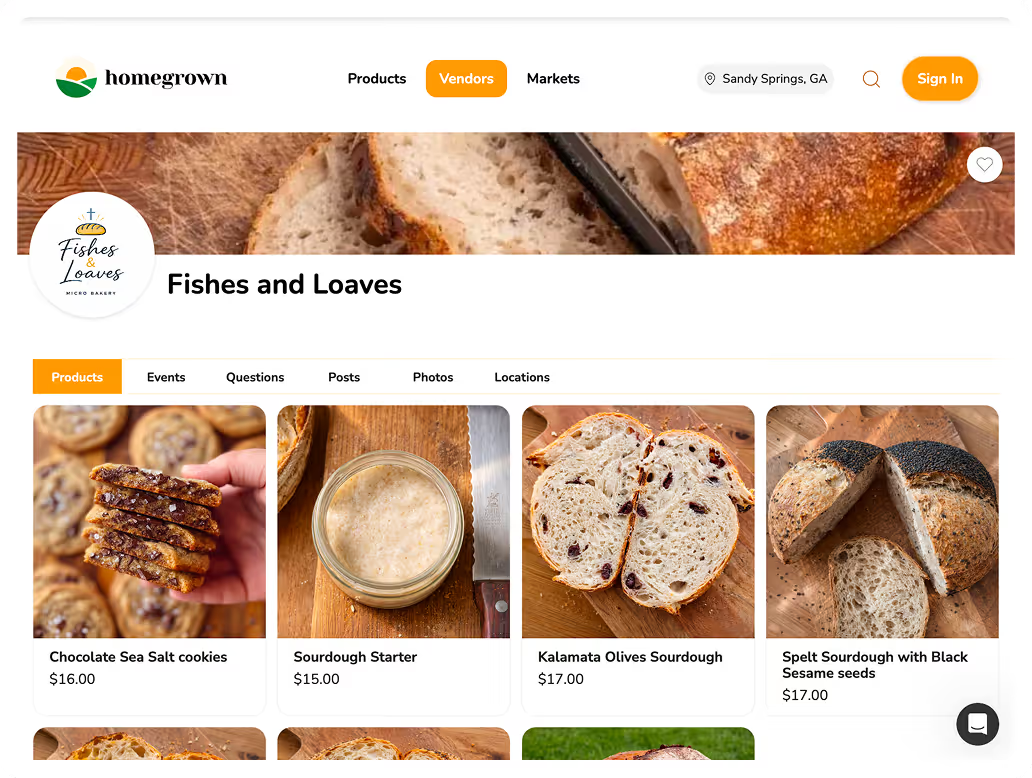


The best Local Line alternative for most small farms running direct-to-consumer is Homegrown — a $10 per month flat storefront that handles the 80 percent of Local Line's value (online ordering, pickup logistics, recurring orders, multi-location) without paying enterprise pricing for the wholesale and B2B features that most small farms never use. Local Line is a real product with real strengths, particularly for farms that genuinely sell to restaurants and food co-ops alongside their direct-to-consumer channel. The structural problem is that the pricing reflects that wholesale capability, and most small farms are paying for tools they don't operate. Homegrown gives you the consumer-side tools at one-tenth the cost.
The short version: Local Line is multi-channel sales software targeting farms with both direct-to-consumer (CSA, farm stand, market) and wholesale (restaurants, food co-ops, institutional) sales channels. Pricing typically runs $89 to $299+ per month based on operation size and tier. Homegrown is $10 per month billed annually with subscriptions, sell-by-weight, no platform commission, no shopper fee, and a public marketplace. Other Local Line alternatives include FarmSite ($79-149/mo, CSA-focused), CSAware ($150-300+/mo, enterprise CSA), and Square Online (generic, $0/mo + per-transaction fees). For small farms whose business is primarily direct-to-consumer with maybe a few one-off restaurant orders, Homegrown is the simpler path.
Local Line is multi-channel sales software for farm operations. The platform's distinguishing feature is that it handles multiple sales channels in one tool: direct-to-consumer storefront, CSA share management, farmers market POS, and wholesale B2B order portals for restaurants, food co-ops, and institutional buyers. According to the Local Line website, the platform serves farms across North America with the multi-channel pattern in mind.
The B2B side is the differentiator. Local Line lets you set up custom pricing tiers per wholesale buyer (a restaurant pays one price, a food co-op pays another), generate invoices, run B2B order portals where restaurant accounts can place repeat orders, and consolidate the wholesale workflow with the consumer-facing storefront. For farms that genuinely sell to wholesale buyers — multiple restaurants, a food hub, an institutional buyer like a school cafeteria — these tools save real time.
The pricing reflects the capability. Entry-level Local Line plans start around $89 per month and scale up based on order volume and feature tier. Higher tiers approach $299+ per month with the full B2B feature set, and payment processing is additional on top (typically Stripe at 2.9% + $0.30 per transaction). Annual contracts are common.
The most common reasons farms shop for alternatives:
If those constraints sound familiar, the question isn't "is Local Line bad?" — it's whether you should pay for wholesale-tier software when your operation is mostly consumer.
Three alternatives stand out for different operating profiles.
Homegrown is built for the direct-to-consumer side of small farm sales. Online storefront, pre-orders with pickup scheduling, multi-location pickup support, a public marketplace, no platform commission, no shopper fee, no payout fee.
What you get with Homegrown:
What Homegrown does not do (the honest gap): wholesale B2B order portals, custom pricing tiers per wholesale buyer, automated invoicing for restaurant accounts. If those are critical to your operation — meaning you have multiple restaurants and food co-ops as recurring buyers — Local Line still wins on that workflow. If your wholesale activity is "I sell to one restaurant occasionally," you can handle that with a separate invoicing tool (Wave, FreshBooks) for free or at minimal cost.
The math on a small farm: Homegrown billed annually is $120/year. Local Line entry-level at $99/mo is $1,188/year. Net savings: $1,068/year. Multiply by however many seasons you'd otherwise stay paying for wholesale tools you don't use.
Pros:
Cons:
If your farm is primarily a CSA at 200+ members, CSAware is purpose-built for that scale. Harvest forecasting, automated box-packing rule engines, multi-share-type configurations. Overkill for any CSA below ~100 members; appropriate at the higher end.
Pros:
Cons:
FarmSite is mid-tier CSA software — cheaper than CSAware, more focused than Local Line. CSA management, member portals, pickup scheduling.
Pros:
Cons:
| Feature | Homegrown | Local Line | CSAware | FarmSite |
|---|---|---|---|---|
| Monthly price | $10/mo annual | $89-299+/mo | $150-300+/mo | $79-149/mo |
| Annual contract | No | Often | Often | Often |
| Setup fee | $0 | Sometimes | Common | Sometimes |
| Free trial | 7 days | Demo only | Demo only | Demo only |
| Direct-to-consumer storefront | Yes | Yes | Limited | Limited |
| Wholesale / B2B tools | No | Yes | Limited | Limited |
| Custom pricing per buyer | No | Yes | No | No |
| Subscriptions / CSA | Shipping M1-M2 | Yes | Yes | Yes |
| Sell-by-weight | Shipping M1-M2 | Yes | Limited | Limited |
| One-off product sales | Yes | Yes | Limited | Limited |
| Marketplace discovery | Yes | No | No | No |
| Multi-pickup locations | Yes | Yes | Yes | Yes |
| Mobile-first member experience | Yes | Mid | Dated | Mid |
| Card processing | 2.9% + $0.30 | Variable | Variable | Variable |
| Platform commission | None | Varies | Varies | Varies |
The cleanest switch happens at the end of your current Local Line contract. Export your product catalog, customer list, and any active CSA share configurations. Spin up Homegrown during the gap weeks (the 7-day free trial covers most setup). Re-onboard customers with one email pointing to your new ordering link.
If you have wholesale buyers, you'll need to handle them separately. Most small farms can keep the wholesale workflow simple — direct invoicing via email, payment via ACH or check, light spreadsheet tracking. If you have enough wholesale volume to need a dedicated tool, options like QuickBooks (for invoicing) or FreshBooks (for invoicing + simple B2B portals) can fill that gap at $15-30/mo, still leaving you well below Local Line's pricing.
What you'll need to recreate in Homegrown: product catalog with photos and descriptions, pickup locations, pickup schedules (each becomes a recurring subscription rule), and customer accounts (members create their own at first order). What you'll lose: Local Line's wholesale B2B tools. What you'll save: roughly $1,000+/year on software, time spent in Local Line's admin UI, and the annual contract.
No. Homegrown serves any local food vendor selling for pickup — sourdough bakers, microgreens farms, soap and candle makers, pet treat producers, homestead operators, specialty food vendors, and CSA farms. The platform handles the consumer side of farm sales without forcing you into a specific operating model.
Probably not. For occasional restaurant sales, you can handle the workflow with direct invoicing (email + ACH) and skip the wholesale platform overhead. Spending $100+/mo on B2B tools to support two restaurant accounts is the wrong ratio. Homegrown handles your direct-to-consumer side; a free invoicing tool handles your occasional wholesale.
Homegrown today offers one price per product. If you genuinely need per-buyer custom pricing (a specific restaurant gets 15% off, a co-op gets 20% off, a school district gets institutional pricing), Local Line's wholesale tools handle that workflow. Homegrown does not.
Each share type lives as its own product (Full Share, Half Share, Egg Add-On, Flower Add-On). Members subscribe to the combinations that fit their household. It's less elegant than a rules engine but works for most small to mid-sized CSAs.
Homegrown is a customer-facing storefront and ordering platform — it doesn't replace farm management software. If you use one of those tools for crop planning, it stays separate.
Yes. Members log in and can pause, skip a week, or update their subscription. Vendor-side, you can override member subscriptions if needed.
Homegrown doesn't have one. If your wholesale volume grows to the point where you genuinely need automated B2B ordering, you'd graduate back to a multi-channel tool like Local Line. For most small farms, this is a "future problem" that hasn't shown up yet — and paying $1,000+/year today against the chance of needing it in three years is the wrong tradeoff.
If your Local Line plan is $99/mo, that's $1,188/year. Homegrown billed annually is $120/year. Net savings: $1,068/year. Larger Local Line plans save proportionally more.
---
For most small farms whose business is primarily direct-to-consumer, Local Line is paying for capability you don't use. Homegrown gives you the consumer-side tools at one-tenth the cost, with a public marketplace for discovery and no annual contract. If you genuinely sell to multiple wholesale buyers and need B2B order portals, Local Line is the right tool — but most small farms aren't there yet, and many never will be.
Before you commit, you can see exactly what your Homegrown farm storefront would look like — paste your current product list into our free 60-second storefront preview tool and our AI rewrites it in Homegrown voice instantly. No signup needed.
Start a free 7-day Homegrown trial and have your storefront live before this Saturday's pickup.