
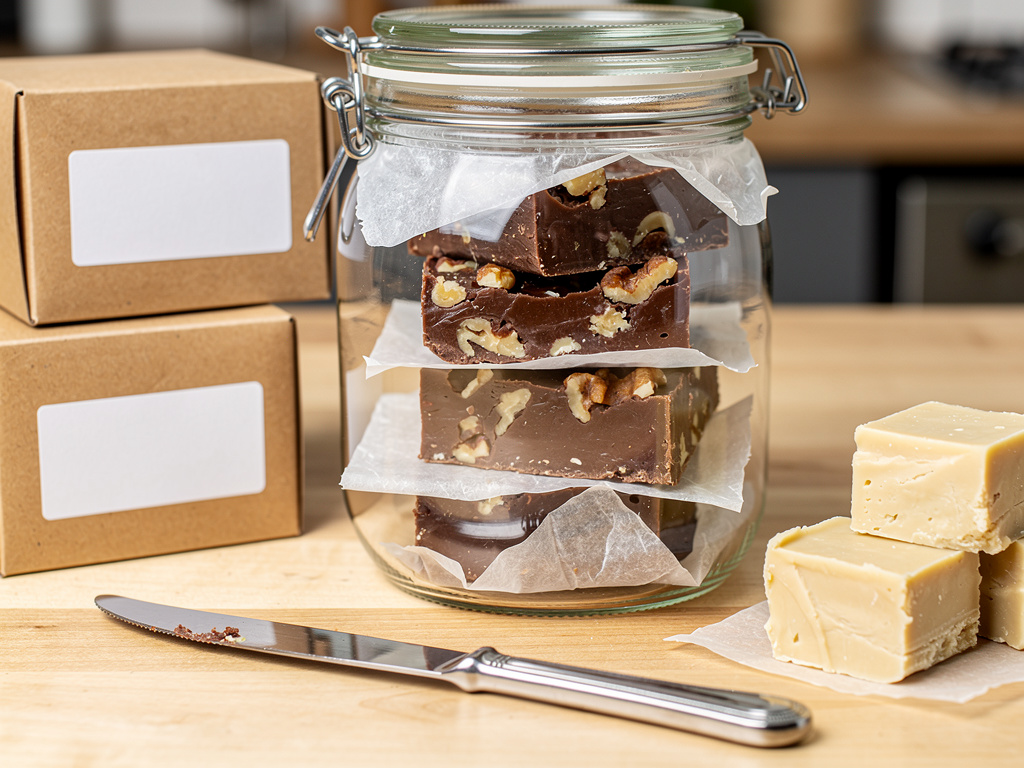


The short version: Homemade fudge cooked from sugar, butter, milk and chocolate lasts about 2 weeks at room temperature when every piece is wrapped airtight, about 3 weeks in the fridge and about 3 months in the freezer, by our own estimate. For fudge you sell, print a best-by date 14 days after the day you made it, also our own rule, because no federal agency publishes a shelf life for homemade fudge. Fudge made with cream cheese is a different product: keep it cold, tell buyers to eat it within 7 days, and check whether your state lets you sell it from a home kitchen at all. Old fudge almost always fails on texture first, turning dry, crumbly or grainy long before it becomes unsafe.
Checked on the Arkansas Department of Health, Washington State Department of Agriculture, California Department of Public Health and USDA pages, the Global Cold Chain Foundation candy manual and Homegrown's signup page, October 13, 2026: state rules on candy differ, so verify your state's current rules before you sell a batch. Homegrown customers create an account to place their first order, and Homegrown has no drops or countdown-release feature.
Fudge is one of the most forgiving products a home candy vendor can sell. It needs no fridge, and a pan you made on Thursday still sells on Saturday. That forgiving streak is also how vendors get caught out. A box that sat for a month in a warm kitchen comes back from a customer dry and sandy, and nobody is sure what date should have been on it.
This guide is for people who sell fudge, or want to. It covers how long each kind lasts on the counter, in the fridge and in the freezer, why cream cheese fudge plays by different rules, what to print on the label, how to handle a hot market day and how much to make at once. If you are still setting up, our guide to selling fudge from home covers permits, flavors and pricing first.
Cooked homemade fudge lasts about 2 weeks at room temperature, about 3 weeks refrigerated and about 3 months frozen, as long as every piece is wrapped airtight. Those are quality windows, not safety deadlines. Fudge holds so little free water that spoilage is rarely the first problem. It dries out, turns grainy or picks up fridge smells long before anything grows on it.
No federal agency publishes a number for homemade fudge. USDA's FoodKeeper data file, which lists storage times for 661 foods, had no fudge entry when we searched it on October 13, 2026. Recipe sites fill that gap with their own ranges. Taste of Home, for example, gives 1 to 2 weeks at room temperature for fudge layered between waxed paper or parchment in an airtight container in a cool, dry cupboard, 2 to 3 weeks in the fridge, and 2 to 3 months frozen for classic boiled-sugar fudge (up to a year for condensed milk fudge). On the counter it goes shorter for classic fudge cooked the traditional way: that kind dries out faster than a quick fudge, so Taste of Home says to eat it within one week or freeze it before it hardens. Our window for cooked fudge on the counter is about 2 weeks, and it is our own rule, not a published figure. It sits at the top of Taste of Home's general range, matches its "two weeks or possibly longer" for fudge that is not the classic kind, and lines up with the 14-day best-by we print. It is still longer than Taste of Home's one week for classic fudge, and we do not claim a candy thermometer or a good seal buys that extra week: Taste of Home's figures already assume an airtight container, and the classic fudge it says dries out faster than quick fudge is the kind cooked with a candy thermometer. Nor does the candy manual's 10 months for commercial fudge carry over, for the reasons in the store-bought section below. So treat 14 days as a ceiling, not a promise. If your fudge starts to dry or harden before then, shorten the best-by on the next batch, and freeze the rest, as Taste of Home advises once the texture starts to change. By "room temperature" we mean a pantry at 50 to 70°F, by "fridge" 32 to 40°F, and by "freezer" 0°F or below, the ranges Texas A&M AgriLife Extension's Safe Home Food Storage guide sets for home storage. Every window in the table below is our recommendation for fudge you sell, not an agency's, because no agency publishes one for homemade fudge.
Scroll sideways to see every column.
| Kind of fudge | Counter, wrapped airtight | Fridge, wrapped airtight | Freezer, double wrapped | Best-by we would print |
|---|---|---|---|---|
| Cooked fudge (sugar, butter, milk or cream, chocolate, cooked with a candy thermometer) | About 2 weeks | Up to 3 weeks; it firms up | Up to 3 months | 14 days after cooking (our rule) |
| Sweetened condensed milk and chocolate chip fudge | About 2 weeks (our rule) | Around 3 weeks | 3 months at most | 14 days (our rule) |
| Fudge with walnuts, pecans or peanuts | About 2 weeks; the nuts taste stale first | Close to 3 weeks | Up to 3 months | 14 days, with fresh nuts (our rule) |
| Fudge with marshmallows, crushed cookies or candy pieces | About 1 to 2 weeks; the mix-ins change first | Up to 2 weeks | Up to 3 months; test one batch | 10 days after cooking (our rule) |
| Fudge made with cream cheese | Not a counter product | Eat within 7 days (our rule) | Not recommended | "Keep refrigerated" and "eat within 7 days" |
| Fudge with fresh fruit or fresh fruit puree | Not a counter product | Days, not weeks (our rule) | Not recommended | Ask your state before you sell it |
We loaded each source on October 13, 2026. Every storage window and best-by in this table is our recommendation, because no federal or extension source we found gives a number for fudge made at home. The cream cheese freezer line follows USDA FoodKeeper's entry for cream cheese, which lists 2 weeks in the fridge and freezing as not recommended.
Fudge keeps for weeks because sugar ties up most of its water, so most germs cannot use it, and food scientists measure that as water activity. Water activity runs from 0 for something bone dry to 1.0 for pure water. A review of candy science by Ergun, Lietha and Hartel, published in Critical Reviews in Food Science and Nutrition, lists caramel, fudge and toffee at a water activity of 0.45 to 0.60. The same review also lists fudge in the 0.60 to 0.80 range, where molds and some yeasts can grow, and shows ordinary bacteria and the germs that make people sick needing more than 0.88.
That review makes the point that matters most to a vendor, and it is why we treat our 2-week estimate as a limit on quality, not on safety. In candy, the end of shelf life usually comes from water moving in or out of the piece, not from microbes. Your fudge goes stale long before it goes bad.
Arkansas turns the same science into a legal test. Its Homemade Food Production Guidelines, updated May 21, 2026, allow candy made at home, with fudge named on the list, only when the finished product "does not require refrigeration for food safety and has a final aw ≤0.85." Aw is short for water activity.
What pushes fudge's water activity up and shortens its life:
What keeps it low and steady:
Commercial fudge can keep about 10 months at 68°F because a candy plant controls the humidity, the recipe and the packaging, and a home kitchen or a farmers market booth cannot. The Global Cold Chain Foundation's candy storage manual, revised in 2024 from earlier versions drafted at the National Confectioners Association, lists fudge at 10 months at 68°F, 20 months at 50°F and 30 months at 32°F, all held at 50 to 60% relative humidity. Fudge with nuts drops to 9, 18 and 27 months.
How long commercial fudge keeps, by storage temperature (months)
Source: Global Cold Chain Foundation Commodity Storage and Handling Manual, Candy, revised 2024, fudge without nuts held at 50 to 60% relative humidity, loaded October 13, 2026. These are commercial numbers, not homemade ones.
Read the fine print before you borrow those months. The manual says its periods assume candy made with "good commercial production techniques" and "stored shortly after manufacture," in rooms where humidity "should at no time be higher than 60% RH." A home batch sits in a kitchen that swings from dry winter heat to sticky summer air, gets cut into squares, and goes into a box that does not block moisture.
What still carries over to your kitchen:
Our 14-day best-by is a small slice of the commercial number on purpose. It leaves room for a hot car, a warm booth and a customer who leaves the box open on the counter for a week.
Fudge usually goes downhill in texture first: the surface dries, the edges crumble, and the inside turns grainy as sugar crystals grow. The candy manual lists drying, which it calls case hardening, as what happens to fudge when the air is too dry, and says pieces can collapse or shrink for the same reason. Move that fudge into a warm, humid room and it sweats and turns sticky instead.
Check for these signs before a box goes out, especially once it is more than 14 days old, listed from least to most serious:
Freezing can sometimes rescue fudge that has only started to dry. The manual says that for fudge and similar candies, "in some instances, if the drying out is not excessive, freezing and then thawing restores the original freshness." It will not fix grainy fudge, rancid nuts or mold, and a rescued batch still gets a fresh look before it sells.
Keep one square from every batch in a labeled bag at room temperature and taste it on day 7, day 14 and day 21. After 3 or 4 batches you will know how your own recipe ages in your own kitchen, which beats any number in a guide, ours included.
No, cooked fudge made from sugar, butter, milk or cream and chocolate does not need refrigeration for safety, and the fridge often makes its texture worse. Washington's cottage food permit lists "fudge or fudge-like candies" among approved candies that are "not potentially hazardous," as long as they are cooked on a stove top or in a microwave with a candy thermometer, according to the Washington State Department of Agriculture's cottage food brochure. California's approved cottage foods list names fudge under candy and confections, on a list limited to foods that do not need temperature control. Both states are saying the same thing: properly cooked fudge is safe on a shelf.
Why the fridge can hurt a good batch:
When the fridge does make sense:
If you do refrigerate, wrap the fudge before it goes in, and let the closed container sit on the counter until it reaches room temperature before you open it. That way the water condenses on the outside of the box instead of on the fudge.
Treat cream cheese fudge like a refrigerated dessert: keep it cold and tell buyers to eat it within 7 days, which is our rule. Cream cheese brings water and fresh dairy that sugar cannot fully tie up. USDA's FoodKeeper gives cream cheese itself 2 weeks in the fridge and lists freezing it as not recommended, and fudge made with it should not outlive its most fragile ingredient.
K-State Research and Extension's guide to frosting and filling safety works through a typical cream cheese frosting and finds it at 54.8% sugar by weight. That sits below the 65% the guide uses as a rough line for room-temperature stability, and K-State calls it "not stable at room temperature." That test was a frosting, not a fudge, but the ingredient brings the same problem to both.
The legal side matters as much as the storage side. The Arkansas guidelines list "cream based filling" as not allowed in home candy, and leave anything "cream cheese based" out of home frostings unless the finished product is documented as safe without refrigeration. States that only allow home foods that need no fridge may leave cream cheese fudge out entirely, and the rules differ from state to state.
Cream cheese fudge is the fudge most likely to fall outside a cottage food permit. A cheesecake, key lime or strawberry shortcake flavor often means cream cheese is in the pan. Ask your state's cottage food office before you list it, not after a customer asks why it came warm.
If your state allows it and you sell it:
Yes, most mix-ins age faster than the fudge around them, so a fudge loaded with marshmallows, crushed cookies or candy pieces usually tastes old up to a week sooner on the counter than plain chocolate fudge. That gap is our estimate from how each mix-in behaves, which is why the table above gives marshmallow, cookie and candy fudge a 1 to 2 week counter window and a 10-day best-by instead of 14, so the date lands inside that shorter window. Nut fudge keeps the 14-day best-by as long as the nuts go in fresh, because the nuts are what taste stale first. The candy review explains the cause: when two parts of a candy have different water activity, water moves from the higher one to the lower one until their water activity is about the same.
Swipe the table to read all four columns.
| Mix-in | What changes first | Why | What we would do |
|---|---|---|---|
| Walnuts, pecans, peanuts | Nuts taste stale or bitter | Nut oils go rancid; FoodKeeper gives walnuts 2 to 4 weeks in a pantry, and the candy manual cuts fudge with nuts from 10 months to 9 | Buy fresh nuts per batch, keep the 14-day best-by, freeze anything held longer |
| Mini marshmallows or marshmallow creme | Marshmallow on the surface goes tough | Marshmallow dries out in dry air, which the candy manual lists as a problem for marshmallows too | Fold them inside the slab, not on top, and use a 10-day best-by |
| Crushed cookies, cereal, pretzels | Crunch turns soft | Dry pieces pull water out of the fudge around them | Use a 10-day best-by, or add the crunch as a topping the day you pack |
| Hard-shell candy (candy-coated chocolates, toffee bits, sour candy) | Colors bleed or shells go soft | The shells take up water from the fudge | Press them on top after the fudge sets, not into hot fudge |
| Freeze-dried fruit | Fruit goes chewy | Freeze-dried fruit is very dry and pulls water fast | Add it right before packing, or skip it for anything held over a week |
| Fresh fruit, fresh zest, fruit puree | Fudge softens and can grow mold | Fresh fruit adds free water the sugar cannot tie up | Use extracts or dried zest instead, or check your state first |
FoodKeeper and the candy storage manual were loaded October 13, 2026. The "What we would do" column is our recommendation.
A practical way to use this: sort your flavors into two groups. Plain chocolate, vanilla, maple, peanut butter and mint go in the 14-day group, and so does nut fudge made with fresh nuts. Anything with marshmallows or crunchy cookie, cereal or candy mix-ins goes in the 10-day group, and those are the flavors you make in smaller pans.
Yes, fudge freezes well, and freezing is the best way to keep holiday fudge fresh when you make it 4 to 6 weeks ahead without selling a stale box in December. The same candy manual says all of the roughly 300 types of candy it covers freeze well except honeycomb candy and some chocolate-covered nuts. It also says some special recipes can crack in the freezer, so test a small batch before you freeze a large one. It also explains why: the water in candy is so full of sugar that "ice crystals do not form during freezing." Its fudge row runs past 30 months at 0°F in commercial packaging. For homemade fudge we use 3 months as the outside limit, which is our rule and leaves a wide margin.
The manual is just as clear about the risk. "A moisture-vapor-proof barrier is essential for candy that is to be frozen," it says, because nobody controls the humidity inside a freezer. The other risk is thawing, when water from warm air lands on cold fudge.
A batch made and frozen on November 10 and thawed on December 12 spent 32 days in the freezer, well inside a 3-month limit. Thaw one week's worth at a time, not the whole stockpile, so nothing thawed sits on the counter past its 14 days.
Do not refreeze fudge that thawed and sat out for days, and do not freeze cream cheese fudge at all. Everything else on your flavor list is fair game.
Fudge stays soft longest in an airtight barrier with wax paper between layers; a decorative tin or a folded bakery box on its own lets air in and the fudge dries out faster. The candy manual adds a warning that surprises vendors who buy pretty packaging: "Not all cellophanes or plastic packaging materials are moisture-vapor barriers, and this characteristic frequently cannot be determined by visual inspection." In other words, a clear bag that looks sealed may not be.
Scroll sideways to see every column.
| Package | Keeps moisture in? | Best use | Watch for |
|---|---|---|---|
| Plastic wrap around each piece, inside a sealed container | Yes | Storage at home and in the freezer | Takes time to wrap; fine for stock, slow for a booth |
| Heat-sealed or zip-top food bags | Yes, when the seal is closed | Single pieces and 4-piece packs at a booth | Some thin cello bags let moisture through; test one |
| Snap-lid clamshell or deli container | Partly | Half-pound boxes for pickup orders, inside a sealed food bag | Lids pop open in a hot car; add a sticker seal |
| Kraft or white candy box with a window | No | Gift presentation | Put the fudge in a sealed bag inside the box |
| Decorative metal tin | Only if it has a rubber gasket | Holiday gifts | Line it with a sealed bag; most tins are not airtight |
| Glass jar with a gasket lid | Yes | Display jars and gift jars | Heavy to carry; pad it for travel |
The cellophane warning comes from the cold chain candy manual, loaded October 13, 2026. The rest of the table is our guidance from how each package handles air and heat.
A few wrapping habits that help a box reach its full 14 days:
Put two dates on every box you sell: the day you made it and a best-by date, which we set 14 days later for cooked fudge kept at room temperature. Federal law does not require either one. USDA's Food Safety and Inspection Service says that "except for infant formula, product dating is not required by federal regulations," and when a business does date food, it recommends the phrase "Best if Used By." Your state can ask for more, and some do.
The Arkansas Homemade Food Production Guidelines require you to disclose "the date that the Homemade Non-TCS Food was manufactured, produced, or processed" (TCS means food that needs time and temperature control for safety, so non-TCS food is food that does not), along with your name, address and phone number (or a state ID number), the food's name, the ingredients in order and the statement "This product was produced in a private residence that is exempt from state licensing and inspection. This product may contain allergens." For online sales, "the website must include the above labeling information and the package itself must be labeled."
The Washington State Department of Agriculture's cottage food brochure asks for a label for every product and variation, with ingredients "listed in order by weight" and every major food allergen named. Fudge counts as an approved candy only when you cook it with a candy thermometer.
Here is a label block that covers the dates and storage in plain words:
That sits next to the rest of what your state requires, like your name, address, ingredients and allergens. Fudge usually carries milk and often tree nuts or peanuts, so name each one on the label. Our guide to cottage food labeling requirements covers the full label state by state.
Plain fudge handles a few hot hours: the candy manual says short exposure to high heat and humidity, up to 8 hours, does not damage candy without a chocolate coating, and that candy should be kept out of direct sunlight, but chocolate-dipped fudge should not go above 85°F once the coating has set, even for 1 hour. Above that, the coating blooms with grey streaks. Fudge that sat soft in the sun also tends to lose its shape and its clean cut edges, which customers notice before they notice anything else.
How to run a summer booth:
Put a cheap thermometer inside your booth cooler and check it at 10 a.m. and 1 p.m. If it reads over 85°F, any chocolate-dipped fudge in there is likely to bloom once it cools, so sell those pieces first.
Cooked fudge usually handles a 3 to 5 day trip by mail: Washington State University Extension lists fudge among foods that "usually can handle a bumpy trip and will not mold or become unsafe to eat in the 3-5 days travel time." Texture is the bigger risk in a mail truck in July. Fudge softens in heat, and a box that rides in a hot truck for 3 days can arrive greasy and slumped even though it is safe to eat.
The legal side comes first, though. Cottage food laws decide whether you can ship at all, and the answers range widely. Arkansas, for example, lets the food be delivered by you, someone acting for you, a third-party vendor or a carrier such as the mail, and allows sales in another state if you comply with all federal laws. Its Homemade Food Production Guidelines also tell you to check with the FDA and the buyer's state and local health department before any out-of-state sale. Other states keep home food sales inside the state or face to face. Washington, for one, lets a cottage food permit holder sell "only within Washington State," and its cottage food brochure says "you cannot ship your products to customers. They must pick up the product in person." Our guide on whether you can ship cottage food walks through the rules before you print a shipping label.
If your state allows it, pack fudge to ship like this:
Make only what you can sell inside your best-by window, which for most part-time vendors means one or two batches a week, not a month of stock. Say you sell about 24 half-pound boxes a week. A 100-box stockpile made in one weekend takes a little over 4 weeks to sell at that pace (100 ÷ 24 = 4.2 weeks), so the last boxes would leave your table about 2 weeks past a 14-day best-by.
The same 100 boxes split into four weekly batches of 24 to 26 never age past 7 days at the table. The work is the same. The fudge is fresher, and a slow week leaves you a few boxes to freeze instead of a pile past its date.
A planning rhythm that works for a Saturday market:
For the November and December rush, the freezer changes the math. You can cook plain flavors from late October, freeze them, and thaw one week's worth at a time through December, so the busiest weeks go to selling instead of cooking.
Yes, because fudge with a 14-day best-by punishes guessing, and the cheapest fix for shelf life is knowing your order count before you cook. If 18 people ordered half-pound boxes for Saturday pickup, you cook 18 boxes plus your booth stock on Thursday, and nothing in the order pile is more than 2 days old when it leaves your hands.
That is the part Homegrown handles. It costs $10 per month billed annually ($12.50 billed monthly), with no percentage fees beyond standard payment processing of 2.9% + $0.30 per order, which the vendor pays. For a fudge vendor, the parts that matter are:
In a pull of the Homegrown catalog on October 13, 2026, 38 of the 2,872 products listed by 317 vendors were fudge, from 3 vendors. Legacy Fudge lists 15 flavors at $4 each plus a $20 six-pack where the customer writes six flavors in the order message. Another shop lists 21 flavors at $15 each, 20 of them marked half pound, and a sourdough bakery lists one $20 fudge with 33 flavor choices. 14 of the 38 name cream cheese or mascarpone in their descriptions, and none of the 38 says how long the fudge keeps or how to store it. We searched names and descriptions for "fudge," then read every listing from each shop with a fudge product or "fudge" in its shop name, because 7 of Legacy Fudge's flavors and all 21 of that shop's flavors never use the word. Fudge brownies, a fudge brookie, a fudge cookie and a cake pop were left out, and so were two half-pound listings in that shop with no description.
Here is how the cost compares with two places a fudge vendor might sell instead, for 50 orders a month of one $15 half-pound box each, checked on each company's pricing page on October 13, 2026:
Slide this table left to see the fee columns.
| Platform | Monthly plan | Trial | Service or platform fee | Card processing | Customer pays on a $15 order | Vendor pays on a $15 order | Vendor pays in a month of 50 orders at $15 |
|---|---|---|---|---|---|---|---|
| Homegrown | $10 billed annually ($12.50 billed monthly) | 7 days, no charge until day 8 | None, 0% commission | 2.9% + $0.30, paid by the vendor | $15.00 | $0.74 plus the plan | $46.75 on the annual plan ($49.25 on the monthly plan) |
| Square Online, Free plan | $0 | None needed | None | 3.3% + 30¢ online, paid by the vendor | $15.00 | $0.80 | $39.75 |
| Etsy | $0 (a one-time set-up fee may apply) | None | $0.20 listing fee per box sold plus a 6.5% transaction fee | 3% + $0.25 on the order total, paid by the vendor | $15.00 plus the shipping you set | $1.88 before shipping and tax | $93.75 before shipping and tax |
Per-order math: Homegrown 15 × 2.9% = $0.435, plus $0.30 = $0.735, times 50 orders = $36.75, plus the $10 plan = $46.75. Square Free 15 × 3.3% = $0.495, plus $0.30 = $0.795, times 50 = $39.75. Etsy $0.20 + $0.975 (6.5%) + $0.45 (3%) + $0.25 = $1.875, times 50 = $93.75. The per-order column rounds these to $0.74, $0.80 and $1.88. Etsy charges both fees on shipping, and its processing fee on sales tax too, so a shipped order costs more, and an Etsy Offsite Ads sale can add a 15% fee. Square's Free plan comes out $7.00 a month cheaper than Homegrown's annual plan at this volume. All three rows are before any sales tax, which depends on your state and on whether it taxes fudge.
So Homegrown is not the cheapest line on that table. Square's Free plan is, and it also offers pickup and local delivery with ordering windows. What Homegrown's plan fee adds for a fudge vendor is sales tax handled for you: Homegrown calculates it at checkout and remits it. Both have order cutoffs, pickup days and box counts. Etsy is set up for shipping, which summer fudge does poorly, and its fees on a $15 box run more than double Homegrown's per order. Taking orders through Instagram messages costs nothing, but you end up counting boxes across 20 conversations the night before you cook.
What Homegrown does not do, so you can decide with clear eyes:
If your fudge has a 14-day window and you are tired of guessing how many pans to make, set up a Homegrown storefront and take this week's fudge orders before you cook. The 7-day trial means no charge until day 8.
Tell every buyer three things in one short card: keep it sealed at room temperature, eat it by the best-by date on the label, and freeze it if it has to last longer. None of the 38 fudge listings in Homegrown's catalog on October 13, 2026 said how to store the fudge, which leaves the customer to guess, and a customer who guesses usually puts fudge in the fridge uncovered.
A card that fits in a half-pound box:
Put the same lines in your product description, so the buyer reads them before they order and not after the box goes soft. A buyer who knows the best-by date also knows when to reorder, and those reorders are easier to plan when every fudge order comes through one link.
Gift buyers need one extra line. Someone who buys 6 boxes for teachers in mid-December is giving them away days later, so tell them the best-by date at pickup and suggest they hand the boxes out within the week.
Throwing less fudge away comes down to smaller pans more often, a date on every box, and turning aging stock into samples or seconds before it turns into waste. None of it takes special equipment. It takes a habit and a calendar.
The habits worth copying:
Once a box is within 3 days of its best-by, sell it as a "second" at a lower price, labeled honestly with the best-by date. A $15 box sold at $10 on day 11 brings in $10, and the same box brings in $0 once it turns into samples on its best-by date, day 14.
Homemade fudge cooked from sugar, butter, milk and chocolate stays good for roughly two weeks on a cool counter when it is wrapped airtight. Refrigerated, it keeps around three weeks, and frozen, around three months. If you sell it, print a best-by date 14 days after the day you made it, which is our rule, since no agency sets one for fudge made at home.
Cooked fudge does not need refrigeration for safety, because sugar ties up most of its water. Washington lists fudge cooked with a candy thermometer as an approved cottage food, and California lists fudge on its list of foods that need no temperature control. It does go stale on the counter over time, drying out or turning grainy, so keep it sealed. Fudge made with cream cheese is the exception and belongs in the fridge.
Wrapped airtight, cooked fudge keeps for about three weeks under refrigeration, about a week longer than on the counter. We do not double the counter window even though cold slows aging, because the seal has to hold the whole time: fridge air is dry and full of smells, and a box opened while it is still cold collects water on the fudge. Let refrigerated fudge warm up in its closed container before you open it, so water does not condense on the surface.
Yes, homemade fudge freezes very well for up to 3 months when you wrap it twice, first tight against the fudge and then in a freezer bag with the air pressed out. Foil alone is not enough; if you use it, put the foil-wrapped slab inside the freezer bag. Thaw it in the fridge and then on the counter before unwrapping it, so it does not turn sticky. The one fudge not to freeze is the kind made with cream cheese.
Fudge made with sweetened condensed milk and chocolate chips lasts about 2 weeks at room temperature in a sealed container, close to three weeks refrigerated and up to three months frozen, which is our rule. That is more cautious than Taste of Home, which says quick fudge stays soft longer than classic fudge and can last up to a year frozen; we keep it shorter because a soft-set batch holds more water, and we cap every homemade fudge at 3 months in the freezer. Treat it like cooked fudge for labeling and print a 14-day best-by. Some states, Washington among them, approve fudge only when it is cooked with a candy thermometer, so check your state's rules before you sell a batch made without one. A batch that sets soft is the one to sell first.
Fudge that is only old feels dry, crumbly or sandy, which is a texture problem rather than spoilage. Throw it out if you see fuzzy mold spots, smell something sour or fermented, or taste bitter, paint-like nuts, since those mean mold, yeast or rancid oil. White or grey streaks on chocolate fudge are bloom, which looks odd but is not spoilage.
These 5 guides pick up where a 14-day best-by date leaves off, covering permits, places to sell, prices and storage for other foods. Two are about fudge itself: the how-to guide for permits, flavors and gift boxes, and the where-to-sell guide for markets, shops and holiday fairs. One covers which candies cottage food laws allow in different states, which matters most if you are thinking about cream cheese flavors. One is a pricing guide for candy, so the fudge you keep fresh is also priced to pay for your time. The last one covers shelf life for every kind of cottage food, if you sell more than candy. Start with the pricing guide if your fudge already sells and you want each box to earn more. Start with the candy permission guide if you are not sure your flavors are allowed.
Fudge gives you more room than most baked goods you could sell from a home kitchen. Sealed cooked fudge keeps about two weeks on the counter and three months frozen, and it does not need a fridge to stay safe. The catch is that it fails quietly. It dries, crumbles or turns sandy without any sign a customer would call spoiled, and the first person to notice is the one who paid for it.
So give yourself a short, honest window and stick to it. Print the cooking date and a best-by 14 days later. Keep cream cheese flavors cold and on a 7-day clock. Freeze anything you will not sell this week, and thaw it one week at a time. Most of all, cook to the orders you already have instead of the orders you hope for, so every box leaves your hands with most of its life ahead of it. Start your Homegrown storefront, set your pickup day, and take next week's fudge orders before you turn on the stove.



