
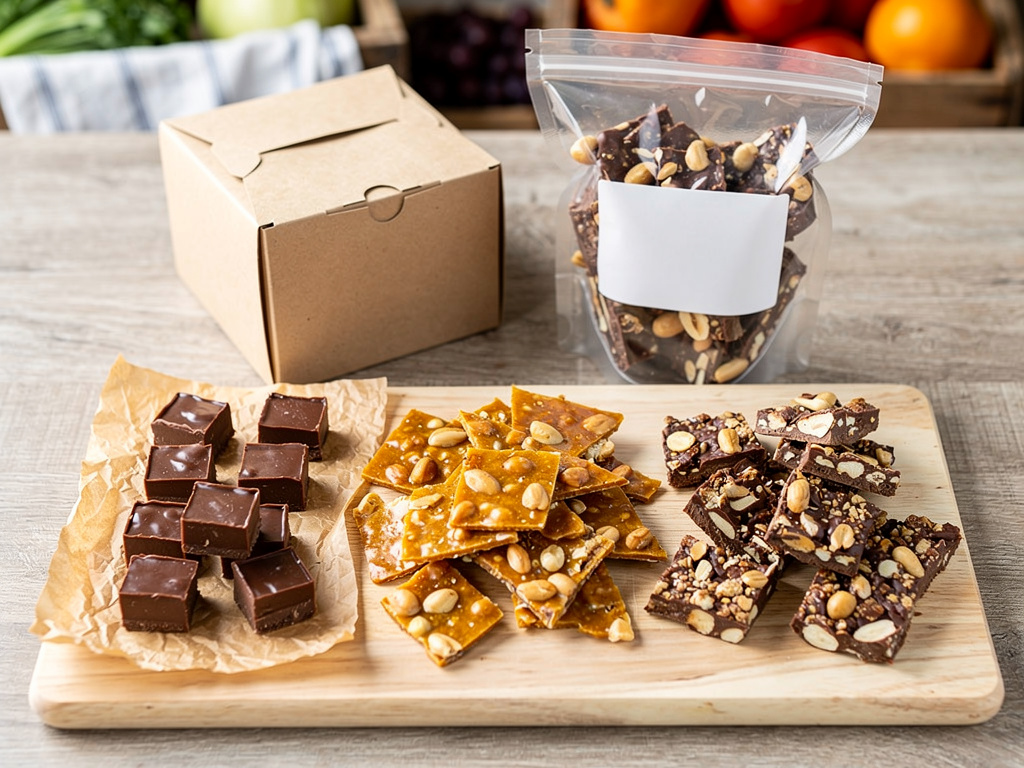


The short version: Sell fudge at $10 to $12 the half pound, peanut brittle at $12 to $15 for an 8 ounce bag, chocolate-coated toffee at $12 to $16 for 6 to 8 ounces, and a small freeze-dried candy pack at $5. The fudge, brittle and toffee ranges come from what real small-batch candy shops were charging when we checked them; the $5 freeze-dried pack is what Homegrown's own vendors charge. That box costs about $3.08 in ingredients, packaging and label, so $10 is about three and a quarter times your cost, and the gift-packaged half pound at $17.95 that Chocolate Moonshine was charging is closer to six times. Candy carries a bigger multiple than most cottage food because it is bought as a gift, so price it against the shelf it sits on rather than against your receipt.
Checked September 22, 2026: shop prices come from each shop's own product page loaded that day (Chatham Candy Manor half pound fudge box $10.00, Touch of Fudge half pound $12.00, Chocolate Moonshine Belgian chocolate fudge half pound $17.95, Dudley's Toffee 6 ounce bag $11.99, Hansel and Gretel Candy Kitchen 8 ounce peanut brittle $12.53, Rusty's Peanut Brittle 8 ounce bag $17.00). Ingredient prices come from Bulkfoods.com the same day, packaging from Paper Mart the same day, and selling fees from findhomegrown.com/signup, etsy.com/legal/fees, hotplate.com/pricing, shopify.com/pricing and squareup.com/us/en/pricing, all loaded September 22, 2026. Honest bounds: these are cost and fee numbers, not a promise that $12 sells in your town. Two of the ingredient lines in the worked examples are grocery buys we assumed rather than loaded, and they are labeled as assumptions where they appear.
Candy is cheap to make and hard to price. A pan of fudge costs a few dollars in sugar, butter and chocolate, and then you stand at your booth trying to decide whether a half pound is a $6 item or a $14 one. Nobody wants to be the vendor whose price makes people put the box back down.
Here is the thing most pricing advice gets wrong about candy. The usual food rule is to multiply what a batch cost you by three or four and call that your price. Candy does not work that way. Candy is a gift, which means the shelf it sits on sets the price, not your receipt, and real candy shops charge three to six times what a batch like yours costs to make.
This guide prices candy the way a small vendor actually sells it: by the type of candy, from real supplier prices loaded the day this was written, against what real shops charge right now. Then it subtracts what each way of selling takes back out, so the number you keep sits next to the number you charge.
Sell candy by the format, not by the pound, and start at these numbers: $10 to $12 for a half pound of fudge, $12 to $15 for eight ounces of peanut brittle, $12 to $16 for six to eight ounces of chocolate-coated toffee, $2 to $4 for a single piece at a booth, $5 for a small freeze-dried candy pack, and $20 to $35 for a gift box. The fudge, toffee and brittle ranges come from prices real small-batch candy shops were charging on September 22, 2026; the $5 pack comes from Homegrown's own catalog, and the $2 to $4 single piece is the impulse price a booth supports rather than a number we loaded from a shop or from that catalog. None of it comes from a formula.
Candy is unusual among cottage food because the price is set by what it is standing next to. A half pound of fudge in a plain deli container reads as a snack. The same fudge in a printed box with a ribbon reads as a gift, and a gift has a price floor that has nothing to do with sugar. This is why two vendors with identical recipes can charge $8 and $18 for the same weight and both be right.
Three things move your number inside those ranges:
If you are still working out whether you can legally sell candy from your kitchen, the companion guide on whether you can sell homemade candy walks through what five state agencies actually allow, including which ones will not let you mail it. This page is the arithmetic that sits underneath it.
A batch of candy costs $3 to $15 in ingredients depending almost entirely on one thing: whether the recipe leans on sugar or on nuts and chocolate. Sugar-and-corn-syrup candy like brittle, hard candy and divinity lands near the bottom. Anything built on real chocolate, butter and pecans lands near the top.
Here is what the ingredients a candy maker actually buys in bulk cost at a US bulk food supplier, at each size they sell:
Scroll sideways to see every column.
| Ingredient | 1 lb zip bag | 5 lb bulk bag | Case | Cost per pound at the 5 lb bag | Cost per pound at the case |
|---|---|---|---|---|---|
| Raw blanched peanuts | $4.29 | $17.59 | 30 lb, $96.95 | $3.52 | $3.23 |
| Lite milk melting wafers | $8.49 | $38.89 | 25 lb, $166.95 | $7.78 | $6.68 |
| Chocolate drops, real milk chocolate | $11.29 | $52.99 | 30 lb, $281.95 | $10.60 | $9.40 |
| Pecan halves, raw | $12.49 | $58.69 | 30 lb, $324.95 | $11.74 | $10.83 |
Every price read off the Bulkfoods.com melting wafers page and its three sibling product pages on September 22, 2026, with each size option read in turn. Plain granulated sugar, corn syrup, butter and evaporated milk are grocery buys rather than bulk-supplier buys, so the worked examples below cost them at assumed grocery prices, labeled as assumptions where they appear: sugar $1.10 a pound, butter $5.00 a pound, corn syrup $4.29 for a 16 ounce bottle, evaporated milk $1.60 for a 12 ounce can, marshmallow creme $2.29 for a 7 ounce jar. Swap in your own receipt. The same supplier's organic cane sugar runs $3.58 a pound at the 5 pound bag, which is more than three times the grocery price, so buying your sugar from a bulk ingredient supplier is usually the wrong move.
Notice the spread. A pound of peanuts costs $3.52 and a pound of pecan halves costs $11.74 at the same supplier on the same day. That single line decides more about your cost sheet than any other choice you make, and it is why peanut brittle can sell for $12 and a box of pecan turtles has to sell for more. Candied pecans show it even more plainly, because the pecans are about 97% of a batch's ingredient cost, which is why candied nut prices start with which nut you pick.
The other thing the table shows is what buying bigger actually saves you. Going from the 1 pound bag to the 5 pound bag takes 18 percent off your peanuts and 8 percent off your melting wafers. Going from the 5 pound bag to the case takes another 8 to 14 percent, and the chocolates save the most: melting wafers drop 14 percent and chocolate drops 11 percent, against 8 percent on both of the nuts. The first jump is worth making as soon as you are selling at all. The second is worth making once you know you will get through 25 or 30 pounds before it goes stale, which for most part-time vendors means during the holiday run and not in March.
A few things that move a candy cost sheet up or down:
Budget 10 to 25 cents of packaging on a bagged candy, which is the bag itself at a penny to twelve cents plus the tie and the tissue that go with it, and 60 cents to $1.50 on a boxed one, then add 5 to 15 cents for the label. Packaging is a small line on your cost sheet and a large line on your price, which is the opposite of how most vendors treat it.
Checked at Paper Mart on September 22, 2026:
The label is the cost you supply yourself. Printing on blank label sheets at home usually lands between 5 and 15 cents a label once you count ink. A printed roll from a label company drops the per-label cost but costs $60 to $150 up front, and it only makes sense once you know a flavor is staying on your list.
Whatever you spend, the label has to carry what your state requires, and getting that wrong costs more than any box. The cottage food labeling requirements guide lists what has to go on it. Verify your own state's current rules before you print a thousand of anything.
Three ways candy vendors trim packaging cost without cheapening the product:
Use three to six times your materials cost for candy sold direct to a customer, with five and six reserved for gift-packaged boxes, rather than the three to four times you would use on bread or jam. That is not a rule somebody invented. It is what the shelf prices work out to when you put a real cost sheet next to what real candy shops charge.
Work it through on fudge. A half pound box of classic chocolate fudge costs about $3.08 to make, including the box and the label. The shops we loaded on September 22, 2026 were charging $10.00, $12.00 and $17.95 for a half pound. That is 3.2 times cost at the bottom, 3.9 times in the middle and 5.8 times at the top, and the shop at the top is selling Belgian chocolate fudge in gift packaging.
Candy carries a bigger multiple than most cottage food for three reasons a customer would agree with:
What the multiple is not is your profit. At six times materials your gross margin is 83 percent, and everything else still has to come out of it: the booth fee, the card processing, the thermometer, the hours at the stove. A vendor selling 50 half pound boxes a month at $10 brings in $500 and keeps $346 after ingredients and packaging, then $325.50 once Square's in-person rate of 2.6 percent plus 15 cents takes $20.50 of it across the 50 sales. Take a $40 booth fee off that and you are at $285.50, with your own cooking hours still unpaid.
For the general version of this formula across other products, the guide to pricing food products for a farmers market works through the two-to-three-times rule that candy sits above. That rule multiplies a cost that already includes your own time at $15 to $25 an hour, which is why its multiple is smaller than the three to six this page applies to materials alone.
Price a batch by costing every ingredient at its per-pound rate, dividing by how many units the batch yields, adding packaging, then multiplying. Here is the whole thing on a real batch: classic chocolate fudge, three pounds finished, sold as six half pound boxes.
Two notes that save arguments with yourself later. Cost the chocolate you actually use, including what stays in the pan, because a batch of fudge leaves more behind than you think. And do not add your labor into the cost before you multiply, because five times an inflated cost prices you out of your own market. Labor comes out of the margin, not into the multiplier.
Each type of candy has its own price shape, set by what the ingredients cost and how the candy is normally sold. Here is what real small-batch shops were charging when we loaded their product pages on September 22, 2026.
Scroll sideways for all the columns.
| Candy | Common size | What sellers charge today | Price per pound | Where to start |
|---|---|---|---|---|
| Fudge | half pound box | $10.00 to $17.95 | $20.00 to $35.90 | $10 to $12 |
| English toffee, chocolate coated | 6 to 8 ounce bag or box | $11.99 to $17.95 | $31.97 to $35.90 | $12 to $16 |
| English toffee, 1 pound gift box | 1 pound | $30.00 | $30.00 | $28 to $32 |
| Peanut brittle | 8 ounce bag | $12.53 to $17.00 | $25.06 to $34.00 | $12 to $15 |
| Freeze-dried candy | small pack | $5.00 | not printed on most packs | $5 flat |
| Single pieces at a booth | 1 piece | $2 to $4, a booth impulse price we did not load from a shop | not applicable | $3 |
Fudge prices from the Chatham Candy Manor half pound fudge box at $10.00, Touch of Fudge milk chocolate half pound at $12.00 and Chocolate Moonshine Belgian chocolate fudge half pound at $17.95, each read off its own product page on September 22, 2026. Toffee from Dudley's Toffee 6 ounce bag at $11.99, Northwest Expressions butter crunch almond toffee 8 ounce gift box at $17.95 and Brown's English Toffee 1 pound box at $30.00, same day. Brittle from Hansel and Gretel Candy Kitchen 8 ounce at $12.53 and Rusty's Peanut Brittle 8 ounce bag at $17.00, same day. Two pages we checked were listed out of stock that day and their prices are not in the table: Bedford Candies half pound chocolate fudge at $8.00 and a 4 ounce freeze-dried Spree pack at $6.99. The $5 freeze-dried figure comes from Homegrown's own catalog, described in the section below. The $2 to $4 single piece is the impulse price a booth supports rather than a number we loaded: that catalog's candy listings start at $4, and it carries no booth prices at all because Homegrown is an online storefront rather than a market table. Our own guide to selling peanut brittle from home quotes a wider $8 to $14 range for a bag, which is the range across all sellers rather than the small-batch shops in this table.
Read the price-per-pound column, because it is the one that tells you the truth. Toffee and brittle land between $25 and $36 a pound at the small-batch end of the market, and fudge runs wider, from $20 a pound in a plain half pound box up to $36 in gift packaging, even though their ingredient costs are nothing alike. Brittle is mostly sugar and peanuts and toffee is half butter, and the shelf charges about the same for both. That is the clearest sign there is that candy is priced by what it is, not by what it cost.
Two formats sit outside that pattern:
If you are pricing one specific candy rather than a range, the guides to selling fudge from home and pricing chocolate truffles go deeper on those two.
Price by the piece at a booth and by the bag or box everywhere else, and only price by the pound if you are actually weighing candy in front of the customer. Each of the three is a different sale, and mixing them on one table confuses people out of buying.
Here is what each one is good for:
One rule follows whichever you pick. If you put a weight on the package, that weight has to be the net weight of the candy and nothing else, and it has to be accurate. The federal packaging and labeling rules are administered through NIST's Office of Weights and Measures, and state weights-and-measures inspectors are the people who actually check a farmers market. The practical version: fill to a little over the number you print, never a little under, and do not count the bag.
Freeze-dried candy is the one format where most sellers print no weight at all, and that is not a loophole you should copy without thinking. Packs puff up to several times their original volume, so a bag that looks full can hold under an ounce. If you print a weight, print the real one. If you do not print one, price flat and describe the pack by what is in it, the way the Homegrown freeze-dried vendor does with its $5 packs.
Homegrown's candy vendors mostly sell small, low-priced packs, with a handful of larger boxes at the top. That pattern is worth knowing before you price, because it is what a local customer who already buys candy online is used to seeing.
A catalog pull on September 18, 2026, published in our companion guide to whether you can sell homemade candy, found 2,485 products from 288 vendors on Homegrown. Candy made up 91 of those listings, sold by 6 vendors. Sixty-one of the 91 were freeze-dried candy packs from a single shop, every one of them priced at $5. The other five vendors' 30 listings ran from $4 for a single fudge flavor up to $32 for a zefir from a marshmallow flower shop, with salted almond toffee at $13, peanut brittle at $20, cotton candy at $6, and coconut truffles, buckeyes and turtles between $4 and $10. Buckeyes are among the cheapest of those to make, about 21 cents a ball from Taste of Home's 66-ball recipe at Walmart.com prices on September 25, 2026, and the peanut butter ball prices in our nut butter guide build a $15 box of 12 from that cost.
The shape of that is worth saying plainly. Most candy sold on a local storefront is a $4 to $10 item, a few are $13 to $20, and the ceiling is around $32. Nobody is selling a $60 box. If your plan depends on a $45 assortment, sell that one at the holiday market table and put a $25 to $32 box on the storefront.
Flat pricing beats weighing when the units are small. The Homegrown freeze-dried candy vendor prices all 61 of its packs at $5, so a customer can build a five-pack mixed order for $25 without doing any arithmetic. Only 13 of those 61 listings print a pack weight at all, and the ones that do run from three quarters of an ounce up to 4 ounces, so the flat price is doing the work rather than a standard size.
The same half pound of fudge is a $10 sale at your booth, a $10 sale plus shipping on your own ordering page, and a $5.00 to $6.00 sale to a shop that is going to resell it. Which of those counters to fill first depends on your state and the season, and the guide to where to sell candy works through seven of them, from holiday markets to local shops, on that same $10 box. Wholesale halves your price, and the two retail channels differ only in what the processing takes.
Swipe to see the whole table.
| Channel | What to charge for a half pound box | What comes out of it | What you keep |
|---|---|---|---|
| Farmers market booth | $10.00 | Booth fee, plus card processing on card sales | $10.00 cash, or $9.59 on a card at 2.6% + 15 cents |
| Your own ordering page, pickup | $10.00 | Card processing 2.9% + $0.30, plus the monthly subscription | $9.41 |
| Your own ordering page, shipped | $10.00 plus actual shipping | Card processing on the full total, plus the box and the postage | $9.41 minus what the shipping actually cost if you undercharged it |
| Wholesale to a shop | $5.00 to $6.00 | Nothing per unit, but you deliver and invoice | $5.00 to $6.00, on a bigger order |
Processing rates read off squareup.com/us/en/pricing and findhomegrown.com/signup on September 22, 2026. The wholesale figure is the standard 50 to 60 percent of retail convention rather than a price we loaded from a shop. Shipping candy is its own problem in warm months: chocolate will not survive a hot mail truck in summer without a cold pack, and a shop that ships chocolate in warm months packs one in and charges the customer for it, so put that into your shipped price rather than absorbing it.
Wholesale is the one channel where candy's economics get uncomfortable. At $5.00 on a box that costs you $3.08, you are keeping $1.92 before your driving time, which only works if the shop is ordering 30 boxes at once. The guide to wholesale pricing for food products works through when that trade is worth making and when it is not.
Selling fees take between 67 cents and $2.35 off a $20 box of candy, depending on where you sell it and on your Hotplate customers paying that platform's service fee the way they do by default, before you count any monthly subscription. A Hotplate vendor who absorbs the service fee instead pays $2.43 a box, its 5% plus 55 cents on top of the same card processing every platform here charges, which is more than any row in the table. Here is the complete stack on every platform, with nothing left out of any row.
Scroll sideways for the rest of the row.
| Platform | Subscription | Trial length | Platform fee or commission | Card processing | Customer pays on a $20 box | Vendor pays on that box | Vendor cost, 50 boxes a month |
|---|---|---|---|---|---|---|---|
| Homegrown | $10/mo billed annually, $12.50 billed monthly | 7 days, no charge until day 8 | $0, 0% commission, no shopper surcharge | 2.9% + $0.30, vendor-paid | $20.00 | $0.88 | $54.00 |
| Etsy | $0 (Etsy Plus optional) | none | 6.5% transaction fee on price plus shipping, plus $0.20 per listing and per renewal after each sale | 3% + $0.25 for a US bank account | $20.00 | $2.35 | $117.50 |
| Hotplate | $0 | none | 5% + $0.55 of the subtotal, charged to the customer at checkout by default, or absorbed by the vendor if you choose | 2.9% + $0.30, vendor-paid | $21.55 | $0.88 | $44.00 |
| Shopify Basic | $29/mo paid yearly, $39/mo paid monthly | 3 days free, then $1/mo for 3 months | $0 with Shopify Payments, 2% with any other processor | 2.9% + 30 cents online, 2.6% + 10 cents in person | $20.00 | $0.88 | $73.00 |
| Square, Free plan | $0 | not applicable | $0 | 2.6% + 15 cents in person, 3.3% + 30 cents online | $20.00 | $0.67 in person, $0.96 online | $33.50 in person, $48.00 online |
Every fee read off the platform's own page on September 22, 2026: findhomegrown.com/signup, etsy.com/legal/fees plus Etsy's published country table for payment processing, hotplate.com/pricing, shopify.com/pricing and squareup.com/us/en/pricing. Etsy does not print the amount of the one-time shop set-up fee its policy says it may charge when you open a shop, so that amount is not in this table. Hotplate does not publish which amount it charges card processing on; its own worked example pays $1.27 of processing on a $30.00 subtotal with a $2.05 Hotplate fee, a $3.00 tip and $2.55 of tax, and $1.27 works back to a base above the subtotal, so treat the Hotplate row as the floor. The 50-box column adds the subscription to 50 times the per-order cost.
What 50 boxes a month at $20 costs the vendor
Computed from the fee table above, all rates read on September 22, 2026. Bar widths are each figure divided by $117.50. Hotplate's $44.00 is the vendor's cost only; the customer pays a further $1.55 on every box, which is $77.50 across the 50.
The cheap-looking rows are cheap for different reasons. Hotplate is low for you because by default your buyer pays the 5% plus 55 cents of service fee, which is $1.55 more on every single box, while you still pay the same 2.9% plus $0.30 of card processing everyone else pays. Hotplate's own pricing FAQ says that fee is yours to pass on or to pay yourself, and a vendor who absorbs it pays $121.50 across 50 boxes instead of $44.00, which turns the cheapest-looking row in the table into the most expensive one, above Etsy. Square's in-person rate is low because it is a card reader at your booth and not an ordering page, so it does nothing for the customer who wants to order on Tuesday for Saturday pickup. Compare what the customer pays and what the vendor pays as two separate numbers, because a platform can move cost from one column to the other and call it a discount.
A $20 box of fudge sold through your own Homegrown storefront costs you 88 cents in card processing and nothing else per order, on a $10 a month subscription billed annually, or $12.50 billed monthly. On 50 boxes that is $54.00 against Etsy's $117.50, which is $63.50 a month you keep because candy sells locally and Etsy is built for shipping.
That difference matters more for candy than for most products. None of the five state cottage food pages our companion permission guide checked allows mailing homemade candy to another state, so check your own state's page before you build on a shipping marketplace, and for most candy vendors a nationwide marketplace is charging a nationwide fee for what is really a local sale. Homegrown is $10 per month with no percentage fees beyond standard payment processing, and it gives you a storefront link where a customer browses your flavors, picks a pickup time and pays before you start cooking. For a candy maker that means you know how many boxes of fudge to pour before the pan goes on the stove, which is the whole ballgame in a product you pour to order rather than stockpile.
Compare that to the two platforms a candy vendor usually looks at first. Etsy is the right tool if your candy ships and your customers are strangers, but it takes $2.35 off every $20 box and its listing fee renews after each sale, so a fast-moving $5 freeze-dried pack gives up a larger share than a $32 gift box does. Hotplate is built around timed release windows and it costs you nothing monthly, though you still pay 2.9 percent plus $0.30 of card processing on every order, and its 5 percent plus 55 cents service fee lands on your customer's total, so your $20 box is $21.55 at their checkout. The model assumes you are selling in bursts rather than keeping a standing list of flavors.
What Homegrown does not do, said plainly. Your customer creates a Homegrown account to place a first order, which is one extra step for a neighbor who just wants fudge. There is no countdown release or drop feature, so if your business runs on timed drops that is a real gap. Your storefront is listed on the marketplace, but plan on most of your orders coming from people you send to your own link rather than from shoppers who find you browsing. And the 2.9 percent plus 30 cents of card processing is paid by you, with nothing passed through to the customer.
Price a gift box at the sum of its parts plus $5 to $10 for the presentation, and expect the box to become most of your November and December revenue. An assortment that holds four half pound products worth $40 loose should sell for $45 to $50 at a holiday market table or shipped, not $40 and not $65. That sits above the $32 ceiling on Homegrown's own local catalog in the section above, so for storefront orders build the smaller two-product box at $25 to $32 and keep the big assortment for the table in December.
The mechanics of why that works:
Keep the assortment small enough to actually assemble on a weeknight. Two or three fixed boxes at different prices beat a build-your-own system that takes you ten minutes per order to pack. The guide to bundle pricing works through how to set the bundle price against the individual ones so the bundle still looks like a deal.
Use melting wafers at $7.78 a pound rather than tempering real chocolate at $10.60 a pound, until you are making candy most days of the week. Wafers save you $2.82 a pound in ingredient cost, and tempering real chocolate costs you that $2.82 plus the failed batches and the time at a part-time volume.
The arithmetic. Melting wafers at $7.78 a pound need no tempering and set hard and shiny every time. Real chocolate drops at $10.60 a pound taste noticeably better and have to be tempered, which means holding the chocolate inside a two or three degree window and starting over when it streaks. That is $2.82 a pound you save by using wafers, which on a half pound box with 2 ounces of coating is 35 cents.
Thirty-five cents is not a reason to learn tempering. Taste is. If your candy is a chocolate-forward product and you are charging at the top of the range, real chocolate is worth the failure rate and worth saying so on the label. If your candy is brittle with a chocolate drizzle, wafers are the right call and nobody will ever know.
The same logic applies to every other ingredient a candy maker is tempted to make themselves. Roasting your own peanuts saves 82 cents a pound: the same supplier wanted $3.52 a pound for raw blanched peanuts at the 5 pound bag and $4.34 a pound for the roasted, unsalted version of the same nut on September 22, 2026. Growing the pecans saves $11.74 a pound in cash and costs you a decade and an orchard. Spend the effort on the flavor nobody else at your market has, not on the input you can buy for three dollars.
The most expensive mistake is pricing candy at the three-times bread floor, which lands a half pound box 8 to 23 percent under the shops in the middle of the market and close to half under a gift-packaged box, and is very hard to walk back once your regulars have seen the number.
The five that cost the most money:
Raise candy prices between seasons, in one move, with the new price on a new label. A dollar on a $10 box is a 10 percent raise, and it is invisible to a customer who is buying twice a year for gifts.
Three things that make a raise land quietly:
If you have been holding a price for two years and are nervous about moving it, the guide to raising prices without losing customers has the scripts for the conversation at the booth.
Your candy price is right when you sell out of your best format late in the day most market days, without anyone commenting on the price. Those two signals together are the test, because either one alone points the wrong way.
Three signals to read:
Check the number twice a year at minimum, once before the holiday run and once in the spring, and recost a batch any time an ingredient moves more than 20 percent. Butter and chocolate both move enough to matter within a single season.
Charge $2 to $4 for a single piece of fudge at a booth, and $10 to $12 for a half pound box. The piece price is an impulse price that works out to far more per pound than the box, which is fine, because the customer buying one piece is not comparing it to anything. Keep both on the table so a first-time customer can try one flavor and come back for a box.
A half pound of fudge that costs $3.08 in ingredients, box and label and sells for $10 is a 69 percent gross margin. Candy usually lands between 65 and 85 percent gross, which is higher than most cottage food because it does not spoil quickly and it is bought as a gift. That is gross margin only; your booth fee, card processing and your own hours still come out of it.
Price at the top of each range rather than the bottom, because a holiday buyer is comparing your box to other gifts and not to other snacks. A half pound of fudge that sells for $10 in June is a comfortable $12 in December, and a gift assortment that would struggle at $45 in the spring sells at $50 in the first week of December. Set those prices in September, before you print labels.
Usually yes. Net weight is one of the six elements a cottage food label normally carries, alongside the product name, the ingredient list, your name and address, the allergen declaration and your state's own disclaimer wording, and your state's rule is the one that decides. If you print a net weight it has to be accurate and it has to be the candy only, not the candy plus the bag. Federal packaging and labeling standards are administered through NIST's Office of Weights and Measures, and state weights-and-measures inspectors are the ones who check markets. Your state's cottage food label rules may require more than the weight, so verify your own state's current rules before printing.
A three pound batch of classic chocolate fudge costs about $14.59 in ingredients, which is $2.43 per half pound before packaging. A pound of peanut brittle costs about $3.41 in ingredients on a standard batch: 7 ounces of sugar at an assumed $1.10 a pound is $0.48, 5.5 ounces of corn syrup at an assumed $4.29 for a 16 ounce bottle is $1.47, 5 ounces of raw blanched peanuts at the supplier's $3.52 a pound is $1.10, an ounce of butter at an assumed $5.00 a pound is $0.31, and the soda and salt round to $0.05. The spread comes almost entirely from the nuts and the chocolate: raw blanched peanuts were $3.52 a pound and pecan halves were $11.74 a pound at the same bulk supplier on September 22, 2026.
On a $20 box of fudge, Etsy takes $2.35 and a Homegrown storefront takes 88 cents of card processing plus a $10 monthly subscription billed annually. That works out to $117.50 against $54.00 across 50 boxes a month, so your own storefront is cheaper from about the seventh $20 box onward, or from about the thirteenth box if you are selling the $10 half pound this guide starts you at, where Etsy takes $1.40 a box against the storefront's 59 cents. Etsy is the better tool if your candy ships to strangers, though the companion permission guide read five state agencies and not one of them allows a cottage food candy sale mailed out of state, so read your own state's page before you build on a shipping marketplace.
Pricing is one piece of it. If you are working out the rest of the candy business alongside the number on the label, these five go deeper on the parts this guide only touches, and each one is written for the same part-time vendor selling a few dozen units a week rather than a factory:
If you only read one of them, read the permission guide first. Not one of the five state agencies it read allows a home-kitchen candy sale shipped out of state, and that single rule decides whether a shipping marketplace or a local storefront is the right place for your prices to live.
Your prices should live on a page your customers can open on a Tuesday, because candy is bought in advance of an occasion and almost never on the day. Someone deciding what to bring to a party on Saturday is looking on Wednesday night, and if your prices only exist on a chalkboard at a booth, that order goes somewhere else.
A Homegrown storefront gives you one link with every flavor, every price and a pickup time, for $10 a month billed annually with no commission on your sales beyond the standard 2.9 percent plus 30 cents of card processing. You will know how many boxes to pour before you turn the stove on, which on a product you pour in batches to order is the difference between a good December and a freezer full of fudge.
That matters most in the eight weeks that carry a candy business. Between the middle of October and Christmas, a candy vendor is selling into gift buying rather than snack buying, and almost all of those orders are placed days ahead for a specific date. A chalkboard at a booth cannot take a Tuesday order for a Saturday pickup. A page with your prices on it can, and it will keep taking them on the weekends your market is rained out.
Put the prices from this guide on that page, keep a note of what each batch actually cost you, and check the two numbers against each other twice a year. Start your storefront and put your candy prices somewhere they work while you sleep.



