
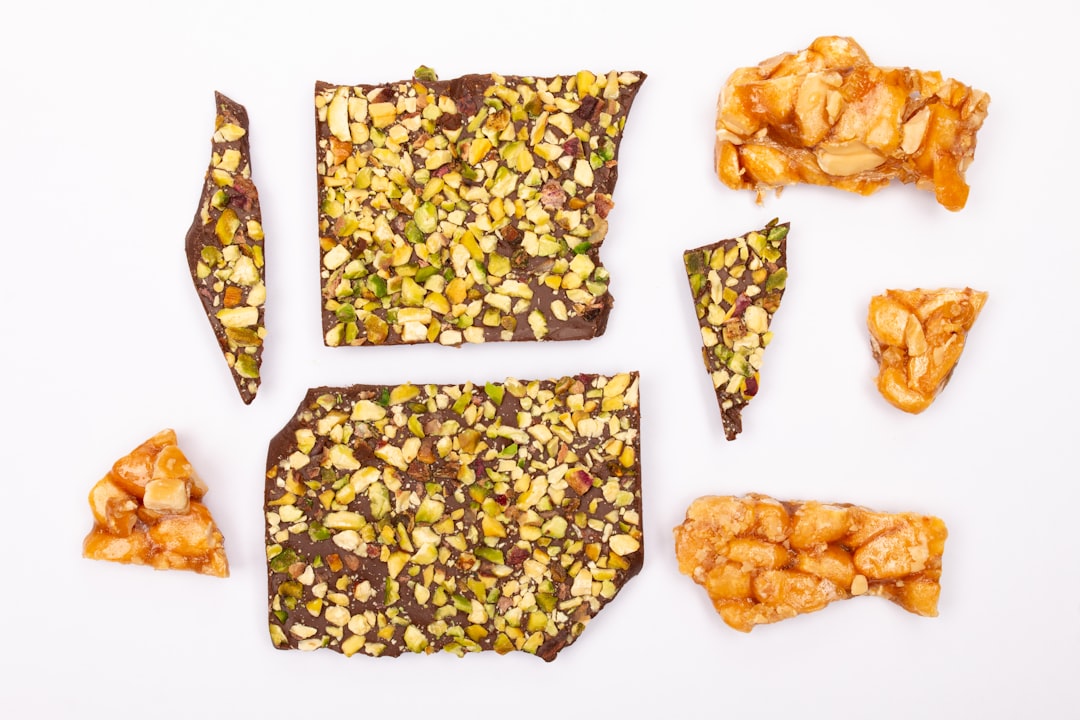


The short version: Every one of the 8 state cottage food pages we read allows peanut brittle, but New York's list allows it only "using commercially roasted nuts," and only 3 of the 8 let you mail it to a customer. Ingredients, bag and label for an 8 ounce bag come to about $1.83, and small-batch candy shops charged $12.53 to $17.00 for that size, so $12 to $15 is a fair starting price. By our candy shelf-life guide's working rule, homemade brittle keeps about 3 to 4 weeks sealed at cool room temperature, with a 21-day best-by date and no freezer. Label peanuts and milk (from the butter) on every bag, cook to the hard-crack stage of 300 to 310°F, and build gift bags for November and December, the peak candy season.
Checked October 19, 2026: the cottage food pages of the 8 states we read (California, Connecticut, Florida, Michigan, New Jersey, New York, Texas and Washington), the FDA's allergen page, the Exploratorium, Kansas State and Ohio State candy guides, the Global Cold Chain Foundation candy manual (revised 2024), and the pricing pages of the four selling platforms in our fee table. Ingredient, packaging and shop prices come from our candy and caramel pricing guides, which checked them in September 2026. Homegrown is built for pickup and local delivery, its signup page lists no shipping option, customers create a Homegrown account to place a first order, and there is no drop or countdown release feature. Rules change, so verify your state's current rules before you sell.
Peanut brittle is an old-fashioned candy with staying power, and the gap between what it costs you and what it sells for is wide. It costs little to make, keeps for weeks when it is sealed, and sells as a nostalgic gift and holiday treat. A pound of brittle takes about $3.42 in sugar, corn syrup, peanuts and butter, and small-batch candy shops charged $12.53 to $17.00 for half that much. If you enjoy candy-making, brittle gives you a bag that keeps about 3 to 4 weeks sealed at cool room temperature and sells hardest as a gift in November and December.
This guide covers why peanut brittle sells, what 8 states actually allow, the label, the real cost and price, how to get the crunch, how long it keeps, shipping, and how to reach gift and holiday buyers.
You can cook brittle days before a pickup day or delivery run, and where your state allows payment online, you can set up a Homegrown storefront so regulars order and pay before you start.
Peanut brittle is a smart product because it is inexpensive to make, keeps longer than most candy a home vendor sells, and carries strong nostalgic and gift appeal. Unlike delicate baked goods, brittle is hard and dry. The Global Cold Chain Foundation's candy manual lists peanut brittle at 1.8% moisture against 10.9% for vanilla fudge, and less water is why brittle keeps for weeks instead of days.
Here is what makes it work:
The honest note: brittle-making takes attention, because you are cooking sugar to the hard-crack stage, about 300°F, where a minute too long tastes burnt. And a $12 bag means your money comes from volume and gift sets, not from one big order. But the ingredient cost is low, the product forgives a few days on the shelf, and the nostalgic appeal makes it an easy sell, especially in the holiday season.
Yes: all 8 states we read for this guide allow peanut brittle as cottage food, because it is a shelf-stable candy, but the states differ on peanuts, chocolate and where the bag can go. California, New Jersey, New York and Washington name brittle outright. Connecticut, Florida and Michigan allow candy and confections in general, and Texas allows any food that is not on its short list of exceptions.
California's list of approved cottage foods puts "Brittles" under Candy and Confections. New Jersey's cottage food rules read "Candy, including brittle and toffee." Washington's cottage food page lists "Nut Brittles" and adds that for stovetop candy, "temperature monitoring with candy thermometer is required."
New York is the state that changes the recipe. Its home processor page approves "Peanut brittle (using commercially roasted nuts)" and prohibits "Any products containing raw nuts." The department's reason: "there is no control step with raw products. Raw nuts have been linked to foodborne illness (i.e. salmonella)."
Most brittle recipes stir raw peanuts into the boiling syrup. New York's home processor rules do not allow that. Its approved list reads "Peanut brittle (using commercially roasted nuts)," and the department says processors who use nuts "must use commercially processed (roasted or otherwise heat treated) nuts." It also prohibits "Tempered chocolate/candy melt/almond bark for dipping/coating/drizzling," so a chocolate-drizzled brittle is out there too. All of it is on the New York Agriculture and Markets home processing page, read October 19, 2026.
Here is what each of the 8 states says about brittle and about getting it to a customer.
Scroll sideways to see every column.
| State | Is brittle allowed? | Can you mail it to a customer? | Yearly sales limit on the page we read |
|---|---|---|---|
| California | Yes: "Brittles" are on the approved list | Yes, inside California: a direct sale "may be fulfilled in person, via mail delivery," and must be "a transaction within the state" | Not on the list we read |
| Connecticut | Yes: "Candies and confections" | No: "Products may not be delivered by mail or by other third-party delivery services such as UPS or FedEx." You may advertise and take orders online, but "Sales and product delivery must be directly from the producer or designee to the consumer, in a person-to-person transaction" | $50,000 |
| Florida | Yes: "Candies and confections" | Yes: sales "on their website, by mail order, and direct to consumer" | $250,000 |
| Michigan | Yes: "Confections and candies (made without alcohol)" | Yes, inside Michigan: "may be sold by internet or mail order," and "may only be sold or delivered within Michigan" | $50,000 |
| New Jersey | Yes: "Candy, including brittle and toffee" | No: "You may not send products to your customers through the mail" | $50,000 |
| New York | Yes, "using commercially roasted nuts" | Not stated for mail inside the state; internet sales "within New York State only," and "Shipping products out of state is not permitted" | Not on the page we read |
| Texas | Yes: allowable foods "include any foods, except for" meat, seafood and a short list of others | No: online sales only when "the operator, an employee, or a household member personally delivers the food" | $150,000 |
| Washington | Yes: "Nut Brittles," with a candy thermometer required | No. You may advertise and take orders online, but delivery and payment must both be person to person, with no mail or courier and no sales outside the state | $35,000 |
We read each state's cottage food page on October 19, 2026: California's approved list (last reviewed April 2026) and Health and Safety Code section 113758, Connecticut's accepted products list and sales FAQ, Florida FDACS, Michigan MDARD's what-can-I-make and selling pages, the New Jersey Department of Health FAQ, New York Agriculture and Markets, Texas DSHS and Washington WSDA. California and Michigan allow mail only to customers inside the state.
A few points to keep straight:
Every state sets its own rules and sales limit, so confirm your own before you sell. Our overview of what foods you can sell under cottage food laws and the cottage food laws by state directory point you to the specifics where you live, and can you sell homemade candy walks through candy rules state by state.
A peanut brittle label needs the product name, your name and address, the ingredients in order by weight, the net weight, and an allergen line that names peanuts and milk. That is the list New York spells out on its home processing page. On top of it, 7 of our 8 states require their own home-kitchen statement, and New York recommends one.
What to print on every bag:
Then add your state's own statement, and copy it exactly. New Jersey's labeling page says it plainly: "Altering it in any way will cause your label to be rejected." Here is the wording each state's own page or law gave on October 19, 2026:
A "may contain peanuts" line on your cashew or pecan brittle is not a substitute for clean equipment. The FDA's allergen page says advisory statements like "may contain" are "not required by law" and should be used only after a business has "taken every precaution to avoid cross-contact." If you cook cashew or pecan brittle in the same pot as your peanut batch, wash the pot and every tool between batches, and list the real ingredients on each label.
For the full allergen rules, our guide to the big 9 allergens on a cottage food label shows the exact wording for each.
A pound of peanut brittle costs about $3.42 in ingredients, and an 8 ounce bag costs about $1.83 once you add the cello bag and a label. Raw blanched peanuts were $3.52 a pound in the 5 pound bag on September 22, 2026, which keeps the peanuts to about $0.55 of an 8 ounce bag, and the candy pricing guide costs the whole batch out line by line (it rounds each line first, so it shows $3.41 a pound). Ingredients are inexpensive, especially when you buy peanuts in bulk, which is what gives brittle its healthy margin. Peanuts ground into butter price out differently: a 16 ounce jar of homemade peanut butter cost about $4.07 including the glass at Walmart.com prices on September 25, 2026, and the guide to pricing homemade nut butter shows why it sells for about $13.
Here is the breakdown for one pound of brittle, which fills two 8 ounce bags:
Swipe left on a phone to see the whole table.
| Item | Amount for 1 pound | Price used | Cost per pound | Cost per 8 oz bag |
|---|---|---|---|---|
| Sugar | 7 oz | $1.10 a pound (assumed grocery price) | $0.48 | $0.24 |
| Corn syrup | 5.5 oz | $4.29 for 16 oz (assumed) | $1.47 | $0.74 |
| Raw blanched peanuts | 5 oz | $3.52 a pound, Bulkfoods.com 5 lb bag | $1.10 | $0.55 |
| Butter | 1 oz | $5.00 a pound (assumed) | $0.31 | $0.16 |
| Baking soda and salt | Pinch | Rounded | $0.05 | $0.03 |
| 4 x 9 inch cello bag with twist tie | 1 per bag | 200 for $9.99, Walmart.com | $0.05 | |
| 2-inch round label | 1 per bag | 120 for $8.87, Walmart.com | $0.07 | |
| Total | $3.42 in ingredients | $1.83 a bag |
Ingredient amounts and prices come from our candy pricing guide (Bulkfoods.com peanuts read September 22, 2026; sugar, corn syrup and butter are that guide's labeled grocery assumptions). Bag and label prices come from our caramel pricing guide (Walmart.com, September 25, 2026). We loaded both guides October 19, 2026. Each row is rounded to the cent, so the columns add to $3.41 and $1.84 against the unrounded totals of $3.42 a pound and $1.83 a bag.
That bag costs about $1.83 to make and sells for $12 to $15. At $12, you keep $10.17 before any selling fee, about 85% of the price. Corn syrup is the biggest line, not the peanuts, and the candy pricing guide explains why it stays: it keeps brittle from turning grainy. Because brittle keeps for weeks, you have little spoilage waste, and you can cook ahead of a busy holiday weekend.
Two cost changes are worth knowing:
The one-time tools are cheap. A candy thermometer started at $9.52 at Walmart.com on September 25, 2026, so a thermometer, 200 bags and 120 labels come to $28.38 before your first batch.
Weigh every bag. Brittle breaks into uneven pieces, and a bag that looks full can come in at 6 ounces. If your label says 8 oz, put 8 oz in it. A kitchen scale and a habit of filling to weight keep your label honest and your cost per bag at the $1.83 you planned.
Price peanut brittle at $12 to $15 for an 8 ounce bag, and put gift boxes at $20 to $35. Our candy pricing guide read small-batch candy shops on September 22, 2026: Hansel and Gretel Candy Kitchen charged $12.53 for 8 ounces of peanut brittle and Rusty's Peanut Brittle charged $17.00 for an 8 ounce bag. That works out to $25.06 to $34.00 a pound.
A pricing structure that works:
Scroll sideways for the full table.
| Format | Size | Suggested price | Your cost to make | Who buys it |
|---|---|---|---|---|
| Standard bag | 8 oz | $12 to $15 | $1.83 | Everyday buyers and reorders |
| Gift box or tin | About 1 lb | $20 to $35 | $3.42 in brittle, plus a box or tin at 60 cents to $1.50 | Holiday gifts, teachers, coworkers |
| Premium nut brittle | 8 oz | Above your peanut price | Higher: pecans cost more than three times what peanuts do | Gift buyers and regulars who want something new |
| Pan, as one Homegrown vendor sells it | 8x8 or 9x13 pan | $20 or $40 | Depends on your pan weight | Families and parties |
Bag and gift box ranges and the 60 cents to $1.50 box budget come from our candy pricing guide, which read the shops on September 22, 2026. The pan prices are a live Homegrown listing read October 19, 2026. Your cost uses the table in the cost section.
Gift boxes and premium nut versions are your best tools for raising the average order, and the holidays are your peak window. The candy pricing guide puts the peak in November and December, "when it is competing with other gifts rather than with other snacks." If pricing your work fairly feels uncomfortable, read why charging what you're worth feels wrong, and see how vendors price honey, jam and baked goods at a farm stand. Given the low ingredient cost and nostalgic appeal, price for the value and tradition you deliver.
In a pull of the Homegrown catalog on October 19, 2026, 1 of the 2,921 products listed by 327 vendors was peanut brittle: Divine Destiny Desserts' Peanut Brittle, $20 for an 8x8 pan or $40 for a 9x13, described as made "on the stovetop with six simple ingredients and roasted peanuts." No other listing was a brittle of any nut. How we counted: we searched every product name, description and flavor option for "brittle," then read the vendor's full list of products.
One listing in a catalog of 2,921 is an opening. A vendor who sells brittle by the bag, with a clear best-by date and a gift box for December, has very little company on the platform.
You get peanut brittle's crunch by cooking the sugar to the hard-crack stage, 300 to 310°F, and stirring in baking soda at the end for a light, airy snap. The Exploratorium's chart of sugar stages puts hard crack at 300 to 310°F, where the syrup is about 99% sugar with "almost no water left," and names nut brittles as one of the candies cooked there. Texture is everything with brittle, and getting there is mostly temperature control.
Steps that produce great brittle:
Practice your temperature and timing, since under-cooked brittle is chewy and over-cooked brittle tastes burnt. Watch the weather too. Blakeslee says a humid or rainy day is "probably not the best day to make (non-crystalline) candy," and the Ohio State book says to "cook the candy longer, or wait for a dry, cool day." Consistent crunch and clean, uniform pieces are what make your brittle look and taste professional.
Homemade peanut brittle lasts about 3 to 4 weeks in a sealed bag or tin at cool room temperature, by the working rule in our guide to how long homemade candy lasts, and that guide puts the best-by date at 21 days. Humid air makes the surface sticky first, and the peanuts slowly go stale after that. Those times are about quality, the crunch and the flavor, not a lab test.
That working rule sits between two sources. Virginia Tech's Alexis Hamilton, an assistant professor of food processing microbiology, says homemade treats "fully cooked to their crunchy and sticky best" usually last "anywhere from four to seven days" at room temperature. The Global Cold Chain Foundation's candy manual gives factory-made nut brittle 12 months at 68°F, but only for candy made with "modern production techniques" and stored at controlled humidity. A home kitchen and a cello bag are neither, so our candy guide gives sealed homemade brittle weeks, not months.
What moves brittle toward the short end of that window:
Peanut brittle goes stale before it goes bad: the first signs are a tacky surface and pieces that bend instead of snapping, then nuts that taste flat or rancid. Brittle has very little water for mold to use, at 1.8% moisture in the cold chain manual's figures, so a sealed bag usually loses quality long before anything else happens. If a piece smells rancid or shows mold, throw the batch out.
Peanut brittle should stay out of the freezer, and out of the fridge too. Ohio State's 4-H candy book says "Peanut Brittle and hard tack type candies should not be frozen" and should be stored in an "airtight container, dry canister or glass jar" instead. Kansas State adds that cold storage "can cause candy to absorb extra moisture and get sticky," which is the exact thing that ruins brittle.
The practical rule for a vendor: cook no earlier than 10 days before the sale. With a 21-day best-by date, that leaves your customer 11 or more days of good brittle at home, which is the cook-ahead row in our candy shelf-life guide.
Store and sell peanut brittle in an airtight package, at room temperature, out of sunlight. Kansas State's holiday candy guidance says candy "should be stored in an airtight container at room temperature and out of sunlight." For brittle, the package is the shelf life.
Packaging that keeps the crunch:
Print the best-by date on every bag. A line like "Best by November 30. Keep sealed and dry, away from heat" answers the question your customer will otherwise text you about.
The peanut brittle variations that sell best build on the classic with premium nuts, flavors and giftable formats. If you also sell the nuts candied on their own, one pound of pecans turns into about 21 ounces of cinnamon sugar pecans for $13.43 in store-brand ingredients, and what to charge for candied pecans and almonds follows from that batch cost. Because brittle is a nostalgic favorite, the classic sells reliably, while variations and gift packaging let you charge more and reach more occasions.
Variations that sell:
Formats that drive sales:
Keep the classic front and center and add a premium variation or two, plus a seed brittle for customers who avoid peanuts. Sample at markets where your state allows it, since one crunchy bite sells the bag. Florida lets cottage food operators "serve free samples for tasting, but the samples must be prepackaged," and Connecticut allows free samples "subject to local health department approval." A lineup anchored by great classic brittle with a few premium and giftable options lets one cooking session fill both $12 to $15 bags and $20 to $35 gift boxes.
Peanut brittle usually cannot cross state lines under a cottage food exemption. Our guide to shipping cottage food read 25 states on October 1, 2026, and found that only Arkansas, North Dakota and Pennsylvania let home food vendors sell across state lines under their own law, while 15 say outright that cottage food stays in the state. The same guide calls Florida a fourth case: its statute lets cottage food go by mail without saying in-state or out, and the University of Florida's extension fact sheet reads that as permission to ship "across state lines." Among the 8 states in this guide, California, Connecticut, Michigan, New York and Washington all keep sales inside the state.
What that means for a brittle vendor:
If your state does allow mail, Ohio State's candy book gives the packing rule: "wrap each piece of candy individually," pack it in layers "using bubble wrap or shredded paper in a sturdy box," and "do not mail in hot weather." Pack brittle snugly so it arrives as pieces, not crumbs.
Sell peanut brittle to gift shoppers, holiday buyers and nostalgic treat lovers, using sampling, gift packaging and a clear best-by date, and a gift box at $20 to $35 lifts your average order well above a single $12 bag. Brittle is a traditional gift and an impulse treat, so your presentation and the occasions you market to drive most of your sales, and our guide to where to sell candy covers the venues.
Ways to sell more:
Because brittle keeps for weeks, you can carry stock, fill gift orders and handle reorders without the waste a baker faces. Managing gift orders and holiday rushes through DMs still gets messy, so a real storefront helps. Here's how to sell food online as a local vendor so your gift and holiday season runs smoothly.
If your December runs on texts and comments, you already know the problem: three people want tins, two want bags, and nobody has paid. Where your state allows payment online, a storefront takes the order and the payment in one step, and you can set up a Homegrown storefront before the holiday rush starts.
A candy that keeps for weeks, sells as a gift and has to be handed over in person in 4 of the 8 states we read fits a local pickup storefront. Homegrown is $10 a month billed annually ($12.50 billed monthly) with no percentage fees beyond standard payment processing, and it gives you an order page where customers browse your brittle and gift tins, pick a size, pay, and choose pickup or local delivery. Every listing shows allergens and ingredients, so "Contains peanuts, milk" is on the page before anyone orders.
Check your state's online rules before you take a payment online. In Washington, you may advertise and take orders online, but delivery and payment must both be person to person, with no mail or courier and no sales outside the state. WSDA's cottage food page says you can "take orders over the Internet," and the same page says "Internet, mail, consignment, wholesale, & retail sales outside the state are prohibited." The state rule, WAC 16-149-040(2), squares the two: you may keep a website "displaying available products provided any sales arising from the website are completed as in-person transactions." WSDA adds that "Product delivery and payments must be directly from the producer to the end consumer in a person to person transaction." Connecticut's sales FAQ says the same: you "may advertise and take orders for your product online," but "Sales and product delivery must be directly from the producer or designee to the consumer, in a person-to-person transaction," and "the actual sale must be made in person." A Washington or Connecticut vendor should confirm with the state before collecting payment through a storefront. Texas allows online sales when you post your label information on your website before you accept payment and "the operator, an employee, or a household member personally delivers the food," per its cottage food page.
How it compares on a $20 gift order:
Swipe sideways to see every column.
| Platform | Monthly plan | Platform or service fee | Card processing | Customer pays on a $20 order | You pay on a $20 order | You pay in a month of 50 orders at $20 |
|---|---|---|---|---|---|---|
| Homegrown | $10 billed annually ($12.50 monthly); 7-day trial, no charge until day 8 | None, 0% commission | 2.9% + $0.30, paid by you | $20.00 | $0.88 plus the plan | $54.00 ($56.50 on monthly billing) |
| Hotplate, default | $0 | 5% + $0.55, paid by the customer | 2.9% + $0.30, paid by you | $21.55 | About $0.88 to $0.92 | About $44.00 to $46.25 |
| Hotplate, you cover the fee | $0 | 5% + $0.55, paid by you | 2.9% + $0.30, paid by you | $20.00 | $2.43 | $121.50 |
| Etsy | None required; a one-time set-up fee may apply | $0.20 listing fee for each item sold (one gift box here) plus 6.5% transaction fee | 3% + $0.25 | $20.00 plus shipping | $2.35 | $117.50 |
| Square Online, Free plan | $0 per location | None | 3.3% + 30¢ online | $20.00 | $0.96 | $48.00 |
We checked these on each platform's own pages on October 19, 2026: findhomegrown.com/signup, hotplate.com/pricing and Hotplate's post "What Hotplate does," etsy.com/legal/fees and Etsy's payment processing help page, and Square's pricing and fees pages. Card processing is figured on the $20 price. Hotplate's own pricing example puts its card fee on the order and tip, the $0.88 end; the $0.92 end is the card fee on everything the customer pays. Hotplate's post says it charges "a fee to your customer" by default and that "80% of Hotplate chefs keep the default as-is." Etsy's transaction and processing fees also apply to what you charge for shipping.
How the alternatives fit a brittle vendor:
What Homegrown does well for a brittle vendor: sizes and flavors under one listing, each with its own price, so an 8 ounce bag and a gift tin sit side by side; quantities that update as you sell, so 40 tins stop at 40; allergens and ingredients on every listing; pickup or local delivery; and a signup page that says you can be live in 15 minutes. What it does not do: it does not ship orders, it will not cook or package your brittle, and it cannot promise you sales. Customers create a Homegrown account to place a first order, and there is no drop or countdown release feature. Your storefront is listed on the Homegrown marketplace, but plan on most orders coming from people you send to your own link. When you're ready, you can set up your storefront and sell your brittle today.
Plan holiday brittle by counting backward from each pickup day: cook no earlier than 10 days before it, so every bag still has 11 or more of its 21 days left when the customer takes it home. Brittle is the candy that lets you get ahead in December, because caramels and fudge in the same shelf-life guide get much shorter windows.
A week that works for a Saturday pickup:
The math is easy to plan: every pound you cook fills two 8 ounce bags, and a pound costs about $3.42 in ingredients. Twenty bags means 10 pounds of brittle, about $34 in ingredients, and $240 to $300 in sales at $12 to $15 a bag.
The most common peanut brittle mistakes are pulling the pan before 300°F, labeling peanuts but forgetting the milk in the butter, and packaging that lets humid air in. Because brittle is a candy with a serious allergen, the errors that matter most affect quality and safety.
Mistakes to avoid:
Get these right and a bag that costs about $1.83 to make sells for $12 to $15 and holds up to its 21-day best-by date.
In all 8 states covered here, you sell peanut brittle from home under a cottage food or home processor exemption, and the paperwork ranges from none to a permit. Michigan says cottage food producers sell "with no license, registration, or inspection," New Jersey issues a Cottage Food Operator permit, New York asks you to register as a home processor with no fee, and Washington charges $355 for a two-year permit and inspects your kitchen. Training and fees can come with the paperwork: Texas requires the operator to "successfully complete a basic food safety education or training program for food handlers," per its cottage food page, and New Jersey's permit application asks for a copy of your "Food Manager's Certificate" and a "$100 payment for the application fee," per its cottage food FAQ. Check your own state's cottage food page, and remember that New York allows brittle only "using commercially roasted nuts."
Homemade peanut brittle keeps 3 to 4 weeks sealed in a bag or tin at cool room temperature, by the working rule in our candy shelf-life guide, with a best-by date 21 days after cooking. Humid air makes it sticky first, and the peanuts go stale after that. Do not refrigerate or freeze it: an Ohio State 4-H candy book says peanut brittle "should not be frozen" and belongs in an airtight container.
Peanut brittle sells for $12 to $15 for an 8 ounce bag, with gift boxes at $20 to $35. Small-batch shops charged $12.53 and $17.00 for 8 ounce bags when our candy pricing guide checked them on September 22, 2026. Since ingredients, bag and label for 8 ounces come to about $1.83, margins on peanut brittle are strong, and gift tins and premium nut versions raise your average order.
Peanut brittle turns out chewy instead of crunchy usually because the sugar did not reach the hard-crack stage, 300 to 310°F. Use a candy thermometer, lower the target about 1 degree for every 500 feet of elevation, and avoid cooking on humid days, when the syrup holds onto water. Brittle that was crunchy and went soft later was stored where humid air could reach it.
Peanut brittle ships well physically, but cottage food rules usually limit or forbid shipping it: our shipping guide found 15 of the 25 states it read keep cottage food inside the state. Of the 8 in this guide, California and Michigan allow mail only inside the state, Florida allows mail order, and Connecticut, New Jersey, Texas and Washington rule mail out. In Washington, you may advertise and take orders online, but delivery and payment must both be person to person, with no mail or courier and no sales outside the state. Shipping across state lines generally needs a licensed commercial kitchen, so confirm your state's rules before you mail a single bag.
A seed brittle made with pumpkin or sunflower seeds is a good peanut-free option, since it serves customers who avoid peanuts and uses the same hard-crack technique. Do not call it allergen-free if it shares your kitchen with peanut batches, and remember the butter still makes it a milk product. Wash every pot and tool between batches, list the real ingredients, and keep the "Contains milk" line on the label. In New York, peanut brittle is the only brittle the approved list names, so check with the department before you add a seed brittle.
Peanut brittle is profitable because a pound costs about $3.42 in ingredients and fills two 8 ounce bags that sell for $12 to $15 each. At $12, you keep $10.17 a bag before selling fees, about 85% of the price. It also keeps for weeks in a sealed bag, so you can cook ahead for gift orders and waste little.
More on candy, pricing and the rules around them:
Peanut brittle rewards vendors who nail the crunch and lean into its gift appeal: cook the sugar to 300 to 310°F, label peanuts and milk clearly, seal every bag and date it 21 days out, and build gift tins for November and December. Because it keeps for weeks and costs about $1.83 a bag to make, it is one of the most forgiving and profitable candies you can sell. When you're ready to take brittle and gift tin orders in one place, set up a Homegrown storefront and start selling your brittle.



