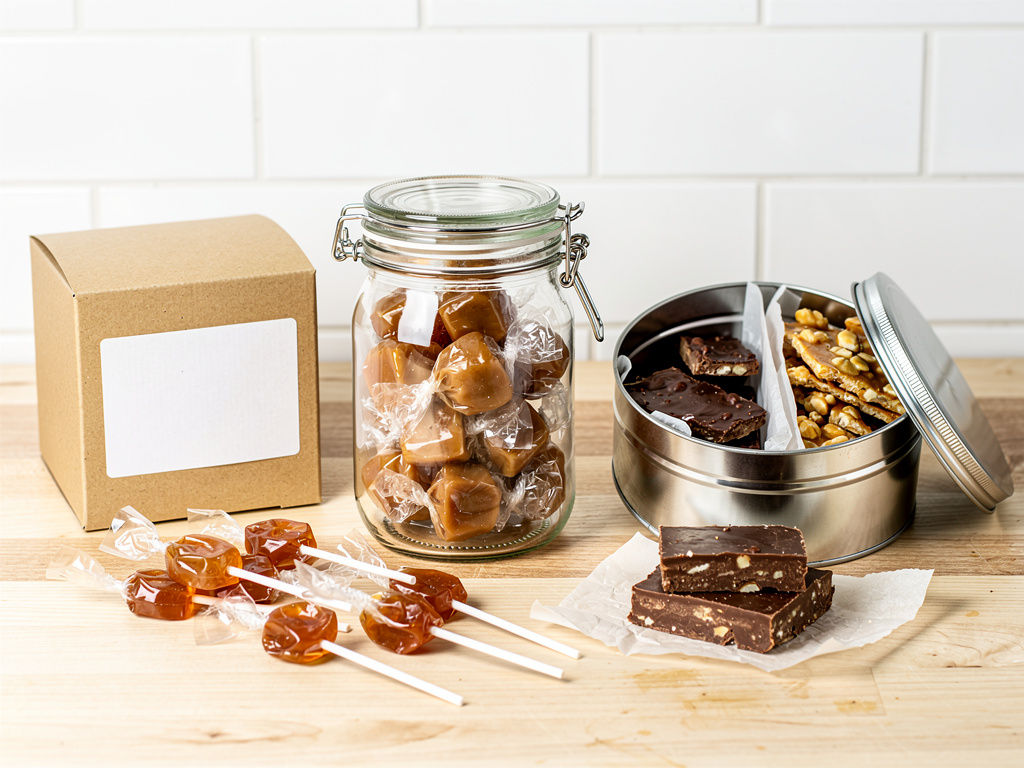


The short version: Homemade candy lasts anywhere from a few days to a few months, and the drier the candy, the longer it keeps. Sealed hard candy and lollipops keep about 2 to 3 months, brittle about 3 to 4 weeks, toffee 2 to 3 weeks, cooked fudge about 2 weeks, and wrapped caramels, pralines and marshmallows about 1 to 2 weeks, all by our own working rule. Candy made with cream cheese or fresh cream belongs in the fridge and gets eaten within about a week, and caramel apples keep only a few days. When you sell candy, print a best-by date that falls inside its window, using the days in our table, and sell it within the first half of the days before that date, so your customer gets the rest at home.
Checked October 13, 2026: the Global Cold Chain Foundation's candy storage manual (revised 2024), Kansas State University's freezer guide (revised June 2026), Virginia Tech's and Michigan State's food safety experts, the USDA's food dating page, California's approved cottage foods list (reviewed April 2026), the Homegrown, Etsy and Hotplate pricing pages, and a pull of 2,872 Homegrown listings. No federal agency or university publishes a shelf life for homemade candy by type, so the windows above are our planning numbers. Most of them run longer than Virginia Tech's 4 to 7 days for homemade treats, because they assume each piece is wrapped airtight and kept in a cool, dry room. Cottage food rules differ by state, so verify your state's current rules before you sell. On Homegrown, a first-time customer creates an account to order, there is no drops feature, and most orders come from people you send to your own link.
A customer buys a bag of your sea salt caramels at the Saturday market and tucks it in a cupboard for a Christmas stocking two weeks later. By then the caramels have softened into the wrappers, or turned grainy, and the first thing she tastes from your kitchen is a tired piece of candy. Nothing about that bag was unsafe. It was just sold too close to the end of its life, with no date to warn her.
This guide is for people who sell candy, not people storing a holiday tin. It takes what candy storage researchers and university food scientists say about sugar, moisture and heat, turns it into a shelf-life table by candy type, and then works through the fridge, the freezer, packaging, labels, gift boxes, holiday timing and shipping. If you still need to know whether your state lets you sell candy from home at all, start with whether you can sell homemade candy, which checks the rules in five states, then come back here for the storage side.
Homemade candy lasts from a few hours for an opened tub of cotton candy, or a few days for divinity, to about 3 months for sealed hard candy, and most of what a home vendor sells (caramels, fudge, toffee, brittle) falls between 1 and 4 weeks at cool room temperature in an airtight package. Those times are about quality: texture, flavor and appearance. Michigan State University Extension calls old hard candy a quality problem rather than a safety one, and in our reading the same goes for other properly cooked, sealed candy unless it shows mold or smells sour. It gets sticky, grainy, dry or stale first.
Every number in the next table counts from cooking day, not from the day the candy sells. It assumes each piece or bag is sealed and kept in a room near 68°F, out of the sun, in dry air.
Slide the table sideways to see the fridge, freezer and best-by columns.
| Your candy | Counter, sealed, cool dry room | Best-by to print (days after cooking) | Fridge | Freezer | What goes first |
|---|---|---|---|---|---|
| Hard candy, lollipops | About 2 to 3 months, each piece wrapped | 60 days | No, it turns sticky | Not needed, and not advised | Surface turns sticky in humid air |
| Peanut brittle and other nut brittle | About 3 to 4 weeks | 21 days | No | Not advised | Sticky surface, then stale nuts |
| Toffee (butter, often with chocolate and nuts) | About 2 to 3 weeks | 14 days | No | Up to 3 months, double wrapped | Butter and nut flavor going stale |
| Wrapped caramels and taffy | About 1 to 2 weeks | 10 days | Not needed | Up to 3 months, wrapped | Softening into the wrapper, or graining |
| Cooked fudge (no cream cheese) | About 2 weeks, each piece wrapped | 14 days | About 3 weeks | About 3 months | Dry, crumbly or grainy texture |
| Pralines | About 1 to 2 weeks | 10 days | No | Up to 3 months | Graining and drying |
| Marshmallows made without egg | About 1 to 2 weeks | 10 days | No | Up to 3 months | Drying out and shrinking |
| Chocolate-dipped candy (buckeyes, turtles, truffles made without fresh cream) | About 1 to 2 weeks at 68°F or cooler | 10 days | Only in summer heat, sealed | Up to 3 months | Gray or white bloom on the chocolate |
| Divinity and egg-white nougat | About 3 to 5 days | 5 days | No | Freeze a small test batch first | Dries out fast |
| Cotton candy | A few days in a sealed tub, hours once opened | 3 days | No | No | Collapses in humid air |
| Cream cheese fudge, fresh-cream truffles | Not a counter candy | 7 days, kept cold | Yes, required | Not recommended, since USDA FoodKeeper advises against freezing cream cheese | Spoilage, not just texture. Ask your state agency before you sell it |
| Caramel or candy apples | Sell the day you dip them | 4 days, kept cold | Yes, if made ahead | No | The fresh apple inside |
These windows are our working rule, not a lab test, built October 13, 2026, from these sources: Virginia Tech's 4 to 7 days for crunchy and sticky homemade treats and up to a week for fudge, the Global Cold Chain Foundation's commercial storage table, Kansas State University's 6 to 12 months for candy in the freezer, and an Ohio State Extension 4-H candy book that says brittle and hard candy should not be frozen and divinity "does not keep well." How we built it: we started from Virginia Tech's homemade figures, then gave a longer counter window to candy that is wrapped airtight and kept in a cool, dry room. That is why caramels, toffee, brittle and fudge all run longer than Virginia Tech's range. We kept every window a small fraction of the cold chain manual's commercial months, and two candies break from the manual's order. It gives caramels 12 months, level with brittle, but it also names caramels first among the candies that soften and stick to the wrapper in warm or humid storage, so we put home caramels below toffee and fudge. It gives divinity 10 months, level with fudge, but the Ohio State book says divinity "dries out quickly," so we gave it days. The 4-day caramel apple date is our own rule too. Virginia Tech's 4 days is for an apple that has been bitten and then refrigerated. Virginia Tech gives properly made fudge up to a week at room temperature. Our 2-week fudge window assumes every piece is wrapped airtight in a cool room, so if your fudge sits unwrapped or warm, use Virginia Tech's week instead.
The pages that rank for this question give hard candy anywhere from 2 weeks to a year, usually with no source. Both ends can be right, which is the problem. A lollipop wrapped tight in a dry January kitchen keeps for months. The same lollipop in an open bowl at a humid July market is sticky by noon.
Hard candy and brittle keep longest because they hold the least water: the Global Cold Chain Foundation files hard candy with its low-moisture candies, under 5% water, and lists peanut brittle at 1.8% moisture against 10.9% for fudge and 16.4% for marshmallows. Milk chocolate is drier still, at 1.3%, but heat and bloom limit how chocolate looks, and the soft centers inside buckeyes, turtles and truffles are why chocolate-dipped candy gets a short window in the table. Less water means less for mold to use and less room for the texture to change. It also means the candy wants to pull water back out of the air, which is why dry candy fails by going sticky rather than by spoiling.
The water left in a candy is set by how hot you cook the sugar. The 4-H candy book from Ohio State's Fairfield County extension office lists the stages most recipes use:
The higher the stage, the longer the candy keeps, as long as you keep humid air away from it. Ingredients pull the clock the other way. Butter, cream and nuts all carry fat, and the cold chain manual says candies containing "butter, cream, nuts, chocolate, or other fatty material" need colder storage to prevent rancidity, and that staleness and rancidity, common in candies with chocolate, coconut, butter, cream or nuts, come with age. That is why toffee, cooked to nearly the same temperature as brittle but made with a lot more butter, gets a shorter window in the table.
Kansas State University food scientist Karen Blakeslee splits candy into two families. Crystalline candy, like fudge and fondant, is built on tiny sugar crystals. Non-crystalline candy, like lollipops, taffy and caramels, has none. In practice, and this is our reading of the quality changes the cold chain manual lists, fudge mostly ages by drying out in dry air, while caramels and lollipops mostly go soft and tacky in damp air, or turn grainy if they dry out.
Factory-made candy keeps 6 to 24 months at 68°F in the Global Cold Chain Foundation's storage table, which is why store-bought candy outlasts yours by months. The foundation's candy storage and handling manual, revised in 2024, is written for warehouses that hold candy for holiday stockpiles, and it sorts candy by type the same way the table above does.
How long factory-made candy keeps at 68°F (months)
Source: Global Cold Chain Foundation, Commodity Storage and Handling Manual, Candy, revised 2024, expected storage periods at 68°F (20°C) at the humidity listed for each candy. Loaded October 13, 2026.
The order on that chart is the useful part. It matches the homemade table at both ends: hard candy keeps longest, and marshmallows and pralines sit near the bottom. Caramels and taffy are the exception. They get 12 months in a factory, level with brittle, but only 1 to 2 weeks in our homemade table, below toffee and fudge, because the manual lists caramels first among the candies that go soft in their wrappers when storage runs warm or humid. The months are not something a home kitchen can borrow, for three reasons the manual spells out itself:
Even with all of that, the manual sets its quality bar at candy that looks, tastes and feels the way it did "within 4 weeks of being produced." That is a good bar for your own boxes too.
Old hard candy is a quality problem rather than a safety problem, according to Michigan State University Extension, and we read shelf-stable brittle, toffee and caramels the same way unless they show mold or smell sour. Michigan State University Extension food safety educator Christine Venema explains that hard candy is nearly pure sugar cooked to the hard crack stage, so "there is not a foodborne illness issue there either." The issue is quality: in humid air it becomes "a sticky mess," and over time the flavoring fades.
That changes when the candy carries something that can spoil. Here is how to tell which kind of old you are looking at:
The cold chain manual lists "mold, souring, or mustiness" as something that "can happen to all candies, but especially in hygroscopic, high moisture pieces," caused by high temperature and high humidity. Hygroscopic means the candy pulls water out of the air. Soft, damp candy stored warm is where safety comes into it.
Gray or white streaks on chocolate are called bloom. The manual describes two kinds: fat bloom, from chocolate that got warm and set again, and sugar bloom, from moisture that condensed on the surface and dried. The manual lists both under its common quality changes, and it says nothing about bloom making candy unsafe. Neither should go out in a box with your name on it, and the manual says chocolate-coated candy that goes above 85°F for even 1 hour after it sets will develop fat bloom.
Candy made with cream cheese, fresh cream fillings or fresh fruit that is not cooked into the candy, like a dipped apple, has to stay in the fridge, and that can also mean it does not count as a cottage food at all. Cottage food laws, the state laws that let you sell certain foods made in a home kitchen, mostly cover foods that are safe without refrigeration.
California's Department of Public Health says its cottage foods are "non-potentially hazardous foods," meaning foods "that do not support the rapid growth of microorganisms or toxins that could make people sick when the food is held outside time and temperature control." Its approved cottage foods list, last reviewed in April 2026, names these candies:
The list is examples, not a complete list, but notice what it leaves out. Marshmallows only qualify "without eggs," and divinity, which is whipped egg white and sugar, is not named. Candy with a fresh cream ganache or cream cheese is not named either, and those are the ones that need a fridge.
Cream cheese fudge is out there, and it does not behave like cooked fudge. In our October 13, 2026 pull of the Homegrown catalog, 14 of the 38 fudge listings, all from one shop, named cream cheese or mascarpone in the description. Keep that kind cold, tell buyers to eat it within 7 days, and ask your state cottage food office whether you can sell it from a home kitchen before you list it. The same goes for truffles made with fresh cream and for chocolate-dipped strawberries.
Caramel and candy apples sit in between. California lists candied apples as a cottage food, but the fruit inside is fresh. Alexis Hamilton, a food safety microbiologist at Virginia Tech, told Virginia Tech News that coated apples "are a risk if partially eaten and not kept in the fridge," and keep up to 4 days once bitten if they go in the refrigerator. She also suggests waiting to put the stick in until right before eating, or refrigerating them if you make them ahead.
No, shelf-stable homemade candy does not need the fridge, and Kansas State University's freezer and refrigerator guide lists candy in the refrigerator column as "Not necessary." K-State Research and Extension's holiday candy advice goes further: store candy "in an airtight container at room temperature and out of sunlight," because "cold storage can cause candy to absorb extra moisture and get sticky."
The problem is not the cold itself. It is the water that condenses on cold candy when you take it out into warm air. The cold chain manual makes the same point from the warehouse side: damage blamed on refrigeration has been "traced to improper packaging, storage at the incorrect relative humidity, or allowing moisture to condense on the material."
So there are three good reasons a candy vendor might still use the fridge:
If you do refrigerate, seal the candy in a container that blocks moisture, and let the closed container come all the way to room temperature before you open it. Opening a cold box in a warm kitchen is how chocolate gets sugar bloom and caramels get wet.
Most homemade candy freezes well, and Kansas State's refrigerator and freezer storage guide (revised June 2026) gives candies 6 to 12 months in the freezer. We plan on 3 months for anything with butter, cream or nuts, because the flavor fades well before the candy is unsafe. Fudge, caramels, toffee, marshmallows and chocolate candies all freeze well with good wrapping.
The exceptions are the glassy candies. The Ohio State 4-H candy book says "Peanut Brittle and hard tack type candies should not be frozen" and should be kept in an airtight container, canister or glass jar instead. The cold chain manual adds that honeycomb candy "coated or uncoated" tends "to crack when frozen." Divinity is a different case. The Ohio State book says it "dries out quickly and does not keep well," so eat it while it is fresh. The cold chain manual counts divinity among the candies that freeze well, but it also says special formulations should get a small test before you freeze a large volume, so try a few pieces of your own recipe first.
One thing that surprises new candy vendors: ice crystals are not the risk. The manual explains that "since the moisture in candies is saturated with sugar, ice crystals do not form during freezing." The manual's risks are drying and water condensing on the candy as it thaws, and a loose wrap can also pick up freezer smells.
Here is the freeze and thaw routine that avoids all three:
Freezing works best as a planning tool. Cook caramels and fudge two or three weeks before a big holiday market, freeze them the day they set, and thaw them two days before the market. That moves your stove time to a quiet week without moving the candy's best days.
Heat and humidity are the two biggest levers on candy shelf life, and the cold chain manual gives a handy rule: drop the storage temperature by 18°F and the shelf life roughly doubles. Read the other way, a box kept in an 86°F garage instead of a 68°F pantry keeps about half as long.
Humidity matters as much as heat. The manual says candy stored too damp "will become sticky," and too dry it will "dry out and crack." It sets 40 to 50% relative humidity as the target and 60% as the ceiling. A summer kitchen in much of the country sits above that for weeks.
For a market day, three numbers from the manual are worth knowing:
Keep one sealed 2-piece bag from every batch on a shelf at home and taste it on day 7 and day 14. Write down what changed. After three or four batches you will know your own recipe's shelf life in your own kitchen, which beats any chart, ours included.
Kansas State's Blakeslee adds a warning about cooking day too. On a humid or rainy day, a cooking candy "can absorb moisture from the environment," and it takes longer to drive that water off. Brittle and hard candy cooked on a damp day can start life softer and go sticky sooner.
The packaging that keeps candy freshest is an individual wrap plus an airtight outer container, and the right wrap depends on whether the candy pulls in moisture or loses it. Kansas State recommends wrapping some candies one by one, "such as caramels or taffy," because "that helps prevent moisture absorbing back into the candy and prevents them from sticking together."
Here is how that plays out by candy type:
Remember the manual's warning that not all cellophane or plastic packaging is a moisture barrier, and that you often cannot tell by looking. If candy inside a bag turns sticky within 3 days, the bag is the weak point. A heat sealer and thicker poly bags are cheap fixes compared to a week of returned candy.
You can mix candies in one gift box only if each kind is sealed on its own, because candies that pull in moisture and candies that give it off will ruin each other in a shared space. The University of Arkansas Cooperative Extension puts it plainly: "Do not mix candies that absorb moisture (caramels, mints, hard candies, toffee) in the same container as candies that lose moisture (fudge, fondant, meringues)." If they share air, "the hard candies will become sticky."
That matters most in November and December, when assorted gift boxes carry a big share of a candy vendor's sales. Sort your lineup into the two groups first. Arkansas names the first four candies in the first group and the first three in the second, and the rest behave the same way:
Then build the box so the two groups never share air:
That last step is the one vendors skip. A box that mixes lollipops good for 60 days with caramels good for 10 days is a 10-day box. If you want a gift box that keeps longer, build it from the long-keeping candies, like hard candy, brittle and toffee, and sell the fudge and caramels in their own boxes.
Federal law does not require a date on candy, so the date you print is your promise about quality, and we suggest a "Best if Used By" date that falls inside the candy's window, using the best-by days in our table. The USDA's Food Safety and Inspection Service says that "except for infant formula, product dating is not required by federal regulations," and that dates are "not an indicator of the product's safety." Its page on food product dating recommends "Best if Used By" as the wording, since research shows shoppers take it to mean best quality rather than a safety cutoff.
Your state's cottage food label rules decide what else must be on the package, such as your name, address, ingredients and a home-kitchen statement, so read your own state's label page before you print. On top of what your state requires, a candy label works best with three lines:
The best-by days in our table already sit inside each candy's counter window. A 14-day date on toffee that keeps about 2 to 3 weeks means a customer who eats it on day 14 still gets good toffee, and one who finds it in a drawer on day 18 is probably fine too.
Cook each candy no earlier than half its best-by window before the sale, which puts hard candy up to 30 days ahead, brittle up to 10 days, toffee and fudge up to 7 days, and caramels up to 5 days. That keeps at least half of each candy's good days for the customer, which is the whole point of the date.
Swipe left for the customer and freezer columns.
| Candy | Best-by days | Cook no earlier than | Days left for the customer on sale day | With the freezer |
|---|---|---|---|---|
| Hard candy, lollipops | 60 | 30 days before | 30 or more | Not needed |
| Nut brittle | 21 | 10 days before | 11 or more | Not advised |
| Toffee | 14 | 7 days before | 7 or more | Up to 3 weeks ahead if frozen on cooking day |
| Cooked fudge | 14 | 7 days before | 7 or more | Same as toffee: 3 weeks out, frozen once set |
| Caramels, pralines, marshmallows | 10 | 5 days before | 5 or more | Can be cooked 3 weeks out if they go in the freezer the day they set |
| Divinity | 5 | 2 days before | 3 or more | Only after a small test batch freezes well |
Worked from the best-by column of our working rule, October 13, 2026. "Cook no earlier than" is half the best-by days, rounded down. Frozen candy should be thawed sealed and sold within the days it had left when it went in.
The calendar shows why a holiday candy week is easier with orders in hand. Hard candy and brittle can be made early and held. Caramels and fudge cannot, so the best plan is to know how many boxes of each you need before you cook them.
That is where taking orders ahead helps a candy vendor more than most. If customers order and pay a few days before pickup, you cook caramels for the 30 boxes people actually bought, not the 50 you hoped to sell, and every box leaves your kitchen on day 2 or 3 of its window. A Homegrown storefront for taking candy orders before you cook lets you require a set number of days of notice before each pickup date, so the order count is locked before your stove day.
Hard candy, brittle and toffee survive the mail well in cool months, while chocolate and soft caramels are risky once trucks and porches run above 85°F. The Ohio State 4-H candy book gives the short version for shipping: "wrap each piece of candy individually," pack in layers "using bubble wrap or shredded paper in a sturdy box," and "do not mail in hot weather."
Before you think about packing, check whether your state lets you mail cottage food at all. Some states keep home-kitchen candy sales inside the state or require the sale to be in person. New Jersey's cottage food FAQ says you may not send products to your customers through the mail, and Texas allows online sales only when the operator, an employee or a household member personally delivers the food. Our guide to the rules for selling homemade candy shows the mailing rules for the five states it checked, and these rules get amended, so verify your own state's current page before you ship.
If you can ship, plan around these limits:
Count shipping days against your best-by window. Three days in transit on 10-day caramels leaves the customer a week at most, which is why caramels and fudge sell better as local pickup than as mail order.
None of the 56 candy listings in our October 13, 2026 pull of the Homegrown catalog tells the shopper how long the candy keeps. That is the cheapest fix on this page. One line on a listing answers the question a gift buyer is already asking.
In a pull of the Homegrown catalog on October 13, 2026, 2,872 products were listed by 317 vendors. 56 of them, from 10 vendors, were candy the vendor cooks or sets: 38 fudge, 8 marshmallow flowers and zefir (a whipped fruit marshmallow, often made with egg white), 2 truffles, 2 turtles and buckeyes, and 1 each of toffee, peanut brittle, pralines, cotton candy, pâte de fruit (a French fruit jelly) and a handmade chocolate bar. Prices ran from $4 to $32. 0 of the 56 descriptions say how long the candy keeps or how to store it, and 9 have no description at all. Another 73 listings were freeze-dried candy, 70 of them from one shop, and most of them made from named store-bought candies.
How we counted: we searched product names and descriptions for candy words, then opened every matching vendor's full list of products and kept only listings that are a candy themselves. Cookies, cake pops and brownies with candy in them, candied jalapeños sold as "cowboy candy," caramel apples, chocolate-dipped fresh fruit, granola and one farm stand's $1.50 gummies, listed beside its $1.50 beef sticks and energy shots, were left out.
Fudge is most of the candy Homegrown vendors cook or set themselves, 38 of the 56 listings, which fits what the shelf-life table says about selling it. Fudge has a 2-week window, so a fudge vendor is working against the clock every week. The other 18 listings are spread thin across nine other kinds of candy, and that spread is an opening for a vendor who makes brittle, toffee or hard candy, the candies with the longest windows.
A storage line for each kind of candy takes one sentence. These are the lines we would add, based on the table:
Shoppers price candy against what it is worth to them, and a stated shelf life makes a $20 gift box feel safer to buy two weeks before the holiday. Our guide to how much to sell candy for works out what each kind should cost, and the date line is part of what earns that price.
Shelf life is a timing problem, and the fix is knowing how many boxes you need before you turn on the stove. Homegrown is $10 per month billed annually, or $12.50 billed monthly, with no percentage fees beyond standard payment processing. It gives you a storefront where customers order and pay ahead of a pickup date, so caramels and fudge go home on day 2 of a 10-day or 14-day window instead of day 9.
The parts that matter for candy, each one live on the signup page on October 13, 2026:
Here is how the cost compares with the two platforms a candy vendor usually looks at, on a $20 box picked up locally:
Swipe this one left to read every fee.
| Platform | Subscription | Trial | Platform fee | Card processing | Customer pays on a $20 box | You pay on a $20 box | You pay on 50 boxes a month |
|---|---|---|---|---|---|---|---|
| Homegrown, billed annually | $10/mo, billed annually | 7 days, no charge until day 8 | $0, 0% commission | 2.9% + $0.30, paid by you | $20.00 | $0.88 | $54.00 ($44.00 processing + $10) |
| Homegrown, billed monthly | $12.50/mo | 7 days, no charge until day 8 | $0, 0% commission | 2.9% + $0.30, paid by you | $20.00 | $0.88 | $56.50 ($44.00 + $12.50) |
| Hotplate, fee passed to the customer (its default) | $0 | None (no subscription) | 5% + $0.55, paid by the customer | 2.9% + $0.30, paid by you | $21.55 | $0.88 to $0.92 | $44.00 to $46.25 |
| Hotplate, you pay the fee | $0 | None (no subscription) | 5% + $0.55, paid by you | 2.9% + $0.30, paid by you | $20.00 | $2.43 | $121.50 |
| Etsy | None (a one-time set-up fee may apply) | None (no subscription) | $0.20 listing fee, renewed after each sale, plus 6.5% transaction fee | 3% + $0.25, paid by you | $20.00 | $2.35 | $117.50 |
We checked these on findhomegrown.com/signup, hotplate.com/pricing, Hotplate's own post "What Hotplate does" (which says "we charge a fee to your customer" by default), and Etsy's fees policy and payment processing help page on October 13, 2026. Sales tax and shipping are left out. Hotplate's pricing page does not say whether processing is charged on the $20 or on the $21.55 with its fee, so we show both.
Etsy is built for shipping to strangers across the country, which works against 10-day caramels and against state rules that keep home candy local. Hotplate is built around drops, timed order windows with a countdown, and has no subscription, but by default your customer pays $1.55 more on every $20 box, and you still pay 2.9% + $0.30 card processing on each order.
The honest bounds: customers create a Homegrown account to place their first order. Homegrown has no drops or countdown-release feature. Your storefront is listed on the Homegrown marketplace, but plan on most orders coming from people you send to your own link. And Homegrown does not print your labels or track best-by dates for you; the dating in this guide is still your job.
Tell customers three things at pickup: keep the candy sealed, keep it cool and dry, and eat it by the date on the label. A printed card or a line on the bag does this better than a conversation at a busy booth, and it heads off the most common complaint, candy that went sticky or soft in a warm car or a damp kitchen.
A storage card for a candy box can be this short:
The card also protects you. A customer who leaves your toffee in a hot car for an afternoon knows why it went soft, and is far more likely to order again than one who thinks your toffee is just like that.
If you sell at markets, put the same line on your listing for pickup orders. Our guide to where candy sells best through the year covers which candies hold up at a summer booth and which ones to save for cooler months.
Homemade candy is good for about 1 to 4 weeks for most types sold at markets, and up to 2 to 3 months for sealed hard candy, by our working rule. Caramels, pralines and marshmallows sit at the short end, around 1 to 2 weeks at cool room temperature, and cooked fudge keeps about 2 weeks wrapped. Brittle and toffee keep 2 to 4 weeks. Divinity lasts only a few days, and a cream cheese fudge or a ganache truffle made with fresh cream needs the fridge and should be eaten within about a week.
Most homemade candy does not need to be refrigerated, and Kansas State University's storage guide lists candy in the refrigerator column as "Not necessary." Cold storage can make candy sticky when it warms up and pulls moisture from the air. The exceptions are candies made with cream cheese, fresh cream fillings or fresh fruit that is not cooked into the candy, like a dipped apple, which belong in the fridge and may not qualify as cottage food in your state.
You can freeze most homemade candy, including fudge, caramels, toffee, marshmallows and chocolate candies, and Kansas State gives candy 6 to 12 months in the freezer. Wrap each piece, seal it in a freezer bag and thaw it unopened at room temperature. Skip the freezer for brittle and hard candy, which an Ohio State 4-H candy guide says should not be frozen, and test a small batch of divinity before you freeze a full one.
Homemade toffee lasts about 2 to 3 weeks in an airtight tin at cool room temperature, by our working rule, and up to about 3 months in the freezer if it is double wrapped. Its butter and nuts are what go stale first, so we suggest a best-by date 14 days after cooking. Keep it out of the fridge, where it can turn sticky once it warms up.
Homemade peanut brittle lasts about 3 to 4 weeks in a sealed bag or tin at cool room temperature, by our working rule, and we suggest a 21-day best-by date. Humid air makes the surface sticky first, and the peanuts slowly go stale after that. Do not freeze it, and do not leave it in an open box at a market booth.
Homemade candy has gone bad if it shows mold or smells sour, musty or rancid, and it should be thrown out. Stickiness, graininess, dry fudge and white or gray streaks on chocolate are signs of age, not danger, but they mean the candy is past its best and should not be sold. A cream cheese or fresh-cream candy that was left unrefrigerated at a market or in a warm car should be discarded.
These guides cover the parts of a candy business this page only touches on, from the rules to the price to the packaging. Each one is live on the Homegrown blog and written for a home vendor, not a factory.
The surest way to sell candy at its best is to cook it for orders that already exist. Every window in this guide starts on the day you cook, so a caramel sold two days after cooking has eight good days left in a customer's kitchen, and one that sat at three markets first has none.
A Homegrown storefront lets regulars order and pay before your stove day, with the notice you need set on each pickup date and quantities that stop at what you made. It costs $10 a month billed annually, or $12.50 billed monthly, with a 7-day trial and no charge until day 8, plus 2.9% + $0.30 card processing on each order and no commission. Customers create an account for their first order, and most orders will come from the regulars who already know your candy, so put the link on your booth sign, your label and your social posts.
Write your best-by days on a card by the stove, set your order notice to match, and open your Homegrown storefront for candy orders before the holiday rush starts.