
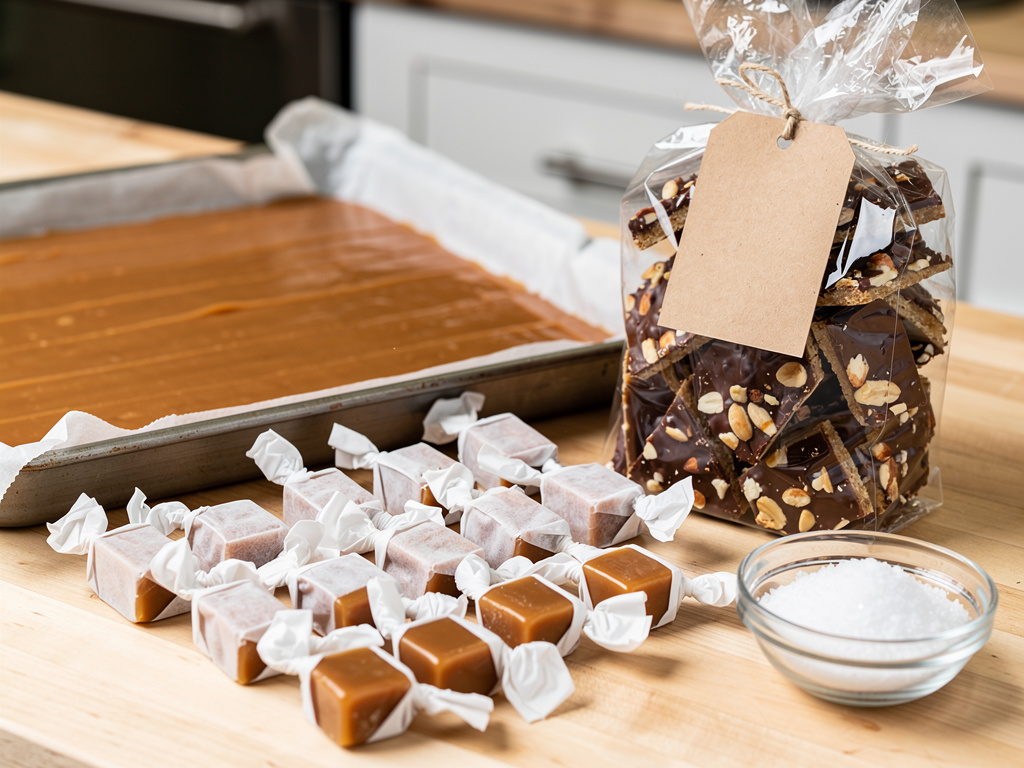


The short version: Wrapped caramels and toffee are allowed as cottage food in all 8 states we read for this guide, but a pourable caramel sauce is a different product: 4 of those 8 states rule it out under a ban on sauces or syrups, and Texas allows foods that need refrigeration only after you register with the state. Caramel cooks to the firm-ball stage (245 to 250°F) and toffee to the hard-crack stage (300 to 310°F), which is why sealed toffee keeps about 2 to 3 weeks in a cool room and wrapped caramels roughly 1 to 2 weeks, by the working rule in our candy shelf-life guide. A caramel costs about $0.10 to make and sells for $1.50, and a 4-ounce bag of toffee costs about $1.57 and sells for $10, so your real cost is the time at the stove and the wrapping table. Cook close to the sale and print a best-by date 10 days out on caramels and 14 days out on toffee.
Checked October 15, 2026: the cottage food pages of the 8 states we read (California, Connecticut, Florida, Michigan, New Jersey, New York, Texas and Washington), the FDA Food Code (2022) and the FDA's allergen page, the Exploratorium and Iowa State candy guides, the Global Cold Chain Foundation candy manual (revised 2024), Kansas State's freezer guide (revised June 2026), the Homegrown, Hotplate, Etsy and Square fee pages, and a pull of 2,927 Homegrown listings. Ingredient costs come from our caramel pricing guide (Walmart.com prices of September 25, 2026) and our toffee pricing guide (Walmart.com prices of October 8, 2026). The shelf-life windows are planning numbers, not a lab test. Cottage food rules differ by state, so verify your state's current rules before you sell. On Homegrown, a first-time customer creates an account to order, there is no drops feature, and you should plan on most orders coming from people you send to your own link.
Caramel and toffee are two of the most approachable confections you can sell at a farmers market. The ingredients are simple: sugar, butter, and in the case of caramel, cream. The equipment is minimal. And the margins are high: a 9x13 pan of caramels costs about $7.15 in ingredients and wrappers and turns into 72 pieces, and a pan of chocolate almond toffee costs about $6.81 and fills five 4-ounce bags.
But caramel and toffee are not the same thing. They cook to different temperatures, behave differently in production, and keep for different lengths of time. Toffee is easier to start with: no cream, it gets stirred the whole time instead of left alone at the boil, and it takes 9 to 15 minutes from melted butter to 300°F. Caramel takes more technique, but it gives you a chewy, rich candy with an even lower cost per piece. This guide covers both: the cottage food rules state by state, the candy science, production costs, how long each one keeps, and how to build a product line around these two core products.
How long each candy keeps is the fact that shapes everything else, from how far ahead you cook to what date goes on the label. Our guide to how long homemade candy lasts builds a shelf-life table for every common candy from extension and cold-storage sources, and the caramel and toffee numbers in this guide come straight from it.
Wrapped caramels keep about 1 to 2 weeks, so it pays to know how many bags you will sell before you cook. Where your state allows payment online, you can set up a Homegrown storefront so regulars order and pay for a bag during the week and pick it up on market day.
Yes: wrapped caramel candy and toffee are allowed as cottage food in all 8 states we read for this guide, while jarred caramel sauce is shut out in 4 of them by a ban on sauces or syrups. The reason is water. Caramel cooks to a syrup that is about 87% sugar and toffee to one that is about 99% sugar, according to the Exploratorium's chart of sugar stages, so there is very little free water left for germs to grow in.
The federal yardstick for that is water activity, a measure of the free water in a food. The FDA Food Code (2022 edition) counts a food with a water activity below 0.88 as one that does not need time and temperature control for safety, whatever its acidity. That is the category state cottage food lists are built on. California's Approved Cottage Foods list (last reviewed April 2026) calls them "non-potentially hazardous foods" and names caramels, salted caramels, toffee, brittles and candied popcorn by name.
Solid caramel candy and toffee qualify in every state we read, and caramel corn in 7 of them (Washington's page does not mention popcorn), with a few state limits on chocolate coating, nuts and liquor.
Caramel sauce, caramel apples in some states and anything made with real liquor are the caramel products most likely to be refused.
Texas works differently from the rest. Its Department of State Health Services page says allowable foods "now include any foods, except for" a short list (meat and poultry, seafood, ice and ice products such as ice cream, low-acid canned goods, cannabis products and raw milk), and that operators "that sell time and temperature control for safety (TCS) foods must register" and follow labeling rules that include safe handling instructions and temperatures. So a refrigerated caramel sauce can be legal in Texas once you register.
Do not try to can caramel sauce at home to make it shelf-stable. Clemson University's Home and Garden Information Center says "there are no science-based methods for home canning of cheeses, milk, butter or other dairy products," and that Clemson Extension and the National Center for Home Food Preservation "do not recommend any process for canning these products." If you want to sell caramel sauce outside Texas, you will likely need a commercial kitchen and a food processor license. For everything else (wrapped caramels, toffee, caramel corn), cottage food is your path. Read our guide on how to start a cottage food business for the full setup process, and can you sell homemade candy for how the candy rules play out in other states.
Scroll sideways for all eight states.
| State | Caramels and toffee | Caramel sauce | Chocolate-topped or dipped toffee | Caramel corn | Yearly sales cap | Wholesale | Online orders and shipping |
|---|---|---|---|---|---|---|---|
| California | Caramels, salted caramels and toffee named | Not on the approved list | Chocolate and chocolate-covered nonperishables listed | Candied popcorn (caramel) named | $88,878 (Class A) or $177,756 (Class B) in 2026 | Class B only, "through restaurants and food markets" | Allowed: internet sales, filled in person or by mail, to customers in California only (Health and Safety Code 113758) |
| Connecticut | "Candies and confections" | "Syrups" not allowed | "Chocolates" listed | Popcorn and popcorn balls listed | $50,000 | Not allowed | Orders online, but sale and delivery must be person to person inside Connecticut; no mail |
| Florida | "Candies and confections" | Not on the list | Not named; candies and confections listed | Popcorn and popcorn balls listed | $250,000 | Not allowed | Allowed: website, mail order and in person |
| Michigan | "Confections and candies (made without alcohol)" | Sauces banned in general ("No sauces and condiments") | Chocolate-covered pretzels, marshmallows and fruit listed | "Popcorn is allowed" | $50,000 | Not allowed | Internet or mail order inside Michigan, if the customer can talk to you before buying |
| New Jersey | "Candy, including brittle and toffee" | Not on the list | Not named; chocolate-covered nuts and dried fruit listed | "Popcorn and caramel corn" named | $50,000 | Not allowed | Orders online, handed over in person in New Jersey: "You may not send products to your customers through the mail" |
| New York | "Sugar confections" incl. toffees and caramels | "Fudge/caramel sauces" prohibited | Prohibited | Named, with no chocolate topping | None stated on the page we read | Allowed to local businesses inside New York | Internet sales allowed, inside New York only; no shipping out of state |
| Texas | Allowed (any food not on the banned list) | Allowed only after registering with DSHS to sell foods that need refrigeration | Allowed | Allowed | $150,000 | Only to a registered cottage food vendor, and not for foods that need refrigeration | Online sales need personal delivery by you, an employee or a household member |
| Washington | "Caramels" named; stovetop candy needs a candy thermometer | "Syrups are not allowed" | Chocolate coatings listed | Not mentioned | $35,000 | Not allowed | Orders online; delivery and payment both person to person, with no mail or courier and no sales outside the state |
We read each state agency's cottage food pages on October 15, 2026: California CDPH (its approved list, its cottage food operations page and its 2026 adjusted sales limits), Connecticut DCP (accepted and prohibited lists, sales limit and selling rules), Florida FDACS, Michigan MDARD (its allowed list and its selling rules), New Jersey Department of Health, New York Agriculture and Markets, Texas DSHS and Washington WSDA. We read California Health and Safety Code section 113758, which defines a cottage food sale as "a transaction within the state," on October 19, 2026. "Not on the list" and "not mentioned" mean the page we read did not say, not that it is allowed. These are 8 states, not all 50, so verify your state's current rules before you sell.
Washington is the state where the candy thermometer is the law, not just good practice. Its cottage food page allows "Candies cooked on a stove top or in a microwave (temperature monitoring with candy thermometer is required)." It also says products "may be sold only to the end consumer," that "Internet, mail, consignment, wholesale, & retail sales outside the state are prohibited," and that you may advertise and take orders online, but delivery and payment must both be person to person, with no mail or courier. We read that page on October 15, 2026.
Caramel is a chewy candy cooked to 245 to 250°F, and toffee is a brittle candy cooked to 300 to 310°F. These two products look similar on a market table, but they are made with different ingredients, cook to different stages and have different textures. The Exploratorium's candy science guide explains the sugar stages from soft ball through hard crack, with the share of sugar in the syrup at each one.
Caramel is a chewy candy made from sugar, butter, heavy cream and corn syrup cooked to the firm-ball stage (245 to 250°F). The brown color and rich flavor come from the Maillard reaction, which Iowa State University Extension describes as "a reaction between the sugar and the protein in the cream." This is not the same as caramelization, which is what happens to plain sugar on its own; the Exploratorium's chart and Iowa State both put caramelized sugar at 338°F.
Toffee is a brittle candy made from sugar and butter cooked to the hard-crack stage (300 to 310°F). At that stage, the Exploratorium says, "there is almost no water left in the syrup." The result is a glassy, crunchy candy that shatters when you bite it.
The Global Cold Chain Foundation's candy storage manual, written for warehouses that hold commercial candy, sorts the two by moisture too. It files caramels with candies that hold 5 to 12 percent moisture, and toffee with candies "with a moisture content below 5%." That difference in water is the same difference you will see in shelf life later in this guide.
Swipe left to compare the two candies.
| Question | Caramel | Toffee |
|---|---|---|
| Cooking stage | Firm ball, 245 to 250°F | Hard crack, 300 to 310°F |
| Sugar in the syrup at that stage | About 87% | About 99% |
| Cream in the recipe | Yes, 1 cup | No |
| Texture | Chewy | Brittle, snaps |
| Ingredient cost | About $0.10 a piece | About $0.34 an ounce |
| How long it keeps, sealed, cool room | About 1 to 2 weeks | About 2 to 3 weeks |
| Best-by date to print | 10 days after cooking | 14 days after cooking |
Stages and sugar percentages from the Exploratorium's sugar stages chart, loaded October 15, 2026. Costs from our caramel pricing guide (Walmart.com, September 25, 2026) and toffee pricing guide (Walmart.com, October 8, 2026). Keeping times and best-by days are the working rule from our guide to how long homemade candy lasts, not a lab test.
You make caramel by cooking sugar, corn syrup, cream and butter to 248°F, stirring until the sugar dissolves and then leaving it alone at medium heat, and adding vanilla and salt off the heat. Chewy caramels require precision and patience. The most common failure is crystallization: the sugar seizes into a sandy, grainy texture that ruins the batch. Here is how to avoid that.
One 9x13 pan of this recipe makes 72 half-ounce caramels for about $7.15 in ingredients and wrappers. It is the same batch our caramel pricing guide for bags, half pounds and gift boxes costs out, so the numbers in the cost section below match it line for line. Cut the pan 8 by 9. The method is ours, built step by step on Iowa State's caramel tips rather than copied from a tested recipe, so cook one trial batch before you cook for a market.
Ingredients:
Process:
Iowa State University Extension provides eight tips for successfully making any form of caramel. It explains that corn syrup is "an invert sugar" that "acts as an 'interfering agent'" to keep sugar from crystallizing, that heavy cream means "approximately 36% milk fat," and that "medium heat is best" because rushing it "can result in a scorched flavor and grainy texture."
These six mistakes are our list, drawn from Iowa State's eight caramel tips.
You make toffee by melting butter and sugar together, stirring constantly, and cooking to 300°F, then pouring it thin and topping it with chocolate. Toffee is more forgiving than caramel and much faster. Once the butter has melted, the cook takes about 9 to 15 minutes.
One pan of this recipe makes about 20 ounces of chocolate almond toffee for about $6.81 in store-brand ingredients. It is the chocolate almond toffee our toffee pricing guide costs out, adapted from a Scotch and Scones English toffee recipe. Its author says it makes about 1¼ pounds, in pieces of about two-thirds of an ounce. In New York, leave the chocolate off the toffee and use commercially roasted nuts, because the state bans chocolate for "dipping/coating/drizzling" and "Any products containing raw nuts."
Ingredients:
Process:
The most common toffee failure is butter separation: a layer of melted butter pools on top and you get a greasy, grainy mess. You can usually save it. The Scotch and Scones recipe says that if the candy "appears to separate (with a layer of melted butter on top) stir vigorously to make it come back together again." To keep it from happening in the first place:
Yes: humidity and altitude both change the temperature you should aim for, by 1 to 2 degrees on a humid day and 1 degree for every 500 feet of elevation, per Ohio State's 4-H candy guide. The Ohio State University Extension 4-H candy making guide gives the rules most candy makers use:
Kansas State University food scientist Karen Blakeslee says the same about weather for chewy and glassy candy like caramels: "If it's a humid day, or it's raining outside, that's probably not the best day to make (non-crystalline) candy." Plan your big production days for dry weather when you can, and keep a note of the weather beside each batch so you can spot the pattern.
Write the stove temperature, the weather and the cut count on a card for every batch. If your caramels come out soft on a rainy Thursday, add 1 to 2 degrees next time, the way Ohio State's 4-H guide suggests, and you will know whether that fixed it by the third batch.
You need a heavy pot, a reliable candy thermometer, a 9x13 pan and your packaging, and most home kitchens already have everything but the thermometer and the packaging. The prices below are the ones our pricing guides and the thermometer maker's own page showed on the dates in the note.
Slide the table sideways to see each tool and its price.
| Item | Price we checked | Notes |
|---|---|---|
| Heavy-bottomed saucepan (3 to 4 qt) | Not priced here | Iowa State recommends a thick, heavy-bottomed pot for even heat |
| Clip-on candy thermometer | From $9.52 at Walmart.com (most under $13) | Required for stovetop candy in Washington |
| Instant-read thermometer (Thermapen ONE) | $74.00 closeout price ($115.00 compare-at price) | ThermoWorks lists ±0.5°F accuracy in key temperature ranges |
| Silicone baking mat or foil | Not priced here | For pouring toffee |
| 9x13 baking pan | Not priced here | For setting caramel and toffee |
| Offset spatula | Not priced here | For spreading toffee and chocolate |
| Pastry brush | Not priced here | For washing sugar crystals off pan walls |
| Wax twist wrappers | $12.59 for 500 | About $1.81 for a 72-piece batch |
| 4 x 9 inch cello bags with ties | $9.99 for 200 | For bags of eight caramels |
| Kraft stand-up pouches with window, 4.7 x 8 in | $13.45 for 100 | Heat sealable, for 4-ounce toffee bags |
| 2-inch round labels | $8.87 for 120 | One per bag |
Thermapen price from ThermoWorks' own product page, loaded October 15, 2026, where ThermoWorks marks the Thermapen ONE a closeout. The candy thermometer, wax wrappers, cello bags and labels are the Walmart.com prices our caramel pricing guide recorded on September 25, 2026, and the pouches are the Walmart.com price our toffee pricing guide recorded on October 8, 2026. Tools marked "not priced here" are ones most kitchens already own.
The cheapest thermometer plus the first packs of wrappers, cello bags, pouches and labels in that table come to $54.42. That buys wax wrappers for 500 caramels, cello bags for 200 bags of caramels and pouches for 100 bags of toffee, with labels for the first 120 bags, so your startup cost is mostly the first few batches of ingredients and a second pack of labels.
A 72-piece batch of salted caramels costs about $7.15, or $0.10 a piece, and a 1¼-pound pan of chocolate almond toffee costs about $6.81, or $0.34 an ounce. Both figures come from our two pricing guides, which priced every ingredient at Walmart.com and show their math. Labor is the cost that sets the real price, so read the cost tables as a floor, not a price.
Swipe left for each caramel ingredient.
| Component | Amount | Price paid | Cost per batch |
|---|---|---|---|
| Granulated sugar | 2 cups, about 0.88 lb | $2.97 for 4 lb | $0.65 |
| Light corn syrup | 1 cup | $5.23 for 32 oz | $1.31 |
| Heavy whipping cream | 1 cup | $4.74 for 32 oz | $1.19 |
| Unsalted butter | 1 cup, 0.5 lb | $3.06 for 1 lb | $1.53 |
| Pure vanilla extract | 1 teaspoon | $5.12 for 2 fl oz | $0.43 |
| Flaky sea salt | About 6 grams | $9.49 for 240 g | $0.24 |
| Wax twist wrappers | 72 pieces | $12.59 for 500 | $1.81 |
| Total per batch | 72 pieces, about 2.25 lb | $7.15 | |
| Cost per piece | $0.10 |
From our caramel pricing guide, which priced each item at Walmart.com on September 25, 2026 (store-brand sugar, cream, butter and vanilla; Karo corn syrup; marketplace salt and wrappers). Rows are rounded to the cent, so they add to $7.16 against the unrounded total of $7.15.
At $1.50 a single piece and $10 for a 4-ounce bag of eight, those are the prices our caramel pricing guide recommends. One batch sold as nine $10 bags brings in $90. Each bag costs you about $0.92 with its cello bag and label, so the gross margin is about 91 percent on a bag and 93 percent on a single, before your time, your booth fee and card fees. Labor is the cost that sets the real price, and the caramel pricing guide counts about an hour and a half of hands-on work for every 72-piece batch, then lines the result up against the $30.50 to $75 a pound that four small caramel companies charged in September 2026, three of them between $30.50 and $39.95. Its worked market-day example puts the whole picture together: make 36 bags, sell 30 at $10, and you keep about $209 after a $40 booth fee, card fees and the cost of all 36 bags, for four batches and about six hours of hands-on kitchen time plus the market itself.
Slide left for each toffee ingredient.
| Component | Amount | Price paid | Cost per pan |
|---|---|---|---|
| Unsalted butter | 8 oz (1 cup) | $3.06 for 16 oz | $1.53 |
| Granulated sugar | 7 oz (1 cup) | $2.50 for 4 lb | $0.27 |
| Light corn syrup | 1 tbsp | $3.28 for 16 oz | $0.10 |
| Pure vanilla extract | 1 tsp | $5.38 for 2 fl oz | $0.45 |
| Semi-sweet chocolate chips | 12 oz | $3.86 for 12 oz | $3.86 |
| Sliced almonds | 1 oz | $9.48 for 16 oz | $0.59 |
| Total per pan | about 20 oz finished | $6.81 | |
| Cost per 4-oz bag, with pouch and label | $1.57 |
From our toffee pricing guide, which priced each store-brand item at Walmart.com on October 8, 2026. Salt is under a cent and left out. These prices come from a different Walmart.com check (October 8) than the caramel table (September 25), so sugar and vanilla cost a little differently in the two tables. Rows add to $6.80 against the unrounded total of $6.81. The bag cost adds a $13.45-per-100 kraft pouch and a $9.14-per-120 label from the same guide. The 20-ounce yield is the recipe author's figure; the toffee guide's own paper math puts a pan closer to 27 ounces, because only the butter has much water to cook off, so 20 ounces is the cautious case. Weigh your own pan.
At $10 per 4-ounce bag, the price the toffee guide recommends, one 20-ounce pan fills five bags and brings in $50 from about $7.86 in ingredients and packaging. That is an 84 percent gross margin on each bag, before your time and fees. Chocolate, not butter, is the biggest line: the chips are $3.86 of the $6.81. The toffee pricing guide for bags, half pounds and gift tins recosts this chocolate almond pan at $6.81 in store-brand ingredients on October 8, 2026 and lines it up against nine small toffee shops that charged $15 to $20 for a half pound.
Price caramels at $1.50 a piece and $10 for a 4-ounce bag, and toffee at $10 for 4 ounces and $16 for a half pound.
Slide sideways for every size and price.
| Product | Suggested price | Your cost | Notes |
|---|---|---|---|
| Single wrapped caramel | $1.50 | About $0.10 | Impulse buy, the sample people pay for |
| 4-oz caramel bag (8 pieces) | $10 | About $0.92 | Take-home size, your everyday product |
| Half-pound caramel bag (16 pieces) | $18 | About $1.71 | Regulars and households |
| 1-lb caramel gift box (32 pieces) | $34 | About $4.83 | Birthdays, teacher gifts, holidays |
| 4-oz toffee bag | $10 | About $1.57 | Core product |
| Half-pound toffee bag | $16 | About $3.18 | For bigger buyers |
| 1-lb toffee bag | $28 | About $5.80 | Gift buyers and families |
Suggested prices are the ones our caramel pricing guide (September 25, 2026) and toffee pricing guide (October 8, 2026) recommend after checking small candy shops. Costs are ingredients plus the bag or box and a label, using the same guides' prices (the half-pound and pound toffee costs are our math from those prices), and leave out your time.
Wrapped homemade caramels keep about 1 to 2 weeks and toffee about 2 to 3 weeks, sealed airtight at cool room temperature. Those windows come from the working rule in our guide to how long homemade candy lasts, built October 13, 2026 from extension and cold-storage sources, and they are about quality: texture, flavor and appearance. We found no university or federal source that gives a room-temperature shelf life for homemade caramels or toffee, so treat these as planning numbers and taste your own batches.
Swipe for the fridge and freezer columns.
| Candy | Counter, sealed, cool dry room | Best-by to print | Fridge | Freezer | What goes first |
|---|---|---|---|---|---|
| Wrapped caramels | About 1 to 2 weeks | 10 days | Not needed | Up to 3 months, wrapped | Softening into the wrapper, or graining |
| Toffee (butter, often with chocolate and nuts) | About 2 to 3 weeks | 14 days | No | Up to 3 months, double wrapped | Butter and nut flavor going stale |
| Caramel or candy apples | Sell the day you dip them | 4 days, kept cold | Yes, if made ahead | No | The fresh apple inside |
Rows copied from the working-rule table in our guide to how long homemade candy lasts (published October 2026). That guide built them from Virginia Tech's food safety expert, the Global Cold Chain Foundation's candy storage manual, Kansas State University's freezer guide and an Ohio State Extension 4-H candy book. They are our planning numbers, not a lab test.
Alexis Hamilton, an assistant professor of food processing microbiology at Virginia Tech, gives the cautious floor. She told Virginia Tech News that homemade treats "fully cooked to their crunchy and sticky best" usually last "anywhere from four to seven days" at room temperature. Our longer windows assume every caramel is wrapped and every bag of toffee is sealed airtight in a cool, dry room. If yours sit unwrapped on a warm table, plan on Virginia Tech's days instead.
The toffee recipe we adapted from Scotch and Scones is stricter too. It says to store the toffee "at room temperature in an airtight container for up to a week," and that it lasts "a few weeks" in the refrigerator and "a few months" in the freezer. Our 2 to 3 weeks assumes a sealed pouch or an airtight tin in a cool, dry room. If your toffee sits in a tin that gets opened again and again, plan on their week.
Factory candy keeps far longer, which is why a store bag of caramels can sit for months. The Global Cold Chain Foundation's candy manual gives commercial caramels 12 months and toffee 10 months at 68°F in controlled humidity. A home kitchen cannot borrow those numbers: the manual says they assume "good commercial production techniques" and that "Poor quality merchandise will have a shorter expected storage life."
How long factory-made candy keeps at 68°F (months)
Source: Global Cold Chain Foundation, Commodity Storage and Handling Manual, Candy, revised 2024, expected storage periods at 68°F (20°C) at the humidity listed for each candy. Loaded October 15, 2026.
Caramels are the odd one in that chart. The factory number puts them level with brittle, but the same manual names caramels first among the candies that go soft: "Softening or sticking to the wrapper. Too high humidity or too high storage temperatures may cause this, particularly to caramels, some hard candies, lollipops, nougats, and brittles." Caramels also hold more water, 5 to 12 percent moisture against below 5 percent for toffee, and that is the reason we give homemade caramels the shorter window, below toffee.
Some sources sound stricter. Iowa State's AnswerLine says "any caramel product made with dairy (cream, etc) must be refrigerated to prevent spoilage or food related illnesses." State cottage food lists, including California's, still name wrapped caramels as candy that does not need refrigeration. The difference is water. A caramel cooked to the firm-ball stage is a syrup about 87 percent sugar, by the Exploratorium's chart, while a pourable sauce stops well short of that, and Iowa State's own storage notes give caramel sauce 2 to 3 weeks in the refrigerator. If your caramels are soft enough to slump at room temperature, you have made something closer to a sauce, so keep it cold and check your state's rules before you sell it.
Store both in an airtight container at cool room temperature, out of the sun, with every caramel wrapped and every bag of toffee sealed. Kansas State University Research and Extension says candy "should be stored in an airtight container at room temperature and out of sunlight," and that "Cold storage can cause candy to absorb extra moisture and get sticky."
Cook no earlier than half the best-by window before the sale. That puts caramels up to 5 days ahead and toffee up to 7 days ahead, and it leaves your customer at least half of each candy's good days at home. If you need to cook earlier for a holiday rush, freeze the candy the day it sets and thaw it two days before the market.
Package caramels in individual wax twist wrappers inside a bag, and toffee in a sealed pouch or a lidded tin. Packaging directly affects how long both products stay good, especially toffee.
Toffee needs a sealed pouch or a tin with a tight lid because it is hygroscopic: it absorbs moisture from the air. The University of Arkansas Cooperative Extension puts toffee in the group of "candies that absorb moisture (caramels, mints, hard candies, toffee)." Toffee left open on a humid day turns tacky and loses its snap, so proper packaging is essential:
Caramels need two layers: a wax twist wrapper on every piece, then a sealed cello bag of 8 pieces for about 4 ounces.
Do not pack caramels or toffee in the same box as fudge. Arkansas Extension says not to mix candies that absorb moisture with "candies that lose moisture (fudge, fondant, meringues)," because "the hard candies will become sticky." Caramels and toffee can share a gift box if each kind is sealed on its own, but the box is only as fresh as its shortest-lived candy: a box with 10-day caramels is a 10-day box.
Both caramel and toffee contain major allergens that must be declared on your label. The FDA lists nine major food allergens: "milk, eggs, fish, Crustacean shellfish, tree nuts, peanuts, wheat, soybeans, and sesame."
The FDA's allergen labeling page gives two ways to do it: name the source in parentheses after the ingredient, like "whey (milk)," or add a statement right after the ingredient list, like "Contains wheat, milk, and soy." Either format works. Our guide to the big 9 allergens on a cottage food label has label examples.
Allergens are one line of a full label. New York's home processing page lists what every home processor label there must carry, and it is a good model to check yours against:
Other states word it differently. Texas, for example, requires every cottage food label to carry the statement "THIS PRODUCT WAS PRODUCED IN A PRIVATE RESIDENCE THAT IS NOT SUBJECT TO GOVERNMENTAL LICENSING OR INSPECTION." A "cottage food vendor" who resells your candy must also post the same words on a sign near the food, and Texas adds safe handling instructions and temperatures to the label rules for foods that need refrigeration. Read your own state's label section before you print.
A home caramel business runs on one stove, a candy thermometer and packaging that cost about $54 at the prices we found, and it sells candy that keeps 1 to 2 weeks (caramels) or 2 to 3 weeks (toffee). A caramel or caramel sauce plant is a licensed, inspected food factory, a different business that this guide does not price. If you landed here searching for what a manufacturing plant costs, the useful comparison for a small vendor is what you can do at home and when you would need to leave it.
Seven of our 8 states put a yearly dollar cap on a home candy business, and New York's page names none. Florida's page says gross sales "must not exceed $250,000 annually," and Texas raised its threshold to $150,000. California's 2026 adjusted sales limits are $88,878 for a Class A operation, which sells only directly to customers, and $177,756 for Class B, which can also sell through restaurants and food markets. Connecticut, Michigan and New Jersey cap sales at $50,000 a year, and Washington's page says gross sales "may not exceed $35,000 annually." Those caps are the line where a bigger kitchen starts to make sense.
Homegrown vendors sell caramel and toffee mostly as a flavor in baked goods, not as candy on its own, which leaves room for a vendor who makes the candy itself.
In a pull of the Homegrown catalog on October 15, 2026, 2,927 products were listed by 324 vendors. 87 of them, from 48 vendors, mention caramel, toffee or butterscotch in the name, the description or a flavor option. Only 1 is a toffee sold as candy on its own: Deal Family Creations' Salted Almond Toffee at $13.00. None is a wrapped caramel. The closest are one bakery's Turtles (pretzels, caramel, pecans and chocolate, $10 a dozen) and another bakery's popcorn with a Caramel flavor option ($4 small, $7 large). 69 of the 87 sit in the Bakery category, mostly cookies, cakes, rolls and fudge that use caramel or toffee as a flavor.
How we counted: we searched every product's name, description and flavor options for caramel, toffee, butterscotch and the "carmel" spelling, read every match, then opened the full product list of each shop we counted. For the candy-on-its-own count, we left out baked goods and fudge with caramel or toffee in them, caramel apples, freeze-dried store-bought candy, jams, drinks and anything that only named caramel as a scent or a tasting note.
Deal Family Creations is a good model for a small toffee vendor. Its shop lists the toffee beside its jams, a salsa mix and a seasoning rub, and the toffee listing spells out its ingredients (butter, sugar, milk chocolate, chopped almonds, vanilla, salt) and carries the home-kitchen notice: "This product was produced in a private residence that is exempt from state licensing and inspection."
Salted caramels and chocolate almond toffee are the two products to start with, because they are the two recipes in this guide and their costs and prices are already worked out for you. Start with two products: one toffee and one caramel flavor. Expand once you know what sells. In New York, leave the chocolate off the toffee and use commercially roasted nuts, because the state bans chocolate for "dipping/coating/drizzling" and "Any products containing raw nuts."
Start with 2 products, one toffee and one caramel, and add 1 new flavor at a time once regulars are buying every week.
Toffee starters:
Caramel starters:
Expansion flavors (once you have regulars):
Our toffee pricing guide found pecan halves at $0.81 an ounce against $0.59 for sliced almonds on October 8, 2026, so a nut swap barely moves your cost. A new flavor is mostly a reason for regulars to buy again.
Put free tastes and a $1.50 single caramel at the front of your market table, once you check that your market and your local health department allow samples. Connecticut, for one, allows free samples "subject to local health department approval."
Put a jar of $1.50 single caramels at the front of the table and the $10 bags right behind it. At about $0.10 a piece in ingredients and wrapper, ten singles given away as tasters cost you about $1, and the single is the sample people pay for.
Aim to turn a first bag into a weekly habit, so make it easy for a customer who liked one bag to get another. The problem is that your salted caramels sell out by 10am and your best customers show up at 11. Telling them "just text me during the week" works for 5 regulars. It falls apart at 20. And with a 10-day window on caramels, every bag that sits through two markets is a bag a customer gets with half its life gone.
For vendors who also sell other confections like chocolate bark or truffles, read our guide on how to sell chocolate and confections from home for complementary product ideas. If you also want fudge on the table, how to sell fudge from home covers its rules and pricing, and caramel corn has its own guide to selling popcorn from home.
If you already sell at a market and want to add online ordering, see how to add online ordering to your existing farmers market business.
Caramels keep 1 to 2 weeks and toffee 2 to 3, so the cheapest way to sell them fresh is to cook to orders you already have. Homegrown is $10 per month billed annually, or $12.50 billed monthly, with no percentage fees beyond standard payment processing of 2.9% + $0.30 per order, which you pay. You list your current flavors and bag sizes, regulars order and pay before market day, and you cook for the 30 bags people bought instead of the 50 you hoped to sell.
The parts that matter for a candy maker:
Etsy is built for shipping to strangers across the country, which works against 10-day caramels and against state rules like New Jersey's ban on mailing cottage food. Hotplate is built around drops, timed order windows with a countdown, and has no subscription, but by default your customer pays $1.55 more on every $20 order, and you still pay card processing. Square's Free plan is $0 a month and charges 3.3% + 30¢ on online orders.
Scroll sideways to see every fee column.
| Platform | Monthly plan | Trial | Platform or listing fees | Card processing | Customer pays on a $20 order | You pay on a $20 order | You pay in a month of 50 orders at $20 |
|---|---|---|---|---|---|---|---|
| Homegrown | $10 billed annually ($12.50 monthly) | 7 days, no charge until day 8 | None, 0% commission | 2.9% + $0.30, paid by you | $20.00 | $0.88 plus the plan | $54.00 on the annual plan ($56.50 monthly) |
| Hotplate, default | $0 | No plan to try | 5% + $0.55, paid by the customer | 2.9% + $0.30, paid by you | $21.55 | About $0.88 to $0.92 | About $44.00 to $46.25 |
| Hotplate, you cover the fee | $0 | No plan to try | 5% + $0.55, paid by you | 2.9% + $0.30, paid by you | $20.00 | $2.43 | $121.50 |
| Etsy | None required (a one-time set-up fee may apply) | No plan to try | $0.20 listing fee for each item sold (two caramel bags here) plus a 6.5% transaction fee | 3% + $0.25 | $20.00 | $2.55 | $127.50 |
| Square Online, Free plan | $0 | No plan to try | None | 3.3% + 30¢ online | $20.00 | $0.96 | $48.00 |
A $20 order here is two $10 bags of caramels, picked up, with no shipping or tax. We checked the Homegrown signup page, Hotplate's pricing page and its post "What Hotplate does," Etsy's fees policy and payment processing help page, and Square's fee help page and pricing page on October 15, 2026. Hotplate's pricing page says who pays its fee is "your choice," and its own post says the fee is charged to the customer by default and "80% of Hotplate chefs keep the default as-is." Your Hotplate cost on a $20 order is a range: about $0.88 if card processing is figured on the $20, and about $0.92 if it is figured on the $21.55 the customer pays. The high end is about $0.925 an order before rounding to the cent, which is $46.25 for 50 orders.
Honest bounds: Homegrown handles pickup and local delivery, and its signup page lists no shipping option, so it will not get a box of toffee to another state. It does not print your labels. It has no drops or countdown release feature. Your customers create a Homegrown account to place their first order. Your storefront is listed on the Homegrown marketplace, but plan on most orders coming from people you send to your own link. In Washington, delivery and payment must both be person to person, so a storefront that takes payment at checkout does not fit a Washington cottage food permit; ask WSDA before you take orders that way. Connecticut's sales FAQ says the same about the sale itself: "Sales and product delivery must be directly from the producer or designee to the consumer, in a person-to-person transaction," so ask the Department of Consumer Protection first there too.
Ready to sell caramels before they are cooked? If your salted caramels keep selling out before your regulars arrive, a pre-order page fixes it: they reserve and pay during the week, and you cook Thursday for a Saturday pickup. Set up a Homegrown storefront in about 15 minutes, or compare the options first in our guide to the best platform to sell food from home.
Only in Texas, of our 8 states, and only after you register. Jarred caramel sauce made with cream and butter is a pourable product, and New York lists "Fudge/caramel sauces" as prohibited, Michigan bans "sauces and condiments" in general without naming caramel, and Washington and Connecticut rule out syrups. California, Florida and New Jersey do not list it among the foods they allow. Texas is the exception among the 8: it allows foods that need refrigeration if you register with the state and follow its labeling rules. The solid candy form of caramel is allowed in every one of those 8 states, so most home vendors sell wrapped caramels and leave the sauce to a commercial kitchen.
Toffee is easier to start with. It needs no cream, it gets stirred the whole way to 300°F (the start of hard crack) instead of being left alone at the boil, and it cooks in 9 to 15 minutes once the butter melts. Caramel needs more attention to prevent sugar crystallization, uses cream, and takes about 45 minutes at the stove plus 2 to 3 hours to cool. If you are new to candy, sell toffee first and add caramels once your thermometer and timing are dialed in.
Homemade toffee lasts about 2 to 3 weeks in an airtight tin or sealed pouch in a cool room, following the working rule in our candy shelf-life guide, and up to about 3 months in the freezer if it is double wrapped. Its butter and nuts go stale first, so print a best-by date 14 days after cooking. Keep toffee out of the fridge, where Kansas State says candy can "absorb extra moisture and get sticky."
Wrapped homemade caramels last about 1 to 2 weeks at cool room temperature in a sealed bag, so a 10-day best-by date is a safe one to print. They freeze well: Kansas State gives candies 6 to 12 months in the freezer and Iowa State says wrapped caramels can go up to a year, but we plan on 3 months for best flavor. Unwrapped caramels stick together, so always wrap each piece before bagging.
Crystallization. The usual causes are stirring after the mixture boils, leaving out the corn syrup (an "interfering agent," in Iowa State's words), or sugar crystals on the pan walls falling into the mixture. Use a wet pastry brush to wash sugar off the pan sides during cooking, keep the heat at medium, and resist the urge to stir once the mixture is boiling. Caramels can also turn grainy in storage if they dry out, which is why they get wrapped.
Toffee separates when the butter pools out of the sugar, usually from uneven stirring or a rushed cook. The Scotch and Scones recipe our toffee guide uses says to "stir vigorously to make it come back together again," and that usually saves the batch. Melt the butter and sugar together from the start, stir constantly the whole way to 300°F, and pick a dry day to cook.
The best candy thermometer is any one you have checked and that clips to the pan without touching the bottom. Clip-on candy thermometers started at $9.52 at Walmart.com when our caramel pricing guide checked on September 25, 2026. An instant-read thermometer does not clip to the pan, so treat it as a second tool for checking your clip-on one: ThermoWorks listed its Thermapen ONE, with ±0.5°F accuracy in key temperature ranges, at $74.00 on closeout ($115.00 compare-at price) on October 15, 2026, and its page says "It's time to say goodbye to Thermapen ONE." Washington requires a candy thermometer for stovetop candy sold under its cottage food rules.
These six guides go deeper on the numbers and rules behind selling caramel and toffee, and each one answers a question this page only touches.
Caramel and toffee need little to start: a low startup cost, simple ingredients, and margins of 84 to 93 percent on the 4-ounce bags and single caramels, before your time and fees. Start with one batch of each this weekend, put a cook date on every bag, take them to your next market, and see what happens.
A simple first month looks like this:
By the end of that month you will know your own numbers: what sells, how long your recipe really keeps in your kitchen, and how many bags to cook for a Saturday.



