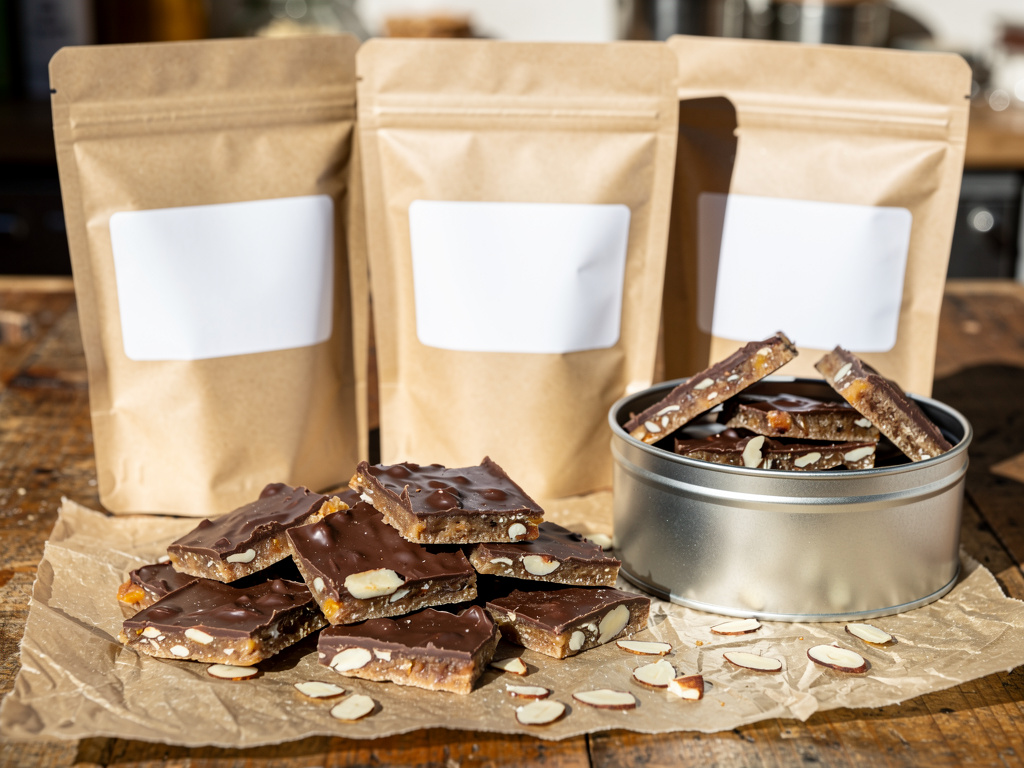


The short version: Sell homemade toffee for about $10 a 4-ounce bag, $16 a half pound and $28 a pound bag, and ask $38 when the pound goes in a gift box or tin. Nine small toffee shops we checked charged $15 to $20 for a half pound (median $17), leaving out one shop's $28 half-pound box, and pound sizes at six shops ran $26 to $38. One 1¼ pound pan costs about $6.81 in store-brand ingredients, or $12.65 with Kerrygold butter, Ghirardelli chips and pecans. Chocolate, not butter, is the biggest line in a chocolate-topped pan, and this year's butter price swing moved a half-pound bag only about 16 cents.
Checked on each shop's own website and on Walmart.com, October 8, 2026: prices change, so recheck before the holidays. Homegrown fees come from its signup page the same day; customers create a Homegrown account to place a first order, and there is no drops or countdown release feature.
Your coworkers ate a whole tin of your almond toffee in one afternoon, and now three of them want to buy some for the holidays. You know it is good. What you do not know is whether $12 for a bag is fair, too low, or a little embarrassing.
Toffee is one of the easier candies to price, because the recipe is short and every ingredient has a shelf price you can look up. This guide does that math with numbers loaded on October 8, 2026: what 11 small toffee shops charge, what Almond Roca costs at Walmart, what one pan costs you in two ingredient tiers, what bags, boxes and tins add, and what card fees take from a $16 bag. Then it turns those numbers into a price list you can print for your table.
Charge $10 for a 4-ounce bag, $16 for a half pound and $28 for a one-pound bag of homemade chocolate almond toffee made with store-brand ingredients. If you use Kerrygold butter and Ghirardelli chocolate, move the half pound to $18 and the pound bag to about $34. The store-brand prices run about 1.7 to 2.8 times your full cost, including your time, and each one sits inside the range real small toffee shops charge for that size. The premium prices come to about 1.7 to 2.5 times your full cost. The premium pound bag and tin sit above every shop price we found for a pound bag ($26 to $31) and a pound box ($28.95 to $38), because capped at $38, the premium tin would leave only $11.41 over its $26.59 full cost.
Here is the ladder to start from:
Scroll sideways to see both ingredient tiers.
| Size | Your full cost, store brand | Suggested price, store brand | Your full cost, premium | Suggested price, premium | What small shops charged |
|---|---|---|---|---|---|
| 4 oz bag | $3.57 | $10 | $4.74 | $10 to $12 | $9.99 to $12.25 |
| 8 oz bag (half pound) | $7.18 | $16 | $9.52 | $18 to $19 | $15.00 to $20.00 |
| 1 lb bag | $13.80 | $28 | $18.48 | $34 to $37 | $26.00 to $31.00 (bags) |
| 1 lb gift box or tin | $21.92 in a tin | $38 | $26.59 in a tin | $44 or more | $28.95 to $38.00 (boxes) |
Full cost is ingredients, the bag or tin, a label and $20 an hour for your labor, from the cost tables later in this guide. Ingredient prices come from Walmart.com on October 8, 2026. Shop prices come from each shop's own website the same day.
A few things push you up or down that ladder:
If you want the recipe, the cooking temperatures and the packaging basics first, our guide to how to sell caramel and toffee from home covers the cook and the storage. And if you sell fudge and brittle next to your toffee, the candy pricing guide runs the same kind of math across the whole candy table.
Eleven small toffee shops charged between $1.63 and $3.50 an ounce on October 8, 2026, which works out to $26 to $56 a pound depending on the size and the package. Price per ounce is the fair way to compare, because shops sell 4, 5, 8 and 16 ounce sizes.
Slide left to see each shop's price per ounce.
| Shop | Size | Price | Per ounce | Per pound |
|---|---|---|---|---|
| Tonja's Toffee | 4 oz | $9.99 | $2.50 | $39.96 |
| Nashville Toffee Company | 4 oz pouch | $12.25 | $3.06 | $49.00 |
| Oklahoma Toffee Company | 5 oz bag | $11.00 | $2.20 | $35.20 |
| Frisco Candy Kitchen | 8 oz | $15.00 | $1.88 | $30.00 |
| Bedford Candies | 8 oz | $15.50 | $1.94 | $31.00 |
| Tonja's Toffee | 8 oz | $15.99 | $2.00 | $31.98 |
| Nashville Toffee Company | 1/2 lb box | $16.75 | $2.09 | $33.50 |
| Hampshire Toffee | 8 oz | $17.00 | $2.13 | $34.00 |
| Northwest Expressions | 8 oz gift box | $17.95 | $2.24 | $35.90 |
| Pete's Perfect Toffee | 1/2 lb | $18.00 | $2.25 | $36.00 |
| Trisha's Toffee | 1/2 lb bag | $18.00 | $2.25 | $36.00 |
| Handmade Idaho | 8 oz gift box | $20.00 | $2.50 | $40.00 |
| Trisha's Toffee | 1/2 lb box | $28.00 | $3.50 | $56.00 |
| Oklahoma Toffee Company | 1 lb bag | $26.00 | $1.63 | $26.00 |
| Tonja's Toffee | 16 oz | $26.99 | $1.69 | $26.99 |
| Trisha's Toffee | 1 lb bag | $28.00 | $1.75 | $28.00 |
| Nashville Toffee Company | 1 lb gift box | $28.95 | $1.81 | $28.95 |
| Brown's English Toffee | 1 lb box | $30.00 | $1.88 | $30.00 |
| Bedford Candies | 16 oz | $31.00 | $1.94 | $31.00 |
| Trisha's Toffee | 1 lb box | $38.00 | $2.38 | $38.00 |
Every price was read off the shop's own website on October 8, 2026, using the milk chocolate almond version where a shop sells several. Pete's Perfect Toffee says its toffee is sold at Seattle-area farmers markets. Shipping is not included in these prices; Tonja's Toffee ships free on orders of $150 or more, and Bedford Candies on orders of $100 to $200.
Three patterns stand out in that table:
Ten half-pound prices at nine small toffee shops
Source: each shop's own website, October 8, 2026. Ten 8 ounce prices from the table above.
The box is the product at gift time, and Trisha's Toffee prices it that way: its half pound of milk chocolate almond toffee is $18 in a bag and $28 in a box, and its pound is $28 in a bag and $38 in a box. Same toffee, same weight, a flat $10 more for the box both times. Most boxed toffee in the table above costs about what a bag of the same weight does: Nashville Toffee Company's half-pound box is $16.75, and its pound gift box ($28.95) and Brown's English Toffee's pound box ($30) sit inside the $26 to $31 range for pound bags.
That gap tells you how gift buyers think. Someone buying a snack compares your bag with other candy. Someone buying a present for a teacher or a client compares your box with flowers, wine or a gift card. A $28 box of toffee is competing with those, not with a candy bar.
A retail tin eats most of that $10. The 7 x 3.2 inch round tin we priced, bought three to a pack, costs about $8.40 each, against about 28 cents for a pound pouch, so it takes $8.12 of the $10 gap and leaves you about $1.88. The box-versus-bag gap only pays off if your box costs you well under $10, so price tins by the case or look at smaller ones. Ways to use this at your own table:
Yes, for the customers who are buying a handmade gift, but you will not win the shopper who just wants cheap buttercrunch. Almond Roca cost $1.04 to $1.55 an ounce at Walmart.com on October 8, 2026, and Heath Miniatures cost about 66 cents. The small shops above charged $1.63 to $3.50.
Swipe to compare grocery toffee with your price.
| Grocery toffee | Size | Price | Per ounce | Same price for 8 oz |
|---|---|---|---|---|
| Heath Miniatures share pack | 9.1 oz | $5.97 | $0.66 | $5.25 |
| Almond Roca stand-up pouch | 4.5 oz | $4.66 | $1.04 | $8.28 |
| Almond Roca canister | 28 oz | $29.99 | $1.07 | $8.57 |
| Roca Buttercrunch | 10 oz | $13.99 | $1.40 | $11.19 |
| Dark Roca Buttercrunch | 9 oz | $13.99 | $1.55 | $12.44 |
| Your half pound at $16 | 8 oz | $16.00 | $2.00 | $16.00 |
Walmart.com search results loaded October 8, 2026. The 10 ounce Roca was marked down from $18.95 and the 28 ounce canister from $35.99 that day.
Your $16 half pound costs about 1.3 to 1.9 times what the same weight of Roca costs. Here is how to explain it at the table without sounding defensive:
A 1¼ pound pan of chocolate almond toffee costs about $6.81 in store-brand ingredients and $12.65 in premium ones, using what Walmart.com listed for each ingredient on October 8, 2026. That is 34 cents and 63 cents an ounce. The recipe is the Scotch & Scones English toffee: 1 cup butter, 1 cup sugar, a tablespoon of corn syrup, a teaspoon of vanilla, a pinch of salt, cooked to 300°F, then topped with 12 ounces of chocolate chips. Its author says it makes about 1¼ pounds. We swapped the almond meal topping for an ounce of sliced almonds, which the recipe suggests as an option.
Swipe left for the premium column.
| Ingredient | Amount | Store brand | Cost | Premium | Cost |
|---|---|---|---|---|---|
| Unsalted butter | 8 oz (1 cup) | Great Value, 16 oz $3.06 | $1.53 | Kerrygold, 16 oz $9.27 | $4.64 |
| Granulated sugar | 7 oz (1 cup) | Great Value, 4 lb $2.50 | $0.27 | Same | $0.27 |
| Light corn syrup | 1 tbsp | Karo, 16 oz $3.28 | $0.10 | Same | $0.10 |
| Pure vanilla extract | 1 tsp | Great Value, 2 fl oz $5.38 | $0.45 | Same | $0.45 |
| Chocolate chips | 12 oz | Great Value semi-sweet, 12 oz $3.86 | $3.86 | Ghirardelli semi-sweet, 12 oz $6.38 | $6.38 |
| Nuts on top | 1 oz | Great Value sliced almonds, 16 oz $9.48 | $0.59 | Great Value pecan halves, 16 oz $12.97 | $0.81 |
| One pan | about 20 oz | $6.81 | $12.65 | ||
| Per ounce | $0.34 | $0.63 |
Prices are what Walmart.com showed on October 8, 2026 for each product named. Salt is under a cent and left out. Store-brand rows are rounded to the cent, so they add to $6.80 against the unrounded total of $6.81. The 20 ounce yield is the recipe author's figure; weigh your own pan.
Two things in that table are worth knowing before you price:
Chocolate is the bigger cost in a chocolate-topped pan: 57% of the store-brand pan and 50% of the premium one. Butter is 22% of the store-brand pan and 37% of the premium pan. The toffee layer itself is mostly butter and sugar, but a pan takes 12 ounces of chocolate chips, and chips cost far more per ounce than sugar, so the topping carries the bill.
That matters when butter prices move. The U.S. average price of a pound of grade AA salted butter was $4.83 in August 2025 and $4.02 in August 2026, according to the Bureau of Labor Statistics average price series for butter. It also rose 21 cents between June and August 2026. Here is what those moves mean in your pan:
Butter, chocolate and nut prices move. We checked the ingredient prices in this guide on Walmart.com, and the BLS series, on October 8, 2026. Recost one real pan from your own receipts each fall before you print a holiday price list.
Better chocolate adds about $1.01 to a half-pound bag, Kerrygold butter adds about $1.24, and pecans instead of almonds add about 9 cents, based on the same day's Walmart.com shelf prices. Each swap is worth making only if you put it on the label and charge for it.
Here is each swap figured per pan and per half-pound bag:
The upgrade customers notice first is usually the one they can read. "Made with Kerrygold butter" on a label is a reason to pay $2 more. "Made with butter" is not. If you upgrade, upgrade the label too.
A stand-up pouch costs 13 to 38 cents depending on size, a label costs about 8 cents, and the 7 x 3.2 inch retail tin we priced costs about $8.40, going by Walmart.com listings we loaded on October 8, 2026. Other tin packs in the same search ran about $3 to $4 a tin, in sizes their listings did not give. The tin is the one that changes your price.
Swipe to see what each package adds.
| Package | Product and size | Pack price | Per package | Holds |
|---|---|---|---|---|
| Small pouch | Muka kraft stand-up pouch with window, 4.7 x 8 in, heat sealable | 100 for $13.45 | $0.13 | 4 oz bag |
| Half-pound pouch | Muka 7 mil stand-up pouch with window, 6.2 x 9.6 x 2.4 in | 100 for $37.99 | $0.38 | 8 oz bag |
| Pound pouch | WAFUNNE kraft window pouch, 8 x 12 in | 100 for $27.90 | $0.28 | 1 lb bag |
| Gift tin | XIMEI round cookie tin, 7 x 3.2 in | 3 for $25.19 | $8.40 | 1 lb box |
| Label | Avery 2 in round labels | 120 for $9.14 | $0.08 | One per package |
Pack prices from Walmart.com product pages and search pages, October 8, 2026. The two Muka pouch sizes are rated by the seller on coffee beans, which take more room per ounce than broken toffee, so each holds its toffee weight with space to spare. WAFUNNE sells its 8 x 12 inch pouch as its 16 oz, 1 lb size. The tin holds about 123 cubic inches.
Toffee needs a sealed package, because it pulls moisture out of the air and the pieces turn sticky. The how-to guide covers storage in detail. For pricing, the takeaway is simpler:
Plan on about 30 minutes of hands-on work per pan once you have done it a few times, which is about 50 cents an ounce if you pay yourself $20 an hour. The cook itself is short: the Scotch & Scones recipe says the butter and sugar reach 300°F in about 9 to 15 minutes of steady stirring. The rest of your time goes to melting and spreading the chocolate, waiting, breaking the slab, weighing, bagging, sealing and labeling.
The 30 minute figure is our working assumption, not a measured average, so time your own first few pans. Here is how it adds up for one pan:
Cooling is waiting time, not working time. You can cook a second pan while the first one sets, which is why we figure one hour for two pans, or 2½ pounds of toffee.
Cook two pans back to back on the same night. One pan covers about 30 minutes of work, which is $10 at a $20 hourly rate. Two pans in the same hour is what that 30 minute figure assumes: the cleanup, the setup and the labeling run happen once for 40 ounces instead of 20. Cook one pan at a time and each pan will likely take you longer.
These numbers leave out pans that burn or separate, the pieces you hand out as samples and bags that do not sell. If one pan in ten fails, add about 10% to your ingredient cost before you double it.
If you skip your time in the math, your half pound costs $3.18 and every price looks like a fortune. Put your time in and it costs $7.18, which is why $16, not $6, is the real starting price.
Price toffee in five steps: cost one real pan, weigh what it makes, add packaging and your time, double it, then check it against what small shops charge. Do this once with your own receipts and you only need to redo it when your ingredients or your package change.
Why double and not triple? Triple your materials alone ($3.18 x 3) is $9.54, which is under what Almond Roca's 10 ounce bag costs. Doubling your full cost, with your time in it, lands close to where small toffee shops sit, and the shop-range check in the last step moves it the rest of the way. For a wider look at the doubling rule on other products, the guide to pricing food at a farmers market walks through it.
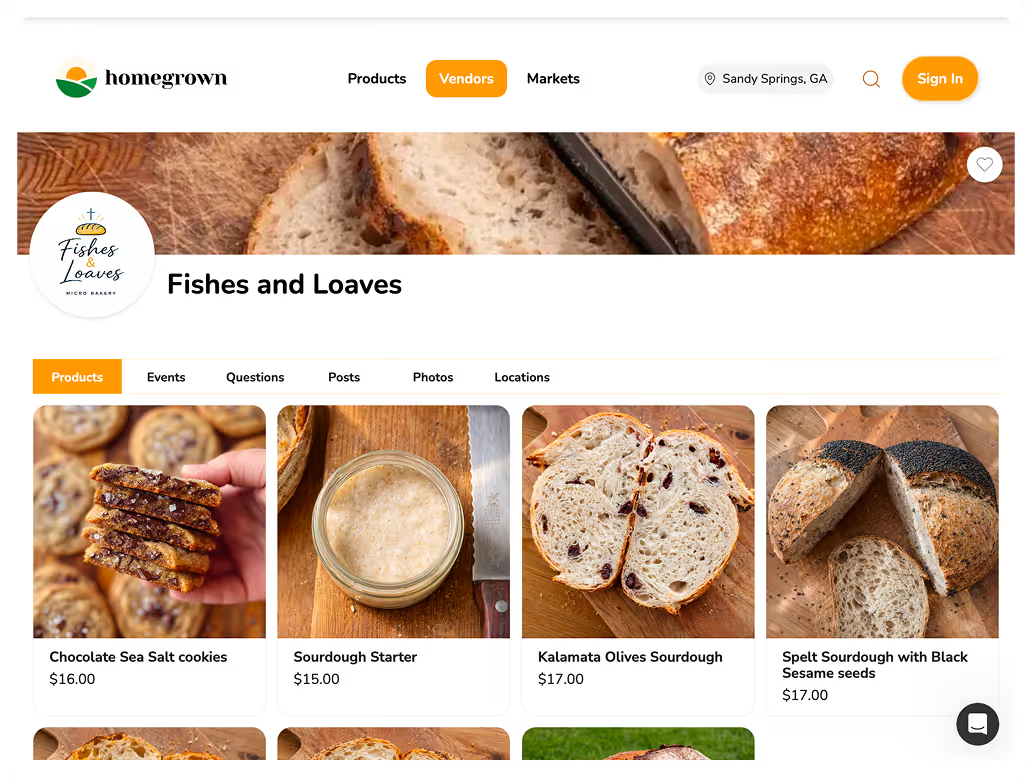
Once you have a price list, the next headache is collecting holiday orders without a pile of texts. You can put your bag, box and pound sizes on a Homegrown storefront at your ladder prices, so customers pick a size and pay before your cooking night.
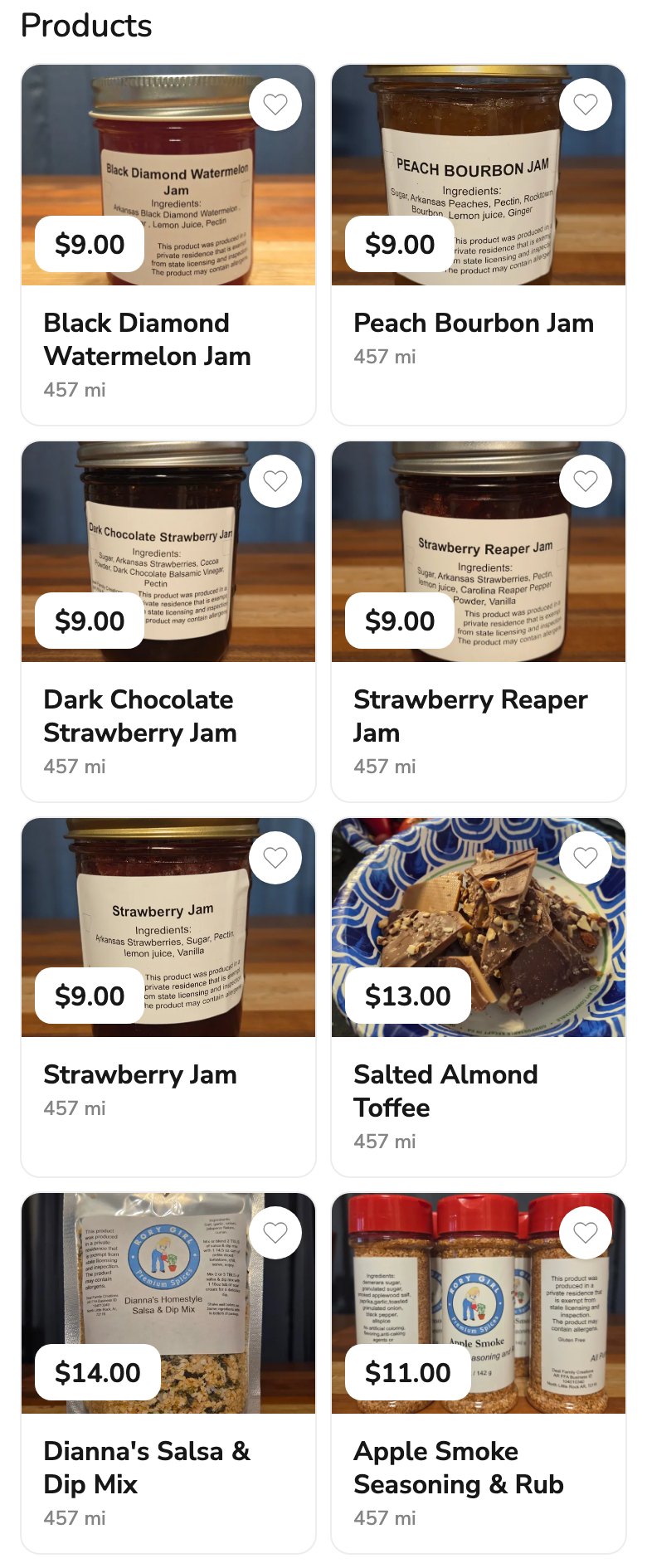
One vendor sells a standalone toffee on Homegrown today: Deal Family Creations, a husband-and-wife shop in North Little Rock, Arkansas, lists Salted Almond Toffee at $13.00. Its listing names the ingredients (butter, sugar, milk chocolate, chopped almonds, vanilla and salt) but not the weight.
In a pull of the Homegrown catalog on October 8, 2026, 1 of the 2,907 products listed by 310 vendors was a standalone toffee candy, and 1 more was a peanut brittle (Divine Destiny Desserts, $20 for an 8x8 pan). Another 17 listings used toffee pieces or Heath bits as an ingredient, mostly cookies, plus two fudge flavors, two cakes and a half-pound s'mores treat from a fudge shop, and 2 more only described a toffee taste. We searched every listing's name and description for toffee, butter crunch, brittle, Heath and Almond Roca, read every match and opened each vendor's other listings. A lettuce named Buttercrunch was left out.
What a small toffee shop can take from that storefront:
That last point is the easiest win on any toffee listing. A price without a weight makes a good deal look like a guess.
Usually yes, if your state's cottage food rules cover candy, but check your own state's list before you print labels. Toffee is a cooked sugar candy that does not need a refrigerator, which is the kind of food those laws are written for. Each state still writes its own list.
Both of the 2 states we checked on October 8, 2026 allow it: Michigan's list covers toffee under candy, and California's list names toffee outright. Here is how the wording differs:
Your label has to name the allergens in your toffee. The FDA's food allergy page lists milk, tree nuts and soybeans among the 9 major allergens, and its example of the "Contains" line reads "Contains wheat, milk, and soy." For toffee that usually means milk from the butter and chocolate, the nut you used, and soy if your chocolate lists soy lecithin. The FDA's food allergen labeling page has the full rule.
State lists change. We read the Michigan list and the California Approved Cottage Foods List on October 8, 2026. Verify your state's current rules with your state or county before your first sale, and see whether your state also caps yearly sales.
For a state-by-state look at candy specifically, whether you can sell homemade candy goes deeper on permits and labels. If you also cook peanut brittle, look for it on the same candy line of your state's list, and the peanut brittle guide covers how to sell it.
Charge more for the package and the trouble, not for the toffee itself. Keep your per-ounce price steady and let the tin, the box and any shipping carry the extra. Small toffee shops already work this way.
Look at how three of them handle it:
Here is how to set up your own holiday pricing:
On a $16 half pound, card processing takes about 76 cents on Homegrown, Hotplate and Shopify, 83 cents on Square online, and $1.97 on Etsy once its listing and transaction fees are added, based on each company's fee page on October 8, 2026. Hotplate also adds $1.35 to your customer's total by default, unless you choose to cover it.
Slide the table to see every fee column.
| Platform | Monthly plan | Trial | Platform or service fee | Card processing | Customer pays on a $16 bag | You pay on a $16 bag | You pay in a month of 40 bags |
|---|---|---|---|---|---|---|---|
| Homegrown | $10 billed annually ($12.50 monthly) | 7 days, no charge until day 8 | None, 0% commission | 2.9% + $0.30, paid by you | $16.00 | $0.76 plus the plan | $40.56 |
| Hotplate, default | $0 | No plan to try | 5% + $0.55, paid by the customer | 2.9% + $0.30, paid by you | $17.35 | $0.76 | $30.56 |
| Hotplate, you cover the fee | $0 | No plan to try | 5% + $0.55, paid by you | 2.9% + $0.30, paid by you | $16.00 | $2.11 | $84.56 |
| Etsy | $0 (one-time set-up fee varies) | No plan to try | $0.20 listing + 6.5% transaction | 3% + $0.25 | $16.00 plus shipping | $1.97 | $78.80 |
| Square Online, Free plan | $0 | No plan to try | None | 3.3% + $0.30 online | $16.00 | $0.83 | $33.12 |
| Shopify Basic | $29 billed yearly ($39 monthly) | 3 days, then $1 a month for 3 months | None with Shopify Payments (2% with another provider) | 2.9% + $0.30 online | $16.00 | $0.76 plus the plan | $59.56 |
Fees from each company's own pricing or fee page, checked October 8, 2026: Homegrown's signup page, Hotplate's pricing page, Etsy's Fees and Payments Policy and payment processing help page, Square's fee help article and Shopify's pricing page. Card processing is figured on the $16 price; platforms that charge it on the full total with tax, tips or shipping run a few cents higher. Etsy's figure leaves out shipping, tax and its optional ad fees. Monthly totals use the annual plan price where there is one.
Hotplate's pricing page says you can pay its fee yourself or pass it to customers, "your choice." Its own post "What Hotplate does" says the fee is charged to the customer by default and that "80% of Hotplate chefs keep the default as-is." We checked both on October 8, 2026, so a $16 bag reads $17.35 at checkout unless you change the setting, and you still pay 2.9% + $0.30 card processing either way.
Three things stand out for a toffee vendor:
Toffee pricing only works if you sell what you cook, and a pan of chocolate almond toffee does not wait well for buyers who never show. Homegrown is $10 per month billed annually, with no percentage fees beyond standard payment processing, and it gives you a storefront where regulars choose a 4-ounce bag, a half pound or a pound, pick pickup or local delivery, and pay before your cooking night. You list each size as its own option with its own price, so your $10, $16 and $28 ladder reads the same online as on your table.
Compare that with the two places toffee vendors usually start. Hotplate is built for pickup windows too, but by default it adds a 5% + $0.55 fee to your customer's checkout, so your $16 bag reads $17.35. Etsy reaches shoppers across the country, but each sale pays a $0.20 listing fee, 6.5% on the candy and the shipping, and 3% + $0.25 processing, about $1.97 on a $16 bag before postage. Holiday orders by text message cost nothing, but you end up tracking 20 conversations to figure out how many pans to cook.
What Homegrown does well for toffee:
What it does not do: customers create a Homegrown account to place their first order, there is no drops or countdown release feature for a limited holiday batch, and selling by weight is not live, so list fixed sizes instead. Shoppers can find your storefront on the Homegrown marketplace, but most toffee orders will come from the coworkers, neighbors and market regulars you send your link to. You pay the 2.9% + $0.30 card processing on each bag, and there is no setting to pass it on to the buyer. If your holiday toffee list lives in a notebook and a pile of texts, you can set up a toffee storefront in an evening with a 7-day trial, no charge until day 8.
Forty half-pound bags at $16 bring in $640 and leave about $312 after ingredients, packaging, Homegrown's fees and $20 an hour for your time, using the store-brand costs above. That month takes 16 pans and about 8 hours of hands-on work.
Put another way, you earn $20 an hour for the work and another $312.29 on top as profit for the month. Switch to premium ingredients and charge $18, and each bag leaves about $8.48 after materials and your time, close to the $8.82 a store-brand bag leaves at $16.
The math also shows where the money hides. Every $1 you add to the half pound adds about $39 a month at this volume after card fees, with no extra pans. That is why the step from $15 to $16 matters more than a sale on butter.
The most expensive toffee mistake is pricing from ingredients alone, which puts a half pound near $6 (twice its $3.18 in materials) when small shops charge $15 to $20. The rest are smaller, but they add up across a holiday season.
If one of these sounds familiar, fix the price list first. A clear ladder of $10, $16, $28 and $38 does more for your margin than any single recipe change.
Charge about $10 for a 4-ounce bag, $16 for a half pound, $28 for a pound bag and $38 for a pound in a gift box or tin. Those prices run about 1.7 to 2.8 times your full cost with store-brand ingredients and your time included. When we checked nine small toffee shops on October 8, 2026, their half pounds ran from $15 to $20. If you are still deciding how much to charge for toffee at your first market, start at $16 for the half pound and adjust after four weeks.
A pound of chocolate almond toffee costs about $5.45 in store-brand ingredients and about $10.12 with Kerrygold butter, Ghirardelli chips and pecans, from the Walmart.com ingredient costs in this guide. Add about 36 cents for a pouch and label, or about $8.47 for a retail tin and label. Your time at $20 an hour adds about $8 a pound.
Selling toffee is profitable when you charge what small shops charge and count your time. A $16 half pound with store-brand ingredients leaves about $8.82 after materials and $4 of your time, before card fees. At 40 bags a month, that is about $312 of profit after Homegrown's fees and $160 paid to yourself.
Handmade toffee from small shops sold for $26 to $38 a pound on October 8, 2026, across seven pound-size prices from six shops. Grocery toffee costs far less per pound: Almond Roca ran $1.04 to $1.55 an ounce at Walmart.com the same day, which is about $16.64 to $24.80 a pound. When you set how much to charge for toffee by the pound, aim near $28 for a bag.
Many states let you sell toffee under cottage food rules, because it is a shelf-stable cooked candy. Michigan's list allows candy made without alcohol, and California's Approved Cottage Foods List names toffee in its candy category. Verify your state's current rules before your first sale.
Selling single pieces works as a sample or an impulse buy at a market table, at about $1.50 to $2 a piece. The Scotch & Scones recipe cuts pieces of about two-thirds of an ounce, and at a 4-ounce bag's $2.50 an ounce, one piece works out to about $1.67. Use singles to get people to taste, then point them to the half pound.
More on pricing and selling candy from home:
You now have a price for every size: $10 for 4 ounces, $16 for a half pound, $28 for a pound bag and $38 for a pound in a tin. You also know why those numbers hold up. Each one comes to between 1.7 and 2.8 times what that size costs you with your time counted, and they land inside the $15 to $20 half-pound range that small toffee shops charge.
The last step is a place where customers can see those sizes and order before you cook. A price list taped to your table only works on market day. A link works the whole week, which is when coworkers, teachers and neighbors decide what to give for the holidays.
Start your Homegrown storefront for $10 a month billed annually, with a 7-day trial, no charge until day 8. List your four sizes, set a pickup day and an order deadline, and send the link to the coworkers who ate your last tin. When the orders are in, you will know exactly how many pans to cook.