
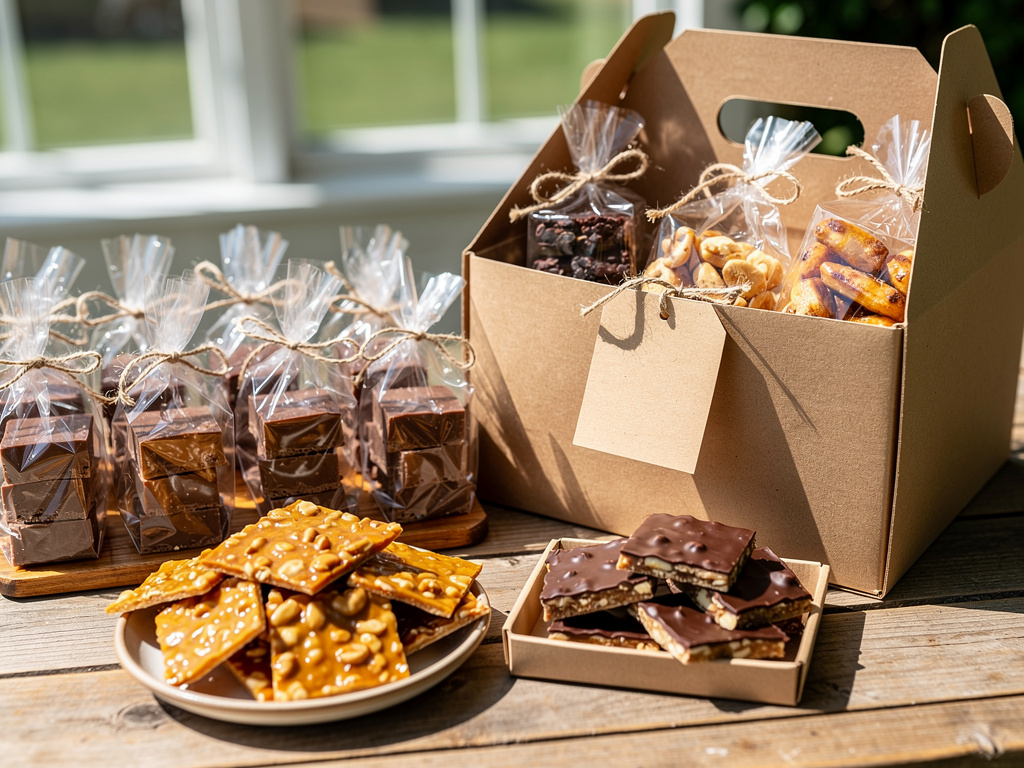


The short version: Candy sells in seven places: a farmers market booth, your own online ordering link, holiday markets and craft fairs, local shops that resell it, Etsy, bulk orders for weddings and offices, and Amazon, which rarely fits a home kitchen. On a $10 half-pound box of fudge, selling fees take $0.41 per card sale at a market booth plus the booth fee, $0.59 through your own link plus $10 a month, and $1.40 on Etsy with no monthly plan, and a shop pays you about $5 a box to resell it. Most part-time candy vendors do best with one place in person, where people can taste a sample, and one link where a regular can order a gift box on a Wednesday. Whether a shop shelf is even allowed depends on your state: Ohio lets cottage food candy go into grocery stores, and Washington does not.
Checked September 22, 2026: fees read that day on findhomegrown.com/signup, Etsy's fees and payments policies, shopify.com/pricing, squareup.com/us/en/pricing, hotplate.com/pricing (5% + $0.55 charged to the customer, 2.9% + $0.30 card processing paid by the vendor) and sell.amazon.com/pricing. State rules read that day on the Ohio Department of Agriculture and Washington State Department of Agriculture cottage food pages. Homegrown customers create an account to place their first order, and Homegrown has no timed drop feature.
You have a fudge recipe people ask for by name, or a freeze dryer humming in the garage, and now there are boxes of candy stacked on the counter. Making it was the easy part. Deciding where those boxes should go, and what each place quietly takes off every sale, is where most home candy vendors stall.
This guide covers the seven places a home candy vendor actually sells, what each one costs on the same $10 half-pound box of fudge, and which places your state lets you use at all.
Seven places take homemade candy, and a part-time vendor can run two of them at once without hiring anyone. Each one asks something different of you: a Saturday on your feet, a pitch to a shop owner, product photos, or just a link you text to the people who already love your toffee.
Candy has two things going for it that most cottage foods do not. It is a gift, so people pay more for a box than they would for the same weight of cookies. And most of it keeps for days or weeks, so leftover fudge from Saturday can still sell on Wednesday. How many days depends on the candy, and how long each kind of homemade candy lasts runs from about 1 to 2 weeks for wrapped caramels to 2 or 3 months for sealed hard candy. The catch is heat. Chocolate and soft caramels struggle at an outdoor July market, which shapes where candy sells in each season.
If you make freeze-dried candy and have not set up the machine or the legal side yet, the companion guide on how to sell freeze-dried candy from home covers the equipment, the state rules, packaging and pricing. This article picks up where that one stops: you have product, and you need to decide which counters it sits on.
Start with the place that matches what you already have, not the one with the biggest audience. A weekly market booth paired with a $10 a month ordering link gives a candy vendor one place to sell in person and one to sell online, for the booth fee plus $10 a month and card processing. A vendor with 300 friends in a local Facebook group needs a different first move than a vendor with a great peanut brittle and no following at all.
Scroll sideways to see every column.
| Your situation | Start here | Add second | Why |
|---|---|---|---|
| New, no customers yet | A farmers market booth | Your own ordering link, printed on a card in every bag | Samples turn strangers into buyers, and the link turns them into repeat buyers |
| You already have a following online | Your own ordering link | One holiday market in November | Your followers are ready to order; the market adds gift buyers |
| You work weekdays and cannot do a weekly market | Pre-orders for weekend pickup | Two or three holiday fairs a year | Candy keeps, so one production day can fill a week of orders |
| Your state allows shop sales and you want volume | One local gift shop | A farmers market to keep retail margin | Wholesale moves boxes; retail pays the bills |
Booth fees run $20 to $75 per week at a farmers market and $50 to $500 or more at a craft fair or holiday market, from our guides to farmers market costs and craft fairs. Shop sales depend on your state's cottage food rules, covered further down.
Whatever you pick, pick two, not five. Running five channels means five sets of inventory counts, five price lists and five places to answer messages. Two channels, one in person and one online, covers most part-time candy vendors:
A farmers market is a strong first place for most candy vendors, because a free sample does the selling and a booth costs $20 to $75 a week. At the $10 half-pound box our candy pricing guide works out, with $3.08 of ingredients, box and label in it, you keep $6.92 on a cash sale. Six cash sales cover a $40 booth. If every buyer taps a card on a Square reader, the 2.6% plus 15 cents takes $0.41 a box and you need seven.
What makes a candy booth work:
Heat is the one thing that turns a good candy booth into a loss. Chocolate, fudge and soft caramels soften in a July sun, while brittle, hard candy and freeze-dried candy hold up better in heat, though freeze-dried candy goes soft fast in humid air once a bag is open. Plan a summer lineup around the heat-tolerant candies and bring the chocolate back when the weather cools. Your market may also have its own rule about samples, so ask the manager before you set out a tray.
The real cost of a market is your Saturday, not the booth fee. Setup, five hours of selling and teardown is a seven or eight hour day, and our breakdown of what it really costs to sell at a farmers market walks through the costs no booth invoice shows. Candy earns that day back better than most foods, because nothing you bring has to be thrown out that night.
Between markets, your candy should live on an ordering link you own, where a customer picks flavors, picks a pickup time and pays before you start cooking. That is the channel that turns a one-time sample into a standing customer, and it is the one most candy vendors skip until the DMs pile up in December.
The problem it solves is specific to candy. Someone tastes your salted almond toffee in October, and they want six boxes for teacher gifts in December. If the only way to order is a text message, you are the order form, the payment chaser and the spreadsheet, all during your busiest two weeks of the year.
Homegrown is $10 per month billed annually ($12.50 month to month) with no percentage fees beyond standard payment processing of 2.9% plus 30 cents, which is $0.59 on a $10 box of fudge. Your customer sees your flavors and box sizes, picks a pickup time or local delivery, and pays by card at checkout. You get the orders listed by pickup day, so you know you need 14 boxes of peanut butter fudge before the pan goes on the stove. That matters more for candy than for most products, because fudge and toffee are poured to a batch size, and guessing short means a second batch.
Compare that to the three places candy vendors usually look first:
What Homegrown does not do, said plainly. Your customers create a Homegrown account to place their first order, which is one extra step for a neighbor who just wants fudge. There is no countdown or drop feature for timed releases. It is not built for shipped orders, so if your state lets you mail candy and your buyers are far away, Etsy is the better tool. Your storefront is listed on the Homegrown marketplace, but plan on most of your orders coming from people you send to your own link. And the 2.9% plus 30 cents of card processing is paid by you, with nothing passed on to your customer.
If your regulars are texting you for gift boxes every December, set up your Homegrown storefront before the holiday rush, list your flavors and box sizes once, and send one link instead of answering 30 messages.
Holiday markets can pay more per hour than any other table a candy vendor books, because the crowd is there to buy gifts and a boxed assortment is exactly that, but the booth fee is higher too. Our craft fair and festival guide puts booth fees at $50 to $75 for small local events and $300 to $500 or more for large regional festivals and popular holiday markets. Before you book, check whether your state limits which events count; Ohio, for one, allows cottage food only at festivals run by a local government body.
Run the numbers before you book. At $6.92 kept on each $10 box:
Those counts are why candy vendors build gift boxes for fairs rather than selling single squares. A $25 assortment cuts the break-even at a $300 holiday market from 44 boxes to 17. A few things that raise the take at a fair:
Price the fair box so the booth fee disappears in the first hour. If your $25 three-flavor box costs you $7 to make, you keep $18 a box, and 17 boxes cover a $300 holiday market. Selling only $10 half-pound boxes, the same booth takes 44 sales before you earn a dollar.
You can sell candy to local shops only if your state's cottage food law allows sales through a third party, and states split sharply on this. Ohio's rules let cottage food go through grocery stores and restaurants. Washington's rules say no shop, no consignment and no wholesale at all without a separate food processor license. Michigan draws the same line for fudge, down to the orchard counter, while Pennsylvania inspects home kitchens instead, and where to sell fudge in states like Michigan and Pennsylvania walks through what that leaves a fudge vendor.
The Ohio Department of Agriculture's cottage food page lists candy as a permitted cottage food and says labeled products may be sold from your home and "through grocery stores, registered farm markets, farmers markets," and in a restaurant, but "may only be sold in Ohio." Festivals count only when the event "is organized by a political subdivision of the state and lasts for a period not longer than seven consecutive days," so a privately run craft fair may not qualify. Cottage food operators there are exempt from the department's inspection and licensing. Read September 22, 2026.
The Washington State Department of Agriculture's cottage food page says cottage food "may be sold only to the end consumer" from your home, at farmers markets, craft fairs and other public venues, and that "Internet, mail, consignment, wholesale, & retail sales outside the state are prohibited." The same page lets you take orders online, as long as delivery and payment happen person to person (see the online orders question below). Selling through a shop needs a WSDA Food Processor's License. The permit is $355 for two years and gross sales are capped at $35,000 a year. Read September 22, 2026.
If your state allows it, a shop can be your steadiest channel. The shop buys your candy at a wholesale price and resells it, or holds it on consignment and pays you when it sells. Here is how the two deals compare on a $10 box:
Wholesale candy margins are thin, so a shop order only makes sense in volume. At $1.92 a box, a 30-box order earns $57.60 before the drive to deliver it. Go into the pitch prepared:
Sell candy on Etsy only if your state's cottage food law allows mail orders and your buyers are strangers searching by name, such as "freeze dried taffy" or "English toffee gift box." Etsy's fees are higher than every online option here except Amazon and Hotplate when you cover its fee: a $0.20 listing fee, a 6.5% transaction fee on the price plus shipping, and 3% plus 25 cents in payment processing for a vendor with a US bank account. On a $10 box with no shipping charge, that is $1.40, and you keep $8.60.
A few Etsy details that hit candy harder than most products:
The bigger question is legal. Ohio keeps cottage food sales inside Ohio, and Washington's rules ban mail sales outright, so an Etsy shop that sells nationwide can put a home candy vendor outside the rules. Our guide to selling food on Etsy covers the shop setup if your state allows it. If it does not, Etsy is a tool for later, after you move into a licensed kitchen.
Amazon is rarely a good place for a home candy vendor, because it sells to shoppers nationwide and cottage food rules like Ohio's and Washington's keep home-kitchen candy inside the state. Even the fees are not in your favor at a $10 price. Amazon's Grocery and Gourmet category takes an 8% referral fee on products priced at $15.00 or less and 15% above that, and a vendor on the Individual plan also pays $0.99 per sale.
On a $10 box, that is:
Amazon works for a candy business that has moved into a licensed kitchen and wants national reach. For a vendor selling fudge from a home kitchen, a local link and a market table are cheaper and inside the rules.
Fees on a $10 box of fudge run from $0.41 at a booth card reader to $1.79 on Amazon's Individual plan, and a flat monthly plan changes the ranking, so the last column shows each one at 50 boxes a month. Here is the full stack for every platform, with nothing left out of any row.
Scroll sideways to see every column.
| Platform | Subscription | Trial | Platform fee or commission | Card processing | Customer pays on a $10 box | Vendor pays on that box | Vendor pays on 50 boxes a month |
|---|---|---|---|---|---|---|---|
| Homegrown | $10/mo billed annually, $12.50 billed monthly | 7 days, no charge until day 8 | $0, 0% commission, no shopper fee | 2.9% + $0.30, vendor-paid | $10.00 | $0.59 | $39.50 |
| Square Free plan, reader at the booth | $0 | not applicable | $0 | 2.6% + 15 cents in person | $10.00 | $0.41 | $20.50 |
| Square Free plan, online | $0 | not applicable | $0 | 3.3% + 30 cents online | $10.00 | $0.63 | $31.50 |
| Hotplate, default | $0 | none | 5% + $0.55, added to the customer's total | 2.9% + $0.30, vendor-paid | $11.05 | $0.59 | $29.50 |
| Hotplate, vendor covers the fee | $0 | none | 5% + $0.55, paid by the vendor | 2.9% + $0.30, vendor-paid | $10.00 | $1.64 | $82.00 |
| Shopify Basic | $29/mo billed yearly, $39 billed monthly | 3 days, then $1/mo for 3 months | $0 with Shopify Payments, 2% with another processor | 2.9% + 30 cents online | $10.00 | $0.59 | $58.50 |
| Etsy | $0 (Etsy Plus optional at $10/mo) | none | 6.5% transaction fee on price plus shipping, $0.20 listing fee renewed after each sale | 3% + $0.25 for a US bank account | $10.00 | $1.40 | $70.00 |
| Amazon, Individual | $0.99 per sale | none | 8% referral fee at $15.00 or less | no separate processing fee listed on the pricing page | $10.00 | $1.79 | $89.50 |
| Amazon, Professional | $39.99/mo | none | 8% referral fee at $15.00 or less | no separate processing fee listed on the pricing page | $10.00 | $0.80 | $79.99 |
Every fee read on the platform's own page on September 22, 2026: findhomegrown.com/signup, etsy.com/legal/fees and Etsy's payments policy, squareup.com/us/en/pricing, hotplate.com/pricing, shopify.com/pricing and sell.amazon.com/pricing. The 50-box column is 50 times the per-box cost plus the monthly plan, on annual billing where there is a choice. Card processing is figured on the $10 price with no tax, tip or shipping. Hotplate's own example on its pricing page charges $1.27 in card processing on a $30.00 subtotal with a $3.00 tip and $2.55 tax, more than the $1.17 that 2.9% + $0.30 comes to on the subtotal alone, so treat its rows as the floor. If processing is charged on the full $11.05 your customer pays, Hotplate's default row is $0.62 a box, or about $31 for 50 boxes. Etsy says it may charge a one-time shop set-up fee but does not print the amount, and Amazon shipping and fulfillment fees are not included.
What 50 boxes a month at $10 costs the vendor
Computed from the fee table above, rates read September 22, 2026. Bar widths are each figure divided by $89.50. Hotplate's default $29.50 is the vendor's side only; customers pay another $1.05 a box, or $52.50 across 50 boxes.
Two rows look cheap for reasons worth knowing. Hotplate's default is low for you because your customer pays the service fee, so your $10 box shows up as $11.05 at their checkout, and you still pay 2.9% + $0.30 in card processing. The Square reader is the cheapest row because it is a card reader at your booth, not an ordering page, so it does nothing for the customer who wants to order a gift box on a Tuesday.
Bulk candy buyers are people planning an event or a thank-you, and they order 25 to 200 pieces at a time from a vendor they already trust. One of these orders can equal a month of Saturday sales, and you make it in one production day. The usual bulk buyers:
Price bulk orders per piece or per bag, and set a minimum. A wedding order of 100 favor bags at $3 each is $300 for one day of cooking and bagging, paid in advance. Ask for payment up front, confirm the pickup date in writing, and add a line to your price sheet for custom ribbon or tags so the extra hour of tying bows is paid for.
The best source of bulk orders is your existing customers. Put a line on your ordering page and in every bag that says you take event and gift orders, with a minimum of 25. The person who buys a $10 box at your booth in March may be the one planning a wedding in June.
Homegrown's candy vendors mostly sell small, low-priced packs, with a few gift boxes near the top. That is what a local customer who already buys candy online is used to seeing, so it is worth knowing before you set your own prices.
In a pull of the Homegrown catalog on September 22, 2026, 94 of the 2,584 products listed by 293 vendors were candy, from 7 vendors. Sixty-three were freeze-dried candy packs from one shop, Over Terrill Creek, every one priced at $5. Legacy Fudge listed 15 fudge flavors at $4 each and a six-pack for $20. The rest ran from $4 coconut truffles and $6 buckeyes and cotton candy, through a $10 box of turtles, $13 salted almond toffee, an $18 Dubai chocolate bar and $20 peanut brittle, up to $27 marshmallow flower sets and $32 zefir from the same shop. Eighty-one of the 94 listings are under $10. These are listings, not sales.
Two things stand out. First, the one shop with 63 listings prices every pack at $5, so a customer can build a mixed five-pack for $25 without doing any math. Second, every one of those 63 listings carries the same delivery note: the buyer must be home, because the candy is "very sensitive to heat and cold" and cannot be left outside or in a mailbox. That is a real candy problem solved in one sentence, and worth copying if you deliver.
The price spread matters for where you sell. A $4 square is an impulse buy at a booth. A $20 to $32 box is a gift, and gifts sell best where people plan ahead: your ordering link in December, a holiday market, or a bulk order. If most of your line sits under $10, the booth is your main channel; if it sits above $20, the link and the fairs are.
Where you may sell homemade candy is set by your state's cottage food law, which is the state law that lets you make low-risk foods like candy in a home kitchen without a commercial license. Most of those laws allow direct sales to the person who will eat it. Washington caps cottage food sales at $35,000 a year and charges $355 for a two-year permit, while Ohio requires no license from its Department of Agriculture at all. The laws differ on three questions, and you need your state's answer to each before you pick a channel:
Rules also vary on which candies count. Washington's list names fudge, caramels, nut brittles, taffy, marshmallow-like candies and molded chocolates, and it requires a candy thermometer for any candy cooked on a stove or in a microwave. Candy with a cream filling or fresh fruit that needs a refrigerator can fall outside cottage food rules, which is why chocolate-dipped strawberries are a different product from chocolate bark.
Whichever channel you use, the label travels with the candy. Our guide to cottage food labeling requirements covers the name, address, ingredient list, allergens and home-kitchen statement most states ask for. For a state-by-state look at whether candy is allowed at all, see our guide to whether you can sell homemade candy.
Rules change, and a channel that is fine in one state is banned in the next. Before your first sale in a new place, verify your state's current rules on its agriculture or health department website. The Ohio and Washington rules in this guide were read on September 22, 2026.
Candy sells on holidays, and the season decides which channel does the work. Open pre-orders about 2 weeks before each holiday, as the Valentine's line below does, and close them early enough to cook, since fudge and toffee are made a few days ahead of pickup. Summer heat pushes candy toward heat-tolerant products and online pickup orders, while October through December moves most of a year's gift sales through holiday markets and ordering links.
A rough candy calendar for a part-time vendor:
Plan production backward from those dates. Fudge and toffee keep well enough to make a few days ahead, so a Thursday and Friday of cooking can fill a Saturday fair and a Sunday pickup.
You can open a new channel in 4 weeks if you add one place at a time and test it with a batch of 20 to 30 boxes before committing. Here is the order that works for most candy vendors:
The ordering link is the step people skip, and it is the one that makes every other channel pay twice. A fair customer who can reorder from a link is worth more than one who has to find you again next December. When you are ready, start your Homegrown storefront and put the link on your booth sign before your next market.
Every channel has costs no pricing page lists, and for candy the biggest ones are your time, heat losses and unsold stock. Count these before deciding a channel is cheap:
The cheapest channel is usually the one that reuses customers you already have. A regular reordering through your link costs you $0.59 on a $10 box and none of your Saturday.
The places to sell homemade candy near you are your local farmers market, holiday markets and craft fairs, an online ordering link for pickup, and in some states local gift shops and groceries. Start with a market booth where people can taste samples, and hand out your ordering link so buyers can reorder between markets.
In many states you can sell homemade candy online if the customer picks it up or you deliver it locally, but shipping it out of state is usually off the table under cottage food law. Washington's rules ban mail sales for cottage food, and Ohio limits sales to inside Ohio. Check your own state's rules before you list anything online.
It depends on your state. Some states require a cottage food permit or registration, and others require none. Washington charges $355 for a two-year permit, while Ohio exempts cottage food operators from its licensing and inspection. Your market may also ask for proof of your permit and a label on every package.
Only if your state allows cottage food to be sold through a store. Ohio's rules allow sales through grocery stores, while Washington's require a separate food processor license for any wholesale sale. If your state allows it, expect the store to pay about half your shelf price, or to take 30 to 50 percent on consignment.
Candy that sells best at craft fairs is candy packaged as a gift: assorted fudge boxes, toffee, brittle and freeze-dried candy in clear bags. A ribbon-tied box of three flavors at $20 to $30 covers a booth fee far faster than single squares, and heat-tolerant candy like brittle holds up best at summer events.
For local customers, your own storefront costs less once you sell about 13 boxes a month: $0.59 in card processing on a $10 box of candy through Homegrown, plus the $10 monthly plan, against $1.40 a box on Etsy with no plan. Each box saves $0.81, so the $10 plan pays for itself at 13 boxes, and at 10 boxes a month Etsy costs $14.00 against $15.90. Etsy makes sense when your state allows mail orders and your buyers are strangers searching nationwide. Most home candy vendors sell locally, so an ordering link for pickup fits better.
Five Homegrown guides cover the parts of a candy business this article only touches: the freeze dryer, the price of each box, the state rules, and fudge, caramel and toffee.
Candy sells best where people can taste it once and order it again. Pick one table and one link, get both running, and add the next place when the first two do their job.



