
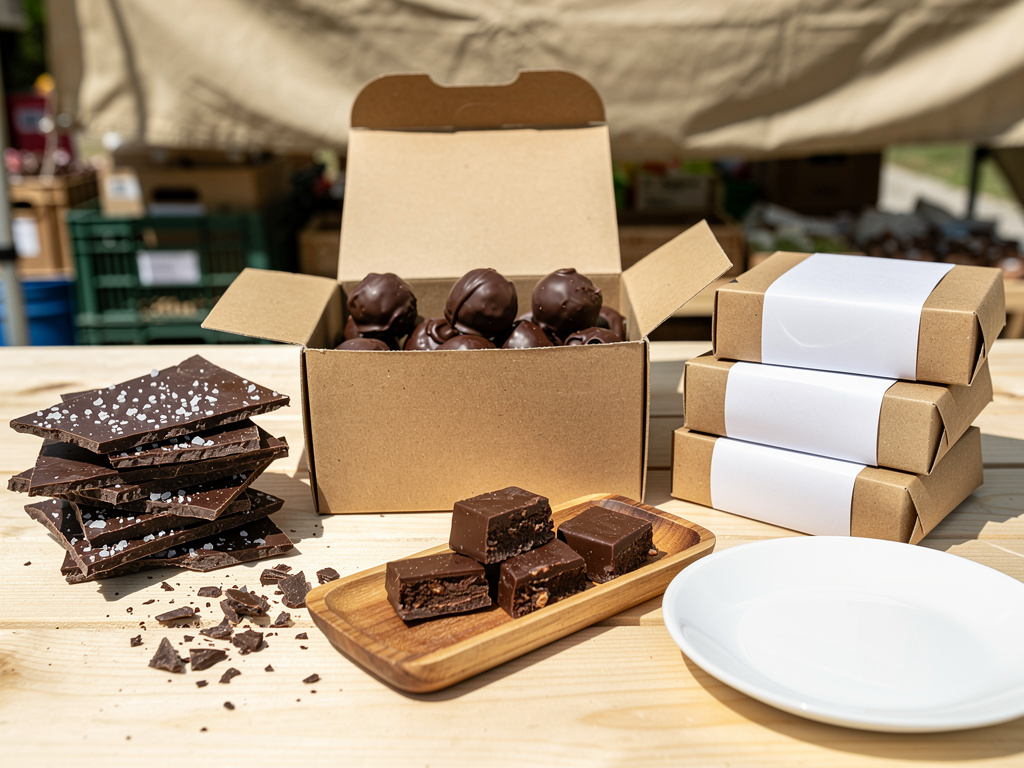


The short version: Homemade chocolate sells in seven places: a farmers market booth, your own online ordering link, holiday markets and craft fairs, local shops and cafes that resell it, Etsy, bulk orders for weddings, offices and fundraisers, and Amazon, which only works once you move into a licensed kitchen. On a $20 gift box of chocolates, selling fees take $0.67 per card sale at a market booth plus the booth fee, $0.88 through your own Homegrown link plus $10 a month, $2.35 on Etsy, and $3.00 on Amazon plus $39.99 a month on its Professional plan ($3.99 a box on the Individual plan), while a shop pays you $10 to $14.29 for the box so it can resell it at $20. Heat decides the rest: chocolate sells best from October to February, in person at holiday markets through December and by pre-order for Valentine's Day, and in summer it moves to pre-orders picked up indoors. Most part-time chocolate vendors do best with one place where people can taste a sample and one link where a regular can order a gift box any day of the week. Whether a shop, an online order or a shipped box is allowed at all depends on your state's cottage food rules.
Checked on each company's own page, September 25, 2026: Homegrown's signup page, Etsy's sell page, Shopify, Square, Hotplate and Amazon's pricing pages, and Amazon's meltable inventory policy. Homegrown is $10 a month billed annually, customers create a Homegrown account to place their first order, there is no timed-drop or countdown feature, and most of your orders will come from people you send to your own link.
You temper a good batch, the bark snaps clean, and the truffles look like they came from a shop window. Then the real question shows up on the counter next to the boxes: who is going to buy all of this, and where? Chocolate is one of the easiest products to sell once someone tastes it, and one of the hardest to keep sellable once it leaves your kitchen, because it melts, blooms and scuffs.
This guide covers the seven places a home chocolate vendor actually sells, what each one takes from the same $20 gift box, and which ones still work in July.
Homemade chocolate has seven realistic outlets, and most part-time vendors can keep two of them going at the same time on their own. That holds in most states, but not all: New York and Wisconsin, for example, do not allow chocolate candy made in a home kitchen, so check your state's rules before you plan. Each of the seven asks something different of you: a Saturday at a booth, a pitch to a cafe owner, a box of cold packs, or just a link you text to the people who already love your sea salt caramels.
Two traits set chocolate apart from most cottage foods. It is the default gift for Valentine's Day, Easter, Mother's Day and the December holidays, so a $20 box reads as a present, not a snack. And bark, molded bars and fudge keep for weeks when stored cool, so Saturday's leftovers can still sell on Wednesday. The catch is heat, and it shows up in every channel below.
If you have not worked out tempering, packaging or which chocolate to buy yet, the companion guide on how to sell chocolate and confections from home covers the kitchen side: couverture versus compound chocolate, tempering, equipment, allergens and gift box pricing. This article picks up where that one stops. You have boxes on the counter, and you need to decide where they go.
The right place depends first on what you make, because a $4 bar of bark and a $30 box of dipped strawberries live very different lives once they leave your kitchen. Shelf life and heat tolerance decide which channels a product can survive, so start by matching the product to the place.
Scroll sideways to see every column.
| What you make | Keeps how long | Handles heat | Best places to sell it |
|---|---|---|---|
| Bark, molded bars, chocolate-dipped pretzels | Weeks, stored cool | Fair, in shade | Farmers market, your own link, shops and cafes, craft fairs |
| Fudge and toffee | One to three weeks | Good | Farmers market all summer, your own link, bulk gift orders |
| Truffles and filled bonbons | Days to two weeks, depending on the filling | Poor | Pre-order pickup, holiday markets, gift orders |
| Dubai-style filled bars | Short, the filling softens | Poor | Pre-orders through your own link, in-person pickup |
| Chocolate-dipped strawberries and fruit | One to two days | Very poor | Pre-order pickup only, and only where your state allows it |
Shelf life depends on your recipe and storage. Dipped fresh fruit needs refrigeration, which puts it outside cottage food rules in many states. Check before you list it.
Two rows need a warning before you plan anything. Dipped fresh fruit is usually treated as a food that must stay refrigerated, and many states keep those foods out of home kitchens entirely. The guide to selling chocolate-covered strawberries from home walks through where it is allowed. Ganache truffles made with fresh cream sit in a gray area in some states, which our homemade chocolate rules by state break down.
For everyone else, a simple rule holds. The longer a product keeps and the better it handles a warm day, the more places it can go:
A farmers market is the best first place for most chocolate vendors, because one tasted piece does the selling and a booth costs $20 to $75 a week. The companion how-to guide lists 4-piece truffle boxes at $16 to $24 with a 50 to 60 percent margin, so a $20 box leaves you about $10 to $12 at that margin. Four cash sales cover a $40 booth. If every buyer taps a card on a Square reader on the free plan, 2.6% plus 15 cents takes $0.67 a box, so at the low end of that margin you need a fifth sale.
What makes a chocolate booth work:
An outdoor summer market can ruin a table of truffles by 11 a.m. The companion how-to guide recommends keeping product below 75 degrees with ice packs under a hotel pan, never in direct contact with ice, and switching the summer menu to toffee, brittle, bark and fudge. If your market has no shade, skip the filled chocolates from June through August.
The market's real value is the list of people who tasted your chocolate and want more. Plenty of them will not come back every Saturday. They will come back when a birthday, an anniversary or Valentine's Day shows up, and they need a way to order that is not a Saturday morning. The booth is also where you learn which flavors sell before you make 200 of them. For the full cost of a market season, including fees nobody mentions, see what it really costs to sell at a farmers market.
Chocolate customers order between markets through a link you own, and for a home vendor that link is where most repeat and gift orders end up. A shop clerk cannot answer "can you do a box of twelve with no nuts for Friday?", and a Saturday booth is packed away on the Wednesday when someone remembers a birthday. The job is a page where someone picks a box, pays, and chooses a pickup time, without a string of DMs.
Homegrown is built for exactly that: a storefront link your customers use to order and pay, with pickup from your house, farm stand or market booth, or delivery to their door. It costs $10 per month with no percentage fees beyond standard payment processing (billed annually, or $12.50 billed month to month; processing is 2.9% + $0.30, paid by you, so a $20 box shows your customer $20.00 at checkout). Here is how it compares to what chocolate vendors usually try first:
The parts of Homegrown that matter for chocolate are the dull ones. Customers choose a pickup time, so filled chocolates go from your cool kitchen straight to their hands instead of sitting on a porch. Pre-orders tell you how many Valentine's boxes to make before you temper a single pound. Setup takes about 15 minutes. And each order carries a notes field, where a customer can write "no nuts" or a gift message.
What Homegrown does not do: it does not ship chocolate nationally for you, pack cold boxes, or bring you buyers you never met. Your storefront is listed on the Homegrown marketplace, but plan on most orders coming from the people you send to your own link. Customers create a Homegrown account to place their first order. There is no countdown or timed-drop release feature.
If your chocolate is already selling at a booth and the orders in between are coming through text messages, a Homegrown storefront gives those regulars one link to order a gift box on a Wednesday. It is $10 a month, and you can have it live before next Saturday's market.
Holiday markets and craft fairs are worth it for chocolate from November through mid-December, when most people at the table are shopping for gifts. The companion how-to guide calls October through February peak chocolate season and says it is when you make most of your annual chocolate revenue. Booth fees run from $50 for a small community event to $500 or more for a large regional festival, so the math has to work before you apply.
On a $20 box that leaves you about $10 to $12 at the companion guide's 50 to 60 percent margin, a $150 fair booth needs 13 to 15 boxes sold just to break even. That is a realistic number at a busy December fair. It is a stretch at a small spring craft show, where chocolate competes with soap and candles for the same $20.
What sells at a chocolate table in the gift season:
Indoor holiday markets also take heat off the table entirely, which is why filled truffles sell there when they would not last an hour at a July market. For more on picking events and pricing a fair table, see our write-up on selling food at craft fairs and festivals.
Bring twice as many 4-piece boxes as 9-piece boxes. A $20 box is an easy yes for a coworker or teacher gift, and the buyers who want the bigger box can order it from your link for pickup the following week, so you never carry 30 unsold $45 boxes home.
You can sell chocolate to local shops in states that allow cottage food to be resold, and a shop typically pays $10.00 to $14.29 for a box that sells at $20. That range comes from the 40 to 100 percent markup small stores put on shelf-stable products, covered in the guide to selling food products in local stores. Some stores prefer consignment, where you own the chocolate until it sells and the store keeps 30 to 50 percent of the price.
Chocolate fits more kinds of stores than most cottage foods, because it pairs with what they already sell:
Whether any of this is legal depends entirely on your state, and two big states show how different the answer can be.
The California Department of Public Health's cottage food page splits home kitchens into two classes. A Class A operation sells "directly to the public," including orders by phone or online, and can deliver in person, by mail or through a delivery service, with gross annual sales up to $75,000. A Class B operation can also sell "indirectly through restaurants and food markets," with sales up to $150,000. So a cafe or market shelf needs Class B, which you apply for through your local environmental health department, usually the county's. A florist or bookstore may not count as either, so ask your county before you pitch one. Read September 25, 2026.
The Texas Department of State Health Services cottage food page explains the changes from Senate Bill 541. A home kitchen may now sell at wholesale to a registered cottage food vendor, who can resell it "at a farmers' market, a farm stand, a food service establishment, or any retail store," with a posted sign saying the food was made in a private home that is not inspected. Foods that need refrigeration are not eligible for wholesale. The annual gross income limit is $150,000. Read September 25, 2026.
Some other states allow direct sales only, which means no shop, cafe or florist can resell your chocolate at all. Check your state's current rules before you pitch anyone. If shops are allowed where you live, the pitch itself is short:
Etsy works for chocolate only if you are allowed to ship it and willing to pack it for heat, and it costs $2.35 in fees on a $20 box. That fee is a $0.20 listing fee, a 6.5% transaction fee ($1.30) and payment processing of 3% plus 25 cents ($0.85), all read from Etsy's own sell page, checked September 25, 2026. The 6.5% also applies to the shipping price you set, and a sale that comes through Etsy's Offsite Ads, the ads Etsy pays for to promote your listings across the web, costs a 15% ad fee on top, another $3.00 on a $20 box.
The bigger limit for a home kitchen is not the fee. It is the shipping rule. Cottage food exemptions are state laws, and the guide on whether you can ship cottage food explains why interstate shipping is almost always off-limits for a home kitchen. For a home kitchen, much of Etsy's national audience is out of legal reach. Where Etsy fits:
Where it does not fit: a home kitchen selling filled chocolates to people within a 20-minute drive. Those buyers are better served by a pickup link that costs $0.88 a box plus the $10 monthly plan, instead of $2.35 a box on Etsy, and they never have to wonder whether the box melted on a porch. Past about 7 boxes a month the link costs less (9 boxes on month-to-month billing). The guide on selling food on Etsy covers the platform in more depth.
If you do ship chocolate, send orders Monday through Wednesday only. A box that leaves on Thursday can sit in a warm truck or depot over the weekend, and one melted $20 box sent back as a replacement erases the profit on the next box or two.
Amazon is a poor fit for homemade chocolate, because it charges a 15% referral fee on a $20 box and only ships chocolate from its own warehouses in the cool months. Amazon's Grocery and Gourmet category takes 8% on products with a total sales price of $15 or less and 15% above that, so a $20 box costs you $3.00, plus $39.99 a month on the Professional plan or $0.99 per item on the Individual plan.
The heat rule is easy to miss. Amazon's meltable inventory policy treats chocolate as a heat-sensitive product, and its warehouses stop holding it through the summer.
Amazon's policy for meltable products in Fulfillment by Amazon (FBA, the program where Amazon stores and ships your products for you) says chocolate "can be inbounded to FBA starting September 21, 2026 and will begin to be fulfilled by Amazon starting October 5, 2026." Meltable inventory still in its warehouses after April 15, 2027 may be disposed of by May 1, 2027. The policy says you can keep selling chocolate the rest of the year by shipping it yourself, using your own cold packs or a suitable carrier. We read that page on September 25, 2026. Check it again before you plan around the dates.
For a home kitchen, Amazon also runs into the same interstate problem as Etsy, since an Amazon buyer can be anywhere in the country. What that leaves you with on Amazon:
Amazon makes sense for a chocolate business that has moved into a licensed kitchen and wants national reach. For a vendor making truffles at home, a local link and a market table are cheaper and inside the rules.
Fees on a $20 box of chocolates run from $0.67 at a booth card reader to $3.99 on Amazon's Individual plan, and a flat monthly plan changes the ranking, so the last column shows each one at 50 boxes a month. Every row shows the full stack: monthly plan, trial, platform fee and card processing.
Swipe the table sideways to see all eight columns.
| Place | Monthly plan | Trial | Platform fee | Card processing | Customer pays on a $20 box | Vendor pays on a $20 box | Vendor pays, 50 boxes a month |
|---|---|---|---|---|---|---|---|
| Square reader at a booth (free plan) | $0 | Free plan | $0 | 2.6% + 15¢ in person | $20.00 | $0.67 | $33.50, plus the booth fee |
| Hotplate, default | $0 | None | 5% + $0.55, paid by the customer | 2.9% + $0.30, paid by the vendor | $21.55 | $0.88 | $44.00 |
| Square Online (free plan) | $0 | Free plan | $0 | 3.3% + 30¢ online | $20.00 | $0.96 | $48.00 |
| Homegrown | $10 billed annually ($12.50 monthly) | 7 days, not charged until day 8 | $0, 0% commission | 2.9% + $0.30, paid by the vendor | $20.00 | $0.88 plus the plan | $54.00 ($56.50 on monthly billing) |
| Shopify Basic | $29 billed yearly ($39 monthly) | 3 days, then $1 a month for 3 months | $0 with Shopify Payments (2% with another provider) | 2.9% + 30¢ online | $20.00 | $0.88 plus the plan | $73.00 ($83.00 monthly) |
| Etsy | $0 | None | $0.20 listing + 6.5% transaction fee (15% more on Offsite Ads sales) | 3% + $0.25 | $20.00 | $2.35 | $117.50 |
| Hotplate, vendor covers the fee | $0 | None | 5% + $0.55, paid by the vendor | 2.9% + $0.30, paid by the vendor | $20.00 | $2.43 | $121.50 |
| Amazon Professional, you ship | $39.99 | None | 15% referral fee (over $15) | Included in the referral fee | $20.00 | $3.00 plus the plan | $189.99 |
| Amazon Individual, you ship | $0 | None | 15% referral fee + $0.99 per item | Included in the referral fee | $20.00 | $3.99 | $199.50 |
We checked every number in this table on each company's own pricing page on September 25, 2026 (Etsy's figures come from its sell page). Card processing is figured on the $20 price; a platform that charges it on the total with fees, tips or tax runs a few cents higher. Etsy's one-time shop set-up fee, if you are charged one, is not included. Shipping, cold packs and booth fees are not included in any row.
What 50 boxes a month at $20 costs the vendor
Source: each company's pricing page, checked September 25, 2026. Annual billing where a plan has one. Booth fees and shipping not included.
Three rows look cheap for reasons worth knowing. Hotplate's default is low for you because your customer pays the service fee, so your $20 box shows up as $21.55 at their checkout, and you still pay 2.9% + $0.30 in card processing. The Square reader is the cheapest row because it is a card reader at your booth, not an ordering page, so it does nothing for the customer who wants a gift box on a Tuesday. Square Online stays cheaper than Homegrown's plan until about 125 boxes a month, where its extra 8 cents per box adds up to the $10 plan.
A local shop does not fit in the table, because it is not a fee. A shop that pays $10.00 to $14.29 for a box it sells at $20 keeps $5.71 to $10.00 of every box, and that is the price of reaching its customers without standing at a booth.
A home chocolate maker can supply a fundraiser, but the setup that stays inside most cottage food rules is one where each supporter orders and pays you directly, and you give the group a share of every sale. The big fundraiser companies set the bar the group will compare you to: See's Candies' fundraising page promises groups they can "earn up to 50% profits," checked September 25, 2026. A home maker cannot match that on a $20 box with $10 to $12 of margin, so the pitch has to be something the catalog companies do not offer: a local maker, fresh chocolate and a pickup at the school.
The legal question is who sells the chocolate to the final customer. When a PTA buys 100 bars from you and resells them, that is a sale through a third party, and many states that allow only direct sales do not allow it. California's Class B permit covers indirect sales only through restaurants and food markets, and in Texas a reseller has to register with the state as a cottage food vendor. Two setups keep it simpler:
Texas has one more wrinkle worth knowing. The same Senate Bill 541 page says the definition of a cottage food operation now includes nonprofit organizations, so in Texas the group itself may be able to run the kitchen. Everywhere else, confirm with your state's cottage food office before you agree to any setup where someone other than you hands over the chocolate. The guide to selling food at school fundraisers and church events covers finding the organizer and running the table.
If you searched for where to sell a box of fundraiser candy bars your child brought home, that is a different job: parents usually sell them at work, to neighbors and family, and at school pickup. The companies behind those programs, like See's and World's Finest, run the fundraiser; this guide is for the people who make the chocolate.
Bulk buyers order chocolate in runs of 25 to 200 pieces, and they come from four kinds of customers. An order of 100 two-piece wedding favors at $3 a piece would be $600, the same as 30 gift boxes at a Saturday market, from one conversation.
Bulk orders are where chocolate's heat problem is easiest to manage, because you set the pickup date. Take a deposit when the order is placed, confirm flavors and allergies in writing, and schedule the pickup for the morning after you finish, so the pieces never sit in a warm car. For how to price a custom box, the guide on pricing chocolate truffles walks through the per-piece math.
Quote bulk orders per piece, not per box. A couple asking for 100 favors of two pieces each, 200 pieces in all, can compare "$3 a piece" with every other quote they get. "$15 a box of five" makes them do the math, and some of them will not bother.
On Homegrown, most chocolate shows up as an ingredient in baked goods, and in a hand count only a handful of vendors sell chocolate as the product itself, among them the six listed below. That gap is the useful part: a vendor who makes real bars, bark or truffles is one of very few on the marketplace doing it.
In a pull of the Homegrown catalog on September 25, 2026, 171 of the 2,705 products listed by 305 vendors had chocolate, cocoa or cacao in the name, from 92 vendors. 110 of those 171 were chocolate chip or chocolate chunk bakes, and 154 sat in the Bakery category. One vendor had "Chocolatier" in its name: Nush Chocolatier, with one listing, a Dubai pistachio chocolate bar at $18. These are listings, not sales.
Six of the chocolate-first listings in that pull, and what they cost:
Two patterns stand out. The prices cluster at the two ends: $4 single pieces for impulse buyers and $12 to $30 products bought as gifts. And the most perishable of them, the dipped strawberries and the fruit tray, only work with a pickup time, which is why a pre-order link matters so much for chocolate. Pricing your own boxes against these is a starting point, not a rule. Your costs, your flavors and your town decide the number.
Heat moves chocolate indoors from roughly June through August, and the channels that work in December are not the ones that work in July. The companion how-to guide calls October through February peak chocolate season, with Easter, Mother's Day and graduation in spring, and a switch to toffee, brittle, bark and fudge in summer. Amazon's warehouse window, which opens October 5, 2026 and closes in spring, follows the same calendar.
Scroll the table sideways to see each season.
| Months | What sells | Where it sells best | What to pause |
|---|---|---|---|
| October to December | Gift boxes, truffles, peppermint bark | Holiday markets, your own link, office and client gift orders, Amazon if you have a licensed kitchen | Nothing. This is the peak |
| January to February | Valentine's boxes, truffles | Pre-orders through your link, florists, cafes | Outdoor markets in cold regions that close for winter |
| March to May | Easter shapes, Mother's Day and graduation boxes | Farmers market opening days, your own link, school gifts | Shipping late in May, as it warms up |
| June to August | Toffee, brittle, fudge, bark | Shaded morning markets, pre-order pickup indoors | Filled truffles at outdoor tables, and most shipping |
| September | Back-to-school and fundraiser orders, first fall flavors | Your own link, school and church events | Nothing new. Build the holiday list |
Seasons follow the companion chocolate how-to guide; the September row and the split of its October to February peak into two rows are ours. Amazon's dates from its meltable inventory policy, read September 25, 2026. Your climate shifts the months; a cool coastal town gets a longer market season than Phoenix.
The practical move is to keep one channel that never has a heat problem, your pickup link, and let the in-person channels come and go with the weather. A customer who found you at the May market can still order a box in July for a birthday if the link is on the card in their bag.
You can add a new place to sell chocolate in about two weeks if you do it in order: rules first, product second, place third. The usual way to stall is to skip the first step and find out after printing labels that their state does not allow the channel they picked.
Keep the plan to two channels at a time, one in person and one online. Five channels means five inventory counts, five price lists and five places to answer messages, and a part-time chocolate vendor may have one tempering day a week to feed all of them:
Every place to sell chocolate has costs that never appear on a pricing page, and for chocolate most of them come back to heat. A $2.35 Etsy fee on a $20 box is easy to see. A melted $20 box you replace for free costs you two boxes plus two rounds of shipping, and never shows up in any fee table.
The cheapest channel on paper is often not the cheapest one in practice. The booth card reader has the lowest fee, but a booth also takes your Saturday and a cooler full of ice. A pickup link with a flat monthly plan often costs less once your time and melt losses are counted, because the chocolate goes from your kitchen to the customer's hands in one trip.
The closest places to sell homemade chocolates are a local farmers market booth, holiday markets and craft fairs, and your own ordering link for pickup at your home. Cafes and other shops can resell your chocolate in states that allow cottage food to be resold. In California that takes a Class B permit, which covers restaurants and food markets, so a florist or wine shop may not count; ask your local environmental health department first. A booth costs $20 to $75 a week, and a Homegrown storefront link costs $10 a month billed annually ($12.50 month to month) plus card processing.
Yes, in most states you can take orders online, but where you can deliver is the real limit. A few states, New York and Wisconsin among them, do not allow chocolate candy from a home kitchen at all, so check your state first. Many states allow online orders only for in-person pickup or local delivery, and shipping cottage food across state lines is almost always off-limits. An ordering link with pickup times is the simplest way to sell homemade chocolate online and stay inside those rules.
If you make chocolate, the simplest setup is to let supporters order directly from your storefront link, pick up at the school or church on one afternoon, and give the group a share of each sale. Having a group buy your chocolate and resell it counts as a third-party sale, which many states do not allow for home kitchens. If you are selling fundraiser bars from a company like See's or World's Finest, the usual places are work, family and neighbors, and school pickup.
Most states let you sell shelf-stable chocolate like bars, bark and fudge at a farmers market under cottage food rules, but many require a registration, a permit or a food handler course first. California, for example, requires every home kitchen to register or get a permit through the local environmental health department, usually run by the county. The market itself may also ask for liability insurance. Verify your state's current rules before your first market.
You can sell chocolate to a coffee shop only if your state allows cottage food to be resold by a business. California allows it with a Class B permit. In Texas the coffee shop itself has to register with the state health department as a cottage food vendor and post a sign saying the food was made in a private home that is not inspected, each label has to show the date the food was made, and foods that need refrigeration can't be sold this way. A shop usually pays you between $10.00 and $14.29 for a box it sells at $20.
For local customers, your own storefront is usually better: $0.88 in card processing on a $20 box plus $10 a month on Homegrown, against $2.35 per box on Etsy. Etsy makes sense if you have a licensed kitchen and can legally ship across state lines. For filled chocolates that melt, a pickup link beats any shipped order.
Five Homegrown guides cover the parts of a chocolate business this article only touches: the kitchen, the rules, the price and the cousins of chocolate on the candy table.
With chocolate, the first sale usually comes from a free taste and the next one comes from a link. Pick one table and one link, get both running before the holidays, and add the next place when the first two do their job. When you are ready for the link, set up your Homegrown storefront and put it on the card in every box.



