
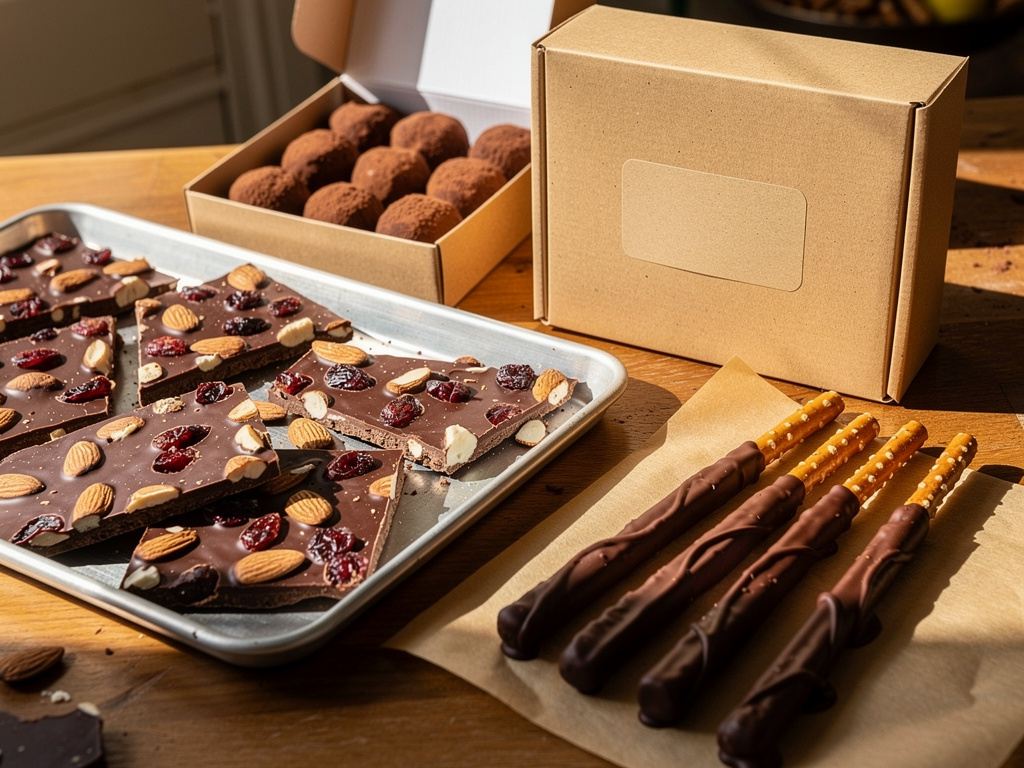


The short version: Yes, you can sell homemade chocolate from your home kitchen in 8 of the 10 states whose agency pages we read, as long as the chocolate keeps safely at room temperature. New York is the big exception: its home processor rules ban melting or tempering chocolate for dipping, coating or drizzling, so bark, truffles, dipped pretzels and cocoa bombs are out there, and Wisconsin's home exemption only covers baked goods. The filling decides most other cases: fresh cream ganache and dipped fresh strawberries are barred in several states, CBD chocolates in 4 and liqueur chocolates in 2, while Michigan names chocolate-covered strawberries as allowed and Texas takes refrigerated chocolates once you register. Chocolate baked into cookies and brownies is allowed in all 10.
Checked on September 24, 2026: the chocolate rules come from each agency's own page (New York Ag and Markets, Wisconsin DATCP, Minnesota MDA, Michigan MDARD, Washington WSDA, Colorado CDPHE, Texas DSHS, California CDPH, Florida FDACS, Ohio ODA), the naming rule from 21 CFR Part 163, and platform fees from each company's pricing page the same day. Homegrown customers create an account to place their first order.
Your peppermint bark sold out at the office in a day last December, and now three people want truffle boxes for Valentine's Day and are offering $30 each. Before you buy a tempering machine and a stack of gift boxes, there is one question to settle: are you allowed to sell chocolate you made at home?
For most chocolate in most states you are. The catch is rarely the chocolate. It is what goes inside it, what it gets poured over, and which state you live in. This guide walks through the rule, what 10 state agencies actually say about chocolate, and what to do once you know your answer.
Yes, in eight of the ten states whose cottage food pages we read on September 24, 2026, you can sell chocolate candy made in your home kitchen. A cottage food law is a state law that lets you make certain low-risk foods at home and sell them without a commercial kitchen. California, Florida, Michigan, Washington, Colorado, Texas, Ohio and Minnesota all allow chocolate candy or confections under theirs.
The two states that say no do it in different ways:
If your state says yes and you already know how to temper, our companion guide on how to sell chocolate and confections from home covers compound versus couverture chocolate, tempering, equipment and pricing. This page stays on the rules.
Plain chocolate has almost no free water for germs to grow in, which is why eight states in this guide allow it as a candy or confection. Trouble starts when you add something wet. Fresh cream, butter, fruit puree and cut fruit bring water back in, and a food that needs a refrigerator to stay safe falls outside almost every cottage food law.
Regulators call that kind of food "time and temperature control for safety," or TCS. It means the food can grow bacteria if it sits out too long. Minnesota's cottage food training spells out the test in numbers: a non-standard recipe should be tested, with a home meter or kit or by a lab, with a water activity of 0.85 or less as the line (or a pH of 4.6 or less for acidic foods). Water activity is a lab measure of how much water in a food is free for germs to use.
What pushes a chocolate product over the line:
New York gives its reason in its own FAQ: "Melting chocolate is not a thermal process (no control step). Chocolate melts at very low temperatures." 8 states in this guide accept that risk for plain chocolate. New York does not.
Plain chocolate, chocolate bark, molded chocolates and chocolate-covered pretzels, nuts or dried fruit are allowed in eight states on our list, and chocolate chip cookies and brownies are allowed in all 10 states. The status gets less certain the wetter the center gets. Here is how the common products line up.
Swipe the table to see why each product lands where it does.
| Chocolate product | Typical status | Why | Where it differs |
|---|---|---|---|
| Chocolate chip cookies, brownies, chocolate cake | Allowed in all 10 | Baked through, shelf-stable | New York bars chocolate or candy melt toppings on some baked products |
| Solid bars, molded chocolates, bark | Allowed in 8 of 10 | Almost no free water | New York prohibits tempered chocolate and almond bark; Wisconsin licenses all candy |
| Chocolate-covered pretzels, nuts, marshmallows, dried fruit | Allowed in 8 of 10 | Dry center, shelf-stable | Pretzels named by Michigan and Ohio; California lists "chocolate-covered nonperishables"; New York bars the coating; Minnesota's guidance bars chocolate-covered fruit without saying fresh, so ask MDA about dried fruit |
| Fudge | Allowed in 9 of 10 | Cooked sugar candy | New York names fudge on its approved list; Wisconsin licenses it |
| Truffles and bonbons with fresh cream ganache | Depends on the recipe | Cream adds water | Texas allows refrigerated ones with registration; Washington and Colorado exclude foods that need refrigeration |
| Chocolate-covered fresh strawberries | Not allowed in most | Most states treat fresh fruit as needing cold holding | Michigan allows by name; Texas allows with registration |
| Liqueur or alcohol-filled chocolates | Check first | Alcohol rules plus the filling | Michigan and New York bar them; Washington allows alcohol only when the finished product is 1% alcohol or less by weight, with a label statement |
| CBD or THC chocolates | Not allowed where addressed | Cannabinoids banned in cottage food | Named by Texas, Michigan, Colorado and Minnesota |
| Hot cocoa bombs | Allowed in 8 of 10 | Shelf-stable shell and mix | New York names cocoa bombs as prohibited |
Status comes from the ten agency pages listed in the next section, all loaded the same day, September 24, 2026. "Allowed" still means you follow your state's registration, label and sales cap rules.
Eight of the 10 agency pages we read on September 24, 2026 allow chocolate candy from a home kitchen, and sales caps on those pages run from $35,000 in Washington to $250,000 in Florida, and Colorado caps each product type, flavor by flavor, at $10,000 in net revenue. Four of those eight (California, Michigan, Washington and Ohio) name chocolate products outright, and the other four cover chocolate under "candy," "confections" or Texas's rule that allows any food outside a short banned list.
Drag sideways for the fruit, alcohol and CBD columns.
| State (agency) | Chocolate candy | Named chocolate line | Dipped fresh fruit | Alcohol or CBD |
|---|---|---|---|---|
| New York (Ag and Markets) | Prohibited | "Tempered chocolate/candy melt/almond bark for dipping/coating/drizzling" prohibited | Prohibited | "Products containing alcohol" prohibited |
| Wisconsin (DATCP) | License needed | Home exemption covers baked goods only | License needed | License needed |
| Minnesota (MDA) | Allowed | "Candy and confections" | "No. Chocolate-covered fruit is not allowed" | "Foods that contain cannabinoids" banned |
| Michigan (MDARD) | Allowed | "Confections and candies (made without alcohol)" | Allowed: strawberries, pineapple, bananas named | No alcohol confections; no CBD |
| Washington (WSDA) | Allowed | "Molded candies and chocolates"; "Products dipped or coated with candy or chocolate coatings" | Prohibited ("Food products made from fresh fruits") | Alcohol allowed only at 1% or less by weight, with a label statement |
| Colorado (CDPHE) | Allowed | "Candies such as cotton candy and fudge" | Prohibited (foods that need refrigeration for safety; "Cut fresh fruits" listed as ineligible) | CBD and THC ineligible |
| Texas (DSHS) | Allowed | Any food outside a short banned list | Allowed with registration and cold holding | CBD and THC banned |
| California (CDPH) | Allowed | "Chocolate", "Bonbons", "Chocolate-covered nonperishables" | Not on the list | Chocolate extract allowed as an extract |
| Florida (FDACS) | Allowed | "Candies and confections" | Not named | Not named |
| Ohio (ODA) | Allowed | "chocolate covered pretzels or similar chocolate covered non-perishable" products | Not named | Not named |
Each line quotes the agency's own page as it stood on September 24, 2026. Rules change, and some states update their lists with only a short notice, so verify your state's current rules before your first sale.
A few details from those pages that matter for chocolate:
New York bans melted and tempered chocolate for home processors because, in the words of the New York home processor rules, "Chocolate and chocolate-like products have been implicated in food borne illnesses," and melting is not hot enough to act as a kill step. It is the clearest chocolate ban in this guide, and it reaches further than most vendors expect.
New York's home processor rules list "Tempered chocolate/candy melt/almond bark for dipping/coating/drizzling (i.e. cocoa bombs, chocolate candy, chocolate/candy melt covered fruits, etc.)" as prohibited. Fudge, cookies, brownies and cakes stay on the approved list, and registration has no fee, but the state warns that reviews can take up to 16 weeks. We read the page on September 24, 2026.
What a New York vendor can still sell with chocolate in it:
The list also bars "Products containing alcohol" and "Any products containing raw nuts," so nuts in any home-processed product must be commercially roasted or otherwise heat treated. New York also keeps sales inside the state: internet sales are allowed within New York only, and shipping out of state is not permitted.
Truffles with a shelf-stable ganache are allowed in most of the 8 states that allow chocolate candy, and fresh cream truffles that need a refrigerator are allowed in only 1 of them, Texas, with registration. A ganache is chocolate melted with hot cream. A firm ganache with plenty of chocolate for its cream can test low enough in water activity to count as shelf-stable, while a soft one made with plenty of fresh cream needs a refrigerator.
How the states we checked treat a fresh cream truffle:
If your state judges truffles by recipe, a water activity test on your actual ganache is the proof a regulator will want. Keep the lab report with the recipe you tested and do not change the cream ratio afterward. We price truffle boxes separately in our guide to pricing chocolate truffles.
Usually not: 8 of the 10 states we checked bar chocolate-covered fresh fruit, leave it off their lists or require a food license, because most states treat a dipped strawberry as a food that needs a refrigerator. Michigan is the clear exception: its list counts chocolate-covered strawberries, pineapple and bananas among foods that do not need temperature control. Texas allows them with registration.
Two Great Lakes states read the same strawberry in opposite ways. Minnesota's cottage food guidance answers the question directly: "No. Chocolate-covered fruit is not allowed to be sold as a cottage food (e.g., berries, pineapple, melon)." Michigan's list names strawberries, pineapple and bananas as allowed. We read both pages on September 24, 2026.
Minnesota's answer is on its cottage food law guidance page, in the section on which foods are allowed. Where the other states on our list land:
Dried fruit, pretzels and nuts are the legal swap in most states. Our guide to selling chocolate-covered strawberries from home covers pricing and the Valentine's rush if your state allows them.
CBD and THC chocolates are banned for home vendors in all 4 states on our list that address them, and alcohol-filled chocolates are banned in 2 states, New York and Michigan. Washington is the one state we checked that writes an alcohol limit into its rules: 1% alcohol or less by weight, with a label statement. California allows only its listed extracts, and Texas's banned list does not mention alcohol, so ask DSHS before selling a spiked chocolate there.
Michigan's cottage food list allows "Confections and candies (made without alcohol)" and says "No confections that contain alcohol, like truffles or liqueur-filled chocolates." Flavorings such as rum flavoring are fine; rum extract, rum, Champagne, Grand Marnier and Chambord are not. The same page says "No CBD, cannabis, or foods with these products." We read it on September 24, 2026.
You can read those lines yourself on Michigan's list of what you can make, under Candy, Confections, and Syrups. The rest of the list:
Watch the extracts too. Michigan allows rum flavoring but names rum extract as not allowed, while California approves chocolate, vanilla and orange extracts of at least 70 proof as a cottage food category of their own.
You can call it chocolate only if it meets the federal recipe, such as at least 10% chocolate liquor for milk chocolate. The FDA sets "standards of identity" in 21 CFR Part 163, and a coating made with vegetable fat instead of cocoa butter has to carry a different name on the label.
The federal lines, as written in 21 CFR Part 163 on September 24, 2026:
Candy melts and almond bark are usually made with palm or coconut oil in place of cocoa butter. You can still sell a pretzel dipped in them in most states, but the product name should not say "milk chocolate" unless the coating meets that standard. Copy the coating's name and ingredient list from its own package. If you melt real couverture as is, list it by the name on its package, such as semisweet chocolate.
Florida, Ohio, Colorado, Texas and Michigan require no state permit for shelf-stable chocolate, New York and Minnesota require a free or low-cost registration, California requires a county registration or permit, and Washington requires a $355 permit with a kitchen inspection. 7 of the 10 states in this guide also put a number on your yearly sales.
Move the table left to see costs, caps and training.
| State | Permit or registration | Cost | Yearly sales cap | Training |
|---|---|---|---|---|
| New York | Home processor registration | No fee; up to 16 weeks to review | Not stated on the page | Not required on the page |
| Minnesota | Yearly registration | $0 up to $7,665 in sales; $50 from $7,666 to $78,000 | $78,000 | Online training and exam (Tier 1) or a food safety course (Tier 2) |
| Washington | Cottage food permit and inspection | $355 for two years; every product must be approved on the permit, and adding one later costs $30 plus a $75 review fee, and WSDA may add a $125 inspection fee | $35,000 | Food Worker Card for each person on the application, plus a Master Business License |
| Texas | None for shelf-stable; registration for refrigerated foods | No state fee on the page | $150,000 | Food handler course required |
| Florida | None from FDACS | $0 | $250,000 | Not required on the page |
| Colorado | None from the state | $0 | $10,000 net revenue per product type | Food safety training required |
| Ohio | None; exempt from license and inspection | $0 | Not stated on the page | Not required on the page |
| Michigan | None; exempt from licensing and inspection | $0 | $50,000 ($75,000 if products sell for $250 or more per unit) | Optional online training from MSU Extension |
| California | County registration or permit | Set by your county | $88,878 (Class A) or $177,756 (Class B) in 2026, adjusted each year | Cottage Food Operator Training within three months of registering |
| Wisconsin | Food license for chocolate candy | Set by DATCP license type | n/a | License rules apply |
Read on each agency's page on September 24, 2026. Minnesota's revised law, effective August 1, 2027, moves to one $30 yearly registration, requires advanced training for every registrant, and allows shipping within Minnesota. California's training rule comes from CDPH's Cottage Food Operations page, and its caps come from the Cottage Food Operation Adjusted Gross Annual Sales Limit 2026 PDF linked there, which raises them for inflation every January. Michigan's cap comes from MDARD's Cottage Food One Pager, dated March 2026.
Check with your city or county too. Minnesota's page reminds vendors that local zoning can prohibit home sales even when the state allows them, and zoning rules like that exist outside Minnesota too.
The states in this guide generally require the product name, your name and address, an ingredient list in order of weight, the net quantity, the allergens, and a statement that the food was made at home. Minnesota also requires the date the food was made, and Minnesota and Texas let you print a registration number in place of your home address. Chocolate is allergen-heavy, so the allergen line is where most home vendors slip.
The common allergens in chocolate products:
The home statement changes by state. Here is the wording for 4 states in this guide:
| State | Required home statement |
|---|---|
| New York | A phrase such as "Made in a Home Kitchen," which the state says home processors should add, at 1/16 inch or larger |
| Minnesota | "These products are homemade and not subject to state inspection." on the label and on a sign or webpage |
| Ohio | "This Product is Home Produced." in 10-point type |
| Texas | "THIS PRODUCT WAS PRODUCED IN A PRIVATE RESIDENCE THAT IS NOT SUBJECT TO GOVERNMENTAL LICENSING OR INSPECTION." on every label; refrigerated foods also need the safe handling instructions in 12-point type |
When you buy chocolate, copy its ingredient list into yours. New York's own sample label shows how: its chocolate chip cookie lists "semisweet chocolate (sugar, chocolate, cocoa butter, milkfat, soy lecithin, natural flavors)" inside the cookie's ingredient list. Our guide to cottage food labeling requirements walks through the full label layout.
You can usually take orders online, but 8 of the 10 states in this guide limit shipping or require you to hand the chocolate over in person or inside the state. Florida is the most open on our list, with mail order allowed and no in-state limit, while California and Michigan allow mail order only for sales inside the state.
How the states handle it:
Heat is the other shipping problem. Chocolate starts to soften in a warm mail truck, so even a state that allows shipping may not be the right fit for a July order. Our guide to whether you can ship cottage food covers the federal and interstate side.
Once your state says yes, chocolate orders pile up in two short seasons, the holidays and Valentine's Day, and tracking 40 truffle boxes through text messages is where they fall apart. Homegrown gives you an ordering page for $10 a month billed annually ($12.50 billed monthly) with no percentage fees beyond standard payment processing. Customers pick the box and the pickup day and pay when they order, so you temper exactly as much chocolate as you sold. If you are deciding where else those boxes can go, the seven places to sell homemade chocolate range from farmers markets and florists to Etsy, and a shop pays $10 to $14 for a box it resells at $20.
Slide across to compare what each platform costs per box and per month.
| Platform | Monthly plan | Trial | Platform fee | Card processing | Customer pays on a $30 box | Vendor pays on a $30 box | Vendor pays in a month of 20 boxes |
|---|---|---|---|---|---|---|---|
| Homegrown | $10 billed annually ($12.50 monthly) | 7 days, no charge until day 8 | None, 0% commission | 2.9% + $0.30, paid by the vendor | $30.00 | $1.17 plus the plan | $33.40 ($35.90 on monthly billing) |
| Hotplate | $0 | No plan to try | 5% + $0.55, added to the customer's checkout by default (you can choose to pay it) | 2.9% + $0.30, paid by the vendor | $32.05 | $1.17 | $23.40 |
| Etsy | $0 (one-time set-up fee may apply) | No plan to try | $0.20 listing fee plus 6.5% transaction fee | 3% + $0.25, paid by the vendor | $30.00 plus shipping | $3.30 | $66.00 |
| Shopify Basic | $29 billed yearly ($39 monthly) | 3 days, then $1 a month for 3 months | None with Shopify Payments (2% with another provider) | 2.9% + 30¢ online, paid by the vendor | $30.00 | $1.17 plus the plan | $52.40 ($62.40 on monthly billing) |
We checked every fee on September 24, 2026, on findhomegrown.com/signup, Hotplate's pricing page, Etsy's fees policy and payment processing help page, and Shopify's pricing page. Card processing is figured on the $30 price; a platform that charges it on the total with tax, tips or shipping runs a few cents higher, and Hotplate's own example charges it on more than the box price: $1.27 on a $30 order with a $3 tip, where 2.9% + $0.30 on $30 alone would be $1.17. Etsy's month assumes one $0.20 listing per sale and no shipping.
How the alternatives fit a home chocolate vendor:
What Homegrown gives a chocolate vendor: pre-orders by pickup date, payment at the time of order, pickup and delivery windows you set, and a link you can share before Valentine's Day. Homegrown does not check whether your truffles are legal in your state, does not print labels, has no timed drop or countdown feature, and is set up for local pickup and delivery, not for packing chocolate with cold packs. Customers create a Homegrown account to place their first order, and while your storefront is listed on the Homegrown marketplace, plan on most orders coming from people you send to your own link. In Washington, where WSDA says payment must be person to person, ask WSDA whether taking payment online at the time of order fits that rule before you turn it on.
Castiron, which some older guides recommend for home candy and chocolate vendors, has shut down. Its old shop address did not load when we checked on September 24, 2026, and its former castiron.me domain now shows an online casino page.
If your chocolate is legal where you live and the holiday orders are already coming in by text, the fix is one page where people order by pickup date. Set up your Homegrown storefront and list your first chocolate box before the rush.
Careful chocolate vendors write down their legal answer for every product before they list it, and they plan around heat as seriously as they plan around the law. A bark that is legal but melted is still a refund.
Habits worth copying:
Work backward from your busiest day. New York says home processor reviews can take up to 16 weeks, and 16 weeks before February 14 is October 25. Wherever you live, send your registration and your agency questions by late October if you want Valentine's orders to be legal from the first box.
You can settle your state's chocolate rules in one afternoon with the agency's own pages and one email. Work through it in this order.
Steps 1 through 4 are reading you can do at the kitchen table. Steps 5 and 6 take waiting: an agency reply to your email, and in New York a registration review of up to 16 weeks, so start in October if you want to sell Valentine's boxes.
A "no" on one product still leaves you brownies, chocolate cake and chocolate chip cookies, which every state in this guide allows. You can move the chocolate into a product your state does allow, rent a licensed kitchen for the product it does not, or change the recipe until it no longer needs a refrigerator.
Your options, from cheapest to most involved:
In a pull of the Homegrown catalog on August 14, 2026, 112 of the 1,804 products listed by 219 vendors had "chocolate" in the name, from 61 vendors. 73 of them were chocolate chip or chocolate chunk baked goods from 46 vendors, and 22 more were other bakery listings like chocolate cake and brownies. Only 11 were candy or chocolate-dipped treats, such as toffee, dipped fruit and chocolate-coated 'sicles on a stick, from 5 vendors. On Homegrown, most chocolate reaches customers baked into something.
Homegrown products with "chocolate" in the name, by type
Source: Homegrown catalog pull, August 14, 2026, 112 products with "chocolate," "cocoa" or "cacao" in the name out of 1,804 products from 219 vendors.
Often not a license, but usually some paperwork. Florida, Ohio, Colorado, Texas and Michigan require no state permit for shelf-stable homemade chocolates, New York and Minnesota require a registration, California requires a county registration or permit, and Washington requires a $355 permit with an inspection. Wisconsin requires a food license for chocolate candy because its home exemption only covers baked goods.
Under a California cottage food registration, yes, because the state's approved list allows chocolate-covered dried fruit and other nonperishables but not fresh fruit. To sell fresh dipped strawberries there, you would make them outside the cottage food program, in a permitted commercial kitchen. Michigan is one of the few states that allows them from home by name.
Not in most cottage food states. Ohio and Michigan name chocolate-covered pretzels on their allowed lists, and California covers them as chocolate-covered nonperishables, so a registration or no permit at all is enough there. New York is the exception: its home processor list says "No chocolate or candy melts allowed for topping" on pretzels.
Yes, in 8 of the 10 states on our list you can start a homemade chocolate business under a cottage food law, as long as your chocolate is shelf-stable and you stay under the sales cap. New York limits you to chocolate baked into cookies, brownies or cakes, plus fudge, and Wisconsin to baked goods only. Everywhere, start by reading your state agency's page and registering if it asks you to.
Yes, in most states. Solid chocolate bars and molded chocolates are about as low-risk as candy gets, and Washington names "Molded candies and chocolates" outright while California lists "Chocolate." If you use candy melts instead of real chocolate, the name should not say "milk chocolate" or "semisweet chocolate" unless the coating meets the federal standard, so use the name printed on the coating's own package.
Yes, in the states that allow homemade chocolate at all. Minnesota and Ohio name farmers markets as a place to sell cottage food, and New York does too for its approved list, where products must be packaged and labeled at home, not at the market. Your market may also ask for your registration, label and insurance before you set up.
More on selling chocolate and candy from home:
You now know which of your chocolates your state allows, which fillings keep them legal, what the label needs and whether you can ship. The next step is a simple way for customers to order a box for a pickup day and pay before you temper a single batch, so you are not answering 20 text threads the week before Valentine's Day.
A good way to start: list the 3 or 4 chocolates your state clearly allows, with the filling written into each name, set one or two pickup days a week, and send the link to the people who already ask you for bark every December. Add truffles or seasonal boxes once you have your state's answer on them in writing.
Start your Homegrown storefront and take chocolate orders by pickup date for $10 a month billed annually ($12.50 billed monthly), with no percentage fees beyond standard payment processing.



