
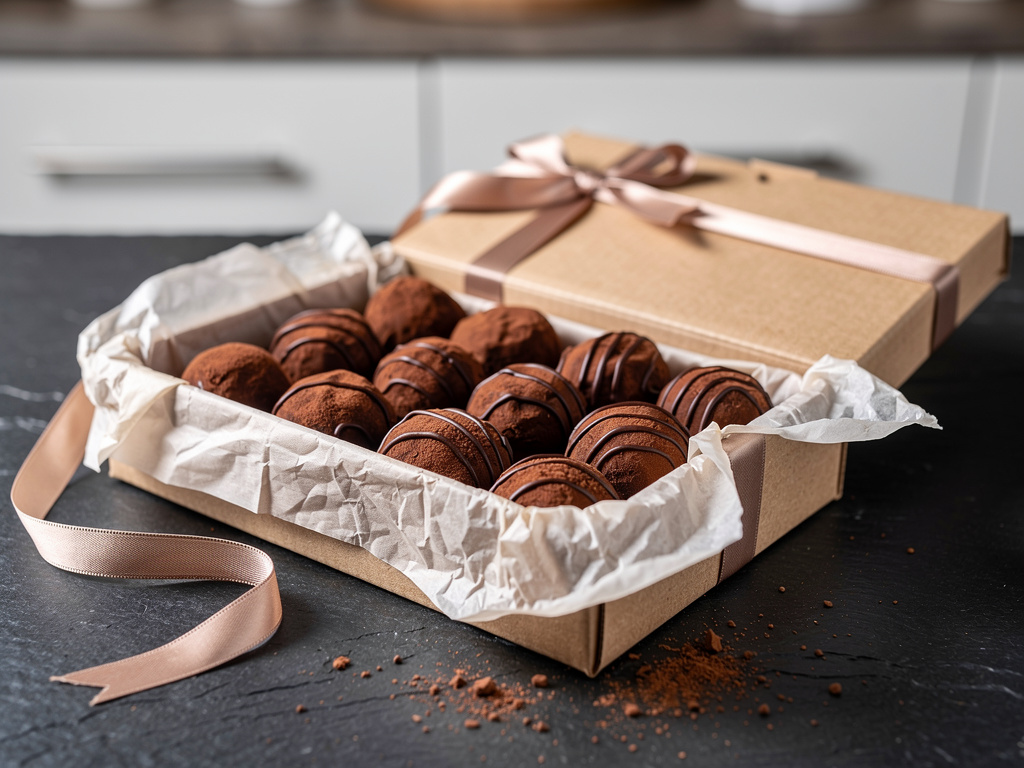


Chocolate truffles are one of the most underpriced products in the whole home-confectionery world, because they're deceptively labor-intensive and makers almost always forget to charge for their own time. A hand-rolled, hand-dipped truffle takes real skill and real minutes, and the vendors who thrive are the ones who price for that, and who make the gift box, not the single truffle, their hero product. This guide walks through pricing chocolate truffles for retail and gift boxes, from the true cost per piece to what the market actually pays.
The short version: Price truffles with cost-plus: add your ingredients, your packaging, and a real hourly rate for your labor per piece, then apply a markup, commonly two to three times cost for handmade specialty confections. Labor is the cost makers forget, and it's the biggest one, since truffles are hand-rolled and hand-dipped one at a time. Handmade truffles retail for roughly $2 to $4.50 per piece, and gift boxes are your highest-margin product, so build attractive multi-piece boxes and price them as gifts. Truffles are generally cottage-food eligible as confections, though a fresh-cream ganache can raise refrigeration questions in some states, so confirm yours. Homegrown gives you the storefront and clean records to sell and price from, but you set your prices.
This guide covers cost drivers, the pricing method, market prices, gift boxes, seasonal pricing, cottage food eligibility, and mistakes. This is general information, not legal advice.
The real cost of a truffle comes from four things: quality chocolate, the ganache ingredients, packaging, and, above all, your labor, which is the cost makers most often ignore. Understanding where the money and time actually go is the foundation of pricing correctly.
The cost drivers, from most to least obvious:
The takeaway: a truffle's cost is mostly your skilled time, not just its ingredients, so any pricing that ignores labor will underprice badly. The rule is to count your hours as a real cost, because with truffles, labor is the largest input by far.
You price a truffle with cost-plus: total your ingredient cost, packaging cost, and labor cost per piece, then multiply by a markup, commonly two to three times your total cost for handmade specialty confections. This method makes sure every real cost, especially your time, is covered before you add profit.
The step-by-step method:
The single most important discipline here is honestly costing your labor, since a maker who prices only ingredients plus packaging and works for free is the classic underpricing story. The takeaway: cost-plus pricing with your real labor included is what turns truffles from a money-losing hobby into a business. The rule is to never price a truffle without your hourly rate in the math, which the guide on your true cost per item walks through in full.
Handmade truffles typically retail for roughly $2 to $4.50 per piece, with boxes priced by the piece count, so knowing the market range lets you check that your cost-plus number is competitive. This is where you sanity-check your price against what real chocolatiers charge.
Here's a market-anchored pricing picture, drawn from independent and premium chocolatiers like Lake Champlain Chocolates:
| Box size | Typical retail range | Per-piece |
|---|---|---|
| 4-piece | ~$17 to $20 | ~$4.25 |
| 6-piece | ~$21 to $24 | ~$3.50 to $4 |
| 9-piece | ~$30 to $39 | ~$3.30 to $4.30 |
| 12-piece | ~$36 to $48 | ~$3 to $4 |
A few things to notice:
The takeaway: use the $2 to $4.50 per-piece range to confirm your cost-plus price is in market, not to replace your own cost math. The rule is to price from your real costs first, then check against the market, never the other way around, so you're never accidentally selling below cost to match a competitor.
Gift boxes are your highest-margin product because the packaging and curation let you charge for presentation, not just chocolate, and because nearly all truffle buyers are buying a gift. A naked single truffle can't carry much markup, but a beautiful box can.
Why the box is the hero:
Because of this, your product design and pricing should center on attractive boxes at gift-friendly price points, with singles as a minor add-on. The takeaway: build and price gift boxes as your main product, since that's where both the demand and the margin live. The rule is to make the box the hero and price it as a gift, which pairs naturally with a broader holiday gift box strategy.
Charging more for holiday and occasion truffles, Valentine's Day, Mother's Day, and Christmas, is standard practice for gift confections, because demand spikes and buyers expect a premium seasonal product. A special holiday box can and should command a higher price than an everyday one.
How to approach seasonal pricing:
Treat seasonal premiums as an accepted market norm rather than a guaranteed formula, and set your holiday prices by the added value of the presentation and the occasion. The takeaway: holiday and occasion boxes are a natural place to price higher, because the gift context supports it. The rule is to build special seasonal boxes and price them for the occasion, capturing the demand that arrives on a schedule.
Chocolate truffles are generally cottage-food eligible as confections, but a fresh-cream ganache can raise shelf-stability and refrigeration questions in some states, so you have to confirm your state's rules. Most of the time truffles qualify, but the ganache is the detail to check.
What the eligibility picture looks like:
The takeaway: truffles usually qualify as cottage foods, but cream ganache is the detail that can complicate it, so verify your specific recipe against your state's rules. The rule is to confirm eligibility before you sell, the same first step as starting any cottage food business.
The truffle pricing mistakes that lose money are ignoring your labor, undervaluing the gift box, forgetting packaging cost, and competing against commodity chocolate. Each pushes your price below what the work is worth.
The mistakes to avoid:
The takeaway: the mistakes all come from underpricing your time and your packaging, and from comparing yourself to the wrong products. The rule is to price your labor and your boxes fully, and benchmark against artisan makers, not grocery-store chocolate.
Once you know your prices, you need a clean way to sell truffles and gift boxes and to keep the records that make your next round of pricing easy. Homegrown is a $10-per-month online storefront, with no percentage fees beyond standard payment processing, where you can list your truffles and gift boxes, take orders, and run seasonal pre-orders.
You list each box size and single option at the prices your cost-plus math produced, take payment at order time, and open pre-orders for Valentine's or the holidays so you make to confirmed demand. Because your storefront keeps clean records of what sold at what price, you can see which boxes move and refine your pricing over time, instead of guessing. A flat monthly price also means a strong Valentine's season isn't eaten by per-sale percentage fees stacking up on every box, the way they would on a marketplace like Etsy.
To be clear about what Homegrown does not do: it does not calculate your costs, set your prices, or decide your margins. Your cost-plus math and your judgment do that. What it gives you is the storefront to sell your truffles and gift boxes and the clean records to price smarter each season. Once your prices are set, set up your Homegrown storefront and start taking truffle and gift-box orders.
Price them with cost-plus: total your ingredient cost, packaging cost, and a real hourly rate for your labor per truffle, then multiply by a markup, commonly two to three times your total cost for handmade specialty confections. Check that against the market, where handmade truffles typically retail for roughly $2 to $4.50 per piece, boutique makers near the lower end and premium chocolatiers near the top. The most important thing is to include your labor, since truffles are hand-rolled and hand-dipped, and skipping that cost is the classic way makers underprice their work.
Price the box by its piece count plus its packaging and curation value, since the box, not the single truffle, is your highest-margin product. Market ranges run roughly $17 to $20 for a 4-piece, $21 to $24 for a 6-piece, $30 to $39 for a 9-piece, and $36 to $48 for a 12-piece. Because nearly all truffle buyers are buying a gift, price the box as a gift, the presentation, ribbon, and curated assortment justify a price a loose truffle can't carry. Make attractive gift boxes your hero product and your main pricing focus.
Almost always because you're not charging for your labor. Truffles are extremely labor-intensive, tempered, rolled, dipped, decorated, and boxed by hand, one at a time, and pricing only ingredients and packaging while working for free guarantees a loss. Add a real hourly rate divided by your true output per hour into your cost, then apply a two-to-three-times markup. Also check that you're pricing your gift boxes for their presentation value and including all packaging costs. Underpriced labor and undervalued boxes are the two reasons handmade truffles most often fail to make money.
Usually yes, since chocolate truffles are shelf-stable confections and most states permit candies and confections as cottage foods. The nuance is the ganache: some states judge eligibility by whether a food needs time and temperature control for safety, and a fresh-cream ganache with higher water activity could require refrigeration and fall outside the cottage food exemption in those states, while a shelf-stable tempered truffle is fine. Because it depends on your recipe and your state, confirm your specific truffles against your state's cottage food list and health department before selling.
Yes, charging a premium for holiday and occasion boxes is standard practice for gift confections. Valentine's Day, Mother's Day, and the winter holidays are peak truffle-gifting moments, and a themed, beautifully packaged holiday box is a premium product that carries added presentation value beyond the same truffles in a plain box. Price the occasion, not just the chocolate, and because these dates are predictable, open pre-orders ahead of time so you make to confirmed demand rather than over- or under-producing for the rush.
Total the cost of a full batch, chocolate, cream, butter, flavorings, and the packaging, then divide by the number of truffles the batch makes to get ingredient and packaging cost per piece. Then add labor: take your hourly rate and divide it by how many truffles you actually complete per hour, including tempering, rolling, dipping, decorating, and boxing. Add those together for your true cost per truffle, then apply your markup. The labor step is the one makers skip, and it's usually the largest single cost, so never leave it out of the calculation.
Chocolate truffles can be a genuinely profitable product, but only if you price for the real work they take and make the gift box your hero. Cost your labor honestly, price your boxes as gifts, and lean into the seasons that sell. Start your Homegrown storefront and sell your truffles and gift boxes at prices that finally pay you for your time.



