
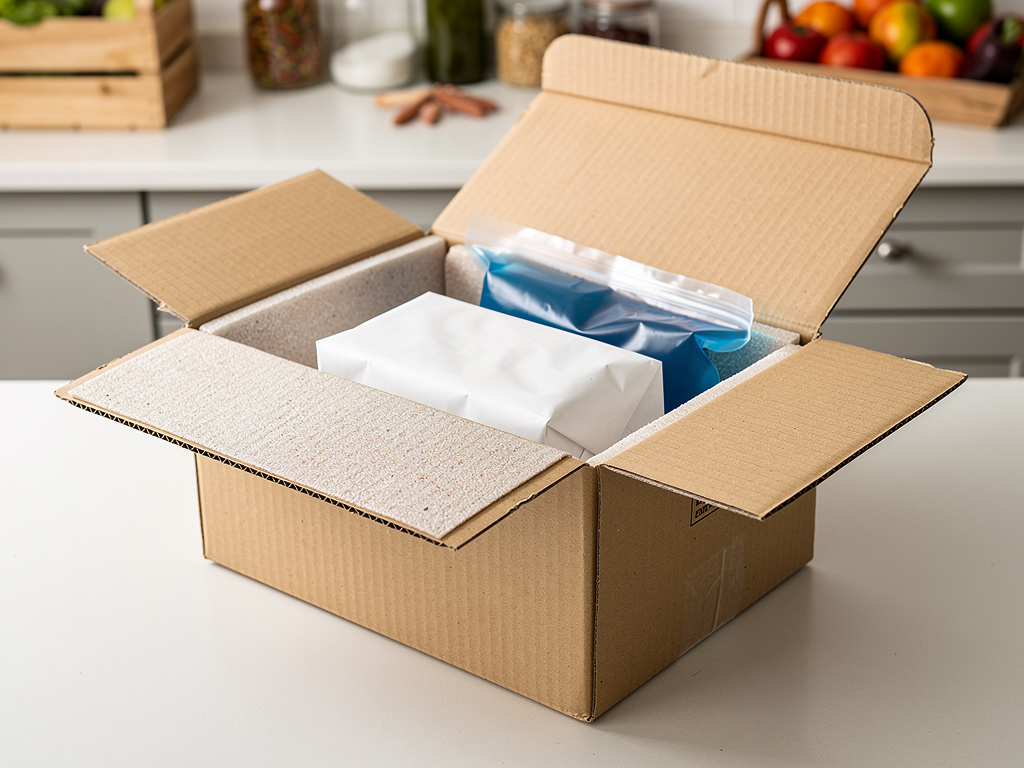


Once you decide to ship your food, the box becomes part of the product. A great cookie that arrives as a warm, crumbled mess is a refund and a lost customer, and the difference almost always comes down to the box and what's inside it holding temperature. The good news is you don't need a lab to get this right, just the correct insulation for how cold your product has to stay and how long it's in transit. This guide walks through choosing the right box and insulation for shipping perishable food, from the temperature target to the box type, insulation options, sizing, and cost.
The short version: Shipped perishable food should arrive frozen or at least below 40°F, so your packaging has to hold that temperature for the entire transit time. Use an insulated liner or foam box inside a sturdy corrugated shipping box, pick your insulation for the job (recycled paper liners and foam for cold-and-fast, thicker foam for frozen or two-day trips), and size the box snugly to cut both air gaps and shipping cost. Pair the insulation with the right coolant, ship early in the week so nothing sits over a weekend, and match everything to your actual transit time rather than guessing.
This guide covers the temperature target, box types, insulation options, sizing, coolant, transit timing, and cost.
Perishable food should arrive frozen, partially frozen with visible ice crystals, or at minimum refrigerator-cold below 40°F, and your packaging exists to hold that temperature the whole way. USDA guidance treats home-shipped perishable food the same as commercial mail-order: if it arrives warmer than 40°F, it shouldn't be eaten.
This sets the bar your box has to clear:
The rule that drives every packaging choice: your box and insulation have to keep the product below 40°F, or frozen, from the moment it ships until it lands on the doorstep. If you're not sure your product can ship safely at all, start with whether you can ship cottage food under your state's rules.
You need two layers: an insulated liner or foam container on the inside, and a sturdy corrugated shipping box on the outside. The insulation holds the cold, and the outer box takes the beating of carrier handling so the insulation stays intact.
The standard configurations:
General packing practice for perishable shipments is to keep product at least a couple of inches from the outer walls, double-bag anything that could leak as it thaws, and fill empty space so nothing shifts. The clear takeaway: insulation on the inside, corrugated on the outside, and never ship a foam cooler naked without an outer box. For product that travels short distances, the guide on packaging for pickup and transport covers the lighter-duty options.
Choose your insulation based on how cold the product must stay, how long it's in transit, and how much you care about sustainability and cost. The main options trade off performance, price, and recyclability, and the right pick depends on your product.
Here's how the common options compare:
| Insulation | Performance | Cost | Sustainability |
|---|---|---|---|
| EPS foam (standard cooler) | Good, roughly R-3.6 to R-4.2 per inch | Low | Not curbside recyclable in most areas |
| Closed-cell foam panels | Higher than EPS per inch | Higher | Not curbside recyclable |
| Reflective bubble liner | Weakest of the group | Low | Mixed materials, hard to recycle |
| Recycled paper cold-chain liner | Strong; benchmarked in hours, not R-value | Moderate | Curbside recyclable, plant-based |
| Recycled cotton liner | Moderate | Higher | Compostable / biodegradable |
A few practical notes on the standouts:
The rule of thumb: match insulation to the job. Recycled paper liners for cold product on a sustainability-minded brand, thicker foam for frozen or longer transit, and skip reflective bubble for anything that has to stay truly cold.
Size the box as snugly to the product as you can, because a right-sized box holds temperature better and costs less to ship. Empty space is the enemy twice over: it's air the coolant has to keep cold, and it's volume the carrier charges you for.
Sizing rules that save money and product:
The takeaway: snug beats roomy on every axis. A box sized to the product holds temperature longer and costs less to send, so right-sizing is one of the few packaging choices that improves performance and price at the same time.
Insulation slows heat transfer, but it's the coolant that keeps the product cold, so the two work as a pair. Insulation alone will not keep food safe on a multi-day trip; it just makes your coolant last longer.
The basic pairing logic:
For the full breakdown of how to choose and size your coolant, see the companion guide on dry ice versus gel packs. The short version: the insulation and the coolant have to be sized together for your transit time, not chosen in isolation.
Ship fast enough that the product stays safe for the entire transit, which usually means overnight for frozen product and no slower than two-day for hardier cold items. Speed and insulation are two levers for the same goal, and cheaping out on one means spending more on the other.
Transit-time guidance:
The rule to live by: match ship speed to your packaging and never ship into a weekend. A great box can't save product that sits idle in a distribution center for three extra days.
Expect roughly a few dollars per box for an insulated liner on the small end, up to fifteen dollars or more for a large molded foam setup, plus the coolant and the outer corrugated box. Costs vary a lot by size and quantity, so treat any figure as a starting estimate and confirm current pricing with your supplier.
How the costs stack up:
The honest bottom line: perishable shipping packaging typically runs several dollars to well over ten dollars per box all-in, which is why you build it into your shipping price and why right-sizing to cut both material and dimensional-weight cost matters so much. Verify your real numbers against a supplier quote before you set shipping rates.
Before you spend on foam, liners, and coolant, it's worth asking how many of your customers are actually local. Every dollar of packaging and coolant exists to solve a problem that pickup and local delivery simply don't have. Homegrown is a $10-per-month online storefront, with no percentage fees beyond standard payment processing, where nearby customers order and pay ahead and then pick up or get a local drop-off, so your product never needs a cold-shipping box at all.
That changes the math on your whole operation. Packaging that would cost you several dollars a box and put your product at the mercy of a carrier's weekend backlog gets replaced by a customer driving to you or a short local run. Compare that to shipping every order through a marketplace like Etsy, where per-transaction fees pile on top of your packaging costs, or fielding orders in Instagram DMs with no pickup system to organize them. Homegrown makes local pickup and delivery the default, with pre-orders so you only ever pack what's already sold.
To be clear about what Homegrown does not do: it is not a shipping carrier, it won't supply your boxes or insulation, and when you do ship to a distant customer, the packing is still on you. What it does is let you serve local customers without a cold-chain box in the first place, and keep any shipping you do reserved for orders that are already paid for. If most of your buyers are within driving distance, set up your Homegrown storefront and let pickup replace the packaging. For product that needs a longer life on the shelf either way, see the guide on extending shelf life without preservatives.
It should arrive frozen, partially frozen with visible ice crystals, or at least refrigerator-cold below 40°F. USDA guidance treats home-shipped food the same as commercial mail-order, and food that arrives warmer than 40°F should not be eaten. Your insulation and coolant have to hold that temperature for the whole transit, so size them to the slowest realistic delivery time.
For most cold-not-frozen product on a one or two-day trip, an insulated liner inside a corrugated box works fine and costs less than a molded foam cooler. Foam coolers earn their keep for frozen product or longer transit, where you need the extra insulation. Either way, the insulation goes inside a sturdy outer box.
Thicker insulation holds temperature longer, and general perishable-shipping practice keeps product a couple of inches from the outer walls with insulation filling that gap. For frozen product or two-day transit, lean toward thicker foam or a higher-performance liner. For a short, cold-only trip, a thinner liner paired with enough coolant can be enough.
Some you can and some you can't. Gel packs are reusable, and rigid foam coolers can sometimes be reused if they come back intact, but most liners are single-use per shipment. Recycled paper liners are designed to be curbside recyclable rather than reused, which is part of their appeal for customers who don't want foam piling up.
Right-size the box to the product, since a snug box both holds temperature better and lowers the dimensional-weight charge carriers bill you. Ship the shortest safe distance and speed, use good insulation so you need less coolant, and avoid shipping into a weekend. The cheapest safe box is the smallest one that still keeps the product below 40°F for the whole trip.
For local customers, pickup is almost always cheaper, because it eliminates the insulated box, the coolant, and the carrier fee entirely. Shipping makes sense for customers outside driving distance, but if a large share of your buyers are local, offering pickup or local delivery saves you the entire cost of cold-chain packaging on those orders.
Getting perishable shipping right comes down to matching your box and insulation to how cold the product must stay and how long it's traveling, then sizing it snug to save on both temperature and cost. For a lot of vendors, though, the smartest packaging decision is to serve local customers without a box at all. Start your Homegrown storefront and let pickup and local delivery handle the customers who never needed a cold-shipping box in the first place.



