


The short version: Fudge sells in seven places: a farmers market booth, holiday markets and church bazaars, your own online ordering link, orchards and Christmas tree farms, county fairs and festivals, local gift shops, and bulk orders from offices, couples and fundraisers. On a $15 half-pound box, selling fees take $0.54 at a booth card reader plus the booth fee, about $0.74 through your own Homegrown link plus $10 a month, and $1.88 on Etsy before shipping, while a gift shop, where your state allows it, would pay $7.50 to $9.00 a box at a common 50 to 60 percent wholesale price. Your state decides which of the seven you can use at all: Michigan bars home fudge from gift shops and consignment, and from being donated to a public auction or fundraiser, while Pennsylvania registers and inspects home kitchens for $35 a year instead. Most part-time fudge vendors do best with one in-person spot where people can taste a sample and one link where regulars order a holiday tray ahead.
Checked September 25, 2026: fees read that day on findhomegrown.com/signup, etsy.com/sell, shopify.com/pricing, squareup.com/us/en/pricing, hotplate.com/pricing (5% + $0.55 shown to the customer, 2.9% + $0.30 card processing paid by the vendor) and sell.amazon.com/pricing. State rules read that day on the Michigan Department of Agriculture and Rural Development cottage food pages and the Pennsylvania Department of Agriculture's Limited Food Establishment page. Homegrown customers create an account to place their first order, and Homegrown has no timed drop feature.
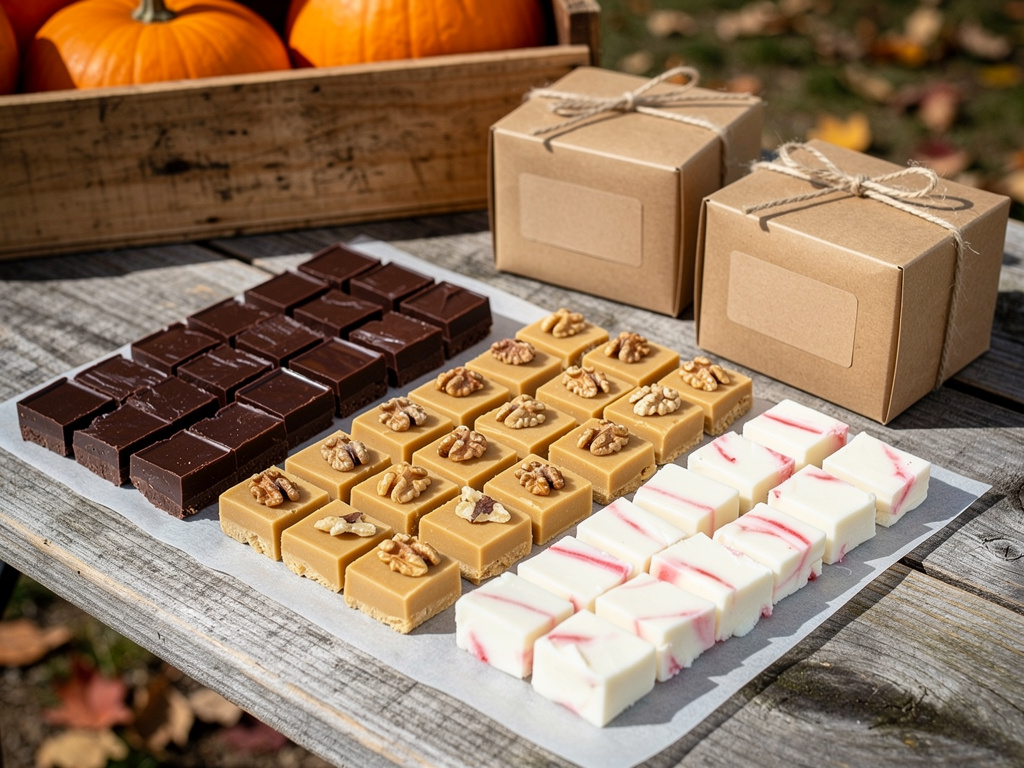
The pan sets overnight, you cut clean squares in the morning, and by Thursday there are thirty half-pound boxes of maple walnut and peanut butter fudge stacked by the door. The recipe was never the hard part. The hard part is that fudge is an impulse buy and a gift at the same time, and the places that catch impulse buyers are not the places that catch gift buyers.
Fudge sells in tourist towns, at orchards and at county fairs, not just at farmers markets, and at a gift shop or a farm's register your state may not let someone else sell it for you.
This guide walks through the seven places a home fudge vendor actually sells, what each one takes from the same $15 half-pound box, and which ones Michigan and Pennsylvania let you use.
Homemade fudge sells in seven places, and most part-time vendors keep two or three going at once: one where people taste it, one where regulars reorder, and one seasonal spot that brings in new faces. Here are the seven, roughly in the order most fudge vendors add them:
If you are still sorting out permits, flavors and packaging, start with how to sell fudge from home, which covers the kitchen side of the business. This guide is only about where the boxes go once they exist.
Fudge has one big advantage in all seven. That guide puts its shelf life at two to four weeks at room temperature when it is wrapped well, so a $15 box left over from a Saturday market can still sell the following Wednesday through a pickup order. Bread and cinnamon roll vendors do not get that second chance.
The way you package fudge decides where it sells best: single $2 to $4 pieces move at markets and fairs, while $15 half-pound boxes and $20 six-packs move at holiday markets, through pickup links and on gift shop shelves. Pick your channels to match the packaging you already make, or change the packaging to match the channel you want.
Scroll sideways to see every column.
| How the fudge is packed | Typical price | Where it sells best | Why it works there |
|---|---|---|---|
| Single pieces or slices | $2 to $4 each (Legacy Fudge lists 15 flavors at $4) | Farmers markets, county fairs, festivals | A walking customer eats it now, and a sample turns into a sale in seconds |
| Half-pound box | $8 to $15 (QueenBees lists 21 flavors at $15) | Markets, holiday markets, gift shops, your own link | It reads as a gift, and a regular can reorder the same flavor online |
| Mix-and-match six-pack | $20 (Legacy Fudge's six-pack) | Your own ordering link, holiday markets | The customer picks six flavors, so the order note matters more than shelf space |
| One-pound slab or holiday tray | $14 to $20 for a vendor pricing the half pound at $8 to $12; about $30 at a $15 half-pound price | Holiday pre-orders, office gifts, church bazaars | One order feeds a party or a whole office |
| Wedding or shower favors, 2 to 3 pieces each | Charge 20 to 30 percent above your standard retail (the guide's advice) | Direct bulk orders | Custom labels and colors justify the higher price |
The $4 piece, the $15 half pound and the $20 six-pack come from the Homegrown catalog pull of September 25, 2026. The $2 to $4 range for a 2-ounce piece, the $8 to $12 half-pound range, the $14 to $20 one-pound range and the favor markup come from the Homegrown fudge how-to guide. The $30 pound is simply two $15 half pounds.
Two patterns show up in that table. Single pieces need foot traffic, so they belong where crowds already are. Boxes and trays need a reason to buy ahead, so they belong wherever a customer is planning a gift, which is why your own link and holiday markets carry most of the box sales.
A farmers market is the best first place to sell fudge, because a booth costs $20 to $75 a week and a $15 box keeps $14.46 after a Square card reader's 2.6% plus 15 cents, so two to six boxes cover the booth. After that, every box goes toward ingredients, packaging and your time. The other reason is the sample tray: fudge sells on the first bite.
Those booth figures come from Homegrown's breakdown of what a farmers market really costs a vendor, which also counts gas, packaging and unsold product. The booth fee is usually the smallest line.
What a fudge booth needs that a bread booth does not:
Fudge handles heat better than chocolate bars, but it still softens and turns greasy on a table in direct July sun. Bring a smaller summer lineup, keep the boxes in a cooler behind the table, and set out only what you can sell in an hour. Your market may also have its own rule about samples, so ask the manager before you set out a tray.
Fudge customers should order between markets through one link that lists every flavor and box size, takes the card payment and gives them a pickup time, so the person who tasted your maple walnut on Saturday can order a $15 box for a Wednesday gift without texting you. That link is what turns a market booth into a year-round fudge business, because most fudge is bought for someone else and gifts happen on weekdays too.
Homegrown costs $10 per month billed annually ($12.50 month to month) with no percentage fees beyond standard payment processing of 2.9% plus 30 cents, which comes to about $0.74 on a $15 box. Your customer sees your flavors and box sizes, picks pickup or local delivery, and pays by card at checkout. Each order lands in your dashboard with its pickup time, so you can count up eleven boxes of peanut butter and six of dark chocolate before you start cooking, which matters because fudge is poured to a batch size and a short guess means a second pan.
Compare that to the alternatives most fudge vendors try first:
Mix-and-match boxes work on Homegrown the way Legacy Fudge runs its $20 six-pack: the customer buys the pack and leaves the six flavors in the order message.
What Homegrown does not do, said plainly. Your customers create a Homegrown account to place their first order, which is one extra step for a neighbor who just wants fudge. There is no countdown or drop feature for timed releases. It is not built for shipping boxes across the country. Your storefront is listed on the Homegrown marketplace, but plan on most orders coming from people you send to your own link. And the 2.9% plus 30 cents of card processing is paid by you, with nothing passed on to your customer.
If the orders you already get come in as texts after each market, set up a fudge ordering link on Homegrown and put the QR code on your booth sign before the holiday rush starts.
Holiday markets and church bazaars are worth it for most fudge vendors, because a small event's $50 table is covered by four $15 boxes and gift shoppers in November and December buy boxes instead of single pieces. The bigger events are a different bet: a $300 to $500 regional holiday market needs 21 to 35 boxes sold just to pay back the booth fee, before the cost of the fudge itself.
Those fee ranges come from Homegrown's guide to selling food at craft fairs and festivals, which puts small local events at $50 to $75 and large regional festivals at $300 to $500 or more. Holiday markets also fill early, and the guide to Christmas markets and holiday night markets notes that many open applications in January through March.
How to set up a holiday fudge table:
Church bazaars and school craft fairs are the cheap end of the season. Homegrown's fundraiser guide notes that most school and church events charge little or no booth fee, and their shoppers are neighbors who come back, so even a $25 table there is covered by two boxes.
Bring about a third of your holiday fudge as single pieces and two thirds as boxes. Early shoppers taste a $4 piece, walk the market, and come back for a $15 box on the way out, so keep the boxes stacked where the exit line passes your table.
You can usually sell fudge at orchards, pumpkin patches and Christmas tree farms if you run your own table there and make the sale yourself, but check your state's rules first. Leaving boxes at the farm's register for them to sell is consignment or wholesale, and some states, including Michigan, do not allow that for home kitchens.
Few fudge guides separate running your own table at a farm from leaving boxes at the farm's register, and that difference decides whether it is legal. The channel fits fudge well. Homegrown's agritourism guide counts 50 to 200 visitors a day at a September and October pumpkin patch, and those visitors came to spend money on a family outing. A $15 box of pumpkin spice or apple cider fudge fits that trip.
Farms that tend to welcome a fudge table:
Michigan spells out why the table has to be yours. Its cottage food selling rules say the sale must go directly from you to the customer and that "Another person or business cannot sell your products for you." So in Michigan the orchard can rent you a spot by the cider donuts, but it cannot ring up your fudge at its own counter. Ask the farm for a flat weekend fee or a small share of your sales, and bring your own card reader.
County fairs and festivals are worth it only when the crowd is large and the booth fee is known in advance, because a $300 festival booth needs 21 half-pound boxes sold just to cover the booth fee, before ingredients and packaging. Fudge by the slice does well at fairs, where people eat as they walk, but boxes are harder to sell to someone carrying a stuffed animal and a funnel cake.
Before you book one, check three things:
A good fair plan leans on single pieces at $4 and small quarter-pound bags, with a stack of $15 boxes for the families heading to the parking lot. Hand every buyer a card or sticker with your ordering link, because the real value of a fair can be the people who reorder a holiday tray in November.
Count the fair as a marketing cost, not just a sales day. If a $300 booth sells 30 boxes and 12 of those buyers each order one $15 box later in the year, the later orders add $180 of sales at about $0.74 in card processing each.
You can sell fudge to gift shops, general stores and cafes only if your state's cottage food law allows sales through a third party, and in states that do, a common wholesale price is 50 to 60 percent of your retail price, which is $7.50 to $9.00 for a $15 box. Fudge is the classic souvenir in tourist towns, so a gift shop near a lake, a ski hill or a historic downtown is the natural first pitch.
There are two ways a shop can carry your fudge:
Those splits come from Homegrown's guide to getting food into a local gift shop. With a shelf life of two to four weeks, consignment fudge needs a clear date on every box and a plan to pull and replace boxes before they get old. A cooking date plus a best-by 14 days later works on a shop shelf too, and our guide to how long homemade fudge lasts shows how to wrap each box so it reaches that date soft instead of dry.
How to pitch a shop, in order:
Bulk fudge orders come from five kinds of customers, and each one can order dozens of pieces at a time instead of one or two. Plan to charge 20 to 30 percent above your standard prices for custom work.
Fundraisers need a closer look at your state's rules. Michigan's cottage food page says you "Cannot donate to a public auction, fundraiser, or soup kitchen," so a Michigan fudge vendor can sell fudge at a school event from their own table but cannot hand boxes to the PTA to sell. Homegrown's guide to selling food at school fundraisers and church events walks through the setups that work.
For any bulk order, take a deposit of at least half up front and set a firm order deadline. Fudge keeps well enough to make a few days ahead, so a 100-piece favor order can be cooked over two evenings rather than one long night.
You can ship fudge only if your state lets home kitchens take mail orders, and Etsy takes about $1.88 on a $15 box before shipping: a $0.20 listing fee, a 6.5% transaction fee and 3% plus 25 cents of payment processing. Fudge ships better than most cottage foods because it is firm and keeps for weeks, so the limit is usually the law, not the fudge.
Here is what to check before you list fudge online:
Homegrown's guide on whether you can ship cottage food lists which states allow shipping and which only allow delivery in person. For most home fudge vendors, a national Etsy shop sounds bigger than it turns out to be, because the buyers you are legally allowed to ship to live in your own state.
Amazon is a poor fit for most home fudge vendors: its Grocery and Gourmet referral fee is 8% on products priced at $15.00 or less and 15% above that, plus either $0.99 per sale on the Individual plan or $39.99 a month on the Professional plan. On a $15 box that is $1.20 in referral fees, and raising the price to $16 doubles it to $2.40.
The fee is the smaller problem. Amazon sells nationally, and a cottage food law that keeps sales inside your state, like Michigan's, rules out most of those customers before you list anything. Amazon makes more sense once a fudge business has moved into a licensed commercial kitchen and wants shoppers well beyond its home state.
If you are in that position, a few things to plan for:
For a part-time vendor still cooking at home, a market table and a local ordering link are cheaper and stay inside the rules.
Fees on a $15 box of fudge run from $0.54 at a booth card reader to $2.19 on Amazon's Individual plan, and a flat monthly plan changes the ranking, so the last column shows each one at 50 boxes a month. Every row shows the full stack: monthly plan, trial, platform fee and card processing.
Scroll sideways to see all eight columns.
| Place | Monthly plan | Trial | Platform or service fee | Card processing | Customer pays on a $15 box | Vendor pays on a $15 box | Vendor pays on 50 boxes a month |
|---|---|---|---|---|---|---|---|
| Square reader at a booth, Free plan | $0 | None needed, the plan costs $0 | None | 2.6% + 15¢ in person | $15.00 | $0.54 | $27.00 plus the booth fee |
| Hotplate, default | $0 | None, no plan | 5% + $0.55, paid by the customer | 2.9% + $0.30, paid by the vendor | $16.30 | $0.74 | $36.75 |
| Square Online, Free plan | $0 | None needed, the plan costs $0 | None | 3.3% + 30¢ online | $15.00 | $0.80 | $39.75 |
| Homegrown | $10 billed annually ($12.50 monthly) | 7 days, no charge until day 8 | None, 0% commission | 2.9% + $0.30, paid by the vendor | $15.00 | $0.74 plus the plan | $46.75 ($49.25 on monthly billing) |
| Shopify Basic | $29 billed yearly ($39 monthly) | 3 days, then $1 a month for 3 months | None with Shopify Payments (2% with another provider) | 2.9% + 30¢ online | $15.00 | $0.74 plus the plan | $65.75 ($75.75 on monthly billing) |
| Etsy | $0 | None, no plan | $0.20 listing + 6.5% transaction fee | 3% + $0.25 | $15.00 plus shipping | $1.88 | $93.75 |
| Amazon, Professional, shipped by you | $39.99 | None | 8% referral at $15.00 or less | No separate fee listed | $15.00 plus any shipping | $1.20 plus the plan | $99.99 |
| Hotplate, vendor covers the fee | $0 | None, no plan | 5% + $0.55, paid by the vendor | 2.9% + $0.30, paid by the vendor | $15.00 | $2.04 | $101.75 |
| Amazon, Individual | $0.99 per sale | None | 8% referral at $15.00 or less | No separate fee listed | $15.00 plus any shipping | $2.19 | $109.50 |
Card processing is figured on the $15 price and rounded to the cent per box; monthly totals use the exact figure. A platform that charges processing on a total that includes tax, tips or shipping runs a few cents higher. Every rate was read on the company's own pricing page on September 25, 2026 (Etsy's on etsy.com/sell and its Fees & Payments Policy page). Etsy's 15% Offsite Ads fee and its possible one-time shop set-up fee are left out because they do not apply to every sale. Amazon figures its referral fee on the total price, so check whether a shipping charge pushes a box over the $15.00 line into the 15% tier.
What 50 boxes a month at $15 costs the vendor
Computed from the fee table above, rates read September 25, 2026. Bar widths are each figure divided by $109.50. Hotplate's default $36.75 is the vendor's side only; customers pay another $1.30 a box, or $65 across 50 boxes.
Three things stand out once the whole stack is on one line:
Homegrown's fudge vendors price fudge two ways: $4 a piece with a $20 six-pack, or $15 for a half pound, which works out to $30 a pound. That spread is the whole reason the channel matters, since a $4 piece is a market impulse buy and a $15 half pound is a gift someone plans.
In a pull of the Homegrown catalog on September 25, 2026, 37 of the 2,705 products listed by 305 vendors were fudge, from 2 vendors. Legacy Fudge listed 15 flavors at $4 each, from chocolate and dark chocolate to maple toffee and pistachio, plus a six-pack for $20 where the customer leaves six flavor choices in the order message. QueenBeesfudge&gifts listed 21 flavors at $15 each, 20 of them marked as a half pound, with names like Tiramisu, Key lime pie and Birthday cake. Four more listings had "fudge" in the name but were brownies, a cake pop and a snack cake from bakeries. These are listings, not sales.
What that pull says for your own fudge:
If you sell at $4 a piece, a six-pack at $20 gives the customer a small break per piece ($3.33 each) and gives you a bigger order. If you sell by weight, pricing the half pound at a round $15 keeps checkout simple and, on Amazon, keeps the item price inside the 8% tier as long as shipping does not push the total past $15.00.
Where you can sell fudge depends on your state's rules for home kitchens, and the biggest split is whether a third party such as a gift shop, orchard counter or fundraiser can sell it for you. Michigan and Pennsylvania give two very different answers to that question.
Michigan's cottage food selling rules let you sell up to $50,000 a year in gross sales ($75,000 if your products sell for $250 or more each) with no license, registration or inspection. You can sell at farmers markets, farm stands and roadside stands, and by phone, internet or mail order inside Michigan, as long as the customer has an opportunity to interact directly with you before the sale. The same page lists what you cannot do: sell to wholesalers, brokers or distributors, sell to a restaurant or grocery store, donate to a public auction, fundraiser or soup kitchen, or sell on consignment. Michigan's what-can-I-make page allows confections "made without alcohol" and says "No confections that contain alcohol," so bourbon or liqueur fudge is out. Rum flavoring and lemon flavoring are fine, but that page lists rum extract itself as not allowed. Read September 25, 2026.
Pennsylvania takes the opposite approach: instead of exempting home kitchens, the Department of Agriculture registers them as Limited Food Establishments for $35, with a $35 annual renewal. The page says "Registration involves inspection of the food production site on a routine basis," limits home kitchens to foods that do not need refrigeration, covers sales from your kitchen including internet sales, and notes that selling across state lines "might also need FDA registration." Apply at least 60 days before you plan to sell. Read September 25, 2026.
The trade is clear once you see both. Michigan asks for no license or inspection up front but keeps every sale between you and the customer. Pennsylvania inspects your kitchen, and in return a registered kitchen can sell into retail stores and restaurants as well as direct to customers, according to Homegrown's Pennsylvania cottage food guide, which covers the wider set of places a registered kitchen can sell to.
Two fudge-specific rules to check in any state:
Rules change, and every rule in this guide was read on September 25, 2026. Verify your state's current rules with its agriculture or health department before you pitch a shop or book a fair, and start with Homegrown's cottage food laws by state for the link to your state's page.
Fudge sells year-round, but the channel doing the work changes with the season: holiday markets and office orders carry November and December, orchards and pumpkin patches carry September and October, and summer leans on fairs and early-morning markets. Plan your booth bookings and your pre-order windows around this calendar.
Swipe left to see the whole calendar.
| Months | Where fudge sells | Flavors that fit | What to do now |
|---|---|---|---|
| January and February | Your ordering link, Valentine's pickup orders | Chocolate raspberry, dark chocolate, cherry | Open Valentine's pre-orders about 2 weeks ahead and apply for next December's holiday markets |
| March to May | Spring markets, Easter and Mother's Day orders, graduation favors | Lemon, strawberry, cookies and cream | Pitch gift shops before the summer tourist season |
| June to August | Morning farmers markets, county fairs, tourist-town shops | Peanut butter, vanilla, mint | Keep a smaller, shaded display and sell slices at fairs |
| September and October | Orchards, pumpkin patches, fall festivals | Pumpkin spice, apple cider, maple walnut | Book tree farm weekends and holiday market tables |
| November and December | Holiday markets, church bazaars, tree farms, office and realtor orders | Peppermint, eggnog, gingerbread, classic chocolate | Take tray pre-orders by a set cutoff and cook in batches |
Seasons and flavors are a planning guide, not measured sales. Your local market calendar and weather decide the exact dates.
Plan production backward from each date. Fudge keeps well enough to make three or four days ahead, so a Wednesday and Thursday of cooking can fill a Saturday holiday market and a Sunday pickup.
Start with one new place at a time and give it four weeks, because one well-run spot that sells 20 boxes a week teaches you more than three half-staffed ones. Here is the order that works for most part-time fudge vendors:
Once one spot is steady, add a second of a different kind: an in-person channel and an online one cover each other's slow weeks. Homegrown's guide on how much to sell candy for helps you set the box price before you print labels.
The best places to sell homemade fudge near you are a local farmers market, a holiday market or church bazaar, an orchard or Christmas tree farm that will rent you a weekend table, and your own ordering link for pickup. Where to sell fudge beyond that, such as gift shops or fundraisers, depends on your state's cottage food law. Start with one market and one link, then add a seasonal spot.
You can sell fudge online in most states if the customer picks it up or you deliver it in person, and some states also allow mail orders inside the state. Michigan, for example, allows internet and mail order sales inside Michigan when the buyer can interact with you directly before buying. A local ordering link at $10 a month billed annually costs less than Etsy's $1.88 on every $15 box once you sell more than about 9 boxes a month (about 11 boxes on monthly billing).
Some states require a cottage food registration or permit and others require nothing for home fudge. Michigan requires no license or inspection for sales under $50,000 a year, while Pennsylvania requires a $35 Limited Food Establishment registration with a kitchen inspection, and a farmers market there may also call for a retail food license. Check your state's agriculture or health department before your first market.
You can sell fudge to a gift shop only in states that allow cottage food through a third party, and Michigan is one state that does not. Where it is allowed, a common wholesale price is 50 to 60 percent of your retail price, or $7.50 to $9.00 for a $15 half-pound box, or to take 30 to 50 percent on consignment. Bring a sampler box and a one-page price sheet to the pitch.
Bring enough to cover the booth fee several times over, then add a margin for good weather. A $50 small-town fair takes four $15 boxes to cover the booth fee and a $300 regional show takes 21, before ingredients and packaging, so plan on at least three times that count, split about one third single pieces and two thirds boxes. Leftover fudge keeps two to four weeks when wrapped well, so extra boxes can go to pickup orders the next week.
For a local fudge vendor, your own storefront is usually better: Homegrown costs $10 a month billed annually plus about $0.74 in card processing on a $15 box, while Etsy takes about $1.88 on the same box before shipping. Etsy only comes out ahead below roughly 9 boxes a month (about 11 on monthly billing). Where to sell fudge online also depends on your state, since most cottage food laws limit shipping across state lines.
Five Homegrown guides cover the parts of a fudge business this article only touches: the kitchen and the recipe, the other candies on your table, the price of a box, shipping, and one state's rules in full. Each one answers a question that comes up the week after you pick your first two places to sell.
Your fudge already sells itself on the first bite. The next step is a place for people to order it after they walk away from your table, so start your Homegrown storefront and list your flavors before the holiday markets open.



