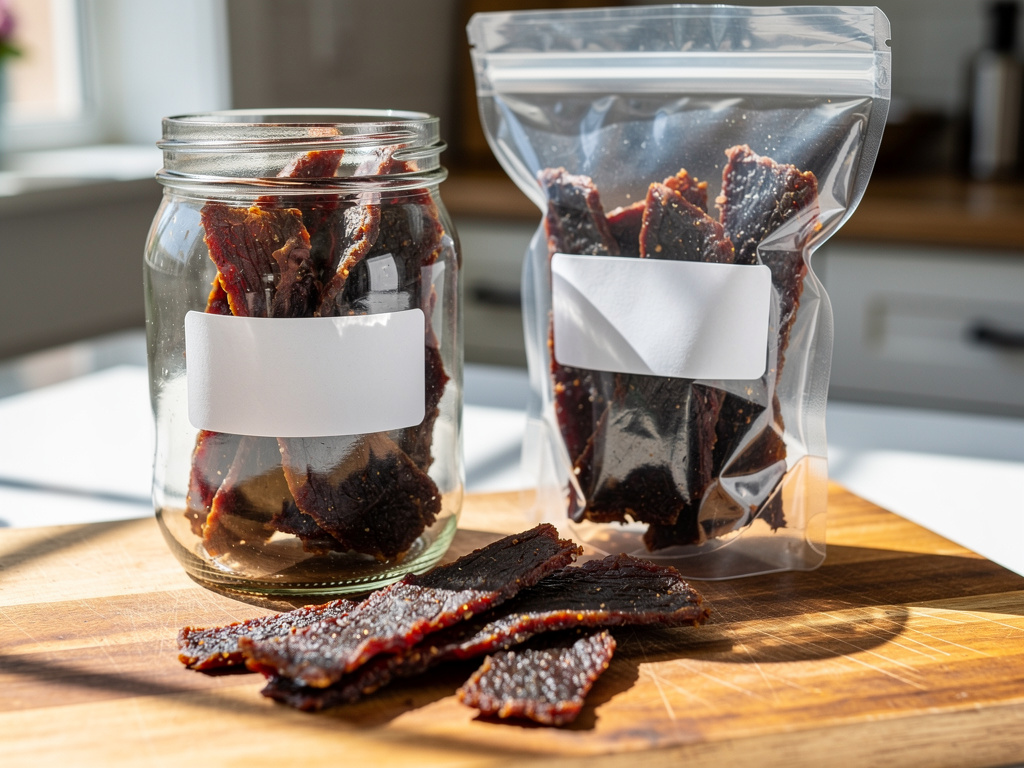


The short version: Homemade jerky lasts about 2 weeks at room temperature in a sealed container by the most cautious official count, and up to 1 to 2 months by USDA's count, if it was heated to 160°F and dried properly. It keeps 3 to 6 months in the refrigerator and up to 1 year in the freezer. Store-bought jerky is rated for about 12 months, and inspected plants dry it to a measured water activity of 0.85 or lower (up to 0.91 if vacuum packed) and pack it to hold there. For selling, plan on the 2-week number unless your plant has tested a longer one, because a home kitchen cannot measure the dryness that decides shelf life.
Checked on the USDA Food Safety and Inspection Service jerky page, the University of Georgia's home food preservation center, Ohio State and PNW 632 extension guides, and Colorado's 2027 cottage food page, October 12, 2026: storage times differ by source, and this guide shows all four. Homemade beef jerky cannot be sold in 8 of the 9 states our permission guide checked, so verify your state's current rules before you plan a single bag. Homegrown customers create an account to place their first order, and Homegrown has no drops or countdown-release feature.
If you make jerky, you have probably seen two very different answers to how long it keeps. One site says two weeks. Another says two months. The bag of jerky at the gas station says next summer. All three can be right, because they describe different jerky made in different places.
This guide sorts that out for vendors. It covers the official storage times, why they disagree, what makes jerky last, how to store and label it, and how far ahead to make it for a market. It also covers the part most storage charts skip: whether you are allowed to sell the jerky at all.
Homemade jerky keeps about 2 weeks on the counter in a sealed container, 3 to 6 months refrigerated and up to 1 year frozen. That assumes you heated the meat to 160°F, dried it until a bent piece cracks but does not snap, and packed it airtight. Two official sources stretch the room-temperature number to 1 to 2 months. The shortest number is the safe one to plan around when other people are eating your jerky.
Here is what each source says, in its own words, checked on October 12, 2026:
Swipe left to see all four sources.
| Source | Room temperature, sealed | Refrigerator | Freezer | Which jerky it means |
|---|---|---|---|---|
| NCHFP, University of Georgia | 2 weeks | Refrigerate "for best results" | Freeze "for best results" | Properly dried home jerky |
| Ohio State University Extension, HYG-5362 | Up to 2 weeks | 3 to 6 months | Not given | Home jerky that was pre-heated or post-heated |
| PNW 632, revised August 2020 (Idaho, Oregon State, Washington State) | 1 to 2 months for best quality | 3 to 6 months | Up to 1 year | Home jerky heated to 160°F and dried |
| USDA Food Safety and Inspection Service | 1 to 2 months | Not given | Not given | Home-dried jerky |
| USDA Food Safety and Inspection Service | 12 months | Not given | Not given | Commercially packaged jerky |
We read each page on October 12, 2026. The USDA page was last updated November 3, 2016, and PNW 632 was revised in August 2020. "Not given" means that source does not state a time for that storage method.
The same numbers, as the longest room-temperature time each source allows:
Longest room-temperature storage time, in months
Source: the five rows of the table above, read October 12, 2026. Two weeks is shown as 0.5 months. Bar width is each value divided by 12.
Ohio State and the NCHFP give 2 weeks at room temperature, while PNW 632 and USDA give 1 to 2 months, and none of the four pages explains why the others differ. Ohio State and USDA present theirs as a safe storage time, PNW 632 uses its number for both quality and shelf stability, and the NCHFP does not say. So read each one for what it actually says.
Here is what each one claims, word for word where it matters:
Our read, not any source's: the gap is about what a home cook cannot see. PNW 632 says home cooks often call jerky done while it is still wetter than the shelf-stable line, and that the meter to check it is not something consumers have. The 2-week number leaves room for that. When strangers are eating your jerky, plan around the shortest number.
Usually not: beef jerky made in a home kitchen cannot be sold in 8 of the 9 states our permission guide checked, because under the federal meat inspection rules, meat sold to the public has to come from an inspected plant or fit a narrow exemption such as the retail store one in 9 CFR 303.1. The ninth, Pennsylvania, lists jerky on a registration form that federal meat law may not back up. Our guide on whether you can sell homemade beef jerky walks through the federal rule and what 9 states say, checked October 7, 2026.
A long storage time does not make homemade meat jerky legal to sell. In most states the legal paths are a USDA-inspected co-packer, your own inspected plant, a state-inspected plant in the states that run their own inspection program (its jerky generally sells only inside that state), or a licensed retail store kitchen. Colorado adds a home path on January 1, 2027, with its own packaging limits, covered below, though its page does not yet say whether the federal meat inspection rules allow it. Verify your state's current rules with your state's cottage food or meat inspection office before you sell a single bag.
So who is this storage guide for? Four groups of vendors:
Here is what Homegrown's own catalog shows for jerky today.
In a pull of the Homegrown catalog on October 12, 2026, none of the 2,855 products listed by 313 vendors was beef jerky. We searched every product name and description for jerky, biltong, pemmican, beef sticks, snack sticks and meat sticks as whole words, then read every listing from each of the 3 vendors that matched. Two listings had jerky in the name: a $13.00 mushroom jerky from Eco Sun Farms and a $1.50 fruit jerky from Aliken Beach Farm. Four were beef sticks from 2 vendors, priced $1.50 to $10.00. The Meat and Poultry category held 116 products from 16 vendors.
If you are still working out the business side, start with our guide on how to sell beef jerky from home, which covers the legal paths, equipment, packaging and where jerky sells. Then come back here for the storage plan.
Jerky is shelf stable when it is dry enough that germs and mold cannot grow, which USDA measures as a water activity of 0.85 or lower for jerky stored in air. Water activity is a 0-to-1 score for how much free water is left in a food, the water bacteria can actually use. Fresh meat scores close to 1. Well-made jerky scores 0.85 or under.
The USDA's jerky guideline for small and very small plants sets the numbers inspected plants work to:
PNW 632 sets a stricter target for home jerky than the guideline's 0.85: it recommends a water activity of 0.70 to prevent mold growth. It also says the catch plainly. People who make jerky at home often call it done when it still scores above 0.85, and the meters that measure water activity are "special equipment not available to consumers."
Our read: that is likely why home jerky gets a short window. Nobody in a home kitchen knows whether a batch hit 0.85.
Store-bought jerky is rated for about 12 months, and the likeliest reason, in our read, is that the plant proves its process: it uses a tested heat step, measures water activity, and packs the jerky so it stays that dry. Your dehydrator does none of that measuring, so your jerky gets the cautious window.
Here is what a federally inspected plant does that a home kitchen usually does not:
A pound of raw meat makes about 4 ounces of jerky, according to the USDA's jerky page. So a plant is drying off roughly three quarters of the weight and then checking the result with a meter. Our read, not any source's: that measured, tested process is the main reason plant jerky is rated 12 months while home jerky gets 2 weeks to 2 months.
A batch is dry enough to store when a cooled piece cracks but does not break when you bend it, and when 2 to 4 days of conditioning in a closed jar leaves no moisture on the lid. These are the home tests the extension guides use in place of a meter. They follow the safe drying method, step by step:
The conditioning step is easy to skip, and it is the one that catches a damp batch before a customer does. One wet strip packed in with dry ones can bring mold into the whole bag.
Fish jerky and fatty jerky go bad fastest, because fat and fish oil turn rancid. Ground jerky is harder to make safe, so it needs the heat step most. Lean, whole-muscle beef strips are the kind the storage charts above were written around. Here is how the other kinds differ:
Swipe to see each kind of jerky.
| Kind of jerky | Extra step before drying | Storage note | Source |
|---|---|---|---|
| Lean whole-muscle beef strips | Heat to 160°F before or after drying | The baseline for every storage time in this guide | USDA FSIS jerky page, NCHFP |
| Ground and formed beef | Heat to 160°F; use meat at least 93% lean | Germs are "more difficult to eliminate in ground meat than in whole meat strips" | NCHFP, PNW 632 |
| Venison and other wild game | Freeze 30 days at 0°F if 6 inches thick or less, then heat to 160°F | Can carry gut bacteria from the field, so handling before drying matters most. For bear, cougar or wild hog, PNW 632 says freezing may not kill the parasite, so the 160°F heat step is what makes it safe | NCHFP, USDA FSIS jerky page, PNW 632 |
| Pork | Freeze 30 days at 0°F for the trichinella parasite, then heat to 160°F | Freezing does not kill bacteria, only the parasite | NCHFP |
| Turkey and other poultry | Heat to 165°F | NCHFP does not generally recommend raw poultry for jerky because of texture and flavor | USDA FSIS jerky page, NCHFP |
| Fish | Hold at 160°F for 1½ minutes; use non-oily fish | Rancid fish oil shortens shelf life, so store fish jerky in the fridge or freezer | PNW 632 |
| Fruit or mushroom "jerky" | None of the meat steps apply | Not meat, so the meat charts do not cover it; Colorado lists dehydrated fruits and vegetables as cottage foods | Colorado CDPHE food list |
Read on the NCHFP jerky page, the USDA FSIS jerky page, the PNW 632 PDF and Colorado's 2027 cottage food eligibility page on October 12, 2026.
Fruit and mushroom jerky sit in a different legal box from meat. Colorado's 2027 food list, for one, puts "Dehydrated Fruits & Vegetables" under pantry goods. If that is your product, our guide to selling dried fruit from home is the closer fit, and you should still ask your state how it classifies a marinated mushroom snack.
Vacuum sealing helps jerky keep its flavor longer, but it does not fix jerky that is too wet, and Colorado's 2027 cottage food rules ban it for home-made jerky sold to the public. PNW 632 calls vacuum packing "a good option for long-term storage" because it cuts down on rancid flavors and mold. The rules below are about how dry the jerky must be once the air is gone.
Here is how the rules treat vacuum-packed jerky:
If you plan to sell jerky as a Colorado cottage food vendor in 2027, do not vacuum seal it. Colorado's Department of Public Health and Environment lists vacuum-packed beef jerky as not allowed under the act, on a page it marks "for information purposes only" until the law starts January 1, 2027. We read it on October 12, 2026. If you are unsure whether a bag counts as reduced-oxygen packaging, the page gives an address for questions: cdphe_cf@state.co.us.
For jerky you keep for your own family, vacuum bags are a fine way to get the full 1 to 2 months of best quality. For jerky you sell, the packaging question belongs to your plant or your state.
Put homemade jerky in the fridge if you will eat it within 3 to 6 months, and in the freezer if you need it to last up to a year. Both beat the pantry. PNW 632 and Ohio State both allow a refrigerated window of 3 to 6 months, and PNW 632 gives up to 1 year in the freezer.
A few things to know about cold storage:
If you sell jerky made in a plant, follow what the plant's label says. If you sell smoked Colorado cottage jerky, keep it in the cooler, because Colorado's page says smoked food must be refrigerated.
None of the four sources in the table above gives an opened-bag time for homemade jerky, so the safe plan is to finish it within the original window, counted from the day it was made. Opening the bag does not restart the clock. It lets in air and moisture, which shortens it.
For commercial jerky, the USDA guideline gives one clear case. Vacuum-packed jerky dried only to the 0.85 to 0.91 range should be kept refrigerated once opened, and the label should say so. Jerky dried to 0.85 or lower is shelf stable in air, so the date on the bag still guides it after opening.
Good habits for an opened bag:
Make jerky so that it reaches the customer with most of its storage window left: on a 2-week window, that means selling it within about 5 days of drying so the buyer still has 9 or more days. The clock starts when the jerky comes out of the dryer, not when it goes on your table.
Here is how one week can look on the 2-week window:
Jerky from an inspected plant is simpler. The plant prints a date, and your job is to sell well inside it and rotate older stock to the front.
Write each batch's make date on a small sheet taped inside your market bin, and pull any bag past day 5 off the table. On a 2-week window, that still leaves the buyer 9 days at home. A bag you pull is cheaper than a customer who opens a stale one.
Federal law does not require a date on jerky, but if a USDA-inspected product carries one, it must show the month, day and, for shelf-stable food, the year, with a phrase like "Best if Used By" next to it. That is from the USDA's Food Product Dating page, which says that "except for infant formula, product dating is not required by federal regulations."
What the common phrases mean, per the same USDA page:
For cottage food vendors, the label rules come from your state, and some states ask for more than USDA does. Our cottage food labeling requirements guide lists what a home-food label needs state by state. Even where no date is required, a "Made on" or "Best by" date on a jerky bag answers the first question every buyer has.
Your buyer needs three facts: how long the jerky keeps, where to store it, and what to do after opening. A small card in the bag or a line on the label covers all three. Most buyers assume jerky lasts forever because store jerky nearly does.
A storage card for home-dried jerky on the 2-week window can read like this:
Fit the numbers to your source. Jerky from an inspected plant follows the plant's date and any "Refrigerate After Opening" line. Keep the card short. A buyer reads four lines and skips a paragraph.
The jerky clock starts the day the batch leaves the dryer, so the surest way to sell fresh jerky is to make only what customers already ordered. That is what a pre-order page does. Customers pick their flavors and bag sizes during the week, you see the count, and you dry exactly that much.
Homegrown gives you that page for $10 per month billed annually ($12.50 billed monthly), with no percentage fees beyond standard payment processing of 2.9% + $0.30. It starts with a 7-day trial, with no charge until day 8. Customers order ahead, pay online, and pick up at your market booth, your house or wherever you set. You see every order in one list before your drying day, which is how a 2-week window turns into a bag that is 5 days old at pickup. Our guide to taking pre-orders for your food business shows how vendors set up the weekly rhythm.
Here is how the cost compares with two places jerky vendors often try, on a $15 bag:
Swipe sideways to compare all three platforms.
| Platform | Monthly plan | Trial | Platform or sales fee | Card processing | Customer pays on a $15 order | Vendor pays on a $15 order | Vendor pays in a month of 50 orders at $15 |
|---|---|---|---|---|---|---|---|
| Homegrown | $10 billed annually ($12.50 monthly) | 7 days, no charge until day 8 | None, 0% commission | 2.9% + $0.30, paid by the vendor | $15.00 | $0.74 plus the plan | $46.75 ($49.25 on the monthly plan) |
| Etsy | None (a one-time set-up fee may apply) | None | $0.20 listing fee plus 6.5% transaction fee | 3% + $0.25, paid by the vendor | $15.00 plus any shipping you charge | $1.88 | $93.75 |
| Shopify Basic | $29 billed yearly ($39 monthly) | 3 days, then $1 a month for 3 months | None with Shopify Payments (2% with another provider) | 2.9% + 30¢ online, paid by the vendor | $15.00 plus any shipping you charge | $0.74 plus the plan | $65.75 ($75.75 on the monthly plan) |
We checked Homegrown's signup page, Etsy's Fees and Payments Policy and payment processing fee table for US bank accounts, and Shopify's pricing on October 12, 2026. Etsy's listing fee renews at $0.20 each time a multi-quantity listing sells, and its transaction and processing fees also apply to any shipping you charge. Card processing here is figured on the $15 price; a platform that charges it on a total with tax runs a few cents higher.
Etsy reaches shoppers far beyond your town if you ship jerky from an inspected plant, though it costs about $1.88 a bag before shipping. Shopify fits a brand building a full website, at $29 a month before apps. Selling through Instagram DMs costs nothing up front, but you end up tracking flavors and bag counts across a dozen chats. Homegrown fits the local vendor who wants customers to order before drying day and pick up nearby.
What Homegrown does not do: it does not ship, so it fits jerky you hand over at a market, a pickup spot or by local delivery. It does not make home-kitchen meat jerky legal to sell, test water activity, or print labels. It does not price by the pound yet, so list fixed bag sizes like 2, 4 and 8 ounces, each with its own price. Customers create a Homegrown account to place their first order. Homegrown has no drops or countdown-release feature. Your storefront is listed on Homegrown's marketplace, but plan on most orders coming from people you send to your own link.
Jerky has spoiled if you see mold, smell something sour or rancid, or find soft, damp spots in a piece that should be dry. Any one of those means the whole package goes in the trash. PNW 632 says plainly to discard jerky if you find mold.
Check for these:
When in doubt, throw it out. A $15 bag is cheap next to a sick customer. If spoilage shows up early in a batch, look at your drying time and conditioning step before the next run, not just the storage.
Jerky that does not sell within its window should not go back on the table, but it can go in your own freezer or to your family while it is still good. Selling past your stated window is the fastest way to lose a regular customer.
Some plans for leftover bags:
For jerky from an inspected plant, the label date decides. Rotate older bags forward so they sell first, and pull anything past its date. Our guide on where to sell beef jerky covers which sales channels move jerky fastest, and our jerky pricing guide shows how to fold a little waste into your bag price.
Sealed homemade beef jerky keeps about two weeks on a pantry shelf, according to Ohio State and the University of Georgia's National Center for Home Food Preservation. USDA and the PNW 632 guide allow 1 to 2 months for jerky heated to 160°F and dried well. Plan on 2 weeks for any jerky other people will eat.
Properly dried homemade jerky does not need the fridge for the first couple of weeks, but refrigerating it stretches its life to 3 to 6 months. Jerky that still feels soft or damp should go in the fridge or back in the dryer. Commercial jerky labeled "Refrigerate After Opening" must go in the fridge once the bag is open.
Homemade jerky lasts up to 1 year in the freezer, according to PNW 632, the 2020 Pacific Northwest extension guide. Freeze it in an airtight bag with the air pressed out. A simple habit of ours, not from the guides: thaw it in the closed bag so moisture does not settle on the jerky.
Homemade deer jerky follows the same storage times as beef: roughly two weeks unrefrigerated, three to six months chilled and up to a year frozen. The difference is before drying. Wild game should be frozen 30 days at 0°F and heated to 160°F, because it can carry parasites and gut bacteria from the field.
Vacuum sealing helps homemade jerky keep its flavor through the 1 to 2 months PNW 632 gives for a sealed container, but it does not make wet jerky safe. Only a measured water activity tells you whether sealed jerky is truly shelf stable. Colorado's 2027 cottage food rules ban vacuum-packed jerky for sale.
A date does not make homemade meat jerky legal to sell. Under federal meat inspection rules, beef jerky sold to the public must come from an inspected plant or fit a narrow exemption, such as the one for retail stores, and how long homemade jerky lasts does not change that. Colorado lists beef, turkey and pork jerky as cottage foods starting January 1, 2027, though its page is silent on the federal meat inspection rules, so get it in writing from the state before you sell.
These 6 guides cover the questions that come before and after storage:
Jerky gives you about 2 weeks on the shelf by the cautious count, and the simplest way to protect that window is to dry only what is already sold. If you sell jerky from a legal source and want customers to order flavors before your drying day, start your Homegrown storefront and open your first pickup window this week.