
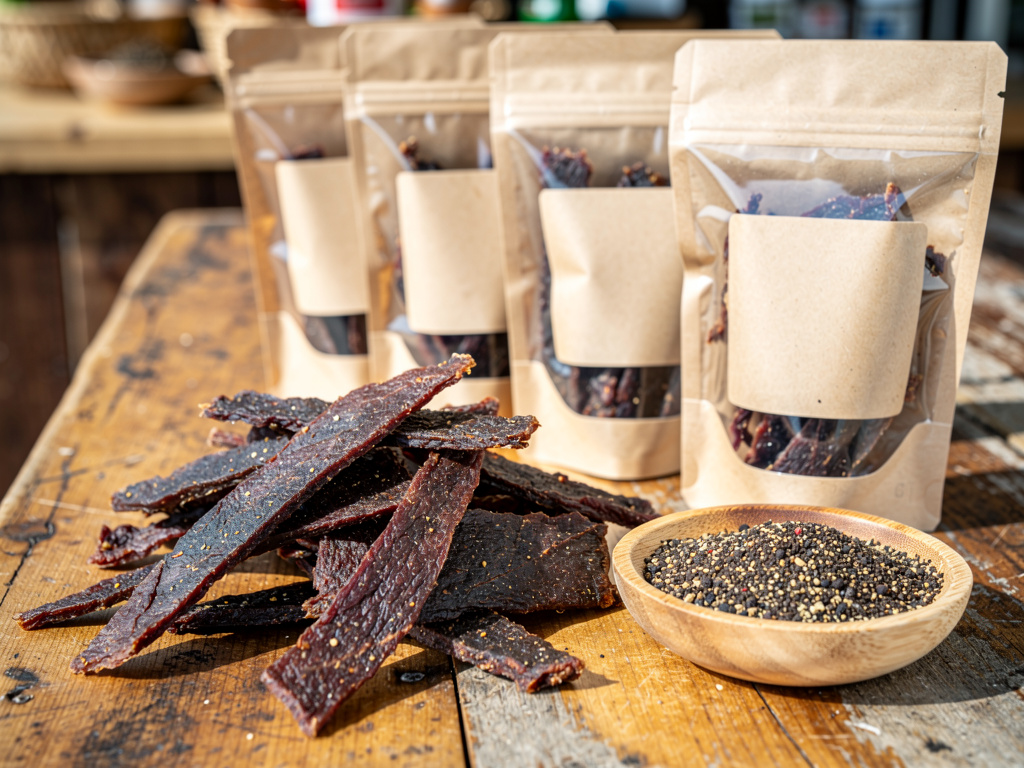


The short version: Of the seven places to sell beef jerky (farmers markets, craft fairs and gun shows, your own online storefront, shipping to customers, Etsy, Amazon and local stores), start where jerky buyers already stand in front of you, at a farmers market or a weekend event with proof of inspection on your label, and then give those buyers a link to order between markets. Shipping out of state, Etsy and Amazon open up fully for jerky made in a USDA-inspected plant or co-packer, or in a state plant in the federal Cooperative Interstate Shipment (CIS) program, while other state-inspected jerky stays with buyers and stores inside your state and a retail store's own jerky can only go to household customers. Jerky from a home kitchen is shut out of all seven places in 7 of the 8 states we read, but the federal rule (9 CFR 303.1) does not settle the home-kitchen question outright, and Colorado lists beef jerky as an approved cottage food from January 1, 2027, for direct sales inside Colorado. On a $12 bag you pay about $0.65 in card fees through a Homegrown storefront ($10 a month billed annually) or Shopify on a standard card ($29 a month billed yearly), $1.59 on Etsy and $0.96 on Amazon with free shipping, plus its $39.99 monthly Professional plan.
Checked October 7, 2026: Homegrown's signup page, Etsy's selling page, Shopify's and Square's pricing pages, Amazon's selling fees page, the federal meat exemption rule (9 CFR 303.1), the USDA's state inspection pages, and the home-food rules of Colorado, Texas, California, Ohio, Pennsylvania, Utah, Wyoming and North Dakota. Fees and rules change, so verify your state's current rules with your state department of agriculture before you book a booth or list online. Homegrown customers create an account to place their first order, Homegrown does not ship, and it has no drops or countdown release feature.
The best places to sell beef jerky are farmers markets, craft fairs and gun shows, your own online storefront, shipping to customers, Etsy, Amazon and local stores like butcher shops and gas stations. Jerky is meat, so where you can sell it depends less on the place and more on where it was made. A bag from a USDA-inspected plant can go anywhere on this list. A bag from your home kitchen is shut out of all seven in every state we read except Pennsylvania, where a state form lists jerky and the federal rule leaves the home-kitchen question open, and Colorado plans to open some of them in 2027.
This guide walks through all seven places for a part-time vendor, what each one asks of you, and what each one costs on a single $12 bag.
You can sell beef jerky in 7 places that actually work for a small vendor. USDA-inspected jerky, whether from a federal plant or a co-packer, can go to all 7 of them, in all 50 states. Jerky made in a state-inspected plant or a licensed retail kitchen reaches fewer of them, as the table below shows, and home-kitchen jerky reaches none of them under seven of the eight state rules we checked. Here they are in the order we suggest adding them:
If you have not made a legal batch yet, start with the partner to this page, our guide on how to sell beef jerky from home. It covers the production side: the kitchen options, the 160 degree cooking step, equipment and flavors. This page picks up once you have jerky you are allowed to sell and need to decide where it goes.
Where you can sell jerky is decided by which kind of kitchen made it, because meat from cattle falls under federal inspection law and each production path carries its own limits. Three paths are built on inspection or the federal retail exemption, and a fourth, the home kitchen, is shut out of every place on this list under the rules of Texas, Utah and five more of the eight states we read. Our guide to whether you can sell homemade beef jerky covers each path in depth. Here is what each one means for where you sell:
Scroll sideways to see every column.
| Place to sell | USDA plant or co-packer | State-inspected plant | Retail exemption (store kitchen) | Home kitchen, in the states we read | Colorado cottage kitchen, from Jan 1, 2027 |
|---|---|---|---|---|---|
| 1. Farmers market | Yes | Yes, at markets in your state, or any state from a CIS plant | Get a written yes from your regulator | No | Likely, as a direct sale in Colorado; confirm markets with the program |
| 2. Craft fairs, gun shows, festivals | Yes, with an event permit | Yes, at in-state events, or events anywhere from a CIS plant | Same question as a market, per event | No | Likely, as a direct sale in Colorado; confirm events with the program |
| 3. Your own storefront, local pickup | Yes | Yes, pickup or delivery inside your state, or across a state line from a CIS plant | Yes, pickup at the store | No | Likely, for pickup or delivery inside Colorado; confirm with the program |
| 4. Shipping to customers | Yes, all 50 states | In-state only, unless the plant is in the Cooperative Interstate Shipment (CIS) program | Unclear, since the rule is written for sales at the store | No | Not to other states; the law covers food sold in Colorado |
| 5. Etsy | Yes | Not practical, since Etsy sets shipping by country, not by state, unless the plant is in the CIS program | Unclear, same as shipping: the rule is written for sales at the store | No | Not practical, for the same reason |
| 6. Amazon | Yes, after category approval | Not practical, buyers are national, unless it comes from a CIS plant | No | No | No |
| 7. Local stores, to resell | Yes | Yes, stores in your state, or stores in any state from a CIS plant | No, consumers only | No | No, the law covers sales directly to consumers |
We read 9 CFR 303.1, the USDA's state inspection program pages and the eight state home-food rules named in the section below on October 7, 2026. CIS is the Cooperative Interstate Shipment program, which lets some small state-inspected plants ship nationwide; the USDA's CIS page (last updated August 19, 2026) names 10 taking part (Indiana, Iowa, Maine, Missouri, Montana, North Dakota, Ohio, South Dakota, Vermont and Wisconsin) and limits it to plants with 25 or fewer employees. The retail exemption is written around sales at the licensed store, so get a yes in writing from your state or county regulator before you take that jerky anywhere else. The Colorado column comes from the state health department's 2027 pages, which it marks "for information purposes only" until the law starts and which describe food "sold in Colorado directly to informed consumers." Those pages list jerky as an approved food but do not name any place to sell it, so the market, event and pickup cells are our reading of that phrase, not a list from the state.
Custom-exempt processing is not a selling path. When a local processor makes jerky from your own animal under a custom exemption, the federal rule requires it to be marked "Not for Sale." That jerky can feed your family. It cannot go on a market table, an Etsy listing or a store shelf. We read that rule on October 7, 2026.
The practical upshot for most part-time vendors: a co-packer is the path that opens all seven doors. A state plant opens most of them as long as every buyer lives in your state, and all seven if it takes part in the CIS program.
Not in 7 of the 8 states whose home-food rules we read on October 7, 2026. Of the eight, five exclude meat by name, two leave jerky off the list of foods they allow, and Pennsylvania lists jerky on a registration form while the federal meat rule does not say whether a home kitchen can count as the retail store it exempts. Cottage food laws, the state laws that let you sell low-risk food made at home, were written mostly for bread, cookies and jam, and beef sits under a separate federal inspection law that those state programs do not switch off.
The federal side is less settled than many guides make it sound. 9 CFR 303.1 exempts a "retail store" that sells "to consumers only" and uses "Only federally or State inspected and passed product," but it never says whether a home kitchen can be that store. That is a question for FSIS or your state agency, asked in writing, before you spend money on it.
Scroll sideways to see every column.
| State | Program and source we read | What it says about meat or jerky | Home-kitchen beef jerky at the 7 places today |
|---|---|---|---|
| Texas | Department of State Health Services, cottage food page | Allowed foods are "any foods, except" a list that starts with "meat, meat products, poultry, or poultry products" | No |
| Colorado, current rule | Department of Public Health and Environment, cottage foods page | Ineligible: "Any meat product such as bacon, jerky, chicharron, poultry, fish and shellfish products" | No, until January 1, 2027 |
| Colorado, from January 1, 2027 | Same department, 2027 food eligibility page for Colorado's new Cottage Food Act (the Tamale Act) | Approved list includes "Jerky (Beef, Turkey, Pork)," made from USDA-inspected meat, with no vacuum packing and no curing for preservation; smoked jerky must be kept refrigerated, since "Smoking as a method of preservation is not allowed" | Listed as allowed, for direct sales inside Colorado |
| Utah | Department of Agriculture and Food, Home Consumption and Homemade Food Act page | "Foods NOT allowed" starts with "Meat" (some exemptions for poultry and rabbit) | No |
| Wyoming | Food Freedom Act, W.S. 11-49-103 | Sales must "Not involve the sale of meat products," with listed exceptions for some poultry, rabbit and fish; a section for beef from your own cattle starts only when the governor certifies that federal law allows it | No |
| North Dakota | Cottage food statute, NDCC 23-09.5 | May not "Include the sale of uninspected products made from meat," except some poultry | No |
| California | Department of Public Health, Approved Cottage Foods list (reviewed April 2026) | The dried foods group gives examples like baking mixes, fruit and tea, "but not limited to" them, and meat is not among them; the California county health directors' cottage food FAQ lists "Fresh or dried meat or meat products including jerky" among foods a cottage kitchen may not make | No |
| Ohio | Department of Agriculture, cottage food page | Only the listed foods are allowed, and "Raw or cooked animal products" are given as an example of foods that need temperature control | No |
| Pennsylvania | Department of Agriculture, limited food establishment packet (Rev 10-2024) | The product checklist includes "Beef/Meat Jerky" | Unclear; the federal rule is silent on home kitchens, so get a written answer |
We read each page, form or statute on October 7, 2026. Colorado appears twice because its current rule and its 2027 rule differ. Count by state: Texas, Colorado (current rule), Utah, Wyoming and North Dakota exclude meat by name; California and Ohio leave meat jerky off their lists of allowed foods, and California's county health directors name jerky as not allowed; Pennsylvania lists it on a form. That is 7 of 8 shut out today. We did not read the other 42 states for this guide, so check yours in our cottage food laws by state guide and then with your state agency.
The state health department's 2027 Tamale Act food eligibility page, read October 7, 2026, lists "Jerky (Beef, Turkey, Pork)" as approved under the new Cottage Food Act (HB26-1033), which starts January 1, 2027. The meat must come from an "approved source," which the page defines as USDA-inspected meat, and the page says "Food packaged in reduced oxygen packaging is not allowed under the act (vacuum packaged fish or beef jerky)," "Curing for preservation is not allowed" and "Smoking for flavor is allowed, but food must be refrigerated." The department's update page says cottage food vendors register every year, total sales stay at $150,000 or less a year, and the law covers food sold "in Colorado directly to informed consumers." The department calls both pages "for information purposes only" until the law starts, and neither one explains how the change fits federal meat inspection, so email the program and get a written answer before you plan a 2027 launch.
What that means for where a Colorado vendor can sell, once registered in 2027:
Pennsylvania's limited food establishment packet, read October 7, 2026, has a "Beef/Meat Jerky" box on its product checklist. The federal rule in 9 CFR 303.1 does not say whether a home kitchen can count as a retail store, so the form alone does not settle the question for beef. If you live in Pennsylvania, ask the Department of Agriculture's Bureau of Food Safety in writing whether your beef jerky needs USDA inspection before you make a batch to sell.
Before you plan around a home kitchen in any state, ask your state agency these three questions and keep the replies:
Yes, you can sell beef jerky at a farmers market if it came from an inspected plant, or from a store kitchen under the retail exemption once your regulator says yes in writing, and your market accepts meat vendors. Farmers markets are the best first place for most jerky vendors because the bag is shelf-stable, needs no cooler once sealed, and sells on taste.
Expect the market to ask for more than it asks of a bread baker. Virginia Tech's extension guide for Virginia meat vendors on what markets expect from meat and poultry vendors says federal or state inspection is required for all meat from cattle, pigs, sheep and goats, which "must be produced in an inspected facility," and that some farmers markets set their own extra requirements on top. A store kitchen under the retail exemption is not a meat-inspected plant, which is why the written yes from your regulator matters. Bring this to your first talk with the market manager:
Booth fees vary by market, and the fee is rarely your biggest cost. Our breakdown of the real cost of selling at farmers markets walks through gas, insurance and the hours behind a Saturday. Jerky from a state-inspected plant sells only at markets in your state, unless it is a CIS plant. A market across the state line counts as interstate sales, even if it is 20 minutes from home.
Put out 3 flavors, not 8. A table with original, peppered and one hot flavor sells faster than a long lineup, because a shopper can taste all 3 in under a minute and decide. Keep a 2-ounce bag at a lower price next to your 3-ounce bags for people who are only trying you.
Yes, and events suit jerky well, because hunting, fishing and car show crowds already know it as a snack they grab on the road. Craft fairs, gun shows, rodeos, county fairs and outdoor festivals pack a big crowd into one or two days, so one good event can equal several market Saturdays.
The rules are the same as a farmers market, plus one more piece of paper. Many counties require a temporary food event permit for each event, and the event organizer often asks for it along with your application. Plan for these before you pay a table fee:
Gun shows and hunting expos are a strong fit for spicy and peppered flavors in bags of 4 ounces or more. Holiday craft fairs favor gift packs of 3 flavors. Our guide to selling food at craft fairs and festivals covers applications and table setup in more detail.
A state-inspected vendor can work any event in their own state, and out-of-state events too if it uses a CIS plant. A county fair one state over is interstate commerce, and so is a gun show in the next state, so check where each event is before you apply.
You turn market buyers into weekly orders by giving them one link where they can pick flavors, pay and choose a pickup day between markets. Jerky buyers tend to stick with a flavor they like, which makes them some of the easiest customers to get ordering ahead. The problem is that most vendors take those orders through text messages and Venmo, and a Saturday with 15 half-finished conversations is how orders get lost.
That is the problem Homegrown is built for. It costs $10 per month billed annually ($12.50 billed monthly), with no percentage fees beyond standard payment processing, and gives you a storefront link your jerky buyers use to order and pay before your next batch or co-packer run. On a $12 bag, card processing at 2.9% + $0.30 comes to $0.65, paid by you, and your customer pays $12.00 at checkout. For a jerky vendor, the parts that matter:
Colorado's 2027 cottage rules describe direct sales to buyers inside Colorado, which likely covers pickup and local delivery for Colorado vendors who register under them, but confirm with the program before you plan on it.
Compare that to the two tools jerky vendors usually reach for. Square Online's Free plan costs $0 a month, but charges 3.3% + $0.30 online, which is $0.70 on a $12 bag, and it is a strong pick if you already use a Square reader at your booth. Shopify Basic is $29 a month billed yearly ($39 monthly) plus 2.9% + $0.30 online on standard cards, or 3.5% + $0.30 on premium cards, which Shopify says include business cards and American Express, and it is the better fit once you ship federally inspected jerky across the country, because it is built for shipping.
Homegrown does not ship, so it is a pickup and local delivery tool, not a way to reach buyers three states away. It does not handle inspection paperwork, wholesale accounts or store invoices. Customers create a Homegrown account to place their first order. There is no drops or countdown-timer release feature, and no release date to share for one. Your storefront is listed on Homegrown's marketplace, but plan on most orders coming from people you send to your own link, starting with the people who already bought a bag at your table.
If your market regulars keep asking "are you here next week?", that question is your first pre-order list. Set up a jerky storefront and hand out the link with every bag, so the next order comes in before the next batch is made.
You can ship beef jerky to all 50 states if it came from a USDA-inspected plant or co-packer, or from a state plant in the Cooperative Interstate Shipment (CIS) program. Jerky from any other state-inspected plant can be sold to customers inside your state, but it cannot be mailed across a state line. The University of Wisconsin's guide to direct marketing meat spells it out: meat from federal plants can be shipped over state lines, meat from state plants cannot unless the state and the plant both join the CIS program, and custom-exempt meat must be labeled "Not for Sale."
Jerky is one of the easier meat products to ship once you clear that bar. A properly dried, vacuum-sealed bag needs no ice packs, weighs a few ounces and fits in a padded mailer. Shipping direct makes sense when:
The costs to plan for are postage, mailers, your time packing, and a storefront built for shipping. Shipping is where Shopify, Square Online or Etsy earn their fees, since each one prints labels and collects shipping costs at checkout.
Shipping an online order to a neighboring state is interstate commerce, even if that state line is 20 minutes away. If a state-inspected plant outside the CIS program made your jerky, block out-of-state shipping addresses at checkout and say "in-state customers only" on your product page. Do that on your own storefront, not on Etsy: Etsy's shipping settings pick countries, not states, per its calculated shipping help page checked October 7, 2026. The USDA's State Cooperative Inspection Programs page, checked October 7, 2026, describes state programs as covering products distributed within the state.
Etsy is a reasonable place to sell beef jerky if it comes from a USDA-inspected plant or a CIS state plant and you want strangers across the country to find you through Etsy search. Etsy's food policy says selling food "is generally allowed on Etsy," and leaves it to you to follow the government rules on who can make, package and sell it. For jerky, that means inspected product with the establishment number on the label.
Here is what Etsy charges, per its selling page on October 7, 2026:
Per $12 bag that is $0.20 + $0.78 + $0.61, or $1.59, paid by you, before shipping. If the sale came through an Offsite Ad, add $1.80 more, for $3.39. Our full Etsy fee breakdown for food vendors walks through renewals and the ad fee in more detail.
Etsy works less well for local buyers. Your market regulars do not need a national search engine to find you, and sending them to Etsy means paying Etsy's fees on customers you found yourself. Use Etsy for reach, and a direct link for the people who already know you.
A small vendor can sell beef jerky on Amazon, but it is the most demanding of the seven places and rarely the right first step. Jerky falls under Amazon's Grocery and Gourmet fee category, and sellers on Amazon's own seller forums describe having to request approval before they could list in it, with documents like invoices. Plan on USDA-inspected jerky or jerky from a CIS state plant, a finished label on every bag, and a real brand before you apply, and read Amazon's Grocery and gourmet foods category requirements page, which a forum moderator pointed those sellers to, before you request approval.
Amazon's selling fees page, checked October 7, 2026, lists two plans:
On a $12 bag with free shipping that is a $0.96 referral fee. Amazon figures the fee on the price plus any shipping the buyer pays, so a $12 bag with $4 shipping is a $16 sale, and the whole fee moves to 15%, about $2.40. On the Professional plan, 50 bags a month cost you $48 in referral fees plus $39.99, or $87.99, before shipping or any Fulfillment by Amazon charges. On the Individual plan it is $1.95 a bag, or $97.50 for 50.
The bigger cost is competition. Your $12 bag sits next to national brands that buy beef by the truckload. Amazon makes sense once you have a brand, strong photos and reviews, and inventory from a co-packer run. For a vendor doing one market a week, the time is better spent on the market and your own link.
You get beef jerky into local stores by walking in with a sample bag, a price sheet and proof of inspection, and asking the owner to stock one flavor on a trial basis. Stores buy jerky to resell, so this is one of the places on the list where the retail exemption clearly does not work. The federal rule says a retail-exempt store sells to consumers only, so a butcher shop cannot make jerky under that exemption and sell it to a gas station to resell. Your jerky needs a USDA or state inspection mark to go on another store's shelf, and state-inspected jerky stays with stores in your state unless your plant takes part in CIS.
The stores most likely to say yes to a local jerky brand:
Stores pay you one of two ways. Wholesale means the store buys the bags outright and sets its own shelf price. Consignment means the store puts your bags out and pays you only for what sells, on a schedule you agree, such as monthly. Wholesale is cleaner, and consignment is how many small stores try a new vendor with no risk to them. Either way, the store keeps a cut. If a shop keeps 40 percent of a $12 shelf price, you get $7.20 a bag.
Scroll sideways to see every column.
| How the bag reaches the buyer | Who owns the bags on the shelf | When you get paid | What you get per bag on a $12 shelf price, store keeping 40% |
|---|---|---|---|
| You sell it yourself at a market | You | At the sale | $12.00 minus any card fee |
| Wholesale to a store | The store, once delivered | On the invoice terms you agree | $7.20 |
| Consignment in a store | You, until each bag sells | After each bag sells, on a set schedule | $7.20 for each bag sold, $0 for bags that do not |
The 40 percent store share is an example to show the math, not a quote from any store. Stores set their own margins, so ask before you set your wholesale price.
Our beef jerky pricing guide works out whether that covers your cost per bag, and a written wholesale agreement for food vendors sets out payment terms before the first case goes out.
Start with one store you already shop at, bring two sample bags, and ask for a 30-day trial on one flavor. Restock on time. A store that sees the bags move will ask for a second flavor on its own.
On a $12 bag of jerky you pay nothing but your booth fee for a cash sale at a market, about $0.65 in card fees on a Homegrown storefront plus its $10 monthly plan (billed annually) or on Shopify with a standard card plus its $29 plan (billed yearly), $0.70 on Square Online's $0 Free plan, $1.59 on Etsy and $0.96 on Amazon plus its $39.99 Professional plan when you offer free shipping. A store is different: it keeps a share of the shelf price, which in the example above leaves you $7.20. Here is every online option side by side with the full fee stack, so the numbers compare fairly.
Scroll sideways to see every column.
| Where you sell | Monthly plan | Trial | Platform fee | Card processing | Customer pays on a $12 bag | You pay on a $12 bag | You pay in a month of 50 bags |
|---|---|---|---|---|---|---|---|
| Homegrown | $10 billed annually ($12.50 monthly) | 7 days, no charge until day 8 | None, 0% commission | 2.9% + $0.30, paid by you | $12.00, plus a flat delivery fee if they choose delivery | $0.65 plus the plan | $42.40 |
| Square Online, Free plan | $0 | Not needed, the plan is $0 | None | 3.3% + $0.30 online, paid by you | $12.00 plus shipping | $0.70 | $34.80 |
| Shopify Basic | $29 billed yearly ($39 monthly) | 3 days, then $1 a month for 3 months | None with Shopify Payments (2% with another provider) | 2.9% + $0.30 online on standard cards (3.5% + $0.30 on premium cards), paid by you | $12.00 plus shipping | $0.65 plus the plan | $61.40 |
| Etsy | $0 (a one-time shop set-up fee may apply) | None | $0.20 listing plus 6.5% of the sale | 3% + $0.25, paid by you | $12.00 plus shipping | $1.59 | $79.50 |
| Amazon, Professional | $39.99 | None | 8% referral fee on a total of $15 or less | No separate fee listed | $12.00, with free shipping | $0.96 plus the plan | $87.99 |
| Amazon, Individual | $0 | None | $0.99 per bag sold plus 8% referral fee | No separate fee listed | $12.00, with free shipping | $1.95 | $97.50 |
We checked these on Homegrown's signup page, Square's online store plans page, Shopify's pricing page, Etsy's selling page and Amazon's selling fees page on October 7, 2026. The month of 50 bags adds the plan price (annual billing where offered) to 50 per-bag fees. Shopify's per-bag and month-of-50 figures assume a standard card; a premium card such as American Express costs $0.72 on a $12 bag. Card processing is figured on the $12 price; charged on a total that includes shipping or tax, it runs a few cents higher. Postage, Etsy's Offsite Ads fee, Amazon fulfillment fees and sales tax are not included. Amazon figures its referral fee on the price plus shipping, so the Amazon rows assume free shipping. Charge $4 shipping on a $12 bag and the $16 total moves the whole fee to 15%, about $2.40.
At 50 bags a month, Square's Free plan costs about $7.60 less than Homegrown, and it is a good choice if you already run a Square reader at your booth. Homegrown's case is pre-orders by pickup day and a marketplace listing for local buyers, not the lowest possible fee. Etsy and Amazon cost the most per bag, and what you buy with the extra is their shoppers.
What you keep per $12 bag, before any monthly plan
Source: fees from each company's pricing page, checked October 7, 2026. Square reader at 2.6% + $0.15 in person on its Free plan. Homegrown or Shopify storefront at 2.9% + $0.30 (Shopify's standard card rate). Amazon at 8% of a $12 total with no shipping charged. The store row is an example split, not a quote.
The chart leaves out booth fees and monthly plans on purpose, because those are fixed costs that shrink per bag as you sell more. A $39.99 Amazon plan on 10 bags a month is $4 a bag. On 200 bags it is 20 cents.
Start with the place your production path allows and that puts you face to face with buyers, which for almost every new jerky vendor is a farmers market. Then add places in this order, one at a time, so you learn what each one takes before you stack another on top:
A vendor with state-inspected jerky stops before the last step unless their plant joins the CIS program, and that is fine. Markets, events, local pickup and in-state stores are plenty for a part-time jerky business.
Experienced jerky vendors sell the same few flavors everywhere, keep one price for the same bag in every place, and use their best in-person places to feed the others. A new vendor tends to do the opposite: a new flavor every week, a different price at every event, and an online store nobody hears about.
Here is what separates the vendors who keep a table full of regulars:
Before you book a gun show or county fair, ask the organizer how many other jerky or meat snack vendors are confirmed. With 1 jerky table at a 300-person show you have the room. With 4, you are splitting it, and the table fee is the same either way.
The costs that surprise jerky vendors most come from the inspection side, not the sales side, and they are the same whichever place you sell. None of them appear on a platform's pricing page, and all of them come before your first bag sells:
Our guide to how much to charge for beef jerky builds these costs into a per-bag price, so your $12 still pays you after every one of them.
Yes, there is room, because jerky is a $2.5 billion a year category in US stores and a local vendor competes for the buyer at the next table, not for that whole shelf. Snack Food and Wholesale Bakery's July 2026 State of the Industry report, using Circana store sales data, put dried meat snacks at $6.7 billion for the year, up 11.8%. Inside that, jerky was about $2.5 billion and grew about 2.1%, while meat sticks and other dried meat snacks reached $4.2 billion and grew 18.4%.
Two figures from the same report matter for pricing: Slim Jim's brand director at Conagra put jerky at $1.80 an ounce against $1.26 for sticks, and also said meat sticks had grown to 54.4% of meat snack dollar sales, from 37.9% in 2022. That works out to about $28.80 a pound for jerky. A $12 bag of 3 ounces is $4.00 an ounce, so your price has to be earned with flavor, freshness and a face behind the table.
What that means for where you sell:
If you found this page looking for a jerky business for sale, the same rules decide what you are buying. A brand made by a co-packer comes with recipes, labels and store accounts, but the inspection belongs to the plant, so ask whether the co-packer will keep making it for a new owner. A business with its own inspected plant holds a federal or state grant of inspection, so ask FSIS or the state program what a change of owner requires before you sign. A "business" that makes jerky in a home kitchen has no legal product to sell in a state like Texas or Utah, which leave meat out of home-food sales.
Price your bag by the ounce before your first market. At the $1.80 an ounce a Conagra brand director gave for jerky, a 3-ounce bag runs about $5.40. If yours is $12, put "made locally, sample one" on the sign so the $6.60 difference has a reason next to it.
On Homegrown, beef jerky is missing: none of the 2,925 products listed on October 7, 2026 was beef jerky, which is an opening for anyone with a legal source. Meat vendors on Homegrown mostly sell raw cuts like steaks, ground beef and pastured chicken, and the only meat snacks listed are beef sticks.
In a pull of the Homegrown catalog on October 7, 2026, 0 of the 2,925 products listed by 310 vendors were beef jerky. We searched every product name and description for jerky, beef sticks, snack sticks, meat sticks, biltong and pemmican as whole words, then read every listing from each vendor that matched. Four were beef sticks from 2 vendors: Circle H Ranch's Original Beef Snack Stick and Honey BBQ Snack Stick at $5.00 each and a Jalapeño Cheddar Snack Stick at $10.00, and Aliken Beach Farm's mini beef sticks at $1.50. The only listings with jerky in the name were a $13.00 mushroom jerky and a $1.50 fruit jerky. The Meat and Poultry category held 115 products from 16 vendors.
The takeaway is not that jerky does not sell online. It is that a buyer looking for local jerky on Homegrown has almost nothing to pick from. If you have inspected jerky and a market table already, your regulars are the fastest way to fill that gap. Time each batch so the bag reaches them early in its window, using the room-temperature, fridge and freezer numbers in our guide to how long homemade jerky lasts. Put your jerky flavors online with a pickup day at your next market, and let the people who already like your jerky order ahead.
The mistakes that cost jerky vendors a place to sell are almost all paperwork mistakes, and any one of the 7 below can lose you a market spot, a store account or an online listing. Watch for these:
Rules also change. Check your state department of agriculture's meat inspection page, or call them, each year before your season starts.
A farmers market is the best place for a beginner to sell beef jerky, as long as the jerky comes from an inspected plant, or from a retail-exempt store kitchen with a written okay from your regulator. The table costs are low, you learn which flavors sell, and shoppers can taste before they buy. Add an ordering link once regulars start asking for more between markets.
Yes, if your jerky carries a USDA or state inspection mark. A gas station buys jerky to resell, so jerky made under the retail exemption in a store kitchen cannot go there. State-inspected jerky can go only to gas stations in your own state, unless your plant is in the CIS program. Independent stations near highways, lakes and trailheads are the easiest to pitch.
You need inspected jerky, or retail-exempt store-kitchen jerky your regulator has approved in writing, and usually a county or state retail food permit plus whatever the market itself asks for. Many markets ask to see the inspection legend on your label, and some ask for a letter from your plant. Requirements vary by state and county, so verify your state's current rules with your department of agriculture and your market manager.
You can sell beef jerky on Etsy or Amazon if it was made in a USDA-inspected plant or in a CIS state plant, since both sell to buyers nationwide. Etsy takes about $1.59 on a $12 bag. Amazon takes an 8% referral fee when the bag and its shipping charge together total $15 or less, and 15% above that, plus $39.99 a month on its Professional plan. Sellers on Amazon's seller forums describe having to request approval in Grocery and Gourmet first.
Usually not. Texas, Utah, Wyoming, North Dakota, California and Ohio leave home-kitchen beef jerky out of their home-food rules, even for sales to people you know, and Colorado does too until 2027. Beef also falls under federal meat inspection law, which those state programs do not switch off. Colorado adds beef jerky to its approved cottage foods on January 1, 2027, for registered vendors selling directly to buyers in Colorado, and Pennsylvania's registration form lists jerky, so in either state get the agency's answer in writing first. To sell it, have it made by a USDA-inspected co-packer, a state-inspected plant or a licensed retail kitchen.
Selling beef jerky online costs anywhere from about $0.65 to $1.95 per $12 bag in platform and card fees, with free shipping on Amazon, plus any monthly plan and before Etsy's Offsite Ads fee, which takes an Etsy sale to $3.39. Your own Homegrown storefront is $10 a month billed annually plus 2.9% + $0.30 a bag. Square Online's Free plan is $0 a month plus 3.3% + $0.30. Etsy is about $1.59 a bag, and Amazon's Individual plan is $1.95 a bag with free shipping.
A Conagra brand director put jerky at about $1.80 an ounce, or about $28.80 a pound, in comments quoted in Snack Food and Wholesale Bakery's July 2026 report on the meat snack category. At the $12 example price used in this guide, a 3-ounce bag works out to $64.00 a pound. It costs a lot to make, too, because a pound of raw meat dries down to about 4 ounces of jerky, according to the USDA, so each pound of beef jerky starts as about 4 pounds of raw beef. Our guide on how much to sell beef jerky for works out a bag price from those costs.
More on selling jerky and meat snacks the legal way:
The seven places to sell beef jerky come down to one question: where was it made? USDA-inspected jerky can go to every place in this guide. State-inspected jerky can go to markets, events, local pickup and stores inside your state, and further when it comes from a CIS plant. Store-kitchen jerky stays with that store's own shoppers. Home-kitchen jerky stays home in 7 of 8 states we checked. In Pennsylvania a state form lists jerky but the federal rule leaves open whether a home kitchen counts as a retail store, so get a written answer first, and Colorado's 2027 cottage rules are the one change to watch.
Whichever path you are on, the buyers who taste your jerky at a table are the ones most likely to buy it again. The job after the first sale is making the second one easy, so regulars can order between markets instead of waiting for you to show up.
Homegrown gives them one link to pick their flavor, pay and choose a pickup day, for $10 a month billed annually ($12.50 billed monthly) with no percentage fees beyond standard payment processing. There is a 7-day trial with no charge until day 8. Open your jerky storefront on Homegrown and hand out the QR code on a card with your next batch of bags.



