
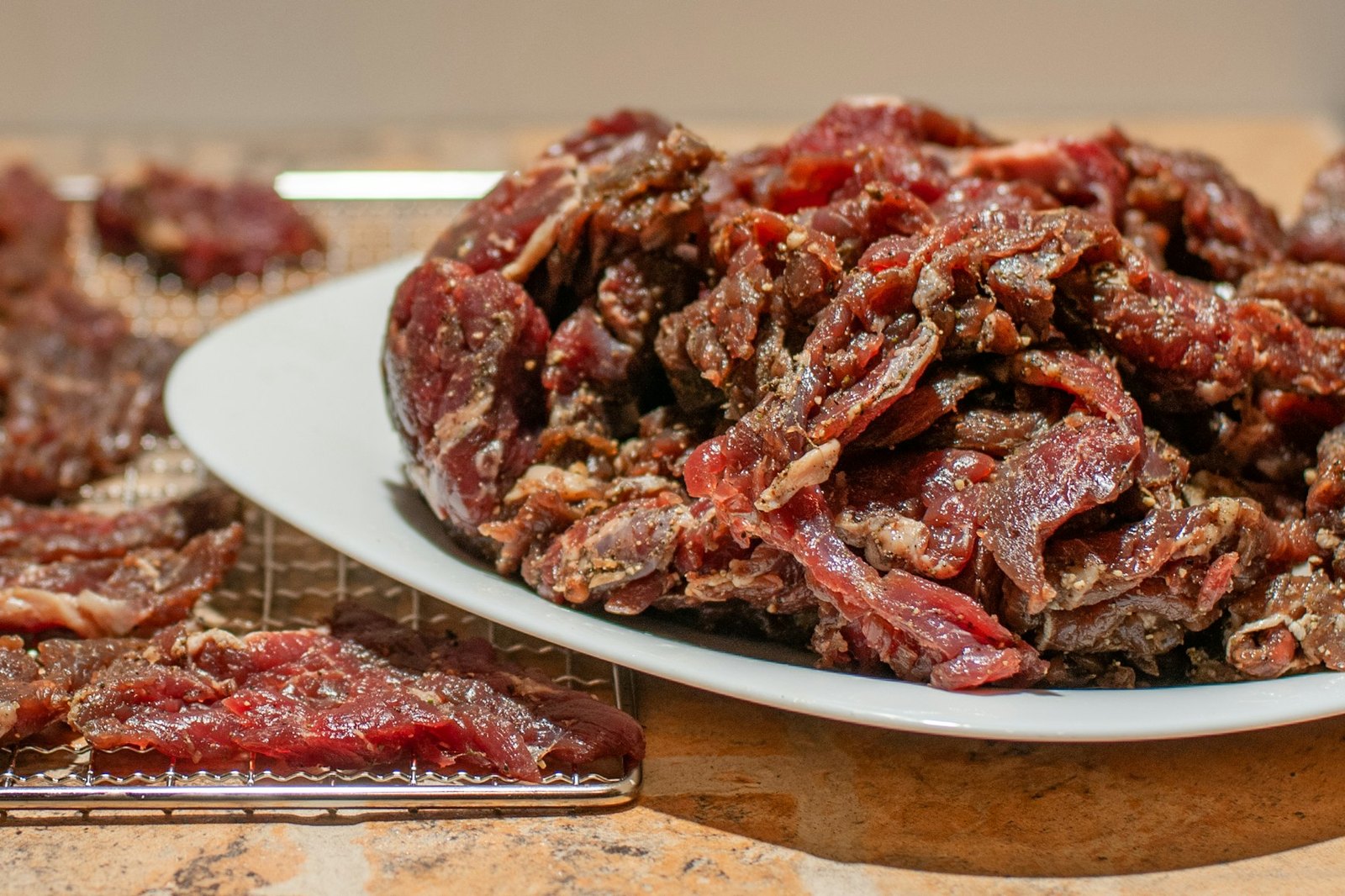


The short version: Charge $10 to $16 for a 3-ounce bag of homemade beef jerky, which works out to about $3.33 to $5.33 an ounce. The low end fits a vendor working in their own licensed space who gets a strong yield. The high end fits a vendor renting kitchen time by the hour. In our planning case, a 3-ounce bag costs $11.41 to make with beef at $8.96 a pound, a rented kitchen and $18 an hour for your time, so $16 leaves you about 29 percent before card fees, or about 24 percent after them. National brands sell standard bags of strip jerky online for $2.00 to $3.75 an ounce, and you will not beat them on price, so do not try.
Checked September 18 to 20, 2026: Bureau of Labor Statistics August 2026 average price for boneless round roast, drying yields from Ohio State and North Dakota State extension, ClearBags' pouch price, the online prices of two national jerky brands, the Homegrown catalog, and the published fees of Etsy, Shopify, Hotplate and Homegrown (card processing on Homegrown is 2.9% + $0.30, charged to the vendor). Kitchen rent, marinade and label costs are stated estimates. Your own receipts beat any average.
A pound of lean round averaged $8.96 at the grocery store in August 2026, and it dries down to between 4 and 6.4 ounces of finished jerky, a quarter to 40 percent of its raw weight. Then you pay for kitchen time, bags and your own hours. This guide works out what each bag size should cost your customer, using August 2026 beef prices, two university drying yields, what national brands charge today, and an hourly rate for the person doing the work.
Sell a 3-ounce bag of homemade beef jerky for $16 if you rent kitchen time by the hour, and for $10 to $13 if you work in your own licensed space or get a better yield than average. That range covers the beef, the marinade, the bag, the kitchen, an hourly wage for you and a margin of roughly 29 to 33 percent before card fees. Price by the ounce first, then by the bag.
If you are still figuring out whether you can legally sell jerky at all, start with how to sell beef jerky from home. That guide covers the licensing paths, food safety, equipment and flavors. This page stays on the money: cost per ounce, bag prices and what a week of sales really pays.
Below is the ladder for this guide's planning case, a vendor renting kitchen time by the hour in a space their state allows for meat:
Every price on that ladder lands between $5.00 and $5.50 an ounce. That is on purpose. When every size sits near the same per-ounce price, customers can see the bigger bag is fair, and you never lose money on the size you sell most.
You cannot match national brand prices because their regular strip jerky sells for $2.00 to $3.75 an ounce, and a small vendor's beef alone costs $1.40 to $2.24 per finished ounce before a single bag, label or kitchen hour. National brands buy beef, bags and labor at a scale no farmers market vendor will ever see. Their price is not your benchmark.
Here is what two well-known jerky brands charged on their own websites on September 18, 2026, per ounce, with this guide's own planning cost and price at the bottom of the chart for comparison:
Price per ounce: national brands vs a small vendor
Source: product listings on peopleschoicebeefjerky.com and righteousfelon.com, checked September 18, 2026. "Your cost" is this article's planning case ($11.41 for 3 ounces). Brand prices are before shipping. The 8-pack and 16-pack rows are case prices; Righteous Felon's single bag is $7.49 for 2 ounces, and People's Choice sells many single 2-ounce bags at $6.99.
What that chart tells you:
The fix is not to cut your price toward $3 an ounce. The fix is to sell what the big brands cannot: fresh batches, local beef if you can get it, flavors made for your town, and a face behind the table. Expect some shoppers to compare you to gas-station prices anyway, and have that answer ready before someone asks it across your table. Where that table sits matters as much as the price on it, and the guide to where to sell beef jerky compares seven places, from a farmers market to Amazon's 8% referral fee, on the same $12 bag.
A pound of raw lean beef makes about 4 to 6.4 ounces of finished jerky, depending on the cut, how hard you trim and how dry you take it. Ohio State University Extension says a pound of meat is typically reduced to about 4 ounces once dried. North Dakota State University Extension puts it higher, at roughly 40 percent of the purchase weight, which is about 6.4 ounces from a pound.
This guide plans on 5 ounces of jerky from each raw pound, which sits between those two numbers. Here is why yield matters more than almost anything else in your price:
That is 19 more bags from the same beef, the same kitchen booking and the same day of your time. Most of what you do to raise yield is trimming smarter and not over-drying. Jerky should crack when you bend it, not snap in half.
Weigh your raw beef after trimming and weigh the finished jerky before you bag it, every batch, for your first 10 batches. Write both numbers down. Your real yield is the single most useful number you will ever put into your price, and it is rarely the number in the recipe.
Beef costs $1.40 to $2.24 per ounce of finished jerky at August 2026 grocery prices. Boneless USDA Choice round roast, a lean cut NDSU Extension names for jerky, averaged $8.96 a pound in August 2026 in the Bureau of Labor Statistics survey of U.S. city prices. Divide that by your yield to get the cost of the beef inside each ounce you sell.
Scroll sideways to see every column.
| Yield per pound of raw beef | Beef cost per finished ounce | Beef in a 3-ounce bag | Beef in an 8-ounce bag |
|---|---|---|---|
| 4 ounces (Ohio State figure) | $2.24 | $6.72 | $17.92 |
| 5 ounces (this guide's planning figure) | $1.79 | $5.38 | $14.33 |
| 6.4 ounces (NDSU figure) | $1.40 | $4.20 | $11.20 |
Beef priced at $8.96 a pound, the Bureau of Labor Statistics August 2026 U.S. city average for boneless USDA Choice round roast, checked September 18, 2026.
A few things push that number around:
Whatever you pay, the beef is the single biggest line in your cost. In the planning case it is $5.38 of the $11.41 it takes to make a 3-ounce bag.
Marinade, seasoning and packaging add about $0.87 to a 3-ounce bag. The marinade is cheap. The bag is not, if you want one that stands up on a table and keeps the jerky fresh.
Here is what this guide counts for a 3-ounce bag:
That comes to $0.57 in packaging and about $0.30 in marinade per 3-ounce bag. A plain vacuum-sealed bag costs less, but it lies flat, hides the product and does not reseal. For a $16 bag, the pouch pays for itself in how it looks on the table.
Kitchen time is the cost most new jerky vendors leave out, and in a rented kitchen it can add $1.00 or more to every ounce you sell. Jerky is slow. Kansas State University Extension says strips that are not heated in marinade first can take 10 to 24 hours to dry, and to start checking pieces after three hours. Even with a pre-cook step, a production day is long.
Many small jerky vendors cannot use their home kitchen. Cottage food laws are written for shelf-stable foods like baked goods, jams and candies, not for dried meat. Some states put that in the statute: Arizona's cottage food law explicitly excludes meat products from cottage food protections, and the National Agricultural Law Center's state cottage-food survey, checked September 20, 2026, names Wyoming's food freedom law as an exception, one that only reaches meat a home producer raised and slaughtered and only if federal law changes to match. Others leave meat to their meat inspection program instead of naming it. Read your own state's allowed list before you plan on your home kitchen, because selling jerky to the public usually means working in a USDA or state inspected plant, or under the federal retail exemption, which covers meat prepared at a retail store and sold to consumers in normal retail amounts. A rented shared kitchen works only where your state's meat program allows retail-exempt processing in it, and only for sales straight to consumers. If you are renting, your kitchen hours belong in your price.
Jerky is a meat product, and the rules for selling it are stricter than for cookies or jam. Before you price anything, call your state department of agriculture and ask three things: how a small producer can legally sell dried meat in your state, whether the kitchen you plan to rent is approved for it, and what your label has to say. Get that answer in writing if you can. Rules change and they vary by state, so price off the rule that is live this season, not off what another vendor did two years ago. Our guide to selling beef jerky from home walks through the common paths.
This guide uses an example of an 8-hour kitchen booking at $25 an hour, $200 in all, for a 40-pound batch of raw beef. Spread over 200 ounces of finished jerky, that is $1.00 an ounce, or $3.00 in every 3-ounce bag. That 8 hours is an assumption, not a promise. It depends on heating the strips in the marinade first, which Kansas State says dries faster than the 10 to 24 hours for unheated strips, and on having enough dehydrator racks to dry all 40 pounds at once. North Dakota State's oven method dries for nine to 24 hours after the cooking step. If your method needs a 12-hour booking and you are there the whole time, rent becomes $4.50 a bag, your pay becomes $3.24, and the 3-ounce bag costs $13.99 to make, which puts its price near $20. Time your own first batch and swap in your real hours. Your kitchen will quote its own rate. If you are still shopping for one, finding and renting a commissary kitchen covers what to ask before you sign.
Ways to shrink this line:
Pay yourself a real hourly wage and put it in the price, because a jerky price that only works when your time is free is not a price. This guide uses $18 an hour. Pick your own number, but pick one.
In the planning case you are in the kitchen for the whole 8-hour booking, slicing, marinating, loading trays, checking doneness, cooling and bagging. That is $144 in wages for 200 ounces of jerky, or $0.72 an ounce. In a 3-ounce bag, it is $2.16.
What your wage covers, and what it does not:
If you skip this line, your price will look profitable on paper and feel like a volunteer job in real life.
The formula is: cost per ounce times bag size, plus packaging, divided by 0.7. Dividing by 0.7 leaves you about a 30 percent margin after every production cost, including your wage, but before card fees. Card processing at 2.9% + $0.30 takes about 5 more points on a $16 bag. Round to a clean number that customers remember.
The same cost-plus method works for anything on your table, and our farmers market pricing guide runs it on baked goods and preserves. Jerky's 29 percent before card fees is on the thin side for a made-by-hand food, mostly because the beef alone eats half the bag; profit margin benchmarks for food products shows where the other categories land.
A 3-ounce bag of jerky costs $6.69 to $11.41 to make, depending on whether you pay kitchen rent and how good your yield is. That is why the right price runs from $10 to $16. Find your row, then use its price.
Scroll sideways to see every column.
| Your setup | Yield per pound | Beef and marinade | Kitchen rent | Your pay | Packaging | True cost, 3 oz bag | Price at about 30% margin before card fees |
|---|---|---|---|---|---|---|---|
| Rented kitchen, average yield | 5 oz | $5.68 | $3.00 | $2.16 | $0.57 | $11.41 | $16 |
| Rented kitchen, strong yield | 6.4 oz | $4.43 | $2.34 | $1.69 | $0.57 | $9.04 | $13 |
| Own licensed space, average yield | 5 oz | $5.68 | $0 | $2.16 | $0.57 | $8.41 | $12 |
| Own licensed space, strong yield | 6.4 oz | $4.43 | $0 | $1.69 | $0.57 | $6.69 | $10 |
All rows: 40 pounds of raw beef at $8.96 a pound (Bureau of Labor Statistics, August 2026, checked September 18, 2026), marinade at an estimated $0.50 per raw pound, one 8-hour production day, your pay at $18 an hour, rent at an example $25 an hour, a $0.42 pouch plus an estimated $0.15 for label and absorber. Rows may be off by a cent from rounding.
How to use this table:
A vendor who works in a licensed space of their own and gets a strong yield can sell a 3-ounce bag for $10 and still pay themselves. Someone paying hourly rent with an average yield who charges $10 is losing about $1.41 on every bag before card fees, and about $2.00 after them.
Price each size at $5.00 to $5.50 an ounce if you rent kitchen time: $11 for 2 ounces, $16 for 3, $21 for 4 and $40 for 8. The per-ounce price drops a little as bags get bigger, which rewards the customer for buying more without giving away your margin.
Scroll sideways to see every column.
| Bag size | True cost | List price | Price per ounce | Margin before card fees | Margin after card fees |
|---|---|---|---|---|---|
| 2 ounces | $7.80 | $11 | $5.50 | 29% | 24% |
| 3 ounces | $11.41 | $16 | $5.33 | 29% | 24% |
| 4 ounces | $15.02 | $21 | $5.25 | 28% | 24% |
| 8 ounces | $29.72 | $40 | $5.00 | 26% | 22% |
Planning case: rented kitchen, 5 ounces of jerky per pound of raw beef, beef at $8.96 a pound (BLS, August 2026, checked September 18, 2026), your pay at $18 an hour. Packaging is $0.57 for the 2, 3 and 4-ounce bags and $0.83 for the 8-ounce bag, which needs a larger $0.68 pouch. Card fees are 2.9% + $0.30, as if each bag were its own order. Margin columns are rounded to the nearest whole percent, so a row can sit up to half a point either side of the exact figure: the 2-ounce bag's after-fee margin is 23.5 percent and the 4-ounce bag's is 24.2 percent.
Some sizing rules that work for jerky:
If you want to sell mixed packs, like three 2-ounce flavors in one bundle, our bundle pricing guide shows how to set a bundle price that keeps your margin.
A jerky vendor who sells 50 three-ounce bags a week at $16 takes in $800, spends about $312 on beef, marinade and packaging, $150 on kitchen rent and $38 on card fees, pays themselves $108 and keeps about $191 in profit on top. That only works if every production day is a full one. The table spreads full 8-hour, 40-pound kitchen days across the weeks they stock, so 50 bags a week means three production days every four weeks, an average of 6 kitchen hours a week. If you instead cook each week's 30 pounds in its own 8-hour day, rent rises to $200, your pay to $144, and profit after your pay falls to about $105. The table below shows three volumes. Card fees use 2.9% + 30 cents per bag, as if each bag were its own online order.
Scroll sideways to see every column.
| Bags a week | Sales | Beef, marinade and packaging | Kitchen rent | Card fees | Your pay at $18 an hour | Profit after your pay | You take home |
|---|---|---|---|---|---|---|---|
| 20 (12 lb raw beef) | $320.00 | $124.94 | $60.00 | $15.28 | $43.20 (2.4 hours a week on average) | $76.58 | $119.78 |
| 50 (30 lb raw beef) | $800.00 | $312.35 | $150.00 | $38.20 | $108.00 (6 hours a week on average) | $191.45 | $299.45 |
| 100 (60 lb raw beef) | $1,600.00 | $624.69 | $300.00 | $76.40 | $216.00 (12 hours a week on average) | $382.91 | $598.91 |
Planning case: 3-ounce bags at $16, 5 ounces of jerky per raw pound, round roast at the August 2026 BLS average, kitchen at an example $25 an hour, card processing at 2.9% + $0.30 per bag. Kitchen rent and your pay assume every production day is a full 8-hour booking drying a 40-pound batch, run as often as the volume needs: about three days every ten weeks for 20 bags, three days every four weeks for 50, and six days every four weeks for 100. At 20 bags a week that is one production day about every three weeks, so the 20-bag row assumes you refrigerate what you do not sell in the first two weeks of a batch (see the shelf-life note below). The hours shown are the weekly average.
Three costs are not in those rows:
The 20-bag week is a realistic starting point for a part-time vendor, but only if you make it in full batches. Cooking 12 pounds of beef in its own 8-hour day every week costs $200 in rent and $144 in wages, which turns the $77 profit in the table into a loss of about $164 after your pay. Even if you keep the whole $144 wage, you end the week about $20 down. Run one full 40-pound day instead. It makes 66 bags, about three weeks of stock at 20 bags a week, and keeps rent at $3.00 a bag. Making 40 bags every other week in its own 8-hour day is better than weekly half-batches, but it still leaves only about $16 in profit after your pay every two weeks.
The price you set at the kitchen table is only worth something if your ordering setup lets you keep it. When your margin is about $4.60 a bag before any fees, a percentage fee on every sale or a surcharge on your customer's total adds up fast. On Homegrown you pay $10 per month, with no percentage fees beyond standard payment processing, or $12.50 a month without the annual plan. Card processing runs 2.9% + $0.30 per order and is deducted from your payout, not tacked onto the shopper's total. A regular who picks up two 3-ounce bags, $32 in all, sees $32.00 at checkout. If they choose local delivery instead, they also pay the flat delivery fee you set, and you keep all of it apart from card processing.
Here is that same $32 jerky order on four setups jerky vendors often weigh:
Swipe the table left to compare all four setups on one $32 order.
| Where the order is placed | Subscription | Trial | Service or platform fee | Card processing | Customer pays on a $32 order | You pay on a $32 order | You pay on 50 orders of $32 a month |
|---|---|---|---|---|---|---|---|
| Homegrown | $10/mo billed annually, $12.50/mo billed monthly | 7 days, no charge until day 8 | $0, no commission | 2.9% + $0.30, paid by you | $32.00 | $1.23 plus the plan | $71.40 ($61.40 in card fees plus $10) |
| Etsy | $0 (a one-time shop set-up fee may apply) | None, no plan to try | $0.20 per item listed or renewed, plus 6.5% of the sale, paid by you | 3% + $0.25, paid by you | $32.00 plus shipping | $3.69 ($0.40 listing renewals, $2.08 transaction fee, $1.21 processing) | $184.50 |
| Shopify Basic, paid yearly | $29/mo ($39/mo paid monthly) | 3 days, then $1/mo for 3 months | $0 with Shopify's own payments | 2.9% + $0.30, paid by you | $32.00 plus shipping | $1.23 plus the plan | $90.40 ($61.40 in card fees plus $29) |
| Hotplate, default setting | $0 | None, no plan to try | 5% + $0.55, paid by the customer | 2.9% + $0.30, paid by you | $34.15 | $1.29 | $64.52 |
Sources: Etsy's fees and payments policies, Shopify's pricing page and the Homegrown signup page, loaded September 18, 2026, and Hotplate's pricing page, reloaded September 20, 2026. Processing on the first three rows is figured on the $32 subtotal and leaves out tax, tips and shipping. Hotplate is the one row where the card is not run for the subtotal: its 5% + $0.55 service fee rides on top, so the customer's card is charged $34.15 and your processing on that is $1.29, not the $1.23 a bare $32 would cost. Tax and tips push the charge higher still on every platform, Hotplate included. Hotplate's own pricing page shows $1.27 in vendor processing on an order with a $30 subtotal, a $3 tip and $2.55 in sales tax, above the $1.17 a bare $30 would cost. Etsy's 6.5% also applies to any shipping you charge, and Etsy can add Offsite Ads fees on some sales.
Etsy fits a jerky vendor who ships across the country to strangers and wants Etsy's search to find them, and on this order it keeps $3.69 of your $32. Shipping jerky to another state generally takes federal inspection, since state meat inspection programs cover products sold within the state unless the plant is in the Cooperative Interstate Shipment program, so check with your state department of agriculture before you list jerky for national shipping. Shopify Basic fits a vendor building a shipping brand with their own website, at $29 a month before a single sale. Hotplate costs you nothing monthly and suits scheduled drops with one pickup window. It charges a 5% + $0.55 service fee per order, which is $2.15 on this order. By default that fee rides on top of your customer's total, which is the row in the table above, but Hotplate's own pricing page says you can pay the fee yourself instead and leave your customer at $32.00. Absorbing it costs you about $2.15 an order and puts you near Homegrown's cost with no monthly plan, so decide which side of the ticket you want it on before you open a drop.
Where Homegrown fits a jerky vendor:
Where it falls short for jerky: it will not work out your cost per ounce, and it will not get you licensed to sell meat. The Homegrown signup page lists pickup and local delivery within a radius you set plus a flat delivery fee you keep, and no shipping option, so a customer three states away is better served by a shipping store, as long as your jerky is made under the federal inspection that shipping across state lines generally requires. First-time buyers create a Homegrown account at checkout. Timed limited-release batches are not there yet either: Homegrown's own feature list, checked September 20, 2026, marks drops, meaning limited-release windows with a vendor-set order count, as in development, so a numbered Friday batch is something you announce and cap by hand today. Your storefront is listed in the Homegrown marketplace too, but expect the bulk of your orders to come from regulars you point to your own link.
Sell jerky by the pound only as a custom or pre-paid order, and price it at $5.00 an ounce or more, which is $80 a pound in the rented-kitchen planning case. A pound of jerky takes about 3.2 pounds of raw beef at a 5-ounce yield, so the beef alone is about $28.67 before rent, labor or packaging.
A national brand sold a 1-pound bag for $31.99 on September 18, 2026. You will never match that, and a customer who wants a pound at that price will buy it online. The customers who order a pound from you want something specific:
For these, take the order ahead with payment, make it in your next batch, and bag it in 8-ounce pouches so it stays fresh after opening. Two 8-ounce bags at $40 each is $80, which is the same per-ounce price as your 8-ounce bag and keeps your math simple.
Charge stores about $12 for a 3-ounce bag once you are working in your own licensed space at an average yield. That is the $8.41 that bag costs you divided by 0.7, the same cost-plus step you used for your retail price, and it leaves you the same rough 30 percent. In the rented-kitchen planning case there is no wholesale price that works at all: the bag costs $11.41 to make, $11.41 divided by 0.7 is $16.30, and a shop keeping 40 percent would have to put that bag on the shelf at $27. If a shop wants to keep 40 percent of a normal $16 shelf price, your bag has to sell to them for $9.60, and that is $1.81 under the $11.41 it costs you to make.
That does not mean wholesale is off the table. It means wholesale works once your jerky is made under inspection and your costs drop:
Selling jerky to a store for resale generally requires USDA or state inspection, with the inspection mark on the label. Under the federal retail exemption rules, meat prepared without inspection can be sold to consumers, not to another business to resell. The rule counts a restaurant or hotel as a consumer, but it separately bars a retail-exempt kitchen from curing, cooking or smoking product for anyone other than a household consumer, at 9 CFR 303.1(d)(2)(iii)(f), so your jerky cannot go to a restaurant under it either. Check your state's current rules with its department of agriculture before you quote a store a price. Then check your margin with our guide to setting wholesale prices.
Raise your jerky prices when your beef cost per ounce moves by 10 percent or more, because beef is about half of your cost. That has already happened. Boneless round roast averaged $7.16 a pound in August 2024, $8.13 in August 2025 and $8.96 in August 2026 in federal price surveys. That is a 25 percent rise in two years.
Beef prices move every month. Round roast averaged $8.55 a pound in January 2026 and $8.96 in August, according to BLS figures checked September 18, 2026. That rise alone added about 25 cents to the beef in every 3-ounce bag between January and August. If you set your price in the winter and never check it, your margin shrinks a little every month beef climbs.
A simple schedule:
This guide to raising prices has the wording for that note, and a whole section on what to say if a regular pushes back on the new number. For how other vendors handle a sudden jump in ingredient costs, see what to do when ingredient prices spike.
The most expensive error is pricing by the pound of raw beef instead of by the ounce of finished jerky. A vendor who thinks "beef is $9 a pound, so a pound of jerky should be about $20" is losing money on every bag, because that pound of jerky took about 2.5 to 4 pounds of raw beef, which is $22.50 to $36 of beef at $9 a pound before a single bag or kitchen hour.
Other mistakes that show up again and again:
When we pulled every listing on Homegrown on September 18, 2026, we counted 2,485 products from 288 vendors, and not one was beef jerky. The only meat snacks were two beef sticks: a single stick at $5 from one ranch and mini beef sticks listed at $1.50 from one farm, with no unit count given on the listing. Jerky is rare on Homegrown right now, which is one more reason your price should reflect a product customers cannot get from the booth next to you.
Sell homemade beef jerky for $10 to $16 per 3-ounce bag, or about $3.33 to $5.33 an ounce. The high end is for vendors paying hourly kitchen rent at an average yield. The low end fits a vendor with their own licensed space and a strong yield. Figure your own cost first, then divide by 0.7.
A 3-ounce bag costs $6.69 to $11.41 to make, counting beef, marinade, a stand-up pouch, a label and your time. Beef is the biggest piece, at $4.20 to $5.38 a bag: $4.20 at the strong 6.4-ounce yield behind the $6.69 bag, and $5.38 at the average 5-ounce yield behind the $11.41 bag. Rented kitchen time adds about $3.00 a bag in the planning case.
National brands charged between $2.00 and $3.75 per ounce for their regular strip-jerky bags on their own websites on September 18, 2026. A small vendor who counts every cost usually needs $3.33 to $5.50 an ounce to make a profit, with $5.50 being the 2-ounce bag in a rented kitchen. Sell on what a national brand cannot offer, like fresh batches and flavors made by someone the customer can talk to, and expect some shoppers to compare you to national prices anyway.
A pound of raw lean beef makes about 4 to 6.4 ounces of jerky. Ohio State's extension service says about 4 ounces, and NDSU's says close to 40 percent of the raw weight. Weigh your own batches to find your real number.
Selling beef jerky can be profitable if you price by the finished ounce and count kitchen rent and your time. At $16 for a 3-ounce bag, 50 bags a week pays you $108 for an average of 6 kitchen hours a week plus about $191 in profit before booth fees, as long as you make it in full 40-pound, 8-hour production days. Priced like a national brand, it loses money on every bag.
Keep one price for the same bag everywhere, and bring your 2-ounce bags and samplers to events instead. Those are your impulse sizes: a 2-ounce bag at $11 and a 3-flavor sampler are easy first buys for someone walking past your table. A different price at every event confuses regulars who follow you from market to market.
These guides cover the parts of a jerky business that sit around the price tag.
Beef jerky looks like a high-margin snack until you weigh what comes out of the dehydrator and add up the kitchen hours. Price by the finished ounce, charge $10 to $16 for a 3-ounce bag depending on your setup, check your beef receipts every month, and when you want regulars ordering ahead of each batch, open a jerky storefront on Homegrown.



