
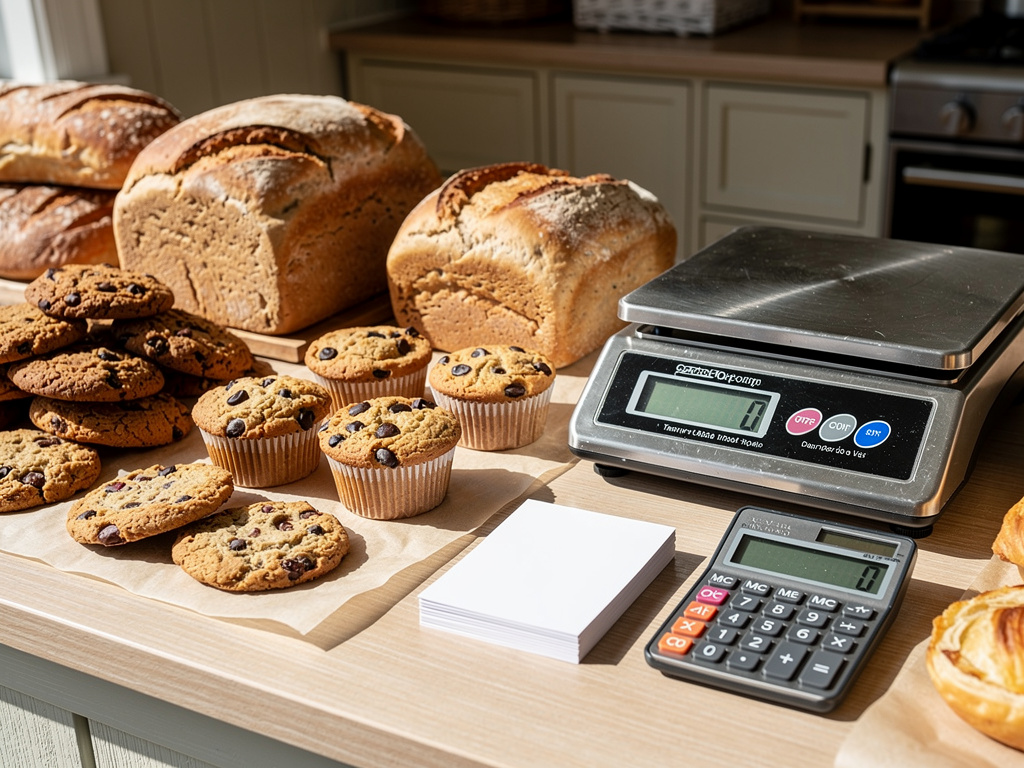


You're pricing your products and you want to know: am I making a healthy margin, or am I leaving money on the table, or worse, losing it? Profit margin, the percentage of each sale you keep after costs, is one of the most important numbers in a food business, and it varies a lot by product type. Baked goods, jams and preserves, and prepared foods each have different cost structures and typical margins, and knowing roughly where healthy margins fall helps you price with confidence and spot problems early. This guide explains what profit margin is, how it differs across food product types, how to calculate yours, and how to use benchmarks without treating them as gospel.
The short version: Profit margin is the percentage of each sale you keep after your costs, and it's a key measure of a food business's health. Different products have different typical margins because their cost structures differ, low-ingredient-cost items like baked goods and jams often support higher margins than ingredient- or labor-heavy prepared foods. But benchmarks are rough guides, not rules; your actual margin depends on your specific ingredient costs, labor, packaging, and pricing. The important thing is to calculate your own margin per product, compare it loosely to typical ranges, and make sure every product earns a healthy margin. Use benchmarks to sanity-check, not to set prices blindly.
This guide covers what profit margin is, how it varies by product type, how to calculate yours, and how to use benchmarks wisely.
Profit margin is the percentage of each sale you keep after subtracting your costs, a core measure of how profitable each product and your business is. It matters because it tells you whether your pricing actually makes money.
Why profit margin matters:
Two related terms:
Profit margin is arguably the most important number in your food business because it answers the fundamental question: does each product actually make money, and how much? A product can sell well and still lose money if its margin is negative, and knowing your margins per product tells you which to promote, which to reprice, and which to reconsider. Understanding the difference between gross margin (after direct product costs) and net margin (after all costs) matters too. Getting a handle on your costs and margins is foundational to running a healthy business, which the U.S. Small Business Administration's guidance on managing your business addresses.
Margins differ across food products mainly because of their cost structures, low-ingredient-cost, shelf-stable items like baked goods and jams often support healthier margins than ingredient-heavy or labor-intensive prepared foods. Knowing the general pattern helps you set expectations.
General patterns by product type (rough tendencies, not rules):
Why the differences exist:
The broad pattern is that products with low ingredient costs and long shelf lives, like many baked goods and jams, tend to support healthier margins, while ingredient-heavy, labor-intensive, or perishable prepared foods often run thinner. But these are tendencies, not guarantees: a heavily decorated cake can have a worse margin than a simple jam, and a premium confection priced well can beat both. The point is to understand what drives margin, ingredient cost, labor, shelf life, packaging, so you can see why your products land where they do and price accordingly. Charcuterie boards show the pattern clearly: a $75 board for six carries about $29.59 in food and packaging, and prosciutto alone is $5.29 of it, which is why the charcuterie board pricing guide prices by the guest instead of by the board.
You calculate profit margin by figuring your total cost to make a product, subtracting it from the price, and expressing the profit as a percentage of the price. It's a simple calculation that requires knowing your true costs.
Steps to calculate margin:
Common mistakes that distort margin:
The calculation itself is simple, price minus cost, divided by price, but its accuracy depends entirely on knowing your true, complete cost per unit. The most common error is undercounting costs: forgetting packaging and labels, ignoring the value of your labor, or not accounting for waste on perishables. Any of these makes your margin look healthier than it is and can lead you to underprice. So be thorough and honest about every cost that goes into a product, including your time. Once you know your real cost, the margin calculation is straightforward, and you'll know exactly which products are pulling their weight.
You should use margin benchmarks as rough sanity-checks, not rigid rules, comparing your calculated margins loosely to typical ranges to spot problems, while recognizing that your specific costs and market determine what's right for you. Benchmarks guide; they don't dictate.
How to use benchmarks well:
Why benchmarks aren't gospel:
Benchmarks are useful as a reality check, if your cookie margin is dramatically below what's typical for baked goods, something's probably off, but they're not rules to price by. Your actual costs and your local market determine what margin is right and achievable for you, and forcing a price purely to hit a benchmark can misprice for your reality. Use benchmarks the way you'd use a map's rough distances: helpful for orientation, not a substitute for knowing your own terrain. The real work is calculating your own margins accurately and making sure each product earns enough to be worthwhile. Growing profitably depends on this kind of understanding, which the U.S. Small Business Administration's guidance on growing your business supports.
Your margin is what's left after costs, including any fees you pay to sell, so keeping selling costs low directly protects your margin. Homegrown is $10 a month with no percentage fees beyond standard payment processing, which means the platform doesn't take a cut of every sale the way percentage-based marketplaces do.
How it compares to the alternatives:
The margin math is simple: on a percentage-fee marketplace, a portion of every sale leaves your margin, while a flat $10 a month means your per-sale margin (beyond standard processing) stays with you. For a small vendor, keeping that percentage protects real money as your sales grow. When you're ready to sell in a way that protects your margins, you can set up your storefront today.
The biggest mistakes are undercounting costs (which inflates your apparent margin) and treating benchmarks as rules instead of guides. Because margin accuracy depends on knowing true costs, the errors that matter most involve cost calculation and benchmark misuse.
Mistakes to avoid:
Getting these right means calculating accurate, complete costs per product, using benchmarks as sanity-checks, and ensuring every product earns a healthy margin for your actual situation.
There's no single "good" margin, it varies by product type and your specific costs and market. Low-ingredient-cost, shelf-stable items like baked goods and jams often support healthier margins, while ingredient-heavy or labor-intensive prepared foods run thinner. Rather than chasing a universal number, calculate your own margin per product and make sure each earns enough to be worthwhile after all your costs, including labor. Use rough benchmarks as a sanity-check, but your real costs and what customers pay determine what's right for you.
Total your complete cost per unit (ingredients, packaging, labels, a value for your labor, and a share of overhead), subtract that cost from your price to get profit per unit, then divide profit by price and multiply by 100 for your margin percentage. For example, a $10 product costing $4 to make earns $6 profit, a 60% margin. Calculate it per product, and be thorough about costs, undercounting (especially labor and waste) inflates your margin and can lead to underpricing.
Jams and preserves often have low ingredient costs (especially with seasonal or homegrown produce) and are shelf-stable with little waste, which supports healthier margins, though jars and packaging add some cost. Prepared and perishable foods typically involve higher ingredient costs (proteins, fresh produce), more labor, and shorter shelf lives with potential waste, all of which compress margins. The difference comes down to cost structure: cheap, shelf-stable ingredients support higher margins than costly, perishable, labor-heavy ones. These are tendencies, though, not guarantees.
No, benchmarks are rough guides, not rules to price by. Your actual costs and your local market determine what margin is right and achievable for you, and forcing a price purely to hit a benchmark can misprice for your reality. Use benchmarks as a sanity-check: if your margin is far below typical for your product type, investigate. But base your actual prices on your real costs plus a healthy margin and what your customers will pay, not on matching an average that may not reflect your situation.
Yes, ideally you should include a value for your labor, because your time has real value and ignoring it makes your margins look healthier than they truly are, which can lead to underpricing. If you leave labor out, you might think a product is profitable when it barely pays you for your time. Including a fair value for your labor gives you an honest margin and ensures your prices actually compensate you. This is especially important for labor-intensive products like decorated cakes, where time is a major cost.
Recalculate whenever your costs change meaningfully, ingredient prices rise, packaging costs shift, or you change a recipe, and periodically as a general check. Costs creep up over time, and a margin that was healthy a year ago can quietly erode if your prices haven't kept pace with rising ingredient costs. Making margin review a regular habit (say, seasonally or when you notice cost changes) keeps your pricing healthy and catches problems before they eat into your profit. Don't set prices once and never revisit them.
Profit margin is a core measure of your food business's health, and it varies by product type because cost structures differ, but benchmarks are guides, not rules. Calculate your own complete costs per product, ensure each earns a healthy margin, and use benchmarks only to sanity-check. And to sell in a way that protects your margins with a flat fee instead of a percentage cut, set up a Homegrown storefront today.



