
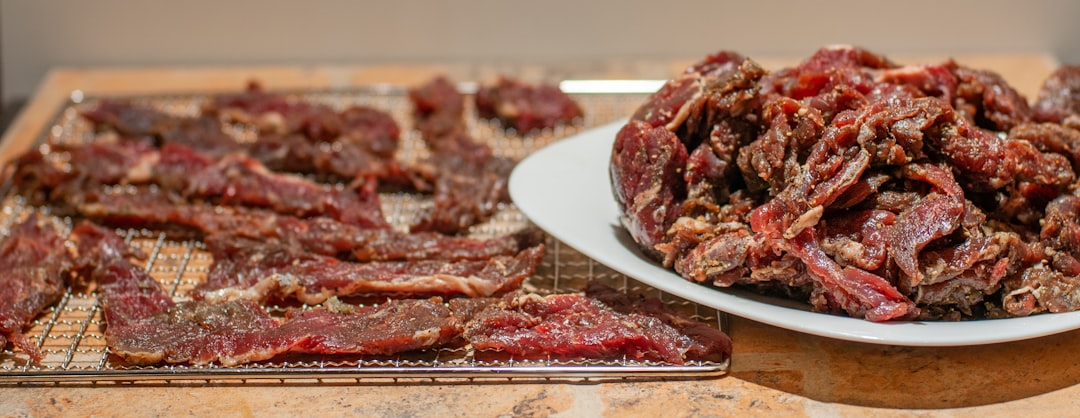


The short version: In 7 of the 8 states we read on October 6, 2026, you cannot make beef jerky in your home kitchen and sell it under the state's home-food program: 5 exclude meat by name, and 2 more leave it off their approved lists. The paths that work are a USDA-inspected co-packer that makes your recipe, your own inspected plant, a state-inspected plant in any of the 30 states that run one, or a licensed retail store selling to household customers under the federal retail exemption. Colorado is the one to watch: starting January 1, 2027, its health department lists beef jerky made from USDA-inspected meat as an approved cottage food, with no vacuum packing allowed, but the department calls those pages "for information purposes only" and they do not say how the law fits federal meat inspection, so get its answer in writing first. In our planning case a 3-ounce bag costs $11.41 to make in a rented kitchen and sells for $16, and an equipment kit runs $563.61 for a starter set to $1,148.61 for a bigger one.
Checked October 6, 2026: 9 CFR 303.1 on eCFR, the USDA Food Safety and Inspection Service list of state inspection programs (last updated December 17, 2025), the cottage food or food freedom rules of Colorado, Texas, California, Ohio, Pennsylvania, Utah, Wyoming and North Dakota, the Bureau of Labor Statistics August 2026 beef price, WebstaurantStore and ClearBags supply prices, and the pricing pages of Homegrown, Etsy, Shopify and Square. Homegrown customers create an account to place their first order, Homegrown does not ship, and there is no drops feature. Rules change, so verify your state's current rules with your state department of agriculture before you spend money.
Once your jerky is made in an inspected kitchen, you can set up a Homegrown storefront so local customers can order ahead, and try it free for 7 days.
Beef jerky is a food many home cooks want to sell. It is shelf-stable, light and easy to carry to a market. But selling beef jerky from home is a lot harder than selling cookies, jam or bread. Meat faces stricter rules than almost any other food you can make.
This guide covers the legal rules, the pathways that actually work for small producers, the food safety rules you cannot skip, equipment, real costs and pricing, packaging and labels, and where to sell your jerky once you are legal. If you only want the legal question answered in depth, our guide to whether you can sell homemade beef jerky goes deeper on the federal law and each exemption. This page is the how-to: what to do, in what order, and what it costs.
For most people the answer is no, at least not jerky made in your own home kitchen. Beef comes from cattle, and federal law requires meat from cattle to be made under inspection before it is sold, with a short list of exemptions. Cottage food laws, the state laws that let you sell low-risk food from home, do not change that federal rule, and 5 of the 8 we read name meat as excluded, with 2 more leaving it off their approved lists. The federal rule does not say outright whether a home kitchen can ever qualify for the retail exemption in 9 CFR 303.1(d), so if you want to try, put that question to FSIS through askFSIS, or to your state, in writing.
"From home" can still describe your business. Plenty of jerky vendors run the whole business from their kitchen table: the recipe, the brand, the orders and the market booth. The difference is where the meat gets cooked and dried. That happens in a plant or store that is allowed to make meat products for sale.
Cottage food laws were written for foods that stay safe on a shelf without special handling, like baked goods, jams and dry mixes. Meat is the food regulators worry about most, because raw beef can carry E. coli O157:H7 and Salmonella, and a drying mistake can make people seriously sick. So state programs either name meat as excluded, or leave it off the list of foods they approve.
We read the home-food rules of 8 states on October 6, 2026. Five name meat as excluded, two leave meat jerky off their approved lists, and one lists jerky on a registration form while federal meat law still covers beef. Here is what each one says.
Scroll sideways to see all 8 states and every column.
| State | Program we read | What it says about meat or jerky | Home-kitchen beef jerky today |
|---|---|---|---|
| Texas | Department of State Health Services, cottage food production page | Allowed foods are "any foods, except" a list that starts with "meat, meat products, poultry, or poultry products" | Not allowed; meat named as excluded |
| Colorado, current rule | Department of Public Health and Environment, cottage foods page | Ineligible: "Any meat product such as bacon, jerky, chicharron, poultry, fish and shellfish products" | Not allowed until January 1, 2027 |
| Colorado, from January 1, 2027 | Same department, 2027 Tamale Act food eligibility page | Approved list includes "Jerky (Beef, Turkey, Pork)"; meat must come from USDA-inspected sources; no reduced oxygen packaging; no curing for preservation | Listed as approved under the new law |
| California | Department of Public Health, Approved Cottage Foods list, last reviewed April 2026 | The dried foods category names fruit, vegetables, herbs, mixes and similar items; meat jerky is not named | Not on the approved list |
| Ohio | Department of Agriculture, cottage food page | Permits a fixed list (bakery products, jams, candy, granola and similar); foods "not listed above" and "potentially hazardous foods" such as "raw or cooked animal products" are not permitted | Not on the permitted list |
| Pennsylvania | Department of Agriculture, limited food establishment application packet, Rev 10-2024 | The product checklist includes "Beef/Meat Jerky," and only non-TCS foods (foods that do not need refrigeration for safety) are allowed | Sources disagree; confirm with the department in writing |
| Utah | Department of Agriculture and Food, Home Consumption and Homemade Food Act page | "Foods NOT allowed" starts with "Meat," with "some exemptions" for poultry and rabbit | Not allowed; meat tops the not-allowed list |
| Wyoming | Food Freedom Act, W.S. 11-49-103 | Sales must "Not involve the sale of meat products," except small-scale poultry, rabbit, some farm-raised fish, animal shares and a beef provision that waits on a change in federal law | Not allowed for store-bought beef |
| North Dakota | Cottage Foods Act, N.D.C.C. 23-09.5-02 | Sales may not "Include the sale of uninspected products made from meat," with a narrow poultry exception | Not allowed; uninspected meat products barred |
We read each state's page, packet or statute on October 6, 2026. Colorado appears twice because its current rule and its 2027 rule differ. Count by state: Texas, Colorado (current rule), Utah, Wyoming and North Dakota exclude meat by name; California and Ohio leave meat jerky off their approved lists; Pennsylvania lists it on a form. We did not read the other 42 states for this guide, so check yours in our cottage food laws by state guide and then with your state agency.
Pennsylvania's limited food establishment packet (Rev 10-2024, read October 6, 2026) has a "Beef/Meat Jerky" checkbox and lists "beef/meat Jerkies" under dehydrated foods. The same registration covers wholesale and internet sales, and the federal meat rule in 9 CFR 303.1 only exempts meat products sold "to consumers only" by a retail store. Those two sources do not line up for beef. Before you make a single batch in a Pennsylvania home kitchen, ask the Pennsylvania Department of Agriculture's Bureau of Food Safety, in writing, whether your beef jerky needs USDA inspection.
Even though your home kitchen is likely off-limits for jerky production, four legal pathways exist for small producers, and one common idea that is not a pathway at all.
Beef jerky is not a product you can start making and selling tomorrow. The legal work comes first, and the vendors who do it upfront can sell in places home-kitchen jerky cannot.
The first step is always to contact your state department of agriculture and ask specifically about selling dried meat products as a small producer. Every state handles this differently, and the rules change. Before that call, it helps to know two federal numbers: 30 states operate a state meat inspection program, and the federal retail exemption lets a store sell up to $109,600 a year in 2026 to restaurants, hotels and similar buyers. That restaurant allowance covers only cutting, grinding, breaking bulk and wrapping or rewrapping. So a store can rewrap jerky made in an inspected plant and sell it to a restaurant, but jerky the store cures, cooks or smokes itself can go to household customers only.
Colorado's health department says that starting January 1, 2027, home cooks registered under its new cottage food law can sell beef jerky made from USDA-inspected meat, as long as it is not vacuum packed. The Colorado Department of Public Health and Environment says its new Cottage Food Act, the "Tamale Act" (HB26-1033), starts January 1, 2027 and "now allows meat and meat products." Its 2027 food eligibility page lists "Jerky (Beef, Turkey, Pork)" among approved foods. Until that date, the current page still lists jerky as ineligible.
Read on the department's 2027 Tamale Act food eligibility page and its other 2027 pages on October 6, 2026: meat must be purchased from an "approved source," which the department defines as USDA-inspected meat; "Food packaged in reduced oxygen packaging is not allowed under the act (vacuum packaged fish or beef jerky)"; "Curing for preservation is not allowed"; "Smoking as a method of preservation is not allowed"; and "Smoking for flavor is allowed, but food must be refrigerated." You register with the department every year, hold a Colorado State University cottage food training certificate or an equivalent, and keep total sales at $150,000 or less a year. The department says the 2027 pages are "for information purposes only" until the law starts.
What that means if you live in Colorado:
Colorado's page does not explain how the new law fits with the federal meat rules, so email the program (cdphe_cf@state.co.us) and get a written answer before you plan a 2027 launch. Our guide to the Colorado cottage food law covers the rest of the state's rules.
Where your jerky is made decides who you can sell it to. A USDA plant opens every door, a state plant keeps you inside your state, and a retail-exempt store keeps you selling to household customers. Pick the path that fits where you want to sell, not the other way around.
Scroll the table sideways to compare the four production paths.
| Where the jerky is made | Who approves it | Other states and online shipping | Stores and wholesale | Household customers |
|---|---|---|---|---|
| USDA-inspected plant (yours or a co-packer) | USDA Food Safety and Inspection Service | Yes. FSIS says "All plants under Federal inspection are eligible to sell in interstate commerce" | Yes | Yes |
| State-inspected plant | Your state's meat inspection program, in one of 30 states | No, unless your state runs the Cooperative Interstate Shipment program and the plant is in it (10 states did as of August 19, 2026) | Yes, inside the state | Yes, inside the state |
| Licensed retail store under the retail exemption | Your state or county retail food regulator | Ask your regulator; the rule is written around sales "to consumers only" | No | Yes, at least 75 percent of the store's meat sales must go to households |
| Custom-exempt processor | Exempt from inspection | No | No | No. Marked "Not for Sale" |
Sources read October 6, 2026: 9 CFR 303.1 on eCFR, the FSIS State Cooperative Inspection Programs page (last updated June 24, 2026), the FSIS list of states with and without inspection programs (last updated December 17, 2025) and the FSIS Cooperative Interstate Shipment program page (last updated August 19, 2026). That newer CIS page says 29 states have a program while the list says 30, so ask your state whether its program is active.
The federal rule behind the retail exemption is 9 CFR 303.1. It lists "Curing, cooking, smoking" among the normal operations of a retail store, which is why a butcher shop can make jerky. It also says sales must be made "to consumers only," that at least 75 percent of sales by dollar value go to household consumers, and that only "federally or State inspected and passed product" goes into what the store makes.
The 30 state programs, per the USDA list: Alabama, Arizona, Arkansas, Delaware, Georgia, Illinois, Indiana, Iowa, Kansas, Louisiana, Maine, Minnesota, Mississippi, Missouri, Montana, Nevada, North Carolina, North Dakota, Ohio, Oklahoma, Oregon, South Carolina, South Dakota, Texas, Utah, Vermont, Virginia, West Virginia, Wisconsin and Wyoming. Arkansas, Georgia, Oregon and South Dakota inspect meat only, not poultry. In the other 20 states, including California, Colorado, Florida, New York and Pennsylvania, inspected jerky means a USDA plant.
Starting a beef jerky business takes 7 steps, in this order: the legal path first, then the recipe, then the sales channel. It is easy to do it backward: perfect a recipe in a home dehydrator, sell a few bags to friends, and only then find out your kitchen does not count. This order saves you that detour.
Yes, and for most people starting a beef jerky brand, a co-packer is usually the quickest legal route to start, because you spend $0 on equipment and the plant's inspection covers every bag. A co-packer is a plant that makes food for other brands. A USDA-inspected co-packer makes your recipe under its own inspection, packs it in your bags, and you sell it under your brand name.
Federal labeling rules allow this. Under 9 CFR 317.2, a meat label shows "The name and place of business of the manufacturer, packer, or distributor for whom the product is prepared," so the label can carry your business as the company the jerky was made for, next to the plant's inspection mark and establishment number.
Questions to ask a co-packer before you sign anything:
We did not find published co-packer rates to quote, because plants price each job by quote. Ask at least three plants for a quote on the same recipe and the same bag size so you can compare like for like.
Every batch of jerky you sell needs a heating step that kills bacteria and a drying step, and the meat has to be handled like raw meat until both are done. In a home kitchen, including a registered Colorado cottage kitchen from 2027, the USDA's Meat and Poultry Hotline recommends heating beef to 160°F inside before drying. An inspected plant uses the validated time and temperature its food safety plan names: the FSIS jerky guideline gives 160°F as one option and points to the time and temperature tables in its Appendix A. When jerky will sit in open air, that guideline says a water activity of 0.85 or lower should control bacteria and mold. The stakes are higher than with baked goods, because jerky that is not heated and dried properly can cause serious illness. Mistakes cost money too: a pound of raw beef dries down to about 4 ounces of jerky, according to the USDA, so a ruined tray is a lot of beef thrown away.
The USDA's Meat and Poultry Hotline recommends heating beef to 160°F and poultry to 165°F before you dehydrate it. Its jerky food safety page explains why: a dehydrator running at 130 to 140°F may never get the meat hot enough to kill bacteria, and bacteria become more heat resistant as the meat dries. After the heating step, the USDA says to dry at a steady 130 to 140°F. North Dakota State University Extension's jerky making guide gives the same 160°F target and dries at 140 to 150°F.
There are two ways to reach that temperature.
Handle jerky meat like the raw meat it is until it has been heated to 160°F: thin slices, cold storage, clean hands. The University of Arkansas Extension's guide on making safe jerky lists the handling steps that matter most.
Two more from the same guide: pork and wild game need a freezing step against the trichinella parasite before slicing, and ground meat is harder to make safe than whole strips. If you are new, start with whole-muscle beef.
Water activity is the lab measure of how much water in a food is free for bacteria to use, on a scale from 0 to 1. The FSIS compliance guideline for jerky made by small plants says a water activity of 0.85 or lower should control the growth of the bacteria of concern, and mold, for jerky stored in open air. For jerky vacuum packed in oxygen-proof packaging the limit can be 0.91 or lower, but then the bag needs a statement like "Refrigerate After Opening."
A plant measures this with a water activity meter, and for jerky you sell, that reading is the test that counts. That missing meter is the reason home jerky gets about a 2-week shelf window while plant jerky is rated for 12 months, and our guide to how long homemade jerky lasts lines up all four official storage times side by side. The extension guides give a simpler check for home batches and test runs: Arkansas Extension dries "until a test piece cracks but does not break when it is bent," and North Dakota State says properly dried jerky "should crack when bent in half but should not break into two pieces." If it bends without cracking, it is not dry enough.
How long jerky keeps depends on who made it.
Weigh every batch raw and finished for your first 10 batches and write both numbers down. The USDA says a pound of meat dries to about 4 ounces of jerky, and North Dakota State's recipe gets 2 pounds from 5, which is 6.4 ounces a pound. On a 40-pound production day that is the difference between 53 three-ounce bags and 85, and it changes every price you set.
A basic kit for making jerky costs $563.61 to $1,148.61 at prices we loaded on October 6, 2026, and what you buy depends on your path. If a co-packer makes your jerky, you need almost none of this, because the plant uses its own equipment. If you run a retail-exempt store, will register under Colorado's 2027 law, or are building toward your own plant, here is the basic kit, priced on WebstaurantStore and ClearBags on October 6, 2026. Colorado cottage producers skip the vacuum sealer, because the 2027 rules do not allow vacuum-packed beef jerky, which brings the starter kit to $508.62.
You need five core tools to make jerky for sale: a dehydrator, a meat slicer, a sealer or pouches, a probe thermometer and labels.
The bigger equipment pick sits one column over, so scroll sideways.
| Item | Starter pick and price | Bigger pick and price | Notes |
|---|---|---|---|
| Food dehydrator | Avantco CFD10, 10 trays, stainless, $189.99 | Avantco 24-tray stainless, $449.99 | Small home dehydrators run out of tray space fast |
| Meat slicer | Backyard Pro SL109E, 9 inch, $269.99 | Avantco SL310, 10 inch, $429.99 | Even thickness means even drying |
| Vacuum sealer | Galaxy VME1 external sealer, $54.99 | VacPak-It VME12SS, $209.99 | Not allowed for Colorado cottage jerky in 2027; vacuum bags at a plant follow the 0.91 rule above |
| Digital probe thermometer | Choice 5 inch pocket thermometer, $6.49 | Taylor 9848EFDA waterproof, $16.49 | Checks the 160°F target in a home or cottage kitchen, or the temperature your plant's food safety plan names |
| Stand-up zipper pouches | ClearBags 4-ounce pouch with window, 100 for $42.15 | ClearBags 8 to 12-ounce pouch, 100 for $67.81 | Ongoing cost, about $0.42 and $0.68 each |
| Labels and printer | Not priced here | Not priced here | Required for legal sales; inspected labels come from the plant's approved design |
| Cutting boards and knives | Not priced here | Not priced here | Dedicated to raw meat only |
| Gloves and sanitizing supplies | Not priced here | Not priced here | Food safety requirement |
Prices are the listed WebstaurantStore and ClearBags prices we loaded on October 6, 2026, before tax and shipping. They change often, so reload them before you buy. We picked the Avantco CFD10, rated 4.5 out of 5 stars on its listing, over a cheaper $149.99 Backyard Pro 10-tray unit rated 1.1 out of 5.
If you rent kitchen time, rent is usually the biggest cost in every bag after the beef: $3.00 on a 3-ounce bag in the planning case, against $5.68 for beef and marinade. This guide uses $25 an hour as an example rate for an 8-hour production day. That is a planning number, not a quote we loaded, so call the kitchens near you. Before you book, ask whether the kitchen's license covers making meat products for sale, because many shared kitchens are licensed for baking and catering, not meat.
A co-packer replaces kitchen rent with the plant's own per-batch charges. A retail-exempt store already has its kitchen. Our guide to renting versus building a commercial kitchen walks through when owning your space starts to pay.
Startup costs run from $0 in equipment with a co-packer, to $508.62, $563.61 or $1,148.61 for an equipment kit, to a full plant build-out.
Each startup path reads across the row; scroll sideways for the range.
| Path | Equipment you buy | Startup range |
|---|---|---|
| USDA-inspected co-packer | None; the plant uses its own | The plant's first-run minimum, by quote |
| Starter kit (retail store or your own plant) | 10-tray dehydrator, 9-inch slicer, basic vacuum sealer, thermometer, 100 of the 4-ounce pouches | $563.61 |
| Colorado cottage starter kit, 2027 | 10-tray dehydrator, 9-inch slicer, thermometer and 100 of the 4-ounce pouches; no vacuum sealer, because vacuum-packed beef jerky is not allowed | $508.62 |
| Bigger kit | 24-tray dehydrator, 10-inch slicer, stainless vacuum sealer, waterproof thermometer, 100 of the 4-ounce pouches | $1,148.61 |
| Own inspected plant (major investment) | A full build-out plus a written food safety plan | No published figure we could verify; get contractor and plant-design quotes |
Kit totals add the October 6, 2026 prices in the equipment table: $189.99 + $269.99 + $54.99 + $6.49 + $42.15 = $563.61; the Colorado kit drops the $54.99 sealer for $508.62; and $449.99 + $429.99 + $209.99 + $16.49 + $42.15 = $1,148.61. Both kits use the 4-ounce pouches. Labels, knives, boards, gloves and the beef itself are extra.
A co-packer or a store you already work with lets you start without buying equipment. You bring your recipes, spices and brand; the inspected space brings the sinks, refrigeration and the inspection mark.
There is no standard price for a beef jerky plant, and we could not find a published figure we trust enough to quote. The cost depends on whether you build or lease, how much equipment you buy and what your inspector requires. What every inspected jerky plant needs is the same, though.
If you are pricing a plant, get quotes from a contractor and a meat plant designer, and talk to your state meat inspection office or the nearest FSIS district office first. Running through a co-packer for a year or two first lets you prove demand before you build.
In our planning case, a 3-ounce bag of beef jerky costs $11.41 to make in a rented kitchen: $5.68 in beef and marinade, $3.00 in kitchen rent, $2.16 for your time and $0.57 for the bag, label and oxygen absorber. Beef is the biggest single cost because jerky loses most of its weight as it dries.
What goes into a $11.41 3-ounce bag (rented kitchen, planning case)
Source: our cost sheet, October 6, 2026. Beef at $8.96 a pound (BLS, August 2026), 5 ounces of jerky per raw pound, marinade estimated at $0.50 a raw pound, 40 pounds of beef in an 8-hour day at an example $25 an hour, your pay at $18 an hour, a $0.42 ClearBags pouch plus an estimated $0.15 for label and absorber.
The math, step by step:
That is $3.612 an ounce, times 3 ounces, plus $0.57 for the bag: $11.41. In a licensed space where you pay no rent, the same bag costs $8.41. This is also why jerky is so expensive in stores. A pound of beef becomes 4 to 6.4 ounces of jerky, so every ounce you sell carries the price of 2.5 to 4 ounces of raw beef before anyone is paid to make it.
Charge about $5 to $5.50 an ounce if you rent kitchen time: $11 for a 2-ounce bag, $16 for 3 ounces, $21 for 4 and $40 for 8. That keeps about 26 to 29 percent of the price after every production cost, before card fees. Your customers are not comparing you to gas station jerky. They are comparing you to small-batch brands, and your story and process justify a higher price.
The price per ounce drops a little as bags get bigger, from $5.50 on a 2-ounce bag to $5.00 on an 8-ounce bag.
Margins sit in the right-hand columns; scroll sideways to reach them.
| Size | Suggested price | Your cost | Price per ounce | Margin before card fees | Margin after card fees |
|---|---|---|---|---|---|
| 2 oz bag | $11 | $7.80 | $5.50 | 29% | 24% |
| 3 oz bag | $16 | $11.41 | $5.33 | 29% | 24% |
| 4 oz bag | $21 | $15.02 | $5.25 | 28% | 24% |
| 8 oz bag | $40 | $29.72 | $5.00 | 26% | 22% |
Rented kitchen, planning case from the cost section above. The 8-ounce bag uses the larger $0.68 pouch. Card fees are 2.9% + $0.30, as if each bag were its own order. Margins are rounded to the nearest whole percent. Our beef jerky pricing guide shows what a 3-ounce bag costs and should sell for in your own licensed space.
If you have your own licensed space and pay no rent, the 3-ounce bag costs $8.41, and about $12 keeps the same margin. If you rent and charge $10, you lose $1.41 on every 3-ounce bag before card fees.
The live question for a new vendor is not the cost of one bag but whether a small batch pays at all. Here is a typical 5-pound batch of beef in its own rented booking, next to a full 40-pound production day.
To put the small batch next to the full day, scroll sideways.
| Line | 5 pounds of beef, 4-hour booking | 40 pounds of beef, 8-hour day |
|---|---|---|
| Beef at $8.96 a pound | $44.80 | $358.36 |
| Marinade and spices (estimate) | $2.50 | $20.00 |
| Kitchen rent at $25 an hour | $100.00 | $200.00 |
| Your pay at $18 an hour | $72.00 | $144.00 |
| Pouches, labels and absorbers | $4.57 (8 bags) | $37.72 (66 bags) |
| Total batch cost | $223.87 | $760.08 |
| Revenue at $16 a 3-ounce bag | $128.00 | $1,056.00 |
| Left after costs, before card fees | Loss of $95.87 | $295.92 |
Both columns assume 5 ounces of finished jerky per raw pound, so 5 pounds make 25 ounces (eight 3-ounce bags) and 40 pounds make 200 ounces (66 bags). The 4-hour and 8-hour bookings and the $25 rate are planning estimates. Worked in our cost sheet on October 6, 2026.
The math shows why kitchen rental costs matter. Rent and your hours do not shrink in step with the batch: the 5-pound batch still needs a 4-hour booking, half the hours for one-eighth of the beef. If you can fill every tray, negotiate a better rate or share kitchen time with another vendor, your margins improve fast.
Once a customer finds a jerky they love, make it easy to come back: keep that flavor in stock and tell your regulars when the next batch is ready.
We did not find a source we trust that ranks jerky flavors by sales for small vendors, so start with a few classics and let your own customers tell you. Three to four flavors is plenty for a first season: one original, one sweet and one hot is a simple spread for a market table. On Homegrown, Circle H Ranch sells its beef snack sticks in 3 flavors at $5 to $10 a pack. Add seasonal flavors once you know what sells.
The table below is a starting lineup, not a sales ranking. The right-hand column says why each one earns a spot.
More flavor notes sit to the side on small screens; scroll sideways.
| Flavor | Profile | Why start with it |
|---|---|---|
| Original/Classic | Salt, pepper, soy or Worcestershire | Your signature base recipe and the one every other flavor builds on |
| Teriyaki | Sweet and savory | Easy first pick for buyers who do not like heat |
| Peppered | Coarse black pepper | Simple, traditional, and only one extra ingredient |
| Spicy/Hot | Chili, cayenne or jalapeño | Lets you offer heat levels from mild to extreme |
| BBQ/Smoky | Sweet with smoke flavor | Smoke flavor from the marinade, not smoking for preservation |
| Garlic | Savory | A good fourth flavor once the first three are steady |
| Sweet and Spicy | Honey or brown sugar with chili | Combines two profiles in one bag |
Starting suggestions, not measured sales. Check every marinade ingredient for allergens: soy sauce usually contains soy and wheat, and both show up in the ingredient list, so declare them the way your plant or regulator requires.
In a pull of the Homegrown catalog on October 6, 2026, none of the 2,893 products listed by 311 vendors was beef jerky. We matched whole words in product names and descriptions (jerky, beef stick, snack stick, meat stick, biltong, pemmican), then read every product of each vendor that matched. The meat snacks we found were 4 beef stick listings from 2 vendors: Circle H Ranch's Original and Honey BBQ snack sticks at $5.00 each and a Jalapeño Cheddar pack at $10.00, and Aliken Beach Farm's mini beef sticks at $1.50. The jerky listings were not meat: Eco Sun Farms' mushroom jerky at $13 (Spicy or Mild) and Aliken Beach Farm's fruit jerky at $1.50. The Meat and Poultry category held 115 listings from 16 vendors. A listing price is not a sale, so read these as what vendors ask, not what they earn.
Start with three to four flavors. Original, teriyaki and one spicy option is a simple first lineup. Add seasonal or limited-edition flavors, like maple-bourbon in fall or habanero-mango in summer, to keep regulars coming back, and make sure every new flavor goes through your plant's or regulator's approval before it goes on a label.
Package jerky so it stays dry and shows the product, and label it to the rules of the path you chose. Packaging and labeling rules for meat are more detailed than for cottage food, and inspected jerky needs a label the plant signs off on.
Label rules depend on where the jerky was made. For jerky made in an inspected plant, the federal rule in 9 CFR 317.2 says the label shows the first six items below, some on the main panel and some, like the ingredient list and the business name, allowed on the information panel. Allergens and nutrition facts come from separate rules.
Colorado's 2027 cottage labels add their own items: your registration number, the county where the jerky was made, your phone number or email, the production date and the department's website address. Our guide to cottage food labeling requirements covers the cottage food side of labels in more detail.
No, not without an inspected plant. Repacking jerky into your own bags counts as preparing meat: 9 CFR 303.1 exempts "Wrapping or rewrapping products" from inspection only when a retail store does it for sale to consumers. Selling it to a gas station is selling to a store, not to a consumer. The federal retail exemption in 9 CFR 303.1 only covers a retail store selling "to consumers only." No order size changes that. The rule lists "Breaking bulk shipments of products" as a normal store task, which lets a butcher split a case for its own shoppers, but it does not let you repack for other stores.
What you can do instead:
Once you have your production and licensing sorted, jerky sells well through several channels. Which ones are open to you depends on where the jerky was made: USDA-inspected jerky can go almost anywhere, state-inspected jerky stays in your state, and retail-exempt jerky goes to household customers. Our guide to where to sell beef jerky maps seven places against each kind of plant, with the fee on a $12 bag at each.
Jerky is ideal for farmers markets: it is shelf-stable, easy to display and easy to sample. Ask your market manager what paperwork a processed meat vendor needs, and bring your plant's name and a finished label to that first conversation. A manager who has your label in hand can tell you right away whether it meets the market's rules. For more sales channels beyond markets, see our guide to 7 places to sell homemade food that are not Etsy or Shopify.
Jerky ships well when it comes from a USDA plant, so online sales are a natural fit. The bigger question for a market vendor is where to send customers between Saturdays, so you know how much beef to buy before your next run. A pre-order page fixes that: customers pick flavors and bag sizes, pay, and you make what was ordered.
Homegrown is $10 per month billed annually ($12.50 billed monthly) with no percentage fees beyond standard payment processing of 2.9% + $0.30, which the vendor pays. On a $16 bag that is $0.76, so you keep $15.24. Each flavor or bag size can be a variant with its own price under one listing, you set pickup times at your market or another spot, you can set an order prep time before each pickup, and you can print a QR code for your booth sign and your bags.
Here is the full fee stack on one $16 bag, checked on each platform's pricing page on October 6, 2026.
Every fee column matters here, so scroll sideways on a phone.
| Platform | Monthly plan | Trial | Platform fee | Card processing | Customer pays on a $16 bag | Vendor pays on a $16 bag | Vendor pays in a month of 50 bags |
|---|---|---|---|---|---|---|---|
| Homegrown | $10 billed annually ($12.50 monthly) | 7 days, no charge until day 8 | None, 0% commission | 2.9% + $0.30, paid by the vendor | $16.00 | $0.76 plus the plan | $48.20 ($50.70 on the monthly plan) |
| Etsy | $0 (a one-time shop set-up fee may apply) | None | $0.20 listing fee plus 6.5% transaction fee; 15% Offsite Ads fee on sales from Etsy's ads | 3% + $0.25 | $16.00 plus shipping | $1.97 | $98.50 |
| Shopify Basic | $29 billed yearly ($39 monthly) | 3 days, then $1 a month for 3 months | None with Shopify Payments (2% with another processor) | 2.9% + $0.30 online | $16.00 | $0.76 plus the plan | $67.20 ($77.20 on the monthly plan) |
| Square Online, Free plan | $0 | Not needed, the plan is $0 | None | 3.3% + $0.30 online | $16.00 | $0.83 | $41.40 |
Checked on Homegrown's signup page, etsy.com/sell, shopify.com/pricing and Square's online store plans page, October 6, 2026. Fees are figured on the $16 price before tax and shipping, one bag per order. Etsy's $1.97 is $0.20 + $1.04 + $0.73. Square's in-person rate is 2.6% + $0.15.
At 50 bags a month, Etsy's fees ($98.50) are about twice Homegrown's on the annual plan ($48.20), and Etsy is built around shipping, so read Etsy's food policy before you list meat. Shopify is built for a brand that ships across the country and costs more per month. Square Online's free plan costs the least at 50 orders a month and is a fair pick if you mainly want a checkout. Homegrown is built for local pickup at your booth or another spot you choose, and local delivery within a radius you set, with a storefront listed on Homegrown's local marketplace, though you should plan on most orders coming from people you send to your own link.
What Homegrown does not do: it does not ship, so it fits jerky you hand over at a market, a pickup spot or by local delivery within a radius you set. Your customers create a Homegrown account to place their first order. There is no drops or countdown-release feature and no release date for one, no automatic recurring billing, and you cannot price by the pound yet, so list fixed bag sizes. It also will not help you manage wholesale accounts with stores or breweries. If you sell from an inspected plant at farmers markets and want regulars to pre-order their bags before you buy beef, you can set up your Homegrown storefront in about 15 minutes and share the link at your booth.
Stores are a strong channel once your jerky is made in an inspected plant: a USDA plant for stores anywhere, or a state plant for stores inside your state. A store reselling your jerky is a wholesale sale, which the retail exemption does not cover. These are the usual fits:
A store keeps part of the shelf price, so price your wholesale bag from your cost per bag, not from your market price. The wholesale section of our beef jerky pricing guide shows how.
A monthly jerky club gives you steady orders and steady production days. Offer two or three tiers, priced from your cost sheet, not from a round number. In the planning case a three-flavor pack of 2-ounce bags at $33 keeps about 29 percent, and an 8-ounce bag at $40 keeps about 26 percent, both before card fees.
Homegrown does not charge customers automatically each month, so a club there works as a standing reminder: keep your listings open year-round and message your regulars before each production run so they reorder on their own schedule. Once your jerky business is running, our guide to adding online ordering to your existing market business shows how vendors move market regulars to pre-orders, and if you also sell foods that do qualify as cottage food, our guide on how to start a cottage food business covers that licensing process.
The most expensive mistakes are legal ones, because they can end your business, and pricing ones, because they quietly drain it. Watch for these:
In 7 of the 8 states we read, no. Of the 8 state home-food programs we read on October 6, 2026, Texas, Colorado, Utah, Wyoming and North Dakota exclude meat by name, and California and Ohio do not list it among approved foods. Pennsylvania's registration form lists beef jerky, but federal meat law still covers beef, so get a written answer from the state before relying on it. Colorado's new cottage food law lists beef jerky as approved starting January 1, 2027. The department marks its 2027 pages as information only and does not address federal meat inspection there, so email cdphe_cf@state.co.us and get the answer in writing before you plan a launch.
A starter equipment kit costs $563.61 ($508.62 without the vacuum sealer, for Colorado's 2027 cottage rules) and a bigger one $1,148.61 at WebstaurantStore and ClearBags list prices from October 6, 2026, before labels, beef and kitchen time. If a USDA-inspected co-packer makes your jerky, you skip the equipment and pay the plant's first-run minimum instead, which plants set by quote. Building your own inspected plant is a much larger investment with no standard price.
The USDA says home-dried jerky keeps 1 to 2 months and commercially packaged jerky keeps 12 months. The University of Arkansas Extension says properly dried jerky keeps two weeks at room temperature in a sealed container and recommends refrigerating or freezing it for longer. Always mark packages with a packed-on or best-by date.
In our planning case, a vendor renting kitchen time keeps about 26 to 29 percent of each bag after every production cost and before card fees, or 22 to 24 percent after them. A 3-ounce bag costs $11.41 to make and sells for $16. In your own licensed space with no rent, the same bag costs $8.41, so the margin on beef jerky rises a lot; our guide to how much to sell beef jerky for runs both cases.
If you sell across state lines or ship to other states, you need jerky from a USDA-inspected plant, or from a state plant accepted into its state's Cooperative Interstate Shipment program, which 10 states run. Inside one of the 30 states with its own meat program, state inspection works for in-state sales, including sales to stores. A licensed retail store can sell its own jerky to household customers without an inspector under the federal retail exemption. Your state agriculture department can confirm which of these applies to you.
Lean, whole-muscle cuts from the round, like top round, bottom round and eye of round, are the usual picks. They slice evenly, and the Arkansas guide says to trim all fat because it goes rancid quickly. North Dakota State's guide also names rump roast and chuck tender roast. Whole muscle is safer to start with than ground beef, which is harder to make safe.
Yes, if it comes from a USDA-inspected plant, which can sell in every state, and jerky ships well because it is light and shelf-stable. State-inspected jerky can ship only within its state, unless its state takes part in Cooperative Interstate Shipment and the plant has been accepted into it. Retail-exempt jerky is limited to household consumers, so ask your regulator before you ship it. To sell beef jerky from home with local pickup instead of shipping, a pre-order page like Homegrown's works for your market regulars.
These guides answer the next question most jerky vendors have.
Jerky takes more legal work up front than almost any other food you could sell, so pick your production path first and confirm it with your state in writing. When your jerky is made in an inspected plant and ready for the market table, start your Homegrown storefront so regulars can order their favorite flavors before you buy the next batch of beef.



